
Michael Baden: Career, Jeffrey Epstein Autopsy Review, and the Disputed Death Findings
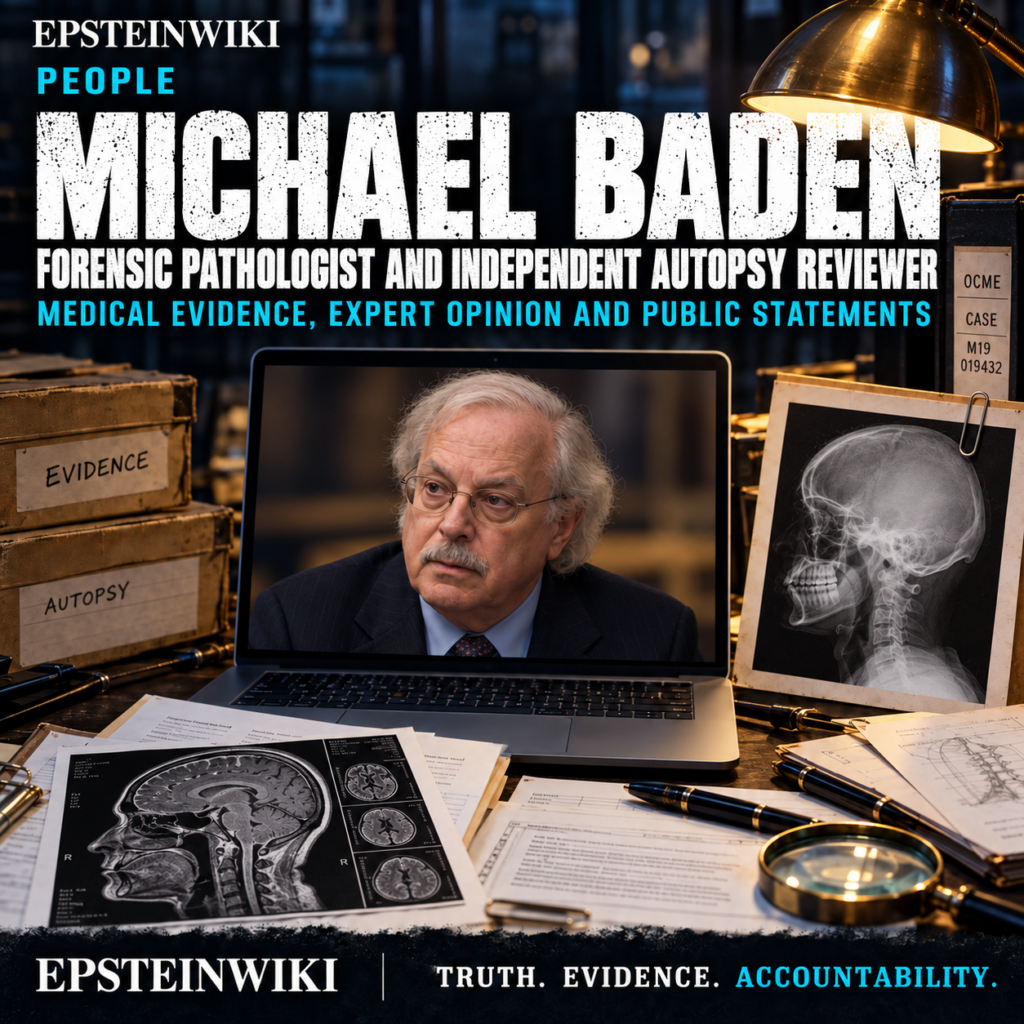
Snapshot
Michael M. Baden is an American forensic pathologist and former chief medical examiner of New York City. He has worked on prominent criminal and civil rights death investigations, advised attorneys and government bodies, taught forensic medicine, written books, and presented HBO’s Autopsy series.
Baden entered the Jeffrey Epstein death investigation in August 2019, when Epstein’s brother Mark Epstein retained him to observe the New York City medical examiner’s autopsy. Kristin Roman performed the autopsy. Baden later disputed her office’s determination that Epstein died by suicide by hanging.
There was no second physical autopsy by Baden in the records reviewed for this article. In his sworn interview with Justice Department investigators, EFTA00113460, Mark Epstein said another examination could have been arranged after the city released the body, but the family did not consider one necessary because Baden had observed the first examination.
Baden’s connection to Jeffrey Epstein is documented as a professional engagement by Epstein’s family after Jeffrey’s death. The records discussed here do not establish a personal or business relationship with Jeffrey Epstein during his lifetime.
Key Takeaways
• Baden was an observer and independent reviewer. Roman conducted and signed the official autopsy. Baden’s later statements were his interpretation of that examination.
• The three neck fractures were not hidden. The official autopsy and specialist report record a left hyoid fracture and fractures of both upper thyroid cartilage horns. Baden disputed what those injuries meant.
• The identity of the precise cloth ligature remained a question. Roman later said that a second photographed candidate, which had not been brought to her during the examination, looked more likely to account for the neck mark.
• Baden has maintained his homicide interpretation. He publicly challenged the suicide ruling in 2019, discussed it in a 2020 interview, and reiterated his view after Roman’s interview became public in 2026.
• His experience spans different types of cases. His work on congressional forensic review, criminal trials, and family commissioned death examinations explains his public prominence. His role differed from case to case.
• The official determination remains hanging by suicide. The Justice Department inspector general documented serious prison failures but reported no evidence contradicting the FBI’s determination about the absence of criminality in how Epstein died.
Education and Forensic Career
According to Baden’s professional biography, he earned a bachelor’s degree from the City College of New York and a medical degree from New York University School of Medicine. He trained in internal medicine and pathology at Bellevue Hospital Medical Center.
Baden worked as a deputy chief medical examiner in New York City and became the city’s chief medical examiner in 1978. He also held a senior forensic pathology position with the New York State Police. His publisher’s biography lists teaching appointments at medical, law, and criminal justice institutions.
His own biography says he has performed more than 20,000 autopsies. That figure is a professional claim from Baden’s biography, rather than an independently audited count presented here. His long practice and public profile make his Epstein opinion significant, while the opinion must still be tested against the case records.
Removal as New York City Chief Medical Examiner
Baden’s tenure as chief medical examiner ended in 1979 when Mayor Edward Koch removed him. The removal and related public statements became the subject of litigation.
The federal appellate decision in Baden v. Koch describes his appointment, removal, and dispute over whether he was entitled to a hearing before dismissal. A later appellate decision addresses his claim concerning damaging public statements made in connection with that removal and the resulting proceedings.
This history belongs in a complete profile because “former chief medical examiner” can otherwise sound as though he retired from that office. The litigation also should not be reduced to a claim that a court either endorsed or rejected every aspect of his forensic work. The decisions addressed legal questions arising from his removal and the accompanying statements.
Other Prominent Forensic Work
Baden chaired the forensic pathology panel for the U.S. House Select Committee on Assassinations, which reviewed forensic evidence concerning the deaths of John F. Kennedy and Martin Luther King Jr. Chairing a later review panel is different from performing either original autopsy.
He also worked as an expert for the O. J. Simpson defense. Public accounts of his career identify involvement in investigations concerning other prominent people. An expert’s role can range from conducting a new examination to reviewing records or testifying; the names should not be treated as a list of autopsies he personally performed.
In deaths that shaped public debate about policing, Baden undertook work for families including those of Michael Brown and George Floyd. The independent examination of Floyd was a separate family commissioned autopsy. That is a materially different role from Baden’s position as an observer during Epstein’s city autopsy.
The distinction matters. Baden’s association with a case does not always mean he performed its physical examination.
Books, Teaching, and Television
Baden hosted HBO’s Autopsy series and wrote or contributed to books on forensic medicine. His nonfiction titles include Unnatural Death, Dead Reckoning, and American Autopsy. His publisher’s page for American Autopsy describes a focus on deaths in custody and racial justice.
He has also held teaching appointments and served as a public commentator on forensic questions. His media presence helped turn his disagreement with the New York City medical examiner into a widely reported part of the Epstein death investigation.
Media interviews are sources for what Baden said. The medical examiner’s file remains the source for what Roman and her specialists documented.
Why Mark Epstein Retained Baden
The New York City Office of Chief Medical Examiner case file, EFTA00063517, records Mark Epstein’s request for an independent forensic pathologist to observe his brother’s autopsy. The office permitted an observer under specified conditions. Its case notes record Baden’s arrival.
Roman began the examination at 9:21 a.m. on August 11, 2019, in the Manhattan Mortuary. She performed the autopsy and authored the official report, which was electronically signed on August 27.
Mark’s September 2021 sworn account, EFTA00113460, states that a second examination remained possible after the body was released. He said it was not needed after Baden attended the city examination. The automated extraction of this interview imperfectly renders Baden’s name in places. The context identifies the former city chief medical examiner retained by Mark as the observer.
Observer, independent reviewer, and author of a second autopsy describe different roles. The available case record supports the first two for Baden in Epstein’s case.
What the Official Epstein Autopsy Found
The signed medical examiner report gives the cause of death as hanging and the manner as suicide. It documents a ligature furrow on the neck, facial congestion, small hemorrhages in the face, eyes, and mouth, and fractures with nearby tissue hemorrhage.
| Structure or finding | Recorded result |
|---|---|
| Left greater horn of the hyoid | Fractured |
| Left superior thyroid cartilage horn | Fractured |
| Right superior thyroid cartilage horn | Fractured |
| Cricoid cartilage | No fracture identified by the specialist |
| Cervical vertebrae | No fractures identified |
| Nearby soft tissue | Hemorrhage accompanying the neck fractures |
| Brain and skull | No skull fracture or bleeding around the brain |
The forensic anthropology examination in the same packet independently describes the fracture sites in the removed hyoid and larynx. It notes that the thyroid cartilage was largely ossified.
Baden’s criticism must be described accurately: he challenged the interpretation of documented findings. He did not bring to light three fractures absent from the official report.
Baden’s Interpretation of the Neck Fractures
In his January 2020 60 Minutes interview, Baden emphasized the combination of the left hyoid fracture and two thyroid cartilage fractures. Based on his experience, he regarded that combination as exceptionally unusual in a suicidal hanging. He said the evidence available to him pointed more strongly toward homicide.
The claim is Baden’s expert assessment, not a mathematical rule that three fractures prove strangulation. A published review of fractures in suicidal hanging and other autopsy research document that fractures of hyoid and laryngeal structures do occur in hangings. Their frequency differs across studies and circumstances.
After Roman’s sworn account became public, Baden told Business Insider in March 2026 that he still disagreed. He acknowledged that the three fracture combination in a hanging was not impossible, while maintaining that he considered it very rare.
Roman’s Interpretation of the Same Fractures
Roman explained her reasoning in her May 2022 sworn interview, EFTA00063459. She focused on where the hyoid and thyroid cartilage had broken, saying that the ends of those structures were injured in a pattern consistent with sustained neck pressure during hanging.
She considered the fracture locations alongside the upward course of the ligature mark, hemorrhages above the neck, and the absence of a broader injury pattern she would expect from a struggle. The Justice Department inspector general’s report recounts her assessment.
Roman did not say that a neck fracture automatically means suicide. Baden did not say that every neck fracture means homicide. Their dispute concerns the combined pattern in Epstein’s case, with different weight assigned to its individual features.
Baden’s Concern About the Ligature Mark
Baden told 60 Minutes that a photographed cloth noose did not appear to match Epstein’s neck furrow. He also thought the mark appeared lower than he would expect in a hanging.
The official autopsy describes a furrow that did not go all the way around the neck. It rose on both sides, more sharply on the right, and branched near the right ear. Roman regarded the upward course as a feature supporting hanging.
The medical examiner scene report describes several pieces of orange cloth in the cell. It records collection of material presented as the ligature. The autopsy says the office separately received, examined, photographed, and submitted a ligature and clothing to evidence.
A comparison between one photographed cloth strip and one photograph of the neck cannot by itself identify which strip made the mark.
The Second Candidate Noose
Roman’s sworn interview supplies a detail absent from many early summaries. She said she was not certain which cloth piece had made the neck mark. Investigators later showed her photographs of two possible nooses from the cell. Roman said both appeared capable of producing the injuries, but she thought the second candidate looked more likely. She said that second item had not been brought to her for the original examination.
The March 2026 reporting on the interview also records Baden’s continued disagreement about whether the photographed nooses fit the mark.
This is a specific unresolved item identification question. It should not be simplified into either “Baden proved the noose was wrong” or “Roman positively identified the exact noose.” Her final medical determination remained hanging by suicide despite that uncertainty.
The inspector general’s evidence transfer request, EFTA00035810, later sought the retained cloth and its chain of custody documents.
The Pending Classification and Final Ruling
The manner of death was not immediately certified at the autopsy. Contemporary correspondence, EFTA00023982, describes waiting for toxicology and investigative information.
Roman told inspector general investigators that she wanted more details about the cell and how Epstein was found. Her account describes the delay as a thorough review in an unusual case. She later affirmed hanging as the cause and suicide as the manner.
An initial pending classification is not an initial homicide finding. It does show that Roman sought investigative context before the office issued its final determination. That sequence is relevant when comparing the timing of Baden’s concerns with the city’s decision.
Scene Documentation and Baden’s Other Objections
Baden told 60 Minutes that he wanted a clearer record of the position in which Epstein was discovered. He noted the absence of an original position photograph and questioned the movement of the body during emergency treatment. He also offered his own estimate that death had occurred before the discovery time.
That estimate is Baden’s opinion. The medical examiner investigator’s record documents the emergency response and the 7:36 a.m. hospital pronouncement. The time of pronouncement is not necessarily the biological time of death.
The inspector general’s review considered witness accounts, prison records, and the available surveillance. The surviving camera did not show the inside of Epstein’s cell. The absence of an original position photograph remains a limitation for anyone attempting to reconstruct the scene solely from images.
What the Inspector General Found
The official Justice Department review documented serious failures in Epstein’s custody and supervision, including missed rounds, falsified records, and the failure to assign a replacement cellmate.
Concerning how Epstein died, the inspector general reported that it did not uncover evidence contradicting the FBI’s determination regarding the absence of criminality. It also reported Roman’s explanation of why she interpreted the injuries as hanging rather than homicidal strangulation.
The inspector general did not perform a second autopsy. Its conclusions concern its broader investigation, which included the medical findings. Baden continued to disagree with the suicide determination after that review.
Baden’s Documented Connection to the Epstein Network
The medical examiner file and Mark Epstein interview establish Baden’s connection as a family retained forensic expert after Jeffrey Epstein’s death.
They do not establish that he visited Epstein’s properties, participated in Epstein’s businesses, belonged to his social circle, or had a role in the underlying trafficking allegations. A person’s appearance in death investigation documents should not be represented as evidence of participation in Epstein’s crimes.
Baden is significant to EpsteinWiki because his criticism became one of the most cited challenges to the official death ruling.
Evidence Appearances
| Record | Baden’s connection or the record’s significance |
|---|---|
| EFTA00063517 | Family request for an observer, Baden’s arrival, official autopsy, specialist examinations, and scene material |
| EFTA00113460 | Mark Epstein’s sworn statement that another autopsy was possible but not needed after Baden observed the examination |
| EFTA00063459 | Roman’s sworn explanation of her findings and her discussion of the possible cloth ligatures |
| EFTA00063395 | Inspector general memorandum identifying Roman’s interview and photographs discussed with her |
| EFTA00023982 | Contemporary correspondence on awaiting toxicology and investigative information |
| EFTA00035810 | Later request for remaining ligature evidence and custody paperwork |
| EFTA00109981 | Postmortem cervical spine radiograph associated with the medical examiner case |
| EFTA00039025 | Released copy of the inspector general investigation |
The 60 Minutes interview and March 2026 interview document Baden’s own public claims. They are separate from the EFTA records documenting the city’s examination and the inspector general’s interviews.
Questions About Michael Baden
• Was Baden Epstein’s official medical examiner? No. Roman performed the official autopsy. Baden observed for the family.
• Did Baden perform a second autopsy? Mark Epstein told investigators that the family decided one was unnecessary after Baden attended the first examination.
• What is Baden’s principal medical objection? He considers the combination of three neck fractures more consistent with homicidal strangulation than suicidal hanging.
• Were those fractures omitted from the city’s report? No. Both the autopsy and forensic anthropology examination record them.
• Did Roman identify the exact cloth piece that made the neck mark? No. She later said a second photographed candidate looked more likely than the piece brought to her, while maintaining her hanging determination.
• Did Baden change his conclusion when Roman’s sworn reasoning was released? No. He continued to dispute the suicide ruling in 2026.
• Does his participation establish a connection to Epstein’s crimes? No. The documented engagement was by Epstein’s family after his death.
Sources
• Michael Baden’s professional biography.
• Michael Baden’s publisher biography.
• Federal appellate decision concerning Baden’s removal, Baden v. Koch.
• Later appellate decision concerning the removal dispute.
• New York City medical examiner case file, EFTA00063517.
• Mark Epstein sworn interview, EFTA00113460.
• Kristin Roman sworn interview, EFTA00063459.
• Inspector general medical examiner interview memorandum, EFTA00063395.
• Contemporary autopsy correspondence, EFTA00023982.
• Inspector general ligature evidence request, EFTA00035810.
• Postmortem radiograph, EFTA00109981.
• Inspector general review in the EFTA release, EFTA00039025.
• Official Justice Department inspector general report.
• 60 Minutes investigation and Baden interview.
• March 2026 reporting on Baden and Roman’s interpretations.
• Forensic research review of neck fractures in suicidal hanging.