
Atlas by Jaz: A Bluesky Conversation Map for Epstein Research Leads
Snapshot
| Field | Documented finding |
|---|---|
| Tool | Atlas by Jaz |
| Official site | atlas.jazco.dev |
| Dataset described by its creator | Recent Bluesky conversations, grouped into topics and regions |
| Advertised window and refresh | The past week, rebuilt about every six hours |
| Use for EpsteinWiki | Discover public discussions and source leads, then verify the underlying evidence |
| Important distinction | This is not the Epstein Data document Atlas and is not a historical evidence index. |
What Atlas Maps
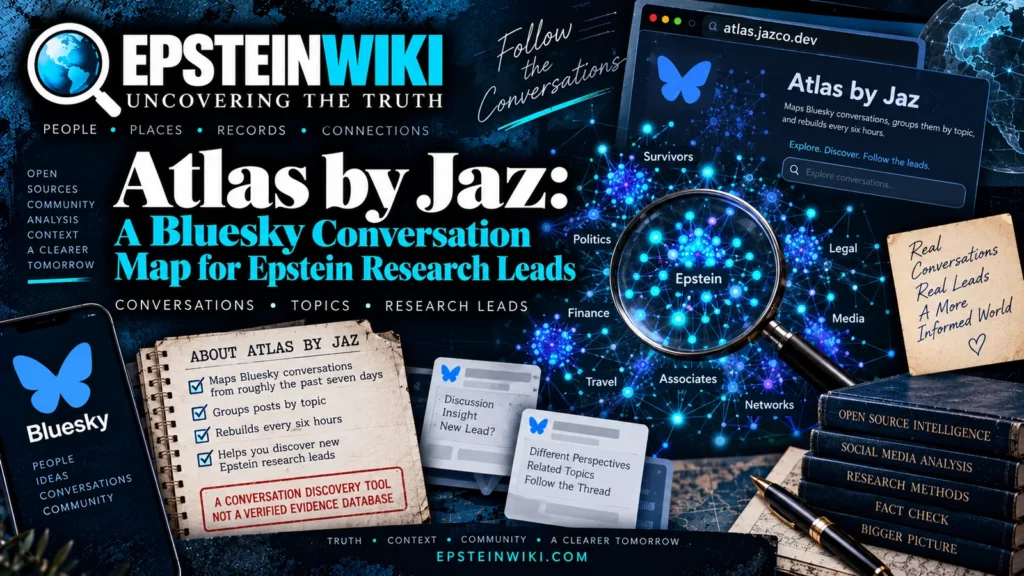
Atlas’s official description calls it a living map of Bluesky conversations grouped into topics and regions. Its site identifies the creator as Jaz. The creator’s September 27, 2026 announcement describes a seven day conversation window and an approximately six hour rebuilding schedule.
The map is useful for learning which public conversations are active and finding people or posts worth reading. It does not authenticate a document, resolve a survivor’s identity or establish that a claim is true because many users discuss it.
Why It Can Help an Investigation
A public discourse map can surface a newly discussed court filing, an original journalist’s thread, a correction, or competing interpretations of a document. Those are starting points. The researcher still needs the exact post, its date, author, linked material and underlying evidence.
A popular topic can include jokes, screenshots, repeated claims, criticism and misinformation. Its prominence is not an evidence ranking. Similar posts may be repeating one source rather than independently corroborating an allegation.
Use It as a Lead Discovery Tool
Open the official Atlas map and inspect discussions relevant to the subject you are researching. Follow through to the original public posts and preserve their canonical links, authors and posting dates in your research notes.
Separate the post’s assertion from any attached document. If the post shows only a screenshot, locate the full original record. Where an EFTA number is supplied, open it through Epstein Data search and read the relevant page and context. If no source is supplied, record the item as an unverified lead.
Check whether an established sleuth has original reporting on the subject. Credit the original investigation rather than the account that reposted it. A thread summarizing someone else’s work is not the origin of the evidence.
Topic Links Can Change
The creator describes a rolling seven-day conversation map rebuilt approximately every six hours. For citation purposes, treat a selected topic or map position as a dated view rather than assuming it is a permanent archive identifier or a stable Epstein category. The durable reference is the original public post or source document.
For durable citation, preserve the actual public post or original report discovered through the map. If recording a map view, note the observation date and describe it as a snapshot of recent discourse, not a comprehensive history.
Atlas and the Epstein Data Atlas Are Different
| Tool | What it organizes | What an investigator must verify |
|---|---|---|
| Jaz’s Bluesky Atlas | Recent social conversations | Original posts, reporter attribution and the documents behind claims |
| Epstein Data Atlas | The project’s document discovery map | The original document and its EFTA page context |
Accuracy, Privacy and Accessibility
Do not infer that every person in a discussion group knows or endorses every other participant. A public conversation cluster is not a criminal association graph. Avoid turning social proximity into an allegation.
Keep protected survivor names, redacted identities, private addresses and contact details out of public research notes. A circulating identification claim still needs verification. If the map is difficult to use with low vision or on a phone, work from the original post and text based document search. The evidence should remain readable without relying on the map’s colors or spatial layout.
What This Guide Does Not Claim
This guide checks the creator’s public description and September 27, 2026 announcement against the sources available on October 15, 2026. The stated seven-day window and roughly six-hour update interval are the creator’s descriptions; this review did not test the live map, measure update performance or establish completeness. It is not an exhaustive list of Epstein conversations, an endorsement of returned posts or evidence that a disappearing topic was censored.
Sources
- Atlas official site and tool description
- Jaz, September 27, 2026 launch announcement
- Epstein Data Atlas, the separate document-discovery map; Epstein Data Wiki, whose method and privacy guidance were checked as research context. Neither is Jaz’s Bluesky conversation map.