DOJ’s February 2026 Epstein Files Names Report: What It Does and Does Not Establish
Snapshot
Report date: February 14, 2026 | Court filing stamp: February 20, 2026
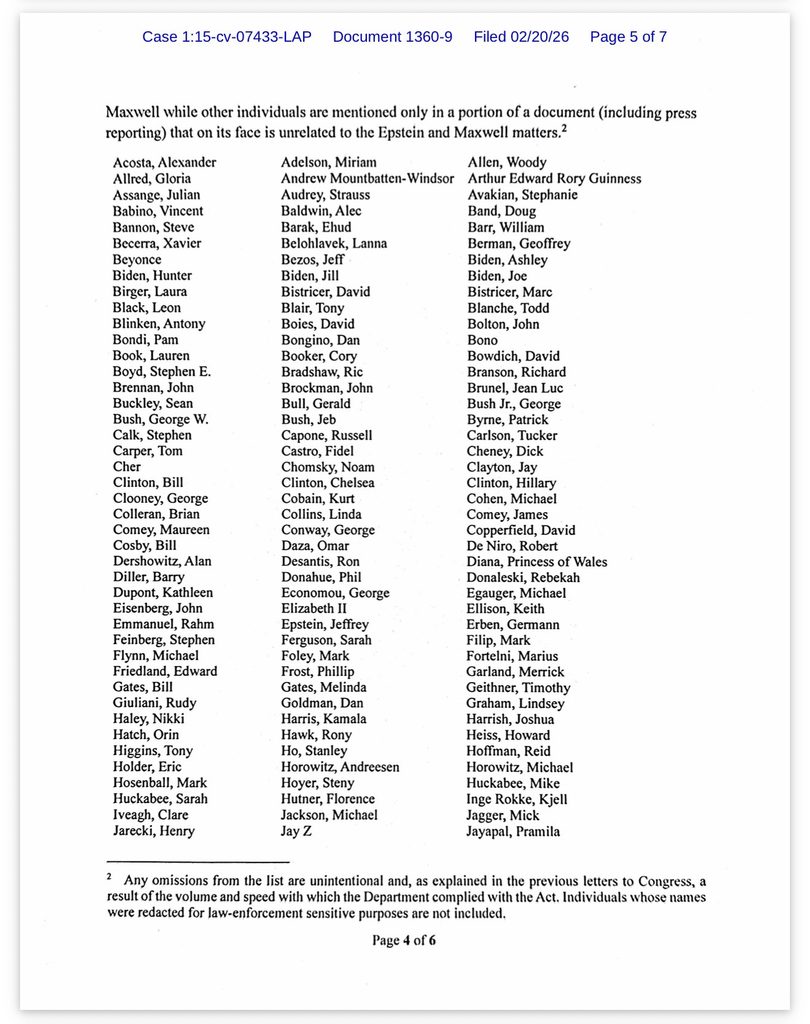
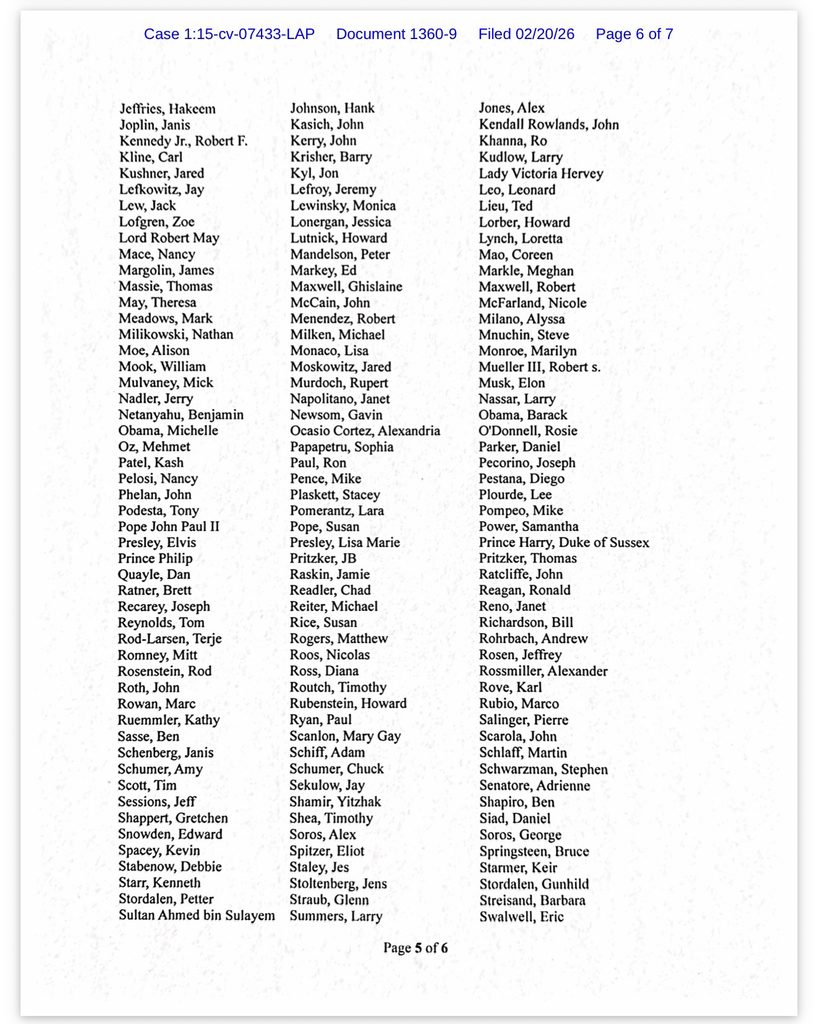
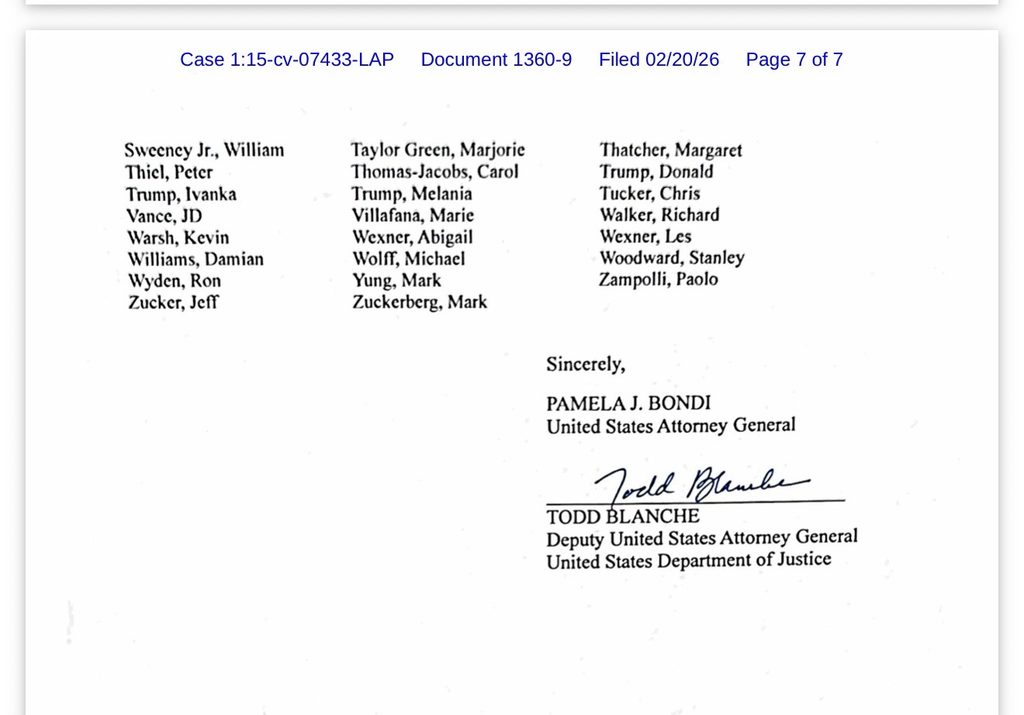
The three list pages in Exhibit 9 identify public figures named or referenced in released Epstein materials. The full document supplies essential context: it is part of the Justice Department’s February 14, 2026 report to Congress under Section 3 of the Epstein Files Transparency Act. The report identifies government officials and politically exposed persons whose names appear in released materials. It is not a list of clients, alleged offenders, or people a court has found to have committed wrongdoing.
The distinction is explicit in the report’s introduction to the list. DOJ says names appear in different contexts, from extensive direct email contact with Jeffrey Epstein or Ghislaine Maxwell to passing references in material, including press reporting, unrelated on its face to the Epstein and Maxwell matters. The report does not assign those different contexts to each listed person. A name appearing here is therefore a starting point for checking the underlying record, not a conclusion about conduct. Report pages 3 to 4
Identify the document before interpreting the names
The court-stamped exhibit is Document 1360-9 in case 1:15-cv-07433-LAP, stamped Filed 02/20/26. Its first page is an Exhibit 9 cover. The remaining six pages reproduce the report on Department of Justice, Office of the Deputy Attorney General letterhead. The report is dated February 14, 2026 and addressed to the chairs and ranking members of the House and Senate Judiciary Committees: Chuck Grassley, Dick Durbin, Jim Jordan, and Jamie Raskin. Report page 1
The closing identifies Pamela J. Bondi as United States Attorney General and Todd Blanche as Deputy United States Attorney General. A handwritten signature appears above Blanche’s typed name in the exhibit. Report page 6
DOJ also hosts the six-page report on its own website. It does not by itself establish who submitted Exhibit 9 to the civil docket or why. Official DOJ report
The dates matter. A new alert about this file does not make the file a new October 2026 disclosure. The report is dated February 14 and the court stamp February 20. Neither date should be replaced by the date someone encounters a screenshot.
Why DOJ produced a list
The report explains that Section 3 required DOJ to report to the House and Senate Judiciary Committees within 15 days of completing the Act’s required release. The requested report had three components:
- categories of records released and withheld;
- a summary of redactions and their legal basis;
- a list of government officials and politically exposed persons named or referenced in released materials.
This is a disclosure-accounting purpose, not a charging standard. The report describes its inclusion test as a person being or having been a government official or politically exposed person, with that person’s name appearing at least once in released files. It says the Act did not define politically exposed persons and that reviewers were instructed to note references in documents, videos, and images. Report page 1
The most important context is split across two pages
At the bottom of report page 3, DOJ begins its explanation of the different contexts in which names appear. The sentence continues at the top of report page 4, immediately above the first names. The warning is therefore easy to lose if only a tight crop of the names is shared.
Read together, the two pages explain that some listed people had extensive direct email contact with Epstein or Maxwell, while other people were mentioned only in a part of a document unrelated on its face to those matters. The list does not identify which description applies to each entry, provide a supporting document ID beside each name, or reproduce the relevant communications. Report pages 3 to 4
That means the list alone cannot establish that a person:
- met Epstein or Maxwell;
- visited a particular residence or island;
- traveled on a particular aircraft;
- participated in a financial transaction;
- knew of abuse;
- was accused of abuse in the underlying material;
- committed an offense or was found liable by a court.
These are different factual propositions. Each requires its own evidence. Even a verified email, travel entry, or allegation must be described for what it actually shows rather than treated as proof of all the others.
How many entries are printed?
The three list pages contain 305 printed entries: 129 on report page 4, 153 on report page 5, and 23 on report page 6. This is a count of table entries, not a verified count of distinct individuals. Report pages 4 to 6
The original uses inconsistent name formats and contains apparent spelling or naming anomalies. For example, report page 4 separately prints “Bush, George W.” and “Bush Jr., George.” Such entries should not be silently merged, corrected, or assigned to a particular person without further evidence. Automated text extraction can introduce additional errors, so a transcription must be checked against the page image.
The report also qualifies completeness. Footnote 2 says omissions are unintentional, attributing them to the volume and speed of DOJ’s work, and says names redacted for law-enforcement-sensitive purposes are not included. That limits what can be inferred from absence as well as presence. A missing name is not proof that a person is absent from every underlying record. Report page 4, footnote 2
What the rest of the report covers
The names occupy only the final part of the report. The earlier pages describe the scope of records DOJ says it released, the material it says it withheld, and its stated redaction rationale.
Nine subject areas
The report describes nine categories covering: Epstein-related investigations, prosecutions and custody; Maxwell; travel records; individuals referenced in relevant criminal, civil-settlement, immunity, plea or investigative contexts; entities with known or alleged links to trafficking or financial networks; agreements involving Epstein or associates; internal DOJ charging and investigative decisions; records concerning destruction, loss or alteration of relevant information; and Epstein’s detention and death. Report pages 1 to 2
A category describing what DOJ searched for or released is not evidence that every named person participated in that category’s conduct. Nor does the list supply a record-by-record inventory of those nine categories.
Withholding and redactions: DOJ’s account
DOJ says records were withheld when permitted withholding material or privileged material could not be separated from responsive content. It identifies deliberative-process, attorney work-product, and attorney-client privileges. The report presents a common-law justification for its privilege position and cites legal authorities. Those are DOJ’s stated legal grounds; this exhibit is not a judicial ruling endorsing every withholding decision. Report pages 2 to 3
The report also describes redactions for victim-identifying and sensitive personal information, child sexual abuse material, narrowly tailored temporary protection of active investigations or prosecutions, and images depicting death, physical abuse or injury. It states that the national-defense or foreign-policy classification ground was not used. Report pages 2 to 3
DOJ asserts that it did not withhold or redact on grounds of embarrassment, reputational harm, or political sensitivity. That is an assertion made by DOJ in its report, not an independent audit result established by the report itself. Similarly, the report’s description of victim consultation and ongoing engagement does not establish that every redaction was correct. Report pages 2 to 3
The report states that members of Congress could inspect unredacted materials at DOJ and that certain members had done so. This describes the position when the report was written; it should not be presented as a verified statement about present-day access arrangements. Report page 3
What this exhibit establishes and what remains open
Directly documented: the report’s date, addressees, stated purpose, inclusion criteria, caveats, printed entries, stated disclosure and redaction policies, and appearance within court-stamped Exhibit 9.
Not established by the exhibit alone: the accuracy or completeness of DOJ’s release; the lawfulness of every withholding; the context behind each listed name; wrongdoing by listed persons; or a judicial finding accepting DOJ’s account.
Needs the surrounding docket: who filed the exhibit, the argument it accompanied, and how the court treated it. A document’s presence in a court file is not the same as a judge adopting its contents as findings.
A claim about a specific person requires the underlying released record, its identifier and page number, and the surrounding context. A direct communication, third-party mention, allegation, lawyer’s question, and judicial finding are different kinds of evidence. None should be substituted for another. Survivor identities and redactions must remain protected.
Primary source
Read the complete Department of Justice report dated February 14, 2026. The official report has six pages. In the seven-page court exhibit, page 1 is the Exhibit 9 cover, so the court PDF page number is one greater than the report page number.
Read the complete report
Open or download the official six page DOJ report.