
Jeffrey Epstein Early Life and Background Timeline: 1953 to 1979
Snapshot
Subject: Jeffrey Edward Epstein’s birth, childhood, education, first institutional access, and entry into finance
Date range: January 20, 1953 through December 31, 1979
Geographic scope: Brooklyn and Manhattan, New York; Interlochen, Michigan
Research question: What can the released record actually establish about Epstein before the 1980s, and where do later biographies, recollections, and institutional records conflict?
Included events: Birth, family setting, childhood location, musical training, high school graduation, college attendance, Dalton School employment, and early Bear Stearns employment
Excluded events: The 1980 limited partnership at Bear Stearns, his 1981 departure from the firm, later financial businesses, and all later criminal investigations, except where a later record supplies evidence about an event inside this timeline
Primary evidence types: New York City birth index entry, institutional statements, school and yearbook reporting, a 1981 sworn Securities and Exchange Commission transcript, and a Bureau of Prisons government memorandum preserved in the EFTA production
Key people and organizations: Jeffrey Epstein, Pauline Epstein, Seymour Epstein, Mark Epstein, Lafayette High School, Interlochen National Music Camp, Cooper Union, New York University, the Dalton School, Donald Barr, Peter Branch, Alan C. Greenberg, and Bear Stearns
Related proceedings: SEC investigation, In the Matter of St. Joe’s Minerals Corporation, File No. NY 5395
Known gaps: No complete public school file, college transcript, Dalton personnel file, original employment application, Bear Stearns personnel file, or contemporaneous explanation of who approved Epstein’s Dalton appointment has been located in the reviewed public record
Content warning: This page discusses a convicted sex offender’s early access to schools, minors, wealth, and elite institutions. It does not allege unproven criminal conduct during the period covered.
Last reviewed: August 28, 2026
Key takeaway: Before 1980, Epstein moved from a comparatively ordinary Brooklyn upbringing into two unusually consequential institutions, Dalton and Bear Stearns, despite never completing a college degree. The documented story is not one of verified academic brilliance automatically rewarded. It is a story of access, informal sponsorship, weak credential checks, and institutions that opened doors while leaving a thin public paper trail.
Overview
Jeffrey Epstein did not begin life as a billionaire, a financier, or a man surrounded by presidents, princes, and famous academics. He was born in Brooklyn in 1953, grew up in Sea Gate at the western edge of Coney Island, finished high school unusually young, attended two universities without earning a degree, and spent part of his youth studying and performing music.
The decisive change came in Manhattan.
In September 1974, at age 21 and without a completed college degree, Epstein entered the Dalton School as a mathematics and physics teacher. Dalton placed him inside an elite private school whose families included some of New York’s wealthiest and best connected people. Former students later remembered a charismatic, boundary blurring young teacher. Those memories deserve careful treatment. They are firsthand recollections, but they were recorded more than four decades later, and the former students interviewed by NPR did not report witnessing sexual contact or physical misconduct at Dalton.
Dalton dismissed Epstein in June 1976 because, according to the later government account, he had not developed adequately as a teacher. Yet the school did not simply mark the end of his first career. It helped create the bridge to his second. Reporting based on interviews with people connected to Dalton and Bear Stearns says a Dalton parent recommended Epstein to the investment bank. By April 1981, Epstein testified under oath to the SEC that he had worked at Bear Stearns for five years, had previously taught at Dalton for two years, and had graduated from neither Cooper Union nor New York University.
That sworn testimony is one of the clearest receipts in his early biography. It also punctures a mythology that Epstein later cultivated. The record supports intelligence, confidence, mathematical ability, and extraordinary social agility. It does not support a college degree. It does not identify a rigorous credentialing process that justified his access to children at Dalton. It does not establish that Donald Barr personally hired him. It does not explain why Bear Stearns accepted him or precisely who waived ordinary expectations.
The early timeline matters because it shows the first visible version of a pattern that later became central to Epstein’s power: credentials were less important than proximity, personal sponsorship, and an institution’s willingness to treat confidence as qualification.
Scope and Methodology
This timeline ends on December 31, 1979. Epstein’s elevation to limited partner at Bear Stearns is generally dated to 1980 and therefore belongs in the next timeline. His March 1981 departure is also outside this page, although the 1981 SEC transcript is used as retrospective evidence because Epstein was questioned under oath about his education and previous employment.
Sources are weighted in this order:
- Contemporaneous records and sworn testimony.
- Institutional records and statements.
- Government compilations that identify their own limitations.
- Named firsthand recollections.
- Credible investigative reporting.
- Epstein supplied biographies and later promotional accounts, which are treated as claims rather than neutral records.
The Bureau of Prisons psychological reconstruction is useful but not a contemporaneous biography. Its authors expressly stated that Epstein had no presentence report available and that the social history section was assembled from publicly available documents. The relevant EFTA pages are EFTA00039367 and EFTA00039368. A readable transcription is also available in the Bureau of Prisons psychological reconstruction.
The SEC transcript is stronger for statements Epstein made about himself. On April 1, 1981, while under oath in an SEC investigation, he said that he had been with Bear Stearns for five years, had taught at Dalton for two years, had graduated from Lafayette High School, and had not graduated from Cooper Union or New York University. The SEC now publishes the transcript and exhibits and the complete scanned PDF.
This page distinguishes evidence from inference. It does not treat later crimes as proof of misconduct at an earlier institution, and it does not treat every social connection as complicity.
Evidence Classification Key
Primary record: A contemporaneous or official record, including a government transcript, index entry, school record, or institutional document.
Sworn testimony: A statement made under oath. It proves that the witness gave the answer, not automatically that every answer was true.
Institutional statement: A later statement issued by an organization about its own records or relationship.
Firsthand recollection: A named person’s memory of an event personally observed, often recorded years later.
Credible secondary reporting: Reporting that identifies sources or underlying records but is not itself the original record.
Self reported claim: A claim traceable to Epstein or a biography supplied on his behalf.
Inference: A conclusion drawn from multiple facts. It is labeled and is not presented as direct proof.
Date Precision Key
Exact: The record supplies a specific day.
Month exact: The record supplies a month and year.
Year exact: The record supplies a year but not a day.
Date range: The record supports a span of time.
Approximate: The date is reconstructed from age, school year, or later testimony.
Conflicting: Credible sources give materially different dates.
Unknown: The reviewed public record does not establish a responsible date.
Timeline
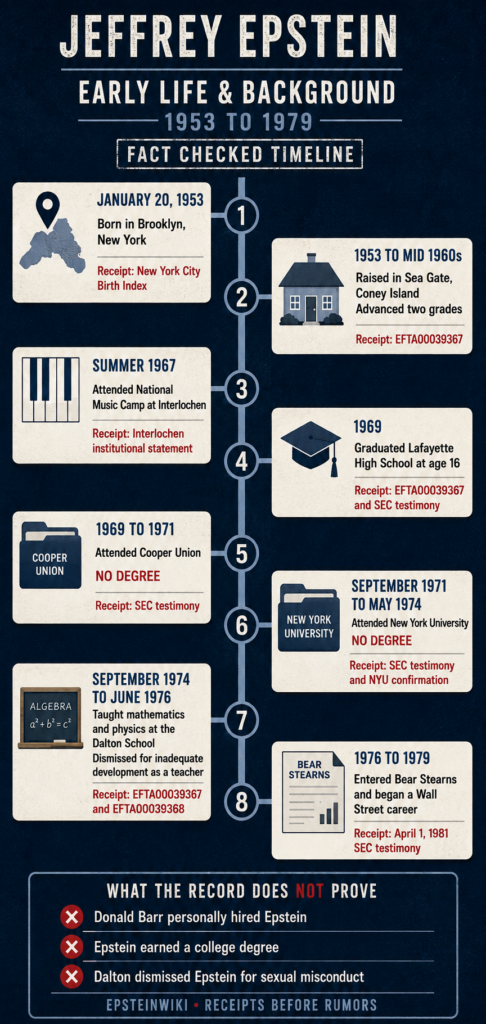
January 20, 1953: Birth in Brooklyn
Date precision: Exact
Time zone: Not applicable
Event type: Birth and family background
People: Jeffrey Edward Epstein; Pauline Epstein; Seymour Epstein; Mark Epstein
Organizations: New York City Department of Health, through the public birth index
Location: Brooklyn, New York City
What happened: Jeffrey Edward Epstein was born in Brooklyn on January 20, 1953. A publicly accessible entry derived from the New York City birth index gives that date and place. The later Bureau of Prisons reconstruction confirms the year, says he grew up with one brother, and places the family in Sea Gate on Coney Island.
Evidence classification: Primary index record, corroborated by a later government compilation
What the source establishes: The public index entry supports the date and borough of birth. The government memorandum supports the year, childhood neighborhood, and presence of one brother.
What the source does not establish: The index does not explain the family’s finances, relationships, or Epstein’s later personality. The Bureau of Prisons account is not based on a presentence report or interviews and should not be treated as a complete social history.
Primary source: New York City birth index entry for Jeffrey Epstein
Related evidence: EFTA00039367, Bureau of Prisons social history page
Related EpsteinWiki pages: Jeffrey Epstein; Epstein Family Background
1953 to the mid 1960s: Childhood in Sea Gate
Date precision: Date range
Time zone: Not applicable
Event type: Childhood and community setting
People: Jeffrey Epstein; his parents; his brother
Organizations: Local New York City public schools, not fully identified in the released primary record reviewed for this page
Location: Sea Gate, Coney Island, Brooklyn
What happened: Epstein grew up in Sea Gate, a private waterfront community at the western end of Coney Island. The Bureau of Prisons reconstruction describes the household as middle class and states that he was promoted ahead by two grades. Later biographies name local public schools, but no complete enrollment record or cumulative school file was located for this review.
The grade advancement is consistent with his graduating from Lafayette High School in 1969 at age 16. It should not be inflated into proof of genius. Acceleration documents academic timing, not character, judgment, or the full quality of a student’s work.
Evidence classification: Government compilation based on public sources
What the source establishes: Sea Gate upbringing, a household with one brother, the government report’s middle class description, and promotion by two grades.
What the source does not establish: Exact elementary school dates, complete grades, IQ, disciplinary history, family wealth, or the names of the officials who approved the grade promotions.
Primary source: Bureau of Prisons psychological reconstruction
Related evidence: EFTA00039367
Related EpsteinWiki pages: Sea Gate; Jeffrey Epstein
Summer 1967: National Music Camp at Interlochen
Date precision: Year exact; season identified
Time zone: Eastern Time
Event type: Music education
People: Jeffrey Epstein
Organizations: National Music Camp; Interlochen Center for the Arts
Location: Interlochen, Michigan
What happened: Interlochen Center for the Arts stated that Epstein attended the National Music Camp as a camper during the summer of 1967. He was 14. The record is relevant because it provides an institutional anchor for the frequently repeated account that music, particularly piano, was part of his early education.
Evidence classification: Institutional statement reported by local news
What the source establishes: Interlochen says Epstein was a camper in summer 1967.
What the source does not establish: His instrument, curriculum, performance level, roommates, conduct, or any relationship between his 1967 attendance and Interlochen students he encountered decades later. Later donations and later allegations must be documented in their own timelines.
Primary source: Interlochen’s statement as quoted in UpNorthLive’s report on the institution’s relationship with Epstein
Related evidence: Interlochen Center for the Arts
Related EpsteinWiki pages: Jeffrey Epstein and Interlochen
1969: Graduation from Lafayette High School at age 16
Date precision: Year exact
Time zone: Not applicable
Event type: Secondary education
People: Jeffrey Epstein
Organizations: Lafayette High School; New York City public schools
Location: Brooklyn, New York City
What happened: Epstein graduated from Lafayette High School in 1969 at age 16. The date is repeated in the Bureau of Prisons social history and is consistent with the later sworn SEC testimony in which Epstein identified Lafayette as the high school from which he graduated.
This is the clearest documented educational credential in his early biography. Later accounts sometimes blur attendance, coursework, and graduation at the college level. The high school diploma is supported. A college degree is not.
Evidence classification: Government compilation corroborated by sworn testimony
What the source establishes: The school, graduation, year, and reported age.
What the source does not establish: Class rank, transcript, exact graduation date, awards, or the quality of his academic work.
Primary source: SEC transcript and exhibits, testimony page 13
Related evidence: EFTA00039367
Related EpsteinWiki pages: Lafayette High School; Jeffrey Epstein Education Claims
1969 to 1971: Attendance at Cooper Union without a degree
Date precision: Date range, supported principally by later reporting
Time zone: Eastern Time
Event type: Higher education
People: Jeffrey Epstein
Organizations: Cooper Union
Location: Manhattan, New York City
What happened: Epstein attended Cooper Union after high school and left without graduating. A 2002 New York profile, relying on a biography supplied for Epstein, places his Cooper Union attendance from 1969 to 1971 and says he took physics classes. The date range is plausible, but the source is not a transcript and the biographical material came from Epstein’s side.
The stronger fact is narrower. Under oath in 1981, Epstein told the SEC that he attended Cooper Union and did not graduate. The Bureau of Prisons reconstruction independently repeats the no degree conclusion.
Evidence classification: Sworn testimony for attendance and non graduation; self reported biography for the specific years and field of study
What the source establishes: Epstein attended Cooper Union and did not graduate.
What the source does not establish: A degree, verified major, complete course list, grades, or the exact reason he left.
Primary source: SEC transcript and exhibits, testimony page 13
Related evidence: Jeffrey Epstein: International Moneyman of Mystery; Bureau of Prisons psychological reconstruction
Related EpsteinWiki pages: Cooper Union; Jeffrey Epstein Education Claims
September 1971 to May 1974: Attendance at New York University without a degree
Date precision: Month exact according to NYU sourced reporting; the federal records establish attendance but not the full date range
Time zone: Eastern Time
Event type: Higher education
People: Jeffrey Epstein
Organizations: New York University; Courant Institute of Mathematical Sciences
Location: Manhattan, New York City
What happened: Epstein attended New York University from September 1971 to May 1974 and did not graduate. A 2026 Washington Square News investigation reported the dates after seeking confirmation from NYU. Epstein’s 1981 SEC testimony described time at New York University’s graduate school but expressly acknowledged that he did not graduate.
That phrasing requires care. Attendance in courses associated with a graduate school is not the same as admission to a degree program, graduate standing, or possession of an undergraduate degree. The public record reviewed here does not contain a transcript or diploma because no diploma existed.
Evidence classification: Sworn testimony and university sourced reporting
What the source establishes: Attendance at NYU and no graduation. The NYU sourced report supplies September 1971 to May 1974.
What the source does not establish: A bachelor’s degree, master’s degree, completed major, graduate degree candidacy, or verified expertise in mathematical biology or physiology.
Primary source: SEC transcript and exhibits, testimony page 13
Related evidence: Washington Square News investigation of Epstein’s NYU degree claims; EFTA00039367
Related EpsteinWiki pages: New York University; Jeffrey Epstein Education Claims
September 1974: Hired to teach at the Dalton School
Date precision: Month exact
Time zone: Eastern Time
Event type: Employment and institutional access
People: Jeffrey Epstein; Donald Barr; Gardner Dunnan; Dalton students and faculty
Organizations: The Dalton School
Location: Upper East Side, Manhattan
What happened: At age 21, without a college degree, Epstein began teaching mathematics and physics at the Dalton School in September 1974. The appointment placed him in daily contact with minors and, just as importantly for his future in finance, with their wealthy and influential families.
The often repeated claim that Donald Barr personally hired Epstein is not established by the released record reviewed for this page. Barr announced his resignation in February 1974 and left at the end of the school year. Epstein began teaching in September. Former Dalton teacher and school historian Susan Semel told NPR that Barr made unconventional hires and did not always insist on traditional credentials, but she also said it was unclear whether Barr hired Epstein. No appointment letter, personnel authorization, or firsthand account from the decision maker has been produced publicly.
Former students later gave divergent accounts. Some remembered Epstein as intelligent, funny, or effective. Others remembered him socializing too freely with students, paying conspicuous attention to girls, or failing to maintain a clear adult boundary. NPR reported that the students it interviewed did not recall physical contact or a witnessed sexual incident at Dalton. Their observations matter, but they must not be silently converted into a criminal allegation that no identified witness made.
Evidence classification: Government compilation, school and yearbook evidence described in reporting, and firsthand recollections
What the source establishes: Start month, subject area, lack of a completed college degree, proximity to students and affluent families, and later student concerns about boundaries.
What the source does not establish: Who personally approved the hire, that Donald Barr hired Epstein, that Epstein possessed a teaching credential, or that a documented sexual offense occurred at Dalton.
Primary source: EFTA00039367 and EFTA00039368; Bureau of Prisons psychological reconstruction
Related evidence: NPR interviews with former Dalton students and faculty; Ellie Leonard, How Jeffrey Epstein Cosplayed His Way to Harvard
Related EpsteinWiki pages: The Dalton School; Donald Barr; Institutional Gatekeeping and Jeffrey Epstein
June 1976: Dalton dismisses Epstein
Date precision: Month exact
Time zone: Eastern Time
Event type: Employment termination
People: Jeffrey Epstein; Peter Branch
Organizations: The Dalton School
Location: Manhattan, New York City
What happened: Dalton dismissed Epstein in June 1976. The Bureau of Prisons reconstruction describes the reason as inadequate development as a teacher. Peter Branch, who had served in Dalton leadership, later told The New York Times that Epstein did not measure up as a teacher and was asked to leave. NPR reported that Branch did not remember receiving complaints about Epstein’s behavior with students.
This distinction is essential. The available evidence supports an employment decision based on teaching performance. It does not establish that Dalton dismissed him for sexual misconduct. Later recollections about boundaries create legitimate questions about the school’s culture and oversight, but they are not a substitute for a personnel file.
Evidence classification: Government compilation corroborated by a named firsthand recollection
What the source establishes: The month of dismissal and the stated teaching performance reason.
What the source does not establish: The complete contents of Dalton’s personnel file, whether concerns were documented internally, or whether any other reason influenced the decision.
Primary source: EFTA00039368; Bureau of Prisons psychological reconstruction
Related evidence: NPR’s Dalton interviews
Related EpsteinWiki pages: Jeffrey Epstein at Dalton; The Dalton School
1976: Entry into Bear Stearns
Date precision: Year exact; exact hiring date not established in the reviewed public record
Time zone: Eastern Time
Event type: Employment and network transition
People: Jeffrey Epstein; Alan C. Greenberg; an unidentified or inconsistently identified Dalton parent
Organizations: Bear Stearns; the Dalton School
Location: Manhattan, New York City
What happened: Soon after leaving Dalton, Epstein joined Bear Stearns. The most reliable date anchor comes from Epstein’s April 1, 1981 sworn SEC testimony. He said he had worked at Bear Stearns for five years and had previously taught at Dalton for two years. That places his arrival in 1976 and fits the documented June end of his Dalton employment.
Reporting by the Miami Herald, summarized by NPR, says a Dalton parent impressed by Epstein recommended him to Bear Stearns executive Alan Greenberg. Public retellings do not always identify the recommending parent consistently, and the reviewed record does not include the original referral letter, interview notes, or employment application. The safest conclusion is that a Dalton family connection helped open the door, not that every detail of the referral story has been proven.
Evidence classification: Sworn testimony for the five year tenure; credible secondary reporting for the Dalton parent referral
What the source establishes: Epstein entered Bear Stearns in approximately 1976 after two years at Dalton. Reporting supports a referral through the Dalton community.
What the source does not establish: The exact hiring day, the complete résumé he submitted, the identity and role of every sponsor, or whether standard hiring requirements were waived.
Primary source: SEC transcript and exhibits, testimony pages 12 and 13
Related evidence: NPR’s account of the Dalton to Bear Stearns referral
Related EpsteinWiki pages: Bear Stearns; Alan C. Greenberg; Dalton to Wall Street
1976 to 1979: Early advancement inside Bear Stearns
Date precision: Date range
Time zone: Eastern Time
Event type: Financial career development
People: Jeffrey Epstein; Bear Stearns colleagues and clients
Organizations: Bear Stearns
Location: Manhattan, New York City
What happened: During the remainder of the 1970s, Epstein moved from a new Wall Street hire into work involving clients and increasingly specialized financial products. The strongest direct description comes from his 1981 sworn testimony, when he said that as a limited partner he served as a representative and account executive who assisted the sales force with commodities and financial futures recommendations. That title was achieved in 1980, outside this timeline, but it describes the destination of the rise that began in 1976.
By the end of 1979, the institutional transformation was already clear. Epstein had left a teaching job for which he lacked conventional credentials and entered a financial firm where personal confidence, quantitative fluency, sales ability, and sponsorship could be converted into status. The reviewed public record does not permit a reliable month by month reconstruction of his promotions before 1980.
Evidence classification: Sworn retrospective testimony, corroborated by later reporting
What the source establishes: A continuous Bear Stearns tenure beginning around 1976 and a later role involving client representation, commodities, and financial futures.
What the source does not establish: Exact pre 1980 titles, compensation, client list, transaction history, licensing history, or the lawful and ethical status of every trade.
Primary source: SEC transcript and exhibits, testimony pages 12 and 13
Related evidence: SEC publication page for the Epstein transcript
Related EpsteinWiki pages: Jeffrey Epstein at Bear Stearns; Epstein Financial Career Timeline
Undated Events
Childhood music training
Multiple biographies describe Epstein as a capable pianist and emphasize early musical study. The verified 1967 Interlochen attendance supports serious interest in music, but the reviewed primary record does not establish when lessons began, who taught him, or what level he achieved. Claims that he was a concert level pianist should not be repeated without a program, examination result, recording, or named instructor.
Attendance at specific Brooklyn public schools
Later biographies frequently identify P.S. 188 and Mark Twain Junior High School. Those names are plausible and widely repeated, but no enrollment card or official cumulative record was located for this review. They should remain secondary biographical details until a school record, yearbook, or equivalent document is produced.
The exact Dalton hiring decision
No released appointment letter or board record reviewed here identifies who proposed, interviewed, approved, or credentialed Epstein. Donald Barr may have influenced the hiring process before his departure, but the evidence does not establish that he personally hired Epstein. Any stronger statement is speculation.
The exact Bear Stearns referral chain
Credible reporting supports a referral from the Dalton parent community to Alan Greenberg. Accounts vary in the identity or role of the parent. Until the underlying correspondence or personnel file is released, the institutional bridge is established more strongly than its precise mechanics.
Major Phases
1953 to 1968: Accelerated Brooklyn childhood
Epstein grew up in Sea Gate, advanced two grades, developed an interest in music, and attended Interlochen in 1967. The surviving record is thin and mostly retrospective.
1969 to 1974: Higher education without a degree
He graduated from Lafayette High School at 16, then attended Cooper Union and NYU without graduating from either. Later biographies dressed these years in specialized academic language. The firm fact is attendance without a degree.
1974 to 1976: Elite school access
Dalton hired Epstein at 21 to teach minors despite his lack of a completed degree. The school gave him access not only to students but to affluent New York families. Former students later remembered both charisma and troubling boundary ambiguity.
1976 to 1979: Conversion of access into a Wall Street career
After Dalton dismissed him, a connection from the school community reportedly helped him enter Bear Stearns. By the end of the decade, he had established the financial career that would define his public identity.
Patterns Supported by the Record
Credentials were repeatedly assumed, blurred, or treated as negotiable
Epstein completed high school but not college. Dalton nevertheless hired him to teach mathematics and physics. Bear Stearns then hired him without a completed degree. The surviving record raises a basic institutional question: who checked, who knew, and who decided the missing credentials did not matter?
Personal sponsorship mattered more than a conventional application path
The route from Dalton to Bear Stearns appears to have run through a parent relationship. That pattern is supported by multiple reports, even though the exact referral chain remains incomplete.
Institutions supplied legitimacy to one another
Dalton made Epstein look qualified enough for Wall Street. Bear Stearns later made him look financially authoritative. Each prestigious affiliation strengthened the next, even when the underlying educational record remained incomplete.
Charisma and ambiguity traveled together
Former students remembered intelligence and charm, but several also remembered conduct that felt too familiar or insufficiently adult. Those recollections do not prove a crime. They do show that concerns about boundaries were visible to some observers long before Epstein’s later offenses became public.
The paper trail is weakest at the moments when gatekeepers made consequential decisions
The public can verify that Epstein entered Dalton and Bear Stearns. It still cannot see the full records showing who approved either appointment, what credentials were presented, what concerns were raised, or what exceptions were made.
What This Timeline Establishes
- Epstein was born in Brooklyn on January 20, 1953 and grew up in Sea Gate with one brother.
- He attended Interlochen’s National Music Camp in summer 1967.
- He graduated from Lafayette High School in 1969 at age 16.
- He attended Cooper Union and NYU but graduated from neither.
- Dalton employed him from September 1974 through June 1976.
- He taught mathematics and physics while lacking a completed college degree.
- Dalton dismissed him for inadequate development as a teacher, according to the government reconstruction and later recollection from school leadership.
- No released record reviewed here proves that Donald Barr personally hired him.
- Epstein entered Bear Stearns around 1976 and told the SEC under oath in 1981 that he had worked there for five years.
- A Dalton parent connection reportedly helped facilitate his move into Bear Stearns, although the complete referral chain remains undocumented.
- By the end of 1979, Epstein had converted school based access and personal sponsorship into a durable Wall Street position.
Gaps and Missing Records
The following records would materially improve this timeline:
- Epstein’s complete New York City public school file.
- Lafayette High School yearbooks, transcript, and graduation program.
- Cooper Union admissions, enrollment, course, and withdrawal records.
- NYU admissions, registration, course, and withdrawal records.
- Dalton’s job application, résumé, credential review, appointment letter, evaluations, complaints, and termination file.
- Dalton board or administrative minutes identifying who approved the appointment.
- Any contemporaneous record showing Donald Barr’s role, if any, in the hiring process.
- Bear Stearns’ employment application, résumé, interview notes, referral correspondence, licensing records, evaluations, promotion history, and compensation records.
- A contemporaneous record identifying the Dalton parent who made the Bear Stearns introduction.
- Documents that distinguish Epstein’s actual pre 1980 job titles from later retrospective descriptions.
Conflicting Accounts and Date Disputes
Dalton dates
The 2002 New York profile says Epstein taught at Dalton from 1973 to 1975, relying on a biography associated with Epstein. The Bureau of Prisons reconstruction gives September 1974 through June 1976. School yearbook reporting and former student accounts align with the 1974 to 1976 period. This page therefore uses September 1974 to June 1976 and identifies the earlier version as a conflicting self reported biography.
Donald Barr’s role
Some articles flatly say Barr hired Epstein. Other reporting notes that Barr left before Epstein began teaching and that no one has established his personal role. The fact that Barr made unconventional hires does not prove that he made this one. Status: unresolved.
College field and status
Later biographies describe physics at Cooper Union and specialized mathematical physiology at NYU. Epstein’s sworn testimony establishes attendance and non graduation but not a verified major or degree candidacy. Status: attendance established; program details only partially supported.
Dalton student conduct
Some former students recalled effective teaching and no physical misconduct. Others recalled flirting, unusual socializing, and blurred boundaries. These accounts are not mutually exclusive, but they do show differing perceptions. Status: firsthand recollections, not contemporaneous adjudicated findings.
Bear Stearns referral
Reporting consistently places a Dalton family connection between Epstein and Bear Stearns but varies in details. Status: the bridge is well reported; the exact chain remains incomplete.
Related Cases and Proceedings
SEC investigation, In the Matter of St. Joe’s Minerals Corporation, File No. NY 5395
On April 1, 1981, the SEC questioned Epstein under oath. The proceeding did not concern his childhood or Dalton employment, but the transcript contains direct answers about his education, two years at Dalton, five years at Bear Stearns, and his role as a limited partner. It is the strongest single source for Epstein’s own early career admissions. The SEC hosts the transcript and attached exhibits.
Later civil deposition concerning Dalton students
NPR reported that in a 2009 deposition Epstein was asked about sexual contact with female Dalton students. He denied contact while teaching, gave a qualified answer concerning the period after he left, and invoked constitutional rights when asked whether he dated a former student. Invoking constitutional rights is not proof of misconduct. The exchange shows that the question arose in later litigation, not that a court found Dalton era abuse.
Key Evidence Index
| Evidence | Date | Classification | What it supports | Principal limitation |
|---|---|---|---|---|
| New York City birth index entry | 1953 | Primary index record | January 20, 1953 birth in Brooklyn | Public derivative view, not a certified long form certificate |
| Interlochen institutional statement | 2019 | Institutional statement | Summer 1967 camp attendance | Does not provide the underlying enrollment file |
| SEC transcript and exhibits | April 1, 1981 | Sworn testimony | Lafayette graduation, no Cooper or NYU degree, two years at Dalton, five years at Bear Stearns, limited partner role | Retrospective and dependent on Epstein’s truthfulness |
| EFTA00039367 | Government record compiled after 2019 | Government compilation | Sea Gate, one brother, grade acceleration, Lafayette 1969, college non graduation, Dalton start | Authors say social history came from public documents, not an official presentence report |
| EFTA00039368 | Government record compiled after 2019 | Government compilation | June 1976 Dalton dismissal and stated reason | Same limitation as preceding page |
| NPR Dalton interviews | 2019 | Firsthand recollections and reporting | Student observations, credential concerns, uncertainty over Barr, reported referral to Bear Stearns | Memories recorded more than forty years later |
| New York 2002 profile | 2002 | Secondary reporting using Epstein supplied biography | Cooper and NYU chronology as Epstein presented it | Contains Dalton dates contradicted by stronger evidence |
| Washington Square News investigation | 2026 | University sourced reporting | September 1971 to May 1974 NYU attendance and no degree | Underlying transcript is not published |
| Ellie Leonard’s Dalton analysis | 2025 | Independent synthesis | Gatekeeping questions and careful treatment of the Barr claim | Not a substitute for the cited school and government records |
Survivor Impact and Perspective
This is a pre 1980 institutional timeline, not a survivor testimony timeline. No survivor’s experience should be forced backward into years for which the available record does not place it.
The period still matters to a survivor centered history for three reasons.
First, Dalton gave an uncredentialed 21 year old adult authority over minors. Former students later described conduct that some experienced as boundary blurring. Even where no documented crime is established, institutions have a duty to maintain clear adult and child boundaries, investigate concerns, preserve records, and explain consequential hiring decisions.
Second, the transition from Dalton to Bear Stearns shows how elite institutions can compound legitimacy. Access to affluent families created access to finance. Financial status later created access to more institutions, properties, employees, and potential victims. This does not mean Dalton or every Bear Stearns colleague knew of later crimes. It means institutional access became part of the material infrastructure of Epstein’s power.
Third, mythology can displace accountability. Describing Epstein only as a mysterious genius makes his ascent sound inevitable. The receipts show something more ordinary and more preventable: incomplete credentials, personal introductions, unrecorded exceptions, and gatekeepers whose decisions remain insufficiently explained.
Survivors are not served by speculation. They are served by preserving records, naming what the evidence proves, identifying what institutions still have not disclosed, and refusing to let prestige fill gaps that documents should answer.
Reliability and Limitations
This timeline has high confidence in the birth date, Sea Gate upbringing, 1967 Interlochen attendance, 1969 high school graduation, lack of college degrees, September 1974 to June 1976 Dalton tenure, and approximately 1976 entry into Bear Stearns.
It has moderate confidence in the precise Cooper Union and NYU attendance ranges because the underlying university files are not fully public. It has moderate confidence that a Dalton parent facilitated the Bear Stearns introduction because multiple reputable reports support the bridge but the original referral record is missing.
It has low confidence in claims about Epstein’s exact childhood schools, verified college majors, who personally hired him at Dalton, and his month by month Bear Stearns promotions before 1980.
The 1981 SEC transcript is scanned and the page image should control over any OCR transcription. The Bureau of Prisons document is official, but its authors expressly warned that no official presentence report was available for the social history. Later interviews with former students are important firsthand evidence but remain vulnerable to memory decay and retrospective interpretation.
Fact Check
| Claim | Finding | Confidence | Receipt |
|---|---|---|---|
| Epstein was born January 20, 1953 in Brooklyn | Supported | High | New York City birth index entry |
| He grew up in Sea Gate with one brother | Supported | High | EFTA00039367 |
| He attended Interlochen in 1967 | Supported by institution | High | Interlochen statement |
| He graduated Lafayette High School in 1969 at 16 | Supported | High | EFTA00039367; SEC transcript |
| He earned a degree from Cooper Union | False | High | SEC transcript |
| He earned a degree from NYU | False | High | SEC transcript; NYU sourced investigation |
| He taught at Dalton from 1973 to 1975 | Contradicted by stronger evidence | High | BOP reconstruction |
| He taught at Dalton from September 1974 to June 1976 | Supported | High | EFTA00039367; EFTA00039368 |
| Donald Barr personally hired Epstein | Not established | Medium | NPR Dalton reporting |
| Dalton fired Epstein for sexual misconduct | Not established and inconsistent with the stated reason in available sources | High | BOP reconstruction; NPR |
| Dalton dismissed him for inadequate development as a teacher | Supported | High | EFTA00039368 |
| He joined Bear Stearns in 1976 | Supported by sworn five year tenure testimony given in April 1981 | High | SEC transcript |
| A Dalton parent helped him reach Bear Stearns | Well reported, original referral record not public | Medium | NPR summary of Miami Herald reporting |
| He became a Bear Stearns limited partner before 1980 | Not supported; the promotion is generally dated to 1980 | High | SEC transcript |
Related EpsteinWiki Pages
- Jeffrey Epstein
- Jeffrey Epstein Education Claims
- Jeffrey Epstein at Dalton
- The Dalton School
- Donald Barr
- Jeffrey Epstein at Bear Stearns
- Alan C. Greenberg
- Jeffrey Epstein Financial Career Timeline
- Jeffrey Epstein and Interlochen
- Institutional Gatekeeping and Jeffrey Epstein
Source List
Primary and institutional records
- U.S. Securities and Exchange Commission, Jeffrey Epstein Transcript and Exhibits, including the April 1, 1981 scanned transcript.
- U.S. Department of Justice, Federal Bureau of Prisons, Psychological Reconstruction of Inmate Death: Jeffrey Epstein.
- DOJ EFTA production, EFTA00039367 and EFTA00039368.
- New York City birth index, Jeffrey Epstein entry.
- Interlochen Center for the Arts statement, reproduced in UpNorthLive.
Reporting and analysis used in this article
- Cat Schuknecht, NPR, A Young Jeffrey Epstein Made an Impression on His High School Students, July 19, 2019.
- Landon Thomas Jr., New York, Jeffrey Epstein: International Moneyman of Mystery, October 28, 2002. Used cautiously because portions rely on Epstein supplied biographical material.
- Washington Square News, Epstein Lied About Earning an NYU Mathematics Degree, May 14, 2026.
- Ellie Leonard, How Jeffrey Epstein Cosplayed His Way to Harvard, July 20, 2025.