
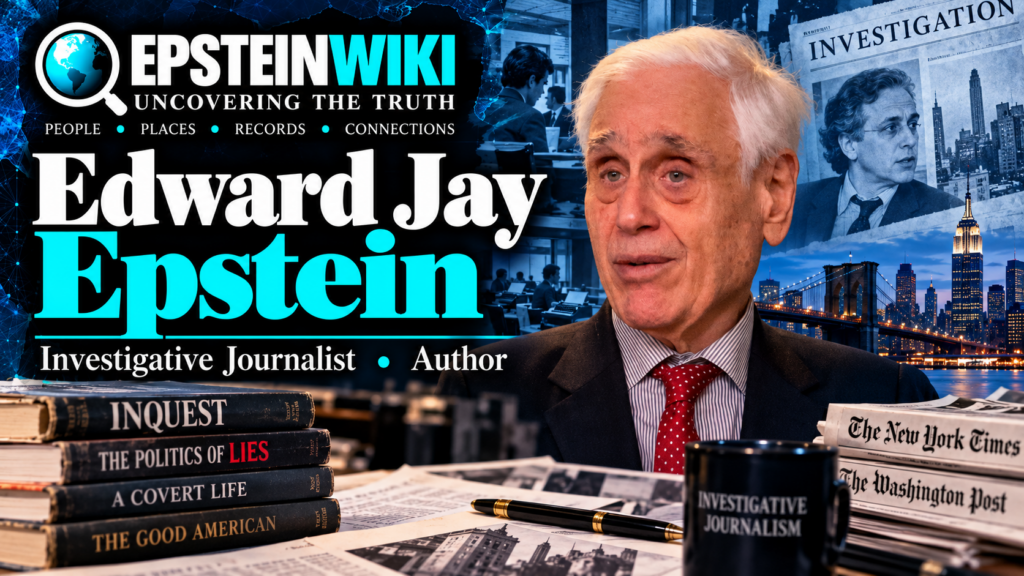
Edward Jay Epstein
Snapshot
| Field | Documented information |
|---|---|
| Identity | Investigative journalist and book author, distinct from Jeffrey Epstein. His publisher biography identifies his work. |
| Main records | A December 2002 greeting and January 2003 commission invitation, plus a declining reply. The reply has unreliable displayed dates. |
| Recipient names | The scans print MAXWELL, GHILANE and G. Max. CBS News reporting identifies the correspondent as Ghislaine Maxwell. |
| Project context | The February 2003 archived website describes investigative questions under a shadow commission heading. |
| Record differences | Some copies preserve a full message; others contain little beyond the header. They are not interchangeable evidence. |
| Main limit | Correspondence and a public project description do not establish participation in abuse, an intelligence role or Maxwell’s membership in the proposed group. |
Introduction
Edward Jay Epstein appears in these records as a journalist corresponding with Ghislaine Maxwell. The central exchange concerns his proposed inquiry into September 11. The preserved reply declines the invitation. Its wording is readable, but conflicting date fields prevent a reliable exact reply date.
This profile compares the Maxwell correspondence with Edward’s historical financial reporting, his first-person descriptions of contact with Jeffrey Epstein, and additional released-record leads from 2012 through 2015. It separates contemporaneous documents, retrospective testimony, unverified index transcriptions, and allegations requiring corroboration. Contact or editorial exchange alone does not establish complicity in Jeffrey Epstein’s crimes.
Key Takeaways
- The full invitation and the declining reply are different messages. Repeated copies do not create additional invitations or independent corroboration.
- One invitation copy, EFTA02333703, has a matching header but lacks the full body.
- The reply copies contain inconsistent timestamps. The quoted invitation time is not a scheduled meeting time.
- The archived website supplies project context, but the inspected page does not establish a roster or completed group work.
- Edward’s own published recollection describes meeting Jeffrey in 1987. A shared surname alone does not explain their documented contact.
Expanded Investigation: The Earlier Financial and Media Record
Edward Jay Epstein’s documented interest in Jeffrey Epstein predates the 2001 to 2003 Maxwell correspondence. In his 2023 first-person retrospective, Edward described meeting Jeffrey and Mark Epstein at a New York Halloween gathering in 1987. He also described travel accommodations and upgrades, early financial questions, and a relationship that extended across several decades. These statements are retrospective testimony by the journalist, not independent verification of every transaction or event.
The original 1989 column
Edward’s early reporting is associated with a 1989 Manhattan, inc. article titled The Win-Win Game. The original publication is a crucial research target because later accounts identify Jeffrey Epstein as the financier behind the unnamed profile. Readers should distinguish the content actually printed in 1989 from Edward’s much later identification and interpretation. The original article needs to be checked against an archival copy before any purported quotations are reproduced.
Financial allegations and the Kroll investigation
Edward’s later account describes disputes and inquiries involving publisher Dick Snyder, financier Steven Hoffenberg, Sotheby’s chairman Alfred Taubman, and investigator Thomas Helsby of Kroll. It refers to an alleged investment, a returned check, a commission dispute, and inquiries during the mid-1990s. These assertions deserve separate source testing. No allegation is treated here as a judicial finding, and the existence, terms, and outcome of each claimed financial transaction require independent corroboration.
Independent Corroboration: The 2003 Vanity Fair Financial Investigation
Vicky Ward’s 2003 Vanity Fair investigation offers an important source independent of Edward Jay Epstein’s later recollections. Ward reported on a proposed Pennwalt takeover, Steven Hoffenberg, Simon & Schuster executive Dick Snyder, and a 1989 deposition involving Jeffrey Epstein. Her account describes a proposed investment of approximately $500,000 attributed to Snyder, while Edward’s later retrospective discusses a different dollar figure in his own account of Snyder’s involvement. The discrepancy does not prove either writer wrong: the accounts could refer to separate transactions or stages, and the underlying checks, banking records and deposition must be examined before reconciling them.
Ward reported that Jeffrey’s deposition described contributing $300,000 of his own money toward a $1 million investment, while Hoffenberg claimed to have advanced the difference. These are attributed accounts, not an independent audit of payment flows. They create specific research targets: the 1989 deposition, Pennwalt takeover documents, communications among Snyder, Hoffenberg, Toboroff and Nederlander, and any surviving legal or financial filings.
Media Ethics: Edward’s 2019 Interview
The Daily Beast’s 2019 interview with Edward Jay Epstein reported his acknowledgment of receiving first-class travel benefits and free lodging from Jeffrey Epstein. The interview also recorded Edward discussing Jeffrey’s rehabilitation after his earlier conviction. These statements raise legitimate questions about journalistic independence and how Edward evaluated his longtime acquaintance; they do not establish criminal participation or prove that his articles were purchased or dictated.
The interview’s description of a prolonged break in contact should be compared with the independently dated communications indexed in 2012. Until the original scans are authenticated, the discrepancy should remain identified as an unresolved chronology question rather than a definitive falsehood.
2012: Direct Email Leads and a Chronological Discrepancy
The records indexed under EFTA02397242, EFTA01839883, EFTA02552772 and EFTA02026531 point to communications in January, March, and April 2012. These leads suggest Edward and Jeffrey were in contact before the April 2013 renewal of contact described in Edward’s later recollections. The EFTA scans and relevant page numbers still need direct comparison with the index transcriptions before their exact wording can be treated as authenticated.
- January 18, 2012, EFTA02397242: Indexed correspondence describes a proposal to meet for coffee in New York and a reply requesting a telephone number.
- March 25, 2012, EFTA01839883: Indexed material concerns comments on a revised written piece. The subject and editorial implications need original-page confirmation.
- April 4, 2012, EFTA02552772: Indexed messages discuss the scheduling of an interview. The interview’s identity and outcome are not established from this description alone.
- April 14, 2012, EFTA02026531: Indexed correspondence mentions a visit involving the initials DSK. Do not expand initials to a named individual without corroborating context.
Why the discrepancy matters: A recollection that contact resumed in 2013 and a document trail apparently showing communication in 2012 cannot both be used as the same precise chronology without explanation. Contemporary messages generally deserve greater chronological weight once their dates and authenticity have been checked.
April 2013: Proposed Lunch and a Separate Scheduling Conflict
EFTA02035137 and a forwarded version in EFTA01974500 reproduce an April 26, 2013 email exchange in which Edward asks if Jeffrey is in New York. Jeffrey proposes breakfast or lunch after returning May 2, and Edward accepts lunch on May 2. A related scheduling chain, EFTA02008471, says Tim Zagat’s office also requested lunch that day and asks whether Edward could instead come for dinner. These documents establish proposed appointments and a scheduling issue, not a confirmed meal, Zagat’s presence at one, or any improper act. The indexed transcriptions must still be matched against the original PDF page images.
March 2015: A Newsweek Article Forwarded to Jeffrey Epstein
EFTA00698921 preserves a March 9, 2015 message from Edward sending Jeffrey his Newsweek article criticizing Bill O’Reilly’s account of reporting on George de Mohrenschildt’s 1977 death. The message includes a link to the article and lists a document attachment. It demonstrates a direct journalistic exchange; it does not establish Jeffrey’s role in researching, editing, financing, or placing the piece. The record is also a useful lead for reconstructing Edward’s network of reporting subjects beyond stories about Jeffrey.
December 2015: Jeffrey Epstein’s Explicit Proposal to Pay Edward
The December 19, 2015 chain in EFTA00838582 is more substantive than a generic possibility of editorial assistance. Edward forwarded his December 18 Wall Street Journal review about conspiracy theories. Jeffrey replied by asking whether he could pay Edward to organize his own story into a coherent presentation, describing a prospective assignment lasting roughly six to nine months. This is a documented proposal for paid narrative assistance, not merely a third-party characterization of it.
Evidence boundary: The inspected public transcription does not establish that Edward accepted the offer, that a contract was executed, that money changed hands, that a manuscript was delivered, or that any resulting article was published. Those questions require subsequent correspondence, financial records, and publication comparisons. The original scan remains the necessary control for exact punctuation and spelling.
December 19, 2015: Edward Responds to the Proposed Paid Biography
The earlier characterization of Jeffrey Epstein’s December 19 proposal as an unanswered offer needs an important correction. A separately indexed response, EFTA02477507, identifies a reply from Edward later that day. Edward said the project would be possible but explained that a biography would require a defined beginning and end and that Jeffrey would need to choose which part of his life it would cover. This shows engagement with the proposed work, but it is not a signed contract or proof that payment was received.
A subsequent message from Jeffrey, EFTA00838586, narrows the proposed subject to the allegations concerning girls and the ensuing police and federal investigations. It also names several defense lawyers, including Ken Starr, Alan Dershowitz, Roy Black and Guy Lewis, as part of the history Jeffrey wanted covered. The inclusion of these names describes Jeffrey’s proposed narrative scope; it does not show that any lawyer collaborated with Edward on the project.
Evidence limits: Both follow-up messages are currently supported by searchable released-record text, which can contain extraction and date-formatting errors. Their original page images should be checked before quoting exact language. The exchanges establish a proposal, Edward’s tentative willingness to discuss it, and Jeffrey’s requested focus. They do not establish a commission, an agreed fee, a completed biography, editorial control over a published article, or assistance concealing criminal conduct.
2013 and 2015: Invitations and Editorial Assistance Leads
EFTA01188251 has been identified as a March 2013 book-event invitation lead. An invitation does not prove attendance, and this document requires direct-page verification. EFTA00838582 is an additional December 2015 lead concerning possible assistance organizing a story. Neither a paid arrangement nor the completion of editorial work can be asserted from an index description alone. The original messages and any follow-up or payment records must be examined.
April 2012: DSK Identified as Dominique Strauss-Kahn
The initials DSK in EFTA02026531 can now be linked to Dominique Strauss-Kahn through independent contemporary reporting. Edward Jay Epstein’s April 14, 2012 email to Jeffrey Epstein says he had spent the previous day with “dsk.” In an April 27, 2012 interview published by The Guardian, Edward expressly identifies an April 13, 2012 meeting with Strauss-Kahn at the Pavillon de la Reine hotel in Paris. The alignment of the day, journalist and initials is strong corroboration that the email concerns the former International Monetary Fund managing director. It does not demonstrate that Jeffrey Epstein attended or arranged that interview.
In the earlier message in the same email chain, Jeffrey refers to the contemporaneous controversy involving US Secret Service agents and alleged payments for commercial sex in Colombia. That was a separate incident, not a description of Strauss-Kahn’s 2011 New York sexual-assault case. New York prosecutors dismissed the criminal charges against Strauss-Kahn in August 2011, and a subsequent civil lawsuit was settled in December 2012. His claims of politically motivated surveillance or orchestration remain allegations, not established findings.
April 27, 2012: Edward Sends Jeffrey His Guardian Interview and DSK Book Announcement
EFTA02553774 is an indexed released-record email dated April 27, 2012, from Edward to Jeffrey with the subject “My Interview with DSK in Guardian.” It announces Edward’s book Three Days in May: Sex, Surveillance and DSK and forwards material from his Guardian interview. The published interview and publisher bibliographic listing independently confirm the contemporary article and book. This correspondence shows Jeffrey was an intended recipient of Edward’s DSK reporting; it does not establish Jeffrey’s participation in the reporting, authorship, funding or fact checking.
The interview itself was contested. A Guardian follow-up on April 29, 2012 reported that Strauss-Kahn’s entourage challenged the characterization of the material as an interview or direct quotations. The Guardian defended its reporting and said the remarks were made in an April 13 two-hour meeting. The dispute should be recorded alongside the article, rather than presenting either party’s interpretation as an undisputed fact.
January 2013: Birthday Greeting and Coffee Reference
EFTA02565172 preserves an email dated January 20, 2013 in which Edward wishes Jeffrey a happy birthday, thanks him for coffee, praises a person identified as Jennifer for preparing it, and recounts his memories of Vladimir Nabokov lectures at Cornell. Related renderings appear in EFTA02370024 and EFTA01906665. These are overlapping records, not necessarily separate occasions. The retrospective claim that contact resumed in April 2013 must be reconciled with this earlier correspondence. The note suggests prior hospitality but does not independently identify a venue or establish a particular meeting date.
August 2017: Intelligence Analysis Forwarded to Jeffrey Epstein
House Oversight document HOUSE_OVERSIGHT_025548 through 025550, preserved in the indexed text of the released estate records, contains a message dated August 18, 2017 from Edward Jay Epstein to Jeffrey Epstein forwarding an article about Russian intelligence and the 2016 United States presidential campaign. The enclosed commentary discusses the Steele dossier, Russian information operations, Michael Flynn, Jared Kushner, and Sergey Kislyak. This provides further evidence of direct correspondence in 2017. The political and intelligence arguments are the writer’s analysis, not findings adopted by EpsteinWiki. Forwarding the article does not prove Jeffrey commissioned, edited, or paid for it. The source should be checked against the original House Oversight release before exact quotations are used.
Photographic Evidence and Archive Restrictions
Getty Images has a photographic record of Edward Jay Epstein participating in a discussion at the 2017 New York Film Festival. A licensed portrait can help establish the subject’s identity, but an unrelated event photograph is not evidence of contact with Jeffrey Epstein. Separately, EFTA01185525, EFTA01185526 and EFTA01185527 have surfaced as photographic leads within the released record. Each image requires individual inspection, identification, and deduplication. Do not imply the people pictured met or participated in any event unless the image and its provenance support that conclusion.
Outstanding Verification Tasks
The expanded historical leads are not yet a complete or exhaustive corpus review. Priorities include acquiring and comparing the 1989 Manhattan, inc. column; validating all 2012 email scans page by page; reviewing the full December 2015 exchange; corroborating financial allegations with contemporaneous sources; verifying event and photographic context; checking other media archives and relevant independent sleuth reporting; and reconciling Edward’s 2019 and 2023 published statements with the dated records. Contact, hospitality, and discussion of reporting do not establish complicity in Jeffrey Epstein’s sexual abuse or trafficking.
Identity and Documented Contact
Penguin Random House’s author profile identifies Edward Jay Epstein as an investigative journalist and author of books including Inquest and The Big Picture. The full email pages sign the name Ed Epstein and show his website, providing more support for the sender’s identity than a first name alone.
In the public opening of My Tea with Jeffrey Epstein, published by Air Mail on September 14, 2019, Edward wrote that he first met Jeffrey at a New York Halloween party in 1987 and met him for tea afterward. This is his retrospective account. It establishes that he publicly described an acquaintance, rather than leaving the shared surname as the only connection. It does not by itself establish criminal knowledge or participation.
Source Names and the Earlier Header
The recipient display name in the invitation and greeting is MAXWELL, GHILANE. The reply uses G. Max. Emma Li’s CBS News report, reproduced by WGHN, identifies the exchange as correspondence between Edward and Ghislaine Maxwell. The scans do not fully spell her given name, and private addresses are obscured.
These display names do not establish an address-book entry or who created the spelling. The separate November 5, 2001 record has a subject referring to a Prague liaison, but its body is blank. It shows a header from Ed to the same recipient display name. That page cannot supply missing content or establish any intelligence-related activity.
December 31, 2002: A Greeting
EFTA00578713 is a one-page New Year greeting. Its header is dated December 31, 2002, at 20:51:57 +0000. The message wishes the recipient well for 2003 and is signed Ed Epstein, with his website below.
This is evidence of a greeting addressed to the recipient shown. It is not a record of a meeting, an address-book export, a response or the proposed commission’s activities.
January 2003: The Invitation
EFTA00578730 dates the invitation January 6, 2003, at 00:02:44 +0000. It asks whether the recipient is interested in a shadow commission concerning September 11 and says the membership list is secret. The fuller rendering displays Edward’s website and a link to its project page.
The invitation documents what Edward proposed. Its reference to a membership list does not supply that list, prove an official appointment or establish that a group met.
The Declining Reply and Its Date Problem
A reply from G. Max thanks the sender and says the writer cannot join the shadow commission. It quotes the invitation. This is a substantive response, not an unanswered invitation.
The displayed date in this copy uses the year 4501. Another copy of the declining reply prints January 5, 2003, at 21:32:59 +0000, which would precede the invitation’s UTC timestamp. These fields do not yield a dependable exact sent date for the reply.
The quoted invitation is marked January 5 at 7:02 p.m. with a minus-five-hour UTC offset, corresponding to January 6 at 00:02 UTC. That is the time of the quoted email, not an announced commission meeting. The reply’s meaning and its unreliable date fields are separate issues.
Why the Copies Must Be Compared
The records differ in more than their identification numbers. EFTA02332458 preserves the invitation and website links. EFTA00578730 preserves the invitation with those links redacted. EFTA02333703 has the matching sender, recipient, subject and displayed time, but only a short opening line remains in the body.
A header-only copy cannot independently substantiate wording absent from that page. Likewise, multiple versions of the declining reply are not multiple separate decisions. The differences in redaction, formatting and completeness do not reveal why the exports differ.
The Public Website and Later Explanation
The February 7, 2003 Internet Archive capture of the linked page presents seven priority questions. They concern military command, aviation security, intelligence handling, presidential risk assessment and related investigations. This is a contemporary public outline of the project. The archive date is a capture date, not a proven launch date, and the page is not a membership register or a set of official findings.
In a later publisher Q&A, Edward said he had planned a book about the 9/11 Commission but dropped the project after concluding that the commission had done its job. That is his own retrospective explanation. The interview does not identify Maxwell as a participant or resolve the full history of the earlier proposal.
Source Quality and Research Boundaries
The cited email pages were inspected as complete Internet Archive copies of identified DOJ files, including their page identifiers. They were not compared byte for byte with the currently served DOJ originals. Their visible contents can be described without claiming forensic authentication of the underlying email accounts.
Graial’s March 2026 review helped locate the email group. Juanne Pili’s February 2026 report for Open and CBS reporting linked the exchange to the archived site. Those are reporting and research sources, distinct from the records themselves. The exact date fields and limits described here come from the inspected pages, rather than treating every published interpretation as established fact.
Private addresses and obscured information are not reproduced or reconstructed. The public opening of Edward’s Air Mail article was reviewed; its access-limited remainder is not the basis for additional claims here. This is a selected-record review, not a complete account of his relationships or career.
Chronology
| Date | Documented event |
|---|---|
| 1987, recalled in 2019 | Edward’s published account describes meeting Jeffrey in New York. This is a retrospective claim. |
| November 5, 2001 | Header-only record from Ed to MAXWELL, GHILANE. No body is visible. |
| December 31, 2002 | New Year greeting is dated in UTC. |
| January 6, 2003, UTC | Commission invitation is timestamped 00:02:44 +0000. |
| Reply date unresolved | Declining reply quotes the invitation, but its date fields conflict across copies. |
| February 7, 2003 | Archived website capture preserves a project outline. This is not a proven founding date. |
| September 14, 2019 | Air Mail publishes Edward’s recollection of his earlier acquaintance with Jeffrey. |
Evidence Appearances
| Source and locator | Evidence and limit |
|---|---|
| EFTA00578713, page 1 | December 2002 greeting. Signed Ed Epstein; website visible. No reply on this page. |
| EFTA00578730, page 1 | Invitation with explicit +0000 timestamp. Website fields are redacted in this version. |
| EFTA02332458, page 1; EFTA_R1_01278326 | Full invitation and visible website links. This copy supplies text absent from the shorter rendering. |
| EFTA02333703, page 1; EFTA_R1_01280410 | Matching invitation header and short opening line, with the rest of the body blank. |
| EFTA02334685, page 1; EFTA_R1_01281668 | November 2001 header with a different subject and no visible body. Not the commission invitation. |
| EFTA02333606, page 1; EFTA_R1_01280270 | Declining reply quoting the invitation. The displayed year is 4501; trailing export material is not a verified sent date. |
| EFTA00582247, page 1 | Another rendering of the decline. Its printed January 5 UTC time conflicts with the quoted invitation chronology. |
| Archived project page, February 7, 2003 capture | Public investigative questions. The inspected page does not identify a membership roster. |
| Publisher biography and Q&A | Professional identity and Edward’s own explanation of abandoning a planned book. |
| Air Mail, September 14, 2019, opening two paragraphs | First-person recollection of meeting Jeffrey in 1987. Only the public opening is relied on. |
Limitations and Open Questions
- The reason Edward invited Maxwell is not established by these messages.
- The declining reply does not provide a trustworthy exact sent date. This review does not repair the conflicting fields.
- The inspected project page does not establish who joined, whether a formal body met or what work any participant completed.
- A subject line cannot replace missing message content. A visible display name does not prove how an address book was configured.
- The copies do not establish criminal participation, an intelligence role or a family relationship between Edward and Jeffrey.
- Other correspondence may add context. This selected set is not a complete audit of the released archive.
Conclusion
The records support a greeting, an invitation and a declining response. The website adds public context for the proposed inquiry. The strongest account keeps the full text, incomplete copies and unreliable dates separate. It also recognizes Edward’s stated acquaintance with Jeffrey without turning that contact into proof of wrongdoing.
Questions and Answers
Are Edward Jay Epstein and Jeffrey Epstein the same person?
No. Edward was the journalist identified in the publisher biography. His own recollection describes meeting Jeffrey as another person.
Did Maxwell accept the invitation?
The reviewed reply declines it. The date fields are unreliable, but the declining wording is visible.
Why not give an exact date for the reply?
Some copies print the year 4501. Another gives a time earlier than the invitation it quotes. The review preserves that discrepancy.
Are the different EFTA numbers identical emails?
No. Some show fuller text, some omit most of the body, and others preserve the reply. Their numbers cannot be counted as separate invitations.
Does the website prove a secret group operated?
The inspected page is a public project outline. It does not establish a membership roster, meetings or Maxwell’s participation.
What does the GHILANE spelling establish?
It is the visible recipient display name. The pages do not establish who entered it or whether it came from an address book.
Related EpsteinWiki Articles
Sources
- Archived email records: EFTA00578713, EFTA00578730, EFTA02332458, EFTA02333703, EFTA02334685, EFTA02333606, EFTA00582247. Each cited file has one page. These are Internet Archive reproductions of identified DOJ URLs; the table above gives their exact locators and differences.
- The Shadow Commission. Edward Jay Epstein’s website, Internet Archive capture dated February 7, 2003. Main project page.
- Edward Jay Epstein: author biography and Q&A. Penguin Random House, undated page. Biography and first interview answer.
- My Tea with Jeffrey Epstein. Edward Jay Epstein, Air Mail, September 14, 2019. Public opening two paragraphs.
- 10 Epstein files conspiracy theories, debunked. Emma Li, CBS News, reproduced by WGHN, February 27, 2026. Section addressing Maxwell and September 11; reporting used for attribution and archival discovery.
- Graial’s review of Edward Jay Epstein’s emails from Jan 30 DOJ release. Paglalayag, March 2, 2026. Record-discovery aid, not independent authentication.
- Epstein files e l’assurdo crossover con l’11 settembre. Juanne Pili, Open, February 28, 2026. Italian reporting used to locate records and website context; the source dates were checked against the pages themselves.