
Fact Check: Viral Trump and Young Girl Image Comes From an AI Generated Video
Snapshot
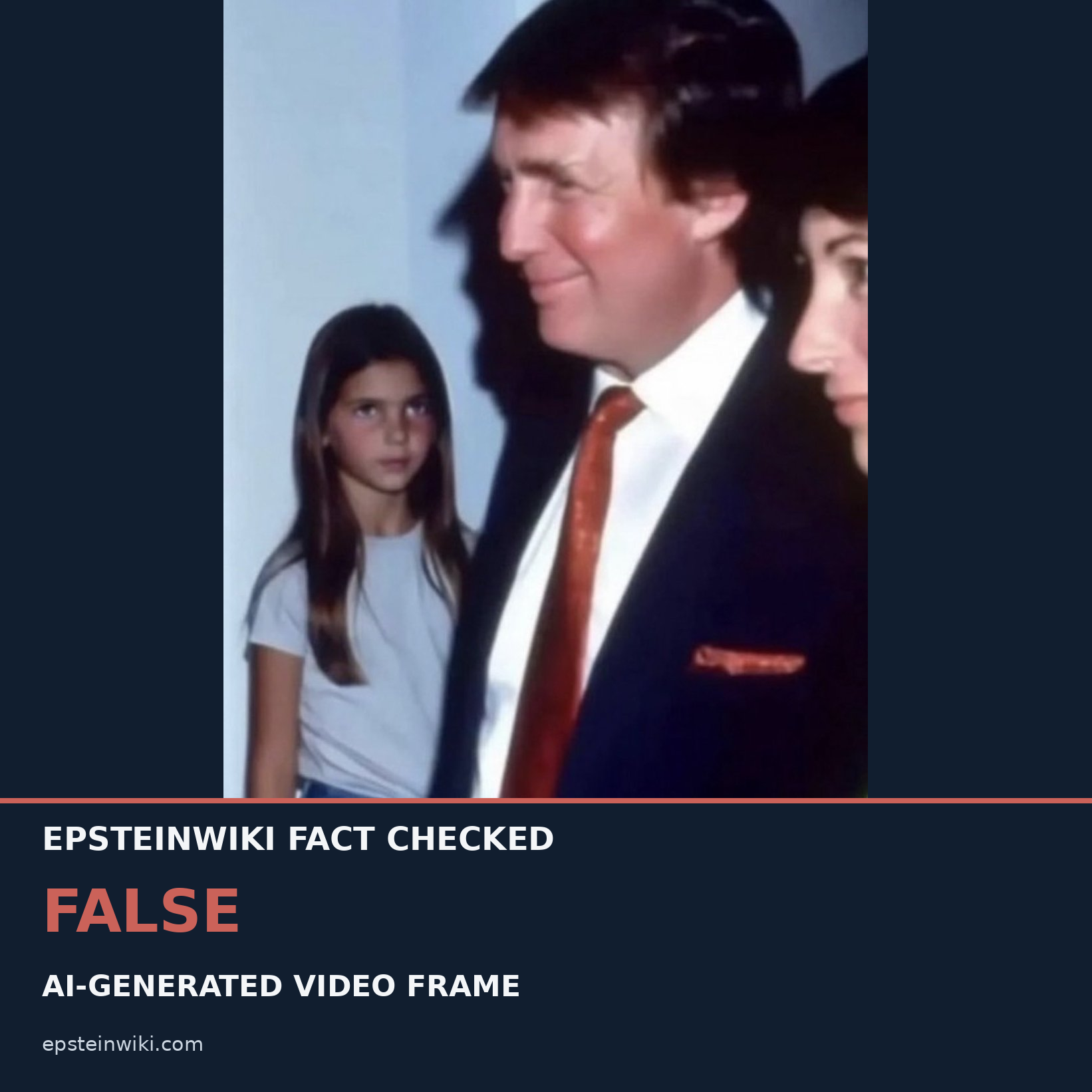
- Claim checked: The circulated image is an authentic photograph of Donald Trump beside a young girl, with Ghislaine Maxwell partly visible at the right.
- Verdict: False. The image is an altered frame from an AI generated video.
- Image examined: A portrait crop with a pale blue shirt at left, a dark suit and reddish tie in the foreground, and a blue wall behind the figures.
- Decisive evidence: Matching published video frames, the earlier source photograph and a specialist assessment of the animation.
- Scope: This particular image and the scene it depicts.
Key takeaways
- The supplied crop matches a frame reproduced in contemporary reporting about the fake video.
- An earlier party photograph contains no children in the frame.
- The event has a separate photographic record in a professional agency catalogue.
- A real source photograph can be used to create a fabricated scene.
Which image is being checked?
This check concerns the portrait crop described in the Snapshot, rather than every image circulating under a description such as “Trump with a young girl.” The file supplied for review has no visible caption, date, photographer credit or document number. Those missing details are reasons to investigate its provenance; by themselves, they would not prove fabrication.
The matching scene appears in the first panel of a social media screenshot reproduced in Snopes’ July 2025 report on Yahoo. The clothing, arrangement, blue wall and crop provide the comparison. Snopes rated the video fake.
This match matters because a still can lose the context of the video from which it was taken. Someone encountering only the cropped image would not see the surrounding animation or the earlier photograph used to construct it. It should therefore be assessed as a frame from that identified sequence, rather than treated as an unidentified archival photograph.
The earlier photograph
The Sun published the source photograph on November 23, 2019, crediting Alpha Press. Its caption identifies Trump, Maxwell and Ann Jones at a New York City party in 1997.
The full published photograph can be inspected directly. It contains three adults, a drink held by the person at left, and a paneled doorway behind them. The young figures in the altered sequence do not appear in this source frame.
Names come from the caption. The first publication anywhere has not been established.
What the agency record corroborates
A separate Getty Images catalogue entry, editorial image 1451592883, documents the Gucci Envy launch at Trump’s Trump Tower penthouse on April 29, 1997. Its caption names a guest, Donald Trump, Ann Dexter-Jones and Mick Jones. The credit is Steve Eichner, WWD and Penske Media via Getty Images.
This is a different photograph. It corroborates the event, date and setting documented in the surrounding photographic record; it should not be represented as Getty’s catalogue entry for the exact Alpha Press picture. A source chain becomes less reliable when a related agency photograph is silently substituted for the actual image under examination.
Why the altered sequence fails authentication
Lead Stories examined the video on July 21, 2025. Digital forensics specialist Hany Farid identified image and text to video generation, citing motion problems and physically implausible shadows. The report also compares the earlier photograph with the sequence: a doorway visible in the source is absent from a later generated view.
Its published comparison graphic lets readers check the relationship between the source photograph, the opening crop and a later frame. This is a stronger basis for the finding than an impression that someone’s skin, expression or hair “looks like AI.”
The verdict rests on the recovered source and the documented video examination together. The original frame provides a concrete reference. The animation supplies the changed scene. Farid’s assessment addresses the method of fabrication. These are complementary observations, rather than a vote among social media users.
Why a realistic still can mislead
The recognizable parts of a source photograph can survive while the scene around them changes. A viewer may correctly recognize an old outfit or a familiar photograph and still be looking at a fabricated interaction. Matching one authentic component does not authenticate every element of the finished image.
Cropping adds another problem. The supplied image excludes much of the setting and the second young figure visible elsewhere in the sequence. It contains none of the social media interface visible in the published screenshot. The result looks like a standalone photograph even though the relevant evidence is a comparison across several images.
This does not require an exact age or identity for the young figure. No such identification has been established here. Calling that figure a named survivor, relative or attendee would introduce a separate assertion for which the examined material supplies no reliable support.
What this finding establishes
The circulated crop should not be used as photographic evidence that the depicted encounter happened. Descriptions of gestures, reactions or intent within the generated sequence cannot turn it into a record of real conduct.
The authentic source photograph remains a separate historical item. Rejecting the fabricated addition does not erase the original photograph or resolve other questions about the people named in its caption. Those questions require their own documents, testimony and properly sourced reporting.
Likewise, the absence of children from this one source frame cannot establish the guest list for the entire event. The supported conclusion concerns the altered image, not everything that may have happened before or after the photographer took the original picture.
Evidence limits
- The exact original creator, software, prompt and complete reposting chain have not been established in this review.
- The examined file is a circulated copy, not a camera original or the generation project.
- An independently accessible Alpha Press catalogue record or original negative for the exact still was not obtained.
- No comprehensive search of every court exhibit or government file is claimed. A repost’s assertion that an image came from “the Epstein files” would require a specific record and page.
Sources
- Snopes, republished by Yahoo, July 15, 2025.
- The Sun’s dated publication and Alpha Press credit, November 23, 2019.
- Getty Images editorial record 1451592883.
- Lead Stories’ video examination, July 21, 2025.