FBI FOIA Deleted Page Index Related to Jeffrey Epstein, HOUSE OVERSIGHT 018872 Through 018875
Snapshot
| Field | Details |
|---|---|
| Record identifiers | HOUSE_OVERSIGHT_018872 through HOUSE_OVERSIGHT_018875 |
| Document type | FBI FOI/PA Deleted Page Information Sheet |
| Producing agency | Federal Bureau of Investigation |
| Related litigation | Radar Online LLC v. Federal Bureau of Investigation |
| Civil action | 1:17-cv-03956 |
| Court | United States District Court for the Southern District of New York |
| Subject of request | FBI records concerning the investigation and prosecution of Jeffrey Epstein |
| Number of released index pages | Four House Oversight pages |
| Material described | FBI pages withheld, removed, duplicated, or covered by court sealing orders |
| Exemption codes visible | b3, b6, b7C, b7D, b7E |
| Other withholding reasons | Duplicate and court sealing order |
| Direct evidence | HOUSE_OVERSIGHT_018872, HOUSE_OVERSIGHT_018873, HOUSE_OVERSIGHT_018874, and HOUSE_OVERSIGHT_018875 |
| Key finding | The index confirms that substantial portions of an FBI Epstein record production were not included in the public release, but it does not establish that the underlying records were destroyed or permanently unavailable |
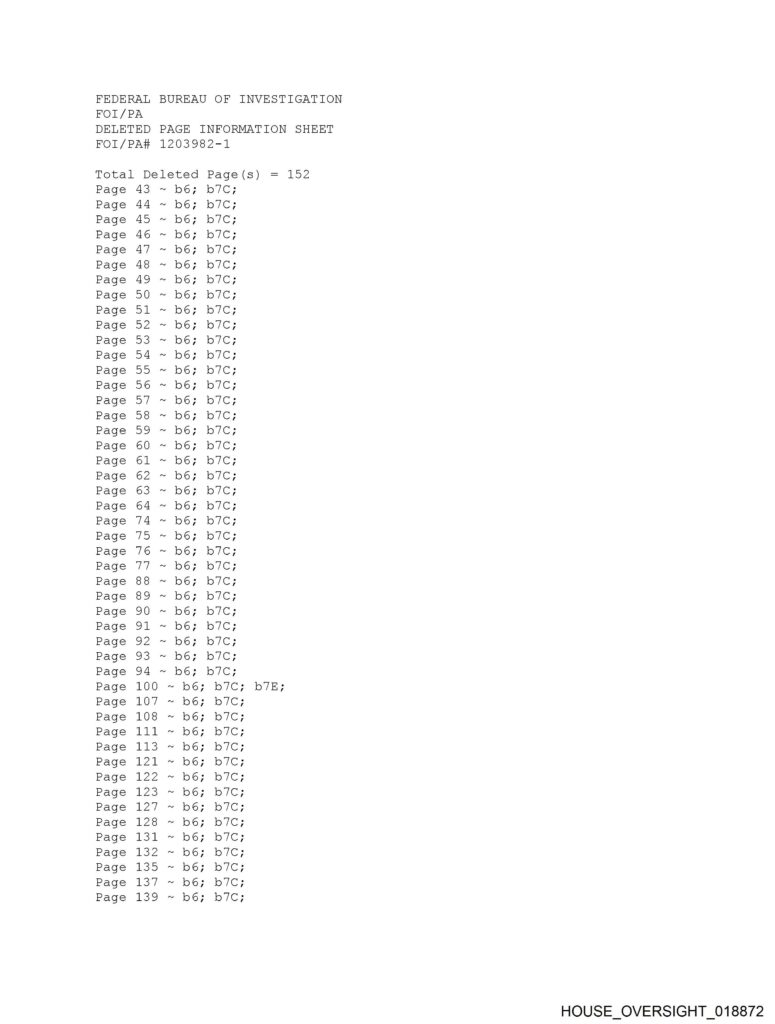
HOUSE_OVERSIGHT_018872 through HOUSE_OVERSIGHT_018875 preserve part of an FBI accounting system for pages removed from a Freedom of Information Act production concerning Jeffrey Epstein.
The word “deleted” has a specific administrative meaning in this context. It generally means that pages were removed from the version released to the requester. It does not establish that the FBI erased, destroyed, or lost the underlying records.
What Is This Record?
The four pages are part of an FBI “FOI/PA Deleted Page Information Sheet” connected to Civil Action No. 17-cv-03956.
That case is Radar Online LLC v. Federal Bureau of Investigation, a Freedom of Information Act lawsuit filed in the Southern District of New York. The litigation sought FBI records concerning the Bureau’s investigation and prosecution of Jeffrey Epstein for child sex trafficking and related conduct.
A deleted page sheet is not the withheld evidence itself. It is an administrative index identifying pages that were excluded from a particular release and recording the FBI’s stated reason for withholding each page.
The entries include statutory FOIA exemptions, duplicate designations, and references to court sealing orders. The sheet therefore functions as a map of information that existed within the processed record set but was not reproduced in the public version.
The larger FBI release identifies hundreds of deleted pages. HOUSE_OVERSIGHT_018872 through HOUSE_OVERSIGHT_018875 preserve only a portion of that deletion index.
Evidence Appearance Table
| House Oversight Record | Document Appearance | Evidentiary Function |
|---|---|---|
| HOUSE_OVERSIGHT_018872 | Continuation of an FBI deleted page list containing numbered page references and withholding codes | Identifies pages removed under privacy and statutory exemptions |
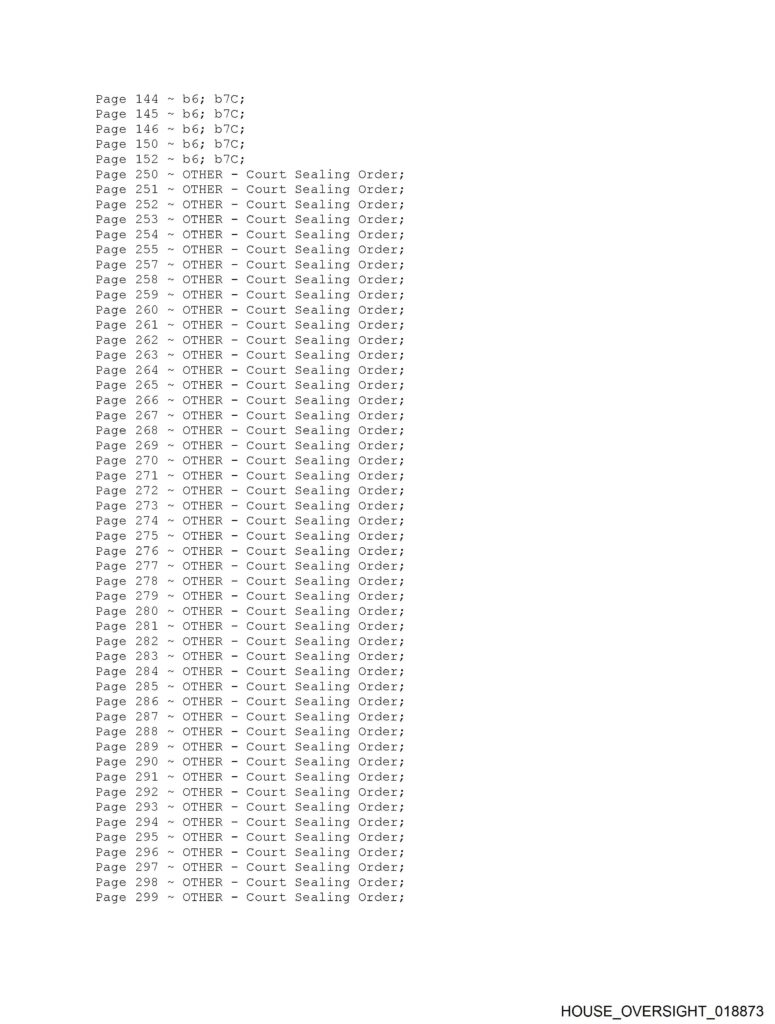
| HOUSE_OVERSIGHT_018873 | Additional page references with repeated FBI exemption codes and other withholding designations | Extends the accounting of material omitted from the FOIA production |
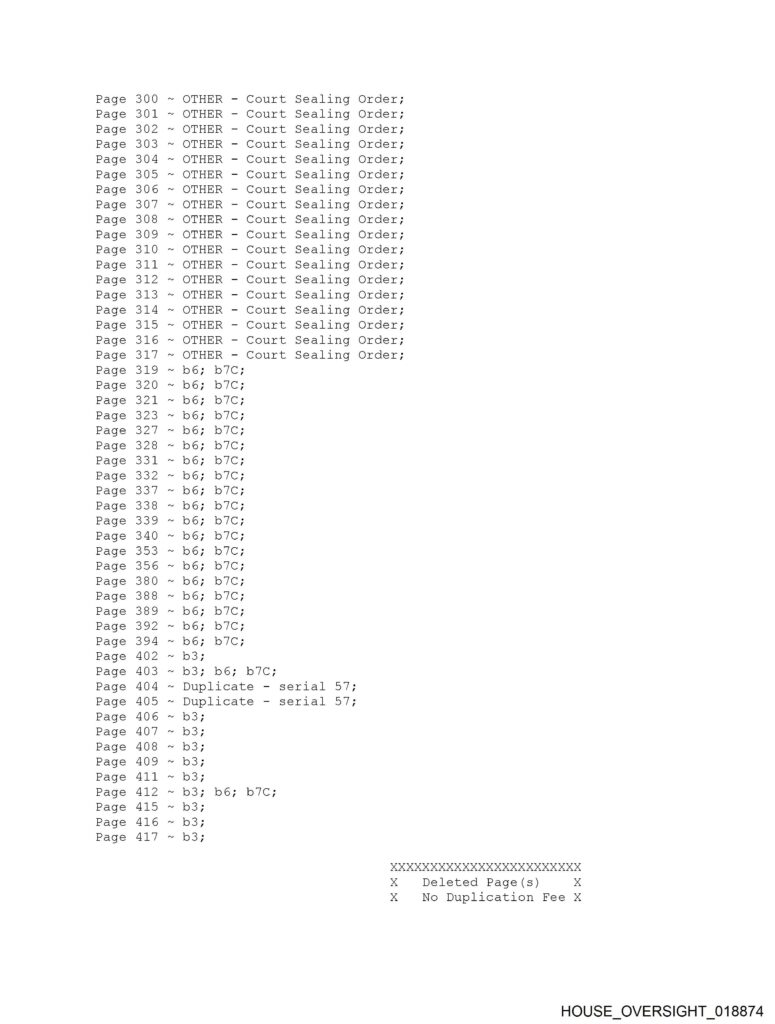
| HOUSE_OVERSIGHT_018874 | Later entries include pages identified as withheld because of a court sealing order | Confirms that some omissions were attributed to judicial restrictions rather than an ordinary FBI redaction decision |
| HOUSE_OVERSIGHT_018875 | Concluding portion of the released index sequence | Completes the visible House Oversight excerpt and preserves the final listed withholding entries |
The precise division between pages may differ in OCR copies because scanned tables can be read out of order. Researchers should verify every page number and exemption code against the original image.
What the Index Contains
The deleted page index uses a repeating format:
| Index Field | Meaning |
|---|---|
| Page reference | The page number assigned within the processed FBI production |
| Exemption code | The FOIA provision invoked to justify withholding |
| Duplicate | The FBI identified the page as a duplicate of another released or processed record |
| Other | A reason outside the listed FOIA exemption codes |
| Court sealing order | A court order restricted the release of the identified page |
The index contains long runs of consecutive page references. Many carry the same combinations of privacy exemptions. Other portions identify pages as duplicates. Later portions include repeated references to court sealing orders.
This structure shows that the FBI reviewed the material page by page and categorized why each listed page would not appear in the public production.
It does not reveal the subject matter of every missing page. A page withheld under a privacy exemption could contain survivor information, witness information, law enforcement personnel information, medical details, addresses, contact information, or other identifying material.
The exemption code identifies the claimed legal basis. It does not provide a complete description of the withheld content.
What “Deleted Page” Means
An FBI deleted page information sheet is easy to misinterpret.
“Deleted” usually means deleted from the releasable copy. It does not necessarily mean deleted from the FBI’s investigative system.
The underlying page may have been:
- Withheld in full under a FOIA exemption
- Removed because a court order prohibited disclosure
- Excluded as a duplicate
- Referred to another agency for review
- Withheld because it contained protected personal information
- Released later in a different production
- Reprocessed after litigation or an administrative appeal
The index proves that a page was not included in that specific release. It does not prove that the government destroyed the page.
It also does not prove that every withheld page remains unavailable today. FOIA determinations can change after litigation, agency reconsideration, the death of a person whose privacy was protected, the end of an investigation, modification of a sealing order, or a later statutory disclosure mandate.
FOIA Exemptions Cited in the Record
The index uses abbreviated codes corresponding to exemptions in 5 U.S.C. § 552.
| Code | General Protection | What the Code Does Not Reveal |
|---|---|---|
| b3 | Information specifically protected from disclosure by another qualifying federal statute | The index does not always identify which separate statute controlled the withholding |
| b6 | Information in personnel, medical, or similar files when disclosure would constitute a clearly unwarranted invasion of personal privacy | It does not identify the protected person or the exact type of personal information |
| b7C | Law enforcement information that could reasonably be expected to constitute an unwarranted invasion of personal privacy | It does not establish whether the protected person was a survivor, witness, investigator, suspect, or unrelated third party |
| b7D | Information that could identify a confidential source or reveal information supplied by a confidential source | It does not establish the source’s identity or whether every related record remains confidential |
| b7E | Law enforcement techniques, procedures, or guidelines when disclosure could reveal protected methods or risk circumvention of the law | It does not describe the protected technique |
| Other | A nonstandard withholding explanation recorded by the FBI | The specific explanation must be read from the corresponding entry |
| Court sealing order | A court prohibited or restricted public disclosure | It does not identify the sealed case, order, docket entry, or continuing status of the seal |
The Department of Justice Guide to the Freedom of Information Act provides detailed legal explanations for these exemptions.
The smaller numbers sometimes appearing after exemption codes are FBI processing annotations. They should not be interpreted as additional sections of FOIA without the agency’s applicable processing legend.
Exemption 3 and the Missing Statutory Citation
Exemption 3 differs from the privacy and law enforcement exemptions because it depends on another federal statute.
The Department of Justice Exemption 3 guide explains that the information must be protected by a qualifying statute that specifically restricts disclosure.
In Epstein related investigative records, one possible Exemption 3 authority could involve federal grand jury secrecy. However, the deleted page index alone does not permit researchers to conclude that every b3 entry contains grand jury material.
The controlling statute must be identified from the complete production, agency declaration, Vaughn index, court filing, or exemption legend.
Without that information, the correct description is that the FBI invoked Exemption 3. It is not safe to describe the exact content that the exemption protected.
Privacy Exemptions and Survivor Protection
Exemptions 6 and 7C appear repeatedly in FBI Epstein releases.
The Department of Justice Exemption 6 guide explains that Exemption 6 protects personal information when disclosure would constitute a clearly unwarranted invasion of privacy.
Exemption 7C applies to records compiled for law enforcement purposes and protects against unwarranted invasions of personal privacy. Its use may protect victims, survivors, witnesses, investigators, employees, suspects, and other individuals mentioned in an investigative file.
Repeated privacy exemptions should not automatically be characterized as evidence of a coverup. Epstein records contain intensely sensitive information about people who reported sexual abuse, witnesses who cooperated with investigators, and private individuals who may never have been accused of wrongdoing.
At the same time, a privacy exemption does not answer whether the FBI released every reasonably segregable portion of a record. That is a separate legal and factual question commonly tested through FOIA appeals and litigation.
Survivor privacy and government accountability can both be protected through careful redaction rather than unnecessary public identification.
Confidential Sources and Investigative Methods
The appearance of b7D indicates that at least some indexed material was withheld to protect confidential source information.
That exemption may protect the identity of a source, information furnished by the source, or both. The code does not reveal whether the source was a survivor, witness, law enforcement agency, institution, employee, or other person.
The appearance of b7E indicates that the FBI also invoked protection for law enforcement techniques or procedures.
The Department of Justice Exemption 7E guide explains that the exemption can protect investigative techniques, procedures, and guidelines when the statutory requirements are satisfied.
Neither code proves that the withheld pages contain explosive evidence. They show only the FBI’s stated legal rationale for excluding the information from that production.
Court Sealing Orders
One of the most significant features of the index is the repeated phrase “Court Sealing Order.”
A court sealing order differs from an ordinary agency redaction. The FBI may be legally restricted from releasing a sealed judicial record even if the agency would otherwise possess the record and consider it responsive to a FOIA request.
The index does not identify:
- The court that issued each sealing order
- The case connected to the sealed pages
- The date of the order
- Whether the order covered an entire document or selected portions
- Whether the order remained active when later Epstein releases occurred
- Whether the sealed material has since been unsealed
- Whether the pages were also withheld under a FOIA exemption
Researchers should not assume that every court sealing reference concerns the same lawsuit.
The entries create a valuable followup task. Each page range should be compared with known federal and state Epstein litigation, including sealed filings, grand jury proceedings, survivor cases, and records from related criminal investigations.
Radar Online LLC v. FBI
Civil Action No. 1:17-cv-03956 was filed in May 2017 as Radar Online LLC v. Federal Bureau of Investigation.
The requester sought records concerning the FBI’s investigation and prosecution of Jeffrey Epstein. The lawsuit challenged the government’s handling of the request and its withholding decisions.
The existence of the civil action number on the deleted page sheet connects the index to that FOIA litigation. It does not mean the House Oversight Committee created the index. The FBI created the sheet during its FOIA processing, and the later House release assigned the HOUSE_OVERSIGHT identifiers.
The litigation record is important because agency declarations, motions, court decisions, and Vaughn submissions may explain exemptions that the deleted page sheet lists only by code.
A DOJ summary of the later litigation describes the request as seeking FBI records about the investigation and prosecution of Epstein for child sex trafficking. Researchers should consult the actual docket before attributing a specific withholding decision to the court.
Relationship to the FBI Vault
The FBI Vault Jeffrey Epstein collection now contains 22 listed parts.
The Vault files are processed FOIA releases. They are not a complete reproduction of every FBI record associated with Epstein.
The collection contains:
- Investigative reports
- Administrative records
- Interview documentation
- Evidence records
- Correspondence
- Referral documents
- FOIA processing sheets
- Redacted pages
- Deleted page indices
The same deleted page material can also be examined through the Internet Archive OCR copy of the FBI production. OCR text is useful for searching, but it can misread page numbers, exemption codes, punctuation, and table columns.
The index should also be reviewed within EpsteinWiki’s FOIA and Government Releases collection and alongside the individual FBI Vault Part 22 record.
Connection to Later Redaction Reporting
The index predates later reporting about the FBI’s internal review of Epstein related files.
EpsteinWiki’s summary, Here’s What FBI and DOJ Hid From Its Epstein Files Review, examines reporting by FOIA journalist Jason Leopold concerning FBI review and redaction procedures.
That reporting concerns internal processing materials and should not be treated as a transcription of HOUSE_OVERSIGHT_018872 through HOUSE_OVERSIGHT_018875. It is relevant because it shows that decisions about searching, reviewing, training, and redacting the Epstein files have themselves become subjects of FOIA litigation and public scrutiny.
Researchers attempting to compare missing pages across releases can also use RSG #346: How To Track Missing Pages Across Epstein Document Releases.
What the Record Proves
The four pages establish that:
- The FBI created a deleted page information sheet for a Jeffrey Epstein related FOIA production.
- The sheet was associated with Civil Action No. 17-cv-03956.
- The FBI excluded numerous pages from the releasable production.
- The FBI cited multiple statutory FOIA exemptions.
- Some pages were identified as duplicates.
- Some pages were withheld because of court sealing orders.
- The House Oversight release later preserved the pages under identifiers 018872 through 018875.
- The omissions can be tracked by page number and stated withholding reason.
The record is therefore useful as evidence of the scope and structure of FBI withholding.
What the Record Does Not Prove
The index does not prove that:
- The FBI destroyed the underlying pages.
- Every listed page remains withheld.
- Every redaction was improper.
- Every withheld page contains evidence of criminal conduct.
- Every b3 entry contains grand jury evidence.
- Every privacy redaction protects an accused person.
- The FBI withheld the pages to protect Jeffrey Epstein.
- The court sealing orders were unlawful.
- All listed pages came from the same investigative file.
- The index identifies every Epstein related record held by the FBI.
- The FBI Vault contains the Bureau’s complete Epstein file.
- A page marked duplicate lacks evidentiary value.
- Congress received unredacted versions of every listed page.
- Later DOJ productions contain identical versions of the records.
The index establishes omission from a particular production, not the substance or significance of every missing page.
Investigative Significance
Deleted page indices are valuable because they reveal the outline of a record set even when the underlying pages remain unavailable.
A large run of missing pages can identify:
- The approximate size of a withheld document
- Repeated exemption patterns
- Blocks potentially connected to the same report or exhibit
- Changes between separate FOIA productions
- Pages later released with fewer redactions
- Records withheld by court order rather than agency discretion
- Duplicate documents appearing elsewhere in the archive
The most productive use of this index is comparison.
Researchers should compare every listed page against the FBI Vault files, House Oversight copies, later DOJ releases, litigation exhibits, and archived versions. A page missing from one production may appear in another with a different Bates number or exemption pattern.
The index is a roadmap for that work. It is not a substitute for the missing evidence.
Reliability Assessment
| Question | Assessment | Reason |
|---|---|---|
| Are the four House Oversight pages authentic public records? | High confidence | They reproduce an FBI formatted FOI/PA processing document |
| Is the index connected to Civil Action No. 17-cv-03956? | High confidence | The civil action number appears on the FBI sheet |
| Did the FBI withhold pages from the relevant production? | High confidence | The document exists specifically to identify deleted pages |
| Are the exemption codes accurately identified? | High confidence for clearly legible entries | The codes match standard FBI FOIA notation |
| Is every OCR transcription accurate? | Moderate to low confidence | Dense tables and degraded scans can produce OCR errors |
| Can the underlying content be determined from the exemption code? | Low confidence | Codes provide legal categories, not substantive descriptions |
| Were the underlying pages destroyed? | No evidence | “Deleted” refers to the released copy |
| Do all court sealing orders remain active? | Unknown | The index does not provide current docket information |
| Has every page been compared with later releases? | Not established | A complete page level concordance is still needed |
Fact Check
| Claim | Status | Finding |
|---|---|---|
| The records are FBI deleted page information sheets | Confirmed | The FBI heading and FOI/PA title appear on the document |
| The sheets relate to Civil Action No. 17-cv-03956 | Confirmed | The case number is printed on the index |
| The civil action was Radar Online LLC v. FBI | Confirmed | The federal docket identifies the parties |
| The case concerned FBI records about Jeffrey Epstein | Confirmed | Court and DOJ descriptions identify the subject of the FOIA request |
| The index cites b3, b6, b7C, b7D, and b7E | Confirmed | These codes appear across the underlying deletion index |
| Some pages were withheld under court sealing orders | Confirmed | The index expressly uses that reason |
| Some pages were excluded as duplicates | Confirmed | Duplicate appears as a withholding or exclusion reason |
| “Deleted” means the FBI destroyed the original records | False | The term refers to pages deleted from the released copy |
| The index reveals what every missing page contains | False | It generally supplies only page references and withholding reasons |
| Every withholding was legally valid | Not established | Validity depends on the record, agency justification, and applicable court rulings |
| Every listed page remains unavailable | Not established | Later productions may have released some records |
| The House Oversight Committee created the original index | False | The FBI created the FOIA processing sheet; House identifiers were added during the later release |
Questions Still Unanswered
- Which FBI Vault part and original production segment correspond exactly to HOUSE_OVERSIGHT_018872 through HOUSE_OVERSIGHT_018875?
- What was the complete FOIA request number associated with this version of the index?
- Which qualifying statutes supported each b3 withholding?
- Which records were protected under b7D as confidential source material?
- What investigative techniques or procedures were protected under b7E?
- Which courts issued the sealing orders referenced in the index?
- What cases and docket entries correspond to the sealed page ranges?
- Do those sealing orders remain in effect?
- Were any sealed pages later released through civil litigation or congressional production?
- Which duplicate pages can be located elsewhere in the FBI Vault?
- Did the FBI provide a Vaughn index describing the withheld documents in greater detail?
- Did Radar Online LLC challenge each withholding category?
- Which exemption claims were upheld, rejected, or reconsidered during the litigation?
- Did Congress receive unredacted versions of any pages omitted from the public FBI release?
- Are the same records now present in the DOJ Epstein Library under EFTA identifiers?
- Do later versions contain fewer redactions?
- Can a page level concordance connect the original FBI page references to House Oversight and EFTA numbers?
- How many unique records are represented after duplicate pages are removed?
- Were any records referred to another agency for review?
- Does the FBI still maintain additional responsive records outside the public Vault collection?
Sources
- HOUSE_OVERSIGHT_018872
- HOUSE_OVERSIGHT_018873
- HOUSE_OVERSIGHT_018874
- HOUSE_OVERSIGHT_018875
- FBI Vault Jeffrey Epstein collection
- Radar Online LLC v. Federal Bureau of Investigation docket
- Internet Archive searchable OCR of the FBI production
- Department of Justice Guide to the Freedom of Information Act
- Department of Justice Exemption 3 guide
- Department of Justice Exemption 6 guide
- Department of Justice Exemption 7C guide
- Department of Justice Exemption 7E guide
- EpsteinWiki FOIA and Government Releases
- EpsteinWiki FBI FOIA Deleted Page Index
- EpsteinWiki summary of reporting on the FBI redaction project
- RSG #346: How To Track Missing Pages Across Epstein Document Releases