
Mobutu Sese Seko

Snapshot
Mobutu Sese Seko was the authoritarian ruler of the Democratic Republic of the Congo and later Zaire from November 1965 until May 1997.
Mobutu built a centralized political system supported by military power, political repression, patronage, foreign alliances, and the diversion of state resources into private wealth. His government became one of the most frequently cited examples of kleptocratic rule.
Mobutu died in Morocco in September 1997. He therefore had no connection to Epstein’s later trafficking prosecution, 2008 conviction, or relationships formed during the final decades of Epstein’s life.
The possible relationship between Mobutu and Jeffrey Epstein rests primarily on two pieces of evidence.
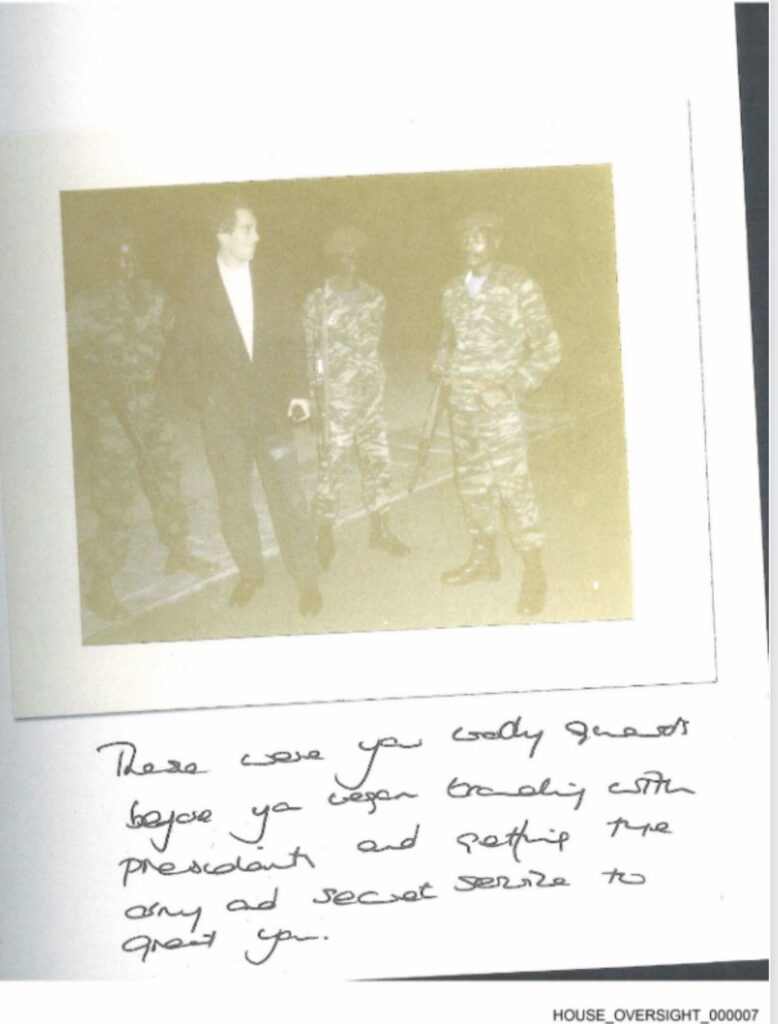
First, a retrospective section of Epstein’s 2003 birthday album referred to Epstein being in Zaire during the middle of the 1980s with members of the presidential guard.
Second, Epstein told Steve Bannon in a February 2018 message that he had been with Mobutu during the middle of the 1980s. Epstein then described Mobutu’s campaign requiring Zairians to adopt African names and joked about the name he claimed to have been given.
These sources support the conclusion that Epstein represented himself as having entered Mobutu’s presidential environment.
They do not independently prove that Epstein met Mobutu, worked for him, recovered money for him, conducted intelligence activity, or performed financial services for the Zairian government.
The claim is important because the alleged encounter occurred during the obscure period between Epstein’s departure from Bear Stearns and his better documented work with Douglas Leese, Intercontinental Assets Group, Steven Hoffenberg, and Towers Financial.
No publicly identified survivor allegation, criminal charge, civil judgment, or law enforcement finding reviewed for this article connects Mobutu to Epstein’s sexual abuse or trafficking operation.
Identity and Rise to Power
Mobutu was born Joseph Désiré Mobutu in Lisala in the Belgian Congo on October 14, 1930.
He served in the colonial Force Publique and later worked as a journalist. During the political crisis surrounding Congolese independence, Mobutu became chief of staff of the army.
Mobutu seized power through a military coup on November 24, 1965. He removed President Joseph Kasa Vubu and established a regime that would last for more than three decades.
He renamed the country Zaire in 1971 and adopted the name Mobutu Sese Seko as part of a broader campaign intended to eliminate European names, clothing, and cultural symbols.
A historical review published by the London School of Economics describes how Mobutu transformed the state into a political system centered on personal rule and extraction.
Mobutu’s political authority depended on control of the military, suppression of organized opposition, foreign support, and the distribution of money and positions to loyal supporters.
The Mobutu Regime
Mobutu established the Popular Movement of the Revolution as the country’s dominant political organization.
His government developed an extensive personality cult. State media presented Mobutu as the source of national unity and political authority. His image appeared across public institutions, currency, broadcasts, and official ceremonies.
Political opponents faced surveillance, imprisonment, exile, torture, and execution.
Human Rights Watch’s 1995 report on Zaire described extrajudicial killings, arbitrary detention, torture, rape, looting, corruption, and the absence of meaningful legal remedies.
A separate Amnesty International report documented severe abuses during Mobutu’s efforts to resist democratic political change.
This political background matters when assessing Epstein’s later statement that he had been inside Mobutu’s environment. Access to Mobutu was access to the leadership of an authoritarian state with military, intelligence, financial, and international relationships.
Kleptocracy and Private Wealth
Mobutu’s government became internationally associated with kleptocracy.
The term describes a political system in which rulers use state power to enrich themselves, their relatives, and their supporters.
Mobutu controlled access to mining income, foreign aid, state companies, import licenses, contracts, land, and government appointments. Public resources were frequently treated as extensions of his personal patronage system.
The United Nations Office on Drugs and Crime has cited accusations that Mobutu diverted approximately five billion dollars from Zaire’s treasury.
Estimates vary substantially because Mobutu’s finances were divided among properties, companies, intermediaries, bank accounts, relatives, and political associates.
An academic examination of external collusion with Zairian kleptocracy argued that foreign banks, governments, corporations, and advisers helped create the structures through which public assets became private wealth.
This environment is relevant to Epstein because he later described his early business as locating concealed or stolen money for wealthy clients.
It does not establish that Mobutu hired him.
Mobutu and the United States
Mobutu maintained close relationships with the United States and other Western governments during the Cold War.
His anticommunist position made Zaire strategically valuable to American policy makers. Zaire supported Western operations in central and southern Africa and became a route for assistance to forces fighting the Soviet aligned government of Angola.
The Association for Diplomatic Studies and Training describes the uneasy combination of Western strategic support, widespread corruption, repression, and economic deterioration under Mobutu.
United States officials were aware of serious abuses and corruption. Strategic priorities nevertheless protected Mobutu from the level of political isolation that his government might otherwise have faced.
This created an environment in which diplomats, intelligence officers, arms dealers, bankers, mineral interests, and private intermediaries moved through Mobutu’s political circle.
A verified Epstein presence inside that circle would be important. The currently released material does not reveal which institution or individual introduced him.
Epstein’s Career During the Middle 1980s
The alleged Mobutu encounter occurred during one of the least documented periods of Epstein’s career.
Epstein left Bear Stearns in 1981 and established Intercontinental Assets Group. He described the company as helping clients recover money lost through fraud, corruption, or misconduct.
Epstein later associated with British defense businessman Douglas Leese. Reporting about their relationship describes Epstein travelling internationally, attending meetings, and entering business environments connected with defense contracts, wealthy families, and government officials.
By the later 1980s, Epstein had also entered Steven Hoffenberg’s orbit at Towers Financial.
The CBS News examination of Towers Financial documents Epstein’s paid consulting relationship with the company.
Towers Financial later collapsed in a massive fraud. Hoffenberg was convicted and imprisoned. Epstein was never charged in the Towers prosecution.
The proposed Mobutu chronology belongs between Epstein’s departure from Bear Stearns and his better documented work with Hoffenberg.
Epstein’s 2003 Birthday Album
In 2003, Ghislaine Maxwell and others assembled a large commemorative album for Epstein’s fiftieth birthday.
The book contained letters, photographs, drawings, recollections, jokes, and retrospective accounts of Epstein’s life. The United States House Committee on Oversight and Government Reform released the album in September 2025 after obtaining it from Epstein’s estate.
The official House Oversight release provides access to the album and other estate material.
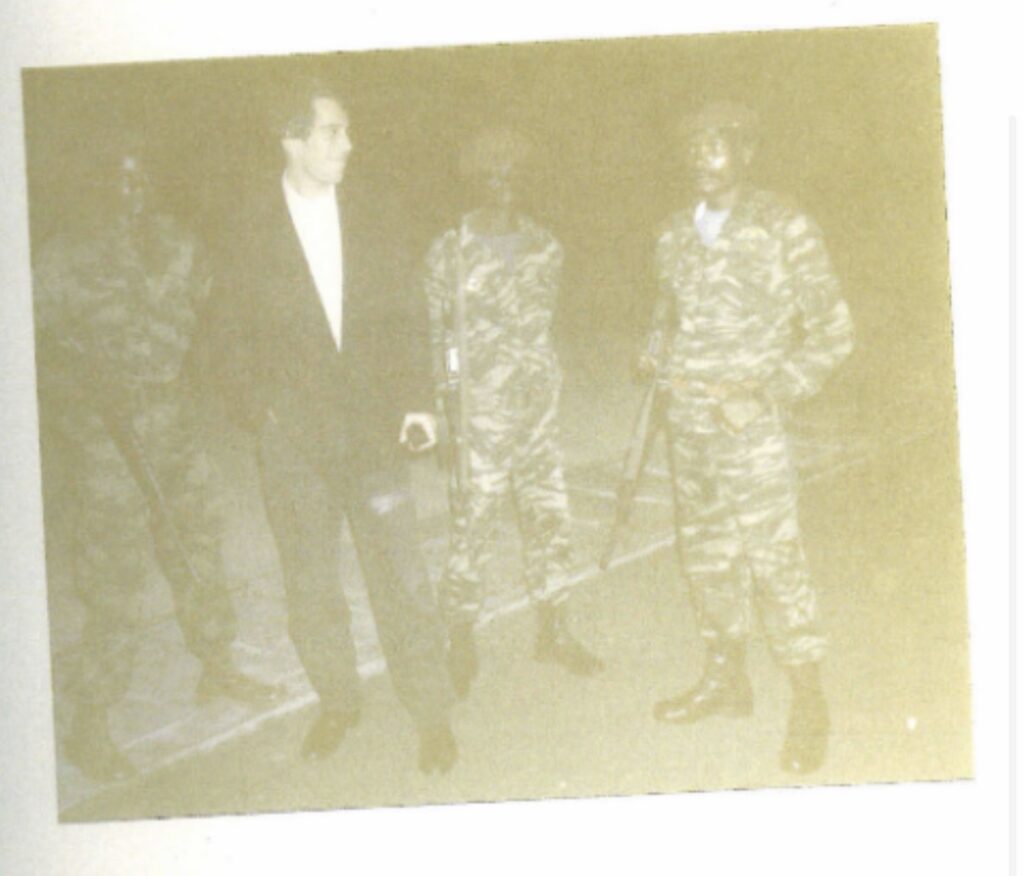
An early chronological section of the album refers to Epstein being in Zaire during the middle of the 1980s with presidential guards.
The entry is important because it was created in 2003, approximately fifteen years before Epstein made a similar claim to Steve Bannon.
The album is not a government travel record. Its contents were assembled by Epstein’s associates as a personal birthday tribute and contain jokes, exaggerations, private recollections, and staged material.
The Zaire reference therefore supports further investigation. It does not independently verify an audience with Mobutu.
The Presidential Guard Reference
The birthday album’s reference to presidential guards places Epstein close to a highly protected institution within Mobutu’s government.
Presidential guards were not ordinary tour guides or private security personnel. They were part of the apparatus protecting the head of state and maintaining regime security.
The wording could indicate that Epstein travelled with guards, was escorted by them, met members of the unit, or posed for a photograph involving them.
The complete context matters.
A photograph with guards could support physical presence in Zaire without proving that Epstein met Mobutu. An escort could indicate official access without identifying the purpose. A caption written years later could also misidentify people, location, or circumstances.
The album should therefore be compared with passports, Zairian immigration records, airline records, hotel records, diplomatic cables, photographs, and testimony from participants.
The 2018 Steve Bannon Exchange
Epstein discussed Mobutu in a February 2018 exchange with Steve Bannon.
The conversation occurred while Epstein and Bannon were discussing film, political organization, populism, and cryptocurrency.
In EFTA00881759, Epstein told Bannon that he had been with Mobutu during the middle of the 1980s.
Epstein referred to Mobutu as the dictator of Zaire. He then described Mobutu’s campaign to replace European names and titles with African alternatives.
The message contains an important direct claim by Epstein. It establishes that Epstein said he had been with Mobutu.
It does not establish whether “with” meant a personal meeting, an extended working relationship, attendance at an event, travel within the same party, or proximity inside a guarded government environment.
The Name Change Story
Epstein told Bannon that Mobutu wanted people to use African names and the title “Citizen” rather than European forms of address.
He joked that “Monsieur Epstein” became “Citizen Bongo Dongo.”
The wording appears in several overlapping copies of the exchange, including EFTA00881743 and EFTA00881551.
Mobutu did conduct an official authenticity campaign that required many people to replace European names with African names. The country became Zaire, Leopoldville became Kinshasa, and Joseph Désiré Mobutu became Mobutu Sese Seko.
That historical context makes Epstein’s anecdote plausible in general form.
It does not prove that Mobutu personally assigned Epstein a name or that Epstein accurately remembered every feature of the policy.
The joking name may have been created by Epstein, Mobutu, an aide, a translator, or another person present.
The Photograph Sent to Bannon
Reporting on the Bannon exchange indicates that Epstein sent a photograph of Mobutu after making the claim.
An image of Mobutu alone would show that Epstein possessed a photograph. It would not prove that Epstein took the photograph, received it from Mobutu, or appeared with him.
The provenance of the image is therefore essential.
Investigators would need the original file, creation date, embedded metadata, transmission history, and any accompanying photographs to determine whether it came from Epstein’s alleged Zaire visit.
A publicly available press photograph of Mobutu could have been downloaded decades later. A private photograph taken inside a controlled location could provide much stronger evidence.
The current public record does not establish which category applies.
Why the Two References Matter Together
The birthday album and the Bannon message were created approximately fifteen years apart.
Both place Epstein in Mobutu’s environment during the middle of the 1980s.
That consistency makes the underlying claim more significant than a single isolated boast.
However, the sources are not fully independent.
The birthday album was created for Epstein by friends and associates. Its authors may have relied on stories Epstein told them. The Bannon message came directly from Epstein.
Both records could therefore trace back to Epstein’s own account rather than two separately verified witnesses.
The combination supports the conclusion that the Mobutu story formed part of Epstein’s personal history. It still does not conclusively prove that the story was true.
Did Epstein Meet Mobutu?
The presently available evidence makes a meeting possible but not conclusively verified.
Epstein explicitly claimed that he had been with Mobutu. The birthday album separately places him in Zaire with presidential guards during the same general period.
No publicly identified passport stamp, government appointment record, diplomatic cable, photograph showing both men, hotel record, flight manifest, or sworn witness account reviewed for this article independently confirms the meeting.
The strongest responsible wording is that Epstein claimed he was with Mobutu and that a second retrospective source placed Epstein near the Zairian presidential security environment.
Stating without qualification that Epstein met Mobutu would go beyond the released evidence.
Did Epstein Work for Mobutu?
No released contract, invoice, bank transfer, engagement letter, government appointment, or corporate record reviewed for this article proves that Epstein worked for Mobutu.
Epstein’s phrase “when I was with Mobutu” does not define an employment relationship.
He might have been:
- A guest.
- A financial consultant.
- An adviser to someone else attending a meeting.
- A representative of a private businessperson.
- A participant in an attempted transaction.
- A social visitor.
- Someone briefly introduced to Mobutu.
- A person exaggerating or inventing access.
Without documentation identifying the work, client, compensation, and purpose, Epstein should not be described as Mobutu’s financial adviser or employee.
The Hidden Money Theory
Epstein told journalists and associates that Intercontinental Assets Group recovered money for clients.
Accounts of his early career describe searches for stolen funds, hidden assets, fraudulent transfers, and money concealed across international jurisdictions.
Mobutu controlled a financial network involving foreign banks, mineral companies, government accounts, relatives, advisers, and offshore holdings. That network would have presented exactly the kind of secrecy Epstein later claimed to navigate.
This creates a plausible investigative hypothesis that Epstein’s Zaire trip involved concealed money or asset recovery.
Plausibility is not proof.
No document reviewed for this article establishes whether Epstein was trying to locate Mobutu’s assets, protect them, move them, recover money for another party, or discuss an unrelated transaction.
Ghislaine Maxwell’s Account of Epstein’s Early Wealth
During her July 2025 interview with Deputy Attorney General Todd Blanche, Maxwell described Epstein as recovering missing or stolen money for wealthy clients.
The official Justice Department transcript records Maxwell discussing Epstein’s claimed work involving wealthy people and African rulers.
Maxwell said Epstein sometimes received a portion of the recovered assets as compensation. She also recalled seeing photographs that she associated with African political figures.
Her account is relevant because it resembles Epstein’s earlier description of Intercontinental Assets Group.
Maxwell did not provide a contract with Mobutu, a bank record, or an independently authenticated photograph proving that Epstein performed work for the Zairian ruler.
Her statements are witness claims made decades after the alleged events. They must be compared with contemporary records.
The Douglas Leese Possibility
Researchers have examined whether British businessman Douglas Leese could have connected Epstein to Mobutu or another African political network.
Leese operated in international defense and government business. Epstein travelled and worked around him during the early 1980s.
Vicky Ward’s investigation of Epstein’s possible intelligence connections describes conflicting accounts of Epstein’s early international work, his relationship with Leese, and the stories he told about recovering money.
The known record does not establish that Leese introduced Epstein to Mobutu.
Other possible routes include mineral interests, arms dealers, bankers, intelligence contacts, wealthy clients, and intermediaries working around the Zairian government.
Until a document identifies the intermediary, every proposed route remains a hypothesis.
Zaire’s Mineral and Financial Networks
Zaire possessed enormous deposits of copper, cobalt, diamonds, uranium, gold, and other valuable minerals.
Control over those resources attracted mining corporations, commodity traders, banks, foreign governments, defense interests, and private intermediaries.
Mobutu’s political system blurred the boundary between state business and private enrichment. Access to the presidential circle could create opportunities involving concessions, debt, currency, mineral rights, infrastructure, weapons, and asset transfers.
Epstein later cultivated people working in many of these same fields.
The broader economic environment helps explain why an ambitious financial intermediary might seek access to Mobutu.
It does not identify what Epstein actually did in Zaire.
Western Enablers of Mobutu’s Wealth
Mobutu could not move and preserve vast sums without institutions and professionals outside Zaire.
Foreign banks, corporations, lawyers, accountants, property agents, governments, and political intermediaries helped sustain the financial architecture surrounding his regime.
The 1993 study of external collusion with Zairian kleptocracy examined how external actors benefited from or enabled the conversion of state resources into private wealth.
This context makes it reasonable to investigate whether Epstein entered Mobutu’s environment through a foreign facilitator.
The record does not establish that Epstein became one of Mobutu’s financial enablers.
A researcher would need evidence of a transaction, service, payment, introduction, or asset movement before reaching that conclusion.
Intelligence Speculation
Mobutu’s government maintained close relationships with Western intelligence services during the Cold War.
Epstein’s alleged access has therefore attracted speculation that his visit was connected with intelligence activity.
No released employment record, operational file, intelligence authorization, security clearance, or sworn testimony reviewed for this article establishes that Epstein was working for the Central Intelligence Agency, another United States agency, British intelligence, Israeli intelligence, or Zairian intelligence during the alleged visit.
Access to an intelligence connected ruler does not make every visitor an intelligence officer.
The claim remains relevant because Epstein later operated through informal networks linking finance, politics, security, technology, and former government officials.
It should be investigated without presenting inference as an established fact.
Steve Bannon’s Reaction
Bannon responded to Epstein’s broader discussion by writing that they were on the edge of real power.
Epstein replied by distinguishing Bannon’s ambitions from his own.
The exchange suggests that Epstein used stories about Mobutu and other powerful figures while discussing political influence with Bannon.
It does not establish that Bannon had independent knowledge of the Zaire episode.
Bannon’s response may reflect enthusiasm, humor, political strategy, or acceptance of Epstein’s self presentation.
The conversation is valuable as evidence of how Epstein described his past to someone he was cultivating in 2018.
Mobutu’s Fall From Power
Mobutu’s position weakened after the Cold War ended.
Western governments became less willing to overlook corruption and repression in exchange for anticommunist cooperation. Zaire’s economy and public institutions continued to deteriorate.
The 1994 genocide in Rwanda created a major regional crisis. Armed groups and refugees entered eastern Zaire, intensifying conflict and instability.
Laurent Désiré Kabila’s forces, supported by Rwanda and Uganda, advanced across the country during the First Congo War.
Mobutu fled Zaire in May 1997. The country restored the name Democratic Republic of the Congo.
The 1997 United States human rights report records Kabila’s seizure of the former Zairian government after a seven month military campaign.
Mobutu died from prostate cancer in Rabat, Morocco, on September 7, 1997.
Chronological Limits
Mobutu’s death imposes a clear limit on the relationship.
He could not have participated in Epstein’s later activities involving Palm Beach, the United States Virgin Islands, the 2007 federal non prosecution agreement, the 2008 Florida conviction, or Epstein’s return to international elite networks after his release from custody.
Any direct contact between Epstein and Mobutu would have occurred before September 1997.
The currently identified sources place the alleged encounter during the middle of the 1980s.
Researchers should avoid merging the Mobutu claim with Epstein’s African relationships from the 2000s and 2010s. Later relationships involving Senegal, Côte d’Ivoire, Rwanda, Libya, Morocco, South Africa, Equatorial Guinea, and other countries belong to separate timelines.
No Evidence Connecting Mobutu to Epstein’s Sexual Abuse
No public evidence reviewed for this article accuses Mobutu of participating in Epstein’s trafficking operation.
The alleged encounter predates the Palm Beach investigation by approximately two decades.
The birthday album reference and Bannon messages concern political access, Zaire, presidential guards, and Mobutu’s authenticity campaign.
They do not mention massages, minors, sexual recruitment, trafficking, or payments to women.
This does not make the possible relationship historically insignificant. It places it in a different evidentiary category.
The Mobutu material is evidence concerning Epstein’s obscure financial and political history, not evidence of sexual misconduct by Mobutu.
The Evidence Needed for Verification
A complete investigation of the Mobutu claim should seek:
- Epstein’s passports from the early and middle 1980s.
- Zairian immigration and customs records.
- Commercial and private aircraft manifests.
- Hotel, telephone, and expense records.
- Intercontinental Assets Group records.
- Douglas Leese correspondence and business files.
- Photographs in their original format with metadata.
- Mobutu’s presidential appointment books.
- Records from the Zairian presidential guard.
- United States, Belgian, British, French, Israeli, and Zairian diplomatic records.
- Bank transfers involving Epstein, his companies, Mobutu, or Mobutu controlled entities.
- Testimony from surviving members of Mobutu’s staff.
- Testimony from people who travelled with Epstein.
- Any original documentation underlying the birthday album entry.
- The complete and unredacted Bannon message thread.
These records could determine whether Epstein’s story described a genuine political encounter, a financial assignment, a social visit, or an exaggeration.
What the Evidence Establishes
The available evidence establishes that:
- Mobutu Sese Seko ruled the Congo and later Zaire from 1965 until 1997.
- Mobutu operated an authoritarian one party government.
- His government committed widespread human rights abuses.
- Mobutu and his associates diverted substantial public resources into private wealth.
- Western governments supported Mobutu for strategic reasons during the Cold War.
- Epstein entered international financial and defense connected environments during the early 1980s.
- Epstein operated Intercontinental Assets Group after leaving Bear Stearns.
- Epstein claimed that his work involved recovering concealed or stolen money.
- Epstein’s 2003 birthday album contains a reference placing him in Zaire with presidential guards during the middle of the 1980s.
- Epstein told Steve Bannon in 2018 that he had been with Mobutu during the middle of the 1980s.
- Epstein described Mobutu’s policy of replacing European names and titles.
- Epstein joked that he received an African style name during the episode.
- Several EFTA records preserve overlapping copies of the Bannon exchange.
- Ghislaine Maxwell later described Epstein as performing asset recovery work involving wealthy people and African rulers.
- Mobutu died in 1997, before Epstein’s publicly documented sex trafficking investigations.
- The Mobutu story formed part of Epstein’s own account of his early international career.
What the Evidence Does Not Establish
The available evidence does not establish that:
- Epstein’s account was accurate in every detail.
- Epstein personally met Mobutu.
- Epstein worked for Mobutu.
- Mobutu hired Intercontinental Assets Group.
- Epstein recovered stolen money for Mobutu.
- Epstein helped Mobutu conceal or move assets.
- Epstein was paid by Mobutu or the Zairian government.
- Epstein negotiated a mining, weapons, debt, or currency transaction for Zaire.
- Douglas Leese introduced Epstein to Mobutu.
- Steven Hoffenberg participated in the alleged Mobutu encounter.
- Epstein travelled to Zaire on behalf of an intelligence agency.
- The Central Intelligence Agency authorized Epstein’s presence.
- The birthday album is an official travel record.
- A photograph of Mobutu proves that Epstein met him.
- Presidential guards personally escorted Epstein to Mobutu.
- Mobutu assigned Epstein the name used in the Bannon anecdote.
- Bannon independently verified Epstein’s story.
- Maxwell’s 2025 account independently proves a Mobutu financial assignment.
- Mobutu participated in Epstein’s sexual abuse or trafficking operation.
- A name appearing in the Epstein files constitutes proof of criminal involvement.
Investigative Assessment
The Mobutu material is a serious historical lead, but the evidence remains incomplete.
Epstein made a direct claim that he had been with Mobutu during the middle of the 1980s. A second retrospective source placed him in Zaire with presidential guards during the same period.
The consistency between those records makes the episode difficult to dismiss as a random reference.
The evidence still comes primarily from Epstein and a birthday album assembled for him. Neither source provides the independence expected from immigration records, government schedules, financial records, or testimony from another participant.
Mobutu’s political and financial environment makes the claim especially important. His government sat at the intersection of mineral wealth, stolen state assets, Western intelligence relationships, foreign aid, defense interests, and international banking.
Those were precisely the kinds of environments in which Epstein later claimed expertise and cultivated influence.
The most defensible conclusion is that Epstein represented himself as having gained access to Mobutu’s presidential environment during the middle of the 1980s.
Whether that access involved a personal meeting, financial assignment, political introduction, intelligence activity, or self promotion remains unresolved.
Key Takeaways
- Mobutu ruled Zaire as an authoritarian leader for more than three decades.
- His government became internationally associated with kleptocracy and human rights abuses.
- Epstein’s alleged contact with Mobutu dates to the middle of the 1980s.
- Epstein’s birthday album places him in Zaire with presidential guards.
- Epstein later told Steve Bannon that he had been with Mobutu.
- The two sources are consistent but may originate from Epstein’s own story.
- No independent government or financial record reviewed for this article confirms the meeting.
- The evidence does not prove that Epstein worked for Mobutu.
- The hidden asset recovery theory remains a hypothesis.
- No record proves that Epstein helped Mobutu conceal, move, or recover money.
- No evidence proves that Epstein visited Zaire for an intelligence service.
- The alleged encounter belongs to the obscure period after Epstein left Bear Stearns.
- Mobutu died in 1997 and had no role in Epstein’s later prosecutions.
- No public allegation reviewed for this article connects Mobutu to Epstein’s sexual abuse.
- Passports, financial records, photographs, and Zairian government files are necessary to resolve the claim.
Related EpsteinWiki Articles
- Jeffrey Epstein
- Ghislaine Maxwell
- Steve Bannon
- Steven Hoffenberg
- Douglas Leese
- Intercontinental Assets Group
- Towers Financial Corporation
- Karim Wade
- Jeffrey Epstein’s African Network
- Jeffrey Epstein’s Intelligence Connections
- Jeffrey Epstein’s Birthday Book
- How to Read an Epstein Document
Primary Government and Institutional Sources
- House Oversight release of records provided by Epstein’s estate
- Jeffrey Epstein fiftieth birthday album
- United States Department of Justice Epstein Library
- Justice Department interview of Ghislaine Maxwell
- United States human rights report on the Democratic Republic of the Congo
- United Nations discussion of Mobutu’s alleged theft of state funds
- Human Rights Watch report on Zaire
- Human Rights Watch report on political violence in Zaire
- Amnesty International report on violence against democracy in Zaire
- Association for Diplomatic Studies and Training history of Mobutu’s regime
Primary Epstein Data Evidence
- EFTA00881759 contains Epstein’s February 2018 statement to Steve Bannon that he had been with Mobutu during the middle of the 1980s.
- EFTA00881743 preserves an overlapping copy of the Mobutu and Bannon exchange.
- EFTA00881551 contains related correspondence in the same message sequence.
- EFTA00881711 preserves another document associated with Epstein’s Mobutu anecdote.
- EFTA00881515 contains overlapping material referring to Mobutu, the name change policy, and Epstein’s joking account.
These records establish that Epstein made the claim. They do not independently establish that the meeting or relationship occurred.
EpsteinWiki Sleuth Sources
- The Butterfly Bureau episode examining Epstein’s possible intelligence relationships
- Vicky Ward’s investigation into Epstein’s intelligence claims
- Epstein Africa investigation of the Mobutu and Bannon messages
These sources provide investigative synthesis. Their interpretations should be checked against the birthday album, the EFTA records, historical evidence, and any newly released travel or financial documentation.