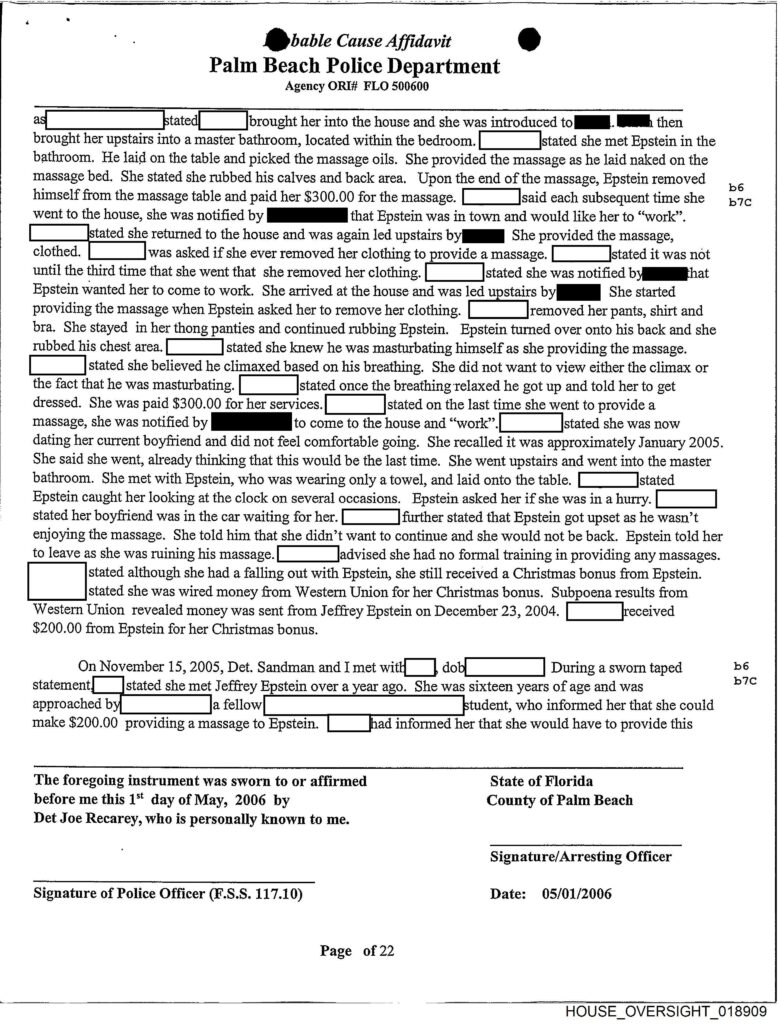
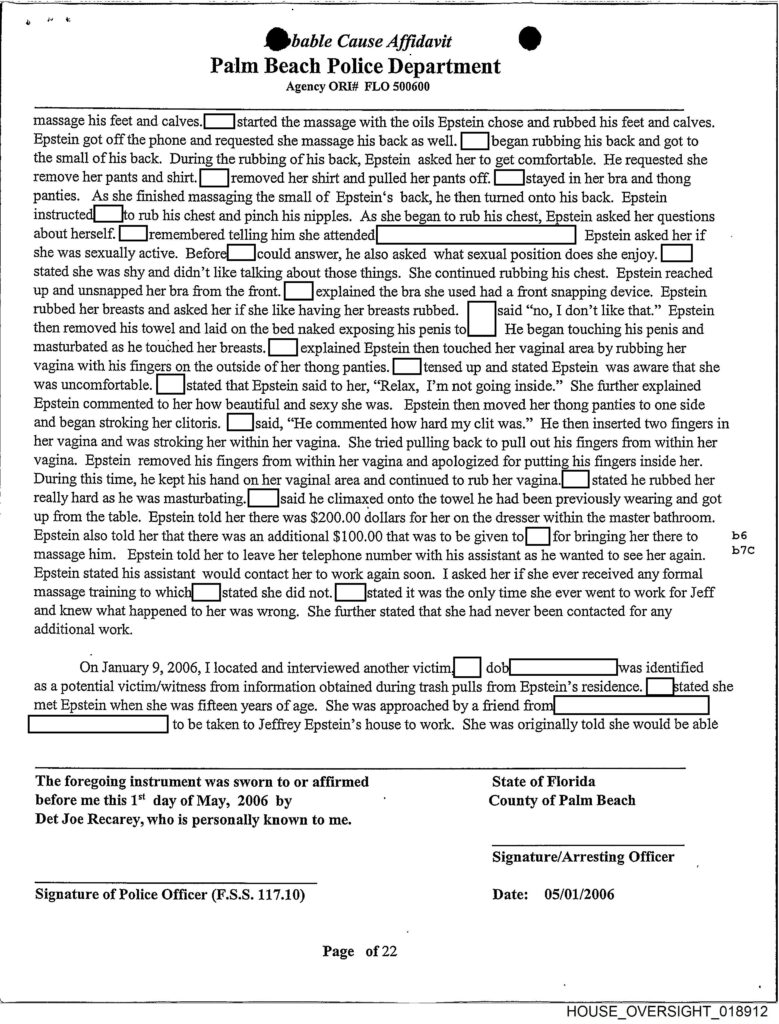
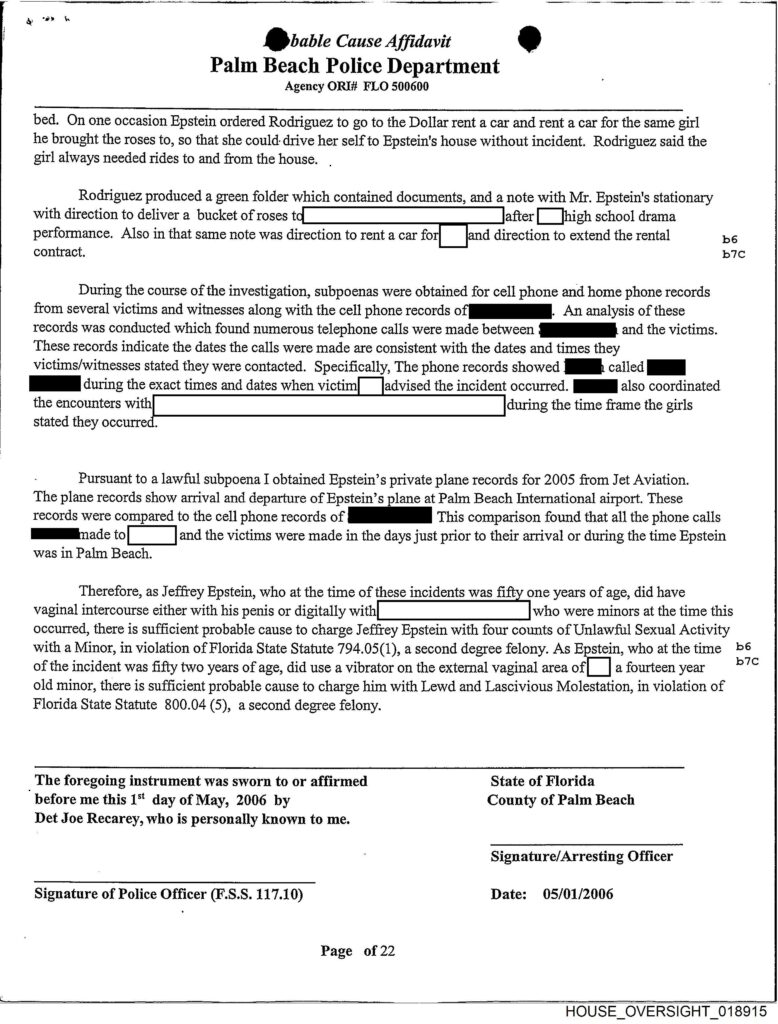
Palm Beach Police Probable Cause Affidavit, EFTA 018894 through 018915
Snapshot
Document type: Sworn probable cause affidavit
Agency: Palm Beach Police Department
Police case: 05-368 (1)
Affiant: Detective Joe Recarey
Date sworn: May 1, 2006
Defendant: Jeffrey Epstein
Length: 22 pages
House Oversight range: HOUSE_OVERSIGHT_018894 through HOUSE_OVERSIGHT_018915
Subject: The Palm Beach Police Department investigation of allegations that Jeffrey Epstein sexually abused minors at 358 El Brillo Way in Palm Beach, Florida
Charges supported by the affiant: Four counts of unlawful sexual activity with a minor under Florida Statute 794.05(1), and one count of lewd or lascivious molestation under Florida Statute 800.04(5)
Why it matters: This affidavit is a contemporaneous law enforcement account of the evidence Palm Beach police assembled before Epstein received a far narrower state resolution. It records survivor statements, recruitment accounts, controlled calls, physical evidence, staff testimony, telephone data, and aircraft records. It is evidence offered to establish probable cause. It is not a trial verdict and does not itself prove every allegation beyond a reasonable doubt.
Document Identification
HOUSE_OVERSIGHT_018894 through HOUSE_OVERSIGHT_018915 form one continuous 22 page affidavit headed “Probable Cause Affidavit” and attributed to the Palm Beach Police Department. The pages carry agency identifier FLO 500600 and police case number 05-368 (1). Each page includes the May 1, 2006 sworn statement block for Detective Joe Recarey.
The first page identifies Jeffrey Epstein as the defendant and lists the contemplated charges. The final page states Recarey’s conclusion that probable cause existed for four counts of unlawful sexual activity with a minor and one count of lewd or lascivious molestation.
The House Committee on Oversight and Government Reform released this material as part of an additional production received from Epstein’s estate. The committee announced on November 12, 2025 that it had released an additional 20,000 pages. The House release does not convert every statement in the production into a congressional finding. It identifies the provenance of the production, not the truth of every assertion within it.
Content Warning and Privacy Note
The affidavit describes alleged sexual abuse of minors, grooming, sexualized massages, penetration, intimidation, and recruitment for payment. This article summarizes those allegations without reproducing unnecessary graphic detail.
Names and identifying details redacted in the released pages remain redacted here. A damaged OCR layer may leave partial characters around blacked out text. Those fragments should not be used to reconstruct a survivor’s identity. The unredacted names of former employees Jose Alessi and Alfredo Rodriguez are retained because the affidavit openly identifies them as adult witnesses.
The affidavit sometimes uses language such as “victim,” “girl,” “masseuse,” and “work.” In this article, “survivor” is used where possible. Quotation marks around “work” reflect the affidavit’s description of coded terminology, not legitimate employment.
What Prompted the Investigation
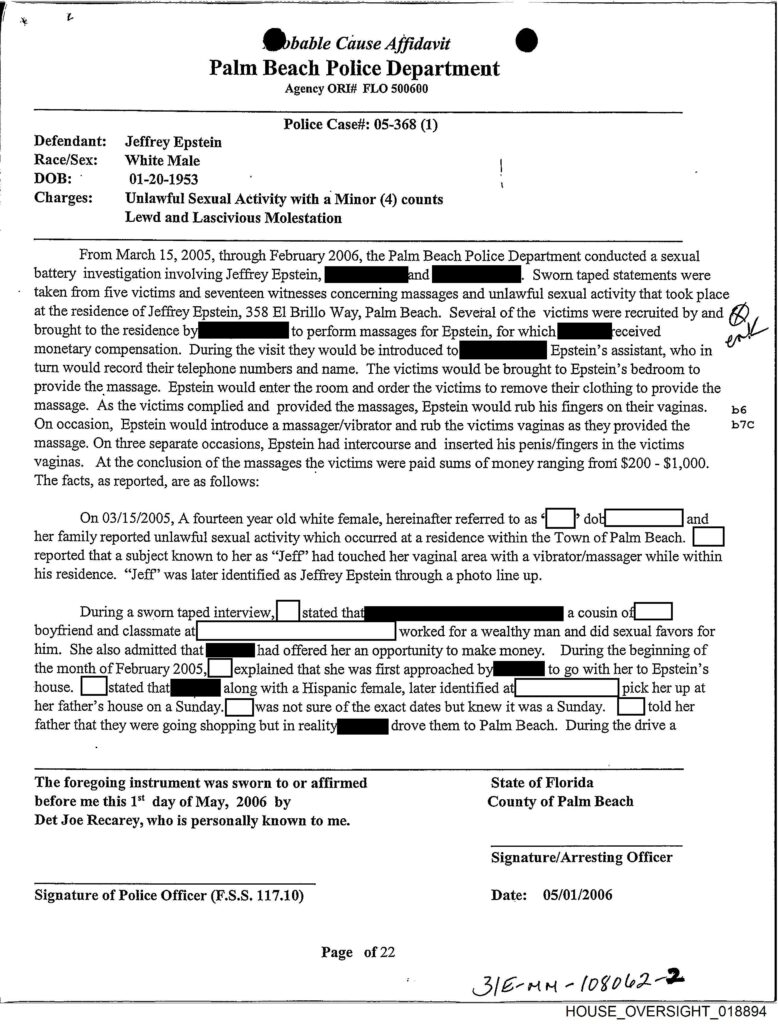
According to the first page, Palm Beach police investigated Epstein from March 15, 2005 through February 2006. The affidavit says officers took sworn recorded statements from five victims and seventeen witnesses concerning massages and alleged unlawful sexual activity at Epstein’s Palm Beach residence.
The investigation began after a fourteen year old survivor and her family reported an encounter at Epstein’s home. She alleged that a man she knew as “Jeff” touched her genital area with a vibrating massager. The affidavit says she later identified Jeffrey Epstein in a photographic lineup.
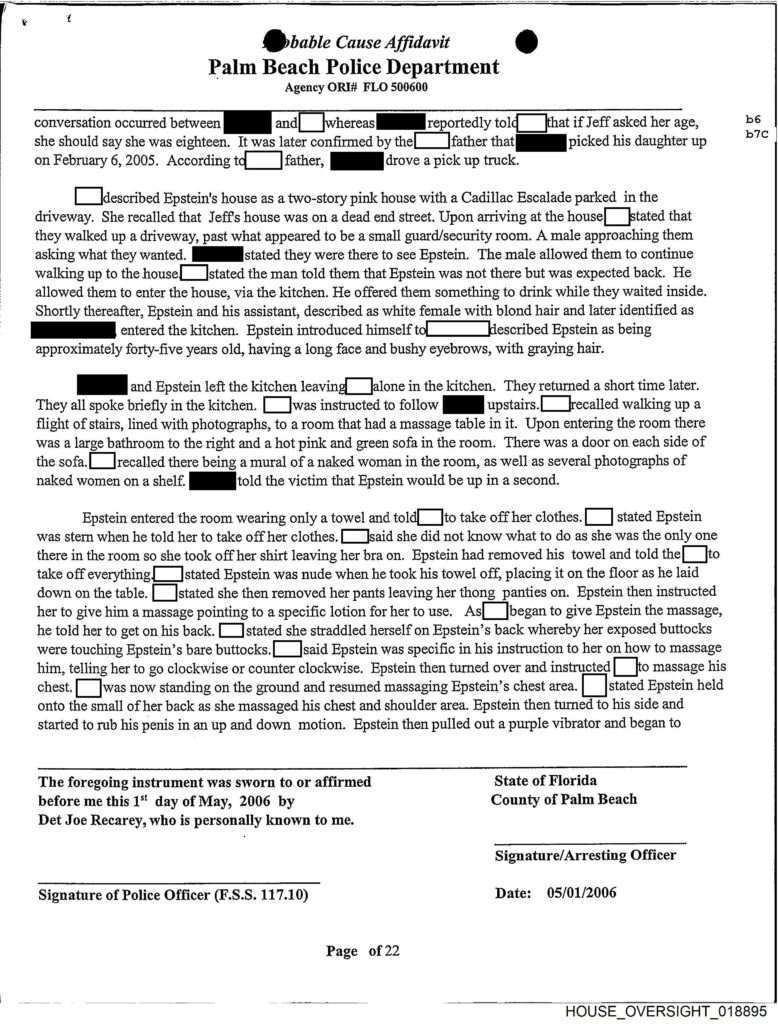
The opening pages describe how another young person allegedly recruited her with an offer to make money. During the drive to Epstein’s residence, the survivor was allegedly told to say she was eighteen if Epstein asked her age. At the house, she described being led from the kitchen to an upstairs room prepared with a massage table. She alleged that Epstein entered wearing a towel, directed her to remove clothing, exposed himself, and used the massager against her over her underwear. The affidavit says she was paid $300 and that the recruiter received $200.
These are allegations recorded by Detective Recarey from interviews and investigative activity. The affidavit does not reproduce the underlying audio recordings or the photographic lineup.
The Alleged Recruitment System
Across the 22 pages, the affidavit describes a recurring recruitment structure rather than isolated appointments.
- A young person who had already visited Epstein’s home approached a friend or classmate with an offer to earn money by giving a massage.
- A recruiter or assistant arranged the appointment when Epstein was in Palm Beach.
- The young person entered through the kitchen and was taken upstairs to Epstein’s bedroom or bathroom area.
- A massage table, oils, and other supplies were prepared before Epstein entered.
- Epstein allegedly pressed the young person to remove clothing and escalated the encounter into sexual contact while he masturbated.
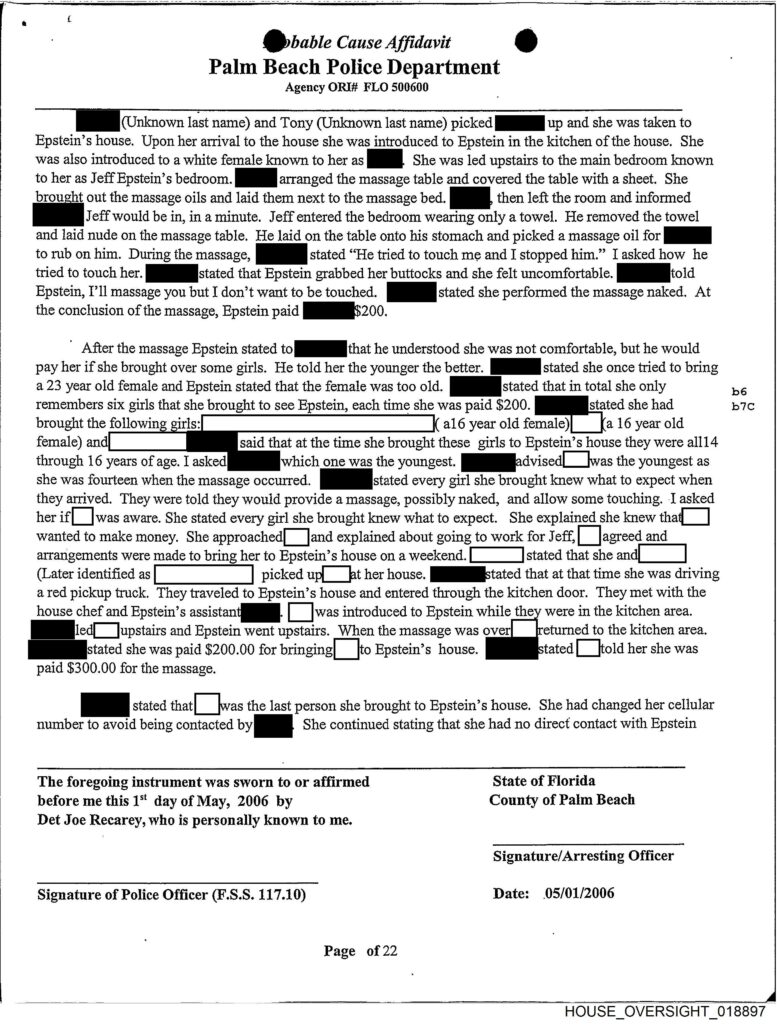
- The young person was paid, usually $200 or $300. A recruiter could receive an additional payment for bringing someone new.
- Contact information was collected for future appointments, and some survivors were offered more money for more sexual activity.
Several interviewees told police they had no massage training. The affidavit repeatedly says the young people were fourteen through seventeen when first taken to the house. Some described being told that Epstein would stop if they objected. Others described pressure, progressive escalation, fear, or conduct continuing after discomfort was apparent.
The payment and referral structure is important evidence of an alleged system. It does not erase the power imbalance between a wealthy adult and teenagers, and payment does not establish meaningful consent to unlawful sexual conduct involving minors.
Survivor Accounts
The affidavit summarizes multiple sworn, recorded interviews. Their accounts vary in frequency, detail, and alleged conduct, but the police narrative identifies recurring features: entry through the kitchen, an upstairs massage space, Epstein appearing in a towel, requests to remove clothing, sexual touching, masturbation, payment, and referral compensation.
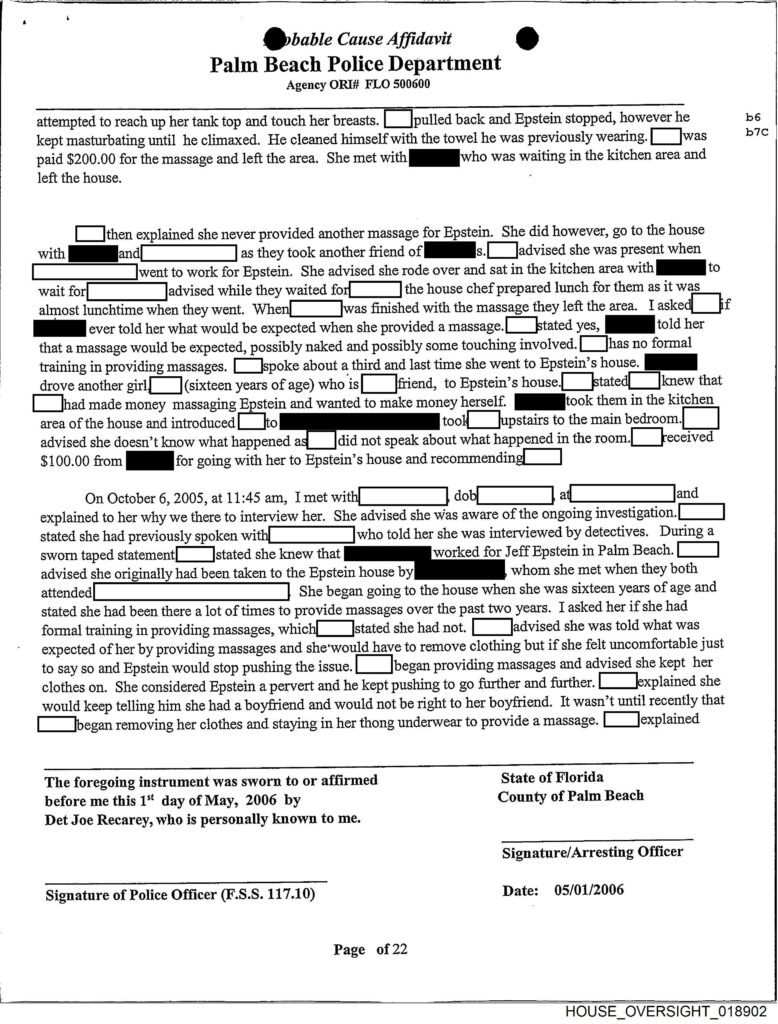
Some survivors described leaving or resisting when Epstein attempted to touch them. One described ending a first massage without payment, then returning later and receiving $200 after again refusing unwanted touching. Another said she visited repeatedly after first being recruited at sixteen and that Epstein attempted progressively more contact during later appointments.
The most serious allegations include digital penetration, penile penetration, and sexual activity involving another adult woman. One survivor alleged that Epstein forcibly penetrated her after she had made clear that penile penetration was outside what she would permit. Another said Epstein penetrated her during a massage when she was seventeen. Other survivors alleged that he inserted fingers into their vaginas, used a vibrating massager on them, touched their breasts or genitals, and masturbated during the encounters.
At least one survivor told police that Epstein warned her that bad things could happen if she disclosed what occurred. Another initially denied inappropriate conduct while her parents were present, then called police and said she had not been fully truthful because she did not want to discuss the incident in front of her mother. That sequence is significant because delayed or partial disclosure can reflect fear, shame, trauma, or lack of privacy. It should not automatically be treated as proof that the later account was false.
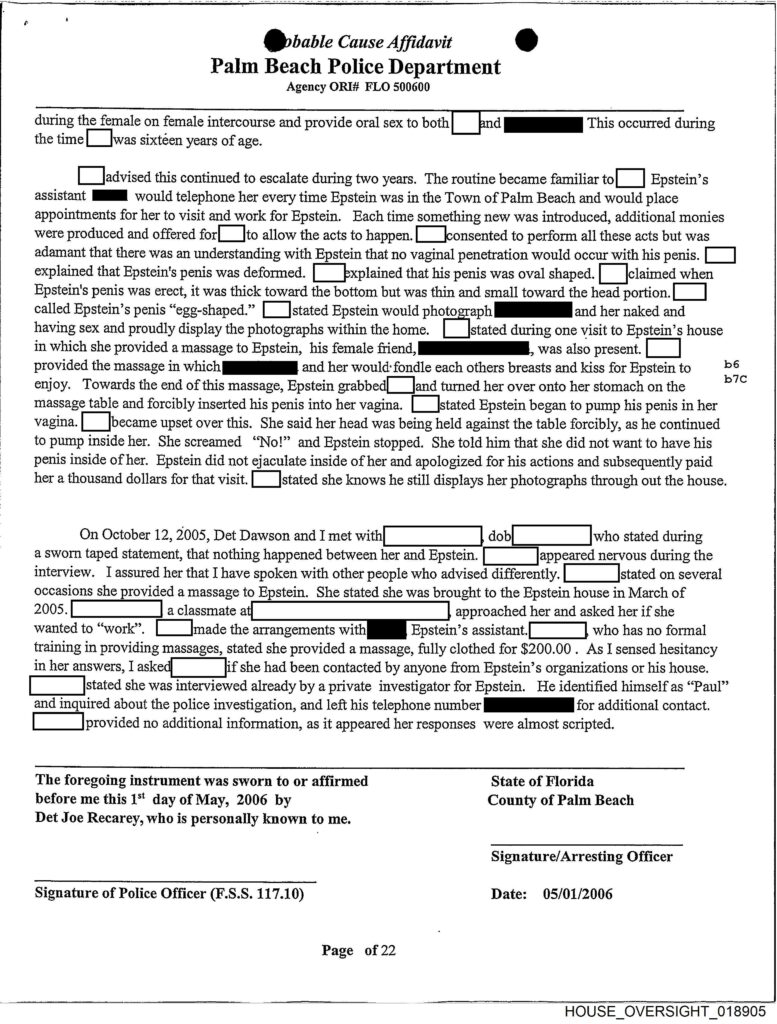
The affidavit also records an interview in which a young woman appeared nervous and provided limited information after having been approached by a private investigator connected to Epstein. Recarey wrote that her answers appeared almost scripted. That is the detective’s assessment, not an adjudicated finding about the witness or the investigator.
Controlled Calls, Voice Mail, and Trash Pulls
Police did not rely only on retrospective interviews. HOUSE_OVERSIGHT_018896 says investigators obtained parental consent for the fourteen year old survivor to assist with controlled, recorded telephone calls. During one call, a recruiter allegedly told her, “the more you do, the more you get paid.” The affidavit also says police preserved a voice mail setting an appointment for April 5, 2005 at 11:00 a.m.
Investigators then arranged trash pulls at Epstein’s residence. The affidavit says the April 5 trash contained a telephone message naming the expected visitors and the same 11:00 a.m. appointment time. Later trash pulls allegedly produced discarded papers bearing names and telephone numbers connected to potential witnesses.
This evidence matters because it could corroborate appointment logistics independently of a survivor’s memory. The pages do not include the recordings, message slip, chain of custody records, or laboratory authentication. Those materials would be needed for a complete evidentiary assessment.
Search Warrant Evidence
HOUSE_OVERSIGHT_018911 describes Detective Recarey’s observations during execution of a search warrant at 358 El Brillo Way.
Recarey wrote that he saw the pink and green couch and the upstairs layout described by interviewees. He reported photographs of nude young females along the stairway and throughout the residence, including images he believed depicted people already interviewed. He also described several massage tables, massage products, a wood armoire near Epstein’s bed, and telephone message books containing first names, dates, telephone numbers, appointment confirmations, and messages about bringing girls.
The affidavit says officers located two cameras concealed in clocks, one in the garage and another behind Epstein’s desk in the library. Recarey wrote that a computer believed to contain images from those cameras was reviewed and showed images of interviewees apparently captured by the camera behind the desk.
These observations can corroborate descriptions of the house and appointment process. The affidavit does not provide an inventory, photographs of the seized items, forensic extraction report, metadata, or proof that every depicted person was a minor. It also does not establish what happened in rooms outside a camera’s view.
Former Employee Statements
The affidavit identifies two former Epstein employees by name.
On November 21, 2005, former houseman Jose Alessi told police that he worked for Epstein from about 1993 through 2004. According to the affidavit, Alessi said Epstein received as many as three massages per day and that the visitors appeared younger toward the end of Alessi’s employment, sometimes no older than sixteen or seventeen. Alessi reportedly prepared massage tables and later cleaned sexual devices left in the bathroom or bedroom.
On January 4, 2006, former house manager Alfredo Rodriguez gave a sworn recorded statement. According to the affidavit, Rodriguez worked for Epstein from November 2004 through May 2005. He said girls arriving for massages appeared too young to be masseuses and that he understood some were high school students. He described preparing the house, admitting visitors through the kitchen, cleaning Epstein’s bedroom, and putting away sexual devices after appointments.
Rodriguez also produced a green folder containing documents. The affidavit says it included instructions on Epstein stationery concerning flowers for a high school drama performance and rental car arrangements for a young woman. The final page says Rodriguez described renting a car for the same person because she otherwise needed rides to Epstein’s house.
These are witness statements reported by the affiant. The pages do not contain the full interview recordings, the folder, the stationery note, employment records, or cross examination of either witness.
Telephone and Aircraft Records
The final page states that investigators subpoenaed cellular and home telephone records for several survivors and witnesses. Recarey wrote that the call patterns were consistent with dates and times the interviewees supplied and showed communications between people whose names remain redacted.
Recarey also wrote that police subpoenaed 2005 records for Epstein’s private aircraft from Jet Aviation. Investigators compared arrival and departure information at Palm Beach International Airport with telephone records. According to the affidavit, the calls arranging appointments occurred shortly before Epstein arrived or while he was in Palm Beach.
This is potentially strong corroborative evidence because it connects travel windows with appointment communications. The released pages provide Recarey’s conclusion but not the underlying call detail records, subscriber information, aircraft logs, comparison chart, or methodology. Readers should distinguish the affidavit’s summary from the primary datasets it summarizes.
Page by Page Guide
| Bates page | Principal content |
|---|---|
| 018894 | Case identification, contemplated charges, investigative period, initial fourteen year old survivor’s report, and photographic identification |
| 018895 | Arrival at El Brillo Way, description of the house, assistant, massage room, and beginning of alleged abuse account |
| 018896 | Completion of initial account, controlled calls, voice mail, April 5 trash pull, and opening of a recruiter interview |
| 018897 | Recruiter’s account of being paid for referrals and identifying teenagers taken to Epstein’s house |
| 018898 | Follow up on recruiter activity and interviews with teenage witnesses or survivors |
| 018899 | Accounts of massage appointments, calls concerning the police inquiry, and a survivor’s later private disclosure |
| 018900 | Resistance to unwanted touching and another survivor’s first appointment account |
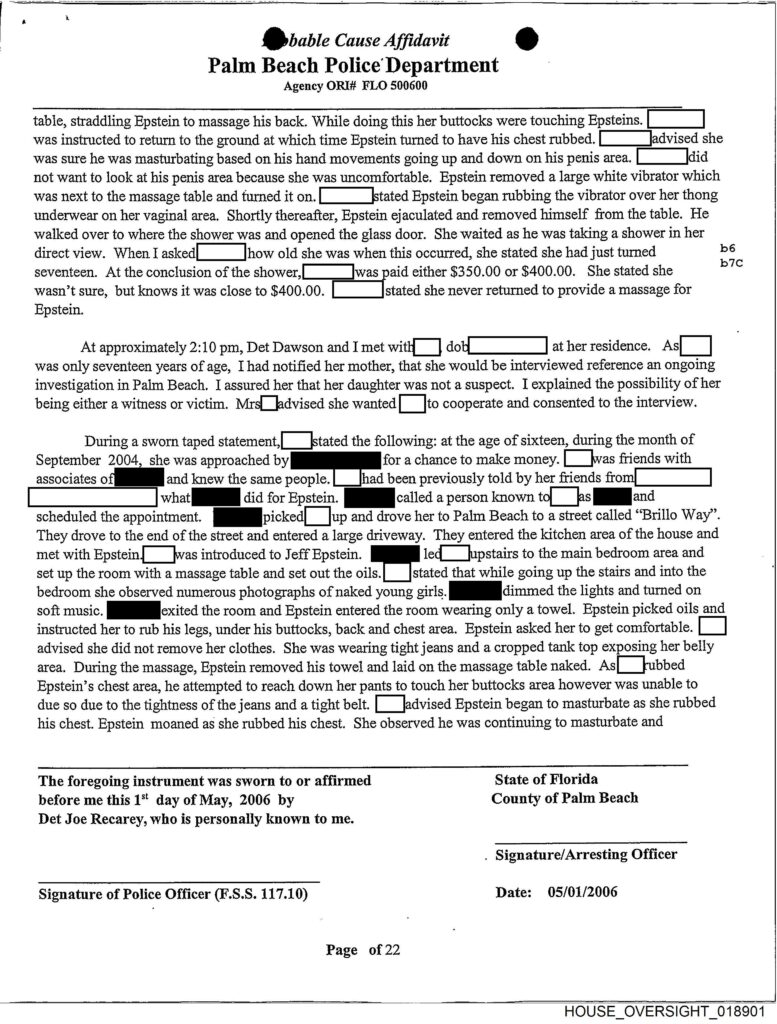
| 018901 | Alleged vibrator use, payment, and another sixteen year old survivor’s account |
| 018902 | Recruitment of friends, referral payment, repeated visits, and progressive escalation |
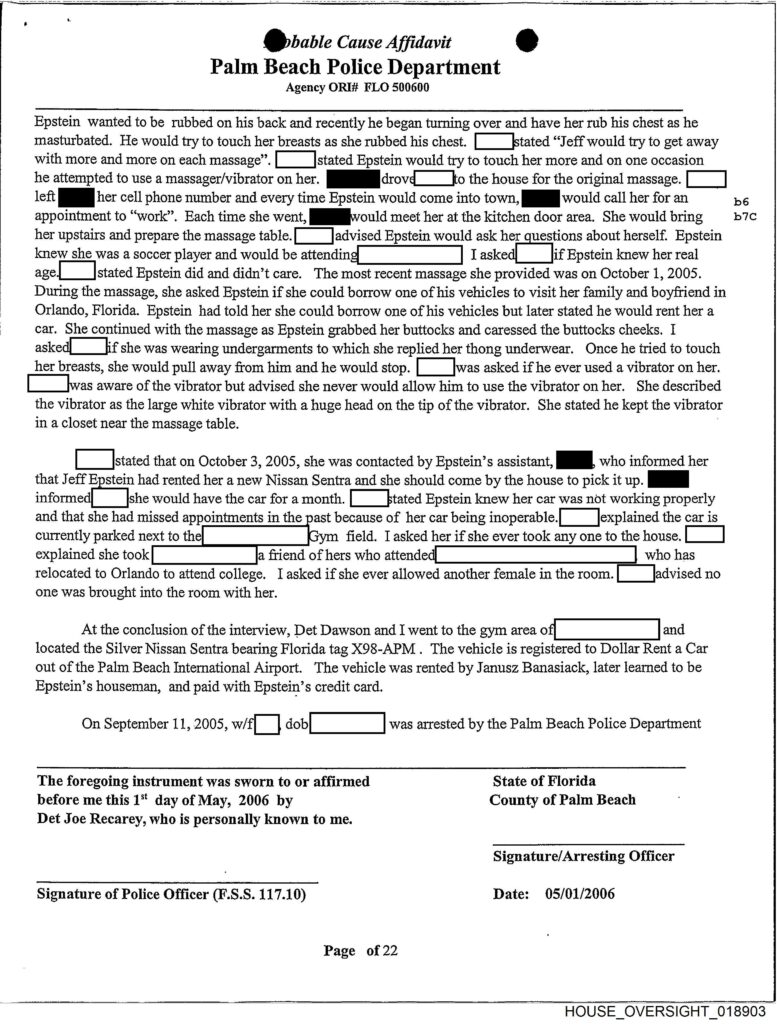
| 018903 | Repeated appointments, knowledge of age, rental car arrangement, and police verification of the vehicle |
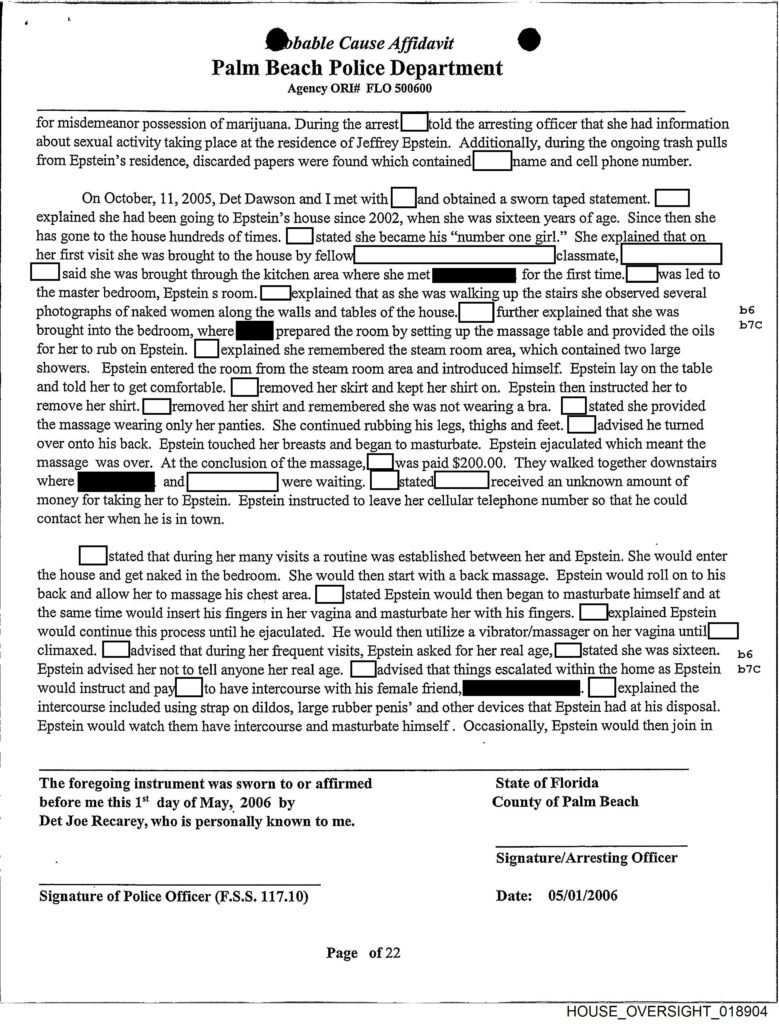
| 018904 | Survivor who reported hundreds of visits beginning at sixteen and described an established routine |
| 018905 | Alleged forced penetration, payments, photographs, and contact by a private investigator |
| 018906 | Adult witness or survivor account of an appointment, referral payment, and later recruitment call |
| 018907 | Witness account of transporting young people and another survivor’s repeated appointment history |
| 018908 | Referral payments, repeated visits, alleged intercourse at seventeen, and sexualized group conduct |
| 018909 | Repeated appointments beginning at sixteen, refusal to continue, and Western Union payment |
| 018910 | Two appointments, alleged masturbation and vibrator use, payment, and stated knowledge of high school status |
| 018911 | Search warrant observations, message books, hidden cameras, computer images, and another survivor interview |
| 018912 | Alleged digital penetration of a sixteen year old and identification of another potential survivor |
| 018913 | Alleged touching, threats, repeat appointment, and accounts from adult witnesses |
| 018914 | Statements from former employees Jose Alessi and Alfredo Rodriguez |
| 018915 | Rodriguez documents, telephone and aircraft record comparison, and Recarey’s probable cause conclusion |
Evidentiary Value
The affidavit’s principal value is cumulative corroboration. Individual accounts describe many of the same physical spaces, routines, objects, payments, and personnel. Police then reported evidence that could independently support parts of those accounts, including appointment messages, recorded calls, telephone records, aircraft records, search warrant observations, hidden cameras, computer images, and statements from former employees.
The document also preserves a near contemporaneous investigative timeline. Several interviews occurred in October and November 2005, close to the alleged conduct. The affidavit was sworn in May 2006, before later civil litigation, the federal non prosecution agreement, Epstein’s 2008 plea, and the extensive publicity after 2018.
It is also important institutional evidence. Recarey sought serious felony charges based on alleged conduct involving minors. The later state case did not mirror those recommendations. A Palm Beach County grand jury instead indicted Epstein in July 2006 for felony solicitation of prostitution. The federal Office of Professional Responsibility later reported that dissatisfied Palm Beach police officials referred the matter to the FBI because they believed the state charge did not address the totality of Epstein’s conduct.
Evidentiary Limits
This document is an affidavit written to establish probable cause. It presents the investigation through the affiant’s selection and interpretation of evidence. Probable cause is a lower legal threshold than proof beyond a reasonable doubt.
The released range does not contain:
- Complete audio or transcripts of every survivor and witness interview.
- The controlled call recordings or complete voice mail recording.
- Search warrant applications, return, inventory, photographs, or chain of custody documentation.
- Forensic reports for the computer or concealed camera images.
- The complete telephone records, aircraft records, or comparison analysis.
- The green folder and stationery note Rodriguez reportedly produced.
- Defense responses, cross examination, suppression litigation, or a judicial finding adopting every allegation.
- A complete explanation of all redactions.
The OCR is visibly imperfect. It misreads letters, drops redacted names, and sometimes merges surrounding words. Quotations and precise factual claims should be checked against the page images.
Survivor Centered Reading
The affidavit records teenagers navigating pressure from an older, wealthy man, recruiters, staff, money, secrecy, and fear. Some needed money. Some returned. Some referred friends. Some initially withheld information. None of those circumstances makes unlawful sexual activity with a minor lawful, and none supplies a simple measure of consent or credibility.
The document also shows how an alleged referral system can entangle survivors. A young person may be harmed and then encouraged or paid to bring someone else into the same environment. That dual position should be described carefully. It does not justify erasing harm suffered by the recruiter, nor does it erase harm experienced by those recruited.
Public analysis should focus on conduct, corroboration, institutional response, and evidentiary limits. It should not attempt to identify redacted survivors or circulate unnecessary sexual detail.
What the Record Establishes
The released pages establish that:
- Detective Joe Recarey swore a 22 page probable cause affidavit on May 1, 2006 in Palm Beach Police case 05-368 (1).
- The affidavit identifies Epstein as the defendant and states that police investigated allegations of sexual activity involving minors at 358 El Brillo Way.
- Recarey reported multiple sworn, recorded survivor and witness interviews.
- Recarey reported controlled calls, a recorded voice mail, trash pulls, a search warrant, telephone subpoenas, and aircraft record analysis.
- Recarey reported that former employees Jose Alessi and Alfredo Rodriguez gave statements concerning young visitors, massages, and conditions inside the residence.
- Recarey concluded that probable cause supported four counts under Florida Statute 794.05(1) and one count under Florida Statute 800.04(5).
- The House Oversight Committee later released the pages as part of a document production received from Epstein’s estate.
What the Record Does Not Establish
The released pages do not establish that:
- Every allegation was tested at trial or proved beyond a reasonable doubt.
- Every person who visited Epstein’s residence knew about or participated in criminal conduct.
- Every photograph described by Recarey depicted a minor or unlawful activity.
- Every redacted person was a suspect, accomplice, survivor, or witness of the same type.
- The affidavit’s recommended charges were the charges ultimately returned by the grand jury or resolved by Epstein’s 2008 plea.
- The House Committee independently verified or adopted every assertion in the affidavit.
- OCR fragments accurately reveal text hidden by official redactions.
Fact Check
Claim: The range is a 22 page Palm Beach Police probable cause affidavit
Verified. The pages are sequentially stamped HOUSE_OVERSIGHT_018894 through HOUSE_OVERSIGHT_018915, carry the same case and agency identifiers, and contain a repeated sworn statement block. The first and last pages identify the purpose and conclusion.
Claim: Detective Joe Recarey swore the affidavit on May 1, 2006
Verified. The jurat on each page states that the instrument was sworn or affirmed on May 1, 2006 by Detective Joe Recarey.
Claim: Police sought four unlawful sexual activity counts and one lewd or lascivious molestation count
Verified as the affiant’s conclusion. The first page lists those charges, and HOUSE_OVERSIGHT_018915 states the statutory basis for Recarey’s probable cause conclusion. This is not the same as a conviction on those counts.
Claim: The investigation began with a report involving a fourteen year old
Verified. The affidavit says a fourteen year old and her family reported the incident on March 15, 2005. The Department of Justice Office of Professional Responsibility later summarized the same origin of the Palm Beach investigation.
Claim: The affidavit relies only on survivor testimony
False. It also reports controlled calls, voice mail, trash pulls, search warrant observations, telephone message books, hidden cameras, computer images, former employee statements, telephone data, and aircraft records.
Claim: The affidavit itself proves every allegation beyond a reasonable doubt
False. It is a probable cause submission. The released range omits much of the underlying evidence and any adversarial testing.
Claim: The House release is a congressional finding that every statement is true
False. The House release identifies the documents as material received from Epstein’s estate. Publication is not adoption of every statement within the files.
Questions Still Unanswered
- Where are the complete audio recordings and transcripts for each sworn interview summarized in the affidavit?
- Are the controlled calls, voice mail, and April 5, 2005 message slip publicly available in an authenticated form?
- What was seized under the search warrant, and what do the return and chain of custody records show?
- What did forensic examination of the computers and concealed cameras establish?
- Do the complete telephone and aircraft records support every comparison described on the final page?
- Where is the green folder and Epstein stationery note reportedly produced by Alfredo Rodriguez?
- Which recommended counts were presented to the Palm Beach County grand jury, and why did the resulting indictment differ so sharply?
- Which people were covered by the redactions, and were all privacy redactions applied consistently without exposing survivors?
- Were allegations of witness pressure or contacts by private investigators separately investigated?
- What additional evidence did the later FBI investigation develop from the local police referral?
Related EpsteinWiki Pages
- Jeffrey Epstein Palm Beach Police Investigation
- Palm Beach County Grand Jury Proceedings
- United States v. Epstein, Southern District of New York, 2019
- Jane Doe v. United States
- Jeffrey Epstein Non Prosecution Agreement
- House Oversight Committee Epstein Records
- Exhibits Index
- Deposition Transcript Index
- Ghislaine Maxwell Criminal Trial
- Jose Alessi
- Alfredo Rodriguez
- Survivor Interview and Testimony Standards
Source List
- HOUSE_OVERSIGHT_018894, affidavit opening and initial report
- HOUSE_OVERSIGHT_018895, house and massage room description
- HOUSE_OVERSIGHT_018896, controlled call and trash pull
- HOUSE_OVERSIGHT_018897, referral payment account
- HOUSE_OVERSIGHT_018898
- HOUSE_OVERSIGHT_018899
- HOUSE_OVERSIGHT_018900
- HOUSE_OVERSIGHT_018901
- HOUSE_OVERSIGHT_018902
- HOUSE_OVERSIGHT_018903, rental car information
- HOUSE_OVERSIGHT_018904
- HOUSE_OVERSIGHT_018905, alleged forced penetration and private investigator contact
- HOUSE_OVERSIGHT_018906
- HOUSE_OVERSIGHT_018907
- HOUSE_OVERSIGHT_018908
- HOUSE_OVERSIGHT_018909, Western Union payment
- HOUSE_OVERSIGHT_018910
- HOUSE_OVERSIGHT_018911, search warrant observations
- HOUSE_OVERSIGHT_018912
- HOUSE_OVERSIGHT_018913
- HOUSE_OVERSIGHT_018914, Alessi and Rodriguez statements
- HOUSE_OVERSIGHT_018915, telephone and aircraft records and probable cause conclusion
- House Oversight Committee release of additional Epstein estate documents
- Department of Justice Office of Professional Responsibility executive summary on the 2006 through 2008 federal investigation