
Wayne Owens
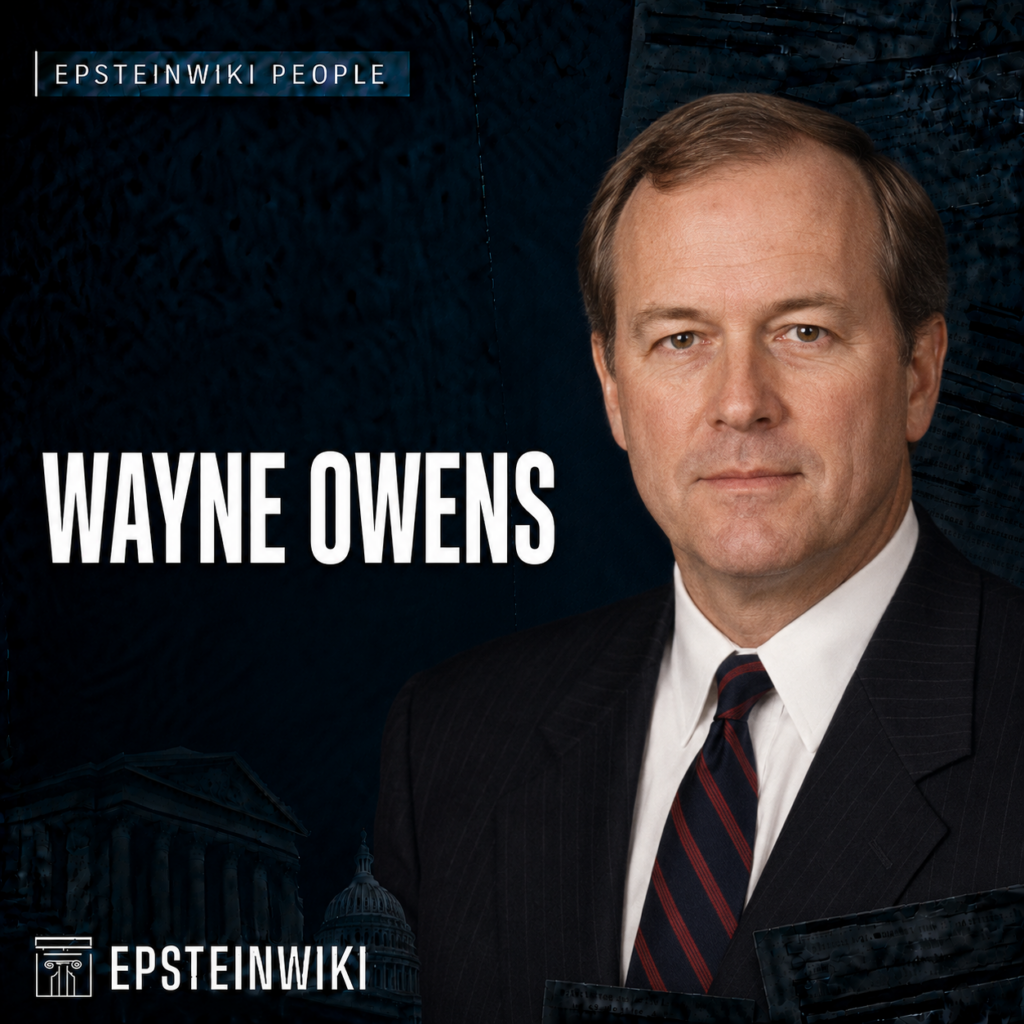
Snapshot
Douglas Wayne Owens was a Democratic member of the United States House of Representatives from Utah, an attorney, a member of the Church of Jesus Christ of Latter day Saints, and an advocate for Middle East peace.
Owens represented Utah’s Second Congressional District from 1973 to 1975 and again from 1987 to 1993. He served on the House Foreign Affairs Committee and helped establish the Center for Middle East Peace and Economic Cooperation with businessman S. Daniel Abraham.
The documented relationship between Owens and Jeffrey Epstein dates principally to 1989 and 1990.
In 1989, Epstein accompanied Owens on a Middle East trip intended to explore business cooperation between Israel and neighboring Arab countries. Later reporting based on interviews with trip participants states that Epstein attended meetings involving Benjamin Netanyahu, Shimon Peres, and Saudi Crown Prince Abdullah bin Abdulaziz Al Saud.
Campaign finance research also shows that Epstein made two one thousand dollar contributions to Owens in 1990.
A separate 2009 email records Epstein claiming that he had participated in political discussions concerning federal funding for cold fusion research associated with University of Utah scientists Stanley Pons and Martin Fleischmann. Epstein named Owens, incorrectly called him a senator, and claimed that he had argued against the funding.
Owens actually supported federal cold fusion research. Contemporary reporting and congressional history document his efforts to secure funding and arrange testimony before Congress. Epstein’s message is therefore evidence of what Epstein claimed twenty years later. It does not independently prove that he controlled the funding decision or defeated Owens’s proposal.
The public record does not establish that Owens participated in Epstein’s sexual abuse, knew about it, or helped conceal it. The documented contact occurred long before Epstein’s first known criminal investigation became public.
Owens died in Tel Aviv in December 2002 while conducting Middle East peace work.
Identity and Congressional Career
Douglas Wayne Owens was born in Panguitch, Utah, on May 2, 1937.
According to the official United States House biography, Owens attended the University of Utah and received his law degree from the university in 1964. He practiced law and worked in Democratic politics before winning election to Congress.
Owens served one term in the House from January 1973 until January 1975. He was a member of the House Judiciary Committee during the investigation that produced articles of impeachment against President Richard Nixon.
Rather than seeking reelection to the House in 1974, Owens ran unsuccessfully for the United States Senate.
He later served as president of the Montreal mission of the Church of Jesus Christ of Latter day Saints. Owens returned to electoral politics and unsuccessfully ran for governor of Utah in 1984.
He won his former House seat again in 1986 and served three additional terms from January 1987 until January 1993. He made another unsuccessful Senate bid in 1992.
Owens’s congressional work included environmental protection, compensation for people exposed to radioactive fallout, international affairs, and Middle East diplomacy.
The Wayne Owens archival collection at the University of Utah documents his campaigns, congressional service, environmental work, and sustained interest in the Middle East peace process.
The Radiation Exposure Compensation Act
One of Owens’s most consequential legislative achievements was his work on behalf of people exposed to radiation from nuclear testing.
Owens introduced House Resolution 2372 in May 1989. The legislation became the Radiation Exposure Compensation Act of 1990.
The law created a federal compensation system for certain uranium workers, participants in atmospheric nuclear tests, and residents affected by radioactive fallout from testing at the Nevada Test Site.
Owens worked with members of both parties, including Utah Senator Orrin Hatch, to advance the legislation.
This history is separate from the cold fusion controversy. Both subjects concerned nuclear science and federal policy, but they involved different legislation, institutions, and public health questions.
The distinction matters because references to Owens, Utah, radiation, fusion, and congressional funding can otherwise be mistakenly combined into a single episode.
Middle East Peace Work
Owens became deeply involved in Middle East diplomacy during his second period in Congress.
He served on the House Foreign Affairs Committee and participated in meetings and travel involving Israeli and Arab officials. He believed that economic cooperation, water development, private investment, and sustained personal communication could support a political peace process.
In 1989, Owens and Slim Fast founder S. Daniel Abraham established the Center for Middle East Peace and Economic Cooperation.
The organization arranged fact finding visits, meetings with regional leaders, policy discussions, and economic development projects. Its work connected members of Congress, government officials, private citizens, business leaders, and political figures from Israel and Arab countries.
The University of Utah’s Wayne Owens photograph collection states that Owens helped establish the center in 1989 and served as its representative in Israel.
A State Department tribute to Shimon Peres delivered by Secretary of State Madeleine Albright in 2000 recognized Owens, Abraham, Stanley Urman, Sarah Ehrman, and the center for their peace work.
This diplomatic and economic network provides the context in which Epstein entered Owens’s orbit.
The 1989 Middle East Trip
The strongest evidence of direct contact is a 1989 Middle East trip involving Owens and Epstein.
A major New York Times investigation into Epstein’s financial rise reported that Epstein accompanied Owens on a trip intended to explore ways of strengthening business ties between Israel and its neighbors.
Epstein was reportedly included as a financial specialist.
The trip took place during an important period in Epstein’s career. He had left Bear Stearns, promoted himself as a consultant capable of recovering hidden assets, worked with figures including Steven Hoffenberg, and established a relationship with retail executive Leslie Wexner.
Participation in Owens’s trip offered Epstein something beyond an ordinary business meeting. It gave him access to elected officials, diplomatic discussions, Middle East leaders, and a setting in which he could present himself as an international finance expert.
The trip occurred approximately sixteen years before the Palm Beach police investigation that first made Epstein’s abuse publicly known.
Meetings with Regional Leaders
The New York Times based part of its account on interviews with people who participated in the trip.
Screenwriter Dan Gordon reportedly recalled Epstein attending meetings involving Benjamin Netanyahu, Shimon Peres, and Saudi Crown Prince Abdullah bin Abdulaziz Al Saud.
In 1989, Netanyahu served in Israel’s Foreign Ministry. Peres was a senior member of the Israeli government. Abdullah was the Saudi crown prince and later became king.
The meetings are important because they place Epstein in high level political settings at a relatively early point in his rise.
They do not establish that Epstein developed independent relationships with every leader present. Participation in a group meeting is different from a private diplomatic relationship.
The surviving reporting also does not show that Owens knew Epstein would later invoke these encounters when cultivating his own reputation.
How Participants Remembered Epstein
The recollections published by the New York Times were not uniformly favorable to Epstein.
Dan Gordon said that Epstein appeared improperly dressed for meetings with senior leaders. Gordon recalled warning Owens that Epstein’s appearance communicated disrespect.
Michael Yeager, an Owens aide, remembered Epstein describing dramatic efforts to locate hidden assets and emphasizing his relationship with Leslie Wexner.
Participants reportedly regarded Epstein as bored or out of his depth in parts of the mission.
These recollections complicate the idea that Epstein was already universally accepted as a brilliant international financier. They suggest that he had obtained access to an important delegation while some of the people around him remained doubtful about his judgment or expertise.
The accounts were collected decades after the trip. They are valuable witness recollections, but they should still be distinguished from contemporaneous transcripts or recordings.
Epstein’s Connection to Leslie Wexner
Epstein’s relationship with Leslie Wexner formed an important part of the image he presented during the Owens trip.
By 1989, Epstein was associating himself with Wexner and using that relationship to establish financial credibility.
Michael Yeager’s recollection that Epstein emphasized his Wexner connection fits a wider pattern documented in reporting about Epstein’s business career. Epstein repeatedly invoked wealthy clients, prominent acquaintances, and exclusive access as evidence of his authority.
The 2003 Vanity Fair profile The Talented Mr. Epstein examined how Epstein used his association with Wexner while cultivating a reputation as a financier serving extremely wealthy clients.
The evidence does not establish that Wexner directed Epstein to join Owens’s trip. It does show that Epstein considered his connection to Wexner useful when presenting himself to political and business figures.
The 1990 Campaign Contributions
Epstein made political contributions to Owens after the Middle East trip.
A Business Insider review of campaign finance records reported that Epstein gave Owens a total of two thousand dollars in 1990.
The total consisted of two contributions of one thousand dollars each.
The contributions are significant because they provide a second documented connection between the men. The relationship was not limited to Epstein’s name appearing on a trip itinerary. Epstein also financially supported Owens’s campaign.
The amount must be evaluated in the context of federal contribution limits at the time. Two one thousand dollar contributions could represent separate primary and general election donations.
A contribution establishes political financial support. It does not establish that the recipient performed a favor for the donor or knew about criminal conduct that had not yet become public.
No evidence reviewed for this article shows that the Owens campaign returned the contributions. Owens died years before Epstein’s 2008 conviction.
Cold Fusion at the University of Utah
In March 1989, University of Utah electrochemist Stanley Pons and British chemist Martin Fleischmann announced that they had produced nuclear fusion at or near room temperature.
The claim generated worldwide interest because successful cold fusion could have transformed energy production.
Scientists struggled to reproduce the reported results. Questions emerged about experimental methods, measurements, theoretical explanations, disclosure practices, and the University of Utah’s handling of the announcement.
The controversy quickly moved from laboratories into politics.
The University of Utah and the state of Utah sought federal support for additional research. Owens became one of the leading congressional advocates for that funding.
This made him a natural target for later discussion whenever Epstein described his own alleged participation in the cold fusion debate.
Owens Supported Cold Fusion Funding
Contemporary evidence establishes that Owens supported continued research.
An October 1989 Deseret News report described Owens trying to build congressional support for cold fusion funding.
Owens also helped arrange the April 26, 1989, appearance of Pons, Fleischmann, University of Utah president Chase Peterson, and consultant Ira Magaziner before the House Committee on Science, Space, and Technology.
A later New Yorker history of the cold fusion controversy states that Owens took credit for arranging the hearing.
Owens supported proposals for federal research assistance and promoted the idea of a national fusion research center at the University of Utah.
The Department of Energy ultimately conducted its own review. Its 1989 assessment found that the evidence did not justify a major special federal program for cold fusion, although it did not prohibit carefully reviewed research proposals.
The scientific review process is important context. Federal skepticism did not depend solely on lobbying by a single private person.
Epstein’s 2009 Cold Fusion Claim
On October 1, 2009, Epstein exchanged emails with Al Seckel concerning cold fusion.
The thread is preserved in EFTA02437604 and in the official Justice Department copy of EFTA02437604.
Epstein claimed that he had helped end Stanley Pons’s influence. In explaining himself, he referred to federal funding, named Wayne Owens of Utah, incorrectly identified Owens as a senator, and said that he had been present and had argued against the proposal.
He also referred to a meeting with the head of the Mormon Church.
The message is poorly punctuated and contains several typographical errors. Its grammar leaves room for disagreement over who met the church leader and exactly how the events were connected.
The document establishes that Epstein made the claim in 2009.
It does not establish that his description was accurate.
Owens Was a Representative, Not a Senator
Epstein called Owens a senator in the 2009 email.
Owens never served in the United States Senate.
He served four terms in the House and twice ran unsuccessfully for a Senate seat.
This error is significant because it shows that Epstein’s account was not a precise contemporaneous record. He was recalling events approximately twenty years later and misstated Owens’s office.
The error does not prove that the entire account was fabricated. It does require caution when using the email to reconstruct exact meetings, participants, dates, or legislative procedures.
The Church Leadership Reference
Epstein’s message also referred to meeting, or having to meet, the head of the Mormon Church.
Owens was a prominent member of the Church of Jesus Christ of Latter day Saints and had served as a mission president. The University of Utah cold fusion project also attracted broad attention within Utah’s political, academic, and religious communities.
The email does not name the church leader.
Some online commentary has attempted to identify the individual as Ezra Taft Benson, Gordon B. Hinckley, or Thomas S. Monson. The document itself does not support a definitive identification.
The chronology also creates problems for some of those claims. Different men held the office of church president or other senior leadership positions at different points in the relevant period.
A responsible account should therefore state only that Epstein referred to a church leadership meeting. It should not convert that vague statement into a verified meeting with a named church president.
The email also does not establish that the Church of Jesus Christ of Latter day Saints determined federal cold fusion policy.
Did Epstein Defeat the Funding?
The presently available evidence does not prove that Epstein personally defeated the proposed funding.
Epstein’s claim conflicts with several features of the historical record.
Owens continued publicly advocating for cold fusion research after the period in which Epstein supposedly intervened. Members of Congress arranged hearings, discussed research appropriations, and considered proposals for a national center.
Scientific institutions also evaluated the Pons and Fleischmann claims. Failed replication attempts and the negative Department of Energy review were central to the decline in federal enthusiasm.
There is no public congressional vote, agency finding, or official decision reviewed for this article that identifies Epstein as the person responsible for stopping the funding.
Epstein had a documented habit of exaggerating his expertise, influence, wealth, clients, and access. His statement may describe genuine lobbying activity, an inflated version of a smaller encounter, or an invented claim designed to impress Seckel.
The email cannot resolve those possibilities by itself.
The Timing of the Two Episodes
The Middle East trip and the cold fusion debate both occurred in 1989.
That chronological overlap raises a legitimate investigative question: did Epstein meet Owens through the Middle East mission and then participate in discussions about the University of Utah funding proposal?
The existing evidence makes that possibility plausible but does not establish the sequence.
The trip is supported by reporting based on participant interviews. The campaign contributions followed in 1990. Epstein’s cold fusion description did not appear until a private email written in 2009.
No presently identified Owens diary entry, staff memorandum, meeting calendar, hearing record, or correspondence has been produced that independently confirms Epstein lobbying Owens against cold fusion.
Owens’s papers at the University of Utah could contain further evidence. Until those records are reviewed at the document level, the precise sequence should remain an open research question.
Political Access and Network Building
Owens appears at an important stage in Epstein’s development as a political networker.
The 1989 trip allowed Epstein to appear beside a member of Congress and to enter meetings with senior Israeli and Saudi figures.
The 1990 donations demonstrated that Epstein was willing to convert access into conventional political support.
The cold fusion email, even if exaggerated, shows how Epstein later represented the relationship. He portrayed himself as someone who could enter congressional and religious leadership discussions about a major scientific controversy.
This pattern recurred throughout Epstein’s life. He cultivated politicians, diplomats, scientists, university leaders, billionaires, and public intellectuals. He then used those contacts to obtain further introductions and reinforce his reputation.
Owens may therefore be important less because of one isolated event than because the relationship shows Epstein learning how political, financial, scientific, and diplomatic access could reinforce one another.
The Center for Middle East Peace Network
Owens’s peace center brought together political figures, regional leaders, business executives, donors, and policy specialists.
The center’s model emphasized private dialogue and economic cooperation. It organized travel and allowed participants to meet officials they might not otherwise encounter.
That structure helps explain why someone presented as a finance expert could join an Owens mission even without holding government office.
S. Daniel Abraham’s involvement also connected the center to a substantial private fortune and a wider philanthropic network.
The documentary record reviewed for this article does not establish that Epstein became an officer, employee, major donor, or formal adviser to the center.
It also does not establish that the center knew about or assisted Epstein’s later criminal conduct.
The 1989 trip should therefore be treated as documented access through Owens’s diplomatic work, not as proof that Epstein controlled the organization.
Owens’s Death in Israel
Owens died on December 18, 2002, while visiting Israel.
The official State Department statement on his death described him as a distinguished former congressman committed to Middle East peace.
According to a detailed Deseret News account, Owens had just completed an intensive trip through Israel, the Palestinian territories, Saudi Arabia, Oman, Qatar, Egypt, Jordan, Lebanon, and Syria.
He suffered an apparent heart attack while walking along a beach in Tel Aviv.
Owens was sixty five years old.
Public obituaries, statements from his family, and accounts from colleagues described the death as a heart attack. No credible public evidence reviewed for this article establishes that Epstein or any intelligence organization caused his death.
Owens died before the 2005 Palm Beach investigation of Epstein became public. He therefore never had an opportunity to answer later questions about Epstein’s conduct, the 1989 trip, the campaign contributions, or the 2009 cold fusion claim.
Early Reporting About the Owens Connection
Vicky Ward’s 2003 Vanity Fair profile of Epstein was an important early examination of Epstein’s financial claims and relationship with Leslie Wexner.
Later investigations returned to Epstein’s early international activity.
The New York Times supplied the most detailed public account of the Owens trip by interviewing Dan Gordon, Michael Yeager, and other people familiar with Epstein’s early career.
Independent researchers then connected that reporting with campaign contributions, Owens’s Middle East work, and the newly released cold fusion email.
The sources are not all equivalent.
Participant recollections provide witness evidence. Campaign finance records document monetary contributions. The 2009 email documents Epstein’s own claim. Contemporary cold fusion reporting establishes Owens’s public position. Sleuth articles provide synthesis and investigative theories.
Those categories should remain separate.
American Freakshow’s State Department Investigation
Nina Burleigh and Katie Chenoweth examined Epstein’s early government access in the American Freakshow investigation Jeff at State.
The article places the Owens trip within a broader pattern that includes Epstein’s later dealings with the State Department, his lease of a Manhattan property controlled by the United States government, and his cultivation of foreign policy figures.
Burleigh and Chenoweth argue that Epstein had meaningful contact with government and diplomatic institutions years before his better known relationships of the 1990s and 2000s.
Their investigation is valuable because it treats the Owens trip as part of a developing access network rather than an isolated anecdote.
Some document links circulated with reporting about the trip have been described inconsistently by public databases. Researchers should verify the content and page number of each cited record before describing it as an official trip report.
The underlying fact of Epstein’s participation is separately supported by the New York Times reporting and participant recollections.
The Epstein Class and the 2003 Profile
The Epstein Class revisited the Owens material in The Talented Mr. Epstein.
The article and accompanying discussion direct attention to Epstein’s travel with Owens and the importance of Israel in Epstein’s early network building.
This sleuth work is useful because the Owens trip can be overlooked when researchers begin with Epstein’s later contacts with Ehud Barak, Shimon Peres, Bill Clinton, or the Council on Foreign Relations.
The Epstein Class analysis should be read together with the original Vanity Fair profile, the later New York Times investigation, and the primary campaign finance evidence.
Its conclusions about the wider meaning of Epstein’s Israeli relationships remain investigative interpretation rather than a court finding.
The Sayer Ji Cold Fusion Investigation
Sayer Ji examined the released email in I Killed Pons Years Ago.
The article identifies several verifiable elements:
- Epstein discussed Stanley Pons and cold fusion with Al Seckel.
- Epstein named Wayne Owens.
- Epstein claimed that he had argued against federal funding.
- Epstein referred to a church leadership meeting.
- Owens was involved in the congressional cold fusion debate.
The article interprets Epstein’s statement as evidence of a deliberate effort to destroy Pons’s career and suppress cold fusion.
That stronger conclusion goes beyond what the email alone establishes.
The collapse of support for Pons and Fleischmann involved replication failures, scientific criticism, university decisions, agency review, funding debates, and intense international controversy.
Epstein’s boast is important evidence about how he portrayed his influence. It is not sufficient by itself to assign him responsibility for the scientific and political outcome.
Other Sleuth Interpretations
Additional independent researchers have connected Owens to Epstein’s political, scientific, religious, and Middle East networks.
Clinton Desveaux’s Missing Scientists, Fusion and Gravity discusses Epstein’s alleged opposition to cold fusion and Owens’s role in the funding debate.
The American Freakshow investigation emphasizes government access and diplomatic travel.
The Epstein Class emphasizes Epstein’s early connections to Israel and Wexner.
These investigations raise useful questions, particularly about:
- Who invited Epstein on the 1989 trip.
- What financial expertise Epstein claimed to provide.
- Whether Owens or his staff recorded meetings with Epstein.
- Whether Epstein lobbied congressional offices about cold fusion.
- Who participated in any church leadership discussion.
- Whether Epstein’s campaign donations were connected to the trip or another political relationship.
The articles should be treated as investigative leads and synthesis. Direct records remain necessary before any disputed inference is presented as fact.
No Evidence of Participation in Epstein’s Abuse
No evidence reviewed for this article accuses Owens of sexually abusing, trafficking, recruiting, or exploiting a girl or woman connected with Epstein.
There is also no evidence that Owens visited Epstein’s island, participated in Epstein’s massage system, or helped conceal his sexual offenses.
The documented relationship occurred in 1989 and 1990, before the period covered by many of the best known survivor accounts and long before Epstein’s first conviction.
That timing does not make every aspect of the relationship unimportant. It does mean that later knowledge cannot automatically be projected backward onto Owens.
A congressional trip, two campaign contributions, and an uncorroborated lobbying claim do not establish awareness of hidden sexual crimes.
What the Evidence Establishes
The available evidence establishes that:
- Douglas Wayne Owens was a Democratic member of the United States House of Representatives from Utah.
- Owens served in Congress from 1973 to 1975 and from 1987 to 1993.
- He worked on Middle East peace, environmental protection, and compensation for people exposed to radioactive fallout.
- Owens helped establish the Center for Middle East Peace and Economic Cooperation.
- Epstein accompanied Owens on a Middle East trip in 1989.
- The trip was intended to explore business cooperation between Israel and neighboring Arab countries.
- Epstein was reportedly included as a financial specialist.
- Trip participants recalled Epstein attending meetings involving senior Israeli and Saudi figures.
- Some participants regarded Epstein as improperly dressed, bored, or out of his depth.
- An Owens aide recalled Epstein emphasizing his relationship with Leslie Wexner.
- Epstein made two one thousand dollar campaign contributions to Owens in 1990.
- Owens supported federal research funding associated with the University of Utah cold fusion claims.
- Owens helped arrange a 1989 congressional hearing involving Pons and Fleischmann.
- Epstein told Al Seckel in 2009 that he had argued against the funding.
- Epstein incorrectly described Owens as a senator.
- Epstein referred to a meeting involving the head of the Mormon Church but did not identify the person.
- Owens died in Tel Aviv in December 2002 while conducting Middle East peace work.
- Owens died before Epstein’s sexual offenses became widely known.
What the Evidence Does Not Establish
The available evidence does not establish that:
- Owens knew about Epstein’s sexual abuse.
- Owens participated in trafficking, recruitment, or sexual misconduct.
- Epstein controlled Owens or his congressional office.
- Epstein was an employee of the Center for Middle East Peace.
- Epstein funded the center.
- Wexner personally arranged Epstein’s place on the 1989 trip.
- Epstein developed a private relationship with every leader encountered during the trip.
- The campaign contributions purchased a government action.
- Owens changed his cold fusion position because of Epstein.
- Epstein successfully defeated federal cold fusion funding.
- Epstein was the primary reason support for Pons and Fleischmann declined.
- Epstein’s 2009 recollection was accurate in every detail.
- Owens served in the United States Senate.
- The church leader mentioned by Epstein was Ezra Taft Benson, Gordon B. Hinckley, Thomas S. Monson, or any other specifically named person.
- The Church of Jesus Christ of Latter day Saints determined federal cold fusion policy.
- Owens’s death involved foul play.
- Owens visited Epstein’s private island.
- Owens was accused of an Epstein related crime.
Investigative Assessment
Wayne Owens represents a significant early political connection in Epstein’s documented rise.
The relationship predates Epstein’s better known access to the Clinton White House, Harvard University, the Council on Foreign Relations, and later Israeli political figures.
The 1989 Middle East trip gave Epstein entry into a diplomatic environment involving a member of Congress and senior regional leaders. The 1990 campaign contributions confirm that Epstein maintained at least some political interest in Owens after the trip.
The cold fusion email adds a second dimension. Epstein later claimed that he had participated in efforts to oppose a proposal Owens supported. That claim may preserve evidence of genuine lobbying, but it also displays Epstein’s tendency to describe himself as the decisive actor in major events.
Owens’s own documented position is clear. He advocated continued cold fusion research and helped bring the Utah scientists before Congress.
The central unresolved question is therefore not whether Owens supported the research. He did. The unresolved question is whether Epstein actually participated in the funding debate and, if so, whose interests he represented.
The most defensible description is that Owens was an early political and diplomatic contact who gave Epstein access to a major Middle East mission and later received campaign contributions from him.
There is no present evidence that Owens participated in or knew about Epstein’s sexual crimes.
Key Takeaways
- Wayne Owens was a Utah congressman and Middle East peace advocate.
- Epstein accompanied Owens on a 1989 trip to Israel and neighboring countries.
- Epstein reportedly joined the trip as a financial specialist.
- Participants recalled Epstein attending meetings with senior Israeli and Saudi figures.
- Some participants questioned Epstein’s presentation and expertise.
- Epstein used his relationship with Leslie Wexner to support his financial credibility.
- Epstein gave Owens two thousand dollars in campaign contributions in 1990.
- Owens strongly supported continued cold fusion research.
- Epstein claimed in 2009 that he had argued against the funding.
- Epstein’s email contains errors and ambiguous language.
- No primary record presently proves that Epstein defeated the funding proposal.
- No reliable evidence identifies the church leader mentioned in Epstein’s email.
- Owens died in 2002, before Epstein’s criminal conduct became publicly known.
- The public record does not accuse Owens of participating in Epstein’s abuse.
- Sleuth analysis is most useful when checked against the campaign records, congressional history, contemporary reporting, and direct EFTA document.
Related EpsteinWiki Articles
- Jeffrey Epstein
- Leslie Wexner
- Shimon Peres
- Benjamin Netanyahu
- S. Daniel Abraham
- Cold Fusion and Jeffrey Epstein
- Council on Foreign Relations
- Jeffrey Epstein’s Political Donations
- Jeffrey Epstein and the State Department
- How to Read an Epstein Document
Primary Government and Archival Sources
- United States House biography of Douglas Wayne Owens
- Wayne Owens papers at the University of Utah
- Wayne Owens photograph collection
- State Department condolences following Owens’s death
- Secretary Madeleine Albright’s recognition of the Center for Middle East Peace
- Deseret News report on Owens’s cold fusion funding effort
- Deseret News account of Owens’s death and peace mission
- Deseret News obituary for Douglas Wayne Owens
- Washington Post obituary
- Los Angeles Times obituary
Primary Reporting and Financial Evidence
- New York Times investigation of Epstein’s financial rise
- Vicky Ward’s 2003 Vanity Fair profile
- Business Insider review of Epstein’s political contributions
- New Yorker history of the cold fusion controversy
Primary Epstein Data Evidence
- EFTA02437604 contains the October 2009 exchange between Jeffrey Epstein and Al Seckel concerning Stanley Pons, cold fusion, Wayne Owens, congressional funding, and a church leadership meeting.
- Official Justice Department copy of EFTA02437604 preserves the same email within the federal Epstein document release.
The email establishes what Epstein claimed in 2009. It does not independently establish that he controlled the congressional or scientific outcome.
EpsteinWiki Sleuth Sources
- American Freakshow: Jeff at State
- The Epstein Class: The Talented Mr. Epstein
- Sayer Ji: I Killed Pons Years Ago
- Clinton Desveaux: Missing Scientists, Fusion and Gravity
These investigations provide useful synthesis and research leads. Claims about lobbying, church leadership, scientific suppression, and political influence should be checked against the direct email, contemporary congressional record, scientific reviews, and participant testimony.