Oversight Democrats Move to Hold Pam Bondi in Contempt Over Epstein Files Investigation
Snapshot
Oversight Democrats announced a civil-enforcement resolution concerning former U.S. Attorney General Pam Bondi on April 29, 2026, after she did not appear for an April 14 deposition. The official introduced text is H.Res. 1228. Bondi subsequently participated in a transcribed interview on May 29, and the committee published the transcript on June 4. The proposed court-enforcement route, the later interview and a judicial contempt finding are different things.
The subpoena and April 29 resolution
Chairman James Comer’s March 17 subpoena announcement identified the committee’s inquiry into the Justice Department’s handling of Epstein-related records and compliance with the Epstein Files Transparency Act. The subpoena sought Bondi’s testimony in her capacity as the official who had led the department.
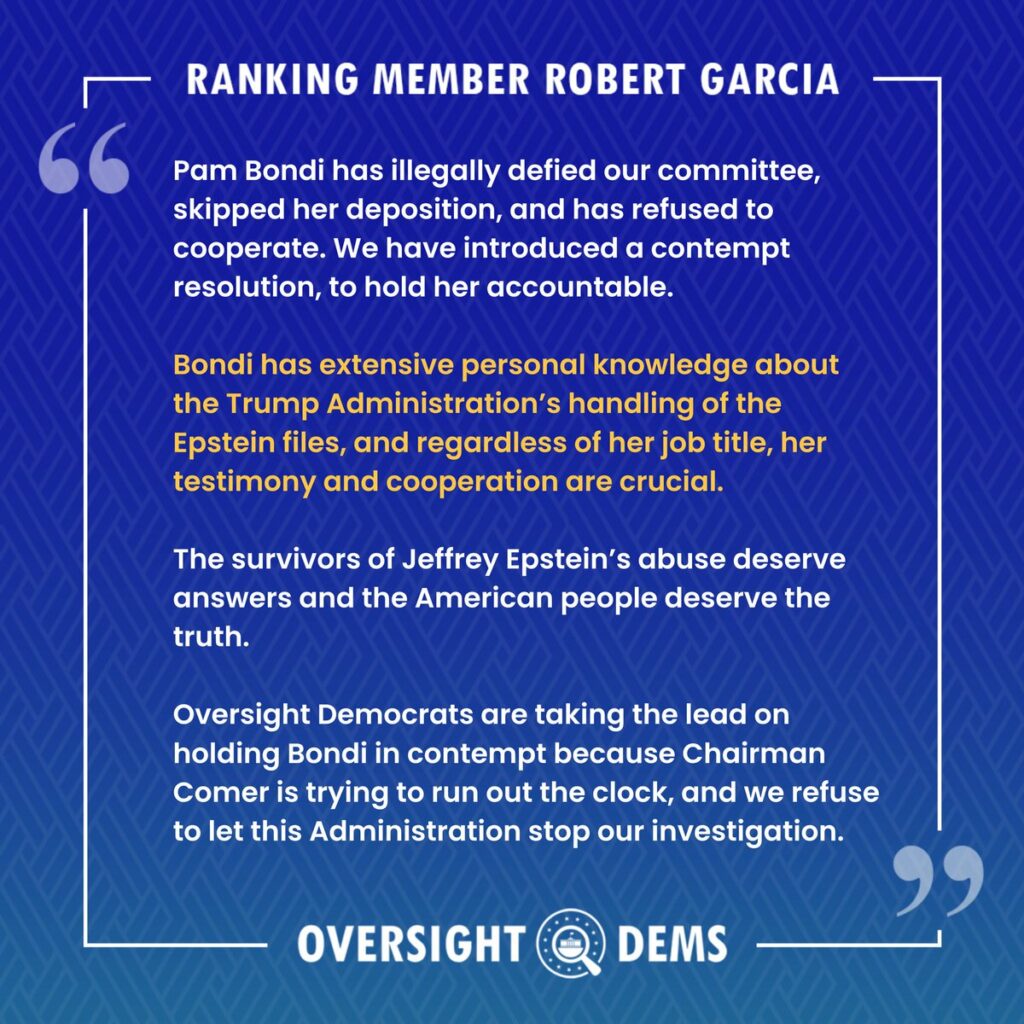
The April 29 announcement by Oversight Democrats described her failure to appear on April 14 and announced their resolution. Ranking Member Robert Garcia accused Bondi of unlawful defiance and criticized Comer’s handling of the inquiry. Those statements represent Garcia’s allegations and political position, not findings by a court. Garcia also framed the demand for testimony in terms of answers for survivors and public accountability.
What H.Res. 1228 would do
The official introduced version of H.Res. 1228 records its submission on April 29 and referral to the House Committee on Rules. Its operative text would direct the Oversight chair, within 30 days after the resolution’s adoption, to initiate or intervene in federal judicial proceedings seeking a declaration that Bondi must comply with the March 17 subpoena, together with appropriate relief, including an injunction.
That is a proposed civil mechanism to compel compliance. The introduced text is not an order imposing punishment, a criminal conviction or proof that the House adopted the resolution. The cited official text establishes introduction and referral; it does not establish a subsequent House vote, an enforcement lawsuit or a final judicial disposition.
May 29 interview and June 4 transcript
A material later development is documented in the committee’s June 4 release: Bondi sat for a transcribed interview on May 29, 2026. The 111-page official transcript identifies the date, participants, questions and answers. This was a later transcribed interview, not an appearance at the missed April 14 deposition.
In her opening statement, Bondi said she had delegated oversight of the document-review process to Deputy Attorney General Todd Blanche rather than conducting the review herself. She defended the department’s compliance and acknowledged redaction errors (transcript page 11). These are her statements to the committee, not independent findings that every required record was produced or every disclosure dispute resolved.
The later interview changes the chronology: an account ending with the April refusal would leave out a documented appearance. It does not, by itself, establish that all subpoena disputes were withdrawn or that a court decided the legality of the earlier nonappearance.
Reading the evidence
The subpoena announcement identifies the committee’s demand. The minority announcement records the sponsors’ allegations and rationale. The numbered resolution supplies the proposed legal mechanism. The interview transcript records Bondi’s own account and the committee’s questioning. None should be substituted for the others when assessing what occurred.
Statement image
The original Oversight Democrats statement graphic is reproduced below. It records the announcement’s language; the official resolution and later transcript provide the procedural history and subsequent development.