
Pamela Jo Bondi
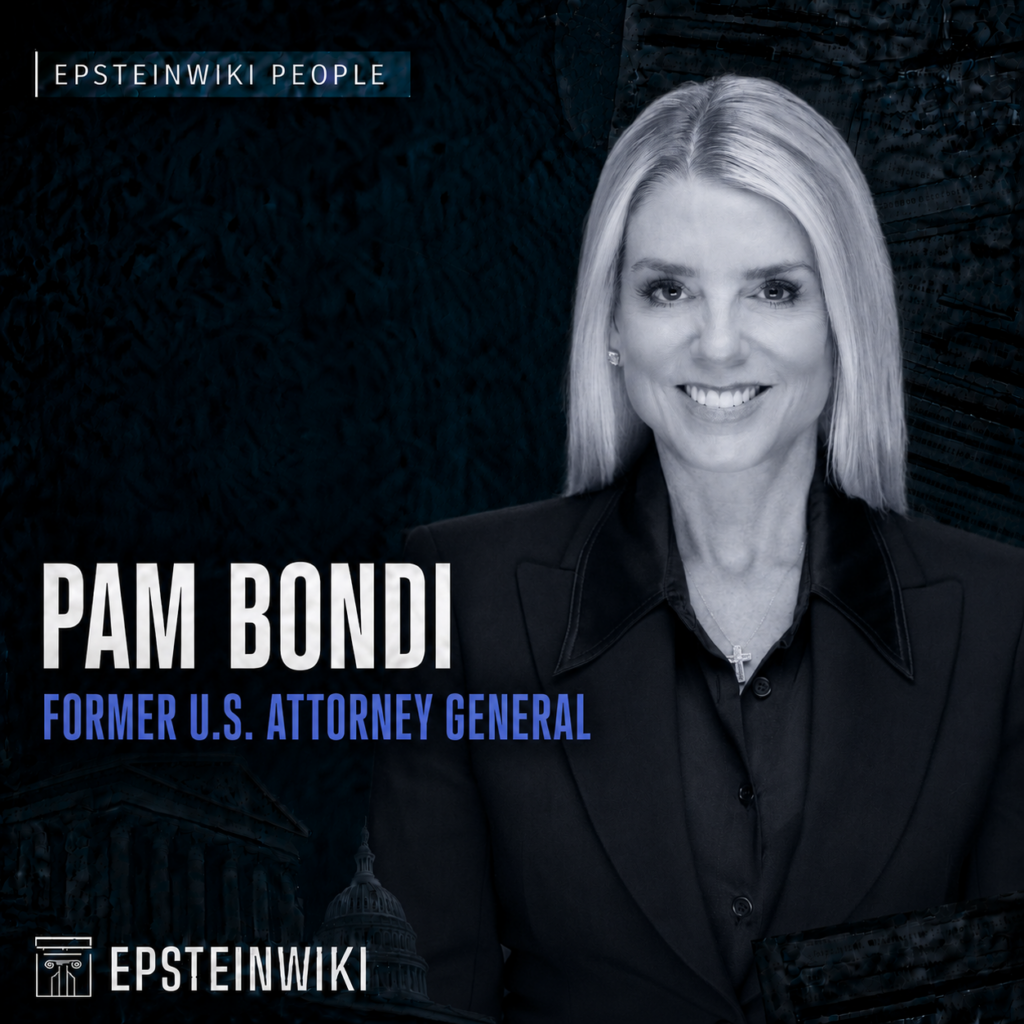
Pam Bondi’s documented connection to the Epstein matter is institutional, not personal. As United States attorney general, she directed the first 2025 release, demanded additional FBI records, delegated the larger review to Todd Blanche, oversaw implementation of the Epstein Files Transparency Act, and later answered questions before the House Oversight Committee. Her interview corrected one part of the public record while leaving major questions about withheld records, survivor privacy failures, White House communications, and investigative decisions unresolved.
Pam Bondi did eventually appear before Congress.
That fact must be stated plainly because an earlier version of this page ended with her failure to attend an April 14, 2026 deposition. The complete record is more complicated.
Bondi did not appear on April 14 despite a bipartisan House Oversight Committee subpoena. Oversight Democrats then introduced a civil contempt resolution. On May 29, however, Bondi appeared voluntarily for a transcribed interview that lasted approximately four hours. The Committee released the 111 page transcript on June 4.
The proceeding was not a sworn deposition. Committee counsel nevertheless warned Bondi that 18 U.S.C. § 1001 required truthful answers and that knowingly false statements, false claims of failed memory, half truths, and deliberate omissions could expose her to criminal prosecution.
What followed was important but incomplete.
Bondi defended the Justice Department’s work, said that the Department had complied with the Epstein Files Transparency Act to the best of her knowledge, and acknowledged that the release process exposed survivor information through human error. She also said that she personally reviewed very little of the underlying material, did not know how many records fell into major withholding categories, and relied repeatedly on Todd Blanche, FBI Director Kash Patel, other Justice Department officials, and the Bureau of Prisons.
When investigators asked whether President Donald Trump directed Epstein related actions or what Bondi discussed with Trump and senior White House advisers, she declined to answer. Her lawyers said no formal assertion of executive privilege was necessary because the interview was voluntary. Bondi confirmed that withholding those answers was her choice.
That is the corrected record.
It does not establish that Bondi knew Jeffrey Epstein, communicated with him, traveled with him, received money from him, or participated in his crimes. No evidence reviewed for this article establishes any such personal relationship.
It does establish that she occupied the most powerful law enforcement office in the country while the government made consequential decisions about locating, reviewing, withholding, redacting, removing, restoring, and describing Epstein related records.
For congressional oversight, that distinction is essential.
Snapshot
| Category | Documented information |
|---|---|
| Full name | Pamela Jo Bondi |
| Relevant public offices | Florida attorney general from 2011 through 2019; United States attorney general from February 5, 2025 through April 2, 2026 |
| Nature of Epstein connection | Institutional and administrative through Justice Department control of Epstein and Maxwell investigative records |
| Evidence of a personal relationship with Epstein | None identified in the records reviewed for this article |
| First major Justice Department action | Released a first phase of records on February 27, 2025 and demanded that the FBI deliver additional files |
| Principal delegated official | Deputy Attorney General Todd Blanche |
| Congressional subpoena | Authorized March 4, 2026 and issued March 17, 2026 |
| Missed appearance | April 14, 2026 |
| Contempt action | Oversight Democrats filed a proposed civil contempt resolution on April 29, 2026 |
| Later appearance | Voluntary transcribed interview on May 29, 2026 |
| Legal character of interview | Not a sworn deposition, but subject to the federal false statements statute |
| Central admissions | She personally reviewed little of the material, delegated operational control, acknowledged missed deadlines and redaction errors, and lacked detailed knowledge of several major decisions |
| Central refusal | She would not answer questions about conversations with Trump or close presidential advisers |
| Current evidentiary status | No Epstein related charge, judicial finding, or contempt adjudication against Bondi was identified |
Overview
Pam Bondi matters to the Epstein record because of authority, not proximity.
The attorney general supervises the Justice Department and the Federal Bureau of Investigation. During Bondi’s tenure, those institutions possessed records from the Palm Beach investigation, federal investigations in Florida and New York, the prosecution of Ghislaine Maxwell, the investigation of Epstein’s death, victim interviews, seized evidence, internal prosecutorial deliberations, and later document reviews.
Bondi publicly made transparency part of her leadership record. On February 27, 2025, she announced a first phase of declassified Epstein files. On the same date, she wrote FBI Director Kash Patel that she had asked for the complete files but initially received only about 200 pages. She demanded that the FBI deliver the remaining material and directed Patel to investigate why the New York field office had not provided it.
The first release largely republished material that had already circulated publicly. The much larger problem arrived later. Congress enacted the Epstein Files Transparency Act on November 19, 2025. The law imposed a 30 day disclosure timetable. The Department missed that deadline and ultimately said it collected approximately six million potentially responsive pages and released nearly 3.5 million pages, including material published before the January 30, 2026 production.
Bondi testified that more than 500 lawyers worked on the review. She said the unreleased material was nonresponsive, privileged, or duplicative. Yet she could not provide the number of records in each category, did not personally verify that the FBI had delivered everything, and repeatedly directed Congress to Blanche, Patel, or other officials for operational answers.
The proper oversight question is therefore not whether Bondi personally read millions of pages. No attorney general could reasonably do that. The question is whether she established a reliable command structure, demanded auditable reporting, protected survivors, preserved records, enforced the law’s disclosure rules, and maintained independence from political influence.
Her transcript does not resolve those questions.
Background and Public Offices
Bondi served as Florida attorney general from 2011 through 2019. Epstein’s Palm Beach investigation, controversial federal nonprosecution agreement, and 2008 state conviction predated her tenure. During her congressional interview, Bondi said that potential state prosecution of Epstein associates would have fallen to the Palm Beach state attorney, while her own office contained the Office of Statewide Prosecution.
Nothing reviewed for this article establishes that Bondi participated in the original Palm Beach investigation, negotiated the federal nonprosecution agreement, or made the decisions that produced Epstein’s 2008 plea arrangement.
The United States Senate confirmed Bondi as attorney general on February 4, 2025 by a vote of 54 to 46. Her Justice Department appointment affidavit records February 5 as her appointment date. President Trump removed her from office on April 2, 2026, after which Todd Blanche became acting attorney general. Blanche was later confirmed and sworn in as attorney general in August 2026.
Bondi’s federal tenure covered the first phase release, the July 2025 Justice Department and FBI memorandum, the Maxwell interview conducted by Blanche, passage and implementation of the Epstein Files Transparency Act, the January 2026 mass publication, and the Department’s response to congressional demands.
Documented Connection to the Epstein Matter
Bondi’s role can be divided into five documented functions.
Public release authority
Bondi announced the February 27, 2025 first phase release. The Department described the material as an initial transparency measure, although much of it was already public.
Demand for additional FBI records
In her February 27 letter to Kash Patel, Bondi said she had requested the complete Epstein files, initially received about 200 pages, and later learned that the FBI’s New York field office held thousands of additional pages. She ordered delivery and asked Patel to investigate.
Before Congress, Bondi said she believed Patel initiated an inquiry, but she did not recall its result. Asked whether she personally confirmed that all records were delivered, she answered that the Committee would have to ask Patel.
Delegation to Todd Blanche
Bondi said she delegated oversight of the main review and release process to Deputy Attorney General Todd Blanche. She credited him with managing the effort, determining what was privileged, directing correction of redaction failures, leading the Epstein matter, and personally interviewing Ghislaine Maxwell.
Delegation is ordinary management. It does not erase the attorney general’s responsibility to understand whether the delegated system complied with law and protected victims.
Implementation of the Transparency Act
The Justice Department’s January 30, 2026 production letter said the Department released more than three million responsive pages that day, along with more than 2,000 videos and 180,000 images. Including earlier publications, the Department reported nearly 3.5 million pages released from approximately six million potentially responsive pages collected.
The same letter identified duplication, privilege, victim protection, child sexual abuse material, and unrelated content as reasons why collection totals and public release totals differed. It also said approximately 200,000 pages had been redacted or withheld under asserted privileges.
Bondi adopted the Department’s overall compliance conclusion but could not give Congress a complete numerical accounting for the major categories.
Congressional accountability
The House Oversight Committee sought Bondi’s testimony about the Department’s Epstein investigation, its response to a separate Committee subpoena, and compliance with the Transparency Act. She first resisted the compulsory appearance, then participated voluntarily after leaving office.
Her relevance rests on these official acts. It does not depend on speculation about a personal Epstein relationship.
Timeline
February 4 and February 5, 2025
The Senate confirmed Bondi as attorney general, and she assumed office the following day.
February 27, 2025
The Justice Department published its first phase of Epstein material. Bondi also sent Patel a letter demanding the full FBI holdings after learning that the New York field office possessed more records than she had initially received.
March 2025
FBI personnel reviewed a large body of Epstein material under Bondi’s authority. At the later House interview, she said she delegated this work to Blanche and did not know whether every instruction given to reviewers had been made public.
July 7, 2025
The Justice Department and FBI issued a joint memorandum stating that their review found no incriminating client list, no credible evidence that Epstein blackmailed prominent individuals, and no evidence sufficient to predicate an investigation of uncharged third parties.
Bondi later said she did not issue the memorandum. She said Blanche and the FBI produced it, that she was briefed, and that she did not recall the briefing beyond what appeared in the document.
July 24 and July 25, 2025
Blanche interviewed Ghislaine Maxwell. Bondi said she knew the interview would occur and understood its purpose to be identifying evidence of other crimes or participants. She did not recall who initiated it.
August 1, 2025
The Bureau of Prisons transferred Maxwell. Bondi testified that she learned of the transfer through public reporting, had no role in it, and had no knowledge that it was connected to Maxwell’s interview. She also said Maxwell should not be pardoned and should remain imprisoned.
August 22, 2025
The House Oversight Committee subpoenaed Justice Department records. Bondi testified that Associate Attorney General Stanley Woodward handled the resulting production of approximately 33,000 pages.
November 2025
Before Congress passed the Transparency Act, Bondi attended a White House Situation Room meeting with Representative Lauren Boebert. Bondi identified Blanche, James Blair, James Braid, and possibly Kash Patel as other participants. She said Trump was not present and remembered the discussion as focused only on the risk that legislation could expose survivor identities.
November 19, 2025
Trump signed the Epstein Files Transparency Act into law.
December 19, 2025
The statutory 30 day deadline arrived. Bondi later acknowledged that the Department had not released all required material by that date.
January 30, 2026
The Justice Department published its largest production and described its work as compliance with the Act.
March 4 and March 17, 2026
The Oversight Committee approved a motion to subpoena Bondi, with support from all Committee Democrats and several Republicans. Chairman James Comer issued the subpoena on March 17.
April 2, 2026
Trump removed Bondi as attorney general.
April 14, 2026
Bondi did not appear for the subpoenaed deposition.
April 29, 2026
Ranking Member Robert Garcia and other Oversight Democrats filed a proposed civil contempt resolution. Its stated purpose was to authorize litigation compelling Bondi’s testimony. The filing was an enforcement proposal, not a judicial finding that Bondi committed a crime.
May 29, 2026
Bondi appeared voluntarily for a transcribed interview in the Rayburn House Office Building. The interview began at 9:05 in the morning and ended at 12:50 in the afternoon.
June 4, 2026
The Committee released Bondi’s transcript.
June through August 2026
Oversight Democrats argued that Bondi’s repeated references to Blanche and Patel made their testimony necessary. In August, Garcia renewed his demand that Chairman Comer bring Blanche before the Committee.
September 3, 2026
Bondi’s interview remains a central oversight record. No public source reviewed for this article establishes that the House obtained a contempt judgment against her. Her later voluntary appearance substantially changed the posture of the April dispute, but it did not answer every question covered by the original subpoena.
The Congressional Interview
The official transcript is the most important source for evaluating Bondi’s conduct.
Chairman Comer thanked Bondi for appearing and described her as responsive to the majority’s questions. Democratic members and staff took a different view, emphasizing her limited personal knowledge and refusal to discuss presidential communications.
Both facts belong in the record.
What Bondi said she knew
Bondi knew that the Department’s first delivery was incomplete. She knew the larger review was underway. She knew Blanche would interview Maxwell. She attended the Situation Room meeting concerning the pending Transparency Act. She knew the Department missed the 30 day deadline. She knew records had been removed after publication and said the Department corrected redaction mistakes. She believed the Department ultimately released everything the law required.
What Bondi said she did not know or could not recall
Bondi did not recall the outcome of Patel’s inquiry into missing New York records. She did not know the evidence underlying the July memorandum in detail. She did not know how many records were duplicative, privileged, or unrelated. She did not know the number of redaction corrections. She did not know whether every reviewer instruction had been released. She said she had read very little of the millions of pages. She did not know how the Maxwell interview was initiated. She said she learned of Maxwell’s transfer after it occurred.
What Bondi would not answer
Bondi refused to discuss conversations with Trump and close White House advisers. When asked whether Trump directed her or her subordinates to take any action involving Epstein or Maxwell, she declined to answer. Her counsel said the voluntary format meant no formal privilege assertion was required. Bondi agreed that it was her choice not to answer that category of questions.
This distinction matters. The transcript does not establish what any such conversations contained. It establishes only that the Committee asked and Bondi declined to disclose them.
The Six Million Page Problem
The largest unresolved accounting issue is the gap between approximately six million potentially responsive pages collected and nearly 3.5 million pages the Department said it released in total.
The collection number and release number cannot be compared as if every page were unique and responsive. The Department says the collection contained substantial duplication, unrelated material, privileged documents, and records whose publication was barred to protect victims or prevent distribution of child sexual abuse material.
At the same time, broad category labels are not an audit.
Bondi could not tell Congress how many records fell into each major category. She relied on the January 30 memorandum and Blanche’s decisions. She also clarified during the interview that unrelated and privileged documents were not available in the congressional reading room, even though duplicative unredacted materials were available there.
The Committee therefore still needs a document level or series level withholding index. Such an index need not expose survivor identities. It should identify the custodian, date range, record type, number of pages, asserted basis for withholding, decision maker, and whether a redacted substitute was released.
Without that accounting, neither Bondi’s assertion of compliance nor critics’ estimates of missing pages can be tested reliably.
Third party calculations about the number or percentage of withheld records should not be presented as established facts unless their methodology is reconciled with the Department’s duplication, responsiveness, and privilege data.
Removed Records and Survivor Privacy Failures
Bondi acknowledged that records were removed after publication. She said some victim names were inadvertently released, other names were improperly redacted, and the Department took files down to correct both kinds of error. She said she was not aware of records that were removed and never restored in an appropriately redacted form.
The transcript documents a grave failure. Committee questioning identified a released email labeled as an Epstein victim list in which most names had not been concealed. Bondi described the disclosure as human error and recalled learning that at least one reviewer may have failed to save redactions properly, although she could not connect that explanation definitively to the particular document.
Bondi said a correction team operated under Blanche’s direction. She did not know how many corrections were made. She acknowledged that if even one victim’s name was released, the process failed that person.
Survivor protection and government accountability are not competing goals. Congress can demand a complete incident log without republishing names. The log should record each affected file, the nature of the exposed information, the time it remained public, who accessed or downloaded it if known, when DOJ notified the survivor, what remedial assistance was offered, and what process change followed.
The current Justice Department Epstein Library invites reports of privacy failures and warns that its search system may be unreliable. That continuing correction mechanism makes preservation of every version and every removal decision especially important.
The Client List Statements
Bondi’s public language changed over time.
Her February 27, 2025 letter demanded material relating to Epstein and his clients. Public reporting later circulated her statement that a client list was on her desk for review. The July 7 memorandum then said the review found no incriminating client list and no credible evidence of blackmail involving prominent individuals.
Those statements are not necessarily contradictory if the phrase client list was used loosely at first and more precisely later. Epstein had contact books, flight records, financial clients, social associates, employees, and people mentioned in investigative records. None of those categories automatically constitutes a list of criminal clients.
Bondi told Congress that she wanted investigators to determine whether such a list existed, that she relied on Blanche and the FBI, and that no client or associate list was compiled to her knowledge. She could not identify the underlying records used to support the July memorandum’s conclusions.
Congress should obtain the review protocol behind that memorandum. It should define what reviewers meant by client, associate, co conspirator, blackmail, credible evidence, and predicate for investigation. It should also identify which investigative interviews, financial records, communications, seized media, and prosecutorial memoranda were considered.
The absence of an incriminating client list does not prove the absence of additional criminal participants. It proves only that investigators said they found no document or evidence fitting the memorandum’s stated conclusion.
Ghislaine Maxwell, the Interview, and the Transfer
Bondi testified that Blanche interviewed Maxwell because Epstein was dead and Maxwell might possess evidence about other crimes or participants. She knew the interview would occur but did not recall who initiated it.
Bondi said she believed the FBI would have examined names supplied by Maxwell, but she did not identify resulting investigations or actions. She said she did not believe the Department took subsequent action based on Maxwell’s statements.
Bondi denied involvement in Maxwell’s later prison transfer and said she learned about it from public reporting. She initially responded to a question describing a move from a maximum security facility to a low security facility, then returned after a break to say she believed the facilities were more comparable than that description suggested. She maintained that the Bureau of Prisons should answer the transfer questions.
Bondi also rejected the prospect of a pardon for Maxwell and used unequivocally condemnatory language about her conduct.
The transcript does not prove a bargain between Maxwell and the government. It does identify records Congress should obtain: communications arranging the interview, any proffer or immunity terms, attendee notes, FBI reports, investigative referrals, communications with the Bureau of Prisons, and the transfer decision file.
White House Communications and the Situation Room Meeting
Bondi confirmed that she attended a meeting with Representative Lauren Boebert in the White House Situation Room before passage of the Transparency Act. She said Trump was not present. She recalled the discussion as focused on protecting victim identities and did not remember other concerns.
That testimony should be tested against calendars, visitor records, invitations, attendee notes, messages, briefing papers, legislative strategy documents, and Boebert’s account.
Bondi separately refused to discuss whether Trump directed official action concerning Epstein or Maxwell. She also declined to discuss conversations with Trump or close advisers more generally.
Bondi said that, to her knowledge, the Department released all Epstein related records concerning Trump. She said she had no knowledge that reviewers were instructed to flag Trump’s name. A Committee question referenced whistleblower allegations that reviewers received such instructions, but the question itself is not proof that the allegation is true.
The appropriate next step is documentary verification. Congress should request every reviewer instruction, search protocol, quality control instruction, name flag, escalation rule, communication about politically exposed persons, and response to Senator Richard Durbin’s reported whistleblower letter.
Epstein Data Evidence Receipts
The following Epstein Data records help document how Bondi’s public statements and the government’s response were captured inside the released corpus. These receipts are primarily government news digests or saved media reports. They are not evidence that Bondi knew Epstein personally.
EFTA01655668
This 15 page record is an FBI news digest containing coverage of Bondi’s March 2025 statement that the FBI delivered a truckload of Epstein files. The record documents that the Bureau collected and circulated reporting about the dispute over file delivery. It supports the chronology of Bondi’s public demand for more records. It does not independently establish the contents, completeness, or chain of custody of what was delivered.
EFTA00163358
This record preserves March 2025 news coverage of Bondi’s statements concerning Epstein files and the expected review. It is useful for comparing her early public claims with her later congressional testimony. Because it is a saved media item rather than an operational case memorandum, it cannot prove what investigators actually reviewed or decided.
EFTA01655462
This record contains later news coverage of congressional questioning of Bondi about the Epstein files. It documents the public controversy and the questions being raised during her tenure. It does not substitute for the original hearing record or the May 2026 transcript.
EFTA01655264
This record preserves July 2025 reporting about the political backlash following the Justice Department and FBI memorandum. It helps establish contemporaneous public reaction to the Department’s decision to describe the review as closed. It does not prove that the memorandum’s investigative conclusions were right or wrong.
EFTA01655277
This related record also preserves reporting about the July 2025 reversal in public expectations. It is relevant to the evolution of Bondi’s transparency claims. Its evidentiary value is limited to what was reported and preserved, not the truth of every statement in the article.
EFTA01655597
This record concerns Bondi’s confirmation and public background. It helps establish the government’s retained media context surrounding her appointment. It is not evidence about Epstein’s conduct or about any personal connection between Bondi and Epstein.
EFTA01655328
This record preserves a congressional or public reference crediting Bondi and Patel for releases. It demonstrates how elected officials characterized the administration’s disclosure effort. That characterization is political evidence, not an independent audit of completeness.
EFTA01655683
This record concerns calls to investigate leaks or disclosures connected with the Epstein files controversy. It is relevant to the institutional environment in which DOJ handled the records. It does not establish that Bondi directed an unlawful disclosure or suppression.
Taken together, these receipts show that Bondi became a central public figure in the Epstein files controversy because of her office and her statements. They do not place her inside Epstein’s historical social, financial, or travel network.
Communications, Travel, Financial, and Professional Evidence
Communications
No direct email, text message, letter, or telephone record between Bondi and Epstein was identified in the sources reviewed for this article. The relevant communications are governmental communications created after Epstein’s death concerning record collection, review, release, legislation, congressional oversight, and Maxwell.
Travel and location records
No reviewed flight log or travel record places Bondi aboard an Epstein aircraft or at an Epstein property. The White House Situation Room meeting she acknowledged was a government policy meeting in 2025, years after Epstein’s death.
Financial records
No reviewed bank record, payment record, gift record, or business agreement documents a financial relationship between Bondi and Epstein.
Professional relationship
No evidence reviewed here establishes that Bondi represented Epstein, worked for him, advised him, prosecuted him, or negotiated his nonprosecution agreement. Her relevant professional relationship was with the Justice Department and its control of the records after she became attorney general.
These negative findings are limited to the materials reviewed. They should not be converted into claims about records that may remain sealed, privileged, missing, or unidentified.
Allegations, Proceedings, and Legal Status
Bondi has not been charged with an Epstein related crime. No court finding reviewed for this article holds that she concealed Epstein evidence, violated the Transparency Act, exposed survivor identities intentionally, or acted at Trump’s direction.
The House subpoena and proposed contempt resolution were oversight and enforcement measures. They were not criminal convictions and did not establish the truth of every allegation made by Committee members.
Oversight Democrats repeatedly described the Department’s conduct as a cover up. That is their allegation and political conclusion. It should not be presented as a judicially established fact.
Bondi’s own statements are also not self proving. Her claim that the Department complied fully to the best of her knowledge is a witness position that can be tested against inventories, withholding logs, communications, audit trails, and the underlying records.
The strongest version of this article does not ask readers to choose between partisan labels. It asks for the evidence needed to test both sides.
Bondi’s Responses and Exculpatory Information
Bondi offered several defenses and explanations that must be included fairly.
- She said the Department undertook an unprecedented disclosure project involving millions of pages, thousands of videos, and hundreds of thousands of images.
- She said more than 500 lawyers worked under severe time pressure created by the Act’s 30 day deadline.
- She said the Department withheld only nonresponsive, privileged, duplicative, or legally protected material.
- She described the exposure of survivor information as human error, not intentional misconduct.
- She said a correction process existed and that files were removed to repair over redaction and under redaction.
- She said she did not blame Blanche and considered his management highly ethical and effective.
- She denied knowledge that reviewers were instructed to flag Trump’s name.
- She denied involvement in Maxwell’s transfer and said she learned about it after it occurred.
- She said Trump was not present at the Situation Room meeting with Boebert.
- She said she did not personally participate in the original Florida Epstein prosecution and lacked the relevant local jurisdiction as Florida attorney general.
- She invited survivors with evidence of criminal conduct to contact the FBI and said the Department remained prepared to investigate evidence supported by facts and law.
These points limit what can responsibly be alleged. They do not eliminate the need for independent verification.
What the Evidence Establishes
The public record establishes that Bondi:
- led the Justice Department during a major period of Epstein record collection and disclosure;
- publicly promised transparency and demanded additional FBI records;
- delegated the operational review to Blanche and other senior officials;
- did not personally review most of the underlying evidence;
- did not personally confirm that the FBI delivered every responsive record after the initial shortfall;
- acknowledged that the Department missed the Act’s original deadline;
- acknowledged that survivor information was exposed through redaction failures;
- could not provide a detailed category accounting for the gap between collected and released pages;
- attended a White House meeting concerning the pending legislation;
- refused to disclose conversations with Trump and senior presidential advisers;
- missed the April 14 subpoena date but later appeared voluntarily on May 29;
- was not adjudged in contempt in any public record identified for this article.
The public record does not establish that Bondi:
- knew Epstein personally;
- traveled with Epstein;
- received money from Epstein;
- participated in Epstein’s abuse or trafficking;
- worked on Epstein’s original Florida prosecution or federal nonprosecution agreement;
- personally ordered the suppression of a particular Epstein record;
- intentionally exposed survivor information;
- arranged Maxwell’s transfer;
- committed an Epstein related crime.
Why Bondi Matters to the Network and the Institutions Around It
The Epstein story is not only a map of people who attended dinners, appeared in address books, or flew on aircraft. It is also a history of institutional decisions.
Prosecutors chose charges. Offices negotiated immunity language. Investigators decided whom to interview. Agencies classified, sealed, lost, recovered, redacted, and published records. Political officials promised disclosure and sometimes resisted oversight.
Bondi sits in that institutional layer.
Her testimony points to a distributed chain of responsibility involving Blanche, Patel, Woodward, the FBI’s New York field office, the Bureau of Prisons, Justice Department review teams, White House legislative officials, and the attorney general herself.
That chain should be reconstructed with records rather than rhetoric. Congress needs to know who made each decision, what information reached Bondi, what she approved, what she delegated, what controls she required, and what happened when those controls failed.
Survivor Perspective and Harm
Before Bondi’s interview, survivors asked that the proceeding be recorded on video. The majority did not permit video recording. The released transcript notes the request and the minority’s objection.
Survivors had reason to demand visibility. The government had already published records that exposed identifying information. Once private information is downloaded, copied, indexed, or reposted, later removal cannot fully restore privacy.
The release problem also ran in the opposite direction. Survivors and their attorneys have argued that relevant FBI interview reports, case records, and evidence concerning their own victimization remained inaccessible or heavily redacted.
Fara Gold, writing from a survivor rights perspective in Victims Ignored Is Justice Denied, argued that disclosure cannot be measured only by page totals. Meaningful transparency must include survivor access, consultation, notice, and remedies when the government causes additional harm.
That is the standard Congress should apply. A process can release millions of pages and still fail survivors if it exposes their identities while withholding the records they need to understand what the government did with their reports.
Independent Reporting and Public Analysis
Independent researchers have helped identify contradictions, missing context, and records requiring official explanation. Their work should be credited while remaining distinct from primary evidence.
Ellie Leonard, writing as The Panicked Writer, covered Bondi’s May 29 appearance in Breaking News: Pam Bondi Refuses to Answer and later examined the transcript’s implications for Blanche’s role. Leonard’s reporting is especially useful for tracking how often Bondi redirected operational questions to Blanche. Her conclusions are independent analysis. The official transcript remains the primary source.
In Yes, Attorney General Todd Blanche Violated the Epstein Files Transparency Act, Leonard argues that Bondi’s testimony undermines the Department’s compliance claims. Congress can test that argument by demanding the full withholding index, review instructions, and decision records.
R. Howard Stone of Document Zero reported in Conservative Journalist Shared Unredacted Epstein Notes on continuing disputes about handwritten materials, withheld context, and privacy failures. That later reporting reinforces the need for a preserved publication history and a file by file correction log. It should not be treated as a substitute for authenticated source records.
EpsteinWiki readers should also review Ellie Leonard Examines Todd Blanche’s Role in the Epstein Files Release Delays and Jeffrey Epstein Survivors Speak to Reporters Ahead of Pam Bondi Deposition.
Reliability and Limitations
The strongest sources for this profile are the official House transcript, Committee releases, Justice Department memoranda, Bondi’s signed letter, the Senate vote, and the statute itself.
Those sources still have limitations.
The transcript records what Bondi said. It does not prove every factual assertion she made. Committee questions may contain allegations or summaries that require separate verification. Partisan press releases accurately establish what members demanded or alleged, but not whether those allegations are true. Epstein Data news digests establish that material was retained in the government corpus, but saved news coverage is not the same as an investigative finding.
No public researcher can reliably certify completeness without the Justice Department’s master inventory, deduplication method, withholding log, redaction history, and chain of custody records.
This article therefore uses three evidence labels in substance:
- Established means supported directly by an official record or authenticated primary document.
- Reported means attributed to a named publication, official, witness, or researcher.
- Unresolved means the available evidence does not permit a reliable conclusion.
Questions the House Oversight Committee Should Pursue
File collection and chain of custody
- What was the final universe of potentially responsive records, measured separately as unique documents, unique pages, duplicate pages, media files, and physical evidence?
- Which Justice Department and FBI components certified that their searches were complete, who signed each certification, and what repositories were searched?
- What did Patel’s inquiry into the New York field office conclude, and why could Bondi not recall the result?
- Did any component fail to preserve, collect, or deliver responsive records after Bondi’s February 27 demand?
Withholding and privilege
- How many unique pages were withheld as nonresponsive, privileged, duplicative, sealed, victim protected, child sexual abuse material, or otherwise legally restricted?
- What specific privilege was asserted for each withheld series, who approved it, and did the Department produce a privilege log to Congress?
- Which prosecution memoranda, declination memoranda, FBI interview reports, internal charging analyses, and investigative referrals remain unavailable to Congress or the public?
- How did the Department interpret the Transparency Act’s treatment of internal investigative and charging records?
Removal, restoration, and survivor protection
- How many files were removed after public release, on what dates, for what reason, and when was each restored or replaced?
- Is there any removed record that has never been restored in a legally publishable form?
- How many survivors or witnesses had identifying information exposed, how long was it public, and when were they notified?
- What incident reports, corrective action records, and quality control reviews were created after each privacy failure?
- Which officials approved the original release process, and what technical testing occurred before publication?
Reviewer instructions and politically exposed names
- Produce every instruction given to reviewers in 2025 and 2026, including later revisions and informal guidance.
- Were reviewers instructed to flag Trump, any member of his family, any administration official, any elected official, or any politically exposed person?
- If names were flagged, what happened to the associated records and who received the alerts?
- How did DOJ respond to reported whistleblower allegations and Senator Durbin’s correspondence?
The July memorandum
- What evidence supported the conclusion that there was no incriminating client list, no credible blackmail evidence, and no predicate to investigate uncharged third parties?
- Which witnesses outside government were interviewed before those conclusions were announced?
- Did reviewers examine the conduct of Epstein employees, lawyers, accountants, recruiters, financial managers, property managers, pilots, and close associates as distinct categories?
- Who drafted, edited, approved, and authorized publication of the July memorandum?
Maxwell
- Who initiated Blanche’s interview of Maxwell, and what written terms governed it?
- What names, crimes, leads, or corroborating records emerged, and what investigative steps followed?
- Did the Department communicate with the Bureau of Prisons about Maxwell before or after the interview?
- Produce the transfer decision file and every communication linking the interview, security assessment, classification decision, and transfer.
White House involvement
- Produce the calendar entry, attendee list, briefing papers, messages, and notes for the Situation Room meeting with Boebert.
- Did anyone ask Boebert or another member of Congress to oppose, delay, narrow, or amend the Transparency Act?
- Did Trump or any White House adviser direct, request, discourage, delay, or shape any Epstein related investigative, disclosure, redaction, or public communications decision?
- If Bondi maintains a privilege claim over those communications, will the White House formally assert it and provide a privilege log identifying dates, participants, subjects, and legal basis?
Management accountability
- What written reports did Blanche, Patel, Woodward, and review team leaders provide to Bondi?
- What metrics did Bondi require to measure completeness, accuracy, survivor safety, and statutory compliance?
- Which decisions required Bondi’s approval, and which were made without her knowledge?
- After the first FBI shortfall, why did Bondi not personally obtain a completion certification or retain the result of Patel’s inquiry?
- What actions did Bondi take after learning that survivor information had been exposed?
- Which unresolved questions from the March subpoena remain unanswered after the May interview?
These questions are designed to produce records, named decision makers, legal bases, and verifiable timelines. They do not presume criminal conduct.
Fact Check
| Claim | Finding | Evidence and qualification |
|---|---|---|
| Bondi refused to appear before Congress and never testified | False | She missed the April 14 subpoena date but appeared voluntarily for a transcribed interview on May 29 |
| Bondi’s May appearance was a sworn deposition | False | It was a voluntary transcribed interview. Committee counsel warned that the federal false statements statute applied |
| The House found Bondi in criminal contempt | Not established | Oversight Democrats filed a proposed civil contempt resolution. No public contempt judgment was identified |
| Bondi personally reviewed all Epstein files | False | She said she reviewed very little of the material and delegated oversight to Blanche |
| Bondi said DOJ fully complied with the Transparency Act | True, with qualification | She said this was true to the best of her knowledge. Her statement is not an independent audit |
| DOJ met the original 30 day deadline | False | Bondi acknowledged that the Department did not complete release by the deadline |
| DOJ collected about six million potentially responsive pages | Supported by DOJ and testimony | The figure includes duplication and material the Department considered unrelated or privileged |
| DOJ released every collected page | False | DOJ reported nearly 3.5 million pages released in total and cited multiple withholding categories |
| Bondi supplied a complete count for each withholding category | False | She could not provide the category totals during the interview |
| Survivor identifying information was mistakenly released | True | Bondi acknowledged multiple redaction failures and described them as human error |
| Records were removed after publication | True | Bondi acknowledged removals and said corrected versions were restored. A complete public audit remains necessary |
| Bondi ordered reviewers to flag Trump’s name | Unresolved | She denied knowledge of such instructions. The Committee referenced a reported whistleblower allegation but did not establish it through the question alone |
| Trump attended the Situation Room meeting with Boebert | Denied by Bondi | Bondi confirmed her own attendance and said Trump was not present |
| Bondi answered whether Trump directed DOJ action | False | She refused to discuss that category of presidential communications |
| Bondi arranged Maxwell’s transfer | Not established | She denied involvement and said she learned of it after the transfer |
| Bondi had a personal relationship with Epstein | No evidence identified | The reviewed records document a governmental role after Epstein’s death, not a personal relationship |
| Inclusion in an EFTA news digest proves misconduct | False | News digests preserve reporting. They are not judicial findings or proof of the reported claims |
Related People and Organizations
- Jeffrey Epstein
- Ghislaine Maxwell
- Todd Blanche
- Kash Patel
- Stanley Woodward
- Donald Trump
- Lauren Boebert
- James Comer
- Robert Garcia
- United States Department of Justice
- Federal Bureau of Investigation
- Federal Bureau of Prisons
- House Committee on Oversight and Government Reform
- FBI New York field office
Related EpsteinWiki Pages
- Jeffrey Epstein
- Pam Bondi
- Epstein Files Transparency Act
- Epstein Files Transparency Act Files
- Todd Blanche Under Scrutiny
- Ellie Leonard Examines Todd Blanche’s Role in the Epstein Files Release Delays
- Jeffrey Epstein Survivors Speak to Reporters Ahead of Pam Bondi Deposition
- Epstein Survivors Respond to Todd Blanche Testimony and Demand Real DOJ Accountability
- Epstein Files Transparency Act II Would Let Survivors and States Sue the Justice Department
- How to Read Epstein Documents Without Making Things Up
Source List
Primary sources
- House Oversight Committee transcript of Pamela J. Bondi’s May 29, 2026 interview
- House Oversight Committee release of the Bondi transcript
- Chairman Comer issues subpoena to Attorney General Pam Bondi
- Oversight Democrats file proposed civil contempt resolution
- Oversight Democrats demand testimony from Todd Blanche and Kash Patel
- June 2, 2026 letter requesting Blanche’s appearance
- Justice Department first phase release
- Bondi’s February 27, 2025 letter to FBI Director Kash Patel
- July 7, 2025 Justice Department and FBI memorandum
- January 30, 2026 Justice Department production letter
- Justice Department Epstein Library
- United States Senate confirmation vote
- Bondi appointment affidavit
Epstein Data receipts
- EFTA01655668
- EFTA00163358
- EFTA01655462
- EFTA01655264
- EFTA01655277
- EFTA01655597
- EFTA01655328
- EFTA01655683
Reporting and analysis
- Reuters report on Bondi’s April 2026 removal
- Reuters report on Bondi’s initial decision not to appear
- The Guardian report on the Bondi transcript
- Ellie Leonard: Breaking News, Pam Bondi Refuses to Answer
- Ellie Leonard: Yes, Attorney General Todd Blanche Violated the Epstein Files Transparency Act
- R. Howard Stone: Conservative Journalist Shared Unredacted Epstein Notes
- Fara Gold: Victims Ignored Is Justice Denied