
Mike Pompeo
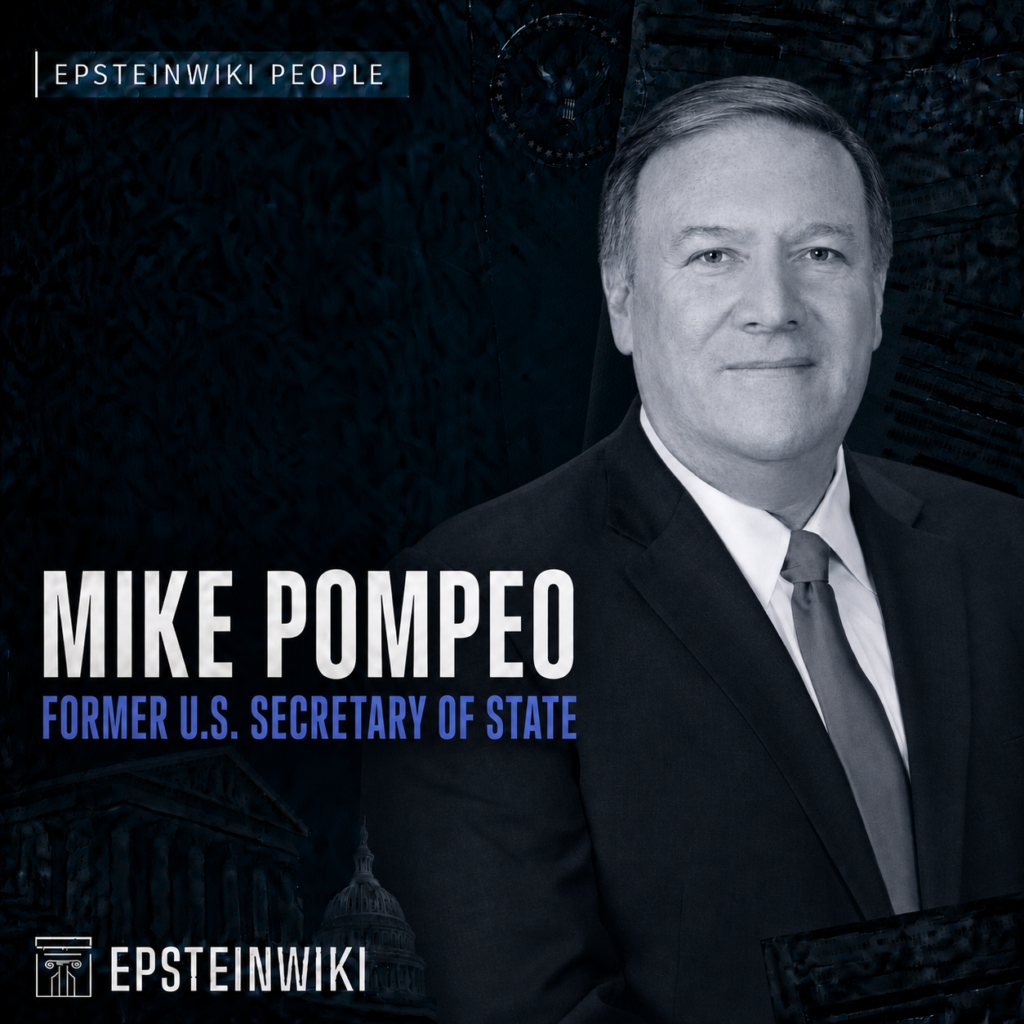
The former CIA director and secretary of state is not documented as an Epstein associate. His significance lies in messages showing Jeffrey Epstein and Steve Bannon discussing Pompeo as a cabinet power center, a possible diplomatic contact, and a source of influence over Iran, NATO, and Trump administration politics.
Snapshot
Full name: Michael Richard Pompeo
Born: December 30, 1963
Public roles relevant to this record: Member of the United States House of Representatives from Kansas, 2011 to 2017; Director of the Central Intelligence Agency, January 2017 to April 2018; United States Secretary of State, April 2018 to January 2021
Documented relationship with Jeffrey Epstein: No direct personal, social, financial, travel, or communications relationship has been established in the public record reviewed for this profile.
Why his name appears: Epstein and Steve Bannon discussed Pompeo while talking about Trump administration personnel, Iran, NATO, foreign officials, and possible approaches to the United States government. Other appearances are ordinary news reports and government press summaries copied into large evidence productions.
Flight records: No verified Epstein aircraft entry located for Pompeo.
Address books: No verified entry located in Epstein’s published address books.
Direct correspondence: No verified email, text message, or letter between Pompeo and Epstein located.
Meetings: No verified meeting between Pompeo and Epstein located.
Payments or financial ties: None established.
Criminal allegation: None established by the documents discussed here.
Central oversight question: Did any person in Epstein’s circle actually approach Pompeo, his office, the CIA, or the State Department after Epstein proposed or discussed doing so, and what records would confirm or disprove such contact?
Overview
Mike Pompeo belongs in the EpsteinWiki record, but only with careful labels.
His name appears in released material. The United States Department of Justice also included “Pompeo, Mike” in its February 14, 2026 list of government officials and politically exposed persons named or referenced in material released under the Epstein Files Transparency Act. Neither fact establishes that Pompeo knew Jeffrey Epstein.
The more meaningful documents are private messages in which Epstein and Steve Bannon discussed Pompeo during the first Trump administration. In one exchange, Epstein referred to Pompeo while discussing which senior officials might remain after possible cabinet removals. In another, Epstein told Bannon that someone could provide insight into Pompeo and National Security Advisor John Bolton. In a third, Epstein suggested that someone on Pompeo’s team meet a person identified only by a nickname. In a fourth, Epstein asked whether a foreign official should contact Bolton or Pompeo concerning what Epstein described as a NATO matter.
These are not direct Pompeo communications. They are communications about Pompeo.
That distinction is the foundation of this profile.
The messages do, however, create legitimate oversight questions. They show Epstein presenting himself as a strategist in foreign policy and administration politics while maintaining a close and active relationship with Bannon, a former White House chief strategist who remained influential in Trump aligned politics. Epstein spoke as if senior officials, foreign diplomats, and political intermediaries could be mapped, approached, and deployed. Whether this posture reflected real access, inflated self importance, information supplied by others, or a mixture of all three cannot be resolved from the messages alone.
The proper inquiry is therefore not “Was Mike Pompeo an Epstein client?” The public evidence reviewed here does not support that description.
The proper inquiries are narrower and more useful. Who was Epstein proposing should contact Pompeo? Did Bannon or another intermediary act on those suggestions? Did Pompeo’s staff receive any approach traceable to Epstein’s circle? Did intelligence or diplomatic agencies ever examine Epstein’s international network? Do government records preserve contacts that have not appeared in the estate and Justice Department productions?
This page documents what is known, what is reasonably inferred, and what remains unproved.
Who Mike Pompeo Is
Michael Richard Pompeo graduated first in his class from the United States Military Academy in 1986, served as a United States Army cavalry officer, earned a law degree from Harvard, worked in business, and entered Congress in 2011. He represented Kansas’s Fourth Congressional District and served on the House Intelligence Committee.
President Donald Trump nominated Pompeo to lead the Central Intelligence Agency. The Senate confirmed him in January 2017. He remained CIA director until April 2018, when he became the seventieth secretary of state. The Senate confirmed that nomination by a vote of 57 to 42 on April 26, 2018. The State Department’s official history records his tenure as secretary from 2018 through 2021.
Those dates matter because the most important Epstein messages mentioning Pompeo fall between December 2018 and June 2019. Pompeo was then the chief United States diplomat, a central figure in the administration’s policies toward Iran, North Korea, NATO, the Gulf states, Israel, China, Russia, and Europe.
When Epstein and Bannon discussed whether someone should contact Pompeo, they were not naming a marginal political personality. They were discussing one of the most powerful national security officials in the United States government.
That status explains why Pompeo might appear in political conversations even if he had no relationship with either participant. It also explains why any successful attempt to reach his office would be important to document.
The Evidence Must Be Classified by Type
The released record contains several very different kinds of Pompeo references. Treating every search result as equivalent would produce a misleading profile.
The evidence falls into four principal categories.
First are direct messages written or received by Epstein in which Pompeo is discussed as an official, political figure, or possible contact. These are the most relevant documents.
Second are messages between Epstein and Bannon that purport to describe internal Trump administration views about Pompeo. These may show what Epstein claimed to know, but they do not independently establish that the reported views were accurate.
Third are copied news articles, government press summaries, and media monitoring packets that mention Pompeo because he was secretary of state. These documents may have entered the release through FBI or Justice Department file collections. Their presence says little or nothing about a connection to Epstein.
Fourth are later commentary, reporting, and database pages that count every occurrence of Pompeo’s name. Those tools can locate documents, but raw totals can inflate the apparent significance of a person whose name appeared frequently in national news.
An accurate profile must keep those categories separate.
The Justice Department List Is Not a Client List
The Justice Department’s February 14, 2026 Section 3 report to Congress includes Pompeo among government officials and politically exposed persons whose names appear at least once in material released under the Epstein Files Transparency Act.
The report contains its own warning about interpretation. It explains that names occur in a wide variety of contexts. Some people had extensive direct contact with Epstein or Ghislaine Maxwell. Others appeared only in a portion of a document, including press reporting, that was unrelated on its face to the Epstein and Maxwell matters.
That warning is essential.
The list is not a roster of associates, clients, suspects, visitors, passengers, or participants in crimes. It is an index created under a statutory reporting requirement. Pompeo’s inclusion proves that his name appears in released material. It does not prove why every appearance occurred, whether he knew Epstein, or whether he engaged in misconduct.
The same report says reviewers were directed to record every government official or politically exposed person named in any reviewed document, including images and videos. A secretary of state discussed constantly in news coverage could therefore accumulate many mentions without any personal connection to Epstein.
This page does not use the Justice Department list as evidence of association. It uses the underlying messages to identify specific questions.
Steve Bannon Is the Principal Bridge in the Relevant Messages
The most important Pompeo references sit inside the much larger documented relationship between Jeffrey Epstein and Steve Bannon.
Bannon served as chief executive of Donald Trump’s 2016 presidential campaign and as White House chief strategist during the first seven months of the administration. After leaving the White House, he continued political work in the United States and Europe. Released messages show that Bannon and Epstein communicated extensively, met, discussed politics and world affairs, and worked on a film project intended to reshape Epstein’s public image.
CBS News reported that Bannon and Epstein were still arranging documentary filming on July 6, 2019, the day federal agents arrested Epstein. The messages included a proposal to film on Epstein’s private island. That documented relationship gives the Pompeo references more significance than a random news clipping, because Bannon had held a senior White House post and retained relationships across Trump aligned political circles.
It still does not make every claim in the messages true.
Bannon could possess real access and still exaggerate. Epstein could receive genuine information and still embellish it. Either man could propose a contact that never occurred. The messages establish what they discussed, not the completion of every plan or the accuracy of every assertion.
Independent researcher Ellie Leonard has published chronological transcriptions of the 2018 and 2019 Epstein and Bannon messages. Those transcriptions are valuable for chronology and context, but the released documents remain the controlling evidence.
December 22, 2018: Cabinet Removal Talk
One of the clearest direct receipts is EFTA02611375, an email exchange dated December 22, 2018.
The discussion occurred during a period of extraordinary turmoil in the Trump administration. Secretary of Defense James Mattis had announced his resignation. Federal Reserve Chair Jerome Powell and Treasury Secretary Steven Mnuchin were subjects of political conflict. The United States was debating troop withdrawals from Syria. Epstein and Bannon discussed these officials as if they were pieces on a personnel board.
ABC News reported the exchange in detail. Bannon asked whether Powell or Mnuchin could be removed. Epstein responded that removing Powell was more important than the Syria and Mattis issue. Epstein then wrote, in part, “I guess pompeo, only one left.” He continued by criticizing Ambassador Heather Nauert and calling for Jared Kushner and Ivanka Trump to go.
The sentence is terse and context dependent. It appears to identify Pompeo as the remaining major administration figure after a hypothetical or desired clearing of other officials. It does not show Pompeo participating in the conversation. It does not show that Epstein had spoken with him. It does not establish that Epstein had power to remove anyone.
What it does show is that Epstein was privately gaming out cabinet power with a former White House chief strategist. The exchange presents Pompeo as an object of strategic discussion within an Epstein and Bannon political conversation.
For oversight purposes, the key questions are who supplied Epstein with information about administration personnel, whether Bannon treated Epstein as a source or merely a sounding board, and whether any recommendations were passed to serving officials.
March 12, 2019: The Better Vice President Claim
Released messages reported by Byline Times contain another Pompeo reference. On March 12, 2019, Epstein told Bannon that Trump was displeased with Vice President Mike Pence, believed Pompeo would be a better vice president, and questioned Pence’s loyalty.
The reporting describes the messages as part of a sequence in which Epstein relayed purported information about internal White House relationships. The source of Epstein’s claim is not identified in the public message. No statement from Trump within the exchange confirms it. No response from Pompeo appears.
The evidentiary value is therefore limited but real.
The message proves Epstein made the claim to Bannon. It may indicate that Epstein was receiving political gossip from someone who claimed access. It may reflect Epstein’s own speculation. It may also have been a way to demonstrate relevance to Bannon by presenting himself as informed about private administration sentiment.
It does not prove Trump seriously considered replacing Pence with Pompeo. It does not prove Pompeo knew of such a discussion. It does not prove a plan existed.
Oversight should seek the complete message thread, participant metadata, and any communications immediately before and after the exchange. Investigators should also determine whether the same claim appears in messages between Epstein and other people. Repetition across independent channels could identify the source. Repetition only from Epstein could show merely that he circulated the same story.
May 11, 2019: “Insight Into Pompeo and Bolton”
The message sequence preserved in EFTA01213040 places Pompeo inside a discussion of escalating tension with Iran.
The thread includes a news report about the United States sending a Patriot missile system and another warship to the Middle East. A participant acknowledges the article. Epstein then writes that the recipient can give an unidentified person “insight into pompeo and bolton.” The response is “Easy.”
Other public indexes preserve duplicates of the same sequence under additional EFTA numbers. Duplication is common in large productions because the same message may appear in different device extractions, email attachments, investigative files, or processed data sets.
The passage raises several questions that the visible excerpt does not answer.
Who was supposed to receive the insight?
What did “insight” mean in this context? It could mean an assessment of Pompeo’s and Bolton’s views, an explanation of their personalities, a prediction of policy, or claimed inside information.
What was the recipient’s basis for providing it?
Did any briefing, meeting, message, or introduction follow?
The exchange does not show Pompeo or Bolton communicating with Epstein. It shows Epstein assigning or encouraging an intermediary role concerning two senior national security officials during a period of acute geopolitical tension.
Arab Digest later argued that the wider sequence deserves scrutiny because it overlapped with reporting on Gulf tanker attacks and Iran policy. That interpretation should not be converted into a claim that Epstein or Bannon had operational foreknowledge. The messages show political and media discussion around unfolding events. Establishing foreknowledge would require timestamps, original metadata, information unavailable publicly at the time, and evidence of how the participants obtained it.
The oversight value is in reconstructing the network, not overstating the excerpt.
May 15, 2019: A Proposed Meeting With Someone on Pompeo’s Team
Four days later, another message moves from analysis toward a proposed contact.
In EFTA01616087, Epstein wrote that someone on Pompeo’s team should sit with a person he called “mr evil.” He added that “They will do a 180 on their sponsor in a heartbeat.” The surrounding conversation concerned Iraq, Iran, Yemen, Gulf politics, and United States policy.
This is one of the most important Pompeo references because it describes a proposed meeting with a member of Pompeo’s team. It still does not show that the meeting occurred.
The primary document, as presented, does not identify which member of Pompeo’s team Epstein had in mind. It does not contain a State Department response. It does not show an invitation, calendar entry, visitor log, call record, or follow up confirming contact.
The nickname also requires caution. A research report maintained by R. Howard Stone argues that “Mr. Evil” referred to Yemeni businessman Shaher Abdulhak, using other messages in which Epstein contrasted “Shaher” with another person and connected the nickname to Yemen. That identification is a researcher conclusion built from multiple documents. It is plausible and should be tested, but the isolated Pompeo message does not itself spell out the name.
If the identification is correct, the proposed contact becomes a specific diplomatic question: why did Epstein believe Abdulhak or people aligned with him could change position on a sponsor, what policy outcome was being sought, and why did Epstein believe Pompeo’s staff should serve as the United States channel?
Congress should request all State Department contact records for Abdulhak and known representatives during the relevant period. It should also identify officials working on Yemen, Iran, Iraq, Saudi Arabia, the United Arab Emirates, Oman, and Qatar who might have been described informally as members of Pompeo’s team.
Without that follow up evidence, the document remains evidence of Epstein’s proposal, not Pompeo’s participation.
June 17, 2019: “Bolton or Pompeo for Miro?”
The final major direct reference reviewed for this profile appears in HOUSE_OVERSIGHT_027802 and the adjacent message record.
Epstein wrote that NATO wanted to check the choice of “Miro” with Washington and asked whether Miro should contact Bolton or Pompeo. A follow up restated the choice between the two officials.
“Miro” in Epstein’s correspondence commonly referred to Slovak diplomat Miroslav Lajčák. Lajčák served as Slovakia’s foreign minister and had also served as president of the United Nations General Assembly. Released records document repeated communications between Lajčák and Epstein.
The exact NATO matter is not fully explained in the short exchange. It may have concerned a personnel choice, candidacy, or diplomatic consultation. The wording should not be expanded beyond what the document supports.
The message proves that Epstein contemplated Bolton or Pompeo as possible Washington contacts for Lajčák. It does not prove Lajčák contacted either official. It does not prove NATO instructed Epstein to arrange anything. The phrase “Nato would like” is Epstein’s statement unless independently corroborated.
This distinction is especially important because Epstein often wrote in compressed language that omitted subjects, context, and source attribution. A single sentence can make him sound like a formal intermediary even when the surrounding record may show only informal gossip or aspiration.
The answer lies in records outside Epstein’s own archive. Investigators should review State Department calendars, visitor access data, telephone logs, email archives, diplomatic cables, executive secretariat records, and Lajčák’s official schedule. The inquiry should cover direct contact and contact through staff.
Incidental Mentions and the Problem of Inflated Counts
Database pages report hundreds of Pompeo mentions across the broader Epstein releases. That number can sound alarming until the documents are classified.
Many records are bulk media products. For example, EFTA00150335 is an FBI public affairs news briefing. It contains summaries of contemporary reporting about federal officials and national events. Pompeo’s appearance in such a packet reflects his public office and media coverage, not a communication with Epstein.
Other documents include articles about foreign policy, administration personnel, intelligence matters, sanctions, and congressional disputes. A globally prominent secretary of state would naturally appear in this material.
Document duplication compounds the problem. The same text may appear as an original message, a forwarded message, an extracted attachment, an image, an OCR file, and a copy in another production. A database count can therefore measure files, pages, or text occurrences rather than distinct interactions.
This does not mean counts are useless. They help researchers find clusters. They can reveal dates when a name becomes unusually frequent. They can identify associated terms and people. But a count must never substitute for document review.
For Pompeo, the current public record supports a small number of substantively important third party discussions surrounded by a much larger field of incidental mentions.
Was Pompeo in Epstein’s Black Book or Flight Logs?
No verified entry for Mike Pompeo has been located in the publicly available versions of Epstein’s address books reviewed for this profile.
No verified flight record placing Pompeo aboard an Epstein aircraft has been located.
No verified photograph of Pompeo with Epstein has been identified.
No verified Epstein calendar entry scheduling Pompeo has been identified.
No verified financial transaction between them has been identified.
These negative findings are important, but they must be stated precisely. They describe the record reviewed and publicly available. They are not proof that no contact of any kind could ever have occurred.
The absence of common association markers sharply distinguishes Pompeo from documented Epstein social contacts, business partners, employees, passengers, and frequent correspondents. It also means that headlines or social posts describing him as an Epstein associate would outrun the evidence presently available.
The CIA Question
Pompeo’s service as CIA director creates a separate category of oversight questions, even without evidence that he knew Epstein.
Epstein cultivated current and former officials, foreign leaders, diplomats, financiers, academics, scientists, lawyers, and political strategists. His network crossed national borders and included people with access to sensitive institutions. Public speculation has long alleged intelligence connections, but speculation is not proof of an agency relationship.
The relevant institutional questions are narrower.
Did the CIA possess reporting about Epstein, his international contacts, his finances, or possible foreign intelligence interest in him while Pompeo was director?
Did the agency receive information from the FBI, Department of Justice, State Department, foreign partners, or private sources?
Did any CIA official communicate with Bannon about Epstein after Bannon left the White House?
Did the agency assess counterintelligence risks created by Epstein’s access to powerful people?
Could responsive records be withheld under intelligence authorities even if they were not included in a general Justice Department production?
None of these questions presumes a hidden CIA operation. Intelligence agencies routinely receive information that produces no operational relationship and no formal investigation. Oversight should seek records and classification explanations rather than build conclusions from the prestige of Pompeo’s title.
The State Department Question
The State Department inquiry is more directly connected to the messages.
Epstein explicitly proposed contact with Pompeo or his team. He discussed foreign officials and policy questions falling within the department’s responsibilities. The record includes Iran, Iraq, Yemen, Gulf states, NATO, and a senior Slovak diplomat.
The department’s record systems could answer whether any proposal reached government.
Relevant repositories may include the secretary’s calendars, call logs, briefing books, executive secretariat tracking, email accounts, staff email, visitor records, diplomatic security access records, memoranda of conversation, front office scheduling systems, country desk correspondence, and records of meetings conducted outside the main department building.
Searches should use more than Epstein’s name. If an intermediary contacted State without mentioning Epstein, a narrow name search would miss it. Investigators should also search for Bannon, Lajčák, Abdulhak, identified participants in the message threads, relevant email addresses, telephone numbers, and the policy subjects being discussed.
Congress should further determine whether Pompeo used any personal or nongovernment systems for official scheduling and communications and whether those records were preserved under applicable federal law.
The aim is not to imply guilt from a missing record. It is to test a concrete proposition created by Epstein’s own messages: that he or someone around him contemplated routes into Pompeo’s national security apparatus.
Epstein’s Foreign Policy Persona
The Pompeo references fit a broader pattern in Epstein’s post conviction life.
Epstein did not confine himself to finance or science. His messages show sustained interest in elections, cabinet appointments, central banks, Russia, China, Israel, Saudi Arabia, Iran, Europe, NATO, and the political future of the Trump administration. He offered advice, circulated information, proposed introductions, and spoke about senior officials as people whose choices could be influenced or anticipated.
This persona served several functions.
It made Epstein useful to ambitious political actors. It allowed him to portray himself as a source of elite intelligence. It may have helped his attempted reputational rehabilitation by shifting attention from his 2008 sex offense conviction to his claimed role as adviser to powerful people. It also created a marketplace in which access, gossip, analysis, and personal introductions could blend together.
Bannon was a particularly important audience because he combined political experience, media skill, international connections, and direct knowledge of Trump world. Their communications show mutual engagement, not an occasional unsolicited message.
The Pompeo references therefore illuminate Epstein more clearly than they illuminate Pompeo. They show how Epstein discussed power and attempted to place himself near channels of state decision making.
Evidence Assessment
| Question | Present assessment | Basis | Confidence |
|---|---|---|---|
| Did Pompeo hold senior offices when the relevant messages were sent? | Yes | Official State Department history and Senate record | High |
| Does Pompeo’s name appear in released Epstein related material? | Yes | Direct documents and DOJ Section 3 report | High |
| Did Epstein discuss Pompeo with Steve Bannon? | Yes | EFTA and House Oversight message records | High |
| Did Epstein discuss Pompeo in relation to cabinet politics? | Yes | December 22, 2018 exchange and March 12, 2019 reported messages | High |
| Did Epstein discuss Pompeo in relation to Iran and John Bolton? | Yes | May 11, 2019 message sequence | High |
| Did Epstein propose that someone on Pompeo’s team meet a third person? | Yes | May 15, 2019 message | High |
| Did Epstein suggest that Lajčák contact Pompeo or Bolton? | Yes | June 17, 2019 House Oversight record | High |
| Did any proposed contact actually occur? | Not established | No confirming contact record located | Undetermined |
| Did Pompeo communicate directly with Epstein? | Not established | No verified direct correspondence located | Undetermined, with no affirmative evidence |
| Did Pompeo meet Epstein? | Not established | No verified calendar, photograph, or witness record located | Undetermined, with no affirmative evidence |
| Did Pompeo fly on Epstein’s aircraft? | No verified record located | Published flight material reviewed | High as to present public record |
| Was Pompeo in Epstein’s address book? | No verified entry located | Published address books reviewed | High as to present public record |
| Did Pompeo receive money or benefits from Epstein? | Not established | No verified financial record located | Undetermined, with no affirmative evidence |
| Does DOJ’s politically exposed persons list imply wrongdoing? | No | DOJ’s express explanation of the list | High |
| Was “Mr. Evil” Shaher Abdulhak? | A documented researcher assessment, not explicit in the isolated message | Cross document analysis by R. Howard Stone | Moderate pending official corroboration |
| Did Epstein have genuine inside White House information? | Some messages suggest access to informed sources, but each claim requires independent corroboration | Bannon messages and later reporting | Moderate as a general pattern, variable by claim |
| Did Pompeo know his name was being discussed? | Not established | No responsive message or acknowledgement located | Undetermined |
What the Documents Establish
The public documents establish several facts.
Epstein and Bannon maintained a substantial political relationship after Epstein’s 2008 conviction.
They discussed the structure and personnel of the Trump administration.
Epstein referred to Pompeo as a major surviving cabinet figure in December 2018.
Epstein later claimed Trump viewed Pompeo as a possible better vice president than Pence.
Epstein discussed providing or arranging insight into Pompeo and Bolton during escalating Iran tensions.
Epstein proposed that someone on Pompeo’s team meet a third person in a conversation concerning Middle East politics.
Epstein asked whether Lajčák should contact Bolton or Pompeo regarding a matter he connected to NATO.
Pompeo’s name also appears in unrelated media summaries and news material included in the broader release.
The Justice Department listed Pompeo as a named government official or politically exposed person while warning that the list covers contexts ranging from direct contact to unrelated press references.
These facts justify records requests and witness questions.
What the Documents Do Not Establish
The documents reviewed do not establish that Pompeo knew Epstein.
They do not establish a meeting, call, email, text, social event, flight, visit, payment, gift, or financial relationship between them.
They do not establish that Pompeo knew Bannon was discussing him with Epstein.
They do not establish that Pompeo or his staff accepted any proposed meeting.
They do not establish that Lajčák contacted Pompeo at Epstein’s suggestion.
They do not establish that Pompeo considered replacing Pence as vice president.
They do not establish that Epstein influenced United States policy toward Iran, Yemen, NATO, or any other subject.
They do not establish that Epstein worked for the CIA or that Pompeo participated in concealing an intelligence relationship.
They do not establish criminal or unethical conduct by Pompeo.
Any account that crosses those lines must produce additional evidence.
Timeline
January 3, 2011: Pompeo begins service in the United States House of Representatives from Kansas’s Fourth District.
January 23, 2017: Pompeo becomes Director of the Central Intelligence Agency.
2017: Released records show Epstein and Bannon developing a relationship centered on politics, strategy, media, and international affairs.
April 26, 2018: The Senate confirms Pompeo as secretary of state by a vote of 57 to 42. He is sworn in the same day.
2018: Epstein and Bannon exchange frequent messages about the Trump administration and international politics.
December 20, 2018: Secretary of Defense James Mattis announces his resignation after disagreement over policy, creating an immediate administration crisis.
December 22, 2018: In EFTA02611375, Bannon and Epstein discuss Powell, Mnuchin, Syria, Mattis, Pompeo, Heather Nauert, Jared Kushner, and Ivanka Trump. Epstein describes Pompeo as “only one left” in the context of the exchange.
March 12, 2019: According to released messages reported by Byline Times, Epstein tells Bannon that Trump is down on Pence and thinks Pompeo would be a better vice president. The source and accuracy of the claim are not established.
May 2019: United States tensions with Iran rise as the administration deploys military assets and issues public warnings.
May 11, 2019: In EFTA01213040 and duplicate extractions, Epstein tells a correspondent that the person can give someone insight into Pompeo and Bolton. The recipient responds, “Easy.”
May 15, 2019: In EFTA01616087, Epstein proposes that someone on Pompeo’s team meet the person he calls “Mr. Evil.” He predicts a rapid change in alignment. No completed meeting is shown.
June 17, 2019: In HOUSE_OVERSIGHT_027802 and the adjacent message, Epstein asks whether “Miro” should contact Bolton or Pompeo concerning a NATO related matter. No completed contact is shown.
July 6, 2019: Epstein and Bannon exchange messages about filming their planned documentary. Federal agents arrest Epstein later that day.
August 10, 2019: Epstein dies in federal custody. His death is officially ruled a suicide.
January 20, 2021: Pompeo’s tenure as secretary of state ends.
November 2025: Major news organizations publish analyses of newly released Epstein and Bannon communications, including their discussions of Pompeo and other Trump administration officials.
January 30, 2026: The Justice Department announces a major release of Epstein related records under the Epstein Files Transparency Act.
February 14, 2026: The Justice Department submits its Section 3 report listing government officials and politically exposed persons named in released material. Pompeo appears on the list. The report warns that inclusion may reflect anything from direct contact to an unrelated press reference.
September 3, 2026: The public record reviewed for this profile still does not establish direct contact between Pompeo and Epstein.
Questions for Mike Pompeo
These questions are designed to establish facts, not presume them.
- Did you ever meet Jeffrey Epstein in any personal, official, political, business, academic, intelligence, or diplomatic setting?
- Did you ever speak with him by telephone, video call, encrypted application, or through an intermediary?
- Did you ever receive an email, text message, letter, briefing, invitation, gift, or introduction originating with Epstein or his staff?
- Did any member of your congressional, CIA, State Department, campaign, transition, or private staff report an approach from Epstein?
- When did you first learn that Epstein and Steve Bannon had discussed you in private communications?
- Did Bannon ever relay Epstein’s views, advice, intelligence, gossip, or proposed introductions to you?
- Did Bannon ever discuss with you a proposal that you replace Mike Pence as vice president?
- Were you aware of any serious discussion inside the Trump administration about replacing Pence with you?
- Did you or your staff meet Miroslav Lajčák between 2017 and 2021?
- If so, what were the dates, subjects, participants, and official records of those contacts?
- Did Lajčák or anyone representing him contact you or your staff around June 17, 2019?
- Did any such contact concern NATO personnel, a candidacy, an appointment, or a matter described as a choice requiring review in Washington?
- Did you or your staff have contact with Shaher Abdulhak or any known representative of his businesses or family interests?
- Did any State Department official meet a person introduced through Bannon, Epstein, Lajčák, or another participant in the released messages?
- Who on your team handled back channel contacts concerning Yemen, Iran, Iraq, Qatar, Oman, Saudi Arabia, and the United Arab Emirates in May 2019?
- Were any unofficial intermediaries used to explore changes in Yemeni factional alignment?
- Did the phrase “Mr. Evil” ever appear in State Department communications, briefing papers, notes, or messaging applications?
- Did Bannon provide you or John Bolton with information or analysis concerning Iran around May 11, 2019?
- Did anyone provide a joint briefing or parallel briefing about your and Bolton’s views during that period?
- Were all contacts with Bannon during your service preserved as federal records?
- Did you use personal email, private messaging applications, or nongovernment devices for any Bannon related official communications?
- Did you authorize staff to communicate with Bannon outside ordinary State Department channels?
- Did the State Department ever assess Epstein as a possible informal intermediary, influence broker, counterintelligence risk, or target of foreign intelligence cultivation?
- While you led the CIA, did the agency possess reporting concerning Epstein’s international network?
- Did you receive any briefing that mentioned Epstein, Ghislaine Maxwell, Les Wexner, Leon Black, Ehud Barak, Prince Andrew, or other central figures in Epstein’s network?
- Did the CIA receive any liaison reporting from a foreign government concerning Epstein?
- Did the CIA maintain records responsive to the Epstein Files Transparency Act that were not held by the Justice Department?
- Did the CIA provide any Epstein related material to the Justice Department for review or release?
- Have you been asked by Congress, the Justice Department, the FBI, or an inspector general to search your records for Epstein related contacts?
- Will you consent to a search of relevant official and personal records for Epstein, Bannon, Lajčák, Abdulhak, and the telephone numbers or email addresses in the cited message threads?
- Will you provide a sworn statement addressing whether any proposed approach in the released messages reached you or your staff?
- Are there classification, privilege, or records preservation issues that would prevent a complete public answer, and if so, will you provide the answer in a secure congressional setting?
Questions for the House Oversight Committee
- Has the Committee obtained the complete native message files, attachments, timestamps, participant identifiers, and device extraction metadata for every Pompeo reference?
- Has it de duplicated the records so repeated copies are not counted as separate interactions?
- Has it separated Epstein authored messages from news clippings, FBI media briefings, forwarded articles, and third party commentary?
- Has it identified the correspondent in the May 11, 2019 “insight into pompeo and bolton” exchange?
- Has it identified the intended recipient of that insight?
- Has it determined whether any briefing, introduction, or meeting followed?
- Has it identified the person called “Mr. Evil” through primary evidence rather than nickname inference alone?
- Has it requested State Department records for contacts involving Shaher Abdulhak and related representatives?
- Has it identified which Pompeo staff members handled Yemen and Iran policy on May 15, 2019?
- Has it interviewed those staff members under oath or requested written declarations?
- Has it obtained all records of contact between Pompeo’s office and Steve Bannon from 2017 through 2021?
- Has it obtained all records of contact between Pompeo’s office and Miroslav Lajčák during the same period?
- Has it asked NATO what matter Epstein may have meant in the June 17, 2019 message?
- Has it requested Lajčák’s official calendars, devices, and communications for the relevant dates?
- Has it compared State Department records with White House visitor logs, call records, National Security Council records, and Bannon’s communications?
- Has it requested responsive CIA records, including indices showing whether records exist even if their contents remain classified?
- Has the CIA issued a Glomar response, a substantive response, or no response to congressional requests concerning Epstein?
- Did Justice Department reviewers search records held by the intelligence community, or only material in Justice Department possession?
- What explains the large number of database mentions attributed to Pompeo, and how many are unique, substantive communications?
- Has the Committee obtained testimony from Bannon about each Pompeo reference?
- Has Bannon identified the source of Epstein’s March 2019 vice presidential claim?
- Has the Committee sought testimony from Heather Nauert concerning the December 2018 message and any related cabinet discussion?
- Has it determined whether Epstein received nonpublic White House information, and from whom?
- Has it issued preservation notices covering personal devices and accounts used for official business?
- Will the Committee publish a document by document index that distinguishes direct contact, third party discussion, and incidental media references?
- Will witnesses be allowed to answer sensitive national security questions in a classified session?
- Will the Committee publish verified negative findings when an investigated contact did not occur?
- What procedures will protect survivor identities while permitting scrutiny of political and national security records?
- Has the Committee coordinated with the House and Senate intelligence committees on records that may fall outside ordinary Oversight jurisdiction?
- Will the Committee correct public claims that confuse a statutory name list with proof of association or wrongdoing?
Survivor Centered Significance
The national security dimension must not displace the reason these records matter.
Epstein was a convicted sex offender who continued to cultivate elite relationships after 2008. His access to influential people, institutions, and political intermediaries helped sustain an image of consequence and protection. That image could discourage witnesses, isolate survivors, and signal that ordinary accountability did not apply to him.
Investigating whether his proposed government contacts succeeded is therefore not celebrity gossip. It is part of understanding the environment that allowed him to remain socially and institutionally powerful.
At the same time, accuracy protects survivors. Inflated claims make serious research easier to dismiss. Calling every named official an associate or client creates noise around the people for whom direct evidence actually exists. It also allows institutions to answer a false accusation instead of the narrower questions the documents support.
The strongest survivor centered approach is disciplined: identify the message, name the participants, preserve the date, distinguish proposal from completion, request the missing records, and publish the answer.
Fact Check
Claim: Mike Pompeo is on an official Epstein client list.
Finding: False. The Justice Department published a statutory list of government officials and politically exposed persons named or referenced in released material. It expressly warned that some names occur only in unrelated press reporting. The document is not a client list.
Claim: Pompeo communicated directly with Epstein.
Finding: Not established. The principal documents reviewed are messages in which Epstein and others discussed Pompeo. No verified direct Pompeo and Epstein communication has been located.
Claim: Pompeo flew on Epstein’s plane.
Finding: No verified evidence located in the public flight records reviewed.
Claim: Pompeo appears in Epstein’s black book.
Finding: No verified entry located in the published address books reviewed.
Claim: Epstein and Bannon discussed Pompeo.
Finding: Supported. Multiple released messages refer to Pompeo in discussions of administration personnel and foreign policy.
Claim: Epstein said Trump wanted Pompeo to replace Pence.
Finding: Partly supported and often overstated. Epstein told Bannon that Trump thought Pompeo would be a better vice president. The message establishes Epstein’s statement, not the truth of the statement or a formal replacement plan.
Claim: Epstein arranged a meeting with Pompeo’s team.
Finding: Not established. Epstein proposed that someone on Pompeo’s team meet a third person. No confirming meeting record has been located.
Claim: Pompeo met Miroslav Lajčák because Epstein directed it.
Finding: Not established. Epstein asked whether Lajčák should contact Bolton or Pompeo. The message does not document completed contact.
Claim: The “Mr. Evil” message proves Pompeo dealt with Shaher Abdulhak.
Finding: Not established. Researchers have linked the nickname to Abdulhak using other records, but the Pompeo message does not show that Pompeo or his staff met him.
Claim: The Pompeo messages prove Epstein controlled United States foreign policy.
Finding: False as stated. The messages show Epstein discussing and attempting to position himself around policy channels. They do not prove control or a policy result.
Claim: Pompeo’s prior leadership of the CIA proves Epstein had an intelligence connection.
Finding: False. A title and a third party mention do not establish an operational relationship. Any intelligence connection requires independent documentary evidence.
Claim: Hundreds of search results mean hundreds of Pompeo and Epstein interactions.
Finding: False. Many results are duplicates, press clippings, or government media summaries. Each document must be classified before a count has meaning.
Research and Source Limitations
The public record is incomplete and uneven.
Some released messages are duplicated under multiple identifiers. Some participant names are redacted. Some extractions separate adjacent messages into different files. OCR can introduce errors. Database entity matching can combine direct communications with incidental references. Search engines may index a document without exposing its full context.
Government records present a different problem. State Department, CIA, White House, and National Security Council materials may be classified, privileged, archived in separate systems, or absent from a Justice Department production because the files were never in Justice Department possession.
Negative findings must therefore be described as negative findings in the reviewed public record. They are not universal proof that no record exists anywhere.
Positive findings must also be bounded. A message from Epstein proves that he sent or stored the message, subject to authentication. It does not automatically prove every factual assertion inside it.
This profile should be updated if direct correspondence, official contact records, sworn testimony, or authenticated metadata becomes public.
Sources
- EFTA02611375, December 22, 2018 Epstein and Bannon cabinet discussion
- EFTA01213040, May 11, 2019 message concerning insight into Pompeo and Bolton
- EFTA01616087, May 15, 2019 message proposing contact with someone on Pompeo’s team
- HOUSE_OVERSIGHT_027802, June 17, 2019 message concerning Bolton or Pompeo
- EFTA00150335, FBI Public Affairs news briefing illustrating incidental media references
- Justice Department, Epstein Files Transparency Act Section 3 Report to Congress, February 14, 2026
- State Department Office of the Historian, Michael R. Pompeo biography
- United States Senate, confirmation vote for Mike Pompeo as secretary of state
- Archived White House biography of Mike Pompeo
- ABC News, Epstein appeared to offer political advice on dealing with Trump in 2018
- CBS News, Inside Jeffrey Epstein’s inner circle, emails and texts show
- Byline Times, Jeffrey Epstein Had Access to Trump’s Inner Circle While Working With Steve Bannon
- The Guardian, Epstein files shed more light on Steve Bannon’s efforts to influence European politics
- Ellie Leonard, The Epstein Bannon Emails, 2018
- Ellie Leonard, The Epstein Bannon Emails, 2019 Part Two
- American Freakshow, Steve Bannon, Populist False Prophet
- R. Howard Stone, Mr. Evil: Shaher Abdulhak and Epstein’s Gulf Lobbying Network
- Amy McVey, Is Flynn’s Alleged Russian Honeytrap Hidden Inside the Epstein Files?
- Arab Digest, Emails Suggest Epstein and Bannon Had Foreknowledge of 2019 Gulf Tanker Attacks