Epstein Survivors Respond to Todd Blanche Testimony and Demand Real DOJ Accountability
Overview
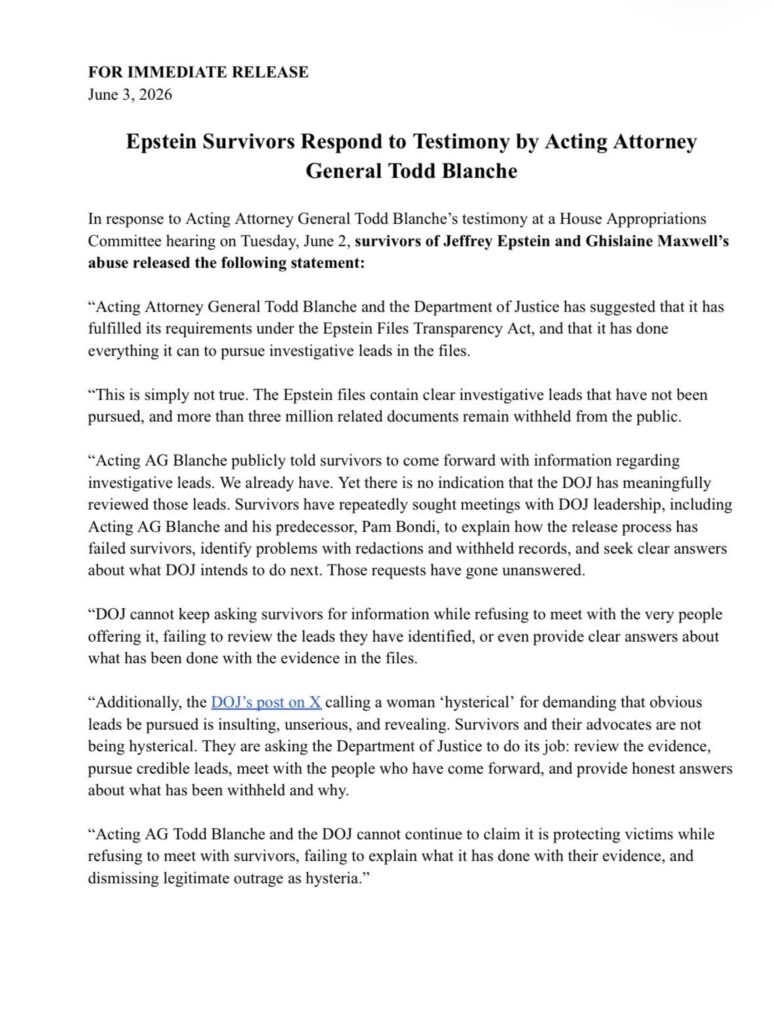
On June 3, 2026, a group of Epstein survivors released a public statement responding to Acting Attorney General Todd Blanche’s testimony before the House Appropriations Committee on June 2, 2026. The statement challenged DOJ claims that the department had fulfilled its obligations under the Epstein Files Transparency Act and had done everything possible to pursue investigative leads in the files.
The survivors were direct and clear. They said the DOJ cannot keep asking survivors for information while refusing to meet with the people who already came forward, identified leads, and raised concerns about redactions, withheld records, and unanswered questions.
Snapshot
This statement matters because it shifts the Epstein files debate away from simple document counts and back to survivor accountability. The central issue is not only whether pages were released. The issue is whether the Department of Justice reviewed the evidence, followed the leads, protected survivors, and gave honest answers about what remains withheld.
The statement also objects to a DOJ post on X that reportedly described a woman demanding investigation of obvious leads as hysterical. Survivors rejected that framing and said they are asking the DOJ to do its job.
Key Points
- Survivors said the DOJ has not fulfilled its obligations under the Epstein Files Transparency Act.
- Survivors alleged that clear investigative leads remain inside the Epstein files and have not been meaningfully pursued.
- The statement said more than three million related documents remain withheld from the public.
- Survivors said they already came forward with information and have repeatedly requested meetings with DOJ leadership.
- The statement named Acting Attorney General Todd Blanche and former Attorney General Pam Bondi in connection with unanswered survivor meeting requests.
- Survivors said the DOJ must explain what it has done with survivor evidence, redactions, withheld records, and investigative leads.
- The statement rejected the use of the word hysterical to describe public pressure for accountability.
- The statement framed survivor outrage as legitimate, evidence based, and tied to DOJ responsibility.
Survivor Signers Listed On The Statement
The signer page lists Maria Farmer, Annie Farmer, Andrea Sterling, Ashley Rubright, Audra Fasano, Dani Bensky, Jane Doe, Jena Lisa Jones, Jennifer, Jess Michaels, Joanna Harrison, Juliette Bryant, Lara Blume McGee, Lisa Phillips, Liz Stein, Marijke Chartouni, Marina Lacerda, Sharlene Rochard, Sky and Amanda Roberts, Rachel Benavidez, and Teresa J. Helm.
Several of those names also appear in EpsteinWiki and Epstein Data survivor resources, including Maria Farmer, Annie Farmer, and the Epstein Victims and Survivor List.
Fact Checked Context
The Epstein Files Transparency Act became Public Law 119 38 on November 19, 2025. The law directs the Attorney General to make publicly available, in searchable and downloadable form, all unclassified DOJ records, communications, and investigative materials relating to Jeffrey Epstein, Ghislaine Maxwell, flight records, immunity arrangements, plea agreements, internal DOJ review material, and other listed categories.
The DOJ later stated that it published over three million additional pages responsive to the Act on January 30, 2026. That DOJ position is part of the conflict addressed by the survivor statement. Survivors argue that release claims do not answer the deeper questions about withheld documents, redactions, ignored leads, and DOJ communication failures.
Epstein Data’s forensic overview describes the DOJ production as a massive release involving hundreds of thousands of PDF documents, multiple datasets, and millions of indexed records. That scale supports the survivors’ broader point. A large release is not the same thing as a complete investigation, a transparent explanation, or meaningful survivor engagement.
Why This Matters
This statement is important because it records survivor pushback against a familiar institutional pattern. Agencies often point to process, page counts, and formal compliance while people harmed by the underlying crimes keep asking whether anyone actually reviewed the evidence and followed the leads.
The survivors are not asking for spectacle. They are asking for meetings, answers, lead review, honest redaction explanations, and meaningful transparency. In the Epstein case, those demands are not side issues. They are the core accountability questions.
Related Epstein Data Evidence Files
The EFTA02731082 SDNY prosecution memorandum on potential co conspirators is a key evidence file because it describes the federal investigation into Epstein associates and employees after Epstein’s 2019 indictment.
The EFTA01660651 NTOC names document and EFTA01660679 follow up document are important because they show how tip information and investigative lead material appear inside the released corpus.
The EFTA00016836 document is relevant because it preserves coverage of the Virgin Islands lawsuit alleging Epstein and associates used a database to track victims.
The Epstein Data Hear From The Survivors page is also relevant because it collects public survivor testimony and interviews in one location.
Related EpsteinWiki Pages
- Epstein Files Transparency Act
- Ellie Leonard Examines Todd Blanche’s Role In The Epstein Files Release Delays
- Maria Farmer
- Annie Farmer
- Epstein Victims and Survivor List
- SDNY Prosecution Memorandum On Potential Co Conspirators In The Jeffrey Epstein Investigation
Source List
- Uploaded survivor statement pages dated June 3, 2026
- Epstein Files Transparency Act Public Law 119 38 (GovInfo)
- DOJ Epstein Files Transparency Act Production Letter (Department of Justice)
- DOJ January 30 2026 Epstein Files Release Page (Department of Justice)
- House Appropriations Rogers Remarks At DOJ Oversight Hearing (House Appropriations GOP)
- AP Report Confirming Blanche Testimony Before House Appropriations (AP News)
- Epstein Data Final Investigation Report (Epstein Data)
- Epstein Data Hear From The Survivors (Epstein Data)
- EFTA02731082 SDNY Prosecution Memorandum (Epstein Data)
- EFTA01660651 NTOC Names Document (Epstein Data)
- EFTA01660679 NTOC Follow Up Document (Epstein Data)
- EFTA00016836 Virgin Islands Lawsuit Coverage In DOJ Production (Epstein Data)