
Chuck Schumer
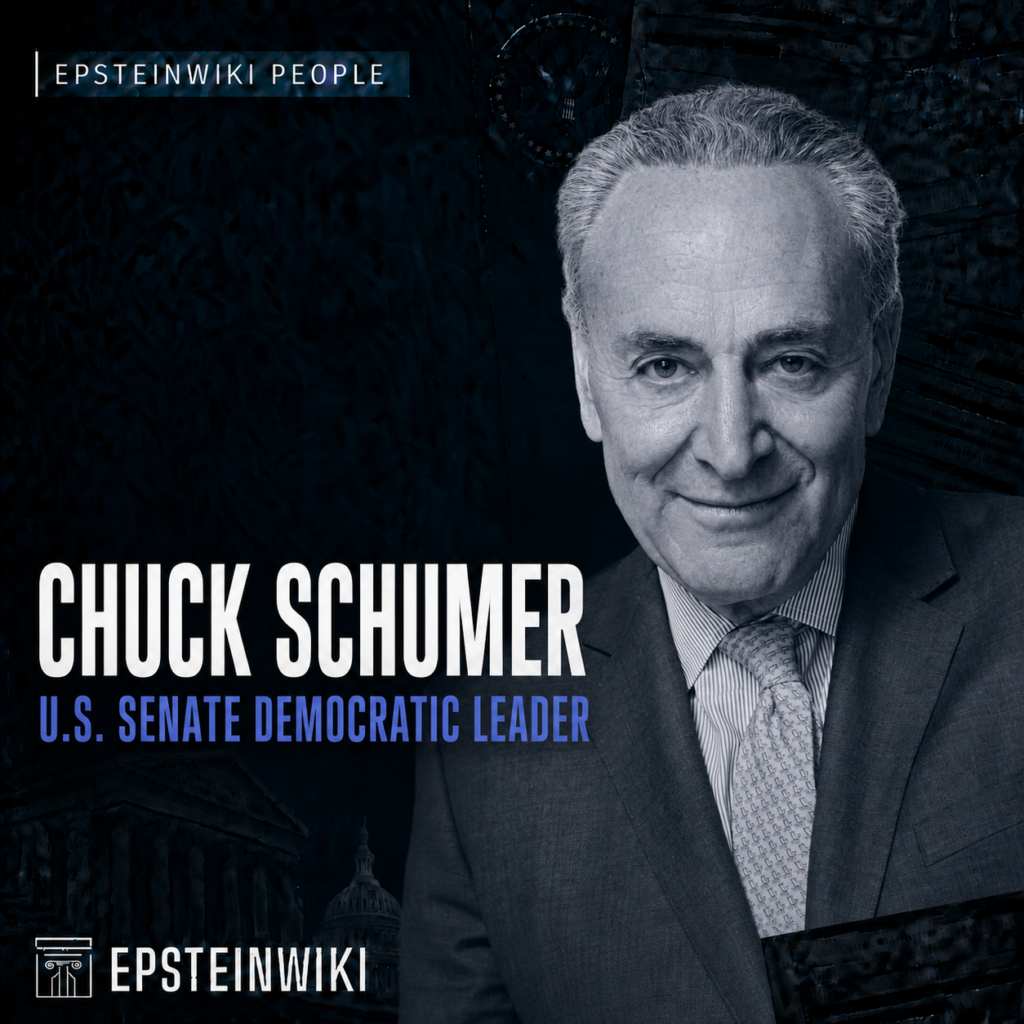
Jeffrey Epstein contributed approximately $22,000 through Chuck Schumer’s campaigns and affiliated fundraising vehicles during the 1990s. Years later, Epstein was invited to a fundraiser where Schumer was described as likely to attend. Neither fact proves criminal involvement, but both belong in the public record alongside Schumer’s later demands for disclosure and accountability.
Snapshot
- Full name: Charles Ellis Schumer
- Born: November 23, 1950
- Public role: United States senator from New York since January 1999 and Senate Democratic leader
- Previous role: Member of the United States House of Representatives from 1981 through 1998
- Direct Epstein contributions: Approximately $22,000 through Schumer’s House and Senate campaigns and affiliated joint fundraising vehicles from 1992 through 1999, according to Federal Election Commission records reviewed by ABC News
- Response to the contributions: In July 2019, Schumer’s campaign announced that an equal amount would be donated to organizations combating sex trafficking and violence against women
- Post conviction document: A November 2012 email from Mortimer Zuckerman invited Epstein to a fundraiser for Senator Max Baucus and said Schumer was likely to attend
- Attendance at that event: Not established by the cited email
- Knowledge of Epstein’s invitation: Not established
- Verified flight evidence: No verified record reviewed for this article places Schumer aboard an Epstein aircraft
- Verified property visit: No verified evidence reviewed for this article places Schumer at an Epstein residence, ranch, or island
- Criminal allegation: No cited record accuses Schumer of participating in Epstein’s trafficking crimes
- Later public role: Schumer called for Alexander Acosta’s resignation in 2019, backed federal disclosure efforts in 2025, helped move the Epstein Files Transparency Act through the Senate, and sought legal action over the Justice Department’s partial release
Overview
Chuck Schumer’s appearance in the Jeffrey Epstein record involves two different stories separated by time and evidentiary weight.
The first is money.
From 1992 through 1999, Epstein contributed approximately $22,000 through Schumer’s House campaign, Senate campaign, and affiliated fundraising organizations. The contributions were made years before Epstein’s 2006 arrest and 2008 Florida conviction. In 2019, after Epstein was arrested on new federal sex trafficking charges, Schumer announced that an equal amount would be given to organizations fighting sex trafficking and violence against women.
The second story is access.
In November 2012, four years after Epstein became a registered sex offender, publisher and real estate billionaire Mortimer Zuckerman emailed Epstein an invitation to a fundraiser at Zuckerman’s home for Montana Senator Max Baucus. Zuckerman wrote that Schumer was likely to attend and described the event as a chance to interact with two important Senate Democrats.
That email is significant because it shows that an influential intermediary continued inviting Epstein into elite political spaces after his conviction. It does not prove that Schumer invited Epstein, knew Epstein had been invited, attended the fundraiser, met Epstein there, or maintained a relationship with him.
Those limitations are not technicalities. They separate evidence from insinuation.
Schumer’s later record adds another layer. He publicly condemned the nonprosecution agreement that allowed Epstein to avoid federal charges in Florida, demanded the resignation of Labor Secretary Alexander Acosta, pushed the Senate to require release of federal Epstein records, supported the Epstein Files Transparency Act, and later proposed that the Senate pursue legal action over alleged Justice Department noncompliance.
A responsible account must document all of it: the money, the access attempt, the absence of evidence proving a personal or criminal relationship, and Schumer’s subsequent use of congressional power.
Who Is Chuck Schumer?
Charles Ellis Schumer is a Democratic politician from New York. He was elected to the New York State Assembly in 1974, entered the United States House of Representatives in 1981, and won election to the Senate in 1998. He became Senate Democratic leader in 2017 and later served as Senate majority leader when Democrats controlled the chamber.
Schumer’s career has placed him near the center of Democratic fundraising, Senate strategy, federal judicial confirmations, New York politics, and national legislation for decades.
That political history matters when examining Epstein’s contributions. Epstein did not give money to an obscure local campaign. He contributed to political committees connected with a rising New York lawmaker who would become one of the most powerful members of Congress.
At the same time, campaign contributions are not proof of a personal friendship. Political committees accept money from thousands of donors. The amount, frequency, fundraising vehicle, surrounding communications, and evidence of access all matter when assessing what a contribution means.
The available evidence establishes that Epstein’s money entered Schumer connected political accounts. It does not, by itself, establish what Schumer personally knew about Epstein at the time or whether Epstein obtained any official action in return.
Epstein’s Political Giving Strategy
Epstein used political donations as one component of a much larger influence network.
He contributed to Democratic and Republican candidates, national party committees, state campaigns, and fundraising organizations. He cultivated relationships with political donors, officeholders, attorneys, academics, business leaders, and media executives. The recipients of his political money included presidential candidates, members of Congress, governors, and party committees.
Epstein once described his approach as investing in people. That philosophy helps explain why individual donations should be studied as part of a system rather than as isolated checks.
A contribution could serve several possible purposes:
- Support a candidate whose policies the donor preferred
- Purchase recognition from political fundraisers
- Secure invitations to private events
- Create opportunities to meet officeholders and other donors
- Build legitimacy through association with respected institutions
- Signal wealth, access, and social importance
None of those purposes can automatically be assigned to a particular contribution without supporting evidence. But Epstein’s broad pattern makes it appropriate to investigate whether political giving opened doors, created relationships, or discouraged scrutiny.
Schumer’s contribution history belongs within that broader influence analysis.
The Approximately $22,000 in Contributions
ABC News reported after Epstein’s July 2019 arrest that Schumer received approximately $22,000 from Epstein through his House and Senate campaigns and affiliated joint fundraising committees between 1992 and 1999.
The wording matters.
The total does not necessarily mean that every dollar went into an account Schumer personally controlled. Schumer’s spokesperson said that two of the political action committees involved were not controlled by Schumer and that the relevant campaign accounts had closed roughly twenty years earlier.
The contributions nevertheless supported political fundraising structures connected with Schumer’s elections and party activity. They were not charitable gifts to unrelated organizations.
The reported period covers important years in Schumer’s career:
- In 1992, Schumer was serving in the House.
- During the 1990s, he expanded his national profile and fundraising network.
- In 1998, he defeated incumbent Senator Al D’Amato.
- In January 1999, he entered the Senate.
Epstein’s last reported Schumer connected contributions arrived years before the Palm Beach investigation became public. That timing limits what can fairly be inferred. A political committee accepting a legal contribution from Epstein in the 1990s did not have the public record available after his 2006 arrest, 2008 conviction, and 2019 federal indictment.
The contributions still deserve documentation because Epstein was already using money and social access to build an elite reputation. The relevant investigative question is not whether the committees should have known facts that were not public. It is whether the donations produced contact, access, favors, or a lasting relationship.
No evidence cited in this article establishes a specific official act performed by Schumer in exchange for Epstein’s contributions.
What Schumer Did With the Money in 2019
After Epstein’s 2019 arrest, Schumer’s campaign said it would donate an amount equal to the approximately $22,000 received to organizations fighting sex trafficking and violence against women.
Schumer spokesperson Justin Goodman told ABC News that the underlying campaign accounts had been closed for about twenty years. Goodman also said Schumer had not controlled two of the political action committees included in the total.
The decision to donate an equivalent amount addressed the reputational and moral problem of retaining the benefit of Epstein’s contributions. It did not literally return the original money to Epstein, and it could not reverse whatever political value the funds provided decades earlier.
Several questions remain appropriate:
- Which organizations received the equivalent funds?
- On what dates were the donations made?
- Were receipts or public confirmations released?
- Which Schumer committees directly received Epstein’s money?
- Which affiliated organizations accounted for the remaining portion?
- Did campaign records identify any fundraiser or intermediary responsible for the contributions?
The announcement is evidence of a corrective action. A complete audit would include documentation showing that the promised charitable transfers occurred.
The November 2012 Zuckerman Email
The most important document connecting Schumer’s name to Epstein after Epstein’s conviction is EFTA00949266.
In November 2012, Mortimer Zuckerman emailed Epstein and asked him to attend a fundraiser at Zuckerman’s home for Senator Max Baucus. Zuckerman added that Schumer was likely to attend and said the gathering would provide an excellent opportunity to interact with two key Senate Democrats.
The timing is critical.
By November 2012, Epstein had pleaded guilty to Florida charges involving prostitution and a minor, served time in the Palm Beach County jail, completed a controversial work release arrangement, and registered as a sex offender. Anyone who knowingly invited him into a political fundraising environment at that point was extending access to a convicted offender.
The document shows that Zuckerman invited Epstein and used Schumer’s expected presence as part of the event’s appeal.
It does not establish that Schumer sent the invitation.
It does not establish that Schumer knew Zuckerman had invited Epstein.
It does not establish that Schumer attended.
It does not establish that Epstein attended.
It does not establish that the two men met at the event.
Those missing facts should not be filled with assumption.
Why the 2012 Invitation Still Matters
The email matters even without proof of a meeting because it reveals how Epstein’s access network operated after his conviction.
Political access was often mediated by wealthy hosts, professional fundraisers, public relations advisers, lawyers, and mutual acquaintances. An officeholder did not need to communicate directly with Epstein for an intermediary to market the officeholder’s presence to him.
The Independent’s examination of congressional invitations found that Epstein received invitations involving numerous current or former lawmakers after his 2008 conviction. The report cautioned that intermediaries often sent the invitations and that it was unclear whether the lawmakers knew Epstein had been invited.
That pattern creates institutional questions beyond any single politician:
- Did political fundraising firms screen donors and invitees for criminal history?
- Did hosts disclose guest lists to officeholders?
- Did campaigns know Epstein was being offered access in their names?
- Did Epstein contribute money, promise money, or provide introductions in connection with the events?
- Were attendance lists, security logs, seating charts, and photographs preserved?
The Zuckerman email provides a lead. It is not a completed finding about Schumer.
Is There Evidence Schumer Attended or Met Epstein?
The cited public record does not establish that Schumer attended the November 2012 fundraiser or met Epstein there.
The phrase “likely to attend” describes an expectation at the time the email was written. It is not an attendance record. Plans change. Invitees decline. Events are postponed. Guests arrive at different times. A person named as a potential attendee may never enter the room.
Evidence that could resolve the question includes:
- Zuckerman’s calendar
- Schumer’s official or political calendar
- Campaign finance records connected with the event
- Guest and security lists
- Driver or travel records
- Photographs
- Seating plans
- Emails after the fundraiser
- Witness testimony from hosts, staff, and attendees
Until such evidence is produced, the proper description is limited: Epstein was invited to a fundraiser where Zuckerman said Schumer was likely to appear.
Claims that the email proves Schumer and Epstein attended dinner together go beyond the document.
Flight Logs, Address Books, and Property Records
No verified flight record reviewed for this article places Schumer aboard an aircraft owned or controlled by Epstein.
No verified evidence reviewed for this article places Schumer at Little Saint James, Great Saint James, Zorro Ranch, Epstein’s Palm Beach residence, or Epstein’s Manhattan townhouse.
No authenticated direct correspondence between Schumer and Epstein has been identified in the evidence cited here.
No published photograph reviewed for this article shows the two men together.
No witness testimony cited here accuses Schumer of participating in Epstein’s trafficking operation.
These negative findings are important because online claims frequently transform a campaign contribution or event invitation into a much broader allegation. The documented record does not support describing Schumer as an Epstein passenger, island visitor, trafficking participant, or confirmed social companion.
If new evidence emerges, this section should be updated. Until then, the limits must remain explicit.
Other Epstein Data Mentions
Searches of Epstein Data return numerous records containing Schumer’s name. Most are not evidence of a personal Epstein relationship.
Schumer is a long serving national political figure. His name appears in news digests, political articles, government media monitoring, congressional coverage, and documents discussing unrelated legislation or public events. A full text search result is not automatically a relationship record.
Three receipts illustrate the difference:
- EFTA00949266 is the substantive 2012 email inviting Epstein to a fundraiser where Schumer was expected.
- EFTA00214226 contains a narrative discussing Epstein’s political contributions and later prosecution. It is a secondary or submitted account within the released corpus, not the original Federal Election Commission ledger.
- EFTA00026723 contains reproduced news material discussing Epstein’s donations and political connections. It documents what reporting entered the evidence collection, but it is not independent proof of every claim in that reporting.
The donation total should therefore be grounded in campaign finance records and credible reporting based on those records. The 2012 invitation should be grounded in the actual email. Each proposition requires the appropriate source.
Schumer’s 2019 Demand That Acosta Resign
Following Epstein’s July 2019 federal arrest, Schumer called for Labor Secretary Alexander Acosta to resign over his handling of the earlier federal investigation in South Florida.
In remarks published by Senate Democrats, Schumer condemned the agreement that allowed Epstein to avoid federal prosecution and called for the Justice Department’s Office of Professional Responsibility to release its review.
Schumer also demanded hearings and criticized the government’s failure to keep survivors informed.
That advocacy was consistent with the need for scrutiny of the 2007 nonprosecution agreement. It also brought renewed attention to Schumer’s own receipt of Epstein’s political money. Both facts can be true:
- Schumer’s committees received Epstein contributions years before Epstein’s crimes became publicly known.
- Schumer later used his office to demand accountability for the prosecutor responsible for the controversial agreement.
The existence of the contributions does not invalidate the demand for accountability. It does justify transparency about the money and any contact surrounding it.
The September 2025 Senate Disclosure Effort
On September 10, 2025, Schumer attempted to attach an amendment to defense legislation directing the attorney general to release Epstein related records within thirty days.
The official Senate vote record shows a 51 to 49 vote on the proposal. Under the procedural circumstances, that total was insufficient to advance it. Republican Senators Josh Hawley and Rand Paul joined Democrats in supporting the measure.
Reuters reported that Schumer’s amendment sought release of Justice Department records while the House pursued its own bipartisan disclosure campaign.
The vote is sometimes described carelessly. Fifty one senators supported the proposal and forty nine opposed it, but the procedural threshold meant the amendment did not advance. It is inaccurate to say that a simple majority voted against disclosure.
The episode also demonstrates that Epstein transparency was not divided cleanly by party. Most Democratic senators supported Schumer’s effort, two Republicans joined them, and later the Senate approved broader legislation without objection.
Passage of the Epstein Files Transparency Act
The House passed the Epstein Files Transparency Act by a vote of 427 to 1 on November 18, 2025. The Senate then approved the measure by unanimous consent, and President Trump signed it on November 19.
Unanimous consent is not the same as a recorded roll call showing an individual vote beside every senator’s name. It means the legislation passed without an objection on the Senate floor.
Schumer supported immediate Senate consideration and helped move the measure through the chamber. His role was consistent with the disclosure position he had taken in September.
The law required the Justice Department to make covered unclassified Epstein records publicly available in a searchable and downloadable form within thirty days, subject to specified protections. It prohibited withholding based merely on embarrassment, reputational harm, or political sensitivity.
Victim privacy remained essential. The law did not require the government to publish identifying information that would expose survivors or material whose release was independently prohibited by law.
The core obligation was broad disclosure with lawful, narrowly applied redactions.
Schumer’s Proposed Legal Action Against the Justice Department
When the December 19, 2025 deadline arrived, the Justice Department released only part of the material and said additional production would occur later. Many documents were heavily redacted.
On December 22, Schumer introduced a resolution directing the Senate to pursue legal action against the administration over alleged noncompliance.
Schumer accused the Justice Department of breaking the law and characterized the partial release as a cover up intended to shield Trump. That was Schumer’s political and legal allegation, not a judicial finding.
The Justice Department argued that review and redaction were required to protect survivors and comply with legal restrictions. Critics responded that the statute did not permit open ended delay or redactions based on political sensitivity.
The dispute created several oversight questions:
- How many potentially responsive pages did the Justice Department identify?
- How many were released?
- What legal basis supported each category of withholding?
- Were politically exposed names treated differently?
- Did the government adequately protect survivor identities?
- Did redactions conceal information beyond what the statute allowed?
Schumer’s resolution attempted to move the dispute from public denunciation toward institutional enforcement.
The Tension Between Recipient and Watchdog
Schumer’s record illustrates a recurring problem in the Epstein investigation: officials demanding transparency may also appear somewhere in the records.
That is not inherently contradictory. Epstein deliberately placed his money and invitations across political, academic, financial, and cultural institutions. If every official whose campaign once received a contribution were disqualified from investigating him, Epstein’s influence strategy would continue protecting his network after death.
The answer is disclosure, not silence.
Schumer should fully disclose the contributions, the committees involved, any associated correspondence, any meetings with Epstein, and any knowledge of the 2012 invitation. He should also continue supporting release of records concerning members of his own party as vigorously as records concerning political opponents.
Oversight credibility depends on one standard for everyone.
If Schumer’s connection is limited to old campaign contributions and an event invitation he did not know about, the records should demonstrate that. If additional contact occurred, the public should see that evidence too.
Evidence Assessment
| Evidence category | What the record establishes | What the record does not establish |
|---|---|---|
| Campaign contributions | Epstein contributed approximately $22,000 through Schumer campaigns and affiliated fundraising vehicles from 1992 through 1999 | The contributions do not prove a personal friendship or official favor |
| Charitable response | Schumer’s campaign announced an equivalent donation in 2019 | The announcement alone does not identify every recipient or provide every transfer receipt |
| 2012 fundraiser email | Zuckerman invited Epstein to a Baucus fundraiser and said Schumer was likely to attend | It does not prove Schumer invited Epstein, knew of the invitation, attended, or met him |
| Direct communications | No authenticated Schumer and Epstein correspondence is cited here | No established direct relationship |
| Flight records | No verified Schumer flight was identified in the sources reviewed | No basis to claim he flew on Epstein’s aircraft |
| Property visits | No verified visit was identified | No basis to claim an island, ranch, townhouse, or Palm Beach visit |
| Criminal conduct | No cited evidence accuses Schumer of participating in Epstein’s trafficking crimes | No basis to label him a participant or client |
| Congressional action | Schumer called for Acosta’s resignation and supported multiple disclosure efforts | Later advocacy does not erase the earlier contributions or answer every access question |
What the Evidence Establishes
The available evidence establishes that:
- Epstein gave approximately $22,000 through Schumer connected campaigns and fundraising vehicles during the 1990s.
- The contributions preceded Epstein’s public arrest and conviction.
- Schumer announced an equivalent charitable donation after Epstein’s 2019 arrest.
- Zuckerman invited Epstein to a November 2012 fundraiser and said Schumer was likely to attend.
- The invitation was sent after Epstein became a registered sex offender.
- Schumer demanded Acosta’s resignation and greater transparency in 2019.
- Schumer attempted to advance Senate disclosure legislation in September 2025.
- The Senate later passed the Epstein Files Transparency Act without objection.
- Schumer proposed legal action over the Justice Department’s partial December 2025 release.
What the Evidence Does Not Establish
The available evidence does not establish that:
- Schumer participated in Epstein’s crimes.
- Schumer flew on an Epstein aircraft.
- Schumer visited an Epstein property.
- Schumer personally solicited Epstein’s contributions.
- Schumer performed an official act in exchange for Epstein’s money.
- Schumer knew Zuckerman invited Epstein to the 2012 fundraiser.
- Schumer attended that fundraiser.
- Epstein attended that fundraiser.
- Schumer and Epstein met at the event.
- Schumer maintained a friendship or business relationship with Epstein.
Survivor Centered Analysis
The political donation story matters because Epstein’s power depended on institutions treating his money as more important than the people he harmed.
Campaign finance records cannot reveal what survivors experienced. They can reveal how Epstein purchased legitimacy, placed himself near decision makers, and remained welcome in elite spaces.
The 2012 invitation is especially troubling at the institutional level. By then, Epstein’s conviction was public. Yet an influential media and real estate figure still believed Epstein belonged at a private political fundraiser.
The response should not be partisan scorekeeping. Survivors gain nothing from a system that exposes donations to one party while ignoring the other. Every contribution, invitation, meeting, intervention, and official decision should be evaluated under the same standard.
Schumer’s later demands for disclosure are valuable only if that disclosure includes records that may concern Schumer, Democratic institutions, donors, allies, and intermediaries. Transparency cannot stop when it becomes politically inconvenient.
Survivor protection also requires competent release procedures. Records should be disclosed without exposing survivor identities, private medical information, or unnecessary personal details. Political names should not be hidden merely to avoid embarrassment, but survivor privacy must never be sacrificed for spectacle.
Timeline
- 1992 through 1999: Epstein contributes approximately $22,000 through Schumer’s campaigns and affiliated fundraising vehicles.
- November 1998: Schumer wins election to the United States Senate.
- January 1999: Schumer begins serving as New York’s senator.
- 2006: Palm Beach authorities arrest Epstein following an investigation involving underage girls.
- 2008: Epstein pleads guilty to Florida offenses and becomes a registered sex offender.
- November 2012: Zuckerman invites Epstein to a fundraiser for Senator Max Baucus and says Schumer is likely to attend. See EFTA00949266.
- July 2019: Federal prosecutors charge Epstein with sex trafficking crimes.
- July 2019: Schumer calls for Acosta to resign and announces an equivalent charitable donation covering the approximately $22,000 in Epstein contributions.
- September 10, 2025: Schumer advances a Senate amendment requiring release of Epstein records. The proposal receives 51 votes but does not clear the procedural threshold.
- November 18 and November 19, 2025: Congress passes the Epstein Files Transparency Act, with the Senate acting by unanimous consent. Trump signs the measure.
- December 19, 2025: The Justice Department makes a partial release by the statutory deadline.
- December 22, 2025: Schumer introduces a resolution seeking Senate legal action over alleged noncompliance.
- January 2026: The Justice Department releases millions of additional pages and claims compliance, while lawmakers continue disputing the completeness and accuracy of the production.
- February 2026: Reporting highlights the 2012 Zuckerman email and other post conviction political invitations sent to Epstein.
Questions for Chuck Schumer and Congressional Investigators
- Which Schumer campaign committees and affiliated fundraising vehicles received contributions from Epstein?
- What was the date and amount of each contribution?
- Who solicited or facilitated each contribution?
- Did Schumer personally know that Epstein had donated?
- Did Schumer ever thank Epstein by telephone, letter, email, or in person?
- Did Epstein attend any Schumer fundraiser, campaign event, donor reception, or private gathering?
- Did any Schumer staff member meet or communicate with Epstein?
- Did Epstein ever request assistance from Schumer’s congressional or campaign offices?
- Did Schumer or his staff perform any official action following an Epstein request?
- Did Schumer ever meet Epstein through a donor, fundraiser, attorney, lobbyist, or media executive?
- Did Schumer know Mortimer Zuckerman had invited Epstein to the November 2012 Baucus fundraiser?
- Did Schumer attend that fundraiser?
- Did Epstein attend?
- Are guest lists, calendars, photographs, seating plans, or security records available?
- Did Schumer speak with Epstein at any other event hosted by Zuckerman?
- Did Zuckerman ever discuss Epstein with Schumer?
- When did Schumer first learn about Epstein’s Florida investigation or conviction?
- Did Schumer’s campaign conduct any review of Epstein connected donations before 2019?
- Which organizations received the equivalent $22,000 announced in 2019?
- Will Schumer publish documentation confirming those transfers?
- Why was an equivalent amount donated only after the 2019 arrest rather than after the 2008 conviction?
- Did Schumer ask affiliated committees to audit or return other Epstein connected funds?
- Did Schumer request records identifying political fundraisers who continued contacting Epstein after his conviction?
- Has Schumer reviewed the unredacted Epstein files made available to members of Congress?
- If so, did he encounter references to himself, his staff, campaigns, or affiliated committees?
- Has Schumer requested that the Justice Department preserve and release all political fundraising records involving Epstein?
- Will Schumer support disclosure when records concern Democratic officials and donors as strongly as when they concern Republicans?
- What became of Schumer’s proposed Senate legal action over Justice Department noncompliance?
- Did the Senate formally authorize litigation, and if not, why not?
- What records does Schumer believe the Justice Department still has not released?
- What protections does Schumer support for survivor identities during future releases?
- Will Schumer support independent review of redactions involving politically exposed people?
- Will he make his official and campaign calendars from the relevant periods available to investigators?
- Will Schumer submit to a recorded interview or sworn testimony if the Oversight Committee requests it?
Fact Check
Claim: Epstein gave Chuck Schumer approximately $22,000.
Assessment: Substantially supported, with an important qualification. The reported total includes Schumer’s campaigns and affiliated joint fundraising or political committees, not necessarily only accounts Schumer directly controlled.
Claim: Epstein’s contributions were made after his sex offense conviction.
Assessment: False. The Schumer connected contributions identified by ABC News occurred from 1992 through 1999, before Epstein’s public arrest and 2008 conviction.
Claim: Schumer returned Epstein’s original money.
Assessment: Misleading. The old campaign accounts were closed. Schumer announced that an equivalent amount would be donated to organizations addressing trafficking and violence against women.
Claim: A 2012 email proves Schumer invited Epstein to a fundraiser.
Assessment: False. Zuckerman invited Epstein and said Schumer was likely to attend.
Claim: The email proves Schumer and Epstein attended the event together.
Assessment: Unsupported. Neither man’s attendance is established by the invitation.
Claim: Schumer flew on Epstein’s plane or visited his island.
Assessment: Unsupported by the evidence reviewed for this article.
Claim: Schumer was accused of participating in Epstein’s trafficking crimes.
Assessment: No such supported allegation appears in the sources cited here.
Claim: Schumer took no action concerning the Epstein case.
Assessment: False. He called for Acosta’s resignation, pushed Senate disclosure measures, supported passage of the transparency law, and proposed legal action over alleged Justice Department noncompliance.
Claim: Senate Republicans voted 51 to 49 against releasing the files in September 2025.
Assessment: Misleading. The proposal received 51 votes in favor and 49 against but failed under the applicable procedural threshold.
Claim: Every senator cast a recorded vote for the Epstein Files Transparency Act.
Assessment: False. The Senate passed the measure by unanimous consent, meaning it proceeded without an objection rather than through an individual roll call.
Reliability and Limitations
This article relies on campaign finance reporting, an original released email, official Senate records, public statements, congressional materials, and established news reporting.
The strongest evidence consists of the Federal Election Commission based contribution reporting and the actual November 2012 email. The contribution records establish money moving into identified political structures. The email establishes that Zuckerman invited Epstein and described Schumer as likely to attend.
Neither record establishes a criminal relationship.
Secondary records within the Epstein corpus require special care. A news article saved in an investigative file remains a news article. A public tip submitted to investigators remains a tip unless independently corroborated. An automated search index can help locate documents but should not replace inspection of the source.
The largest unresolved gap concerns access. Public evidence cited here does not show whether Epstein and Schumer ever met, whether Epstein attended the 2012 fundraiser, or whether Schumer knew Epstein had been invited. Calendars, guest records, photographs, and testimony could answer those questions.
This page should be updated if additional campaign finance records, correspondence, schedules, attendance records, photographs, or sworn testimony becomes available.
Related EpsteinWiki Pages
- Jeffrey Epstein
- Mortimer Zuckerman
- Alexander Acosta
- Pam Bondi
- Epstein Files Transparency Act
- Political Backlash to the Justice Department’s Partial Release
Sources
- Epstein Data receipt EFTA00949266, Zuckerman fundraiser invitation
- Justice Department source copy of EFTA00949266
- Epstein Data receipt EFTA00214226
- Epstein Data receipt EFTA00026723
- ABC News review of Epstein’s political donations
- The Independent review of post conviction invitations involving members of Congress
- Senate Democrats publication of Schumer’s July 2019 Acosta remarks
- Official Senate vote on the September 2025 disclosure amendment
- Reuters report on Schumer’s September 2025 Senate effort
- Senate Democrats publication of Schumer’s December 2025 legal action resolution
- The Guardian report on Schumer’s proposed legal action
- Ellie Leonard special report on the Epstein files
- American Freakshow examination of attorneys and institutional power surrounding Epstein