
Zorro Ranch New Mexico
Snapshot
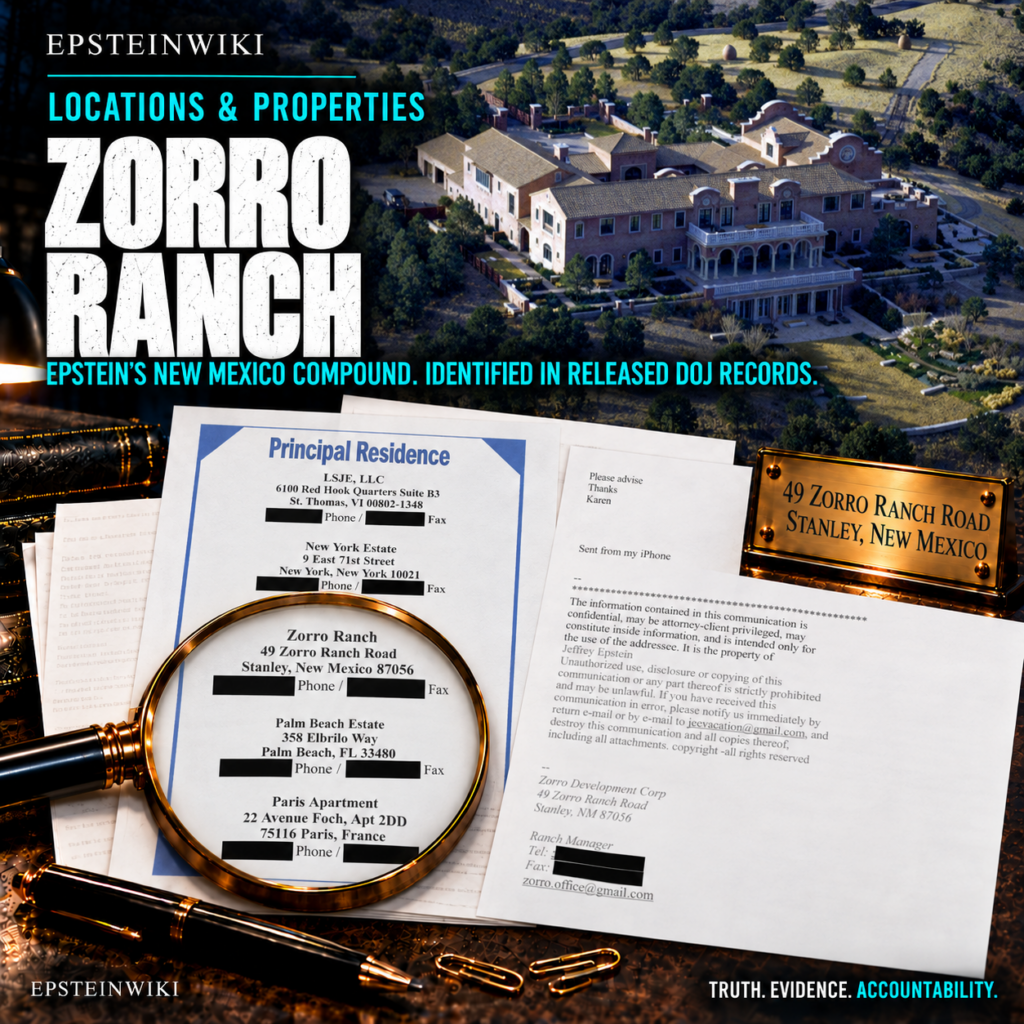
Zorro Ranch was Jeffrey Epstein’s vast private compound near Stanley, New Mexico, about 30 to 35 miles south of Santa Fe. Epstein acquired the core property through Zorro Trust on March 1, 1993. He controlled the ranch until his death in 2019, first through Zorro Trust and later through Cypress, Inc. His estate sold it in 2023 to a company associated with the family of Texas businessman and former state senator Don Huffines. The property has since been renamed San Rafael Ranch.
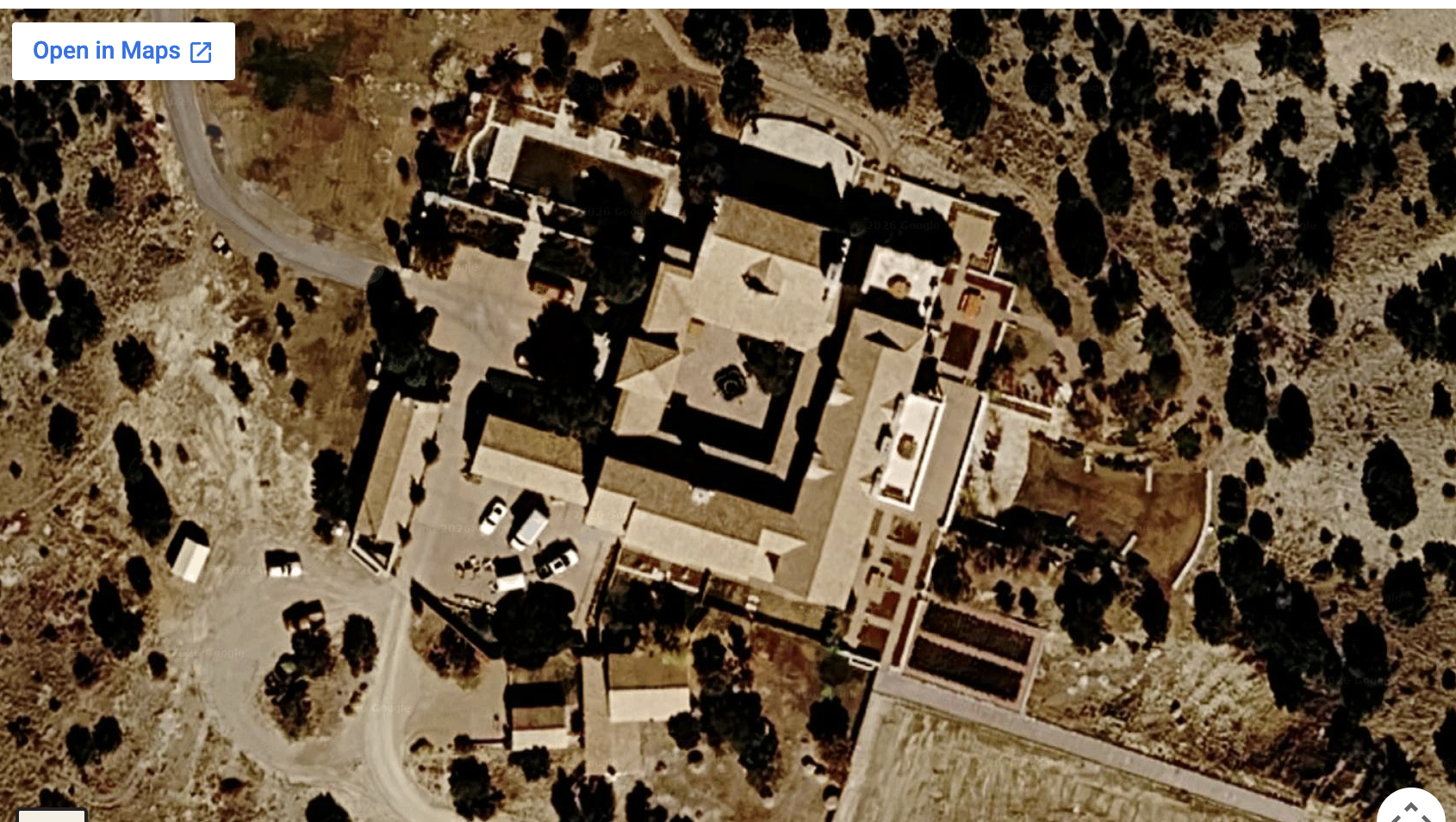
The ranch combined approximately 7,621.74 acres of privately held land with state and federal leases. It eventually contained a three story main residence, multiple guest houses and staff buildings, stables, a ranch office, a firehouse, garages, a helipad, an aircraft hangar, and a private airstrip. Its remoteness, controlled transportation, internal staff network, communications systems, and layered ownership entities made it one of the least publicly visible parts of Epstein’s property system.
Zorro Ranch is not merely a residence that happened to appear in Epstein’s records. Federal charging documents, survivor statements, FBI interviews, civil pleadings, flight logs, and the 2026 New Mexico Survivors’ Truth Commission Interim Report connect the property to grooming, interstate transportation, sexual abuse, coercion, and a wider network of employees and associates.
The Truth Commission reported that the evidence it reviewed supported the conclusion that Epstein abused at least five women and girls at Zorro Ranch between 1996 and 2012. It also identified at least 30 additional people who might have been abused, witnessed abuse, facilitated abuse, or occupied more than one of those categories. The Commission emphasized that its interim report did not make final findings and that its investigation remained active.
New Mexico opened an investigation in 2019 and interviewed possible survivors. According to later state records, federal prosecutors asked New Mexico to stop its trafficking investigation and transfer its evidence to the Southern District of New York. Federal authorities never searched the ranch. New Mexico reopened its investigation in February 2026 and conducted the first known law enforcement search of the property on March 9, 2026, with the current owners’ cooperation.
In August 2026, New Mexico sued the United States Department of Justice for access to unredacted federal records needed for its investigation. That litigation, the continuing Truth Commission inquiry, incomplete flight data, missing personnel records, and the passage of decades mean the full history of Zorro Ranch remains unresolved.
Key Takeaways
- Epstein acquired the core Zorro Ranch property in 1993 through Zorro Trust from King family companies.
- The Santa Fe County Assessor identified approximately 7,621.74 acres of privately held ranch land. State and federal leases expanded the land under ranch control.
- The ranch included a three story mansion, numerous residences and service buildings, a private airstrip, hangar, helipad, garages, stables, and extensive communications infrastructure.
- The property operated through a network that included Zorro Trust, Zorro Development Corporation, Cypress, Inc., Zorro Management, LLC, Darren K. Indyke PLLC, and Harry Beller and Richard Kahn Associates.
- The Maxwell prosecution alleged that a minor was flown to New Mexico in 1996 and groomed at the ranch. Public testimony identifies that survivor as Annie Farmer.
- A different survivor stated that Epstein flew her to the ranch when she was 15 in 2004 and sexually molested her for hours.
- Other survivors, including Chauntae Davies, Virginia Giuffre, and Juliette Bryant, publicly connected Zorro Ranch to sexual abuse or trafficking allegations.
- Juliette Bryant said Epstein trafficked her from South Africa into his property network between 2002 and 2004. She described controlled movement, women and underage girls from several countries, an invasive pelvic examination, and disturbing fragmented memories connected to Zorro Ranch.
- The 2026 Truth Commission reported evidence supporting at least five survivor accounts connected to the property between 1996 and 2012.
- The Commission identified 227 recorded flights involving Albuquerque or Santa Fe on Epstein owned aircraft between December 1992 and May 2019. Eighty of those flight entries listed no passengers. Government Exhibit 662 RR from the Maxwell trial independently preserves repeated Santa Fe and Albuquerque movements, passenger notations, and redactions from the surviving pilot logbooks.
- Federal authorities interviewed ranch manager Brice Gordon in 2007 but did not search the property after Epstein’s 2019 arrest.
- New Mexico’s 2019 investigation was halted after federal prosecutors asked the state to stand down and transfer its materials.
- The New Mexico State Land Office canceled approximately 1,243.83 acres of state leases in 2019 after Cypress, Inc. abandoned its challenge to the cancellation.
- The ranch was sold in 2023 for an undisclosed amount after listing first at $27.5 million and later at $18 million.
- New Mexico conducted the first known law enforcement search of the ranch in March 2026.
- Anonymous burial allegations remain unverified. The 2026 search using cadaver dogs and ground penetrating radar did not confirm human remains.
Ranch Profile Chart
| Field | Documented information |
|---|---|
| Historical name | Zorro Ranch |
| Current name | San Rafael Ranch or Rancho de San Rafael |
| Historical address | 49 Zorro Ranch Road, Stanley, New Mexico 87056 |
| County | Santa Fe County |
| Distance from Santa Fe | Approximately 30 to 35 miles south |
| Epstein acquisition | March 1, 1993 |
| Original holding entity | Zorro Trust |
| Later title holder | Cypress, Inc. |
| Private acreage | Approximately 7,621.74 acres according to the county assessor |
| State lease acreage | Approximately 1,243.83 acres across the principal leases discussed in state records |
| Main residence | Approximately 28,636 square feet in the 2026 Truth Commission report |
| Aviation facilities | Private airstrip, hangar, and helipad |
| Estate inventory value | Approximately $17.25 million for Cypress, Inc. and its ranch asset |
| 2021 listing price | $27.5 million |
| Reduced listing price | $18 million |
| 2023 sale price | Undisclosed |
| Current owner of record after sale | San Rafael Ranch LLC |
| Current investigation | Active New Mexico criminal investigation |
Why Zorro Ranch Matters
Zorro Ranch was one of Epstein’s principal residences. EFTA00003148 lists it with his Manhattan townhouse, Palm Beach residence, Paris apartment, and Little Saint James. Federal grand jury testimony in EFTA00008744 and EFTA00008920 confirms the ranch address and Epstein’s ownership.
The property matters because it combined extreme privacy with independent transportation and a permanent operating staff. Visitors could arrive through Albuquerque, Santa Fe, Moriarty, or the ranch airstrip. Ranch vehicles and employees could control the remaining journey. Once inside the compound, a visitor without a vehicle or independent travel arrangement was dependent on Epstein’s organization.
The ranch also matters because alleged criminal conduct there entered the federal prosecution record. The Maxwell indictment described grooming at Epstein’s New Mexico residence. Survivor statements described sexual abuse at the ranch. Employees and contractors described young women arriving by aircraft, massage arrangements, controlled access, and demands for confidentiality.
Finally, the property is a study in investigative failure. It was owned by a convicted sex offender, identified by survivors, referenced in federal files, and linked to possible state crimes. Yet no law enforcement agency searched it until 2026, after Epstein was dead, the estate had sold the property, and renovations had begun under new ownership.
Geography, Isolation, and Controlled Access
Zorro Ranch occupied high desert land near Stanley, New Mexico. Its distance from Santa Fe and Albuquerque provided privacy while remaining accessible by aircraft and private vehicle.
The compound was not an ordinary rural home. The large private acreage was interwoven with leased public land, rights of way, fences, roads, water systems, communications equipment, and aviation facilities. Buildings were distributed across the estate. Staff members lived on the property, and ranch management controlled who could enter the main residence.
Isolation does not prove criminal conduct. In this case, however, it is relevant to survivor accounts describing transportation across state lines, dependency on Epstein’s staff, and difficulty leaving. It is also relevant to the long failure of investigators to preserve physical evidence.
The current property remains private. It is not a tourist site. Trespassing can endanger visitors, interfere with an active investigation, disturb possible evidence, and violate the rights of current owners and workers.
The 1993 Acquisition
EFTA00065856, EFTA00030804, EFTA00310887, and EFTA01305252 preserve portions of the acquisition and later land record chain.
The available documents identify King Brothers Ranch, King Land and Cattle Company, and Pine Canyon Ranch, Inc. as selling entities. The New Mexico Truth Commission states that sitting Governor Bruce King and his brothers Don and Sam King sold the property and that then state Representative Rhonda King acted as the family’s realtor.
Epstein used Zorro Trust as purchaser. He executed a limited power of attorney that allowed attorney John J. Kelly to act in the transaction. Kelly later became United States Attorney for the District of New Mexico. He said in 2026 that the King family asked him to assist with a transaction involving an out of state buyer who turned out to be Epstein. Kelly denied knowing about Epstein’s criminal conduct at the time.
The exact arm’s length purchase price is not stated consistently across the public records reviewed for this page. Some secondary sources report approximately $12 million. That figure should not be treated as settled until the complete closing statement, payment record, and executed purchase agreement are matched.
The surviving documents establish the buyer, sellers, date, attorney authority, and land interests. They do not establish that the sellers or transaction professionals knew about later abuse.
The King Family Transaction
The King family connection has continuing political significance because Bruce King was governor at the time of the sale and his son Gary King later served as New Mexico Attorney General.
The property records establish a commercial transaction between King family entities and Zorro Trust. They do not establish that every King family member held the same ownership interest, attended the closing, met Epstein, visited the completed ranch, or knew how the property would later be used.
Gary King’s precise role remains disputed. Later reporting described him as connected to the sale, while the primary excerpt identifies family companies as the sellers. Gary King has said that he never visited Zorro Ranch. No verified travel or visitor record reviewed for this article disproves that statement.
The later political relationship is documented separately. Epstein, Maxwell, Darren Indyke, and Eric Gany contributed to Gary King’s 2004 congressional campaign. Zorro Trust contributed $15,000 to King’s 2006 campaign for Attorney General. King said he intended to return that contribution after Epstein was charged in Florida. The available press record does not by itself prove that the full refund occurred.
Those facts justify scrutiny of access and judgment. They do not establish that the ranch sale was corrupt or that Gary King participated in Epstein’s crimes.
Private Land, State Trust Land, and Federal Leases
The phrase “10,000 acre ranch” compresses several different legal interests. The most reliable current assessor figure for the private ranch is approximately 7,621.74 acres. State and federal leases added land used or controlled with the ranch.
| Land interest | Approximate acreage | Status or evidence |
|---|---|---|
| Privately held ranch land | 7,621.74 | Santa Fe County Assessor figure cited by the Truth Commission |
| State lease GR 2122 or predecessor GM 2791 | 1,158.97 | Grazing lease connected to the ranch |
| State lease GR 2088 | 84.86 | Lots 1 through 4 of Section 36, won by Zorro Trust in 1997 |
| Combined principal state acreage | 1,243.83 | Later canceled in the Cypress lease matter |
| Federal land assignments | Acreage not fully established | Bureau of Land Management assignments referenced in transfer files |
An owner can hold private title to one parcel while leasing neighboring public land for a specific purpose. A lease does not convey full ownership. It creates rights and duties under the lease terms.
This distinction explains why reported ranch sizes range from about 7,600 acres to nearly 10,000 acres. Researchers should identify whether a figure describes private title, state leases, federal assignments, or the entire operational footprint.
The 1996 State Trust Land Enclosure
The New Mexico State Land Office GR 2088 packet contains an October 15, 1996 memorandum stating that an 84.86 acre state parcel was fenced within Zorro Ranch.
The memorandum identified ranch spokesman Lyman Fogel. It recorded that Fogel said he had not realized the parcel was state trust land and wanted Zorro Ranch included in a competitive bid.
The agency believed the fence appeared to have been installed without authorization from the Commissioner of Public Lands. The memorandum estimated that it had been built about four years earlier. That estimate places construction around 1992, before Epstein’s March 1993 acquisition. The document therefore does not prove who built the fence.
The State Land Office opened a restrictive sealed bid. Ublivion Enterprises offered $501. Zorro Trust offered $2,000 and won. Lease GR 2088 began on February 3, 1997. Correspondence was sent to Zorro Trust, care of Jeffrey Epstein.
This episode establishes physical enclosure of state land and the administrative response. It does not establish that the fence was built to facilitate trafficking or conceal abuse.
The 2011 Transfer to Cypress, Inc.
On December 19, 2011, Zorro Trust transferred the ranch to Cypress, Inc. through a special warranty deed. EFTA00310887 contains transfer materials involving the deed, State Land Office Grazing Lease GR 2122, a state right of way, and pending federal assignments.
Cypress was a Virgin Islands corporation associated with Epstein. Darren Indyke handled the transaction with New Mexico counsel David G. Gordon of Sutin, Thayer and Browne.
The transfer occurred during a period in which several Epstein properties moved into new holding entities. The ranch remained under Epstein’s beneficial control. A deed between associated entities does not necessarily represent an arm’s length sale or new economic owner.
The verified estate inventory later valued Cypress, Inc., whose principal asset was the ranch, at approximately $17,246,208. An estate value is not a sale price and does not establish what the ranch would obtain in an open market transaction.
Ownership and Operating Entity Chart
| Entity | Documented function | Important caution |
|---|---|---|
| Zorro Trust | Original purchaser and title holder beginning in 1993 | A trust name does not disclose every beneficiary or funding source |
| Zorro Development Corporation | Employed ranch personnel and paid operating expenses | It did not necessarily hold title to every parcel |
| Cypress, Inc. | Received the ranch and associated interests in 2011 | It was an Epstein associated Virgin Islands corporation |
| Zorro Management, LLC | Held a Deutsche Bank account and supported management | Financial activity must be traced transaction by transaction |
| Darren K. Indyke PLLC | Supplied legal, scheduling, and corporate administration | A professional role does not alone prove criminal knowledge |
| Harry Beller and Richard Kahn Associates | Supplied accounting and financial administration | The complete account and payment records remain incomplete |
| San Rafael Ranch LLC | Post 2023 owner of record | Current ownership is separate from Epstein era conduct |
The entities overlapped with Epstein’s wider property network. Zorro personnel also worked on Little Saint James, and central employees managed legal, financial, aviation, and scheduling tasks across jurisdictions.
Construction of the Compound
The main residence did not exist when Epstein acquired the property. Early witnesses described a temporary structure resembling a cabin or mobile home that had been made comfortable.
According to the Truth Commission’s review of assessor records, the completed improvements eventually totaled about 50,000 square feet. The main residence was a three story structure of approximately 28,636 square feet constructed in 1999 by Bradbury and Stamm Construction.
The property also contained multiple guest houses and staff residences, stables, service structures, garages, a ranch office, a firehouse, gardens, fountains, a tennis court, a pool, a movie room, a massage room, a helipad, a hangar, and an airstrip.
Associated Press reporting used a smaller figure of approximately 26,700 square feet for the main residence. The difference may reflect assessor revisions, different measurement conventions, or source error. The later assessor based figure should be preferred while the discrepancy is disclosed.
Epstein personally monitored repairs, furnishings, communications systems, payroll, contractors, and design details. The records show an actively managed compound rather than a passive investment.
The Airstrip, Hangar, and Helipad
The aviation facilities were central to the ranch’s isolation and accessibility. Travelers could reach New Mexico through commercial or private airports, but records also show direct aviation activity associated with the ranch.
In May 2014, Zorro Trust asked the State Land Office for approval connected to adding a grass aircraft landing strip. EFTA00101509 documents the request. EFTA00101512 documents its withdrawal six days later.
The withdrawal does not prove that no runway existed. Flight records, survivor descriptions, photographs, and later property reporting establish that an airstrip and hangar operated during Epstein’s ownership. The exact construction date, permitting path, and parcel location remain unresolved.
The July and August 1997 pilot log uses the location code “ZOR” and records three direct ranch airstrip movements by a Cessna 421B registered N908GM. On July 13, the aircraft flew a ZOR to Santa Fe to ZOR training circuit with four takeoffs and four landings. On July 15, it flew from ZOR to Santa Fe. On August 1, it returned from Santa Fe to ZOR, with “Kirsty Rodgers” written in the remarks.
This is direct evidence that the ranch airstrip was operating by 1997. It also identifies an aircraft capable of using it. The Cessna 421B was a pressurized twin engine light passenger aircraft, not a small single engine Cessna. The exhibit does not establish whether larger Epstein aircraft ever landed at ZOR.
The helipad was incorporated into a labyrinth garden. Aviation records and ranch scheduling should be compared with fuel receipts, maintenance logs, local airport records, aircraft transponder data, and employee vehicle logs.
Ranch Operations and Staffing
The ranch required a permanent operating structure. Zorro Development Corporation employed managers, ranch hands, housekeepers, maintenance workers, cooks, drivers, construction personnel, and specialists.
The Truth Commission identified Brice Gordon and Karen Gordon as central ranch managers. Other documented personnel included Carlos Delgado, Amber Chavez, Steve Chavez, Cynthia Cano, Bradley Royster, Manolito Royal, Wendy Martinez, Wendy Nun, and other employees whose roles or full names remain incomplete.
Central Epstein staff also supported ranch operations. Ghislaine Maxwell managed properties and travel. Darren Indyke handled legal and corporate affairs. Richard Kahn handled accounting and finance. Lesley Groff and Sarah Kellen coordinated schedules and travel. Nadia Marcinkova assisted with logistics. Larry Visoski and David Rodgers handled aircraft operations.
The Commission found that Epstein employed about 50 people across his properties at any given time, with an annual combined payroll of approximately $7 million. That figure describes the wider system, not the Zorro payroll alone.
Few known ranch employees were interviewed by law enforcement. That gap is significant because staff could identify rooms, travel routines, contractors, guests, vehicles, aircraft movements, security systems, and instructions concerning women and girls.
Privacy, Nondisclosure Agreements, and Access Control
Employees and contractors described restrictions on access to the main house. Some workers entered through a rear mudroom and were not permitted in most other rooms. Staff members lived on the property and used ranch vehicles and issued phones.
The records state that Epstein required employees and contractors to sign nondisclosure agreements, officially to protect the privacy of celebrity guests. A reflexologist said she repeatedly refused to sign one and eventually stopped visiting.
Ranch management monitored outside contacts and quickly reported press inquiries to Epstein. EFTA01790757 records a manager informing Epstein that a reporter contacted the reflexologist seeking information about him and Maxwell.
Confidentiality agreements are not proof of trafficking. In a documented abuse network, however, they are relevant to witness access, delayed reporting, information control, and whether employees believed they could speak safely.
Communications and Surveillance Infrastructure
The ranch maintained employee cell and landline directories. EFTA02098147 documents Karen Gordon circulating updated ranch contact information in 2014.
Epstein’s sex offender notification records listed dozens of landlines across his residences. The 2012 update listed 89 landlines, one cell phone, ten vehicles, eleven boats, three aircraft, four websites, two Twitter accounts, and seventeen other social media accounts.
The ranch used dedicated data lines, satellite service, microwave links, and a relay through Sandia Crest. EFTA01206653 and related communications document parts of that architecture. Jermaine Ruan, Brice Gordon, Greg Wyler, local communications contractors, and CenturyLink personnel appear in the development history.
The infrastructure shows the technical capacity for reliable communications at an isolated property. It does not prove that the system was used for surveillance, abuse, or evidence destruction. Released records have not supplied a complete camera map, server inventory, retention policy, or recovered data archive.
Survivor Evidence Overview
The 2026 Truth Commission organized five survivor reports connected to Zorro Ranch. It anonymized them in the interim report, even when some identities were publicly known elsewhere. Public interviews, reporting, and court records identify additional survivors whose ranch accounts must be considered separately from the Commission’s five summaries.
| Survivor designation | Period described | Public record summary | Evidence type |
|---|---|---|---|
| Jane Doe 1 | 1996 | Minor flown to New Mexico, groomed by Epstein and Maxwell, massage conduct described | FBI interview, Maxwell indictment, bail testimony |
| Jane Doe 2 | 1999 to early 2000s | Professional massage therapist described sexual conduct with Epstein and work at the ranch | FBI and media interview |
| Jane Doe 3 | 2004 | Survivor said Epstein flew her to the ranch at age 15 and sexually molested her | Sentencing statement, EFTA record |
| Jane Doe 4 | Multiple visits | Survivor described ranch abuse and alleged trafficking to Bill Richardson | Survivor writing and deposition testimony |
| Jane Doe 5 | 2007 to 2010 | Civil complaint alleged repeated transportation to the ranch and coerced sex | Federal civil pleading |
| Chauntae Davies | About 2002 to 2004 | Publicly stated that most assaults against her occurred at the ranch | Public survivor interviews and court statement context |
| Juliette Bryant | 2002 to 2004 | Described trafficking to New Mexico, controlled movement, an invasive examination, and fragmented memories of a laboratory setting | Survivor interviews, federal civil docket, and estate claim |
These records are not interchangeable. Each account has a separate date range, evidentiary source, legal posture, and degree of public identification.
Annie Farmer and the 1996 Grooming Evidence
The Maxwell indictment alleged that Minor Victim 2 was under 18 when Epstein invited her from another state to New Mexico in 1996. It alleged that Maxwell knew her age, discussed her school and family, took her shopping and to a movie, gave her an unsolicited massage while she was topless, and encouraged her to massage Epstein.
The public trial record identifies this survivor as Annie Farmer. Farmer testified at Maxwell’s trial about the New Mexico visit. Her account was part of the prosecution that ended in Maxwell’s conviction, although a verdict on conspiracy counts does not convert every detail of every witness account into a separate verdict concerning the ranch.
EFTA00162543 contains a 2006 FBI interview describing the 1996 trip and related conduct. EFTA01659401, EFTA01659462, and EFTA01659412 preserve charging and detention records addressing New Mexico conduct.
Farmer’s account is critical because it places alleged grooming at the ranch only three years after Epstein acquired the property and before the large main residence was completed.
Jane Doe 2 and the Professional Massage Evidence
Jane Doe 2 told investigators that she began working at Zorro Ranch as a professional massage therapist in 1999. She said she visited for about three years and became friendly with the house manager.
She recalled massaging Epstein, Maxwell, younger women who appeared to be models, and several guests. She remembered photographs of topless women inside the house and said massages with Epstein became sexual.
She said she was later given a nondisclosure agreement, did not sign it, and stopped going to the ranch. Her account illustrates how legitimate licensed massage work could overlap with Epstein’s sexualized environment without proving that every therapist or client knew the full nature of his conduct.
EFTA00153855 is among the records cited by the Truth Commission for this account.
The Survivor Flown to the Ranch at Age 15
Jane Doe 3 told a federal court that Epstein flew her to Zorro Ranch in 2004 when she was 15 and sexually molested her for hours. She described Epstein presenting the abuse as beneficial to her and using photographs of powerful people to reinforce his status.
She also described riding all terrain vehicles with another girl the next day and being told that nobody got in trouble at the ranch. That detail does not independently identify the other girl or prove what she experienced. It does show another young person present during the survivor’s account.
EFTA00020068 preserves the statement cited by the Truth Commission.
The account is separate from Annie Farmer’s 1996 experience. Combining them would erase distinct survivors and distort the chronology.
Virginia Giuffre and Jane Doe 4
The Truth Commission’s Jane Doe 4 summary describes a survivor who wrote about manicured grounds, fountains, a tennis court, a grass airstrip, a hangar, and a miniature town housing staff. She said Epstein called the main house his castle.
The report connects the account to deposition testimony by Virginia Giuffre. Giuffre alleged that Epstein and Maxwell trafficked her to New Mexico and directed her to have sex with former Governor Bill Richardson.
Richardson denied Giuffre’s allegation. He was never criminally charged in connection with Epstein or Zorro Ranch. A deposition allegation is evidence of what Giuffre stated under oath, not a judicial finding that Richardson committed the alleged act.
Giuffre’s description remains valuable for the physical layout, transportation system, staffing environment, and way the compound appeared to a young person brought there through Epstein’s network.
Jane Doe 5 and the 2007 to 2010 Allegations
Jane Doe 5 alleged in a federal civil lawsuit that Epstein took her to Zorro Ranch multiple times between 2007 and 2010, when she was in her early twenties.
Her complaint described financial vulnerability, coercive control, sexual activity with Epstein and other people, restrictions on clothing, career, and food, and commercial sexual activity in New York, Florida, the Virgin Islands, and New Mexico.
EFTA01249981 contains the civil pleading cited by the Truth Commission.
The pleading is a formal allegation, not a trial verdict. It nevertheless shows that the ranch remained part of the alleged trafficking system after Epstein’s 2008 conviction and while he was subject to sex offender requirements.
Chauntae Davies
Chauntae Davies has publicly identified Zorro Ranch as the location of most of the assaults she attributes to Epstein. In a 2026 BBC Newsnight interview, she described the ranch as cold, dark, eerie, and associated with her darkest memories.
Davies entered Epstein’s orbit as a professional massage therapist after meeting Maxwell in Beverly Hills. She has described rape and repeated abuse over approximately three years. Her age as an adult does not diminish the violence or coercive power she described.
Davies’s account is important because it addresses the ranch directly and publicly. It should not be merged with the separate history of her sister Teala Davies or attributed to an anonymous Jane Doe without evidence.
The released administrative records establish Davies’s contact with Epstein’s organization during the relevant period. They do not independently adjudicate every assault she described.
Juliette Bryant and the 2002 to 2004 Trafficking Account
Juliette Bryant has publicly said that Epstein’s network recruited her in Cape Town, South Africa, in 2002 when she was a 20 year old university student and part time model. She said Epstein promised access to modeling opportunities, his staff arranged her visa and travel, and she was sexually assaulted aboard his aircraft soon after reaching the United States.
Bryant said Epstein trafficked her through his properties for approximately two years, including Little Saint James, New York, Palm Beach, Paris, and Zorro Ranch. In a 2026 Sky News interview, she said that she encountered women and underage girls from Brazil, Romania, France, and Spain during trips to Epstein’s properties, including New Mexico. Her statement documents what she recalls witnessing. It does not, by itself, identify those people or establish their ages and experiences.
Bryant described Zorro Ranch as a controlled environment in which Epstein monitored her movements. In a 2026 Daily Maverick account, she reported an invasive pelvic examination by Epstein, waking in a laboratory, seeing people in protective suits, and experiencing disorienting gaps in memory. She also described a cowboy themed village, cabins, and a saloon on the property.
These medical and laboratory allegations are serious, but the public record reviewed for this article does not independently corroborate them with medical records, identified witnesses, laboratory records, or recovered physical evidence. They must be reported as Bryant’s account rather than as proven medical experimentation. Her fragmented recall is itself relevant to a trauma informed investigation and should not be embellished beyond what she has chosen to disclose.
Bryant filed the federal civil action Bryant v. Indyke, 1:19 cv 10479 in 2019 and joined other survivors in a claim against Epstein’s estate. She later received compensation through the Epstein Victims’ Compensation Program and a separate settlement connected to JPMorgan Chase. Those proceedings establish that she formally pursued claims and received compensation. They do not constitute a judicial finding that every reported event at Zorro Ranch occurred exactly as remembered.
Bryant’s testimony materially expands the Zorro Ranch record. It connects the ranch to international recruitment from South Africa, the movement of women and girls across several Epstein properties, alleged invasive medical conduct, and conditions that may have affected memory and reporting. Investigators should seek travel records, employee testimony, medical supplies, room plans, photographs, security records, and surviving laboratory or clinical documentation capable of testing her account.
The Reflexologist Interview and Corroborating Context
A reflexologist interviewed in 2021 described working at the ranch over several years. She said Maxwell asked her to recommend another practitioner but specified that the person had to be attractive.
The witness recalled seeing approximately four young women arrive together, escorted by staff, apparently after aircraft travel. She estimated that they were about 18 or younger. She also described helping train a young massage therapist and repeated efforts to make her sign a nondisclosure agreement.
EFTA00090043 through EFTA00090084 contain portions of the interview family cited by the Truth Commission.
This testimony can corroborate environmental features of survivor accounts, including young arrivals, massage recruitment, staff coordination, and confidentiality pressure. It does not identify every young woman or prove that each was abused.
Maxwell’s Conviction and the New Mexico Conduct
The federal indictment against Ghislaine Maxwell expressly alleged grooming activity at Epstein’s New Mexico residence. Annie Farmer testified during the 2021 trial.
Maxwell was convicted of five federal offenses involving conspiracy, transportation, trafficking, and the sexual abuse of minors. She was sentenced to 20 years in prison. The Department of Justice sentencing announcement summarizes the grooming methods proven at trial.
The verdict is legally significant to the Zorro Ranch record because the charged scheme included New Mexico conduct. It does not mean Maxwell was convicted of a separate property specific offense for every event alleged at the ranch.
Epstein was never tried for the 2019 federal charges because he died in custody. No New Mexico prosecution adjudicated his conduct at Zorro Ranch.
Flight Activity Chart
The Truth Commission counted 227 flights between December 3, 1992, and May 27, 2019, to or from Albuquerque and Santa Fe on Epstein owned aircraft. Two flights between the two New Mexico airports appear in both location totals.
| Passenger or record category | Recorded flights |
|---|---|
| Jeffrey Epstein | 140 |
| Ghislaine Maxwell | 94 |
| Sarah Kellen | 44 |
| Nadia Marcinkova | 21 |
| Bill Richardson | 5 |
| Lesley Groff | 5 |
| Woody Allen and Soon Yi Previn | 2 |
| Bill Clinton | 1 |
| Entries with no passenger information | 80 |
A flight to Albuquerque or Santa Fe does not prove a visit to Zorro Ranch. Some passengers may have traveled elsewhere. A person recorded on a flight is not thereby implicated in a crime.
The logs are also incomplete. Emails place Epstein in New Mexico on additional occasions for which the Commission found no corresponding flight entry.
Maxwell Trial Flight Log Exhibit
Government Exhibit 662 RR is a 118 page collection of handwritten pilot logbook pages admitted in United States v. Maxwell. The exhibit covers aviation activity from 1991 through 2006 and includes dates, aircraft, departure and arrival codes, flight numbers, pilot remarks, passenger initials, occasional full names, and numerous redactions.
The exhibit is important because it allows the New Mexico flight record to be checked against contemporaneous handwritten entries rather than relying only on a later spreadsheet or summary. It does not replace the Truth Commission count. The Commission reviewed a broader record extending through 2019, while this exhibit ends in 2006 and contains redacted or incomplete passenger information.
Selected New Mexico Sequences Confirmed by the Exhibit
| Dates | Recorded sequence | Aircraft | Passenger notation in the pilot remarks | Exhibit page |
|---|---|---|---|---|
| March 1 and 2, 1995 | Teterboro to Santa Fe to Palm Beach | Gulfstream G 1159B, N908JE | JE, GM, Andy, and Jack on the inbound leg. JE, GM, and Andy on the outbound leg. | EFTA02846492, PDF page 33 |
| January 20 and 21, 1996 | Palm Beach to Santa Fe to Los Angeles | Gulfstream G 1159B, N908JE | JE and GM on both legs | EFTA02846498, PDF page 39 |
| March 25 and 27, 1998 | Teterboro to Santa Fe to Palm Beach | Gulfstream G 1159B, N908JE | JE, GM, and ET on the inbound leg. The outbound notation adds Doug Schoettle. | EFTA02846513, PDF page 54 |
| February 14 through 21, 1999 | Palm Beach to Santa Fe to Van Nuys to Monterey to Santa Fe to Teterboro | Gulfstream G 1159B, N908JE | The February 21 Santa Fe departure lists JE, GM, Jennifer, Sharon, and Clementine. The log records only the first name Clementine. It does not independently establish that this was Clementine Hambro. | EFTA02846521, PDF page 62 |
| November 11 through 14, 1999 | Teterboro to Santa Fe to Van Nuys to San Diego to Santa Fe to Teterboro | Gulfstream G 1159B, N908JE | The first leg lists JE, GM, AP, Alberto Pinto, and one male. Later legs contain narrower passenger notations. | EFTA02846529, PDF page 70 |
| March 29 and 31, 2001 | Teterboro to Santa Fe to Palm Beach | Gulfstream G 1159B, N909JE | The inbound entry lists JE, GM, AP, VR, BK, Marvin Minsky, and Henry Jarecki. The return entry lists JE, GM, AP, VR, Henry Jarecki, and a blacked out block. | EFTA02846540, PDF page 81 |
| July 16, 2001 | A repositioning flight to Santa Fe, followed by Santa Fe to Teterboro | Gulfstream G 1159B, N908JE | The Santa Fe departure lists JE, GS, GM, and VR. The log does not expand the initials. | EFTA02846544, PDF page 85 |
| August 7 and 16, 2001 | LaGuardia to Albuquerque, followed nine days later by Albuquerque to Palm Beach | Boeing 727, N908JE | The inbound entry lists JE, GM, ET, AP, and two females. The departure entry lists JE, GM, ET, AP, Jonathan Mando, and one notation that is not sufficiently clear to identify. | EFTA02846544, PDF page 85 |
| February 28 and March 4, 2003 | Moriarty to Albuquerque, followed by Albuquerque to John F. Kennedy Airport | Boeing 727, N908JE | The March 4 departure lists JE, GM, SK, ET, Juliette Bryant, and at least one additional name that is difficult to read. Bryant is written by full name. | EFTA02846559, PDF page 100 |
| June 23 through July 4, 2004 | Teterboro to Santa Fe to Las Vegas to Santa Fe to Aspen to Palm Beach | Gulfstream G 1159B, N909JE | The remarks include initials and blacked out entries. The redacted identities should not be reconstructed without an independent, survivor safe source. | EFTA02846569, PDF page 110 |
These sequences establish repeated use of both Santa Fe and Albuquerque as New Mexico aviation gateways. They also show that New Mexico travel was sometimes part of a longer chain involving Palm Beach, Teterboro, Los Angeles, Van Nuys, San Diego, Las Vegas, or Aspen.
The paired arrivals and departures can help investigators define possible New Mexico stay windows. For example, the aircraft arrived in Santa Fe on March 25, 1998, and departed on March 27. The Boeing 727 arrived in Albuquerque on August 7, 2001, and a recorded Albuquerque departure followed on August 16. Those intervals are investigative windows, not proof that every listed traveler spent the entire period at Zorro Ranch.
The passenger field requires special care. Initials may be ambiguous. Full names can be misspelled. A notation such as “two females” does not identify the travelers. Blacked out entries may protect survivors or other private individuals. EpsteinWiki does not use contextual guessing to unmask them.
The March 2001 rows are especially sensitive. The log writes VR and BK rather than full names. Other flight log research commonly interprets VR as Virginia Roberts and BK as Banu, but the handwritten page alone does not prove those expansions. The presence of a blacked out passenger field also does not establish that the person was a minor or the survivor who testified at Maxwell’s trial. That possibility may be investigated through unredacted records, but it should not be presented as a confirmed identification.
The March 4, 2003 Albuquerque departure is different because the pilot wrote Juliette Bryant’s full name. It independently confirms that Bryant was aboard an Epstein aircraft leaving New Mexico during the period covered by her trafficking account. It does not, by itself, establish where she stayed before reaching Albuquerque or what occurred there.
The exhibit also does not record the final ground destination after an airport arrival. A Santa Fe or Albuquerque entry does not prove that a passenger entered Zorro Ranch. It does not identify the driver, vehicle, route, lodging, or activity after landing. Those questions require comparison with calendars, ranch schedules, telephone records, fuel and vehicle records, staff testimony, airport service records, and survivor evidence.
The exhibit therefore strengthens the transportation timeline while leaving the central limitation intact: airport presence is evidence of travel, not automatic evidence of ranch presence or criminal conduct.
Guests, Visitors, and the Limits of Presence Evidence
Calendars and emails document planned ranch visits by politicians, scientists, academics, businesspeople, entertainers, staff, contractors, and friends. EFTA01754675 records a 2013 ranch calendar involving Martin Nowak. EFTA01874132 discusses a 2012 flight from East Hampton to New Mexico with arrival planning at Moriarty Airport.
Public reporting has identified additional planned or completed visits involving people such as Reid Hoffman, Joi Ito, Peter Thiel, Robert Redford, Woody Allen, Soon Yi Previn, and others. Each name requires its own primary record and context.
Three distinctions are essential:
- A proposed invitation is not proof of attendance.
- A flight to a New Mexico airport is not proof of entering the ranch.
- Presence at the ranch is not proof of knowledge, abuse, trafficking, or another crime.
A defensible visitor index should record the source, date, route, property confirmation, accompanying people, and what the document actually establishes.
Science, Philanthropy, and Intellectual Prestige
Epstein cultivated scientists and academic leaders as part of his public identity. The Santa Fe area gave him access to the Santa Fe Institute, Los Alamos related scientific circles, and visiting researchers.
Ranch calendars and correspondence document science related visitors and meetings. Martin Nowak’s August 2013 visit appears in EFTA01754675. Other emails connect Epstein to scientists who discussed travel, research, philanthropy, or private gatherings.
Scientific prestige served multiple functions. It gave Epstein social legitimacy, surrounded him with influential guests, and supported his preferred image as a patron of advanced thinking. It also exposed institutions to reputational and ethical risk when they accepted his money or hospitality after his conviction.
Attendance at a scientific discussion does not establish knowledge of abuse. The accountability question is whether individuals or institutions ignored credible warnings, continued accepting benefits after 2008, or helped preserve Epstein’s access to vulnerable people.
The Eugenics and Reproductive Scheme Reports
In 2019, the New York Times reported that Epstein told scientists and associates he wanted to use the New Mexico ranch to impregnate multiple women with his sperm and spread his DNA. The plan was widely described as a eugenics or transhumanist fantasy.
The report is relevant because Epstein connected the proposed scheme specifically to Zorro Ranch and discussed it within his scientific social network.
No reviewed evidence establishes that he implemented a program to impregnate women at the ranch. There is no verified roster of participants, clinic record, consent documentation, birth record, or completed facility proving that the reported idea became operational.
The responsible formulation is that Epstein reportedly described the plan to several people and that no evidence has established its execution. Calling the ranch a confirmed baby farm converts a reported ambition into an unsupported fact.
Photographic and Digital Evidence
The 2019 Manhattan townhouse search recovered compact discs with labels containing the word Zorro. The search warrant record cited by the Truth Commission included discs with sexualized labels and at least one Zorro related photo label. EFTA01648851 preserves related search material.
A seized device catalog in EFTA00004477 listed a folder called ZORRO alongside other folders organized by locations, regions, women, or sexualized descriptions.
Folder names and handwritten disc labels are evidence of organization and possible content categories. They do not prove what every file contained, who created it, whether it depicted a crime, or where an image was taken.
The absence of a timely ranch search created a major evidentiary gap. Public records do not establish that federal agents obtained every ranch computer, camera system, server, phone, storage device, photo album, security log, or backup.
Firearms at the Ranch
The Truth Commission identified evidence that Epstein maintained control over firearms at Zorro Ranch after his 2008 felony conviction.
The records include a 2009 security policy intended to prevent Epstein from possessing firearms, communications about gun cabinets and shooting supplies, and a 2018 inventory after firearms were reportedly stolen.
The Commission stated that the evidence implicated possible federal and state firearms violations. That conclusion is an investigative assessment, not a conviction. No reviewed record shows that Epstein was charged with a firearm offense in New Mexico.
Firearm records matter for more than a separate possession question. They can identify security personnel, rooms, storage systems, access authority, incident reports, and employees present during the relevant years.
Sex Offender Registration in New Mexico
After Epstein completed custody and supervision in Florida, the Florida Department of Law Enforcement notified New Mexico that he had identified Zorro Ranch as a forwarding address.
On July 23, 2010, the New Mexico Department of Public Safety told Epstein to register with the Santa Fe County Sheriff within ten days after establishing residence. EFTA00728275 preserves the initial notice.
Epstein completed a New Mexico registration form on August 17, 2010. He was described as a temporary resident. Two days later, state officials advised that his Florida conviction did not require registration under the listed New Mexico statute, although federal SORNA duties might still apply.
Between December 2010 and July 2015, Epstein or Indyke contacted the Santa Fe County Sheriff’s Office on 13 occasions to provide notice of intended presence in New Mexico. Internal instructions reminded staff that Epstein had to notify a detective before going to the ranch.
The Truth Commission questioned whether federal verification duties were properly enforced. It had not located proof that required recurring photographs and in person verification occurred.
Political Access and Campaign Contributions
Epstein and people or entities associated with him made political contributions in New Mexico. The record includes money connected to Jim Baca, Bill Richardson, and Gary King, as well as later communications involving King’s campaigns.
EFTA01481096, EFTA01480610, and EFTA01481014 are among the released financial records relevant to New Mexico political giving.
The Gary King record is especially significant. In 2004, Epstein, Maxwell, and Indyke each made two $2,000 contributions to King’s congressional campaign. Eric Gany contributed $2,000. In 2006, Zorro Trust contributed $15,000 to King’s Attorney General campaign.
In 2010, an Attorney General employee arranged a meeting between King and Epstein in Santa Fe. In 2014, a campaign letter thanked Epstein for a $50,000 fundraising commitment. After Indyke warned about press risk connected to King’s child protection messaging, Epstein wrote that companies or trusts should be used. Epstein associated companies later contributed to the campaign.
These records establish political access and financial support. They do not prove a quid pro quo, corruption, participation in trafficking, or intervention in a specific investigation.
The 2007 FBI Interview at the Ranch
On February 8, 2007, FBI agents interviewed ranch manager Brice Gordon. EFTA01688746 records the interview.
Gordon reportedly said Epstein spent about 50 days a year at the ranch, sometimes brought massage therapists with him, and also used local massage providers. The interview ended after Gordon received a telephone call from the main office.
This record proves that federal agents reached the ranch and questioned a manager during the Florida investigation. It was not a physical evidentiary search of the compound.
The interview also creates unanswered questions about who placed the call, why the conversation ended, what follow up occurred, whether local law enforcement was notified, and whether agents identified the massage providers Gordon described.
The 2019 New Mexico Investigation
New Mexico began reviewing possible crimes connected to Zorro Ranch in 2019. The state later said its investigators and attorneys contacted and interviewed survivors who reported sexual abuse in New Mexico by Epstein, associates, or former ranch contractors.
The State Land Office provided more than 400 pages of lease records to the Attorney General in July 2019. Those materials addressed public land, access, improvements, leases, and compliance.
The state notified federal authorities that it was investigating and sought coordination. It also raised the possibility that some matters would fall within exclusive federal jurisdiction.
The investigation did not produce New Mexico charges. Later records show that the absence of charges cannot be reduced to a conclusion that nothing happened. The state transferred its evidence and stopped its trafficking work after federal intervention.
The Federal Stand Down Request
The 2026 New Mexico complaint against the Justice Department provides the clearest official account of the 2019 breakdown.
On May 14, 2019, New Mexico informed federal officials that it was actively investigating and asked to coordinate. Federal officials initially said they were not in a position to share information.
During a July 23, 2019 call, federal prosecutors told New Mexico to stand down. Federal records state that New Mexico agreed to cease its sex trafficking investigation and provide what it had gathered to the Southern District of New York.
New Mexico transferred its investigative file on September 17, 2019. The package included police reports, recorded witness interviews, correspondence, and public land records. Federal authorities were expected to refer evidence of state crimes back to New Mexico.
The state alleges that the promised information never arrived. That allegation is central to the pending federal lawsuit and has not yet been finally adjudicated.
State Land Lease Cancellation
After Epstein’s 2019 arrest, Land Commissioner Stephanie Garcia Richard reviewed the ranch’s state leases. The State Land Office questioned whether the land was genuinely used for grazing and sought access to inspect it.
The state moved to cancel the leases after Cypress, Inc. denied or restricted inspection access and disputed the agency’s authority. The land involved totaled approximately 1,243.83 acres.
The State Land Office cancellation announcement states that Cypress abandoned its challenge. The state then regained control of the leased acreage.
Cancellation of a grazing lease is an administrative land action. It is not a criminal forfeiture and does not prove trafficking on the leased parcels. It does establish a serious dispute over public land use, inspections, and privacy surrounding the ranch.
Why Federal Authorities Did Not Search the Ranch
Federal records show that investigators discussed Zorro Ranch after Epstein’s arrest. EFTA00165502 records an August 2019 communication acknowledging a survivor who may have been raped at the New Mexico residence while asserting that agents lacked probable cause to search it.
The New Mexico complaint alleges that federal authorities never searched the ranch, seized it, or preserved its physical evidence. State officials repeatedly asked federal prosecutors to consider seizure for the benefit of survivors.
The probable cause statement explains the stated legal position at one moment. It does not show whether investigators later sought additional evidence, prepared an affidavit, used a subpoena, requested consent, or revisited the decision after Maxwell’s arrest and conviction.
The failure had irreversible consequences. By the time the state searched the property in 2026, Epstein had been dead for more than six years, staff had dispersed, the estate had sold the ranch, and the new owners had begun renovations.
Estate Administration and the 2023 Sale
Epstein’s estate listed Zorro Ranch in 2021 for $27.5 million. The asking price was later reduced to $18 million.
The estate sold the property in August 2023. Estate attorney Daniel Weiner confirmed the sale and said the proceeds would be used to administer the estate and pay creditors. The buyer and estate did not publicly disclose the sale price in the initial announcement.
Santa Fe County records identified San Rafael Ranch LLC as the new owner. Later reporting connected the company to the Huffines family.
| Transaction stage | Amount or status |
|---|---|
| Estate inventory value for Cypress | Approximately $17.25 million |
| Initial 2021 asking price | $27.5 million |
| Reduced asking price | $18 million |
| 2023 sale price | Undisclosed |
An asking price is not a sale price. The estate inventory value is also not proof of market value. The final closing statement, deed consideration, broker commission, tax filings, and distribution ledger are needed to determine net proceeds.
Current Ownership and San Rafael Ranch
The Huffines family renamed the property San Rafael Ranch after a saint associated with healing. Don Huffines said the family intended to create a Christian retreat and reclaim the property for a beneficial purpose.
The current owners have stated that they had no prior connection to Epstein and agreed to cooperate with law enforcement. The March 2026 state search occurred with their cooperation.
The Truth Commission reported that renovations had been completed or were underway. Renovation can complicate historical analysis because rooms, surfaces, landscaping, utilities, and storage areas may change. That does not establish that the current owners destroyed evidence or acted improperly.
Current owners and workers are not responsible for Epstein’s conduct merely because they now control the former property. Accountability requires precise separation between Epstein era activity and post sale use.
The New Mexico Survivors’ Truth Commission
The New Mexico House created a bipartisan Survivors’ Truth Commission in February 2026 by a unanimous 62 to 0 vote. The Commission received subpoena authority and a budget exceeding $2 million.
Its mandate extends beyond identifying abuse. It examines trafficking, institutional failures, political influence, medical and scientific improprieties, financial crimes, land use, government response, and possible remedies for survivors.
The Commission issued subpoenas to government agencies, financial institutions, research bodies, and other record holders. It reported receiving more than 100,000 records while several subpoenas remained unanswered.
The August 2026 interim report expressly states that its allegations and information are not final findings. It is an investigative roadmap and preliminary evidence synthesis.
That distinction matters. The report is an authoritative government document for what the Commission reviewed and concluded provisionally. It is not a criminal judgment against every person named.
The March 2026 Search
New Mexico Attorney General Raúl Torrez reopened the criminal investigation on February 19, 2026. On March 9, investigators conducted the first known law enforcement search of Zorro Ranch.
The search occurred with cooperation from the current owners. Investigators reportedly used cadaver dogs and ground penetrating radar while examining the property for evidence relevant to abuse, trafficking, and other possible crimes.
The state has not publicly announced the recovery of human remains or filed criminal charges based on the search. Silence about evidence does not prove that nothing was collected. Active investigations commonly restrict disclosure.
The search was historically important but severely delayed. Its value depends on what areas remained intact, what records were preserved, whether former staff can authenticate locations, and whether recovered material can be tied to a person, date, or offense.
The Burial Allegations
Two separate public claims have fueled speculation about burials at the ranch.
First, a person claiming to be former staff sent an anonymous encrypted email in November 2019 alleging that two foreign girls were buried at the property. The sender demanded one bitcoin for a supposed video archive and imposed a payment deadline. EFTA00067066 and EFTA01250229 contain records associated with the allegation.
Second, a self described trespasser claimed to have seen grave like excavations in 2020 and later supplied photographs to journalists.
Neither claim has been verified. The bitcoin demand creates an obvious credibility concern. The trespasser’s interpretation of disturbed ground is not forensic evidence.
The 2026 search using cadaver dogs and ground penetrating radar did not confirm human remains. Unless law enforcement announces a verified recovery, EpsteinWiki should not state that bodies were buried at Zorro Ranch.
State of New Mexico v. United States Department of Justice
On August 5, 2026, New Mexico filed State of New Mexico v. United States Department of Justice, No. 1:26 cv 02762, in federal court in the District of Columbia.
The state alleges that the Justice Department failed to provide unredacted records needed to identify survivors, witnesses, possible accomplices, and criminal conduct. The requested materials include EFTA00006970, EFTA00008631, EFTA00068582, EFTA01873236, and EFTA02731082.
New Mexico says it followed the federal Touhy process for requesting agency records and offered to review files under security and confidentiality restrictions. The complaint seeks Administrative Procedure Act review, declaratory relief, and an order requiring lawful action on the request.
The Justice Department has cited privacy obligations and court restrictions affecting survivor identifying material. Protecting survivors and giving investigators lawful access are not mutually exclusive. Records can be reviewed under protective conditions without public disclosure of survivor identities.
No reviewed final judgment has resolved the case. The complaint states New Mexico’s allegations against the federal government.
Evidence Strength Chart
| Claim | Assessment | Basis |
|---|---|---|
| Epstein controlled Zorro Ranch from 1993 until his death | Confirmed | Purchase, deed, corporate, estate, and address records |
| The private ranch contained approximately 7,621.74 acres | Strongly supported | County assessor record cited by the Truth Commission |
| The operational footprint approached 10,000 acres | Supported with qualification | Private land plus state and federal lease interests |
| Zorro Trust purchased the ranch from King family entities | Confirmed | Purchase and power of attorney records |
| The exact 1993 purchase price was $12 million | Not fully verified | Secondary reporting exists, but complete closing proof was not reviewed |
| Cypress received the ranch in 2011 | Confirmed | Special warranty deed and assignment package |
| Minors were transported to and abused at the ranch | Strongly supported | Survivor statements, FBI records, charging documents, and trial evidence |
| At least five women and girls were abused there from 1996 to 2012 | Truth Commission preliminary conclusion | Interim government report, not a final judicial finding |
| Juliette Bryant was transported to Zorro Ranch | Supported as a survivor account | Public interviews, a federal civil docket, and an estate claim document her broader trafficking history |
| Bryant was subjected to medical experimentation at the ranch | Not independently established | Bryant described an examination and laboratory memories, but corroborating medical or physical evidence has not been made public |
| Every New Mexico flight passenger visited the ranch | False | Airport travel does not prove property entry |
| Every ranch visitor knew about abuse | Not established | Presence alone does not establish knowledge |
| Federal agents searched the ranch in 2019 | False based on reviewed record | State and federal records say no search occurred |
| New Mexico was asked to halt its 2019 trafficking investigation | Strongly supported | Federal and state correspondence cited in the 2026 complaint |
| Human remains were found in 2026 | False based on public record | No remains were confirmed |
| Epstein carried out a reproductive breeding program at the ranch | Not established | Reported plan exists, but no evidence proves implementation |
| The 2023 sale price is public | False | Estate and press reports say it was undisclosed |
| The current owners cooperated with the 2026 search | Confirmed | State announcement and reporting |
What the Evidence Establishes
The record establishes that Epstein acquired the ranch through a trust in 1993, built a major private compound, layered its ownership and operations through several entities, and maintained it for more than 25 years.
It establishes that minors and adults were transported to the ranch and that survivors described grooming, sexual assault, coercion, and trafficking there.
It establishes that Maxwell participated in grooming conduct alleged at the New Mexico residence and that New Mexico conduct formed part of the federal prosecution record.
It establishes a substantial aviation pattern, extensive staffing, controlled access, massage arrangements, nondisclosure demands, and a communications infrastructure designed to support an isolated estate.
It establishes that federal authorities visited for an interview in 2007 but did not search the property after the 2019 arrest. It establishes that New Mexico transferred its investigation to federal authorities and did not regain access to the requested evidence.
It establishes that state land leases were canceled, the estate sold the ranch in 2023, New Mexico searched it in 2026, and the state later sued for federal records.
What the Evidence Does Not Establish
The record does not establish that every person who visited Zorro Ranch committed, witnessed, or knew about a crime.
It does not establish that every employee or contractor understood Epstein’s conduct. Roles must be evaluated through testimony, messages, payments, access, duration, and specific actions.
It does not establish a complete list of survivors. Redactions, missing interviews, incomplete travel records, and unreported abuse prevent a final count.
It does not establish that the anonymous burial allegations are true or that human remains were recovered.
It does not establish that Epstein implemented his reported reproductive scheme.
It does not establish that the invasive examination and laboratory events described by Juliette Bryant were part of an organized medical experiment. Her account requires investigation and corroboration, not dismissal or exaggeration.
It does not establish the complete 1993 purchase price, total construction cost, final 2023 sale price, or distribution of net proceeds.
It does not establish that the Truth Commission’s preliminary conclusions are criminal convictions or final judicial findings.
Survivor Centered Evidence Assessment
The central history of Zorro Ranch is the experience of people transported into an isolated environment controlled by Epstein and his staff.
Survivor testimony is evidence. Its value does not depend on whether prosecutors acted quickly enough to preserve a crime scene or bring a timely charge. At the same time, respectful treatment requires precise attribution. Annie Farmer’s account should not be merged with the survivor who was 15 in 2004. Chauntae Davies’s experience should not be confused with her sister’s litigation. Virginia Giuffre’s allegations should be stated with the denials and procedural posture attached. Juliette Bryant’s fragmented laboratory memories should be reported in her words and investigated without converting them into a proven medical experimentation claim.
The long investigative delay harmed survivors. It also harmed the evidence. Memories fade, records disappear, employees die or become unavailable, buildings change, devices are discarded, and physical material degrades.
Public curiosity must not become harassment. Anonymous survivors should not be identified through cross matching flight logs, ages, photographs, payments, or redacted files. Any new witness should have access to confidential and trauma informed reporting channels.
The New Mexico Department of Justice tip portal accepts information relevant to its active investigation. Explicit material should not be uploaded through the public form. The agency instructs people to allow an investigator to arrange secure transfer.
Investigative Significance
Zorro Ranch shows how physical isolation, private aviation, political access, scientific prestige, professional intermediaries, and fragmented jurisdiction can converge around an abuser.
The property was distant enough to avoid ordinary observation but sophisticated enough to host powerful guests. Its public and private land interests complicated oversight. Its entities separated title, payroll, banking, and management. Its staff worked across jurisdictions. Its visitors arrived through several airports and an internal runway.
The investigations were similarly fragmented. Florida handled the original criminal case. New York brought the 2019 case and prosecuted Maxwell. New Mexico held possible state jurisdiction but deferred to federal prosecutors. The State Land Office controlled leases but not criminal prosecution. Federal agents held records that state prosecutors now say they cannot obtain.
This fragmentation should not be mistaken for absence of evidence. It is part of the evidence explaining why no single authority assembled the complete ranch history when witnesses, records, and physical evidence were easiest to reach.
Questions for Further Investigation
- What was the exact purchase price paid in the 1993 acquisition?
- Which bank account funded the purchase and closing costs?
- Who were the original trustees, beneficiaries, protectors, and funding sources of Zorro Trust?
- What ownership interests did each King family selling entity hold?
- What was Gary King’s precise role, if any, in the transaction?
- Why did John J. Kelly act under Epstein’s power of attorney while also assisting the King family?
- Which private, state, and federal parcels made up the ranch at each point from 1993 through 2023?
- Who built the state land fence described in the 1996 memorandum?
- What lawful purpose supported each state and federal lease?
- Were grazing and agricultural requirements satisfied before the 2019 cancellation?
- What did the full construction program cost?
- Which architects, engineers, designers, builders, landscapers, and security contractors worked on the compound?
- When was the runway constructed, and under what permits or land approvals?
- Where are the complete building plans, inspection files, utility maps, and change orders?
- Which rooms were used for massage appointments, guest lodging, security monitoring, and records storage?
- Where are the complete Zorro Development Corporation payroll and contractor files?
- Which employees signed nondisclosure agreements, and what did those agreements require?
- Who instructed Brice Gordon to end the 2007 FBI interview?
- Which local massage providers and spas supplied workers to the ranch?
- Were the people arriving as massage therapists, models, assistants, or students properly identified and paid?
- Which survivors were transported through Albuquerque, Santa Fe, Moriarty, or the private runway?
- Which of the 80 flights with no passenger information can be reconstructed from airport, fuel, billing, and scheduling records?
- Which recorded airport passengers actually entered Zorro Ranch?
- What cameras, access systems, telephone systems, servers, and data storage devices operated at the ranch?
- What happened to ranch computers, recordings, photographs, compact discs, and security archives after Epstein’s death?
- Did investigators identify the people depicted in Zorro labeled images?
- Why did federal investigators conclude they lacked probable cause for a 2019 search?
- What additional evidence was developed after that conclusion?
- Why did federal prosecutors ask New Mexico to stop its investigation?
- What state crime information did federal authorities promise to return?
- Why was the promised information not supplied before the ranch was sold?
- What evidence did New Mexico collect in 2019 before transferring its file?
- Which records or physical conditions were lost between 2019 and the 2026 search?
- What areas and structures did the March 2026 search cover?
- What evidence, if any, was collected during that search?
- Were cadaver dog and ground penetrating radar results preserved in a public or sealed report?
- Did investigators authenticate the anonymous ProtonMail sender or claimed video archive?
- Did any verified evidence support the alleged burial locations?
- What firearm inventory existed after Epstein’s conviction, and who controlled access?
- Did Epstein satisfy federal sex offender registration and verification requirements during each New Mexico visit?
- What did state officials know when they determined he did not have to register under state law?
- Did political donations, meetings, or personal relationships influence any land, registration, or investigative decision?
- Was every 2006 Zorro Trust campaign contribution refund completed and documented?
- What was the final 2023 sale price?
- How were the net proceeds distributed among the estate, creditors, survivors, taxes, and professional fees?
- What renovations occurred after the sale, and were historically important areas documented first?
- Which Truth Commission subpoenas remain unanswered?
- Will the Justice Department provide protected access to unredacted records for state investigators?
- Which potential accomplices or facilitators remain within an unexpired limitations period?
- What permanent survivor archive and memorial process should preserve the history without exposing private identities?
- Which flight, visa, scheduling, and employee records document Juliette Bryant’s travel to and from Zorro Ranch?
- Who was present during the pelvic examination and laboratory events Bryant described, and do any medical, security, supply, photographic, or room records survive?
- Who did the pilot mean by “Clementine” on the February 21, 1999 Santa Fe departure, and do calendars or ground transportation records corroborate the identification?
- Who were VR and BK on the March 2001 Santa Fe flights, and what unredacted records establish their identities?
- Who is concealed by the blacked out passenger block on the March 31, 2001 Santa Fe departure?
- What ground transportation and ranch records correspond to Juliette Bryant’s March 4, 2003 departure from Albuquerque?
- What additional flights used the ZOR airstrip code, and what aircraft could safely operate from the ranch runway?
Related EpsteinWiki Pages
- Jeffrey Epstein
- Ghislaine Maxwell
- Annie Farmer
- Chauntae Davies
- Virginia Giuffre
- Bryant v. Indyke, 1:19 cv 10479
- Zorro Ranch Entities and Jeffrey Epstein
- Zorro Ranch New Mexico State Trust Land Access Memorandum
- New Investigation into Jeffrey Epstein’s Zorro Ranch
- Zorro Ranch Investigation
- New Mexico Sues the Justice Department Over Zorro Ranch Epstein Files
- Epstein’s New Mexico Political Money Trail
- Real Estate Transaction Records
- Epstein’s Flight Logs
- Gary King
- Bill Richardson
Evidence Index
| Evidence | Relevance |
|---|---|
| EFTA00003148 | Internal list identifying Zorro Ranch as a principal Epstein property |
| EFTA00004477 | Device catalog containing a ZORRO folder label |
| EFTA00006970 | Record requested by New Mexico in the 2026 federal access dispute |
| EFTA00008631 | Grand jury and grooming evidence requested by New Mexico |
| EFTA00008744 | Grand jury testimony confirming the ranch address and ownership |
| EFTA00008920 | Related grand jury testimony copy |
| EFTA00019183 | Federal correspondence concerning New Mexico’s halted investigation |
| EFTA00020068 | Statement by the survivor taken to the ranch at age 15 |
| EFTA00030804 | Limited power of attorney connected to the 1993 acquisition |
| EFTA00065856 | King family seller and Zorro Trust transaction record |
| EFTA00067066 | Anonymous burial allegation forwarded to federal authorities |
| EFTA00068582 | Victim testimony concerning New Mexico requested by the state |
| EFTA00090043 through EFTA00090084 | Reflexologist interview records concerning ranch conditions and young arrivals |
| Bryant v. Indyke, 1:19 cv 10479 | Federal civil action filed by Juliette Bryant concerning Epstein’s conduct |
| EFTA00101509 | Airstrip related field assignment request |
| EFTA00101512 | Withdrawal of the airstrip related request |
| EFTA00153855 | Massage therapist interview material cited by the Truth Commission |
| EFTA00162543 | FBI interview describing the 1996 New Mexico visit |
| EFTA00165502 | Federal discussion of probable cause for a ranch search |
| EFTA00310887 | 2011 deed and lease assignment package |
| EFTA00728275 | Initial New Mexico sex offender registration notice |
| EFTA00870192 | Companies or trusts campaign contribution instruction |
| EFTA01206653 | Ranch communications infrastructure record |
| EFTA01249981 | Civil pleading alleging coerced activity at the ranch |
| EFTA01250229 | Burial allegation record requested by New Mexico |
| EFTA01305252 | Major New Mexico purchase, parcel, lease, and land record collection |
| EFTA01480610 | New Mexico political contribution evidence |
| EFTA01481014 | New Mexico political contribution evidence |
| EFTA01481096 | New Mexico political contribution evidence |
| EFTA01588756 | Zorro Trust account closure and transfer record |
| EFTA01590103 through EFTA01590114 | Zorro Development Corporation operating wires |
| EFTA01612462 | Epstein’s 2019 statement concerning ranch size and value |
| EFTA01648851 | Manhattan search record describing Zorro labeled media |
| EFTA01659401 | Maxwell indictment material involving New Mexico grooming |
| EFTA01659412 | Maxwell detention material referencing New Mexico abuse |
| EFTA01659462 | Superseding Maxwell indictment material |
| EFTA01681971 | Federal promise to refer state crime information to New Mexico |
| EFTA01688746 | 2007 FBI interview with ranch manager Brice Gordon |
| EFTA01754675 | 2013 ranch calendar and visitor travel entries |
| EFTA01790757 | Ranch management response to press contact with a contractor |
| EFTA01873236 | Record requested in New Mexico’s federal access demand |
| EFTA01874132 | 2012 New Mexico flight planning email |
| EFTA01989977 | Zorro payroll communication |
| EFTA02098147 | Ranch manager’s staff telephone directory email |
| EFTA02098235 | Internal message tracking a woman’s presence in New Mexico with Epstein |
| EFTA02473035 | 2016 emergency call from the ranch |
| EFTA02731082 | Federal prosecution memorandum concerning possible accomplices and New Mexico |
| EFTA02846460 | Government Exhibit 662 RR, the 118 page Maxwell trial flight log exhibit documenting repeated Santa Fe and Albuquerque movements |
| EFTA02846508 | July and August 1997 Cessna 421B flights using the ZOR ranch airstrip code |
Sources
- New Mexico Survivors’ Truth Commission Interim Report
- State of New Mexico v. United States Department of Justice, complaint
- New Mexico Department of Justice announcement of the federal records lawsuit
- New Mexico Department of Justice Zorro Ranch investigation and tip portal
- New Mexico State Land Office disclosure of Zorro Ranch records
- New Mexico State Land Office Cypress lease cancellation
- New Mexico State Land Office GR 2088 agricultural lease packet
- Department of Justice announcement of Ghislaine Maxwell’s sentence
- Associated Press, New Mexico reopens the Zorro Ranch investigation
- Associated Press, New Mexico investigators search the former ranch
- Associated Press, New Mexico legislators launch the Truth Commission
- Associated Press, Zorro Ranch sold for an undisclosed price
- Reuters, New Mexico approves a comprehensive Zorro Ranch investigation
- Reuters, New Mexico sues for access to unredacted Epstein records
- The Guardian, reported reproductive and eugenics plan for the ranch
- BBC Newsnight survivor special
- R. Howard Stone, Gary King and the Zorro Ranch document trail
- R. Howard Stone, Nobody Asked
- Daily Maverick, Juliette Bryant’s Zorro Ranch account
- Sky News, Juliette Bryant’s trafficking account
- CBS News, Juliette Bryant’s account and compensation history
- Bryant v. Indyke federal docket
- Juliette Bryant and other survivors’ claim against the Epstein estate
- EFTA01305252, New Mexico property and lease records
- EFTA01688746, 2007 FBI ranch manager interview
- EFTA00162543, 2006 FBI survivor interview
- EFTA00019183, federal and New Mexico investigation correspondence
- EFTA00165502, federal search probable cause discussion
- EFTA00310887, Cypress deed and assignment package
- EFTA02731082, federal prosecution memorandum
- EFTA02846460, Government Exhibit 662 RR flight logs
- Department of Justice copy of Government Exhibit 662 RR