
Joi Ito: MIT Media Lab Director and Jeffrey Epstein Associate
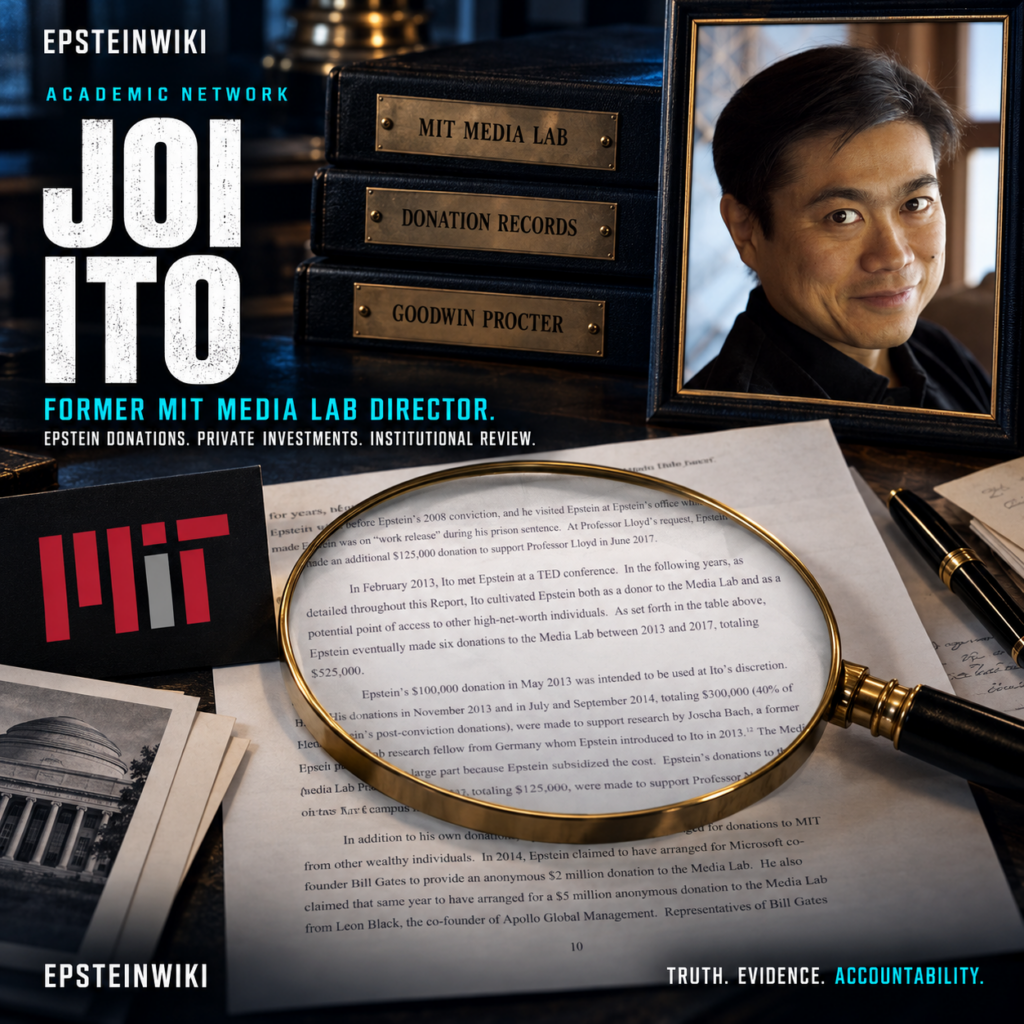
Snapshot
Full name: Joichi Ito
Common name: Joi Ito
Born: June 19, 1966, Kyoto, Japan
Known for: Technology entrepreneur, venture capitalist, former director of the MIT Media Lab, former MIT professor, cofounder of Digital Garage, and president of Chiba Institute of Technology
Documented Epstein connection: Ito cultivated Jeffrey Epstein as a donor and source of introductions from 2013 through at least 2018. He arranged or participated in meetings with Epstein, hosted him at MIT, visited Epstein residences, accepted Epstein money for the Media Lab, permitted Epstein to invest in private ventures, and communicated with him about technology, fundraising, cryptocurrency, reputation, travel, and other matters.
Legal status: No public record reviewed for this article establishes that Ito participated in Epstein’s sexual abuse or trafficking. Ito has not been criminally charged in connection with Epstein. The central documented issues concern fundraising judgment, institutional concealment, access, private investments, and the continuation of a close professional relationship after Ito knew about Epstein’s criminal record.
EpsteinWiki involvement rating: 4 of 5
Key Takeaways
- Ito met Epstein in February 2013 and was warned within days that Epstein might not be someone the Media Lab should work with.
- Ito knew Epstein was a registered sex offender and knew allegations involved underage girls before cultivating him as a donor.
- Epstein gave $525,000 to the Media Lab between 2013 and 2017. This was part of $850,000 MIT received from Epstein between 2002 and 2017.
- MIT administrators approved accepting relatively small, unrestricted Epstein donations on the condition that they be recorded as anonymous and not publicly promoted.
- Ito sought much larger donations from Epstein, including proposals involving an endowed chair, a fellowship program, and research funding. The larger proposals were not funded.
- The MIT investigation found that Ito and Professor Seth Lloyd drove the efforts to obtain post conviction donations from Epstein.
- Ito arranged most of Epstein’s nine documented MIT campus visits between 2013 and 2017.
- The report found that Ito understood the reputational danger and, during one 2016 visit, took steps to keep Epstein out of public view.
- Epstein invested $250,000 in a company formed to commercialize MIT technology and $1 million in a private investment fund managed by Ito.
- Financial and corporate records identify Ito as manager of Kyara investment entities through which Epstein money reached technology ventures including Wearality, Blockstream, and OH2 Laboratories.
- A transaction compilation records $2,000,001 moving from Epstein’s Southern Financial to Ito or Neoteny between 2014 and 2015, followed by identified payments totaling $513,915 in the opposite direction between 2015 and 2018. Those entries do not, by themselves, provide a complete profit, loss, or redemption accounting.
- Epstein’s Coinbase investment belonged to a separate structure. The reviewed records do not establish that Ito managed the Coinbase vehicle.
- Released records document plans for Ito and Reid Hoffman to visit Epstein properties, including an overnight Little Saint James trip.
- Ito resigned from MIT and several outside positions in September 2019.
- Newly released records renewed scrutiny in 2026. Ito defended his conduct, Chiba Tech reaffirmed its trust in him, and he left or prepared to leave several corporate and government advisory positions.
- Ito promised in 2019 to return Epstein’s private investments and raise an equivalent amount for organizations supporting trafficking survivors. No public accounting located for this article verifies completion of either promise.
Overview
Joi Ito’s relationship with Jeffrey Epstein was not a passing encounter. It was a sustained professional and social association built around fundraising, technology investment, introductions, access to researchers, and shared interest in cryptocurrency.
The importance of the Ito record lies in what it reveals about institutional normalization. By the time Ito met Epstein in 2013, Epstein had already pleaded guilty to Florida offenses involving prostitution and a minor, served a jail sentence, and registered as a sex offender. Media Lab employees raised concerns almost immediately. Ito nevertheless cultivated Epstein, arranged access to MIT researchers, permitted him to visit campus repeatedly, and sought money both for MIT and for ventures outside the university.
MIT did not simply fail to discover Epstein’s past. Senior officials discussed it. They approved a framework that allowed certain donations to continue if the gifts remained relatively small, unrestricted, anonymous in MIT records, and unpublicized. That institutional approval is important because responsibility cannot be assigned to Ito alone. It is equally important that the independent investigation identified Ito as the person who repeatedly pressed for the relationship and who continued arranging meetings after employees expressed discomfort.
Ito has consistently denied knowing about or participating in Epstein’s illegal conduct. The public record reviewed here does not establish that he witnessed sexual abuse or trafficking. It does establish that he knowingly affiliated a convicted sex offender with one of the most prestigious research institutions in the world and helped provide Epstein with access, intellectual prestige, investment opportunities, and elite contacts.
Identity and Career
Joichi Ito was born in Kyoto and spent parts of his childhood in Canada, the United States, and Japan. He became prominent during the growth of the commercial internet as an entrepreneur, investor, writer, and advocate for open technology.
Ito cofounded Digital Garage and was involved with organizations including Creative Commons, ICANN, the Mozilla Foundation, The New York Times Company, the Knight Foundation, and the MacArthur Foundation. His public reputation rested on connecting technology, investment, institutional leadership, and international networks.
Ito became director of the MIT Media Lab in 2011. MIT later appointed him professor of the practice in media arts and sciences. Fundraising was a major part of the director’s role. Ito used his relationships with technology executives, investors, philanthropists, and political figures to obtain money and opportunities for the Lab.
He resigned from MIT in September 2019 after reporting exposed the extent of the Media Lab’s Epstein relationship. He also resigned from several outside boards and positions.
Ito returned to major public roles in Japan. He became director of the Center for Radical Transformation at Chiba Institute of Technology and was selected as the university’s fourteenth president in 2023. His current biography identifies him as president of Chiba Tech and chief executive of the Gelephu Investment and Development Corporation.
First Meeting With Epstein
The Goodwin Procter report commissioned by MIT states that Linda Stone, a former member of the Media Lab Advisory Council, introduced Ito to Epstein at the TED Conference in Long Beach, California, in February 2013.
Witnesses told investigators that conference organizers had barred Epstein from attending TED. According to the report, Epstein met people in hallways or a hotel lobby instead. Ito said he met Epstein in a hallway after Stone sent an introductory email on February 27, 2013.
The relationship developed quickly. On March 2, Ito asked Media Lab staff to investigate Epstein as a prospect. He described Epstein as a wealthy individual who had reportedly given more than $30 million to Harvard and might support medical projects.
On March 4, a staff member warned Ito that Epstein might not be someone the Lab should work with and directed him to Epstein’s Wikipedia page. The page described the Palm Beach investigation, allegations involving underage girls, Epstein’s guilty plea, imprisonment, and sex offender registration.
Ito therefore had clear warning information near the beginning of the relationship. The issue was not whether he knew Epstein was controversial. The documentary question is why he decided the potential benefits outweighed the warning.
Ito’s Due Diligence and Decision to Continue
Ito told MIT investigators that he conducted due diligence by searching online and speaking with influential people. Those contacts reportedly included Nicholas Negroponte, members of the Media Lab Advisory Council, technology billionaires, a former LinkedIn executive, and a Harvard Law School professor.
On March 28, 2013, Ito emailed Negroponte that Epstein had a tainted past but that Linda Stone had assured him Epstein was impressive. Negroponte responded that he knew Epstein well and would accept his money.
Ito also asked Stone about public perception. He acknowledged that people in his office were disturbed by Epstein. Stone advised him to emphasize Epstein’s history of funding Harvard and scientists.
The MIT report concluded that Ito was influenced by Epstein’s powerful associates and by people who vouched for him. Witnesses also described Ito as a believer in redemption and restorative justice.
Those explanations provide context, but they do not erase the underlying knowledge. In June 2013, Ito wrote that he knew Epstein’s history and was proceeding carefully. He said he found Epstein intelligent, interesting, and enthusiastic about the Media Lab’s work.
In January 2015, when a Media Lab development official raised new allegations involving an underage girl and Prince Andrew, Ito said he was discussing the matter with Epstein and suggested it was possible the renewed attention could ultimately help clear him.
By December 2017, Ito was still telling employees that Epstein should be treated with respect. The relationship was therefore an informed decision, not a brief mistake caused by incomplete screening.
Epstein Donations to MIT
The MIT fact finding investigation reviewed more than 610,000 emails and documents and conducted 73 interviews with 59 people. It found that Epstein made ten donations to MIT totaling $850,000 between 2002 and 2017.
Nine donations totaling $750,000 came after Epstein’s 2008 conviction. The Media Lab received $525,000, while Professor Seth Lloyd received $225,000 for research.
Epstein made six donations to the Media Lab between 2013 and 2017:
| Purpose | Amount | Context |
|---|---|---|
| Ito discretionary funding | $100,000 | May 2013 donation available for Ito’s use at the Media Lab |
| Joscha Bach research | $300,000 | Three donations in 2013 and 2014 that helped support Bach’s work |
| Neri Oxman research | $125,000 | Donations in 2015 and 2017 supporting Oxman’s work |
| Total to the Media Lab | $525,000 | All six gifts followed Epstein’s conviction |
The report states that Epstein introduced Joscha Bach to Ito and that the Media Lab hired Bach in large part because Epstein subsidized the cost. Ito introduced Epstein to Neri Oxman on campus in October 2015.
This table does not include Epstein’s separate investments in Ito managed private ventures. It also does not treat third party gifts from Bill Gates or Leon Black as Epstein’s money.
Anonymous Donations and Institutional Approval
MIT’s senior administration learned about the May 2013 gift and debated returning it. Vice President and General Counsel R. Gregory Morgan, Vice President for Resource Development Jeffrey Newton, and Executive Vice President and Treasurer Israel Ruiz participated in the decision.
They approved a framework under which Epstein donations could be accepted if the gifts were relatively small, unrestricted, recorded as anonymous, and not publicized by Epstein.
MIT staff then changed its records for Epstein’s post conviction gifts to identify them as anonymous. Internal instructions said Epstein’s name should not appear on donor lists and that staff should not contact him without consulting senior development officials.
The report noted that investigators could not recall another case in which MIT itself initiated anonymous treatment rather than responding to a donor’s request.
Released correspondence provides direct evidence of how the arrangement was explained to Epstein. In EFTA01754963 and the overlapping EFTA01948626, Ito told Epstein that MIT had established a special account for him as an anonymous donor so an intermediary nonprofit would not be necessary. Ito asked whether Epstein accepted that the arrangement could not be discussed publicly. Epstein replied that he did not mind.
The distinction between anonymous and secret became an internal issue. MIT Corporation chair Robert Millard later warned that anonymous giving was not the same as secret giving. The record shows that administrators knew reputational harm could follow if the donations became public.
Ito’s defenders correctly note that senior administrators approved the donation framework. Critics correctly note that the anonymity kept Epstein’s identity away from many members of the MIT community who might otherwise have objected.
Larger Donations Ito Sought but Did Not Receive
Epstein never made the largest donations Ito discussed with him. The MIT report nevertheless documents Ito’s continuing effort to expand the relationship.
The proposals included:
- Sponsorship of a center studying deceptive design in evolutionary biology
- An endowed chair named for Marvin Minsky
- A $12 million fellowship program for antidisciplinary science
- Approximately $1.5 million for research led by Caleb Harper
- Other funding for Ito’s One Science initiative
In 2016, internal discussion concerned a possible donation of several million dollars through an Epstein foundation. In other discussions, senior administrators considered what amount could be accepted anonymously without attracting attention.
The fact that these proposals did not become completed gifts is an important evidentiary limit. They establish solicitation and intent to expand funding. They do not establish that MIT received the proposed amounts.
Epstein’s Campus Access
The MIT report identified at least nine Epstein visits to campus between June 2013 and April 2017. Most were arranged by Ito.
The visits included meetings with senior professors and researchers. They also allowed Epstein to observe or participate in discussions involving neuroscience, artificial intelligence, design, biology, cryptocurrency, and institutional fundraising.
| Date | Documented activity |
|---|---|
| June 28, 2013 | Ito escorted Epstein through the Media Lab and laboratories associated with Ed Boyden and Neil Gershenfeld |
| July 19, 2013 | Epstein met with Ito, Reid Hoffman, Neil Gershenfeld, and, for part of the visit, Megan Smith |
| October 23, 2013 | Epstein visited during a period when Ito discussed the public relations risk of bringing Epstein and Woody Allen to campus |
| April 21, 2014 | Epstein met Ito, Barnaby Marsh, and Professor Kevin Slavin concerning possible Templeton Foundation support |
| October 24, 2015 | Epstein met Neri Oxman, Danny Hillis, two Digital Currency Initiative students, and others in Ito’s office |
| February 7, 2016 | Epstein met Joscha Bach and possibly Seth Lloyd |
| March 17, 2016 | Epstein was kept in Ito’s office during the Marvin Minsky memorial and did not attend the public event |
| April 1, 2016 | Epstein met Ito, Joe Jacobson, and Barnaby Marsh |
| April 15, 2017 | Epstein met Ito, Caleb Harper, and Ed Boyden during a weekend visit |
The report found no evidence that Epstein interacted with students during most visits. It identified the October 2015 meeting with two Digital Currency Initiative students as the only visit Ito recalled involving students.
Some visits included one or two young female assistants who appeared to be in their twenties. Staff members reported discomfort with Epstein’s presence. One employee recalled feeling disturbed both because of his known sexual abuse of minors and because he arrived with young women.
Ito stopped inviting Epstein to campus after employees objected in late 2017. The report found that Ito and other faculty continued meeting Epstein away from campus.
Concealment During the Marvin Minsky Memorial
The March 2016 visit during Marvin Minsky‘s memorial is especially revealing.
Ito discussed whether Epstein could attend and asked whether the press would be present. He proposed keeping Epstein in a private room where people could see him outside public view.
After discussions with Minsky’s family, Epstein was permitted to be inside the Media Lab but was excluded from the memorial and reception. Ito kept him in a secluded office. Professor Kevin Esvelt visited Epstein there to discuss research.
The MIT report concluded that Ito took steps to conceal Epstein’s presence during this visit. A Media Lab communications employee later circulated event photographs with an instruction that they could be posted only if Epstein did not appear in them.
This was not evidence that Ito knew about ongoing trafficking. It was evidence that he understood public association with Epstein could cause serious harm and managed visibility accordingly.
Employee Objections
Multiple people inside the Media Lab warned Ito or expressed discomfort.
The earliest documented warning came in March 2013, days after Ito met Epstein. Professor Ethan Zuckerman told investigators that he urged Ito to end the relationship after learning about Epstein’s visits. Development personnel raised concerns about the allegations. An administrative assistant was reportedly uncomfortable greeting Epstein. Employees sometimes referred to Epstein as Voldemort or the person who must not be named.
In December 2017, a staff member told Ito that several employees believed he should meet Epstein outside the Lab. Ito responded that employees could provide input but should not be making the decision. He emphasized that he had consulted senior people and was managing the risk.
In 2019, whistleblower Signe Swenson provided internal records to journalist Ronan Farrow. The New Yorker’s investigation exposed the internal handling of Epstein donations and the efforts to prevent his name from being publicly associated with the money.
The employee record matters because it shows that objections were not created only after Epstein’s 2019 arrest. People inside the institution raised ethical and safety concerns during the relationship.
Private Investments and Personal Financial Interests
Epstein’s money did not remain confined to MIT donations.
The MIT report found that Epstein invested $250,000 in a company created to commercialize technology developed at MIT. It also found that Epstein invested $1 million in a $9 million private investment fund managed by Ito.
In January 2018, Ito asked Epstein to invest between $5 million and $15 million in another fund. Epstein did not complete that investment.
In his August 2019 apology, Ito acknowledged allowing Epstein to invest in several of his funds outside MIT. Ito said he would return the money.
These investments created a personal financial dimension distinct from Ito’s university fundraising role. Even if the investments were lawful, they complicated the claim that Ito’s Epstein relationship existed only to benefit MIT.
Financial Record at a Glance
EFTA00027019 compiles bank transaction exhibits involving Southern Financial LLC, Ito, Neoteny, and related vehicles. It records the following transfers:
| Date | Sender | Recipient | Amount | Exhibit reference |
|---|---|---|---|---|
| July 2, 2014 | Southern Financial LLC | Joichi Ito | $250,000 | DB SDNY 0003972 |
| September 9, 2014 | Southern Financial LLC | Joichi Ito | $500,001 | DB SDNY 0004084 |
| March 12, 2015 | Southern Financial LLC | Joichi Ito | $250,000 | DB SDNY 0004441 |
| April 13, 2015 | Southern Financial LLC | Neoteny 3 LP | $1,000,000 | DB SDNY 0004518 |
| August 5, 2015 | Joichi Ito | Southern Financial LLC | $483,915 | DB SDNY 0004815 |
| April 20, 2018 | Neoteny 3 LP | Southern Financial LLC | $30,000 | DB SDNY 0007110 |
The four payments from Southern Financial total $2,000,001. The two identified payments back total $513,915. The resulting difference in this specific exhibit set is $1,486,086.
That difference is not proof that Ito personally retained $1,486,086. Some of the money was deployed through investment vehicles, and the records reviewed here do not provide a complete ledger of asset values, later distributions, write downs, redemptions, fees, or returns. It should be described as a transaction gap requiring full accounting, not as established personal profit or loss.
Separate transaction charts record payments from Kyara Investments I to Southern Financial of $10,000 on December 2, 2016, and $11,392 on September 5, 2018. Those payments reinforce that money could move back through the structures, but they still do not resolve the total return question.
The Kyara Investment Structure
The released records identify a series of special purpose entities using the Kyara name. In EFTA01752601, Ito explained in January 2014 that the name came from kyara, a rare and valuable form of Japanese incense used in a traditional scent identification game.
The corporate records connect Ito as manager and Epstein’s Southern Financial as a funding member. The known structure should be separated by entity and target:
| Entity | Formation or agreement evidence | Identified amount | Identified purpose or target | Evidentiary caution |
|---|---|---|---|---|
| Kyara Investments I LLC | EFTA00605699 and EFTA01116280 | $99,999 | Investment target not established in the reviewed primary records | Do not assign the money to a company without further documentation |
| Kyara Investments II LLC | EFTA01186453 and EFTA01186455 | $250,000 | Wearality | Corporate investment, not proof the company knew about Epstein’s crimes |
| Kyara Investments III LLC | EFTA00584696 | $500,001 | Blockstream Corporation | Ito is identified as manager and Southern Financial as the funding member |
| Kyara Investments IV | EFTA02513454 and related OH2 materials | $250,000 | OH2 Laboratories | The email record describes Ito as a minority shareholder and addresses an MIT conflict disclosure |
EFTA01402630 contains wire information associated with Kyara II, III, and IV. EFTA00104945 and EFTA00080250 preserve transaction chart material and footnotes. Together, these records show a repeatable structure rather than a single isolated investment.
The Kyara entities were lawful corporate vehicles on the face of the reviewed documents. Their relevance is that they document a direct, repeated financial relationship between Ito and an Epstein entity after Ito knew Epstein’s criminal history.
Kyara I and the Unidentified Investment
Kyara Investments I LLC, also rendered in some records as Kyara Investments LLC, was formed in May 2014. EFTA01116280 contains an operating agreement, and EFTA00605699 contains formation material.
Transaction research attributes $99,999 to the vehicle, but the reviewed primary documents do not conclusively identify the destination company. This unresolved point matters because later summaries sometimes collapse all Kyara funding into named cryptocurrency companies.
The correct finding is narrower: Kyara I existed, was part of the Ito and Southern Financial investment architecture, and received or deployed approximately $100,000. Its final target remains unverified in the records cited here.
Kyara II and Wearality
Kyara Investments II LLC was formed in June 2014. EFTA01186453 contains the certificate of formation, while EFTA01186455 contains the operating agreement.
The transaction record associates $250,000 with Wearality, a virtual reality optics company connected to technology developed at the University of Southern California Institute for Creative Technologies. This appears to correspond to the MIT report’s broader description of a $250,000 investment in a company commercializing university related technology only if the underlying company and institutional origin are independently reconciled. The source descriptions should not be treated as interchangeable without that verification.
The evidence establishes an Ito managed investment funded by an Epstein entity. It does not establish that Wearality knew of Epstein’s criminal activity or that the investment itself was unlawful.
Kyara III and Blockstream
EFTA00584696 contains the September 2014 operating agreement for Kyara Investments III LLC. It identifies Ito as manager, Southern Financial as the member supplying capital, and ownership of an equity investment in Blockstream Corporation as the entity’s stated purpose.
EFTA01917472 concerns the allocation for the Blockstream investment and indicates that Reid Hoffman increased an allocation from $50,000 to $500,000. The bank exhibit records $500,001 moving from Southern Financial to Ito on September 9, 2014.
The records establish that Epstein money entered a Blockstream investment structure managed by Ito. They do not establish that Blockstream executives knew Epstein supplied the capital, knew about his wider criminal conduct, or participated in wrongdoing. The transaction should not be labeled money laundering without proof of unlawful proceeds, concealment for a criminal purpose, or intent to disguise ownership.
Kyara IV and OH2 Laboratories
EFTA02513454 contains a January 2015 exchange about Kyara IV and OH2 Laboratories, an electronic nose venture connected to work that had previously occurred at the Media Lab.
Ito described a proposed disclosure stating that he was a minority shareholder in Kyara IV and that MIT related activity had ended before the investment. The correspondence shows that conflict questions were recognized and discussed rather than wholly ignored.
EFTA00586577 contains OH2 Laboratories materials. The transaction record identifies $250,000 moving from Southern Financial to Ito on March 12, 2015 in connection with the investment chain.
The evidence establishes a personal investment interest and an effort to address a potential institutional conflict. It does not establish that OH2 knew about Epstein’s crimes or that the investment funded illegal conduct.
Neoteny 3 LP
Neoteny was an Ito investment platform. EFTA00811927 records Epstein accountant Richard Kahn describing a $1 million Epstein investment in Neoteny with Ito.
The bank exhibit shows Southern Financial sending $1 million to Neoteny 3 LP on April 13, 2015. It also shows Neoteny 3 LP sending $30,000 to Southern Financial on April 20, 2018.
The $30,000 return payment is not proof that the entire investment was repaid. It could represent a distribution, partial redemption, proceeds, or another fund transaction. A complete conclusion requires the partnership agreement, capital account statements, portfolio valuation, distribution history, and final redemption documents.
Coinbase Was a Separate Epstein Investment
Coinbase appears in the wider Epstein cryptocurrency investment record, but it should not be folded into Ito’s Kyara structure without evidence.
The financial record attributes a $3,001,000 Coinbase Series C investment in December 2014 to IGO Company LLC. It later records a February 2018 transaction in which Blockchain Capital affiliated funds bought half of Epstein’s Coinbase position from the 2017 Caterpillar Trust. EFTA00843103 contains related buyback correspondence.
The available summaries are not numerically identical. One transaction compilation identifies payments of $10.5 million, $2.625 million, and $1.875 million, totaling $15 million. The buyback email analysis identifies $10 million, $2 million, and $2,666,667, totaling $14,666,667. The discrepancy requires reconciliation against original bank statements and closing documents. This article therefore describes the consideration as approximately $15 million rather than treating either breakdown as conclusively final.
No primary record reviewed for this article establishes that Ito managed IGO Company, the Caterpillar Trust, or the later Blockchain Capital sale. Coinbase is relevant to the network in which Ito and Epstein discussed cryptocurrency, but it is not evidence of another Ito managed fund unless additional records establish that link.
Cryptocurrency, MIT, and Federal Policy Contacts
Ito and Epstein shared a sustained interest in Bitcoin, digital currency, financial regulation, and technology investment.
In EFTA01964463, Epstein told Ito he was willing to remain in the background and compared himself to a version of Bitcoin’s mysterious creator. The message shows Epstein understanding the value of influence without public recognition.
EFTA01916567 documents Ito and Epstein discussing Bitcoin and a possible Media Lab coin. EFTA01746562 contains a message from Lawrence Summers to Ito, copied to Epstein, concerning a possible Bitcoin adviser and Ito’s network of Bitcoin developers.
EFTA02589077 and EFTA02099970 concern an October 2014 call involving Ito, Epstein, and Anne Shere Wallwork of the United States Treasury. Topics included the MIT Bitcoin project, decentralized venture capital, and technical, economic, and regulatory questions. EFTA00631425 shows Epstein offering written thoughts for the discussion, while EFTA00360763 provides evidence that a conference call occurred on October 15, 2014.
Later scheduling records include EFTA00337558, concerning an October 2015 appointment with Jeremy Rubin and a Bitcoin group, and EFTA00328767, concerning a March 2016 Bitcoin Expo.
These records do not establish that Epstein controlled MIT’s Digital Currency Initiative, that $525,000 in Media Lab gifts was earmarked for the initiative, or that United States Treasury officials adopted his ideas. They do establish that Ito included Epstein in substantive technology and policy conversations where Epstein could act as an investor, connector, and adviser.
Travel to Epstein Properties
Ito acknowledged visiting several Epstein residences. Released records add detail to the travel relationship.
EFTA00362228 begins a September 2014 travel planning thread for Ito and Reid Hoffman to visit Little Saint James. The plan contemplated travel from Palm Beach to the island, an overnight stay, and a return flight to Boston.
Related records, including EFTA00362236, EFTA00358172, and EFTA02300458, preserve itinerary, passport, or logistical material associated with the proposed trip.
The released record supports that an island trip was planned and that Ito was part of the travel group. Public reporting and released images support that Ito was present at Epstein’s island with Hoffman. The precise activities during the visit are not established by the itinerary alone.
Other records concern possible or completed visits to Epstein’s New Mexico ranch and New York residence. A 2014 itinerary referenced Ito and Hoffman in connection with a ranch visit. Planning evidence must be separated from proof that a proposed trip occurred.
Ito’s presence at an Epstein property is relevant to the depth of their relationship. It is not proof that he witnessed or participated in abuse.
The available travel evidence should be classified by strength:
| Event | Evidence | Status |
|---|---|---|
| Visits to several Epstein residences | Ito’s 2019 apology | Confirmed by Ito, without a complete location list |
| September 2014 Little Saint James itinerary with Reid Hoffman | EFTA00362228, EFTA00362236, EFTA00358172, and EFTA02300458 | Detailed planning records |
| Ito at Little Saint James | Released photographs and public reporting | Supported, although the itinerary alone is not the proof |
| New Mexico ranch travel | Itinerary and scheduling material | Planned or reported, with each specific trip requiring independent confirmation |
| Other possible property visits | Calendar and email references | Unresolved unless corroborated by travel, image, payment, or admission evidence |
This distinction prevents a calendar invitation from being presented as completed travel while still recognizing that Ito admitted visiting multiple Epstein residences.
Reid Hoffman and Network Building
Ito served as a bridge between Epstein and members of the technology industry. Reid Hoffman was among the most important figures in that network.
Hoffman was a Media Lab Advisory Council member and participated in meetings involving Epstein. Travel records document plans for Ito and Hoffman to visit Epstein properties together. Ito also sought Hoffman’s advice about the reputational consequences of allowing Epstein to attend visible events.
The relationship involved more than introductions. Ito, Hoffman, and Epstein discussed investments, cryptocurrency, fundraising, travel, and access to other influential people.
Hoffman has said his later interactions with Epstein were connected to fundraising for MIT and that he regrets associating with him. The released communications show a broader and longer social relationship than a single fundraising meeting.
Neither Ito’s nor Hoffman’s association proves participation in Epstein’s crimes. It does demonstrate how Epstein used scientific and technology networks to rebuild elite access after his conviction.
Linda Stone, Nicholas Negroponte, and the Vouching Network
Linda Stone introduced Ito to Epstein at the 2013 TED conference. When Ito raised concerns about public perception, Stone emphasized Epstein’s history of supporting Harvard and scientists. Her role was not merely a social introduction because her reassurance became part of Ito’s stated decision process.
Nicholas Negroponte, the Media Lab founder, was another consequential source of reassurance. In March 2013, Ito wrote that Epstein had a tainted history. Negroponte replied that he knew Epstein well and would accept his money.
Ito told investigators that he consulted other prominent people, including technology leaders, a former LinkedIn executive, Media Lab advisers, and a Harvard law professor. The MIT report does not identify every adviser in every instance. Their advice provides context for Ito’s decision, but it did not remove Ito’s responsibility as director.
This vouching network mattered because elite reassurance converted Epstein’s wealth and prior scientific giving into perceived credibility after his conviction.
Dinners, Introductions, and Scientific Access
The released correspondence shows Epstein using dinners and private meetings to connect Ito with scientists, investors, entertainers, and wealthy families.
EFTA02377042 records a May 2013 evening schedule at Epstein’s residence involving Woody Allen and Soon Yi Previn at 7:30 p.m., Ito and Ed Boyden at 8:00 p.m., and Tom Pritzker at 9:00 p.m. The record is a schedule. It establishes planned access and sequencing, but each person’s attendance should be corroborated before being described as completed.
EFTA02377050 concerns Epstein bringing Woody Allen to MIT to meet Ito. EFTA02575363 records Epstein inviting both Ito and Reid Hoffman for Columbus Day weekend.
EFTA02114558 concerns a proposed neuroscience dinner guest list containing prominent researchers. The record is relevant to the broader access system, but it should not be attributed to Ito unless the underlying thread places him in the planning or attendance.
These records reveal Epstein’s method as a connector. They do not establish wrongdoing by every invitee or prove that every scheduled dinner occurred.
Leon Black and Bill Gates Donations
Epstein claimed credit for arranging major third party donations to the Media Lab.
He claimed that a $2 million anonymous donation from Bill Gates and a $5 million anonymous donation from Leon Black resulted from his involvement.
The MIT investigation did not find evidence that either donation consisted of Epstein’s own money. Gates representatives denied that Epstein had anything to do with the Gates donation. The report did not reach a definitive conclusion that Epstein caused Black’s donation.
Internal Media Lab correspondence nevertheless credited Epstein with bringing or influencing millions of dollars from other wealthy donors. This enhanced his value to Ito even when Epstein’s direct donations were comparatively modest.
The safe factual distinction is:
- Epstein gave $525,000 directly to the Media Lab through his foundations.
- Epstein claimed credit for facilitating additional third party donations.
- The MIT investigation found no evidence that Gates or Black were laundering Epstein’s money.
- Gates disputed Epstein’s role in his donation.
Reputation Management
The MIT report states that Ito attempted to help Epstein determine how to reduce damaging publicity after articles appeared concerning litigation brought by survivors.
That conduct is distinct from ordinary donor cultivation. Helping a convicted sex offender manage public criticism arising from survivor litigation could strengthen the person’s ability to regain institutional access.
The public report does not establish that Ito threatened survivors, interfered with litigation, or knowingly spread false information. It does establish that he strategized with Epstein about bad press while continuing to seek funding and meetings.
This is one reason the relationship should not be reduced to a donation controversy. The record concerns reputation, access, and rehabilitation as well as money.
Ito’s 2019 Apology
On August 15, 2019, Ito published an apology on the MIT Media Lab website.
Ito acknowledged that he had invited Epstein to the Lab, visited several Epstein residences, knew about gifts to the Lab, approved their receipt, and permitted Epstein to invest in his private funds.
He denied involvement in or knowledge of Epstein’s horrific acts. Ito accepted responsibility for an error in judgment and apologized to survivors, the Media Lab, and the MIT community.
He pledged to raise an amount equal to Epstein’s Media Lab donations for organizations supporting trafficking survivors and to return Epstein’s private investments.
The apology was significant because it confirmed several core facts before the independent report was complete. It did not disclose every detail later identified by journalists and investigators.
Status of the Repayment and Survivor Support Promises
Ito made two measurable promises in August 2019:
- He would return the money Epstein invested in his funds.
- He would raise an amount equal to Epstein’s Media Lab donations and direct it to nonprofit organizations supporting trafficking survivors.
The public sources reviewed for this article repeat those commitments but do not provide a recipient list, payment dates, fund accounting, canceled interest documents, tax records, or confirmation from beneficiary organizations.
The evidence therefore establishes the promises, not their completion. It would be inaccurate to state that Ito failed to act, because repayment or donations might have occurred privately. It would also be inaccurate to state that he fulfilled the commitments without documentation.
An adequate public accounting would identify the investment principal and any gains returned, the legal recipient of each repayment, the total survivor support amount, the beneficiary organizations, and whether the payments came from Ito personally or from third party fundraising.
Rejected, Returned, and Bounced Donation Proposals
The funding record includes proposed gifts that did not become completed MIT donations.
The MIT report describes large proposals that were discussed but never funded, including a $12 million fellowship program, an endowed Marvin Minsky chair, support for a deceptive design center, approximately $1.5 million for Caleb Harper’s work, and support for One Science.
The report also states that the Media Lab rejected an Epstein linked donation in February 2019. Later released correspondence discusses money that was bounced or could not be accepted. These incidents show that acceptance was not automatic in every instance.
They do not erase the six completed Media Lab gifts totaling $525,000 or the broader MIT total of $850,000. For clarity, proposed, rejected, returned, and completed gifts should never be added together as if all were money received by MIT.
The New Yorker Investigation and Resignation
On September 6, 2019, Ronan Farrow published How an Elite University Research Center Concealed Its Relationship With Jeffrey Epstein.
The investigation relied on internal emails and records supplied by whistleblower Signe Swenson. It reported that Media Lab personnel took steps to keep Epstein’s name away from donations and credited him internally with helping secure millions of dollars from other wealthy donors.
Ito had previously said reporting contained factual errors. The underlying emails and the later MIT report nevertheless confirmed central elements of the story, including anonymous treatment, continuing solicitation, campus visits, internal objections, and private investments.
Ito resigned as Media Lab director and MIT professor on September 7, 2019. He also resigned from the boards of The New York Times Company, the MacArthur Foundation, and the Knight Foundation, and stepped down as chair of PureTech Health.
The resignations were consequences of institutional and public accountability. They were not criminal findings.
Positions Affected After Disclosure
| Organization | Position | Reported outcome | Meaning |
|---|---|---|---|
| Massachusetts Institute of Technology | Media Lab director, professor, and employee | Resigned September 7, 2019 | Institutional consequence, not a criminal judgment |
| Harvard Law School | Visiting professor of practice | Left the role amid the 2019 fallout | No separate finding of criminal conduct identified |
| The New York Times Company | Director | Resigned September 2019 | Board consequence |
| John D. and Catherine T. MacArthur Foundation | Director | Resigned September 2019 | Board consequence |
| John S. and James L. Knight Foundation | Trustee | Resigned September 2019 | Board consequence |
| PureTech Health | Chair | Resigned September 2019 | Corporate governance consequence |
| Digital Society Initiative in Japan | Advisory role | Ito said he would leave on March 31, 2026 | Announced after renewed scrutiny |
| Global Startup Campus Initiative | Government related role | Ito said he would not seek reappointment after March 31, 2026 | Term end rather than an announced misconduct finding |
| Digital Garage | Director | Listed among directors retiring in 2026 | Filing did not state a finding of wrongdoing |
| Chiba Institute of Technology | President | Remained in office after board review | Institution publicly reaffirmed confidence |
MIT’s Independent Investigation
MIT retained Goodwin Procter to investigate donations, campus visits, senior leadership knowledge, and applicable policies. The university released the report in January 2020.
The investigation found:
- Epstein gave MIT $850,000 in ten donations.
- Nine donations totaling $750,000 came after his conviction.
- Ito and Seth Lloyd drove the post conviction fundraising relationships.
- Certain senior MIT leaders knew about Epstein’s record and approved a restricted donation framework.
- Epstein made at least nine MIT campus visits, most arranged by Ito.
- Senior leaders who approved gifts were not shown to know about the campus visits.
- Ito solicited larger donations that Epstein did not ultimately make.
- Epstein invested in two Ito related private ventures.
- Ito understood the reputational risk and sometimes managed Epstein’s visibility.
The report concluded that no member of MIT’s senior team violated a law or MIT policy in connection with the donations. It also concluded that accepting the money involved serious errors of judgment and caused significant harm to the MIT community.
The report was a university commissioned fact finding review, not a criminal investigation or trial. Its findings are important but do not resolve every question about the released federal records.
2026 Document Releases and Renewed Scrutiny
The 2026 Justice Department releases substantially increased the volume of publicly available Ito and Epstein correspondence. Reuters reported that the releases included more than 4,000 emails demonstrating the closeness and persistence of the relationship.
The newer material renewed attention to travel, private investments, cryptocurrency discussions, policy contacts, personal messages, fundraising, and the extent to which the relationship continued beyond the incidents highlighted in 2019.
The release does not automatically make every email evidence of wrongdoing. Routine messages, repeated copies, scheduling notices, and forwarded material must not be counted as separate substantive events.
The new corpus is significant because it permits independent researchers to test the narrative presented by Ito and the scope of the 2020 MIT report against primary records.
Independent Financial Research
Independent researchers have helped connect corporate agreements, bank exhibits, and email records that appear in separate production sets.
R. Howard Stone’s transaction chain analysis identifies flows from Epstein entities into technology and investment vehicles, including the Kyara structure. The associated cryptocurrency network investigation separates Kyara, Blockstream, Coinbase, and later asset sales.
Heather Ashley’s financial network review highlights the $250,000 payments to Ito, the $1 million Neoteny investment, the $483,915 transfer back to Southern Financial, and the later $30,000 Neoteny payment.
These analyses are research aids, not substitutes for primary evidence. This article cites the underlying EFTA records wherever possible and treats any analytical conclusion as provisional when the complete contracts, ledgers, tax records, or bank statements are unavailable.
Ito’s 2026 Response
On March 3, 2026, Ito published a new statement addressing the released correspondence.
He described some media coverage and online commentary as speculative. He repeated that fundraising was central to his Media Lab role, that knowledgeable people advised him it was appropriate to accept Epstein’s donations, and that senior MIT administrators approved the gifts under specified conditions.
Ito stated that he never witnessed or learned of evidence of Epstein’s horrific conduct. He emphasized that the Goodwin Procter investigation found no violation of law or policy.
The statement also said Ito would not seek reappointment to the Global Startup Campus Initiative after his term expired on March 31, 2026. He said he would leave his Digital Society Initiative advisory role on the same date to focus on Chiba Tech.
Ito’s position deserves inclusion in full context. It is also important to note that the MIT report’s absence of a policy violation did not amount to approval of his judgment. The report documented repeated warnings, reputational concerns, concealment, and continued cultivation.
Chiba Tech and Later Institutional Responses
On February 28, 2026, Chiba Institute of Technology issued a statement affirming its trust in Ito.
The university said its board had reviewed the Goodwin Procter report and related materials before selecting him as president. It said it found no basis for concern regarding individual misconduct and that Ito reaffirmed he had no knowledge of or involvement in illegal activity.
The institution kept Ito as president.
Digital Garage separately listed Ito among directors retiring in connection with its June 2026 shareholder meeting. Company materials did not state that the retirement constituted a finding of wrongdoing.
As of September 2026, Ito’s own biography and Chiba Tech materials continue to identify him as the university’s president.
Evidence Appearances
| Record | Subject | What it establishes | Limitation |
|---|---|---|---|
| EFTA01754963 | Anonymous MIT donation account | Ito told Epstein MIT created a special anonymous account | Does not establish illegality |
| EFTA01948626 | Funds to MIT | Epstein accepted the condition that the arrangement not be publicized | Overlaps other produced correspondence |
| EFTA00386874 | 2013 MIT meeting context | Documents early meetings involving Ito, Epstein, and MIT contacts | Scheduling evidence must be checked against completed attendance |
| EFTA00362228 | Little Saint James travel planning | Begins an itinerary for Ito and Hoffman to visit the island | A plan alone does not prove every listed activity occurred |
| EFTA00362236 | Island travel logistics | Continues trip coordination | Does not establish conduct during the visit |
| EFTA00358172 | Travel and passport coordination | Adds logistical context for Epstein property travel | Administrative record only |
| EFTA02300458 | Travel email production | Preserves related itinerary material | May contain duplicated or forwarded material |
| EFTA02394020 | 2016 dinner coordination | Shows continuing social or professional coordination | A dinner invitation does not establish criminal conduct |
| EFTA00027019 | Financial exhibit compilation | Lists transactions involving Ito and Epstein related entities | Requires transaction level interpretation and entity verification |
| EFTA01752601 | Kyara name and early fund planning | Ito explains the Kyara name in January 2014 | Naming discussion is not a complete fund agreement |
| EFTA00605699 | Kyara Investments I formation | Establishes the first Kyara entity | Does not identify the final investment target by itself |
| EFTA01116280 | Kyara Investments I agreement | Documents governance of the entity | Requires related bank records to trace money |
| EFTA01186453 | Kyara Investments II formation | Establishes the second Kyara entity | Formation alone does not prove a completed investment |
| EFTA01186455 | Kyara Investments II agreement | Documents governance and membership | Does not establish company knowledge of Epstein’s history |
| EFTA00584696 | Kyara Investments III agreement | Identifies Ito as manager in an Epstein funded investment structure | Lawful investment structure is not proof of money laundering |
| EFTA01917472 | Blockstream allocation | Records discussion of increasing an allocation to $500,000 | Does not establish what Blockstream personnel knew about the ultimate source |
| EFTA02513454 | Kyara IV and OH2 conflict discussion | Ito describes his minority interest and a proposed MIT disclosure | Does not resolve every conflict question |
| EFTA00586577 | OH2 Laboratories materials | Documents the company and proposed venture | Does not establish illegality |
| EFTA01402630 | Kyara wire details | Connects transfers to Kyara II, III, and IV | Must be reconciled with bank and company records |
| EFTA00811927 | Neoteny investment | Epstein accountant Richard Kahn describes a $1 million investment with Ito | Does not provide a complete capital account |
| EFTA00843103 | Coinbase position correspondence | Documents a separate Epstein cryptocurrency investment transaction | Does not establish Ito managed the Coinbase vehicle |
| EFTA01964463 | Bitcoin discussion | Shows Epstein offering to remain in the background | Does not prove control over MIT cryptocurrency programs |
| EFTA01916567 | Bitcoin and Media Lab coin | Shows substantive technology discussion between Ito and Epstein | Discussion does not prove implementation |
| EFTA01746562 | Bitcoin adviser discussion | Places Lawrence Summers, Ito, and Epstein in a shared policy and technology exchange | Does not prove appointment or policy adoption |
| EFTA02589077 | Treasury call coordination | Shows Ito arranging a Treasury discussion that included Epstein | Access is not proof of policy control |
| EFTA02099970 | Treasury call planning | Places Ito and a Treasury official in planned cryptocurrency discussion | Calendar evidence does not reveal every participant’s influence |
| EFTA00631425 | Virtual currency policy exchange | Indicates Epstein offered thoughts for a Treasury discussion | Does not establish that Treasury adopted his ideas |
| EFTA00360763 | October 2014 conference call | Supports that the planned call occurred | Does not disclose the full substance or impact |
| EFTA00337558 | Bitcoin group appointment | Shows continuing access to Ito’s cryptocurrency network | Scheduling does not establish attendance by every invitee |
| EFTA00328767 | Bitcoin Expo coordination | Shows continued cryptocurrency related communication | Event coordination is not proof of control |
| EFTA02377042 | May 2013 dinner schedule | Places Ito and Ed Boyden in a planned sequence with Woody Allen, Soon Yi Previn, and Tom Pritzker | Schedule needs attendance corroboration |
| EFTA02377050 | Woody Allen MIT introduction | Shows Epstein brokering an introduction to Ito at MIT | Does not establish wrongdoing by attendees |
| EFTA02575363 | Columbus Day invitation | Shows Epstein inviting Ito and Hoffman together | Invitation is not proof of attendance |
| EFTA02114558 | Neuroscience dinner list | Illustrates Epstein’s scientific access network | Ito’s role must be established from the complete thread before attribution |
| EFTA00814216 | Ito correspondence | Adds direct correspondence context to the ongoing relationship | Must be read within its complete email thread |
Evidence Timeline
| Date | Event | Evidence status |
|---|---|---|
| 2011 | Ito becomes director of the MIT Media Lab | Established institutional record |
| February 2013 | Linda Stone introduces Ito to Epstein at TED | MIT report |
| March 2013 | Staff warns Ito about Epstein’s record | MIT report and internal emails |
| May 2013 | Epstein gives $100,000 for Ito’s discretionary Media Lab use | MIT report |
| May 2013 | Dinner schedule links Ito and Ed Boyden with Epstein guests including Woody Allen and Tom Pritzker | EFTA02377042, scheduling evidence |
| June 2013 | MIT approves restricted anonymous donation framework | MIT report |
| June 2013 | First documented Epstein campus visit arranged through Ito | MIT report |
| July 2013 | Epstein meets Ito, Hoffman, and MIT figures on campus | MIT report |
| November 2013 | Ito explains special anonymous MIT account to Epstein | EFTA01754963 and EFTA01948626 |
| 2013 to 2014 | Epstein gives $300,000 supporting Joscha Bach | MIT report |
| May 2014 | Kyara Investments I is formed | EFTA00605699 and EFTA01116280 |
| June 2014 | Kyara Investments II is formed | EFTA01186453 and EFTA01186455 |
| July 2014 | Southern Financial sends $250,000 to Ito | EFTA00027019 |
| 2014 | Ito and Hoffman travel planning includes Epstein’s ranch and island | EFTA travel records |
| September 2014 | Southern Financial sends $500,001 to Ito for the Blockstream related Kyara III structure | EFTA00027019 and EFTA00584696 |
| October 2014 | Ito and Epstein coordinate around a Treasury cryptocurrency discussion, and a conference call occurs | EFTA02589077, EFTA02099970, EFTA00631425, and EFTA00360763 |
| December 2014 | Epstein’s IGO Company makes a separate Coinbase investment | Financial records, not established as an Ito managed vehicle |
| January 2015 | Ito discusses Kyara IV, OH2, and an MIT conflict disclosure | EFTA02513454 |
| March 2015 | Southern Financial sends $250,000 to Ito in the OH2 investment chain | EFTA00027019 |
| April 2015 | Southern Financial sends $1 million to Neoteny 3 LP | EFTA00027019 and EFTA00811927 |
| August 2015 | Ito sends $483,915 to Southern Financial | EFTA00027019, purpose requires full accounting |
| October 2015 | Epstein meets MIT researchers and two Digital Currency Initiative students | MIT report |
| 2015 to 2017 | Epstein gives $125,000 supporting Neri Oxman | MIT report |
| March 2016 | Epstein is kept in Ito’s office during Minsky memorial | MIT report |
| 2016 | Ito pursues larger funding proposals from Epstein | MIT report |
| April 2017 | Final confirmed Epstein visit to MIT campus | MIT report |
| December 2017 | Employees object and Ito stops inviting Epstein to campus | MIT report |
| January 2018 | Ito asks Epstein for a multimillion dollar private fund investment | MIT report, investment not completed |
| February 2018 | Blockchain Capital affiliated funds pay approximately $15 million for half of Epstein’s separate Coinbase position | Financial records contain differing breakdowns, and no Ito management is established |
| April 2018 | Neoteny 3 LP sends $30,000 to Southern Financial | EFTA00027019, not proof of full repayment |
| February 2019 | Media Lab rejects an Epstein linked donation | MIT report |
| August 2019 | Ito publishes apology and acknowledges investments | Ito statement |
| September 2019 | New Yorker publishes internal records and Ito resigns | Investigative reporting and institutional records |
| January 2020 | MIT releases Goodwin Procter report | Official MIT record |
| July 2023 | Ito becomes Chiba Tech president | Chiba Tech record |
| January 2026 | Justice Department releases millions of additional pages | Official release and reporting |
| February 2026 | Chiba Tech reaffirms support for Ito | Chiba Tech statement |
| March 2026 | Ito issues new defense and leaves government advisory roles at term end | Ito statement |
| June 2026 | Ito is listed among retiring Digital Garage directors | Digital Garage filing |
Involvement Assessment
EpsteinWiki involvement rating: 4 of 5
This rating reflects sustained, consequential, and well documented professional involvement.
Ito knew about Epstein’s conviction and the allegations involving minors. He cultivated Epstein for money and introductions, facilitated campus access, visited Epstein properties, accepted investments in private ventures, managed an Epstein funded technology investment structure, and remained in extensive communication with him.
The rating does not allege that Ito participated in sexual abuse, trafficking, victim recruitment, or violence.
| Factor | Assessment |
|---|---|
| Direct contact with Epstein | Extensive and documented |
| Knowledge of criminal history | Documented from March 2013 |
| Institutional authority | High as Media Lab director |
| Fundraising from Epstein | Extensive and documented |
| Epstein campus access | Mostly arranged by Ito |
| Personal financial relationship | Documented through private investments |
| Travel to Epstein properties | Documented through statements, records, and released images |
| Reputation assistance | Documented by MIT investigation |
| Participation in sexual abuse | Not established |
| Criminal charge connected to Epstein | None identified |
What the Evidence Establishes
The evidence establishes that Ito knowingly developed a close relationship with Epstein after learning of his conviction and sex offender status.
It establishes that Ito drove Media Lab fundraising from Epstein and sought donations much larger than the amounts ultimately received.
It establishes that MIT senior administrators approved a restricted donation framework and that Epstein’s post conviction gifts were recorded as anonymous.
It establishes that Ito arranged most of Epstein’s documented MIT campus visits and understood that his presence created reputational risk.
It establishes that employees warned Ito and that some experienced discomfort around Epstein.
It establishes that Epstein invested in private ventures managed by Ito and that Ito managed at least one entity used for an Epstein funded technology investment.
It establishes a series of Kyara entities linked to investments including Wearality, Blockstream, and OH2, as well as a separate $1 million investment in Neoteny 3 LP.
It establishes documented transfers in both directions between Southern Financial and Ito related entities, but not a complete final accounting.
It establishes that Ito traveled to or planned travel to Epstein properties and communicated with Epstein across a wide range of professional and personal subjects.
It establishes that Ito resigned from MIT after the relationship became public and later apologized for his judgment.
What the Evidence Does Not Establish
The evidence does not establish that Ito participated in Epstein’s sexual abuse or trafficking.
It does not establish that he recruited victims, paid victims, transported minors, obstructed a criminal investigation, or knowingly facilitated sexual crimes.
It does not establish that every meeting, invitation, or proposed trip in Epstein’s calendars actually occurred.
It does not establish that third party donations from Bill Gates or Leon Black were Epstein’s money.
It does not establish that MIT violated a criminal law by accepting Epstein’s donations. The university commissioned investigation found serious errors of judgment but no policy or legal violation by the senior officials it reviewed.
It does not establish that Ito or Epstein controlled United States Treasury cryptocurrency policy.
It does not establish that Blockstream or other technology companies knew about or participated in Epstein’s crimes.
It does not establish that Ito managed Epstein’s Coinbase investment or the later sale of part of that position.
It does not establish that every Kyara investment produced a profit or loss, or that the difference between identified incoming and outgoing transfers was personal income to Ito.
It does not establish that Ito completed or failed to complete his 2019 promises to return Epstein investments and support survivor organizations. Public proof of completion was not located.
Fact Check
| Claim | Assessment | Explanation |
|---|---|---|
| Ito did not know about Epstein’s criminal record | False | Internal correspondence shows he knew by March 2013 |
| MIT accidentally accepted Epstein’s money without review | Misleading | Senior administrators reviewed the issue and approved restricted acceptance |
| Epstein gave MIT $7.5 million | False as a statement of direct Epstein giving | MIT found $850,000 in direct Epstein donations. Media Lab emails separately credited him with influencing larger third party gifts |
| Epstein gave the Media Lab $525,000 | Verified | MIT identified six donations totaling $525,000 |
| Ito concealed every donation from MIT leaders | False | Certain senior leaders knew and approved the framework, though many community members did not know |
| Epstein was formally banned as an MIT donor | Misleading | MIT placed restrictions on donations but did not maintain a simple universal ban during the relevant period |
| Ito arranged Epstein campus access | Verified | The MIT report says most of at least nine visits were arranged by Ito |
| Epstein met MIT students | Supported in one identified visit | Ito invited two Digital Currency Initiative students to an October 2015 meeting |
| Ito visited Epstein’s island | Supported | Ito acknowledged visiting Epstein residences, and released travel records and images support island presence |
| Ito accepted personal investment money from Epstein | Verified | MIT found investments of $250,000 and $1 million in Ito related ventures |
| Ito personally received and kept every dollar in the $2,000,001 transaction total | Unsupported | The transfers included investment capital and a payment to Neoteny. The records also show money moving back, and no complete final ledger is public |
| Ito managed Epstein’s Coinbase investment | Not established | The known Coinbase investment used IGO Company and later the Caterpillar Trust, not a documented Kyara vehicle |
| Epstein gave $525,000 specifically to MIT’s Digital Currency Initiative | False | $525,000 was the total of six Epstein gifts to the Media Lab for Ito discretionary funding, Joscha Bach, and Neri Oxman. The MIT report does not assign the entire amount to the Digital Currency Initiative |
| The Kyara investments prove money laundering | Unsupported | The records document investment vehicles and transfers, not unlawful proceeds or criminal intent |
| Ito returned all Epstein investment money | Unverified | Ito promised repayment, but no complete public accounting located for this article confirms it |
| Ito completed his matching pledge for trafficking survivor organizations | Unverified | The pledge is documented, but public recipient and payment records were not located |
| Ito was convicted of an Epstein related crime | False | No criminal conviction or charge was identified |
| MIT’s report cleared Ito of bad judgment | False | It found no law or policy violation but described serious errors of judgment |
| Naming Ito proves he knew about trafficking | False | The records establish extensive association and informed institutional decisions, not knowledge of every crime |
Survivor Centered Significance
The central ethical issue is not whether a technology leader personally witnessed a sexual assault. Institutions rarely receive that kind of direct warning.
The issue is what powerful people do with the warnings they actually receive.
Ito knew Epstein was a convicted sex offender. He knew the public allegations involved minors. Employees urged caution and expressed discomfort. The relationship continued because Epstein offered money, introductions, intellectual stimulation, access to wealthy people, and investment opportunities.
For survivors, anonymity rules and private meetings had a material consequence. They allowed Epstein to gain prestige without the full MIT community being able to evaluate the relationship. Epstein could appear alongside respected scientists and technology leaders while the institution managed the visibility of his name.
This is how reputation rehabilitation works. It does not require every participant to know about every crime. It requires respected people and institutions to keep extending access after enough information exists to justify saying no.
Unresolved Questions
- What did Ito learn during his initial due diligence beyond the information described in the MIT report?
- Which influential people advised Ito to continue working with Epstein, and what facts did they rely upon?
- How many times did Ito meet Epstein outside MIT between 2013 and 2019?
- Which Epstein residences did Ito visit, and on what dates?
- What occurred during Ito’s visits to Little Saint James and other Epstein properties?
- Did Ito ever observe young women whose circumstances caused concern?
- What was discussed in the thousands of released emails not specifically analyzed in the MIT report?
- Did Epstein receive nonpublic research, investment, or policy information through Ito’s network?
- What financial return did Epstein receive from the Ito managed investment structures?
- What company received Kyara Investments I money, and what became of that investment?
- What were the complete capital accounts, fees, valuations, and distributions for Kyara I, II, III, and IV?
- What was the purpose of the $483,915 payment from Ito to Southern Financial in August 2015?
- What did the $30,000 Neoteny payment in April 2018 represent?
- Were all Epstein investments in Ito related funds actually returned?
- Did any repayment include appreciation or only principal?
- Did Ito fulfill his pledge to raise an equivalent amount for trafficking survivor organizations?
- Which organizations received that money, and how much was distributed?
- Why did MIT permit anonymous giving after administrators recognized the reputational risk?
- Did anonymity prevent students, faculty, or staff from making informed objections?
- What role did Ito play in Epstein’s efforts to reach Bill Gates, Leon Black, Reid Hoffman, and other wealthy donors?
- What advice did Ito give Epstein concerning negative reporting and survivor litigation?
- Which proposed dinners, holiday visits, and property trips actually occurred?
- Did the Goodwin Procter review examine every private investment and travel record later released by the Justice Department?
- Will MIT commission a supplemental review of the 2026 records?
- Will Chiba Tech publish the materials its board reviewed before appointing Ito?
- Did any Japanese government body independently review the 2026 correspondence before Ito’s advisory terms ended?
Related EpsteinWiki Articles
- Jeffrey Epstein
- MIT Media Lab
- Massachusetts Institute of Technology
- Reid Hoffman
- Nicholas Negroponte
- Seth Lloyd
- Marvin Minsky
- Neri Oxman
- Joscha Bach
- Bill Gates
- Leon Black
- Little Saint James
- Jeffrey Epstein Financial Network
- Epstein Academic Network
Sources
- Goodwin Procter, Report Concerning Jeffrey Epstein’s Interactions With the Massachusetts Institute of Technology, January 2020
- MIT News, MIT Releases Results of Fact Finding on Engagements With Jeffrey Epstein
- Joi Ito, My Apology Regarding Jeffrey Epstein, August 2019
- The New Yorker, How an Elite University Research Center Concealed Its Relationship With Jeffrey Epstein
- Joi Ito, Regarding Recent Media Coverage and Social Media Comments, March 2026
- Chiba Institute of Technology, Statement Concerning President Joichi Ito, February 2026
- Reuters, Joichi Ito’s Japan Government Role Uncertain Amid Renewed Epstein Scrutiny, March 2026
- Digital Garage, Notice of Candidates for the Board of Directors, March 2026
- The Tech, Epstein’s Ties With MIT Further Revealed in Latest DOJ Document Release, February 2026
- EFTA01754963, anonymous MIT account correspondence
- EFTA01948626, funds to MIT correspondence
- EFTA00386874, early MIT meeting record
- EFTA00362228, Little Saint James travel planning
- EFTA00362236, related island travel logistics
- EFTA00358172, related travel coordination
- EFTA02300458, related travel email production
- EFTA02394020, 2016 dinner coordination
- EFTA00027019, financial transaction exhibits
- EFTA00584696, Kyara Investments III operating agreement
- EFTA01964463, Bitcoin background discussion
- EFTA01916567, Bitcoin and Media Lab coin discussion
- EFTA02099970, Treasury call planning record
- EFTA00631425, virtual currency policy correspondence
- EFTA00814216, Ito correspondence
- EFTA01752601, Ito explains the Kyara name
- EFTA00605699, Kyara Investments I formation material
- EFTA01116280, Kyara Investments I operating agreement
- EFTA01186453, Kyara Investments II certificate of formation
- EFTA01186455, Kyara Investments II operating agreement
- EFTA01917472, Blockstream allocation correspondence
- EFTA02513454, Kyara IV and OH2 conflict correspondence
- EFTA00586577, OH2 Laboratories materials
- EFTA01402630, Kyara wire information
- EFTA00104945, investment transaction chart
- EFTA00080250, investment transaction chart and footnotes
- EFTA00811927, Richard Kahn correspondence concerning the Neoteny investment
- EFTA00843103, Coinbase position correspondence
- EFTA01746562, Lawrence Summers Bitcoin adviser correspondence with Ito and Epstein
- EFTA02589077, United States Treasury call coordination
- EFTA00360763, October 2014 conference call record
- EFTA00337558, Bitcoin group appointment record
- EFTA00328767, Bitcoin Expo coordination
- EFTA02377042, May 2013 dinner schedule
- EFTA02377050, Woody Allen MIT introduction record
- EFTA02575363, Columbus Day invitation to Ito and Reid Hoffman
- EFTA02114558, neuroscience dinner guest list
- R. Howard Stone, Transaction Chain From Auction to Destination
- R. Howard Stone, Cryptocurrency Network Investigation
- Heather Ashley, Epstein’s Financial Web