
Little Saint James “Epstein Island”
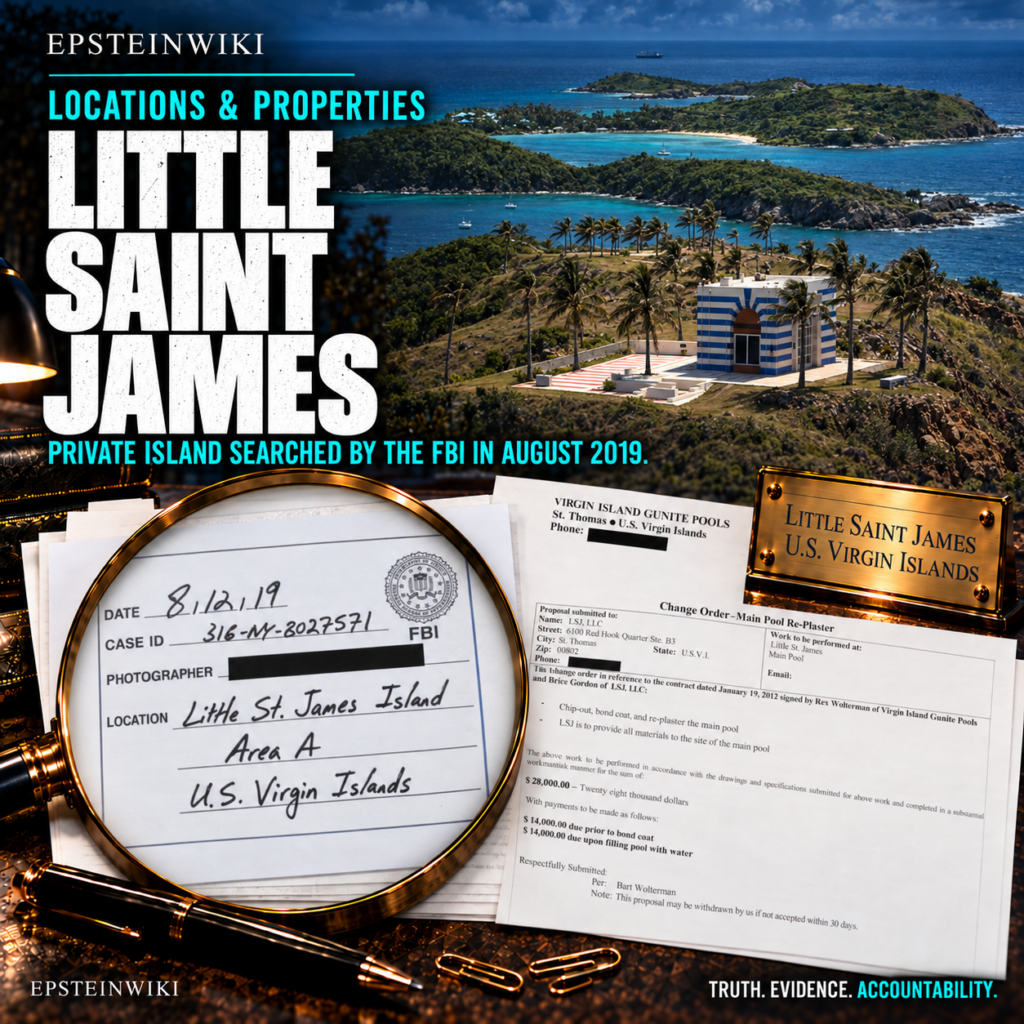
Snapshot
Little Saint James is a privately owned island southeast of St. Thomas in the United States Virgin Islands. Jeffrey Epstein acquired it through L.S.J., LLC in April 1998 for a reported $7.95 million. He transformed the approximately 71.5 acre property into a secluded residential compound with a main house, guest residences, cabanas, pools, staff and maintenance facilities, a dock, helicopter landing area, beach structures, and the blue and white striped building commonly called the temple.
The island became one of the central locations in the documented Epstein trafficking system. Survivors including Virginia Giuffre, Sarah Ransome, Juliette Bryant, and Chauntae Davies publicly connected Little Saint James to sexual abuse, coercion, trafficking, or captivity. The Government of the United States Virgin Islands alleged that Epstein and associated entities used the island to traffic and sexually abuse women and girls, some as young as 13, while using aircraft, helicopters, boats, employees, companies, tax benefits, and institutional relationships to operate and conceal the enterprise.
Little Saint James was geographically isolated but logistically connected. Epstein’s aircraft brought passengers to Cyril E. King Airport on St. Thomas. Helicopters, boats, drivers, pilots, assistants, and island staff controlled the final movement to the property. Once there, a person without independent transportation depended on Epstein’s organization to leave.
The Federal Bureau of Investigation searched the island on August 12, 2019, two days after Epstein died in federal custody. Later search warrant materials state that agents seized 27 electronic devices. Federal records also document photography, evidence collection, structure identification, title research, appraisal requests, and forfeiture work.
The Virgin Islands sued Epstein’s estate and related defendants in 2020. A 2022 settlement required more than $105 million in cash, the return of more than $80 million in economic development tax benefits, the sale of Little Saint James and Great Saint James to independent buyers, and payment of one half of the Little Saint James sale proceeds to a Virgin Islands trust supporting survivors.
Investor Stephen Deckoff purchased both islands through SD Investments in May 2023 for a reported combined price of $60 million. Little Saint James is now held through LSJVI, LLC. Announced plans for a luxury resort have not been completed. The property remains private and has become a target for trespassers and online speculation.
Key Takeaways
- Epstein acquired Little Saint James in 1998 through L.S.J., LLC and later transferred title to Nautilus, Inc., another entity he controlled.
- The island measured approximately 71.5 acres in assessor records. The 2019 FBI search affidavit estimated approximately 75 acres.
- The island could be reached privately by boat or helicopter. Travel through the St. Thomas airport does not by itself prove that a passenger visited the island.
- Survivors publicly described rape, coercive control, threats, trafficking, restricted movement, and dependency on Epstein’s transportation system at Little Saint James.
- Sarah Ransome described arriving for what she believed was a vacation, being raped, threatened, and unable to leave independently.
- Virginia Giuffre alleged that Epstein and Maxwell trafficked her to people at Little Saint James, including Prince Andrew. Andrew denied her allegations and settled her civil lawsuit without admitting liability.
- Juliette Bryant said her passport was taken, she was sexually assaulted during air travel, and she was transported into Epstein’s island system under false promises of modeling work.
- Chauntae Davies publicly described rape by Epstein at an island villa after being recruited through massage work.
- The Virgin Islands government alleged that the island functioned as a protected base for a trafficking enterprise. Those allegations were resolved through a civil settlement rather than a trial verdict.
- Construction records document a main residence, multiple guest buildings, cabanas, pools, a screening room, library work, a massage hut, docks, maintenance buildings, landscaping, and extensive privacy planning.
- The striped building was described by the FBI as a single story structure with blue and white walls, double doors, and large windows. The FBI did not call it a temple or identify a criminal purpose.
- No released official record establishes a tunnel, dungeon, sacrificial chamber, burial site, or underground level beneath the striped building.
- The FBI searched the island on August 12, 2019, photographed structures, and seized 27 electronic devices.
- Location data reviewed by WIRED showed nearly 200 devices visiting the island between 2016 and Epstein’s 2019 arrest. Device presence does not identify the carrier or prove criminal conduct.
- The 2022 estate settlement required the islands to be sold and directed significant money toward the Virgin Islands and survivor support.
- Both islands sold together for a reported $60 million in 2023. The announced resort has not opened.
Island Profile Chart
| Field | Documented information |
|---|---|
| Formal name | Little Saint James |
| Common abbreviation | LSJ |
| Common media name | Epstein Island |
| Jurisdiction | United States Virgin Islands |
| Location | Southeast of St. Thomas |
| Assessor acreage | Approximately 71.5 acres |
| FBI estimate | Approximately 75 acres |
| Epstein acquisition | April 1998 |
| Reported purchase price | $7.95 million |
| Original acquisition entity | L.S.J., LLC |
| Later title holder | Nautilus, Inc. |
| Epstein era mailing address | 6100 Red Hook Quarters, Suite B3, St. Thomas, Virgin Islands 00802 |
| 2019 estate value | Approximately $63.87 million |
| FBI search | August 12, 2019 |
| Combined 2022 listing price | $125 million for Little Saint James and Great Saint James |
| Combined 2023 sale price | $60 million |
| Current holding entity | LSJVI, LLC |
| Current controlling investor | Stephen Deckoff through SD Investments |
Why Little Saint James Matters
Little Saint James was not merely a vacation property associated with Epstein. It was a residential compound, transportation destination, employment site, corporate asset, construction project, and alleged crime scene.
The island matters because its physical isolation amplified Epstein’s control. Survivors described being flown or ferried there, separated from familiar support systems, and dependent on Epstein’s pilots, boat operators, assistants, and household employees for transportation.
It matters because several evidence streams converge there. Survivor accounts, civil complaints, flight and helicopter records, construction documents, employee communications, financial records, photographs, search warrants, electronic devices, and government litigation all identify the island.
It also matters because Epstein continued to control and develop it after his 2008 conviction. His registered sex offender status did not stop him from maintaining a private transportation system, receiving visitors, employing staff, obtaining territorial tax benefits, cultivating government relationships, and expanding his island holdings.
Geography, Isolation, and Access
Little Saint James lies southeast of St. Thomas in the Caribbean. Sources have described it as approximately two to four miles from St. Thomas depending on the shoreline and measurement point used.
The island has no public ferry or commercial transportation. Visitors generally reached St. Thomas by aircraft and completed the journey by private boat or helicopter. The island included its own dock and helicopter landing area.
The Government of the Virgin Islands alleged that the distance, surrounding water, and lack of public transportation made it impossible for trafficked women and girls to leave without permission and assistance. Sarah Ransome similarly described the island as a place with no practical route of escape.
Isolation alone does not prove criminal activity. Here, it is relevant because survivors described coercion, confiscated travel documents, threats, controlled transportation, and dependency on the same organization accused of abusing them.
The 1998 Acquisition
Property records and the Virgin Islands complaint identify April 1998 as the acquisition period. L.S.J., LLC purchased the island from its prior owner for a reported $7.95 million. The property had previously been marketed for approximately $10.5 million.
The available records identify Epstein as the sole member or beneficial controller of L.S.J., LLC. An entity purchase created legal separation between Epstein and the deed while leaving him in practical control of the property.
EFTA00018778 describes the acquisition and the government’s later theory of how the island was used. EFTA00003148 identifies the island among Epstein’s principal properties.
The purchase predates the Palm Beach police investigation and Epstein’s public sex offense conviction. It does not, by itself, establish that the island was acquired for a criminal purpose. The government later alleged that it became a secluded haven for trafficking, assault, and concealment.
The 2011 Transfer to Nautilus, Inc.
A federal financial investigator reviewing the property chain identified a December 23, 2011 quitclaim deed transferring Little Saint James from L.S.J., LLC to Nautilus, Inc. for ten dollars and other stated consideration.
EFTA00037752 documents the deed research and identifies Epstein as the sole beneficial owner and president of Nautilus, Inc.
The transfer occurred between associated entities rather than through an ordinary third party sale. It changed the record title holder without ending Epstein’s control.
Nautilus later appeared in estate records and the Virgin Islands litigation. The use of several entities for title, expenses, employment, transportation, and tax benefits complicates efforts to reconstruct who authorized and paid for particular island activities.
Ownership and Operating Entity Chart
| Entity | Documented role | Important qualification |
|---|---|---|
| L.S.J., LLC | Acquired the island in 1998 | Epstein was identified as its sole member or controller |
| LSJE, LLC | Island operating, mailing, contracting, and emergency records | Similar names must not be treated as interchangeable without checking each document |
| Nautilus, Inc. | Received title in 2011 | Epstein remained the beneficial controller |
| LSJ Emergency, LLC | Named among Epstein related entities in government discovery | Exact operational function requires transaction specific records |
| Southern Trust Company, Inc. | Epstein’s Virgin Islands business and tax benefit vehicle | Did not hold every island asset directly |
| Financial Trust Company, Inc. | Earlier Virgin Islands financial entity | Corporate function differs from island title ownership |
| Hyperion Air, LLC and related aviation entities | Aircraft ownership or operation | Airport travel does not prove island entry |
| Estate of Jeffrey Epstein | Controlled the property after his death | Subject to probate, claims, settlement duties, and sale requirements |
| LSJVI, LLC | Current post sale title entity | Separate from Epstein era conduct |
Construction and Expansion of the Compound
The island was substantially developed during Epstein’s ownership. Construction and design records span the late 1990s through 2019 and show repeated renovation rather than a single completed building campaign.
EFTA00002698 contains a 2009 design development package addressing cabanas, pavilions, a pool, and a screening room. EFTA01928166 concerns a library and study expansion. EFTA01927270 concerns additional design services. EFTA01949552 documents coral stone pavers delivered to the island.
The records show work involving architects, designers, builders, landscapers, marine contractors, utility specialists, suppliers, accountants, lawyers, and household managers. They also show Epstein personally discussing fees, designs, repairs, and privacy features.
Plans and invoices establish proposed or paid work. They do not automatically establish that every design was completed or that a structure was used for a criminal purpose.
FBI Structure Inventory
The affidavit supporting the 2019 FBI search used satellite imagery and drone video to identify structures before agents entered the island.
| FBI description | Documented characteristics |
|---|---|
| Main Residence | Single story stone residence with blue roof and white columns |
| Residences 1 through 5 | Separate residential buildings of different sizes and elevations |
| Four Cabanas | Four smaller structures near the main residence and large pool |
| Dock House | Building at the end of the wooden dock |
| Shed 1 and Shed 2 | Smaller utility structures with green and blue metal exteriors |
| Maintenance 1 | Building with large sally port style doors |
| Maintenance 2 | Additional maintenance structure |
| Helicopter area buildings | Two small structures beside the landing pad |
| Striped building | Single story structure with blue and white walls, double doors, and large windows |
EFTA00020141, EFTA00018586, and EFTA01301561 preserve versions of the search affidavit and related warrant materials.
The official inventory is important because it supplies a neutral starting point. Popular labels such as temple, dungeon, chapel, or ritual chamber are not substitutes for the descriptions used in sworn government records.
Main Residence and Owner Areas
The main residential complex occupied the higher northeastern portion of the island. Photographs and plans show stone walls, blue roofs, terraces, bedrooms, dining and living areas, a kitchen, library space, pools, paths, and landscaped grounds.
The 152 page photographic assessment beginning at EFTA00506228 records repairs and proposed changes throughout the main house. It includes doors, ceilings, drainage, shutters, lighting, furniture, terrace features, bathrooms, service spaces, and landscaping.
The main residence was both a private home and an operational center. Epstein’s schedules, staff, guests, meals, communications, and personal appointments could be coordinated there.
Photographs of a room or furnishing do not establish who used it during a specific event. Room identification should be compared with survivor descriptions, employee testimony, schedules, device locations, construction drawings, and search records.
Guest Residences, Cabanas, and Pools
The FBI identified five residences in addition to the main house and four smaller cabanas near a large pool. Design documents also refer to guest facilities, pavilions, recreation areas, and a screening room.
The property assessment shows guest room entrances, paths, pool approaches, cabana interiors, bathrooms, terraces, storage, furniture, and changes intended to increase privacy.
One proposal would convert Cabana 1 into a private office with a private terrace and bathroom while removing stairs that connected it to housekeeping. Another proposed a more private beach pool and screening of views.
Privacy modifications may have ordinary residential explanations. Their significance comes from context, including the survivor accounts, allegations of controlled movement, and incomplete record of who occupied each building.
The Massage Hut and Beach Facilities
EFTA01927885 includes correspondence in which Epstein referred to island structures including a massage hut on the main beach.
The phrase is significant because massage was repeatedly used as an entry point in Epstein’s abuse system. It does not prove that every massage or beach structure was criminally used.
The property assessment records beach paths, a tiki hut, vegetation, damaged structures, a proposed new pool, privacy screening, shoreline access, and connections to the pier.
Investigators should compare the massage hut reference with survivor descriptions, employee schedules, therapist payments, room assignments, photographs, and the physical search record.
The Blue and White Striped Building
The isolated striped building on the southwestern end of the island is commonly called the temple. The FBI affidavit did not use that term. It described a single story, four wall structure painted with blue and white stripes, with large double doors and large windows on the other walls.
Permit reporting described an earlier plan for a music pavilion intended to contain a grand piano, a living room, and a bathroom. A piano tuner said he entered the building in 2012 and described a large room containing a piano and ordinary furnishings.
FBI photographs taken in August 2019 and released in 2025 show a large interior room under renovation, a carved wooden bookcase, exposed paneling, an incomplete ceiling, and stacked metal bed frames. The exterior had a red and white paved labyrinth.
EFTA00002940 and EFTA00002942 are among the released exterior image records. EFTA00001500 belongs to the FBI search image series.
The striped building deserves investigation because of its isolation, changing appearance, unusual design, and uncertain final use. Those features do not prove ritual activity, human sacrifice, imprisonment, or underground construction.
What Is Known About Tunnels and Underground Claims
No released search warrant, FBI photograph, construction plan, official finding, or survivor account reviewed for this article establishes a tunnel, dungeon, burial chamber, or underground level beneath the striped building.
Released communications reportedly refer to a tunnel in connection with the main house, not the striped building. Architectural records also include an underground screening room concept that available reporting says was not built.
An unbuilt plan is not evidence of a completed hidden structure. A reference to a tunnel at one location cannot be moved to another location because the second building appears mysterious.
Claims about underground systems should require geophysical evidence, excavation records, construction drawings, contractor testimony, or a documented law enforcement finding.
Dock, Boats, and Marine Access
The island’s dock connected it to Red Hook, American Yacht Harbor, St. Thomas marinas, visiting vessels, and other islands. The FBI identified a Dock House at the end of the wooden dock.
The property assessment shows boats, dock surfaces, damaged edges, rocks, shoreline structures, and marine access routes. Other records concern moorings, dock permits, submerged land fees, and repair disputes.
Marine transportation records are essential because many people who reached St. Thomas by air would have completed the trip by boat. Fixed wing flight logs generally do not record that final leg.
Complete vessel manifests, fuel purchases, maintenance records, captain schedules, dock cameras, radio traffic, marina records, and passenger lists have not been made public as one unified archive.
Helicopter Operations
The island included a helicopter landing area and support structures. Epstein and Maxwell both used helicopters in the Virgin Islands context, and survivor accounts describe the aircraft as part of movement between St. Thomas and the island.
Helicopter travel created a direct connection between Cyril E. King Airport and Little Saint James. It also created a gap in ordinary fixed wing flight logs because the final passenger transfer could occur on a separate aircraft.
The property assessment proposed changes to the helicopter station. The FBI affidavit identified two small structures near the landing pad.
A complete reconstruction requires helicopter logs, maintenance records, pilot records, fuel purchases, airport tower data, insurance files, schedules, and passenger manifests. Presence on a helicopter or island does not by itself prove criminal conduct.
Staff, Contractors, and Daily Operations
The island required a permanent or rotating workforce. Records identify household employees, property managers, pilots, boat personnel, maintenance workers, housekeepers, cooks, gardeners, security personnel, architects, builders, accountants, lawyers, and temporary contractors.
EFTA02032292, EFTA02033034, and EFTA01927697 contain island contact or operational correspondence associated with Brice Gordon.
Central Epstein employees also supported travel, appointments, finances, legal matters, and property operations across jurisdictions. These included Ghislaine Maxwell, Lesley Groff, Sarah Kellen, Nadia Marcinkova, Adriana Ross, Darren Indyke, Richard Kahn, Larry Visoski, David Rodgers, and others.
Employment or presence does not automatically establish criminal knowledge. Individual responsibility must be evaluated through specific instructions, schedules, payments, communications, access, observations, recruitment activity, and responses to warning signs.
Emergency and Communications Systems
EFTA00003042 is an LSJE, LLC emergency contact record. Other documents show island telephone numbers, email addresses, satellite communications, marine contacts, staff directories, and contractor coordination.
Reliable communications were necessary for an isolated estate. They supported safety, supply deliveries, construction, aviation, boats, scheduling, and emergency response.
The same systems could also support surveillance, access control, information management, and rapid coordination of visitors. Capacity is not proof of misuse.
Investigators need the complete network map, camera locations, server inventory, account ownership, backup practices, access logs, device assignments, and data retention history.
Survivor Evidence Overview
| Survivor or evidence group | Period | Little Saint James account | Evidentiary form |
|---|---|---|---|
| Virginia Giuffre | Early 2000s | Alleged trafficking, sexual abuse, and encounters involving Prince Andrew on the island | Sworn declarations, depositions, civil complaint, photographs, reporting |
| Sarah Ransome | 2006 to 2007 | Described rape, threats, coercive control, repeated island visits, and inability to leave independently | Civil litigation, estate claim, interviews, memoir, impact statement |
| Juliette Bryant | 2002 to 2004 | Described false modeling promises, passport control, assault during travel, captivity, and repeated rape within Epstein’s property system | Civil litigation, estate claim, compensation history, interviews, photographs |
| Chauntae Davies | About 2002 to 2004 | Publicly described rape by Epstein at an island villa after massage recruitment | Public interviews and survivor statements |
| Anonymous women and girls | Multiple years | Virgin Islands complaint alleged trafficking, forced sexual conduct, forced labor, and confinement | Government civil investigation and pleadings |
These accounts are not interchangeable. Each survivor has a distinct history, date range, legal posture, and level of public identification.
Virginia Giuffre
Virginia Giuffre said Maxwell recruited her as a teenager and that Epstein and Maxwell trafficked her across several properties, including Little Saint James.
Giuffre alleged that Prince Andrew sexually assaulted her on the island. Her 2021 civil complaint stated that one of the alleged encounters occurred at Little Saint James. Andrew denied the allegations. The case settled in 2022 without an admission of liability.
Giuffre also described other young women and girls at the island. Some of her statements about particular visitors were disputed or not independently corroborated. Researchers must distinguish a confirmed trip, a survivor’s sworn allegation, a denial, a settlement, and a judicial finding.
Giuffre’s testimony remains central because it describes recruitment, transportation, sexual exploitation, Maxwell’s role, the island environment, and the movement of a teenager through Epstein’s international property system.
Sarah Ransome
Sarah Ransome said she met Epstein at age 22 after another young woman recruited her in New York. She traveled to Little Saint James believing she was taking a vacation.
Ransome described the island as a place where there was no practical escape and nobody nearby to hear her. She alleged that Epstein repeatedly raped her and threatened to kill her and her parents if she reported him or attempted to leave.
She said Maxwell organized and facilitated the environment. Maxwell denied sexual abuse and trafficking allegations before her criminal conviction on other charged conduct.
Ransome returned to the island more than once, a fact sometimes misused to blame her. Her account describes coercive control, threats, financial vulnerability, trauma, and dependency rather than free and informed consent.
Ransome sued Epstein and Maxwell in 2017 and settled in 2018. She later filed a claim against Epstein’s estate and supplied a victim impact statement connected to Maxwell’s sentencing.
Juliette Bryant
Juliette Bryant said Epstein’s network recruited her in Cape Town in 2002 when she was a 20 year old university student and part time model. She said his organization arranged a visa and travel under promises of modeling opportunities.
Bryant said her passport was taken aboard Epstein’s aircraft and that Epstein sexually assaulted her during the flight. She described being transported to Little Saint James, where she felt trapped by the surrounding water, controlled travel, and lack of independent documents or money.
She said Epstein repeatedly raped her during a two year period and that she continued to experience psychological control after returning home. Her photographs and the timing of Epstein’s 2002 African travel provide contextual corroboration for parts of her account, but each alleged assault remains her testimony rather than a separate criminal verdict.
Bryant filed Bryant v. Indyke in 2019, joined a claim against Epstein’s estate, received compensation through the Epstein Victims’ Compensation Program, and participated in a later JPMorgan settlement.
Chauntae Davies
Chauntae Davies said she met Maxwell while studying massage therapy and was introduced to Epstein as a professional massage therapist.
Davies described escalating sexual misconduct followed by rape. Reporting on her account states that Epstein raped her in an island villa. She later traveled within Epstein’s wider network and described how gifts, education, status, and Maxwell’s apparent concern were used to confuse and control her.
Davies was an adult when she entered the network. That does not reduce the significance of the force, manipulation, or rape she described.
Her account should not be confused with the separate experience of her sister Teala Davies or with anonymous civil plaintiffs.
Anonymous Survivors and the Government Investigation
The Virgin Islands complaint was based on an investigation that included survivor information, third party records, corporate documents, banking evidence, property records, and discovery.
The government alleged that numerous women and girls were transported to the islands, subjected to unlawful sexual conduct, threatened, controlled, or required to perform labor. A 2021 government statement said some girls were as young as 13.
The complaint also alleged that the enterprise used immigration assistance and forced marriages involving survivors. These were government allegations in civil litigation, not criminal convictions against every named defendant.
Anonymous survivors must not be identified by combining ages, nationalities, flight records, photographs, device data, payments, or redacted court filings.
The Alleged Recruitment and Control System
The island accounts fit a wider pattern documented across Epstein’s properties.
Young women or girls were approached through massage work, modeling promises, education, travel, employment, or introductions by trusted people. Epstein or his organization paid for travel, housing, gifts, tuition, health needs, or family assistance.
The relationship then became sexualized. Survivors described pressure, assault, money, threats, shame, dependency, and expectations that they recruit or assist with other women and girls.
On an island, control of aircraft, boats, passports, lodging, communications, and staff could intensify dependency. A person could appear to move freely within the grounds while still lacking a safe or independent way to leave.
Transportation Evidence Chart
| Transportation layer | Documented role | Evidentiary limit |
|---|---|---|
| Commercial or private aircraft | Brought travelers to St. Thomas | Airport arrival does not prove island entry |
| Epstein owned aircraft | Connected St. Thomas with New York, Palm Beach, New Mexico, Paris, and other locations | A passenger log does not prove conduct at the destination |
| Helicopters | Connected the airport and other locations directly to the island | Complete passenger manifests are not public |
| Private boats | Connected Red Hook, marinas, St. Thomas, and the island dock | Vessel records are incomplete |
| Island vehicles | Moved staff and guests within the property | Internal routes do not identify purpose |
| Passports and immigration records | Documented international status and entry | Possession of a foreign passport does not imply victimization or wrongdoing |
| Mobile device location data | Shows devices traveling to and within the island | A device does not reliably identify its user or establish criminal conduct |
Fixed Wing Flight Logs and Their Limits
Epstein’s aircraft frequently traveled through Cyril E. King Airport on St. Thomas. Flight logs identify dates, routes, pilots, and some passengers.
They do not provide a complete island visitor list. Names may be omitted, abbreviated, misspelled, or replaced with descriptions. Some travelers used commercial aircraft or aircraft owned by other people. The final journey by boat or helicopter usually appears in a different record, if at all.
The presence of a person on a flight to St. Thomas does not establish that the person visited Little Saint James. A visit to the island does not establish knowledge of or participation in abuse.
Flight evidence becomes stronger when combined with calendars, helicopter logs, boat records, photographs, messages, staff schedules, immigration records, payments, or testimony.
Customs, Immigration, and Cyril E. King Airport
Newly released records show that federal investigators examined Epstein’s relationships with Customs and Border Protection employees at the St. Thomas airport.
EFTA00149603 and EFTA00149608 relate to the opening of that inquiry. EFTA00159720 records an interview concerning Epstein’s contacts with customs officers. EFTA01249742 concerns an interview with Timothy Routch.
Records show Epstein and his staff discussed preclearance, airport staffing, immigration issues, foreign passengers, and requests to keep processing available after ordinary hours. Epstein also invited some officers to the island or offered social and professional assistance.
No Customs and Border Protection officer was charged with participating in Epstein’s trafficking. The reviewed records do not establish that an officer knowingly assisted abuse. They do establish a relationship network that investigators considered important enough to examine and subpoena.
Mobile Location Data
A 2024 WIRED investigation analyzed exposed advertising location data associated with nearly 200 mobile devices that visited Little Saint James between 2016 and July 6, 2019.
The data included more than 11,000 coordinates and showed movement between St. Thomas locations, docks, aircraft routes, the island, and other places. The inferred home and work locations extended across many states and countries.
This dataset is potentially valuable for generating investigative leads, but it creates serious privacy risks. A device identifier may belong to a visitor, employee, contractor, survivor, family member, shared device, or inaccurately located phone.
EpsteinWiki should not publish inferred identities from commercial location data without strong independent confirmation and a clear public interest. Device presence does not prove that its carrier committed or witnessed a crime.
Cameras, Surveillance, and Recorded Material
Survivors and employees described cameras and monitoring across Epstein’s properties. Search records from the Manhattan townhouse documented extensive labeled media. Island records document communications and technical infrastructure but do not provide a complete public camera map.
The 2019 island search and later device warrant create a direct evidentiary question: what digital material was recovered, what locations it depicted, how it was indexed, and what happened after review?
Public releases include property photographs and evidence lists, but they do not supply a complete catalog of island surveillance footage. The absence of a public catalog does not prove that no footage existed.
Claims that Epstein recorded every guest for blackmail remain unproven as a universal system. Each recording claim requires a specific file, device, witness, location, date, or investigative finding.
The August 2019 FBI Search
The FBI searched Little Saint James on August 12, 2019, two days after Epstein died in federal custody.
The search warrant covered the island and the buildings and structures on it. Agents used advance satellite imagery and drone footage, photographed the property, identified buildings, entered structures, and collected physical and digital evidence.
EFTA00020141 contains the sworn affidavit describing the property. EFTA01301561 preserves related warrant material. EFTA00001500 belongs to the FBI island documentation from the search date.
The timing matters. Epstein had controlled the island for more than 21 years. The search occurred only after his arrest and death, leaving extensive opportunity for renovation, weather damage, removal of records, and loss of witness memory.
The 27 Electronic Devices
EFTA01263024 is a later application concerning 27 electronic devices seized from Little Saint James during the August 12 search.
The device count establishes that agents recovered a substantial body of digital hardware. It does not disclose every device type, owner, user, date range, password status, forensic result, or evidentiary conclusion.
The critical unresolved questions include whether investigators recovered deleted data, cloud credentials, security footage, visitor information, photographs, communications, financial records, schedules, or evidence involving other properties.
An inventory number proves collection. It does not prove what investigators ultimately found on the item.
Title, Appraisal, and Forfeiture Work
EFTA01684602 documents federal asset and forfeiture work associated with the 2019 investigation. The records include requests for title information and appraisal activity concerning Little Saint James.
Forfeiture work was relevant because prosecutors alleged that Epstein used property and companies in connection with trafficking crimes. Epstein’s death ended the criminal case before a forfeiture trial could determine the status of the island.
The property instead entered probate and civil litigation. Government claims, survivor claims, creditors, taxes, professional fees, and estate administration affected the disposition.
The federal collection of title records establishes investigative interest. It does not itself prove that the property was criminally forfeitable.
2025 Photograph and Video Releases
In December 2025, House Oversight Committee Democrats released images and video obtained from the Virgin Islands. The Department of Justice separately released FBI photographs taken during the August 2019 search.
The imagery shows bedrooms, bathrooms, offices, telephones, a chalkboard, furnishings, masks, a dental style chair, exterior paths, pools, cabanas, utility areas, and the interior and exterior of the striped building.
Images can establish the appearance and location of an object at the time it was photographed. They do not automatically establish ownership, use, criminal purpose, or the identity of every person associated with it.
The releases are valuable for matching rooms to search inventories, architectural plans, survivor descriptions, contractor records, and later property changes.
The United States Virgin Islands Civil Case
The Government of the United States Virgin Islands filed suit against Epstein’s estate and related entities in January 2020. It later amended the complaint to add allegations and defendants.
EFTA00018778 preserves the first amended complaint. The government alleged violations of territorial laws addressing criminal enterprises, trafficking, child exploitation, forced labor, fraud, and related conduct.
The complaint described Little Saint James as a secluded base from which Epstein and associates allegedly trafficked, sexually abused, and controlled women and girls. It also alleged use of companies, employees, aircraft, boats, immigration processes, financial systems, and tax benefits.
A complaint states allegations the plaintiff intended to prove. It is not a verdict. The case ended in settlement, so the complete allegations were not tested through a final civil trial.
Darren Indyke, Richard Kahn, and the Entity Defendants
The amended Virgin Islands action named estate coexecutors Darren Indyke and Richard Kahn in their individual capacities and added or discussed multiple Epstein entities.
The government alleged that Indyke and Kahn participated in financial and business operations that supported the enterprise. It described them as captains of the alleged organization and asserted that entity structures helped conceal conduct and assets.
Indyke and Kahn denied wrongdoing. The settlement resolved the government’s claims without criminal convictions or a trial finding that every allegation was proven.
Their documented legal, accounting, banking, corporate, payroll, and estate roles remain relevant to tracing decisions and money. Professional or fiduciary service alone does not establish knowledge of sexual crimes.
Virgin Islands Tax Benefits
Epstein established financial businesses in the Virgin Islands and received substantial benefits through the territory’s Economic Development Commission program.
The government later alleged that his enterprise obtained more than $80 million in tax benefits and used local business structures while trafficking and abusing women and girls.
The 2022 settlement required the estate to return more than $80 million in economic development tax benefits. That recovery was separate from the $105 million cash settlement and the Little Saint James sale proceeds.
The tax history raises questions about compliance reviews, employment claims, physical office requirements, government monitoring, and what officials knew after Epstein’s 2008 conviction.
Local Government and Institutional Relationships
Epstein maintained relationships with lawyers, accountants, business officials, airport personnel, contractors, political figures, and government employees in the Virgin Islands.
Some relationships were ordinary professional contacts. Others involved donations, employment, gifts, business assistance, invitations, tax matters, immigration issues, inspections, or personal access.
Contact with Epstein does not prove knowledge of abuse. The correct investigative questions concern what a person knew, when the person knew it, what authority the person had, what benefit was exchanged, and what action followed.
The island’s long operation after Epstein’s conviction makes institutional due diligence a central issue even where criminal complicity is not established.
Construction Permits and Regulatory Oversight
Records show recurring questions about permits for island structures, docks, moorings, submerged land use, shoreline work, and building modifications.
In 2011, counsel summarized a regulator’s request for a building by building account identifying which permit covered each structure. Other records show contractors, consultants, and lawyers attempting to resolve gaps.
The existence of a permit problem does not establish trafficking. It matters because incomplete plans and inspection disputes can obscure when structures were built, altered, or removed.
Regulatory files may contain drawings, site visits, photographs, contractor names, inspection dates, and sworn representations that are unavailable in criminal files.
Hurricanes, Damage, and Renovation
The Virgin Islands were struck by Hurricanes Irma and Maria in 2017. Later island photographs show damaged vegetation, roofs, finishes, shoreline features, utilities, paths, and structures.
The 152 page assessment from EFTA00506228 through EFTA00506379 appears consistent with a major repair and renovation program, although the file itself does not identify a hurricane or creation date.
Storm damage and reconstruction complicate evidence preservation. A room can be rebuilt, furniture removed, landscaping changed, devices replaced, and records dispersed for legitimate repair reasons.
Investigators must distinguish documented storm work from possible evidence destruction rather than assuming either explanation.
The 2022 Estate Settlement
The Virgin Islands announced a settlement with Epstein’s estate, Indyke, Kahn, and ten Epstein created entities in November 2022.
| Settlement component | Publicly announced term |
|---|---|
| Cash payment to the Virgin Islands | More than $105 million |
| Returned economic development tax benefits | More than $80 million |
| Environmental remediation for Great Saint James | $450,000 |
| Island disposition | Sale to independent third parties required |
| Little Saint James proceeds | One half directed to a Virgin Islands survivor support trust |
The settlement resolved the government’s civil claims against the named defendants. It did not create criminal convictions or a trial verdict on every allegation.
The survivor trust was intended to support people affected by sexual assault, trafficking, sexual misconduct, and child sexual abuse in the Virgin Islands.
Listing and 2023 Sale
The estate listed Little Saint James and Great Saint James together in 2022 for $125 million. Later reporting described a reduced combined price of approximately $110 million.
| Stage | Amount |
|---|---|
| Little Saint James reported 1998 purchase | $7.95 million |
| Little Saint James 2019 estate value | Approximately $63.87 million |
| Great Saint James 2016 purchase | $22.5 million |
| Combined 2019 estate values | Approximately $86.37 million |
| Initial combined 2022 listing | $125 million |
| Later combined asking price | Approximately $110 million |
| Combined 2023 sale | $60 million |
Stephen Deckoff purchased both islands through SD Investments in May 2023. The combined price does not disclose the amount allocated to each island.
The sale price reflected an unusual private island market, the property’s history, settlement duties, development costs, legal risk, environmental obligations, and reputational stigma.
Current Ownership and Resort Plans
Little Saint James is currently associated with LSJVI, LLC and investor Stephen Deckoff. Deckoff said he intended to develop a 25 room luxury resort across the island properties.
The announced resort has not opened. Reporting through 2026 indicates that the only publicly identified current permit effort concerned a warehouse and that broader resort development had not proceeded on the original schedule.
The buildings remained standing in recent imagery, although colors, furnishings, security, and maintenance conditions have changed.
Post sale ownership is legally separate from Epstein era conduct. Current owners and workers should not be accused of participation in events that predated them.
Trespassing, Tourism, and Evidence Protection
Little Saint James remains private property. Online creators and curiosity seekers have attempted unauthorized landings and entries.
Trespassing can endanger visitors, create confrontations with security, damage structures, contaminate possible evidence, invade worker privacy, and undermine lawful investigation.
The public status of some Virgin Islands shorelines does not create unlimited access to buildings, roads, interiors, equipment, or private records.
Photographs or objects taken during an unauthorized visit lack reliable chain of custody. They should not be treated as verified evidence without authentication.
Famous Visitors and the Presence Problem
The island has been associated through schedules, messages, photographs, witness accounts, and travel records with political figures, business leaders, scientists, academics, royalty, entertainers, and philanthropists.
Researchers must avoid turning a visitor list into a criminal accusation list. A documented invitation is not proof of attendance. Airport arrival is not proof of island entry. Island presence is not proof that a visitor witnessed or participated in abuse.
Evidence should be graded by type: invitation, planned trip, flight, helicopter transfer, photograph, staff confirmation, self admission, survivor allegation, or judicial finding.
The most important question is not whether a name appears near the island. It is what specific evidence connects the person to a date, location, act, observation, warning, or response.
Myths, Misidentifications, and Unsupported Claims Chart
| Claim | Assessment | Reason |
|---|---|---|
| The striped building was officially called a temple | Unsupported | The FBI used a physical description and did not assign that function |
| The striped building contained an underground dungeon | Not established | No released official record or photograph proves a lower level |
| Human sacrifices occurred on the island | Unsupported | No verified evidence or official finding supports the claim |
| Bodies were recovered from Little Saint James | False based on the public record reviewed | No announced recovery has been documented |
| Every person in a St. Thomas flight log visited the island | False | St. Thomas served many destinations and required a separate final transfer |
| Every island visitor committed or knew about abuse | Not established | Presence alone does not prove knowledge or conduct |
| The FBI never searched the island | False | The FBI executed a warrant on August 12, 2019 |
| The FBI seized 27 electronic devices | Supported | Later warrant application identifies 27 seized devices |
| Disney purchased the island | False | The buyer was Stephen Deckoff through SD Investments |
| The island has been turned into an operating resort | False as of reviewed reporting | Announced plans have not been completed |
Evidence Strength Chart
| Claim | Assessment | Basis |
|---|---|---|
| Epstein controlled Little Saint James from 1998 until his death | Confirmed | Deeds, entity records, address records, estate filings |
| The island contained approximately 71.5 acres | Strongly supported | Assessor and listing records |
| L.S.J., LLC paid $7.95 million in 1998 | Strongly supported | Property records and consistent reporting |
| Nautilus received title in 2011 | Confirmed | Deed research and beneficial ownership record |
| Survivors were sexually abused on the island | Strongly supported | Multiple independent survivor accounts, litigation, government investigation |
| The island was part of a trafficking enterprise | Government allegation supported by survivor and operational evidence | Civil complaint and related records, resolved by settlement |
| Some trafficked girls were as young as 13 | Government allegation | Virgin Islands investigation statement |
| Prince Andrew assaulted Giuffre on the island | Alleged and denied | Civil complaint, denial, and settlement without admission |
| Every prominent visitor participated in abuse | Not established | Presence and conduct require separate proof |
| The striped building was used for ritual crimes | Unsupported | No verified record establishes that use |
| The FBI searched every structure completely | Not publicly established | Warrant scope was broad, but complete execution details are not public |
| Agents seized 27 electronic devices | Strongly supported | Search and seizure warrant application |
| The estate settlement exceeded $105 million in cash | Confirmed | Official Virgin Islands announcement |
| The islands sold together for $60 million | Strongly supported | Buyer announcement and national reporting |
What the Evidence Establishes
The evidence establishes that Epstein acquired, controlled, expanded, and operated Little Saint James through corporate entities for more than two decades.
It establishes a private transportation and staffing system connecting St. Thomas to the island by aircraft, helicopter, and boat.
It establishes that multiple survivors publicly described sexual abuse, coercion, trafficking, threats, or captivity connected to the island.
It establishes that the Virgin Islands government conducted a major civil investigation, sued the estate and associated defendants, and obtained a settlement exceeding $105 million plus tax benefit recovery and sale proceeds.
It establishes that the FBI searched the property, documented its structures, and seized 27 electronic devices.
It establishes that the estate sold both islands in 2023 and that the current resort plan has not been completed.
What the Evidence Does Not Establish
The public record does not establish a complete list of survivors, employees, contractors, visitors, or witnesses.
It does not establish that every visitor knew about Epstein’s crimes or that every employee participated in them.
It does not establish the identity of every person associated with a flight, helicopter trip, vessel movement, photograph, payment, or mobile device.
It does not establish the complete contents or forensic results of the 27 electronic devices seized in 2019.
It does not establish that the striped building was used for ritual activity or that a dungeon, tunnel, burial site, or underground chamber existed beneath it.
It does not convert allegations in a civil complaint into criminal convictions. It also does not erase those allegations merely because the case settled.
Survivor Centered Evidence Assessment
The island’s history must begin with the people transported there, not with famous guests or architectural mythology.
Survivor testimony is evidence. It should be attributed precisely and compared with travel, photographs, schedules, payments, property layouts, employee records, and other accounts. It should not be sensationalized or dismissed because a survivor returned, accepted money, maintained contact, experienced fragmented memory, delayed reporting, or made an imperfect statement.
The island’s physical isolation can create a misleading picture of freedom. A person may walk outside, eat with others, use a pool, or appear in a smiling photograph while lacking a passport, money, safe support, or an independent way to leave.
Anonymous survivors must remain protected. Public documents should not be cross matched to expose names, addresses, medical history, immigration status, or intimate images.
Investigative Significance
Little Saint James shows how wealth can turn geography into control. Epstein combined a private island with private aircraft, helicopters, boats, employees, shell entities, financial professionals, institutional prestige, tax benefits, and influential relationships.
The island also demonstrates the danger of fragmented oversight. Aviation, customs, immigration, tax incentives, corporate filings, building permits, shoreline permits, sex offender monitoring, banking, and criminal investigations were divided among different institutions.
Each institution could see only part of the system. No single authority assembled the complete picture while Epstein was alive and the evidence was most accessible.
The island should therefore be studied as both a physical crime location alleged by survivors and a systems failure involving transportation, finance, law, regulation, employment, and public authority.
Questions for Further Investigation
- What complete deed, closing, and payment records document the 1998 purchase?
- Which account supplied the $7.95 million purchase price?
- Why were L.S.J., LLC, LSJE, LLC, Nautilus, Inc., and other similarly named entities used for different island functions?
- What was the purpose of the 2011 transfer to Nautilus, Inc.?
- Who held signing authority over every island entity and bank account?
- Where are the complete annual employee and contractor rosters?
- Which employees lived on the island, and during what periods?
- Which employees controlled boats, helicopters, rooms, keys, passports, phones, cameras, and guest movement?
- Which workers signed nondisclosure or confidentiality agreements?
- Who maintained the complete visitor calendar?
- Where are the helicopter passenger manifests?
- Where are the vessel logs, captain schedules, fuel records, and marina records?
- Which St. Thomas flight passengers completed the journey to Little Saint James?
- Which island visitors arrived by commercial aircraft or aircraft not owned by Epstein?
- What did Customs and Border Protection officers know about foreign passengers and island travel?
- Did any airport or immigration employee provide improper assistance?
- Which survivors were assisted with visas, immigration status, or marriages?
- Which records document the recruitment of women and girls outside the United States?
- What rooms and structures did each survivor identify?
- Was the massage hut searched, photographed, and forensically examined?
- What was the final use of the striped building at each stage of construction?
- Why did its exterior design and roof features change?
- Are the complete music pavilion permits and construction drawings public?
- Did any tunnel exist beneath the main residence, and if so, what was its documented purpose?
- Which underground concepts remained unbuilt?
- What did the FBI search in each residence, cabana, shed, maintenance building, dock building, and helicopter structure?
- Were soil, water, biological, or trace evidence samples collected?
- What are the make, model, owner, and forensic status of each of the 27 seized electronic devices?
- Which devices were encrypted or inaccessible?
- Did investigators recover surveillance video, deleted files, cloud accounts, or remote backups?
- Where is the complete inventory of island photographs, compact discs, hard drives, cameras, and recording equipment?
- Which media depicted identifiable survivors, employees, guests, or other properties?
- Were all potential crimes disclosed to the appropriate state, federal, territorial, and foreign authorities?
- Which potential accomplices were investigated after the island search?
- Why did no criminal prosecution concerning island conduct proceed after Epstein’s death other than the Maxwell case?
- Which parts of the Virgin Islands complaint were supported by evidence obtained in discovery?
- Which allegations remained untested because the case settled?
- What evidence supported the government’s age claims concerning the youngest trafficked girls?
- How were Economic Development Commission compliance reviews conducted after Epstein’s conviction?
- Which government officials approved, renewed, audited, or defended Epstein’s tax benefits?
- Did political donations, gifts, employment, or personal relationships influence oversight?
- Which building and shoreline projects lacked complete permits?
- Which structures were altered or removed after Hurricanes Irma and Maria?
- Was possible evidence documented before post hurricane renovation?
- How was the more than $105 million settlement payment distributed?
- How much of the $60 million combined sale price was allocated to Little Saint James?
- How much entered the Virgin Islands survivor support trust?
- How has that trust distributed funds and services?
- What deed restrictions or settlement conditions govern the current property?
- What construction, repainting, removal, or renovation has occurred since the 2023 sale?
- What evidence is threatened by trespassing, weather, demolition, or redevelopment?
- Should historically important rooms, plans, images, and search records be preserved in a controlled survivor archive?
- Can mobile device data be used without exposing survivors, workers, or uninvolved visitors?
- Which island records remain sealed, redacted, withheld, or unreviewed?
- What permanent memorial, educational, or survivor directed use should acknowledge the island’s history?
Related EpsteinWiki Pages
- Jeffrey Epstein
- Ghislaine Maxwell
- Great St. James
- Virginia Giuffre
- Sarah Ransome
- Chauntae Davies
- Bryant v. Indyke
- Government of the United States Virgin Islands v. Estate of Jeffrey Epstein
- Estate of Jeffrey Epstein
- United States Virgin Islands Government
- LSJE, LLC
- Nautilus, Inc.
- Darren K. Indyke
- Richard D. Kahn
- Erika Kellerhals
- Epstein Flight Logs
- EFTA00506228: Little Saint James Property Assessment and Renovation Plan
- Zorro Ranch
Evidence Index
| Evidence | Relevance |
|---|---|
| EFTA00001500 | FBI island documentation from the August 12, 2019 search |
| EFTA00002698 | Cabanas, pavilions, pool, screening room, and landscape design package |
| EFTA00002940 | Exterior image of the blue and white striped building |
| EFTA00002942 | Additional striped building exterior image |
| EFTA00003042 | LSJE, LLC emergency contact record |
| EFTA00003148 | Internal property list identifying the island holdings |
| EFTA00018586 | Island search affidavit and warrant material |
| EFTA00018778 | Virgin Islands first amended complaint |
| EFTA00020141 | Sworn FBI affidavit describing the island and structures |
| EFTA00037752 | Deed research documenting the 2011 transfer to Nautilus, Inc. |
| EFTA00083803 | FBI interview describing the island as a principal Epstein project |
| EFTA00149603 | Record opening inquiry into Epstein’s relationship with a customs officer |
| EFTA00149608 | Related Customs and Border Protection inquiry record |
| EFTA00159720 | Interview memorandum concerning customs relationships and travel |
| EFTA00506228 through EFTA00506379 | 152 page photographic property assessment and renovation plan |
| EFTA01080490 | Complaint concerning inconsistent private aircraft clearance requirements |
| EFTA01249742 | FBI interview concerning Timothy Routch and Epstein |
| EFTA01263024 | Warrant application concerning 27 electronic devices seized from the island |
| EFTA01301561 | Additional island search warrant material |
| EFTA01684602 | FBI forfeiture, title, appraisal, and entity investigation record |
| EFTA01927270 | Additional Little Saint James design services |
| EFTA01927697 | Island operations and contractor correspondence |
| EFTA01927885 | Epstein correspondence referring to island structures and massage hut |
| EFTA01928166 | Library and study expansion correspondence |
| EFTA01949552 | Coral stone paver invoice for Little Saint James |
| EFTA02032292 | Brice Gordon correspondence using the Little Saint James address |
| EFTA02033034 | Related island contact and operational record |
| EFTA02352212 | Customs related island performance scheduling correspondence |
Sources
- Government of the United States Virgin Islands v. Estate of Jeffrey E. Epstein, first amended complaint
- Virgin Islands Department of Justice, amended lawsuit announcement
- Virgin Islands Department of Justice, 2022 settlement announcement
- EFTA00018778, Virgin Islands first amended complaint
- EFTA00020141, FBI island search affidavit
- EFTA01263024, electronic device warrant application
- EFTA01684602, FBI forfeiture and property investigation
- EFTA00506228 through EFTA00506379, photographic property assessment
- United States District Court, Giuffre v. Prince Andrew filings
- Virgin Islands court, Sarah Ransome estate claim
- Virgin Islands court, Virginia Giuffre estate claim
- CBS News, Sarah Ransome describes Little Saint James
- CBS News, Chauntae Davies survivor account
- CBS News, Juliette Bryant trafficking account
- WIRED, mobile location data associated with Little Saint James visitors
- The Guardian, FBI investigation of Epstein’s St. Thomas customs relationships
- PBS NewsHour, 2025 release of island photographs
- Department of Justice, evidence list
- NPR, sale of Little Saint James and Great Saint James
- Business Insider, current ownership, trespassing, and resort status
- Associated Press, federal review of Epstein investigative files
- Epstein Exposed, Little Saint James property and document guide
- EFTA00002698, island design development package
- EFTA00037752, Little Saint James deed record
- EFTA01927885, island construction correspondence
- EFTA01928166, library and study expansion
- EFTA01949552, island materials invoice
- EFTA00159720, customs relationship interview
- EFTA01249742, Timothy Routch interview
- EFTA00083803, FBI interview concerning the island project