
Larry Visoski
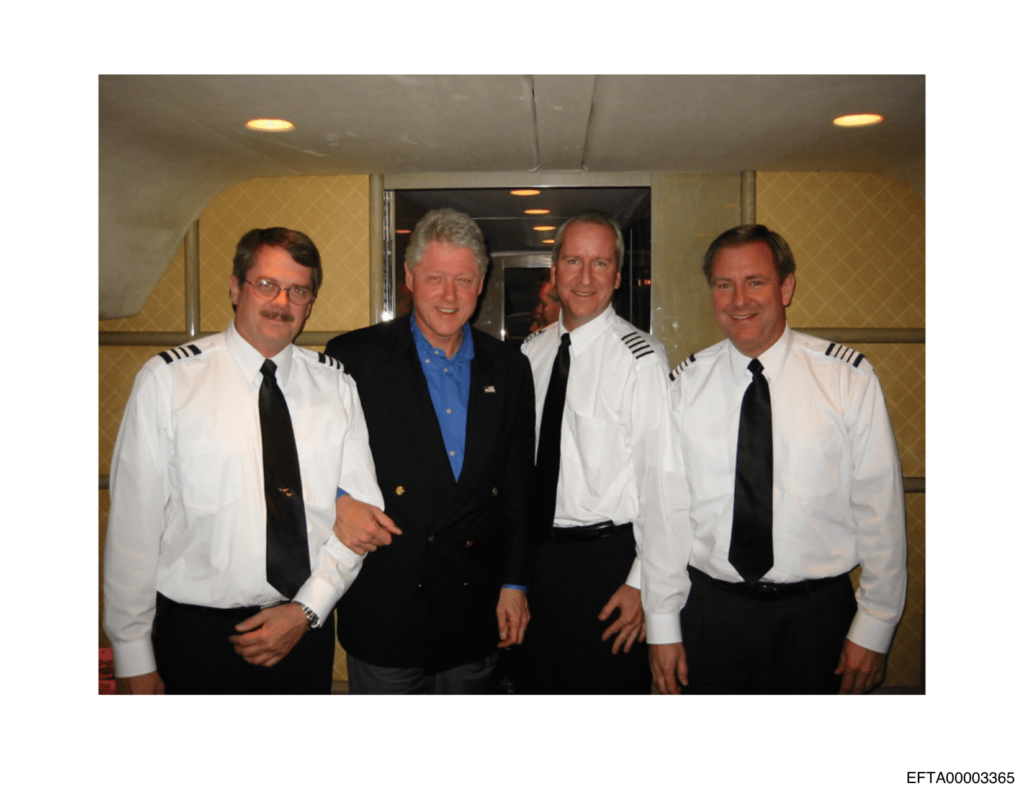
Snapshot
- Full name: Lawrence Paul Visoski Jr.
- Common name: Larry Visoski
- Documented role: Jeffrey Epstein’s longtime pilot, later chief captain, aviation manager, and officer or manager of aircraft-holding entities
- Employer and related entities: NES LLC, Plan D LLC, Air Ghislaine Inc., Shmitka Air Inc., ASI Wings LLC, and Hyperion Air LLC appear in records connected to his work
- Documented period: Approximately 1990 or 1991 through Epstein’s July 2019 arrest, with later aircraft and investigative activity documented through 2021
- Key locations: Palm Beach, New York, New Mexico, the United States Virgin Islands, and airports used for Epstein’s domestic and international travel
- Witness history: Interviewed by the FBI in 2006, questioned again during a federal investigation in 2020, and called by the prosecution at Ghislaine Maxwell’s 2021 trial
- Criminal status: No public record reviewed for this article shows that Visoski was charged with or convicted of an offense connected to Epstein’s trafficking operation
- Evidence base: FBI interview reports, flight and travel records, corporate and aircraft records, financial reviews, emails, and federal trial transcripts
- Article status: Evidence-based profile, updated August 24, 2026
Key Takeaways
- Visoski spent nearly three decades operating Epstein’s aircraft and moving Epstein, Maxwell, staff, guests, and victims or survivors between Epstein-controlled properties.
- Flight manifests and pilot records are important evidence, but they are incomplete. A person’s presence on a flight is not proof of criminal conduct, and absence from a surviving manifest is not proof that a person never traveled.
- In a 2006 FBI interview and at Maxwell’s 2021 trial, Visoski said he never witnessed sexual activity or signs of abuse. He also said the girls and young women he saw appeared mature. That perception does not change the documented ages of survivors, including a trial witness who testified that Epstein began abusing her when she was 14.
- A February 2014 email is direct evidence that Visoski bought motion-activated covert cameras and worked on concealing them inside tissue boxes for Epstein. The email does not establish where the cameras were placed, whom they recorded, whether they were ultimately used, or whether Visoski viewed any recordings.
- Corporate records show that Visoski held authority in Epstein-linked aviation entities and signed aircraft transactions, including one shortly before Epstein’s 2019 arrest and another after Epstein’s death.
- Financial records document substantial payments, loans, bonuses, land, and education benefits. Those benefits establish a significant financial relationship. They do not, without additional evidence, prove knowledge of or participation in trafficking.
- At Maxwell’s sentencing, the court treated Visoski and certain other employees as people whose services were used in the crimes without finding them criminally responsible participants. That judicial finding should be reported alongside the evidence that their work enabled Epstein’s movement and access.
Overview
Lawrence “Larry” Visoski Jr. was Jeffrey Epstein’s longtime pilot and eventually the senior figure in Epstein’s aviation operation. His work placed him close to a central part of Epstein’s system: private travel between residences, airports, and islands with limited outside scrutiny.
Visoski’s importance is not limited to the cockpit. Records describe him coordinating aircraft, helicopters, passenger movements, manifests, property transfers, technical installations, and aircraft purchases. Corporate filings identify him as an officer or manager of aviation entities. A 2014 email also records him purchasing covert cameras and attempting to conceal them in tissue boxes at Epstein’s direction.
The record requires careful distinctions. Visoski’s operational proximity to Epstein is well documented. So are the services he provided and the benefits he received. The public evidence reviewed here does not establish that he committed a trafficking offense, knew the ages of particular survivors, or personally witnessed sexual abuse. His repeated statements that he saw nothing improper are testimony, not an independent resolution of what occurred outside his sight.
This article separates documented conduct, witness statements, judicial findings, and unresolved questions. It does not treat mere association as guilt.
Professional Background
In a December 4, 2006 FBI interview, Visoski said he had worked for a real estate developer in Columbus, Ohio, before Epstein hired him. The interview report places the hire around 1990 at an annual salary of $55,000. At Maxwell’s trial, he described the beginning of his Epstein employment as 1991. The one-year difference may reflect memory, recordkeeping, or the distinction between an initial arrangement and continuous employment. The safest conclusion is that he began working for Epstein around 1990 or 1991.
Visoski told the FBI that he had become chief captain approximately two years before the 2006 interview. He described David Rodgers as the pilot who previously held the senior position. A staff chart later identified Visoski as head pilot and an LSJE manager, with William DiMauro listed as assistant pilot. See EFTA00003150.
At the 2021 trial, Visoski estimated that he had flown roughly 1,000 trips for Epstein over nearly 30 years. His tenure continued after Epstein’s 2008 Florida conviction and sex-offender registration. It also continued after public reporting and civil litigation made the abuse allegations widely known.
Chief Pilot and Aviation Infrastructure
Aircraft and routes
Visoski testified about flying several aircraft used by Epstein, including Gulfstream jets, a Boeing 727, and helicopters. The operation connected Epstein’s residences and frequently used airports, including:
- Teterboro Airport for the New York area
- Palm Beach International Airport
- Santa Fe and other airports serving Zorro Ranch in New Mexico
- St. Thomas in the United States Virgin Islands
- Helicopter or boat transfers to Little St. James
Travel messages show Visoski performing more than pilot duties. In a 2014 itinerary, visitors were to travel by plane to St. Thomas and then by helicopter with Visoski to Epstein’s island. See EFTA02098286. In a 2016 message, Visoski reported a scheduled departure from Teterboro and arrival at St. Thomas, while Epstein’s assistant asked who would be traveling with him. See EFTA00437386.
At trial, Visoski said flights to Little St. James occurred about every ten days and trips to the New Mexico ranch occurred approximately five times a year. These were estimates, not complete route counts.
Manifests and aircraft logs
Visoski’s 2006 FBI interview provides useful detail about recordkeeping. He said the captain completed a manifest and aircraft log. Manifests were generally faxed to the New York office every two or three weeks, while aircraft logs were sent annually. He provided a 2005 manifest, and the report states that David Rodgers had provided the 2004 manifest in response to a grand jury subpoena. See EFTA00270164 and the parallel production EFTA00159473.
These records are evidentiary tools, not self-interpreting proof. A manifest may show that a named person was recorded for a flight. It does not establish what that person knew, saw, or did. Surviving records may also omit passengers, contain transcription problems, use initials or nicknames, or fail to document ground and boat transfers.
Maxwell’s operational role
Visoski told the FBI that Ghislaine Maxwell was Epstein’s business manager and best friend. At trial, he described her as Epstein’s “No. 2” and his “go-to person” for household and nonbusiness matters. He said Maxwell coordinated travel and schedules, handled expenses, interacted with staff, and traveled frequently on Epstein’s aircraft.
Visoski also testified that Maxwell trained as a helicopter pilot. He described annual recurrent helicopter training trips with her in Dallas that lasted several days. This evidence helps explain her operational familiarity with Epstein’s aviation network.
The 2006 FBI Interview
The December 2006 FBI interview occurred during the Palm Beach investigation. It is one of the earliest detailed law-enforcement records of Visoski’s account.
Visoski told agents that:
- Epstein’s primary residence was in the United States Virgin Islands.
- Epstein visited the New Mexico ranch about four or five times per year.
- Little St. James was reached by helicopter or boat, and Visoski sometimes flew the helicopter.
- Flight arrangements usually came through an assistant, although Epstein or Maxwell sometimes gave instructions directly.
- He had not seen girls or women he believed were younger than 20 aboard the aircraft.
- He had not observed inappropriate or sexual conduct on the aircraft.
- He had heard that Epstein received two massages per day, but characterized that information as rumor.
- Massage providers in New Mexico could be arranged through the ranch manager or a local spa.
- He had installed home-theater systems at Epstein’s Palm Beach and New Mexico properties and advised on entertainment systems and vehicles.
- He received a $15,000 Christmas bonus in 2006 and a $10,000 bonus the prior year.
The interview shows that Visoski knew Epstein received frequent massages and that he provided technical and property-related help beyond aviation. It does not establish that the FBI accepted every answer as accurate. An interview report records what a witness said and what agents documented. It is not a judicial finding.
Continued Work After Epstein’s 2008 Conviction
Epstein pleaded guilty in Florida in 2008 to state charges involving prostitution and a minor. He became a registered sex offender. Visoski nevertheless remained in Epstein’s employment and continued operating aircraft for him for more than a decade.
That continued employment is relevant to accountability. By 2008, Epstein’s criminal case and sex-offender status were public facts. Continued employment does not prove that an employee knew the full scope of Epstein’s conduct, but it raises legitimate questions about what information was available, what concerns were discussed, and why Epstein retained such extensive logistical support.
Records from later years show Visoski participating in routine travel planning and aircraft acquisition. In October 2015, he transmitted Gulfstream G550 purchase options and received direction concerning an offer. See EFTA01732261. A July 2018 phone list also placed him among Epstein’s regular operational contacts. See EFTA00285606.
Corporate Titles and Aircraft Transactions
Public records identify Visoski as more than a salaried line pilot. He signed documents using titles that included director of aviation, director of operations, manager, and chief financial officer in Epstein-linked aviation companies.
A federal investigative review of aircraft records, EFTA00021666, documents several transactions:
- Air Ghislaine Inc. purchased a Sikorsky S-76C-2 helicopter in December 2008. Visoski signed as director of aviation.
- The company later became Shmitka Air Inc., and the aircraft’s registration changed. Records include Visoski’s signature as director of operations.
- In June 2019, ASI Wings LLC sold the helicopter to Hyperion Air LLC. Visoski signed as manager for Hyperion Air.
- In May 2021, Hyperion Air sold the helicopter to another company. Visoski signed as chief financial officer.
Additional title records identify Visoski as a Hyperion Air manager. See EFTA00022855.
The June 2019 transfer occurred only weeks before Epstein’s federal arrest. The 2021 sale occurred after Epstein’s death. Those dates make the transactions relevant to tracing control and disposition of aviation assets. The records do not, by themselves, establish improper ownership transfers or concealment.
Plan D LLC, an Epstein-linked aircraft entity, also listed Visoski as its sole manager in its original 2012 organizational filing. A later annual report identified Epstein as the actual principal. See EFTA00018778. A manager title establishes formal authority. It does not necessarily establish beneficial ownership.
Covert Cameras Concealed in Tissue Boxes
A February 5, 2014 email exchange provides direct evidence of Visoski’s involvement in obtaining and concealing recording equipment.
Epstein asked for three motion-detecting hidden cameras capable of recording. Visoski replied that he had already bought two motion-sensor cameras from a surveillance-equipment store in Fort Lauderdale, was learning how to operate them, and was installing them inside tissue boxes. See EFTA02580827.
This exchange is significant for several reasons:
- It documents a direct instruction from Epstein and a responsive technical task performed by Visoski.
- It shows that Visoski’s work extended beyond aircraft and ordinary property maintenance.
- It is consistent with his 2006 statement that he installed entertainment and electronic systems at Epstein properties.
- It provides documentary support for examining surveillance capabilities at Epstein-controlled locations, an issue of particular importance given survivor accounts and longstanding concerns about privacy and recording.
The limits of the evidence are equally important. The exchange does not identify the rooms or property where the tissue boxes would be placed. It does not identify any intended or actual subjects. It does not show that the devices were successfully installed or activated, that recordings were retained, that Visoski watched any footage, or that the cameras were part of a blackmail operation. Any stronger claim requires separate evidence.
For survivors, the operational fact still matters. Secret recording equipment in a private setting can intensify coercion, fear, and loss of control. Reporting should focus on the documented installation task without publishing speculative or sensational claims.
Compensation, Property, Education Benefits, and Payments
The evidence shows a long and financially significant relationship between Epstein and Visoski.
In addition to salary and annual bonuses, Visoski testified that Epstein gave him approximately 40 acres at the New Mexico ranch and paid college tuition for his two daughters. The family members are not accused of wrongdoing, and their private details are not necessary to understand the benefit.
A Deutsche Bank review listed several transfers to Visoski or on his behalf. The itemized entries in EFTA00092643 include:
- $225,000 on December 11, 2013
- $50,000 on March 28, 2017, described as connected to a promissory note
- $12,500 on June 21, 2017
- $150,000 on January 12, 2018
- $175,000 on December 19, 2018, described as connected to a promissory note
- $57,000 on January 16, 2019, described as a loan
Those six entries total $669,500. The table categorized certain recipients as possible co-conspirators for bank-review purposes. That phrase is an investigative or compliance classification in the document, not a criminal charge or judicial finding against Visoski. The distinction is essential.
The broader Deutsche Bank presentation is available as EFTA01681865, with an EpsteinWiki analysis at Deutsche Bank’s Presentation on Jeffrey Epstein’s Financial Network.
Salary, loans, gifts, land, tuition, and bonuses can create loyalty and dependence. They are relevant to understanding the employment relationship and potential incentives. They do not independently prove criminal knowledge or conduct.
The 2020 Customs and Border Protection Inquiry
In 2020, federal investigators questioned Visoski through counsel and during a proffer session about Epstein’s contacts with United States Customs and Border Protection personnel in St. Thomas.
A July 23, 2020 memorandum records that Visoski recognized a photograph only vaguely but had a contact stored as “Bill Rouch Customs STT.” He said Epstein sometimes directed the exchange of phone numbers with customs personnel and invited officials to see his aircraft or helicopter. He also identified customs figures whom Epstein knew and expressed a belief that some did not give Epstein a difficult time. Visoski said he did not recall officials flying on the aircraft. See EFTA00080458.
Later records show that investigators prepared to ask Visoski about:
- Whether customs personnel helped Epstein or his passengers avoid normal processing
- Whether people traveled using foreign passports
- The relationships between Epstein’s staff and St. Thomas customs personnel
- Any flights or favors involving government employees
See EFTA00020852 and EFTA00081477. A March 2021 message states that investigators had interviewed Visoski in November 2020 and were planning a further interview in the customs investigation. See EFTA00038585.
These records establish investigative interest and questioning. They do not establish that Visoski or any customs employee helped traffic victims or committed a crime. No such conclusion should be inferred solely from an interview plan or memorandum.
Testimony at Ghislaine Maxwell’s Trial
Federal prosecutors called Visoski as their first witness at Maxwell’s trial on November 29, 2021. His testimony continued the following day. The case was United States v. Ghislaine Maxwell, No. 20 Cr. 330 in the Southern District of New York.
What his testimony established
Visoski described Epstein’s properties, aircraft, staff structure, travel practices, and Maxwell’s operational role. He authenticated photographs and records and explained how passengers and staff moved through the aviation network. His testimony placed Maxwell near the center of Epstein’s private household and travel operation.
He also identified numerous well-known passengers. Public reporting lists Bill Clinton, Donald Trump, Andrew Mountbatten-Windsor, John Glenn, George Mitchell, Kevin Spacey, Chris Tucker, and Itzhak Perlman among the people he recalled transporting. A passenger identification establishes travel or claimed travel, not participation in abuse. Each person must be evaluated using evidence specific to that person.
Survivors and age perception
Visoski recalled encountering the trial survivor identified by the pseudonym Jane and Annie Farmer. He maintained that the girls and young women he saw appeared mature and that he did not believe they were minors.
Jane testified that Epstein began sexually abusing her when she was 14. Her actual age is not altered by an adult witness’s claimed perception. Visoski’s testimony is relevant to what he says he understood, but it is not a reliable method for establishing whether a person was legally a child.
Survivor-centered reporting should not make a victim responsible for appearing young enough to trigger concern. Adults in positions of authority have an obligation to respond to evidence and warning signs, not to rely on assumptions about appearance.
Denial of witnessing abuse
Visoski said the cockpit door was generally closed during flights. He testified that he did not see sexual activity, sex toys, condoms, or indications of abuse aboard the aircraft. When asked whether he had seen sexual activity involving an underage female, he answered emphatically that he had not.
The testimony establishes his denial. It does not prove that abuse did not occur elsewhere, that all passengers were adults, or that warning signs were absent from the broader operation. Pilots spend much of a flight separated from the cabin, and Epstein’s abuse was documented across private properties as well as during travel.
Visoski also testified that he trusted Maxwell enough to allow his daughters to spend time with her. That statement helps explain his professed view of Maxwell, but it does not rebut the jury’s later verdict or survivor testimony.
The first two trial volumes are publicly available as the November 29 transcript and November 30 transcript.
The Sentencing Court’s Finding
At Maxwell’s June 2022 sentencing, the court addressed whether certain employees were participants in the criminal activity for purposes of a sentencing enhancement. The judge discussed Visoski, former Palm Beach house manager Juan Alessi, and pilot David Rodgers as people whose personalized services were used by Epstein and Maxwell.
The court concluded, by a preponderance of the evidence for sentencing purposes, that these employees were unknowing participants and that the trial record did not establish them as criminally responsible participants. See the sentencing transcript, page 44.
This was a legal finding in Maxwell’s sentencing proceeding, not a general endorsement of every employee decision. It does not erase the enabling effect of aviation, scheduling, property, and technical services. It does mean that this article should not label Visoski a co-conspirator as an established fact.
What the Evidence Establishes
The available record establishes that Visoski:
- Worked for Epstein for nearly three decades and became his chief pilot.
- Operated aircraft and helicopters linking Epstein’s properties and travel network.
- Maintained or generated manifests and aircraft logs as part of the aviation operation.
- Worked closely with Epstein, Maxwell, assistants, household staff, and aviation personnel.
- Continued working for Epstein for more than a decade after Epstein’s 2008 conviction.
- Held formal positions in Epstein-linked aviation entities and signed aircraft transactions.
- Received substantial salary, bonuses, payments, loans, land, and education benefits.
- Purchased covert motion-activated cameras and worked on concealing them inside tissue boxes after Epstein requested hidden cameras.
- Was interviewed by investigators in 2006 and 2020 and testified at Maxwell’s trial in 2021.
- Denied seeing sexual conduct or signs of abuse and said he believed the females he encountered were adults.
What the Evidence Does Not Establish
The reviewed record does not establish that Visoski:
- Was charged with or convicted of participating in Epstein’s trafficking crimes.
- Knew the actual age of every girl or young woman he transported or encountered.
- Personally witnessed sexual abuse.
- Knew the covert cameras would be used to record sexual activity or facilitate blackmail.
- Viewed, retained, or distributed recordings from the cameras.
- Helped any passenger evade customs processing.
- Knew the complete purpose of every flight, payment, property transfer, or corporate transaction.
It is also incorrect to conclude that his denials disprove survivor accounts. His stated lack of observation and survivors’ accounts of abuse can coexist because they concern different locations, moments, and knowledge.
Accountability Questions
The absence of a criminal charge does not end the factual inquiry. Important questions remain:
- What instructions governed manifests, passenger names, and the retention of flight records?
- What did Visoski learn about Epstein’s 2006 investigation, 2008 conviction, civil litigation, and sex-offender status?
- Why did he continue in a senior operational role after those facts became public?
- Where were the tissue-box cameras intended to be placed, and were recordings created or recovered?
- Which aviation entities held each aircraft, who exercised beneficial control, and why were particular transfers made?
- What were the terms and repayment histories of payments described as loans or promissory notes?
- Were all passenger manifests preserved and produced to investigators?
- Did aviation staff observe patterns involving unusually young passengers, repeated massage recruitment, or travel without ordinary family supervision?
- What did investigators conclude after the 2020 proffer and customs-related inquiry?
These questions should be answered through records and sworn testimony, not speculation.
Evidence Index
| Record | Date or period | Relevance |
|---|---|---|
| EFTA00270164 | December 4, 2006 | FBI interview covering employment, routes, manifests, massages, bonuses, and claimed lack of observed misconduct |
| EFTA00159473 | 2006 | Parallel production of the FBI interview record |
| EFTA00003150 | Undated staff record | Identifies Visoski as head pilot and LSJE manager |
| EFTA02098286 | 2014 | Plane and helicopter logistics for travel to Little St. James |
| EFTA02580827 | February 5, 2014 | Hidden-camera request and Visoski’s tissue-box concealment response |
| EFTA01732261 | October 2015 | Gulfstream G550 purchase options and offer discussion |
| EFTA00437386 | 2016 | Teterboro to St. Thomas travel coordination |
| EFTA00285606 | 2018 | Phone list documenting regular operational contacts |
| EFTA00092643 | 2013 to 2019 | Bank review itemizing transfers, loans, and promissory-note payments |
| EFTA01681865 | Bank review | Presentation concerning Epstein’s financial network and categorized recipients |
| EFTA00018778 | 2012 to 2019 | Plan D LLC organization and principal information |
| EFTA00021666 | 2008 to 2021 | Aircraft title history and Visoski’s corporate signatures |
| EFTA00022855 | Aircraft records | Identifies Visoski as Hyperion Air manager |
| EFTA00080458 | July 23, 2020 | Counsel interview memorandum concerning customs contacts |
| EFTA00020852 | 2020 | Proposed subjects for Visoski proffer questioning |
| EFTA00081477 | 2020 | Proffer and customs-investigation records naming Visoski |
| EFTA00038585 | March 30, 2021 | Follow-up reference to the November 2020 Visoski interview |
| Maxwell trial transcript, volume 1 | November 29, 2021 | Direct and cross-examination testimony |
| Maxwell trial transcript, volume 2 | November 30, 2021 | Continued testimony |
| Maxwell sentencing transcript, page 44 | June 28, 2022 | Court’s unknowing-participant finding |
Related EpsteinWiki Pages
- Jeffrey Epstein
- Ghislaine Maxwell Involvement Timeline
- Annie Farmer
- Maria Farmer
- Sarah Kellen
- EFTA01681865: Deutsche Bank’s Presentation on Jeffrey Epstein’s Financial Network
- Fact-Checking and Verification Resources
- Handling Sensitive Material
- Ethical Rules for Naming Public Figures
Sources
Primary records
- DOJ Epstein Library
- United States v. Ghislaine Maxwell case page
- United States v. Maxwell docket
- Direct Epstein Data records listed in the Evidence Index
Trial and document reporting
- The Guardian: Epstein pilot testifies at Maxwell trial
- The Independent: Maxwell trial pilot testimony
- Sky News: Epstein staff email concerning hidden cameras
- The Guardian: Federal inquiry into Epstein’s St. Thomas customs contacts
Editorial Note
This page distinguishes association, employment, investigative labels, allegations, testimony, and adjudicated facts. It does not infer guilt from a flight log, contact entry, payment, or corporate title. Survivor accounts are not negated by a witness’s statement that he did not personally observe abuse.
Private information about relatives, home addresses, and other nonpublic personal details has been excluded unless necessary to understand a documented benefit or official role. Corrections should identify the disputed sentence and provide a primary record whenever possible.