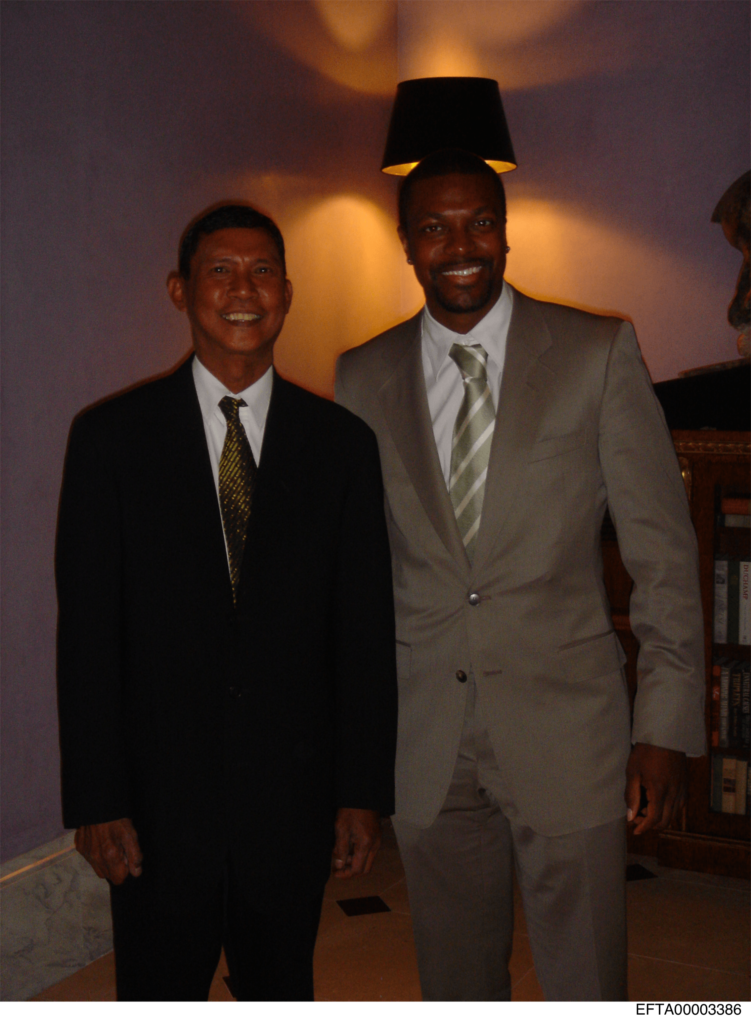
Chris Tucker

Snapshot
Chris Tucker’s connection to Jeffrey Epstein cannot be reduced to a celebrity name appearing in a document.
The American actor and comedian travelled aboard Epstein’s Boeing 727 during a highly publicized humanitarian mission to Africa in September 2002. The delegation included former President Bill Clinton, actor Kevin Spacey, Ghislaine Maxwell, Clinton aides, business executives, Secret Service personnel, Epstein employees, and survivor Chauntae Davies.
Flight databases sometimes describe Tucker as appearing on eighteen flights. Those entries represent individual legs of the same multistop journey through Europe and Africa, not eighteen separate trips with Epstein.
The Africa trip is only part of the record.
Internal emails released years later document renewed contact in July and August 2013, five years after Epstein’s Florida conviction. Epstein asked his staff for Tucker’s contact information. Tucker then visited Epstein’s New York residence with his son before a performance. Days later, an assistant reported that Tucker had called about having dinner with Epstein.
Those records complicate Tucker’s later public explanation that he met Epstein through the humanitarian trip and did not know whose aircraft the delegation was boarding. They do not establish that Tucker knew about Epstein’s crimes, but they demonstrate that the contact did not end with the 2002 flight.
South African survivor Juliette Bryant has also said that she briefly encountered Tucker at a Cape Town gathering where she first met Epstein. Bryant has not accused Tucker, Clinton, or Spacey of abusing her or participating in Epstein’s crimes.
No reviewed criminal charge, civil complaint, survivor statement, or court finding accuses Tucker of sexual misconduct connected with Epstein. No verified record reviewed for this article places him on Little Saint James.
Who Chris Tucker Is
Christopher Tucker was born in Atlanta, Georgia, on August 31, 1971, and grew up in Decatur.
He became nationally known through appearances on HBO’s Def Comedy Jam before appearing in Friday, Dead Presidents, The Fifth Element, Money Talks, and Jackie Brown.
Tucker achieved international fame as Detective James Carter in the Rush Hour films alongside Jackie Chan. He later appeared in Silver Linings Playbook, Billy Lynn’s Long Halftime Walk, and Air.
His official website describes him as an actor, comedian, producer, and humanitarian. The Chris Tucker Foundation says its work grew from AIDS relief into scholarships, youth programs, homeless assistance, and community partnerships.
That humanitarian background supplies relevant context for his participation in the 2002 Africa mission. It does not answer the separate questions raised by his later contact with Epstein.
The September 2002 Africa Mission
In September 2002, Tucker joined former President Bill Clinton on a mission addressing HIV and AIDS, poverty, and economic development in Africa.
Contemporary Associated Press reporting from Rwanda described Clinton, Tucker, and Kevin Spacey as an unusual group united by the goals of fighting AIDS and encouraging economic development.
The itinerary included stops connected with Ghana, Nigeria, Rwanda, Mozambique, and South Africa. The delegation met political leaders, visited development projects, and participated in public discussions concerning treatment and prevention.
Contemporary South African reporting documented Clinton’s visit as part of an effort to support HIV treatment and economic development. The trip was public, covered by news organizations, and involved a substantial delegation.
Jeffrey Epstein supplied or financed the aircraft used for much of the journey.
This is an important distinction. The trip had a legitimate and publicly reported humanitarian purpose, but Epstein used his aircraft and proximity to a former president and internationally famous actors to advertise himself as a philanthropist with access to global power.
The Flight Log Evidence
Tucker appears repeatedly in the released flight records for Epstein’s Boeing 727, registration N908JE.
The principal flight log exhibit from United States v. Maxwell is available as EFTA02846460. Additional flight material appears in EFTA02727130 and searchable compilations of the released records.
The first major leg departed New York for the Azores on September 21, 2002. Passenger lists associated with the journey identify a delegation that included:
- Bill Clinton
- Chris Tucker
- Kevin Spacey
- Jeffrey Epstein
- Ghislaine Maxwell
- Doug Band
- Ron Burkle
- Casey Wasserman
- Rodney Slater
- Gayle Smith
- Eric Nonacs
- Jim Kennedy
- Secret Service personnel
- Epstein staff and other passengers
The aircraft then made numerous stops as the delegation moved between countries and cities.
Some modern databases count Tucker on as many as eighteen flight legs. Earlier reporting counted eleven legs involving Tucker and Spacey. The difference largely results from how researchers divide, merge, and interpret individual route entries, including repositioning flights and records marked with language such as “same as above.”
The responsible conclusion is that Tucker travelled aboard Epstein’s aircraft throughout a multistop international journey in September 2002. The logs do not document eighteen separate vacations or eighteen independent trips with Epstein.
The Aircraft Was Part of Epstein’s Reputation Campaign
Epstein’s role in transporting Clinton, Tucker, and Spacey attracted significant attention before his Palm Beach prosecution became public.
An October 2002 New York magazine profile opened by referring to Epstein’s decision to fly Clinton, Spacey, and Tucker to Africa aboard his customized Boeing 727.
A released copy of that profile appears as EFTA00013640.
The publicity helped transform Epstein from an obscure money manager into a figure publicly associated with a former president, Hollywood celebrities, philanthropy, scientific patronage, and extraordinary wealth.
The flight therefore carried two narratives at once.
For the Clinton delegation, it was presented as a humanitarian mission focused on HIV, AIDS, and development.
For Epstein, it became a powerful reputation asset. His aircraft placed him inside photographs, news reports, and conversations involving globally recognized people. He could point to their presence as evidence that he belonged among political, cultural, and financial elites.
Tucker’s participation should be understood within that larger reputation laundering strategy, even though the record does not establish that Tucker understood how Epstein would exploit the trip.
Photographs From the Journey
Photographs released from the trip show Tucker with members of the delegation.
One widely circulated image shows Tucker posing with Bill Clinton. Another shows Tucker with his arm around Ghislaine Maxwell near an aircraft.
The photographs confirm physical proximity and social familiarity during the journey. They do not establish criminal conduct.
A photograph can document that two people were together at a particular time and place. It cannot, without additional evidence, establish what one person knew about another person’s concealed crimes.
The images are nevertheless historically important because they illustrate how Epstein and Maxwell embedded themselves inside a legitimate delegation and obtained photographs linking them to famous participants.
Later viral posts have sometimes presented these images as though they were newly discovered proof that Tucker visited Epstein’s island. They are not. The available photographs are associated with the Africa journey and its airport stops.
Chauntae Davies Was Also on the Trip
Survivor Chauntae Davies travelled with the delegation.
Davies has said that she was introduced to Maxwell in Los Angeles and became connected to Epstein while pursuing massage therapy and acting work. She later accused Epstein of sexually abusing her.
During the 2002 journey, Davies was twenty two years old. Photographs show her with members of the delegation, including an image in which she gives Clinton a neck massage during an airport stop.
Davies later said Clinton behaved appropriately toward her during the trip. Reporting about her account has not identified an accusation against Tucker.
Her presence matters because Epstein’s public philanthropy and private abuse were not separate worlds. A survivor could be carried on the same aircraft as politicians, celebrities, staff members, and security personnel while Epstein presented the trip as proof of his benevolence.
That does not mean every passenger understood Davies’s relationship with Epstein or knew she had been abused. It demonstrates how Epstein used respectable institutions and prominent companions to create an environment in which his presence appeared legitimate.
Juliette Bryant’s Cape Town Encounter
South African survivor Juliette Bryant has said that she first encountered Epstein in Cape Town during the period of the Africa trip.
Bryant was a twenty year old student and aspiring model. She recalled being approached during a night out and invited to meet people described as important American visitors.
According to CBS News, Bryant met Epstein in a social setting where Clinton, Spacey, Tucker, and South African officials were also present.
Bryant’s EpsteinWiki profile documents that her interaction with the famous guests was brief. She has not accused Tucker, Clinton, or Spacey of participating in her abuse.
Bryant has alleged that Epstein subsequently deceived her with promises of modelling opportunities, transported her to the United States and Little Saint James, took control of her passport, and sexually assaulted her.
Her account makes the Cape Town stop deeply consequential. Epstein allegedly used the access and prestige surrounding the visiting delegation to make himself appear safe, powerful, and connected.
The record does not establish that Tucker knew Bryant was being targeted. His presence is part of the setting in which Epstein cultivated her trust, not evidence that Tucker participated in the alleged trafficking.
A Later FBI Interview Mentioned Tucker
Tucker’s name also appears in an FBI interview memorandum concerning another survivor.
EFTA01248567 is an FBI FD 302 summarizing an August 2019 interview with a woman who described being brought to Epstein’s Manhattan residence as a minor.
The memorandum records her statement that one of her friends met Chris Tucker at Epstein’s house.
The sentence is brief and lacks important details. It does not identify:
- The friend
- The date of the meeting
- Whether Tucker knew the friend’s age
- Whether Tucker met Epstein during the same visit
- Whether the reference was to Epstein’s Manhattan townhouse or another residence
- What, if anything, was said or done
- Whether the interviewee personally witnessed the meeting
The statement may be secondhand because it describes what happened to a friend. An FD 302 is also an agent’s summary rather than a verbatim transcript adopted by the witness.
Most importantly, the interview does not accuse Tucker of sexual conduct, recruitment, or knowledge of Epstein’s abuse.
The entry establishes that Tucker’s name arose in a survivor interview in connection with an alleged meeting at Epstein’s house. It does not establish misconduct.
Epstein Sought Tucker’s Contact Information in 2013
The most important evidence beyond the Africa trip comes from Epstein’s internal correspondence.
On July 25, 2013, Epstein asked assistant Lesley Groff whether his office had contact information for Chris Tucker.
The exchange is preserved in EFTA02722737.
Groff responded with contact details that reportedly included Tucker’s telephone number, email address, and information for an assistant.
This exchange is revealing in two directions.
It shows that Epstein wanted to reach Tucker more than a decade after the Africa journey.
It also suggests that Epstein did not have Tucker’s information immediately available and needed staff to locate it. That is inconsistent with treating Tucker as one of Epstein’s closest or most continuously active associates.
The correspondence documents renewed access. It does not by itself establish who initiated the broader contact or how frequently Tucker and Epstein had communicated between 2002 and 2013.
Tucker Visited Epstein With His Son
The following day, Epstein’s staff prepared for Tucker to visit.
In EFTA02132417, Groff informed household staff that Tucker would stop by to see Epstein before his performance that evening.
A later message in EFTA02131784 reported that Tucker was present with his son.
These are internal logistical messages rather than public reporting or retrospective recollections. They provide strong documentary evidence that the visit occurred.
The messages establish that:
- Tucker planned to see Epstein in July 2013.
- Epstein’s household staff were notified in advance.
- Tucker arrived with his son.
- The visit occurred at a property managed by Epstein’s staff, reportedly his New York residence.
The records do not reveal the complete purpose, duration, or content of the visit.
Bringing his son could suggest Tucker regarded the encounter as an ordinary social or professional visit. It does not establish what Tucker knew about Epstein’s criminal history or why he was willing to meet him.
The date is nevertheless significant. Epstein had pleaded guilty in Florida in 2008 to state prostitution related offenses involving a minor and was a registered sex offender by 2013.
The Proposed Dinner
The contact continued into August 2013.
In EFTA01963012, Groff told Epstein that Tucker had called to say he would be in New York and asked whether Epstein could have dinner.
Epstein’s response, preserved in EFTA01963096, indicated that he could not attend.
The proposed dinner apparently did not occur.
The exchange matters because Tucker, rather than Epstein alone, appears to have initiated that particular contact through Epstein’s office.
It shows that the July visit was not simply an unexpected encounter or an invitation Tucker immediately declined. Tucker’s reported dinner inquiry indicates a willingness to see Epstein again.
The evidence still does not establish an extensive friendship. Epstein declined the proposed dinner, and the reviewed messages do not document a completed meal.
Why the 2013 Records Change the Public Narrative
Tucker later explained his association with Epstein primarily through the Africa mission.
In a 2021 interview later quoted by ABC News, Tucker said he travelled on the aircraft as part of a humanitarian trip and met Epstein because it was Epstein’s plane.
Tucker also said he did not know whose plane the delegation was boarding and observed that people do not necessarily know what others do privately.
That explanation addresses the origins of the relationship and the absence of knowledge during the 2002 trip.
It does not account for the documented 2013 visit.
The later records do not prove that Tucker lied. His statement that he met Epstein on the Africa trip can be true even if they met again. He also may not have considered the relationship personal or close.
The records do show that an explanation confined to a single humanitarian flight is incomplete. Tucker or his representatives would need to address the July 2013 visit and August dinner inquiry to provide a full account of the documented relationship.
The Significance of Epstein’s 2008 Conviction
Timing changes the evidentiary meaning of social contact.
In September 2002, Epstein had not been publicly exposed through the Palm Beach investigation, his federal nonprosecution agreement, or his 2008 guilty plea.
A person accepting a place on an international delegation in 2002 would not necessarily have known about the crimes later established through police records, survivor testimony, and court proceedings.
The situation was different in 2013.
By then, Epstein’s Florida prosecution, sex offender registration, unusually lenient sentence, and allegations involving minors had been publicly reported.
A 2013 visit therefore raises legitimate questions about whether Tucker knew Epstein’s criminal history, what explanation he received, and why he maintained enough contact to visit and seek a dinner.
Those are questions about judgment, disclosure, and the accuracy of Tucker’s later public account. They are not proof that Tucker participated in Epstein’s crimes.
Tucker Did Not Take Eighteen Separate Epstein Trips
The phrase “Chris Tucker flew eighteen times on Epstein’s plane” can create a misleading impression.
Flight logs often count each takeoff and landing as a separate entry. A single international journey with fuel stops and multiple destinations can therefore generate numerous flight records.
For example, the Africa mission involved travel through New York, the Azores, Ghana, Nigeria, Rwanda, Mozambique, South Africa, and European return points.
Tucker’s repeated name across those records establishes that he remained with the delegation through substantial portions of the journey. It does not establish eighteen independently arranged excursions with Epstein.
A more accurate description is:
Chris Tucker appears on numerous flight legs during one documented multistop Africa mission in September 2002.
This formulation preserves the significance of the travel without artificially multiplying it.
The Epstein Island Claim
In January 2024, comedian Katt Williams referred to Tucker as the “Epstein Island” version of Chris Tucker during an appearance on Club Shay Shay.
The remark generated headlines and viral social media posts suggesting that Tucker had visited Little Saint James.
No supporting travel record was presented with the claim.
The reviewed flight logs document Tucker’s travel through Europe and Africa. They do not identify Tucker on a flight to St. Thomas or Little Saint James.
Tucker has denied visiting Epstein’s island.
The distinction is straightforward:
- Tucker travelled aboard Epstein’s aircraft.
- Tucker was photographed with Maxwell during the Africa journey.
- Tucker visited Epstein in New York in 2013.
- Those facts do not establish that Tucker visited Little Saint James.
Unless a reliable flight record, photograph, customs entry, witness account, or other authenticated document emerges, the island claim should be classified as unsubstantiated.
Maxwell’s Deposition and the Africa Trip
The Africa journey later became a subject of questioning in litigation involving Maxwell.
Attorneys used the flight logs to ask about the presence of Clinton, Spacey, Tucker, Epstein, and initials corresponding to Maxwell.
Maxwell acknowledged remembering the Africa trip.
Her recognition of the journey corroborates that it occurred and that she participated. It does not establish that Tucker knew about her role in recruiting or facilitating abuse.
By 2021, a federal jury had convicted Maxwell of trafficking and conspiracy offenses arising from her conduct with Epstein. That conviction changes the historical understanding of photographs showing her travelling socially with Tucker and other prominent people.
It does not retroactively prove that every person photographed with Maxwell understood her crimes.
Epstein’s Use of Tucker’s Name
Epstein repeatedly used famous names as social proof.
Released records, biographical materials, press clippings, and correspondence placed Tucker alongside presidents, actors, musicians, royalty, financiers, and academics whom Epstein claimed to know.
HOUSE_OVERSIGHT_000001, described as a biographical or birthday related account, reportedly includes Tucker in a list of prominent people Epstein had met.
Other released documents repeat the Africa story through copies of articles, legal filings, press summaries, and investigative reports. Examples include EFTA01069308, EFTA02796838, EFTA01110326, and HOUSE_OVERSIGHT_018001.
The repetition does not mean that each document records a different encounter. Many are duplicates, press clippings, legal summaries, or references to the same 2002 journey.
Researchers should count events, not search results.
Contact Book Claims Require Caution
Some later reports have included Tucker among names found in Epstein related contact records.
Contact book evidence must be identified by edition and provenance. Epstein maintained more than one directory, and later databases combine his black book, flight records, emails, staff contacts, litigation exhibits, and government files.
The 2013 email exchange provides direct evidence that Epstein’s staff located Tucker’s telephone and email information. That is stronger and more specific than relying on an unsourced online claim that Tucker appeared on an unidentified “list.”
Possession of contact information establishes the ability to reach someone. It does not establish a sexual, financial, or criminal relationship.
No Allegation of Misconduct Against Tucker
No reviewed survivor has accused Tucker of participating in Epstein’s sexual abuse or trafficking operation.
Chauntae Davies was on the Africa trip but has not accused Tucker of harming her.
Juliette Bryant briefly encountered Tucker in Cape Town but has not accused him of participating in her recruitment or later abuse.
The survivor interviewed in EFTA01248567 mentioned that a friend met Tucker at Epstein’s house but did not describe sexual misconduct by Tucker.
Tucker has not been identified in the reviewed record as:
- An Epstein employee
- A recruiter
- A financial intermediary
- A participant in sexual abuse
- A recipient of a trafficked minor
- A defendant in Epstein related civil litigation
- A charged coconspirator
- A passenger on a verified flight to Little Saint James
The absence of an accusation does not make the documented contacts irrelevant. It determines how they must be described.
Evidence Timeline
| Date | Documented event | Evidentiary meaning |
|---|---|---|
| September 2002 | Tucker joins the Clinton delegation travelling aboard Epstein’s Boeing 727 | Establishes extensive travel during one multistop humanitarian mission |
| September 2002 | Tucker is photographed with Clinton and Maxwell | Confirms physical proximity during the journey |
| September 2002 | Chauntae Davies travels with the delegation | Places an Epstein survivor aboard the same mission, without an allegation against Tucker |
| September 2002 | Juliette Bryant briefly encounters Epstein and delegation members in Cape Town | Places Tucker in the setting where Bryant first met Epstein, without alleging Tucker’s participation |
| October 2002 | New York publishes a major Epstein profile referencing the trip | Shows how Epstein used the journey to build his public image |
| 2008 | Epstein pleads guilty in Florida and becomes a registered sex offender | Creates a clear dividing point for evaluating later contacts |
| July 25, 2013 | Epstein asks staff for Tucker’s contact information | Documents Epstein’s effort to reconnect |
| July 26, 2013 | Staff prepare for Tucker to visit Epstein before a performance | Documents a planned social visit |
| July 26, 2013 | Staff report Tucker present with his son | Confirms the visit occurred |
| August 3, 2013 | Tucker reportedly asks whether Epstein can have dinner in New York | Documents Tucker’s willingness to meet again |
| 2021 | Tucker publicly explains the Africa flight and says he met Epstein during the trip | Supplies Tucker’s account but does not address the 2013 contact |
| January 2024 | Katt Williams invokes “Epstein Island” while discussing Tucker | Produces a viral allegation unsupported by reviewed travel evidence |
| 2026 | New releases and reporting highlight the 2013 emails | Expands the public record beyond the Africa trip |
What the Evidence Establishes
The available evidence establishes that:
- Chris Tucker travelled on Epstein’s Boeing 727 during a humanitarian mission to Africa in September 2002.
- The trip involved numerous flight legs through Europe and Africa.
- The journey’s publicly stated purpose included HIV and AIDS advocacy and economic development.
- Bill Clinton, Kevin Spacey, Jeffrey Epstein, Ghislaine Maxwell, Clinton aides, business figures, security personnel, and other passengers joined portions of the trip.
- Tucker was photographed with Clinton and Maxwell.
- Chauntae Davies travelled with the delegation.
- Juliette Bryant briefly encountered Tucker and other delegation members when she first met Epstein in Cape Town.
- The trip helped Epstein advertise his access to famous and powerful people.
- Epstein asked staff for Tucker’s contact information in July 2013.
- Tucker visited Epstein with his son in July 2013.
- Tucker reportedly contacted Epstein’s office about dinner in August 2013.
- Epstein declined or could not attend the proposed dinner.
- Tucker later acknowledged meeting Epstein during the Africa journey.
- Tucker’s name appears in an FBI interview summary because a survivor said one of her friends met him at Epstein’s house.
- No reviewed source accuses Tucker of participating in Epstein’s crimes.
What the Evidence Does Not Establish
The available evidence does not establish that:
- Tucker knew about Epstein’s abuse during the 2002 trip.
- Tucker knew why Chauntae Davies was travelling with Epstein.
- Tucker participated in the recruitment of Juliette Bryant.
- Tucker sexually abused or trafficked anyone.
- Tucker took eighteen separate trips with Epstein.
- Tucker visited Little Saint James.
- A photograph with Maxwell proves knowledge of her crimes.
- Tucker was an Epstein employee or financial partner.
- The 2013 visit involved illegal activity.
- Tucker’s son was exposed to misconduct during the visit.
- The proposed August 2013 dinner occurred.
- Every document containing Tucker’s name represents a separate interaction.
- Every online “Epstein list” accurately describes Tucker’s relationship with Epstein.
- Tucker has provided a complete public explanation of the 2013 records.
Investigative Assessment
Chris Tucker’s documented relationship with Epstein contains two distinct phases.
The first phase was the public 2002 Africa mission. Tucker joined a legitimate humanitarian delegation that used Epstein’s aircraft before Epstein’s Palm Beach crimes were publicly exposed. Tucker’s participation gave Epstein prestige, photographs, and publicity, but the record does not establish that Tucker understood Epstein’s hidden conduct.
The second phase is more difficult to dismiss as incidental.
In 2013, after Epstein’s conviction and sex offender registration, Tucker visited Epstein with his son and subsequently sought another meeting through Epstein’s office. These records demonstrate post conviction social contact that Tucker’s commonly circulated public explanation does not address.
The 2013 evidence does not prove complicity. It does justify asking what Tucker knew, why he visited, whether Epstein misrepresented his conviction, and why Tucker later framed their association almost entirely around the Africa trip.
Survivor evidence must also be handled precisely. Davies travelled with the delegation. Bryant encountered its famous participants when Epstein entered her life. Another survivor reported that a friend met Tucker at Epstein’s house. None accused Tucker of sexual misconduct.
The accurate conclusion is neither that Tucker was merely a random name nor that his association proves criminal involvement.
He was a documented passenger, a participant in a journey Epstein used to build legitimacy, a later visitor to Epstein’s home, and a person who sought additional contact after Epstein’s conviction. No public evidence reviewed for this article establishes that Tucker participated in Epstein’s abuse or visited his island.
Key Takeaways
- Chris Tucker’s connection to Epstein began with a documented 2002 humanitarian trip to Africa.
- Flight databases divide that journey into numerous legs, which should not be misrepresented as eighteen separate trips.
- Tucker travelled with Bill Clinton, Kevin Spacey, Ghislaine Maxwell, Jeffrey Epstein, aides, business figures, and security personnel.
- Survivor Chauntae Davies was also aboard the journey.
- Juliette Bryant briefly encountered Tucker and other delegation members when she first met Epstein in Cape Town.
- Neither Davies nor Bryant has accused Tucker of misconduct.
- The Africa trip gave Epstein valuable publicity and social legitimacy.
- Released emails establish that Tucker visited Epstein with his son in July 2013.
- Tucker reportedly sought a dinner with Epstein in August 2013, but Epstein could not attend.
- The 2013 contact occurred five years after Epstein’s Florida conviction.
- Tucker’s later explanation focused on meeting Epstein through the Africa trip and did not address the documented 2013 visit.
- A survivor’s FBI interview states that one of her friends met Tucker at Epstein’s house but contains no accusation against him.
- No verified record reviewed for this article places Tucker on Little Saint James.
- Katt Williams’s “Epstein Island” remark is not supported by the reviewed flight evidence.
- Tucker has not been charged with or accused by a survivor of participating in Epstein’s crimes.
Related EpsteinWiki Articles
- Jeffrey Epstein
- Ghislaine Maxwell
- William “Bill” Jefferson Clinton
- Kevin Spacey
- Chauntae Davies
- Juliette Rose Bryant
- Douglas Band
- Lawrence “Larry” Visoski Jr.
- Epstein Flight Logs Passenger List
- Epstein Flight Logs Filed Exhibits
- The Epstein List
- Bill Clinton Deposition in the Epstein Investigation
- How to Read an Epstein Document
Primary Records and Sources
- EFTA02846460 contains the flight log exhibit released from United States v. Maxwell.
- EFTA02727130 contains additional flight records and travel data relevant to Epstein’s aircraft.
- EFTA00013640 preserves the 2002 New York profile discussing Epstein’s transportation of Clinton, Tucker, and Spacey to Africa.
- EFTA02722737 contains Epstein’s 2013 request for Tucker’s contact information and the response from his staff.
- EFTA02132417 contains the staff message announcing Tucker’s planned visit before his performance.
- EFTA02131784 contains the follow up reporting that Tucker was present with his son.
- EFTA01963012 records Groff’s message that Tucker had called about having dinner with Epstein.
- EFTA01963096 contains Epstein’s response indicating that he could not attend the proposed dinner.
- EFTA01248567 is an FBI interview memorandum recording a survivor’s statement that one of her friends met Tucker at Epstein’s house. It does not accuse Tucker of misconduct.
- HOUSE_OVERSIGHT_000001 contains biographical material listing Tucker among prominent people Epstein claimed to have met.
- HOUSE_OVERSIGHT_018001 contains material discussing the Africa journey and its prominent participants.
- EFTA01069308 contains released material mentioning Tucker, Clinton, Spacey, and other people associated with Epstein’s public network.
- EFTA02796838 contains additional compiled references to Tucker and members of Epstein’s social circle.
- EFTA01110326 contains released material naming Tucker among numerous public figures connected through travel or reporting.
- New York magazine’s 2002 Epstein profile documents how the Africa trip brought Epstein significant public attention.
- Associated Press report from Rwanda documents the humanitarian purpose presented during the trip.
- South African reporting on Clinton’s AIDS mission provides contemporaneous coverage of the delegation’s work.
- CBS News interview with Juliette Bryant documents her account of meeting Epstein in Cape Town and her later allegations against him.
- ABC News review of Tucker’s released records reports Tucker’s public explanation and the later emails documenting a visit to Epstein’s home.
- Business Insider’s Epstein flight database provides a searchable compilation of the aircraft records and explains how individual travel legs are counted.
- Chris Tucker’s official website provides biographical and career information.
- Chris Tucker Foundation provides information about Tucker’s humanitarian and charitable work.