
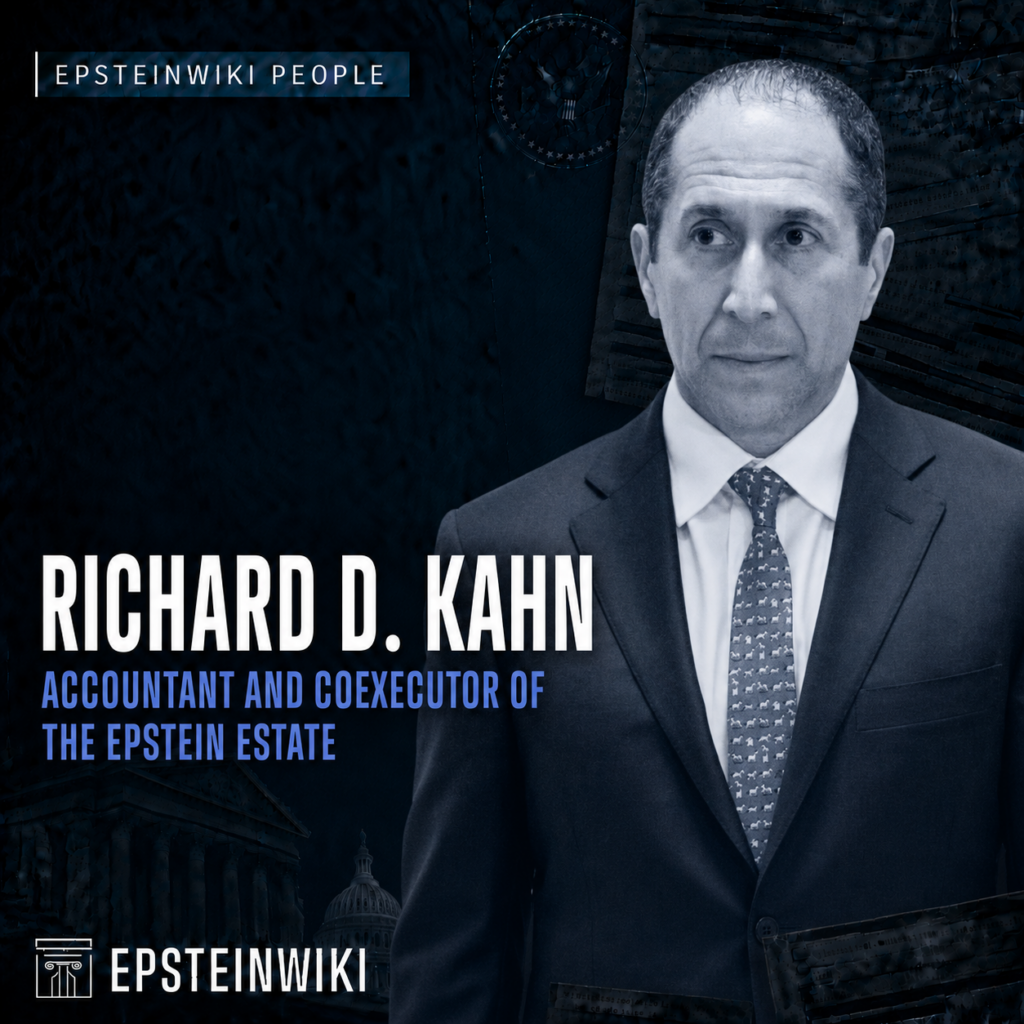
Richard Kahn
Snapshot
- Full name: Richard D. Kahn
- Profession: Accountant and financial administrator
- Documented Epstein role: Accountant, financial manager, project manager, entity administrator, wire contact, trust administrator, and estate coexecutor
- Principal business entity: HBRK Associates, Inc.
- HBRK cofounder: Harry Beller
- Associated attorney: Darren Indyke
- Documented banks: JPMorgan Chase, Deutsche Bank, TD Bank, FirstBank Puerto Rico, and other financial institutions
- Documented trust roles: The 1953 Trust, Butterfly Trust, and other Epstein related structures
- Important entities: Southern Trust Company, Southern Financial, HBRK Associates, LSJ Employees, JEGE, Plan D, NES, Zorro Management, Neptune, Hyperion Air, Gratitude America, Haze Trust, and the Epstein estate
- Estate role: Coexecutor with Darren Indyke
- Congressional deposition: March 11, 2026
- Criminal status: Kahn has not been criminally charged or convicted in connection with Epstein’s trafficking crimes
- Civil status: Survivors have alleged that Kahn and Indyke helped facilitate Epstein’s enterprise. Both men denied wrongdoing. Settlements involving them and the estate did not include admissions of liability
- Evidence base: Bank records, wire instructions, suspicious activity records, emails, corporate documents, trust records, estate documents, property expenses, payroll records, court filings, government records, and congressional testimony
- Article status: Living EpsteinWiki knowledge base article
- Last updated: August 3, 2026
Key Takeaways
- Richard Kahn was one of the principal administrators of Jeffrey Epstein’s money, companies, trusts, properties, employees, and estate.
- An Epstein organizational chart identified Kahn as a project manager, but records show responsibilities extending across accounting, wire transfers, bank accounts, property expenses, construction, payroll, tax matters, investments, and trust administration.
- Kahn operated through HBRK Associates with accountant Harry Beller.
- An FBI interview with a Deutsche Bank employee stated that wire requests generally came from Kahn or included him in the communication.
- HBRK managed accounts and operations involving dozens of Epstein related entities.
- Records identify substantial balances across Southern Trust, Southern Financial, Haze Trust, HBRK, and other entities.
- Kahn tracked payments from Leon Black and communicated about millions of dollars owed to Epstein.
- Records connect Kahn and HBRK to funding for LSJ Employees, the entity used for payroll and operations connected to Little Saint James.
- TD Bank filed a suspicious activity report describing tens of millions of dollars in activity involving Epstein related subjects and accounts. Kahn was an authorized signer on accounts described in the report.
- Kahn and Darren Indyke were named trustees and beneficiaries in Epstein’s estate planning documents.
- The 1953 Trust reportedly proposed a $25 million bequest to Kahn and annual trustee compensation.
- After Epstein’s death, Kahn and Indyke became coexecutors of an estate initially valued at more than $577 million.
- The estate funded a survivor compensation program that distributed more than $121 million.
- In 2022, the estate agreed to pay the United States Virgin Islands $105 million, share proceeds from the sale of Epstein’s islands, and return substantial tax benefits.
- In 2026, a federal judge granted preliminary approval to a proposed settlement of up to $35 million in survivor litigation involving the estate, Kahn, and Indyke. The settlement did not include an admission of wrongdoing.
- Kahn testified before the House Oversight Committee on March 11, 2026. He denied knowing about or participating in Epstein’s abuse.
- Kahn’s authority over money and operations makes him essential to any forensic reconstruction of Epstein’s financial and trafficking infrastructure.
Overview
Richard Kahn was Jeffrey Epstein’s longtime accountant and one of the most important financial administrators in Epstein’s network.
His role extended far beyond preparing tax returns. Released records connect Kahn to wire transfers, company accounts, property expenses, construction projects, payroll, trusts, investments, bank relationships, charitable organizations, payments to associates, and the administration of Epstein’s estate.
Kahn frequently worked alongside attorney Darren Indyke. Their functions were complementary. Indyke handled legal, corporate, trust, and transactional structures. Kahn handled accounting, banking, payments, expenses, financial records, vendors, and operating budgets.
After Epstein’s death, both men became coexecutors of his estate. They gained responsibility for assets, records, property sales, claims, settlements, trusts, and survivor compensation.
Professional proximity does not automatically establish criminal knowledge. The central questions concern what Kahn knew, which transactions he authorized, what warnings he encountered, and whether any financial activity knowingly supported or concealed Epstein’s crimes.
Evidence Standard
This article distinguishes among documented financial roles, survivor testimony, bank records, government allegations, civil complaints, settlements, congressional testimony, and criminal findings.
Kahn has not been criminally charged or convicted of participating in Epstein’s trafficking operation.
Civil lawsuits have alleged that he helped administer structures and payments that supported Epstein’s enterprise. Kahn has denied wrongdoing.
A settlement does not establish every allegation as fact, especially when the agreement includes no admission of liability. However, the underlying records and allegations remain relevant to the historical investigation.
Professional Background
Kahn’s complete education, licensing history, early employment, and professional biography have not been fully reconstructed in the public record.
Released documents identify him as an accountant, project manager, financial administrator, and principal of HBRK Associates.
An Epstein organizational chart listed Kahn as a project manager.
The title understates the breadth of his documented responsibilities.
Records connect Kahn to:
- Accounting
- Bank accounts
- Wire instructions
- Entity management
- Trust administration
- Property budgets
- Construction contracts
- Employee payroll
- Vendor payments
- Investment information
- Foreign exchange negotiations
- Tax returns
- Charitable activity
- Household expenses
- Aircraft expenses
- Estate administration
How Kahn Began Working for Epstein
The exact circumstances through which Kahn met Epstein remain unclear.
Records indicate that Harry Beller worked for Epstein before Kahn and later became Kahn’s partner in HBRK Associates.
This suggests that Beller may have been an important bridge into Epstein’s financial operation, but the precise introduction has not been established.
A complete investigation should locate:
- Kahn’s earliest engagement agreement
- His first invoice to Epstein
- Early correspondence with Harry Beller
- Early correspondence with Darren Indyke
- Corporate filings bearing Kahn’s name
- Tax and accounting records from before HBRK’s formation
- Epstein’s earliest payments to Kahn
Until those records are identified, the origin of the relationship remains unresolved.
HBRK Associates
HBRK Associates was incorporated in New York in August 2008.
Released records and congressional materials identify the letters HBRK with Harry Beller and Richard Kahn.
HBRK became a central accounting and administrative office for Epstein’s financial system.
The firm was associated with:
- Bank accounts
- Wire instructions
- Payments
- Entity records
- Property expenses
- Construction projects
- Employee payroll
- Trusts
- Aircraft
- Charities
- Investments
- Financial reporting
- Estate administration
A TD Bank review stated that HBRK described itself as providing accounting services to extremely wealthy clients. The bank reportedly observed that account activity did not indicate the existence of clients other than Epstein.
That observation raises questions about whether HBRK functioned primarily as Epstein’s private financial office.
Harry Beller
Harry Beller was Kahn’s HBRK partner and another important Epstein accountant.
Beller reportedly worked for Epstein for approximately twenty two years, beginning before HBRK’s 2008 incorporation.
Records identify Beller as an authorized signer on HBRK related accounts.
- JPMorgan authority record involving HBRK and Harry Beller EFTA01582951
- FirstBank Puerto Rico authority record EFTA00065864
Beller’s precise division of responsibilities with Kahn requires additional research.
Investigators should identify:
- Which accounts Beller controlled
- Which transactions required his approval
- When responsibility shifted from Beller to Kahn
- Which clients HBRK served
- Why Beller left or reduced his role
- Which records Beller retained
- Whether Kahn inherited accounts or responsibilities from him
Relationship With Darren Indyke
Kahn and Indyke occupied overlapping positions across Epstein’s financial system.
Their documented roles included:
- Company administration
- Trust administration
- Bank authority
- Property expenses
- Wire transfers
- Tax matters
- Charitable organizations
- Estate planning
- The 1953 Trust
- Estate administration
- Survivor compensation
- Litigation settlements
Kahn and Indyke appear together as signatories, trustees, administrators, and estate coexecutors.
Their relationship is central because legal structures and financial operations often worked together. Indyke could prepare or review the legal documents, while Kahn could carry out the payments, accounting, reporting, and account administration.
Neither professional role independently proves knowledge of trafficking.
Entity Management
HBRK managed or supported accounts involving numerous Epstein entities.
Important entities included:
- Southern Trust Company
- Southern Financial
- HBRK Associates
- LSJ Employees
- LSJE
- JEGE
- Plan D
- NES
- Zorro Management
- Prytanee
- Neptune
- Hyperion Air
- Gratitude America
- Haze Trust
- Butterfly Trust
- Insurance trusts
- Financial Ballistics Trust
- Island Grounds
- J. Epstein Virgin Islands Foundation
- C.O.U.Q. Foundation
- Florida Science Foundation
- Property companies
- Aircraft companies
The number of entities does not independently establish money laundering. Wealthy individuals commonly use multiple companies to hold properties, aircraft, investments, and operating businesses.
The fragmentation made it more difficult to see the complete movement of money across Epstein’s system.
Banking Relationships
Kahn’s financial work crossed several major banks.
JPMorgan
HBRK maintained dedicated accounts at JPMorgan during the period in which Epstein was a bank client.
Records identify HBRK authority and wire procedures.
JPMorgan ended its relationship with Epstein in 2013 after years of internal concerns.
Deutsche Bank
Epstein moved significant financial activity to Deutsche Bank after leaving JPMorgan.
Deutsche Bank used a unified relationship code to manage Epstein and numerous related entities.
Records identify Kahn as a central contact for wires and financial instructions.
TD Bank
HBRK and other Epstein related accounts were opened at TD Bank in 2019.
The timing is significant because the accounts were opened during the period in which Deutsche Bank was ending its relationship with Epstein and only months before Epstein’s July 2019 arrest.
Wire Transfer Authority
An FBI interview with a Deutsche Bank employee described Kahn as a principal source of wire transfer requests.
The employee reportedly stated that wire requests generally came from Kahn or included him in the communication.
This record demonstrates operational authority over Epstein related transfers.
It does not establish that every wire was improper or that Kahn understood every recipient’s relationship with Epstein.
A complete analysis requires:
- The source account
- The receiving account
- The beneficial owner
- The payment purpose
- Supporting invoices
- Contracts
- Tax treatment
- Communications
- Final use of the funds
Aggregate Account Balances
A November 2015 email from Kahn identified significant balances across three Epstein related accounts.
The email reportedly listed:
- Southern Trust with approximately $82.5 million
- Haze Trust with approximately $47.3 million
- Southern Financial with approximately $29.2 million
The combined balance exceeded $159 million.
The communication concerned which account should fund a large transfer to an attorney escrow account.
The balances demonstrate Kahn’s access to detailed financial information and authority to coordinate large movements of money.
Transition From JPMorgan to Deutsche Bank
Records document substantial transfers when Epstein moved accounts from JPMorgan to Deutsche Bank in 2013.
The transferred money reportedly included funds belonging to:
- Southern Financial
- Southern Trust
- Haze Trust
- Jeepers
- Other Epstein related accounts
The documented transfers exceeded $33 million.
The bank transition should be examined alongside JPMorgan’s internal concerns, Deutsche Bank’s client approval process, and Kahn’s role in coordinating the accounts.
Southern Trust and LSJ Funding
Records describe a financial pipeline involving HBRK, Southern Trust, and entities supporting Little Saint James.
Between 2016 and 2019, records identify millions of dollars transferred through HBRK managed accounts.
LSJ Employees received additional funding through repeated wire transfers.
LSJ Employees was connected to payroll and operating expenses on Little Saint James.
Little Saint James was later identified by survivors and the United States Virgin Islands as a central location in Epstein’s trafficking and abuse system.
Funding an employee or property entity does not independently establish that the person authorizing the transaction knew about abuse.
Payroll and Personnel Administration
Kahn appears in records involving employee payroll and the movement of staff from Island Grounds into LSJ Employees.
The transition placed island employees within an entity funded through Epstein’s financial network.
Payroll records could identify:
- Employees
- Job titles
- Work locations
- Compensation
- Housing
- Travel
- Supervisors
- Dates of employment
- Expense reimbursements
- Unusual payments
These records may help reconstruct who worked at the islands and who had access to specific properties.
Property and Construction Management
Kahn managed or reviewed expenses involving Epstein’s properties.
Released records connect him to:
- Road construction
- Pools
- Water systems
- Well drilling
- Interior work
- Lighting
- Landscaping
- Maintenance
- Employee housing
- Island infrastructure
- Zorro Ranch
- Manhattan property expenses
Examples include:
- Road construction record EFTA01746485
- Pool construction record EFTA01795532
- Water system record EFTA00616691
- Zorro Ranch well record EFTA01875410
Property management demonstrates that Kahn’s responsibilities extended beyond conventional accounting.
It does not establish that he knew what occurred within every residence.
Epstein’s Annual Operating Budget
During his March 2026 congressional deposition, Kahn described Epstein’s annual operating expenses as approximately $25 million to $30 million.
He said the budget included:
- Residences
- Employees
- Aircraft
- Vehicles
- Fuel
- Repairs
- Maintenance
- Property improvements
- Personal expenses
- Gifts
- Travel
This estimate illustrates the scale of Epstein’s operation.
The budget should be compared with bank statements, tax returns, invoices, property records, aircraft expenses, payroll reports, and cash withdrawals.
Payments From Leon Black
Kahn tracked payments from Leon Black and Black related entities to Epstein.
An April 2014 communication stated that two transfers totaling $10 million had been received. One was reportedly from Black Family Partners and the other from Leon and Debra Black.
Another communication followed up on an overdue $10 million payment.
Leon Black paid Epstein at least $158 million between 2012 and 2017 for claimed tax and estate planning services. Senate investigators later identified approximately $170 million in payments from Black and related entities.
Black denied participating in Epstein’s trafficking crimes and has not been criminally convicted in connection with Epstein.
Kahn’s role in tracking these payments demonstrates his proximity to one of Epstein’s largest documented sources of income.
Other Reported Epstein Clients
During his 2026 deposition, Kahn identified a small number of people or families as financial clients or sources of payments for Epstein’s services.
Public reporting identified:
- Leslie Wexner
- Leon Black
- Glenn Dubin
- Steven Sinofsky
- Members of the Rothschild family
The precise nature of each relationship differed.
Appearance on a list of reported clients does not establish criminal conduct or knowledge of Epstein’s abuse. Some people have disputed how their financial relationship with Epstein was characterized.
Each relationship requires separate documentation through engagement letters, invoices, payments, tax records, trust documents, and testimony.
Jean Luc Brunel and MC2
Kahn appears in financial records involving Jean Luc Brunel and MC2 Model Management.
Records refer to money owed to Brunel and a credit arrangement involving MC2.
Brunel was accused by multiple women of sexual abuse and of helping supply young women and girls to Epstein. Brunel denied wrongdoing before his death in French custody in 2022.
The financial records do not independently establish that Kahn knew about Brunel’s alleged conduct.
They demonstrate that Epstein’s accounting office administered financial relationships involving Brunel and MC2.
Payments to Other People and Organizations
Records connect Kahn to payments involving:
- Attorneys
- Employees
- Contractors
- Medical professionals
- Public relations consultants
- Charities
- Educational expenses
- Modeling related entities
- Property vendors
- International recipients
Examples include:
- Loan record involving Adam Bly EFTA02032563
- Medical payment record EFTA02032869
- Public relations reimbursement record EFTA01755477
Every payment must be evaluated according to its purpose, documentation, recipient, and source account.
Payment by an Epstein entity does not independently establish participation in his crimes.
TD Bank Suspicious Activity Report
A TD Bank suspicious activity report described approximately $47 million in activity involving multiple Epstein related subjects and accounts.
The record described accounts involving HBRK and related entities.
Kahn reportedly served as the sole authorized signer on certain accounts.
The report identified:
- Incoming wires
- Cash withdrawals
- International payments
- Tuition payments
- Transfers from Epstein related entities
- Activity involving Southern Trust
- Activity involving NES
A suspicious activity report is not a criminal charge or finding. Banks file such reports when activity meets risk criteria or appears inconsistent with expected account use.
The report establishes that the bank considered the activity worthy of federal financial intelligence review.
Cash Withdrawals
The TD Bank record identifies cash withdrawals involving accounts for which Kahn was an authorized signer.
One reported transaction involved a $50,000 withdrawal that generated a currency transaction report.
Cash is especially important in the Epstein investigation because survivors described receiving cash following sexualized massages and additional money for recruiting other girls or young women.
A cash withdrawal does not independently establish that the money funded trafficking.
Investigators must determine:
- Who requested the cash
- Who received it
- How it was recorded
- Whether receipts existed
- Which property or employee received it
- Whether the amount matched documented expenses
- Whether repeated withdrawals corresponded with victim or recruiter payments
Trust Administration
Kahn held roles within Epstein’s trust network.
The 1953 Trust
Epstein executed the 1953 Trust shortly before his death.
The document reportedly named Kahn and Indyke as trustees.
It also reportedly included:
- A proposed $25 million bequest to Kahn
- Annual trustee compensation
- Loan forgiveness involving Kahn or Coatue Enterprises
- Employment provisions affecting people who worked for Epstein or HBRK
- The 1953 Trust EFTA00099303
The proposed bequest and compensation created a potential financial interest in the administration of the estate.
Planned bequests do not necessarily become final distributions. Estate claims, settlements, expenses, and court proceedings can alter what beneficiaries receive.
Butterfly Trust
Records identify Kahn and Indyke as trustees of Butterfly Trust.
Deutsche Bank compliance personnel later questioned changes involving the trust’s beneficiaries.
- Butterfly Trust compliance communication EFTA01420392
- Butterfly Trust record EFTA01296151
- Additional Butterfly Trust record EFTA01282297
The records reportedly indicate that Ghislaine Maxwell was removed and replaced by other beneficiaries, including Kahn and Indyke.
The reason for the change remains an important question.
The 2018 Trust
A 2018 trust document reportedly named Kahn, Indyke, and Kathryn Ruemmler in trustee roles.
The document must be evaluated alongside later estate planning records to determine whether it remained effective or was replaced.
Coatue Enterprises
The 1953 Trust reportedly contained a provision forgiving obligations owed by Kahn or Coatue Enterprises to Epstein or Southern Financial.
The public record has not fully established:
- The ownership of Coatue Enterprises
- Its business purpose
- The amount of the obligations
- Why the obligations were forgiven
- Whether the obligation involved a loan, investment, advance, or another transaction
The name should not be assumed to establish a relationship with another similarly named investment company without corporate evidence.
Florida Science Foundation
The Florida Science Foundation was created before Epstein began serving his 2008 sentence.
Epstein was permitted to leave jail for work release and spend extensive hours at the foundation’s office.
Financial records connect Epstein related charitable entities to the foundation’s rent and expenses.
Kahn reportedly served as vice president of the C.O.U.Q. Foundation, which funded Florida Science Foundation operations.
Relevant records include:
- Florida Science Foundation payment record EFTA01590120
- Florida Science Foundation email record EFTA01899894
Civil allegations later claimed that the office allowed Epstein to continue inappropriate conduct while on work release.
Kahn’s documented financial role does not independently establish that he knew what Epstein allegedly did at the office.
Investment and Tax Work
Kahn’s records show responsibilities involving investment information, foreign exchange pricing, bank recommendations, and tax returns.
Examples include:
- Investment analysis communication EFTA01746531
- Foreign exchange pricing communication EFTA01423992
- Tax and financial record EFTA01873997
Entities and trusts connected to tax work reportedly included:
- Epstein’s personal returns
- Zorro related trusts
- Haze Trust
- Butterfly Trust
- Financial Ballistics Trust
- KCAC
This work placed Kahn near Epstein’s income, deductions, investments, charitable payments, trusts, and entity relationships.
Grand Jury Subpoena
A federal grand jury subpoena dated October 18, 2019 sought documents concerning the 1953 Trust.
The subpoena sought:
- The trust agreement
- Referenced subtrusts
- Drafts
- Notes
- Communications
The existence of the subpoena demonstrates federal interest in Epstein’s estate planning after his death.
The public record does not clearly establish the complete production made in response. Absence of a publicly indexed return should not be treated as proof that no documents were produced.
Financial Actions After Epstein’s Death
Records describe transfers among Epstein entities after his death.
In December 2019, funds from multiple entities were reportedly consolidated into Southern Trust.
The entities included:
- NES
- LSJE
- Neptune
- Plan D
- Hyperion Air
- Zorro Management
- JEGE
The combined amount reportedly exceeded $9 million.
A later transfer moved additional money from Southern Trust into an investment account.
These transactions may represent lawful estate administration, consolidation of accounts, or preservation of assets.
They require documentation showing who authorized them, why they occurred, and how the money was later used.
Epstein’s Will and Estate
Epstein signed his final will shortly before his death in August 2019.
The will transferred assets into the 1953 Trust and named Kahn and Indyke as coexecutors.
The estate was initially valued at more than $577 million, with some reporting placing the gross value above $600 million.
Estate assets included:
- Cash
- Investments
- Companies
- Trust interests
- Manhattan real estate
- Palm Beach property
- Zorro Ranch
- Paris property
- Little Saint James
- Great Saint James
- Aircraft
- Vehicles
- Art and personal property
Kahn and Indyke became responsible for protecting assets, paying creditors, responding to lawsuits, selling properties, administering survivor claims, and resolving government actions.
Epstein Victims’ Compensation Program
The estate established the Epstein Victims’ Compensation Program after Epstein’s death.
The program was independently administered by Jordana Feldman.
Approximately 225 claims were submitted. More than $121 million was distributed to approximately 136 survivors who accepted compensation offers.
The program offered a confidential alternative to conventional litigation.
It allowed survivors to describe what happened without depositions, public testimony, or adversarial questioning.
Acceptance generally required a release of claims against Epstein’s estate. It did not necessarily release unrelated third parties.
Kahn and Indyke’s role was to fund and administer the estate that supported the program, not to determine individual awards.
United States Virgin Islands Settlement
The United States Virgin Islands sued Epstein’s estate and related defendants.
The government alleged that Epstein used Virgin Islands companies, tax benefits, employees, and properties to support a trafficking enterprise.
In 2022, the estate agreed to:
- Pay $105 million
- Share proceeds from the sale of Little Saint James
- Pay for environmental remediation
- Return substantial economic development benefits
The settlement did not include an admission of liability by Kahn or Indyke.
The agreement generated substantial funds, but it also ended litigation that could have produced additional discovery and testimony.
Civil Litigation Against Kahn and Indyke
Survivors filed civil litigation alleging that Kahn and Indyke helped Epstein operate and conceal his trafficking enterprise.
The plaintiffs alleged that the two administrators helped manage companies, accounts, cash, payments, payroll, and property structures that supported Epstein’s crimes.
Kahn and Indyke denied the allegations.
Their attorney stated that neither man admitted misconduct and that no survivor had accused either man of personally committing or witnessing sexual abuse.
In February 2026, the estate, Kahn, and Indyke reached a proposed settlement of up to $35 million.
A federal judge granted preliminary approval in March 2026. A final approval hearing was scheduled for September 16, 2026.
The settlement did not include an admission of wrongdoing.
Congressional Deposition
The House Committee on Oversight and Government Reform deposed Kahn on March 11, 2026.
The committee released video of Kahn’s testimony on March 24, 2026.
Kahn reportedly testified that:
- He did not know about Epstein’s trafficking or continued abuse
- He regretted remaining associated with Epstein
- Epstein’s annual expenses were approximately $25 million to $30 million
- Epstein had only a small number of paying financial clients
- He helped administer the estate and survivor compensation
- He had not previously been interviewed by federal law enforcement about Epstein
- He did not consider company structures or expenses evidence of trafficking
Kahn’s testimony must be compared with bank records, suspicious activity reports, emails, payroll documents, trust records, survivor accounts, and civil allegations.
A deposition documents what a witness said. It does not automatically resolve conflicts between testimony and other evidence.
What Kahn Said About His Knowledge
Kahn denied knowing about Epstein’s trafficking crimes while working for him.
He said he did not observe minors being abused and did not understand financial activity as supporting trafficking.
He has expressed regret over continuing to work for Epstein after the 2008 conviction.
The credibility of this denial must be evaluated against:
- Epstein’s public criminal status
- Cash activity
- Payments to women
- Modeling related financial activity
- Island payroll
- Property operations
- Communications with staff
- Bank warnings
- Civil litigation
- Kahn’s duration of service
Long professional service creates an important investigative question. It does not automatically prove knowledge.
Current Legal Status
Kahn has not been criminally charged or convicted of participating in Epstein’s trafficking crimes.
He has faced civil allegations concerning his role in Epstein’s financial and corporate operation.
Kahn has denied:
- Knowing about Epstein’s trafficking enterprise
- Facilitating sexual abuse
- Knowing that cash supported victim or recruiter payments
- Using entities to conceal crimes
- Participating in fraudulent marriages
- Personally committing or witnessing sexual abuse
Settlements involving the estate and its administrators have not included admissions of wrongdoing.
Why Kahn Matters
Richard Kahn matters because he was positioned near the movement and use of Epstein’s money.
His records touch:
- Client payments
- Bank accounts
- Wire transfers
- Cash withdrawals
- Companies
- Trusts
- Properties
- Construction
- Employees
- Payroll
- Aircraft
- Charities
- Models and modeling companies
- Legal expenses
- Estate planning
- Survivor compensation
- Postdeath asset transfers
Kahn is therefore one of the most important witnesses for understanding how Epstein’s financial system operated.
Unanswered Questions
- How did Kahn meet Epstein?
- Did Harry Beller introduce him?
- When did Kahn begin working for Epstein?
- What were Kahn’s professional credentials and earlier employment?
- Did HBRK serve clients other than Epstein?
- What did HBRK charge Epstein?
- How much compensation did Kahn receive?
- Why did Epstein reportedly plan a $25 million bequest to Kahn?
- What was Coatue Enterprises?
- What obligations involving Kahn or Coatue Enterprises were forgiven?
- Why were Butterfly Trust beneficiaries changed?
- Why was Ghislaine Maxwell reportedly removed as a beneficiary?
- Why were Kahn and Indyke added as beneficiaries?
- What was the purpose of the $23 million transferred to an attorney escrow account?
- Why did HBRK open new TD Bank accounts in 2019?
- What did Kahn know about the bank’s high risk classifications?
- Which cash withdrawals did Kahn authorize?
- Who received the cash?
- What did Kahn know about Epstein’s cash payments to girls and young women?
- What did Kahn know about recruiter payments?
- What did he know about LSJ Employees and island operations?
- What did he know about Jean Luc Brunel and MC2?
- What accounting services did Kahn provide for Epstein’s work involving Leon Black?
- What records did Kahn receive from banks?
- Which suspicious activity concerns were communicated to him?
- Why was Kahn not interviewed by federal investigators before 2026?
- What did Kahn produce in response to the 2019 grand jury subpoena?
- Which estate and trust records remain withheld or sealed?
Evidence Appearances
Professional Role and HBRK
- Epstein organizational chart EFTA00003149
- HBRK office and contact record EFTA01579566
- HBRK authority record EFTA01582951
Banking and Wire Authority
- FBI interview concerning Kahn’s wire role EFTA00128780
- JPMorgan HBRK banking record EFTA01583578
- JPMorgan activity record EFTA00090639
- Deutsche Bank relationship record EFTA01421052
- TD Bank suspicious activity record EFTA01656524
- JPMorgan to Deutsche Bank transfer record EFTA01578684
Account Balances and Entity Funding
- Kahn email concerning $159 million in balances EFTA02671293
- Southern Trust and entity funding record EFTA01273155
- LSJ Employees wire records EFTA01273181
- Additional LSJ Employees wire records EFTA01273198
Leon Black and Other Payments
- Black related payment communication EFTA01927911
- Overdue Black payment communication EFTA01928263
- Brunel payment communication EFTA01928143
- MC2 credit arrangement EFTA01873997
- Adam Bly loan record EFTA02032563
- Medical payment record EFTA02032869
- Public relations reimbursement EFTA01755477
Trusts and Estate
- The 1953 Trust EFTA00099303
- Butterfly Trust compliance communication EFTA01420392
- Butterfly Trust record EFTA01296151
- Additional Butterfly Trust record EFTA01282297
- 2018 trust record EFTA00099449
- Grand jury subpoena for trust records EFTA00088989
Properties and Operations
- Island payroll transition EFTA02006925
- Property management communication EFTA01832061
- Road construction record EFTA01746485
- Pool construction record EFTA01795532
- Water system record EFTA00616691
- Zorro Ranch well record EFTA01875410
Investment and Tax Records
- Investment analysis EFTA01746531
- Foreign exchange pricing EFTA01423992
- Tax and financial record EFTA01873997
Florida Science Foundation
- Florida Science Foundation payment EFTA01590120
- Florida Science Foundation email record EFTA01899894
Related EpsteinWiki Articles
- Jeffrey Epstein
- Darren Indyke
- Harry Beller
- Leon Black
- Leslie Wexner
- Jean Luc Brunel
- MC2 Model Management
- Southern Trust Company
- HBRK Associates
- Haze Trust
- The 1953 Trust
- Epstein Victims’ Compensation Program
- Little Saint James
- Florida Science Foundation
Source List
- House Oversight release of Richard Kahn and Darren Indyke deposition videos
- Epstein Data Richard Kahn witness briefing
- Epstein Data Richard Kahn deposition analysis
- Epstein Data congressional subpoena guide
- Department of Justice Epstein Library
- Proposed survivor settlement involving the Epstein estate
- Preliminary approval of the proposed settlement
- New York Department of Financial Services action concerning Deutsche Bank
- Epstein estate settlement with the United States Virgin Islands
- Epstein Data archive