
Darren K. Indyke
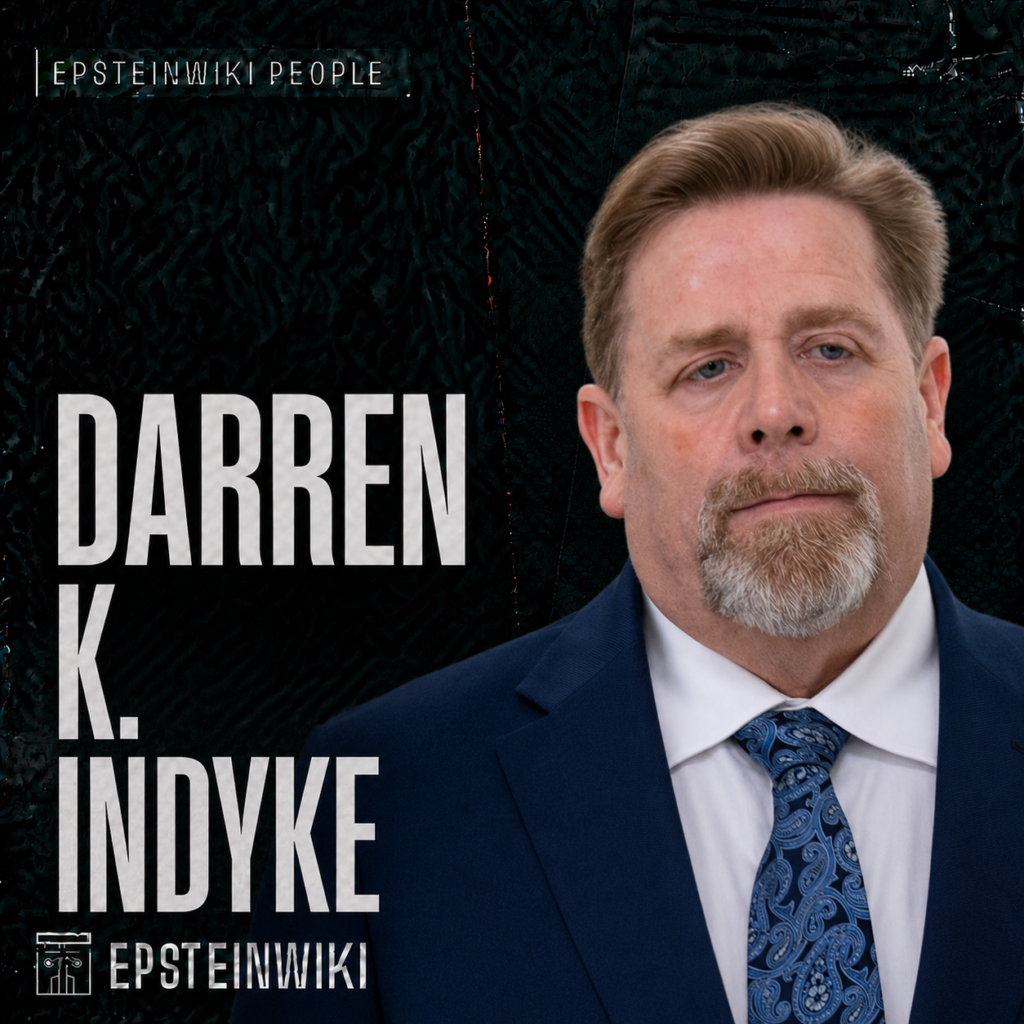
Snapshot
Darren K. Indyke was Jeffrey Epstein’s longtime attorney, corporate representative, trustee, financial signatory, estate planning adviser, and eventual coexecutor of Epstein’s estate.
Indyke began working for Epstein during the 1990s. Over the following decades, records placed him inside the legal and administrative structure surrounding Epstein’s companies, trusts, foundations, properties, bank accounts, investments, aircraft, sex offender registration obligations, litigation, and estate.
His role cannot be reduced to an appearance in Epstein’s address book. Indyke signed corporate records, held positions within Epstein controlled organizations, communicated with banks, confirmed information during financial compliance reviews, handled cash authorizations, transmitted Epstein’s travel information to sex offender registration personnel, participated in estate planning, and later assumed control of Epstein’s estate with accountant Richard D. Kahn.
Two days before Epstein died in federal custody, Epstein signed a will naming Indyke and Kahn as executors. The will transferred his remaining property into the 1953 Trust. Later released trust records identified Indyke as a trustee and prospective beneficiary of a $50 million distribution. That distribution remained subordinate to survivor claims, taxes, debts, litigation expenses, estate costs, and higher priority trust provisions.
Survivors and the Government of the United States Virgin Islands later alleged in civil complaints that Indyke and Kahn were important participants in the corporate and financial infrastructure that enabled Epstein’s trafficking operation. The allegations concerned corporate entities, cash withdrawals, banking arrangements, payments, immigration matters, tax benefits, property transactions, and alleged concealment.
Indyke denied knowing about or assisting Epstein’s sexual abuse. He maintained that his work consisted primarily of corporate, transactional, and general legal services. He stated that no survivor had told him about Epstein’s abuse and that he would have ended the relationship if he had known what Epstein was doing.
In December 2022, Indyke, Kahn, Epstein’s estate, and multiple Epstein controlled entities settled the Virgin Islands enforcement action. The agreement required more than $105 million in cash, one half of the proceeds from the sale of Little St. James, environmental remediation payments, liquidation of Virgin Islands operations, and production of documents. The settlement did not include an admission by Indyke that he knowingly participated in trafficking.
In March 2026, Indyke testified under subpoena before the House Committee on Oversight and Government Reform. He again denied knowing about Epstein’s abuse. He also addressed questions concerning his continued employment after the 2008 conviction, cash transactions, Epstein’s entities, private investigators, estate records, compensation, and the 1953 Trust.
A separate survivor class action reached a proposed settlement in 2026. The estate agreed to provide between $25 million and $35 million for eligible survivors who had not previously resolved claims against the estate. The court granted preliminary approval on March 3, 2026. As of September 2, 2026, the final approval hearing remained scheduled for September 16, 2026.
Indyke is not publicly known to have been criminally charged or convicted for participating in Epstein’s sexual abuse or trafficking operation.
Identity and Legal Career
Darren K. Indyke is an American attorney whose professional work has included corporate, transactional, trust, estate, international, and general legal matters.
Public records and Indyke’s own congressional account identify him as one of Epstein’s attorneys beginning in the mid 1990s. He later operated through Darren K. Indyke PLLC and became deeply integrated into Epstein’s corporate and financial administration.
In EFTA01409205, Deutsche Bank personnel discussed an account opening application involving Darren K. Indyke PLLC. The bank identified the client relationship as attorney.
That description establishes that the bank recognized Indyke as Epstein’s lawyer. It does not describe the complete scope of his authority.
Other records identify Indyke as a director, treasurer, trustee, legal representative, authorized signatory, corporate officer, executor, and estate administrator.
The distinction between an outside lawyer and an internal operator became important in later litigation. Indyke described himself as one of several attorneys consulted by Epstein. Plaintiffs and the Virgin Islands government alleged that his formal positions and administrative responsibilities made him part of Epstein’s internal infrastructure.
The public record conclusively establishes the positions Indyke held. Whether he knowingly used those positions to facilitate trafficking became the disputed question.
The Long Duration of the Relationship
Indyke’s work for Epstein continued for more than two decades.
The relationship crossed several legally and historically important periods:
- Epstein’s expansion of his financial, property, and philanthropic structures during the 1990s.
- The period during which survivors later reported abuse in New York, Florida, New Mexico, Paris, and the United States Virgin Islands.
- The Palm Beach police investigation that began in 2005.
- The federal investigation and controversial nonprosecution agreement.
- Epstein’s 2008 guilty plea in Florida.
- Epstein’s sex offender registration and travel reporting obligations.
- Epstein’s return to international business and social activity after his release.
- Epstein’s 2019 federal arrest on sex trafficking charges.
- The creation of the 1953 Trust.
- Epstein’s death and the administration of his estate.
- The compensation of survivors and defense of estate litigation.
- Congressional investigation of the estate and Epstein’s professional advisers.
During his March 2026 congressional deposition, Indyke described his primary role as providing corporate, transactional, and general legal services to Epstein and Epstein’s companies.
The duration of that service distinguishes Indyke from lawyers retained for one lawsuit or isolated transaction.
Legal Work Versus Operational Authority
A lawyer can provide legal advice without managing a client’s daily business. Indyke’s documentary record shows that his functions extended into entity administration, banking, trusts, regulatory compliance, estate planning, and financial authorization.
His name appears in:
- Corporate formation and governance records.
- Bank account applications.
- Know Your Customer reviews.
- Authorized signatory records.
- Trust documents.
- Foundation records.
- Property holding companies.
- Aircraft related entities.
- Cash authorization communications.
- Sex offender travel notices.
- Estate planning instruments.
- Probate filings.
- Survivor settlements.
- Government enforcement litigation.
- Congressional testimony.
The existence of these records does not prove that every function was illegal. It establishes that Indyke’s relationship with Epstein was operational as well as legal.
Epstein Controlled Companies and Trusts
Epstein conducted his affairs through a large collection of companies, foundations, trusts, investment vehicles, and property holding entities.
Records involving Indyke include structures such as:
- Financial Trust Company, Inc.
- Southern Trust Company, Inc.
- Southern Financial LLC.
- Gratitude America, Ltd.
- Plan D, LLC.
- LSJE, LLC.
- Great St. Jim, LLC.
- Nautilus, Inc.
- Hyperion Air, LLC.
- Poplar, Inc.
- The Haze Trust.
- Epstein insurance trusts.
- The 1953 Trust.
- Property holding companies connected with Epstein’s residences.
- Entities associated with Epstein’s aircraft and transportation.
Indyke did not necessarily own every entity in which his name appeared. His role depended on the company or trust. He could appear as attorney, director, treasurer, trustee, signatory, legal representative, registered contact, or fiduciary.
A company may also have a legitimate legal purpose even when its beneficial owner commits crimes.
The investigative significance lies in how the entities functioned together, who controlled their money, what expenses they paid, who received funds, and whether professional representatives knew that the infrastructure was being used to support abuse.
Gratitude America
Gratitude America was an Epstein controlled foundation that operated after his conviction.
The organization supported donations to academic, scientific, cultural, and philanthropic recipients. Epstein used philanthropy to maintain relationships with prominent institutions and present himself publicly as a benefactor.
In EFTA01422395, Deutsche Bank compliance personnel identified Epstein as president and authorized signatory of Gratitude America. The same record identified Richard Kahn as a director and authorized signatory and Darren Indyke as director, treasurer, and authorized signatory.
This establishes that Indyke held formal governance and banking authority within the foundation.
He was not simply copied on an email because he happened to represent Epstein in an unrelated matter.
The record does not establish that every donation made by Gratitude America was improper. It demonstrates that Indyke helped administer a philanthropic vehicle that contributed to Epstein’s continued institutional access after his conviction.
Financial Trust Company and Southern Trust Company
Financial Trust Company and Southern Trust Company were central components of Epstein’s Virgin Islands financial structure.
Epstein obtained substantial economic development tax benefits through Virgin Islands programs. Southern Trust later became a major focus of the territorial government’s civil enforcement case.
The government alleged that Southern Trust made false representations about its activities and qualifications while obtaining more than $80 million in economic development benefits.
Indyke’s formal roles and legal work connected him to the administration of Epstein’s Virgin Islands entities.
The official 2022 settlement announcement stated that the agreement returned the value of more than $80 million in tax benefits that the government alleged had been fraudulently obtained.
This does not establish that every payment made by Financial Trust or Southern Trust supported trafficking. It does establish that the companies were legally and financially important to Epstein and became part of a major government enforcement action.
Banking Compliance Records
Deutsche Bank records repeatedly identify Indyke within compliance reviews of Epstein related accounts.
In EFTA01422809, bank personnel discussed account and ownership information for several Epstein entities and trusts. The correspondence stated that Indyke confirmed there had been no material changes during an October 2018 compliance review.
The entities under review included Plan D, the Haze Trust, NES, LLC, and Epstein insurance trusts.
The document establishes that Deutsche Bank treated Indyke as someone qualified to confirm legally significant information about Epstein’s ownership, governance, or signatory structure.
EFTA01406598 contains additional onboarding and compliance material involving Southern Financial LLC and Indyke.
A lawyer’s participation in a bank compliance review is not inherently suspicious. The significance is that Indyke possessed knowledge and authority concerning a broad collection of Epstein controlled accounts and entities.
The documents do not establish that Indyke controlled Deutsche Bank’s risk decisions or that every statement attributed to him was inaccurate.
Know Your Customer Information
Financial institutions use Know Your Customer reviews to identify account owners, controlling persons, authorized signatories, business purposes, legal representatives, and potential risks.
Epstein’s conviction and sex offender status created significant reputational and compliance risks for banks.
Records show that Indyke assisted financial institutions in identifying or confirming:
- Entity ownership.
- Trustees and trust representatives.
- Directors and officers.
- Authorized signatories.
- Legal representatives.
- Whether material changes had occurred.
- The stated business purposes of accounts.
- The relationship between Epstein and particular entities.
These records demonstrate that Indyke occupied a position where banks expected him to provide accurate legal and organizational information.
They do not establish that a particular bank accepted his information without independent review.
Cash Withdrawals and Check Authorizations
Cash became one of the most contested subjects in later litigation.
The 2024 survivor complaint alleged that Indyke and Kahn helped structure accounts and withdrawals so that Epstein and his associates could obtain cash used in furtherance of trafficking.
That allegation has not been established by a criminal conviction or civil trial verdict.
In EFTA01352268, bank personnel discussed an authorization to cash checks and referred to obtaining an original authorization form from Darren.
The record establishes that Indyke participated in the mechanics of cash access.
During his 2026 congressional testimony, Indyke acknowledged obtaining or withdrawing cash for Epstein. He denied deliberately structuring transactions to avoid federal reporting requirements.
Indyke explained that Epstein used large amounts of cash and experienced difficulty obtaining conventional credit cards from major financial institutions.
That explanation documents Indyke’s position. It does not establish how Epstein ultimately used every cash withdrawal.
The evidentiary distinctions are essential:
- A cash authorization proves access to cash.
- It does not prove the final use of the money.
- A plaintiff may allege that cash supported trafficking.
- Indyke may deny knowing that purpose.
- A settlement may resolve the dispute without establishing whose interpretation was correct.
Financial Transactions Naming Indyke
Released financial records contain transactions and account data involving Indyke or Darren K. Indyke PLLC.
EFTA01472789 contains financial data listing Darren K. Indyke PLLC alongside Epstein related companies and account figures.
The document should be read with its surrounding pages before a particular number is classified as compensation, account ownership, income, or profit.
EFTA00151545 is a Bank Secrecy Act related record describing transactions involving Southern Financial LLC. It references a check from Darren Indyke and Michelle Saipher with a notation concerning promissory interest.
The document establishes that a transaction involving Indyke entered an Epstein related financial account.
It does not prove that the payment furthered trafficking or that the underlying promissory arrangement was improper.
Suspicious activity reports record information submitted by financial institutions to federal authorities. The existence of a report does not prove that a crime occurred. Such reports may contain unverified concerns, incomplete information, and transactions that later receive innocent explanations.
Indyke’s Compensation From Epstein
During his 2026 congressional testimony, Indyke said Epstein paid him approximately $2 million annually near the end of Epstein’s life.
That amount indicates a substantial financial relationship.
It does not establish that every dollar represented payment for improper conduct. It does show that Epstein was not an occasional or minor client.
The proper questions include:
- What services were invoiced.
- Which entities made the payments.
- Whether compensation was salary, legal fees, distributions, loans, or reimbursements.
- Whether Indyke represented Epstein personally, Epstein’s companies, or both.
- Whether invoices describe the matters handled.
- Whether payments increased after significant investigations or litigation.
- Whether compensation created incentives to maintain the relationship after the 2008 conviction.
The complete answer requires invoices, engagement agreements, tax filings, bank records, company ledgers, and testimony.
Sex Offender Registration and Travel Notices
Following his Florida conviction, Epstein was subject to sex offender registration and travel reporting obligations.
Indyke participated in communications connected with those requirements.
EFTA01305746 contains a series of travel notices involving Indyke, Epstein, and Virgin Islands registration personnel. The records address Epstein’s movement between locations including New York, Florida, Paris, and the Virgin Islands.
EFTA01263156 contains additional communications involving Indyke, Epstein, and government contacts connected with travel or registration administration.
These records establish that Indyke knew Epstein was a registered sex offender and helped administer some of the obligations arising from that status.
They do not establish that Indyke knew Epstein continued abusing girls or young women.
They do show that Epstein’s conviction and registration requirements were not remote facts outside Indyke’s professional responsibilities.
Epstein’s 2008 Conviction
Epstein pleaded guilty in Florida in 2008 to procuring a person under eighteen for prostitution and soliciting prostitution.
Indyke continued working for him.
During his congressional deposition, Indyke said Epstein appeared devastated and contrite after the plea. Indyke said he believed Epstein regarded the conduct as a serious mistake and would not repeat it.
When lawmakers questioned why he remained, Indyke said that he had “drank the Kool Aid.”
The statement reflects his retrospective explanation for continuing the relationship.
It does not independently prove that Epstein successfully deceived Indyke about every aspect of his conduct.
The uncontested chronology remains significant:
- Indyke knew Epstein had pleaded guilty to an offense involving a minor.
- Indyke assisted with legal or administrative matters connected with Epstein’s registration.
- Indyke continued providing extensive services.
- Epstein continued maintaining international properties, aircraft, employees, companies, and social contacts.
- Indyke denies knowing that sexual abuse continued.
The 2007 Nonprosecution Agreement
Epstein’s federal nonprosecution agreement protected Epstein and named potential coconspirators from federal prosecution in South Florida for specified conduct.
Indyke was not publicly named among the women identified as potential coconspirators in the agreement.
His relevance to the agreement concerns his broader role as one of Epstein’s attorneys and his involvement in legal matters surrounding Epstein’s response to investigation and prosecution.
The surviving record must distinguish between:
- Lawyers who negotiated the agreement.
- Lawyers who handled related corporate or personal matters.
- People expressly protected by the agreement.
- People later accused of participating in Epstein’s operation.
- People who were never charged.
An attorney’s participation in a defense strategy does not prove involvement in the underlying offense. Attorneys may lawfully provide representation to people accused or convicted of serious crimes.
Legal Strategy and Internal Memoranda
Indyke participated in coordinating legal work for Epstein.
A released 2008 legal memorandum associated with Indyke appears in EFTA00727491. The record should be evaluated within the wider collection of legal communications produced during or after the Florida investigation.
Legal memoranda prove that a lawyer analyzed or communicated about a subject. They do not automatically establish that every factual statement in the memorandum was accurate.
Some legal communications may be subject to privilege or work product protections. Other communications, such as banking instructions, public filings, entity records, and administrative notices, may not qualify for the same protection.
Private Investigators and Stored Evidence
Epstein employed private investigators and litigation professionals.
During Indyke’s 2026 congressional deposition, lawmakers asked about hard drives and other materials retained by Epstein’s investigators.
The House Oversight minority statement said Indyke confirmed the existence of hard drives held by private investigators. Committee members expressed interest in obtaining them.
The existence of hard drives does not reveal what they contain.
The devices could include:
- Litigation research.
- Witness background investigations.
- Surveillance material.
- Financial records.
- Communications.
- Photographs.
- Evidence concerning survivors.
- Material collected to defend Epstein or attack accusers.
- Duplicate records already held by law enforcement.
- Privileged or confidential information.
Their significance depends on custody, authenticity, contents, preservation, and whether copies have been provided to law enforcement, courts, survivors, or Congress.
Allegations Concerning Surveillance and Intimidation
Survivors and journalists have described aggressive investigative tactics used by Epstein’s legal and public relations teams.
The broader record includes private investigators, background reports, litigation files, and efforts to scrutinize accusers.
The available evidence does not establish that Indyke personally directed every investigator or approved every tactic.
His role as a longtime attorney and later estate custodian makes records concerning the investigators relevant to evaluating:
- Who retained them.
- Who paid them.
- What instructions they received.
- Which lawyers received their reports.
- Whether their work targeted survivors or witnesses.
- Whether materials were preserved after Epstein’s death.
- Whether any records were disclosed during litigation.
An investigative report about a survivor proves that the investigation occurred. It does not prove the truth of every allegation or insinuation assembled by the investigator.
Allegations Concerning Immigration and Marriages
The 2024 survivor class complaint alleged that Indyke and Kahn participated in arrangements involving marriages intended to secure immigration status for women connected with Epstein.
The plaintiffs characterized certain marriages as forced or sham arrangements used to keep women available to Epstein.
Indyke and Kahn denied knowingly participating in trafficking, coercion, or abuse.
Legal assistance involving marriage or immigration is not inherently wrongful. Knowingly using legal structures to maintain control over a trafficking victim would carry entirely different significance.
The evidence required to evaluate a particular marriage would include:
- Marriage records.
- Immigration applications.
- Legal engagement records.
- Payments.
- Communications between the parties.
- Testimony from the women involved.
- Evidence of coercion.
- Evidence showing what Indyke knew.
- Evidence concerning who initiated the arrangement.
- Evidence concerning whether immigration representations were truthful.
The plaintiffs’ allegations were serious, but the cases did not reach a trial verdict establishing that Indyke knowingly organized forced or fraudulent marriages.
Epstein’s August 2019 Will
Epstein signed his final will on August 8, 2019, while detained on federal sex trafficking charges.
He died two days later.
The will filed in the Virgin Islands appointed Darren K. Indyke and Richard D. Kahn as executors and directed Epstein’s remaining property into the 1953 Trust.
The probate filing valued the estate at more than $577 million. Other later estimates used higher figures after additional assets or valuations were considered.
The proximity between the execution of the documents and Epstein’s death generated substantial scrutiny.
A will transferring assets into a trust is not inherently illegal. The investigative questions concern:
- Who drafted the documents.
- Who advised Epstein.
- Why the trust was amended during federal detention.
- Who selected the beneficiaries.
- Why the beneficiary list was not included in the public will.
- Whether the structure complicated survivor claims.
- Whether Epstein anticipated his death.
- Whether all assets and liabilities were accurately disclosed.
- Whether the executors possessed personal conflicts.
- Whether all versions of the trust were preserved.
The 1953 Trust
The 1953 Trust was named for Epstein’s birth year.
It functioned as a pour over trust designed to receive property from the estate. The publicly filed will did not identify the ultimate beneficiaries.
Later released trust records showed that Epstein contemplated distributions to employees, associates, family members, friends, and other people in his network.
Indyke and Kahn were selected for trustee responsibilities.
The trust reportedly contemplated a $50 million distribution to Indyke and a $25 million distribution to Kahn.
Those amounts did not become immediate payments upon Epstein’s death.
Survivor claims, taxes, creditors, litigation costs, administrative expenses, and higher priority trust provisions must be resolved before residual beneficiaries receive distributions.
Indyke testified in 2026 that he did not know why Epstein selected the $50 million amount.
A promised distribution creates a financial interest. It does not establish that Indyke actually received the money or that the bequest was compensation for illegal conduct.
Different Versions of Epstein’s Trust
Epstein revised his estate planning before his death.
Changes between trust versions are relevant because beneficiaries, trustees, distributions, properties, and priorities may have changed.
Researchers should compare:
- The January 2019 trust.
- The August 2019 trust.
- Handwritten amendments or schedules.
- Beneficiary lists.
- Property schedules.
- Trustee succession provisions.
- Letters of instruction.
- Engagement records from the lawyers who prepared the documents.
- Communications made while Epstein was detained.
- Probate representations concerning the trust.
A person’s appearance in an earlier trust does not establish that the person retained a right under the final version.
A planned bequest also does not establish that the beneficiary knew about it before Epstein’s death.
Coexecutor of Epstein’s Estate
After Epstein’s death, Indyke and Kahn became the estate’s joint personal representatives.
Their responsibilities included:
- Locating and preserving assets.
- Identifying creditors.
- Responding to survivor claims.
- Defending civil lawsuits.
- Paying lawful expenses.
- Maintaining properties.
- Selling estate assets.
- Filing tax returns.
- Producing probate accountings.
- Administering Epstein controlled companies.
- Preserving records and electronic evidence.
- Implementing court orders and settlements.
- Funding the survivor compensation process.
- Preparing the estate for eventual distribution.
The Virgin Islands probate portal records the continuing proceedings in In the Matter of the Estate of Jeffrey E. Epstein, Probate No. ST 19 PB 80.
Overlapping Roles and Potential Conflicts
Indyke occupied several overlapping positions:
- Epstein’s longtime attorney.
- An officer or signatory for Epstein controlled entities.
- A trustee associated with Epstein’s trusts.
- A participant in banking and compliance communications.
- A coexecutor of Epstein’s estate.
- A proposed beneficiary of the 1953 Trust.
- A defendant in survivor litigation.
- A defendant in government enforcement litigation.
- A custodian or controller of Epstein related records.
- A congressional witness.
These overlapping roles do not automatically establish a fiduciary breach.
They create potential conflicts requiring judicial supervision, transparent accountings, evidence preservation, and separation between estate obligations and personal interests.
An executor must place estate duties ahead of personal expectations as a beneficiary.
Whether Indyke met those duties must be evaluated through probate records, court rulings, financial accountings, settlement documents, and evidence concerning particular decisions.
Estate Assets
Epstein’s estate included major properties, aircraft, investments, corporate interests, bank accounts, artwork, vehicles, personal property, and claims involving multiple jurisdictions.
Prominent assets included:
- The Manhattan townhouse at 9 East 71st Street.
- Little St. James.
- Great St. James.
- The New Mexico property commonly known as Zorro Ranch.
- Epstein’s Paris residence.
- The Palm Beach residence.
- Aircraft and aviation entities.
- Investment funds and securities.
- Virgin Islands companies.
- Insurance and trust interests.
- Artwork and household property.
- Financial claims and contractual rights.
Indyke and Kahn became responsible for converting assets into funds capable of satisfying taxes, creditors, survivor awards, settlements, property costs, and estate expenses.
Estate Value and Decline
The estate’s reported value declined substantially after Epstein’s death.
Major expenditures included:
- Survivor compensation awards.
- Direct survivor settlements.
- The Virgin Islands government settlement.
- Legal fees.
- Property maintenance.
- Taxes.
- Employee and contractor expenses.
- Probate administration.
- Defense of civil litigation.
- Sales and liquidation expenses.
A decrease in estate value does not by itself establish waste or mismanagement.
Determining whether an expenditure was appropriate requires the underlying invoice, court authority, accounting entry, payee, purpose, and relationship to estate obligations.
Indyke and Kahn have stated that they have not received salaries for administering the estate. That assertion is distinct from compensation Indyke received while Epstein was alive and any prospective trust distribution.
The Epstein Victims’ Compensation Program
Indyke and Kahn supported the creation and funding of the Epstein Victims’ Compensation Program.
Attorney Jordana Feldman designed and administered the program as an independent process. The estate supplied the money, but the administrator stated that eligibility and award decisions were made without interference or control from the executors.
The program received approximately 225 applications.
It determined that 150 applicants were eligible. More than 92 percent accepted compensation offers.
The program’s final results showed that more than $121 million was paid to 136 survivors.
The process offered survivors a confidential alternative to public litigation.
Claimants who accepted awards generally released claims against the estate and other covered parties.
The program’s payments establish the scale of the claims against Epstein’s estate. They do not constitute admissions by Indyke that he personally caused or knew about the abuse.
Direct Survivor Settlements
In addition to the compensation program, the estate directly resolved claims with other survivors.
Indyke testified in 2026 that the estate had directly settled claims by another 59 women for more than $48 million.
Direct settlements may occur when a claimant does not enter the compensation program, files litigation, negotiates separately, or raises issues outside the program’s procedures.
Settlement amounts do not necessarily indicate how a claim was evaluated. Confidentiality provisions may limit public access to allegations, evidence, and payment calculations.
The combination of the compensation program and direct settlements demonstrates that survivor claims became one of the estate’s largest obligations.
Early Survivor Lawsuits Naming Indyke
Numerous survivor cases named Indyke and Kahn as estate representatives.
Some lawsuits sought recovery from estate assets. Others also alleged that Epstein’s professional advisers facilitated, concealed, or financially supported the operation.
The Justice Department’s Doe v. Indyke court record collection provides filings from one such federal proceeding.
Other publicly identified cases involved Juliette Bryant and several pseudonymous survivors.
A complaint against Indyke in his capacity as executor is legally different from a personal claim against him.
The categories should be separated:
- Claims against Epstein’s estate.
- Claims against Indyke as estate representative.
- Claims alleging personal negligence or facilitation.
- Claims alleging intentional participation.
- Claims released through the compensation program.
- Claims resolved through confidential settlements.
- Claims dismissed on procedural grounds.
- Claims never adjudicated.
The Virgin Islands Enforcement Action
In January 2020, the Government of the United States Virgin Islands filed a civil enforcement action against Epstein’s estate, the 1953 Trust, and Epstein controlled entities.
The government later added Indyke and Kahn as defendants.
The proceeding was filed as Government of the United States Virgin Islands v. Darren K. Indyke et al., Case No. ST 20 CV 14, in the Superior Court of the Virgin Islands.
The government relied on Virgin Islands laws addressing criminally influenced organizations, trafficking, sexual servitude, child exploitation, fraud, unjust enrichment, and fraudulent transfers.
The complaint alleged that Epstein used his companies, money, properties, aircraft, employees, professional advisers, and institutional access to recruit, transport, exploit, and silence girls and young women.
A civil enforcement complaint is a formal allegation. It is not equivalent to a criminal conviction or trial verdict.
The “Indispensable Captains” Allegation
The Virgin Islands amended its complaint in 2021 to allege that Indyke and Kahn were “indispensable captains” of the Epstein enterprise.
The government alleged that they helped manage:
- Corporate structures.
- Financial accounts.
- Cash access.
- Tax benefits.
- Property transactions.
- Payments.
- Trusts.
- Estate planning.
- Records.
- Postdeath administration.
The government further alleged that they received substantial compensation and helped sustain the enterprise.
Indyke and Kahn denied the accusations.
The phrase “indispensable captains” was the government’s litigation characterization. It was not a title assigned by a criminal court.
Dispute Over Government Liens
The Virgin Islands government placed restrictions or liens on estate assets during the enforcement litigation.
Indyke and Kahn argued that the restrictions interfered with the estate’s ability to fund survivor compensation and administer claims.
A coexecutors’ filing seeking to vacate the liens presents their legal position.
The filing proves that the coexecutors challenged the government’s restrictions and argued that access to assets was necessary for the compensation program.
It does not establish that the government acted unlawfully or that every expenditure proposed by the estate was appropriate.
The dispute illustrates the competing demands placed on the estate:
- Preserving assets for survivors.
- Paying compensation awards.
- Satisfying government claims.
- Maintaining properties.
- Paying legal expenses.
- Preventing transfers beyond court supervision.
The 2022 Virgin Islands Settlement
The Virgin Islands enforcement case ended through a settlement announced on December 1, 2022.
Under the official settlement announcement, the defendants agreed to:
- Pay the Virgin Islands $105 million in cash.
- Provide one half of the proceeds from the sale of Little St. James.
- Pay $450,000 for environmental remediation around Great St. James.
- Sell Little St. James and Great St. James to independent buyers.
- Wind down Epstein related Virgin Islands business operations.
- Provide documents supporting continuing government investigations.
- Return the economic value of more than $80 million in tax benefits the government alleged had been fraudulently obtained.
- Direct island sale proceeds toward services addressing sexual assault, trafficking, sexual misconduct, and child sexual abuse.
The settlement resolved claims against the estate, Indyke, Kahn, and named entities.
It did not impose a criminal conviction or establish through trial that every allegation against Indyke was true.
The size and structure of the agreement nevertheless represented a major legal consequence arising from the alleged operation of Epstein’s Virgin Islands enterprise.
Sale of Little St. James and Great St. James
The estate later sold Epstein’s two Virgin Islands islands.
The settlement required part of the Little St. James proceeds to support programs for people affected by sexual assault, trafficking, sexual misconduct, and child sexual abuse.
Selling the islands served several purposes:
- Converting property into funds.
- Satisfying settlement obligations.
- Ending Epstein estate ownership.
- Reducing maintenance expenses.
- Preventing continued use by Epstein associated entities.
- Supporting survivor services in the Virgin Islands.
A property sale does not establish that every alleged crime occurred at every location on the property. Survivor accounts and government allegations identified Little St. James as a significant site of abuse.
The 2024 Bensky and Jane Doe 3 Litigation
In 2024, survivors Danielle Bensky and Jane Doe 3 filed related federal cases against Indyke and Kahn.
The principal class case is recorded in the Doe 3 v. Indyke docket, No. 1:24 cv 01204, in the Southern District of New York.
A related estate case appears in the Jane Doe 3 v. Indyke docket, No. 1:24 cv 02192.
The plaintiffs alleged that Indyke and Kahn:
- Created and administered corporations and accounts used by Epstein.
- Structured Epstein’s access to cash.
- Facilitated payments to women and alleged recruiters.
- Concealed the purposes of Epstein controlled entities.
- Participated in immigration and marriage arrangements.
- Profited substantially from their work.
- Continued their services despite warning signs and Epstein’s conviction.
- Misrepresented the extent of their operational involvement.
- Helped Epstein avoid detection and accountability.
- Became central to the administration of his estate after his death.
The complaints did not allege that Indyke personally sexually assaulted the plaintiffs.
Indyke and Kahn denied knowledge of or participation in Epstein’s trafficking operation.
Danielle Bensky’s Allegations
Danielle Bensky alleged that Epstein abused and manipulated her and used threats involving her career, safety, and family.
Her participation in the class case became complicated by a release she had previously signed while resolving an estate claim.
The court concluded that her release affected her ability to maintain the proposed class claims.
This procedural ruling did not mean that the court rejected her account of abuse by Epstein.
The distinction matters because dismissal based on a release is not a factual finding that the underlying abuse did not occur.
Jane Doe 3’s Claims
Jane Doe 3 brought claims against Indyke and Kahn and also asserted claims against them in their capacities as estate representatives.
Her case allowed the court to consider which claims were barred, which were sufficiently pleaded, and whether prior releases prevented litigation.
The identity protections used in the case reflect the privacy concerns that arise when survivors of sexual abuse enter public litigation.
A pseudonym does not reduce the legal significance of a claim.
The August 2024 Court Decision
Indyke and Kahn moved to dismiss the complaints and strike various allegations.
In the August 5, 2024 opinion, Judge Arun Subramanian granted parts of the motions and denied others.
The court removed Bensky from the class docket because of issues involving her prior release. Jane Doe 3’s litigation continued.
The decision did not determine that Indyke or Kahn facilitated trafficking.
At the motion to dismiss stage, a court asks whether the allegations state a legally sufficient claim. It generally does not weigh all evidence or decide whether witnesses are truthful.
The ruling is significant because the court did not accept the argument that every remaining claim was legally barred.
Discovery and Litigation Risks
Had the class case proceeded to trial, discovery could have included:
- Indyke’s legal and financial records.
- Bank communications.
- Corporate formation documents.
- Trust files.
- Estate planning communications.
- Cash authorization records.
- Immigration records.
- Marriage related communications.
- Private investigator files.
- Compensation records.
- Testimony from survivors.
- Testimony from bank employees.
- Expert analysis of Epstein’s financial infrastructure.
- Evidence concerning what Indyke knew after the 2008 conviction.
Settlement prevented many of those issues from being tested before a jury.
The Proposed 2026 Survivor Settlement
In February 2026, the estate, Indyke, Kahn, and survivor counsel disclosed a proposed class settlement.
The agreement provided:
- A $25 million fund if fewer than forty eligible survivors qualified.
- A $35 million fund if forty or more eligible survivors qualified.
- A confidential claims process.
- Eligibility for certain survivors who had not previously resolved estate claims.
- Releases protecting Indyke, Kahn, the estate, and covered related parties.
- No admission of wrongdoing.
The settlement filing reported by Reuters established that the payments would come from estate assets rather than personal payments by Indyke or Kahn.
Survivors who had already received compensation from the estate or compensation program were generally excluded from collecting again through the proposed fund.
Preliminary Approval Is Not Final Approval
Judge Subramanian granted preliminary approval on March 3, 2026.
The preliminary approval report states that the court scheduled a final approval hearing for September 16, 2026.
Preliminary approval means the court determined that the agreement appeared sufficiently fair to provide notice and continue the approval process.
It does not mean that the agreement became final.
As of September 2, 2026, the court had not yet conducted the scheduled final approval hearing.
The settlement should therefore be described as proposed and preliminarily approved.
No Admission of Wrongdoing
Counsel for Indyke and Kahn stated that neither man admitted or conceded misconduct as part of the proposed settlement.
Their attorney said they were prepared to contest the allegations but agreed to mediation and settlement to obtain finality for claims against the estate.
Survivor counsel stated that the agreement followed investigation and vigorous negotiation and would provide another avenue of compensation.
A settlement can provide meaningful compensation without establishing liability.
It can also prevent the public from seeing evidence that would otherwise be tested at trial.
The accurate account is that Indyke faced serious civil allegations, denied them, and participated in settlements that resolved or sought to resolve claims without a trial verdict finding that he knowingly facilitated trafficking.
The 2026 Congressional Subpoena
In January 2026, the House Committee on Oversight and Government Reform voted to subpoena Indyke, Kahn, and Leslie Wexner.
The congressional subpoena announcement stated that lawmakers wanted to follow Epstein’s money and examine whether professional advisers facilitated his activities.
Indyke appeared for a closed congressional deposition on March 19, 2026.
The committee released the Indyke and Kahn deposition videos on March 24, 2026.
A congressional deposition is sworn legislative testimony. It is not a civil court deposition, criminal prosecution, or judicial finding.
Indyke’s Congressional Denials
Indyke told lawmakers that he had “no knowledge whatsoever” of Epstein’s wrongdoing while working for him.
He denied knowingly facilitating or assisting sexual abuse or trafficking.
He said:
- His primary work concerned corporate, transactional, and general legal services.
- He did not socialize with Epstein.
- No woman had accused him of personally committing sexual abuse.
- No woman had accused him of personally witnessing sexual abuse.
- No survivor had reported Epstein’s abuse directly to him.
- He would have severed ties if he had known about the trafficking.
- He believed Epstein appeared remorseful after the 2008 conviction.
- He regretted continuing the professional relationship.
- He did not deliberately structure cash withdrawals to evade reporting requirements.
- He had not received compensation for administering the estate.
These statements establish Indyke’s sworn position.
They do not independently prove that he lacked knowledge.
Congressional Questions About Cash
Lawmakers questioned Indyke about substantial cash withdrawals made for Epstein.
Indyke acknowledged obtaining cash but disputed the claim that withdrawals were deliberately structured to avoid federal reporting thresholds.
He said Epstein used cash because major banks and credit card companies were reluctant to provide him with ordinary credit services.
The explanation requires comparison with:
- Check amounts.
- Withdrawal dates.
- Bank reporting thresholds.
- Denominations requested.
- Accounts used.
- Who collected the money.
- Where the money was delivered.
- Ledger descriptions.
- Payments to women or employees.
- Statements from bank personnel.
The deposition alone cannot resolve every transaction.
Congressional Questions About Continued Employment
Lawmakers repeatedly asked why Indyke continued working for Epstein after the 2008 conviction.
Indyke said he believed Epstein’s conduct had been a terrible but isolated mistake and believed Epstein was remorseful.
He later described himself as having “drank the Kool Aid.”
The statement acknowledged that his earlier judgment had been deeply flawed.
It did not amount to an admission that he knew Epstein continued abusing women and girls.
The credibility of the explanation must be evaluated against his access to legal records, registration communications, financial accounts, staff structures, cash activity, and continuing work for Epstein.
Federal Investigators Did Not Interview Him
Indyke and Kahn reportedly told Congress that federal agents had not questioned them about their work for Epstein before the congressional inquiry.
If accurate, that represents a major investigative gap.
Indyke possessed knowledge concerning:
- Epstein’s companies.
- Bank accounts.
- Trusts.
- Legal work.
- Cash withdrawals.
- Sex offender travel notices.
- Estate planning.
- Private investigators.
- Corporate officers and signatories.
- Records preserved after Epstein’s death.
The failure to interview a person does not establish that the person committed a crime.
It may show that investigators failed to pursue a potentially important source of evidence.
The $50 Million Proposed Bequest
Released trust records identified Indyke as a prospective beneficiary of $50 million.
That amount placed him among the largest proposed individual beneficiaries of the 1953 Trust.
Indyke told Congress that he did not know why Epstein selected that figure.
Several qualifications are required:
- The trust distribution was not an immediate inheritance.
- Survivor claims take priority.
- Taxes and creditors must be paid.
- Litigation expenses reduce available assets.
- Higher priority trust distributions may consume remaining property.
- Indyke may ultimately receive less than $50 million.
- He may receive nothing.
- The record does not establish that the bequest was paid.
- The amount creates a conflict concern but does not prove corrupt intent.
The probate record and final estate accounting will determine what was actually distributed.
Estate Fees and Continuing Costs
Indyke testified that he had not been paid for his work as coexecutor.
This claim is separate from his substantial compensation during Epstein’s life.
Estate administration has continued for years because of survivor claims, government settlements, property sales, investments, tax issues, and litigation.
The estate has incurred significant legal and administrative expenses.
To determine whether those expenses were reasonable, researchers need:
- Probate fee applications.
- Attorney invoices.
- Accounting records.
- Court approvals.
- Property maintenance records.
- Investment management fees.
- Settlement administration costs.
- Executor compensation requests.
A total expense figure without those details cannot establish waste or self dealing.
Attorney Client Privilege
Some communications involving Indyke may be protected by attorney client privilege or attorney work product rules.
Privilege generally protects confidential communications made for the purpose of obtaining or providing legal advice.
It does not automatically protect:
- Public corporate filings.
- Bank account forms.
- Underlying facts.
- Business advice unrelated to legal services.
- Ordinary administrative instructions.
- Communications made to further future crime or fraud.
- Documents disclosed to third parties.
Applying the crime fraud exception requires legal and factual findings. The mere existence of an allegation does not eliminate privilege.
The assertion of privilege should not be described automatically as concealment. It can nevertheless restrict public access to records unless a court orders disclosure.
Evidence Preservation and Estate Custody
As coexecutor, Indyke became responsible for preserving estate records relevant to creditors, survivors, courts, and government investigations.
Those materials could include:
- Emails.
- Bank records.
- Corporate files.
- Legal memoranda.
- Trust documents.
- Property records.
- Aircraft records.
- Employee files.
- Private investigator materials.
- Electronic devices.
- Photographs.
- Surveillance systems.
- Estate planning communications.
- Litigation records.
The estate’s possession of evidence creates duties extending beyond ordinary property management.
Records must be preserved while also protecting survivor privacy, privileged communications, and legally restricted information.
Indyke’s Address Book and Contact Records
Indyke appears in Epstein’s contact records with professional and personal contact information.
An address book entry alone proves only that Epstein or his staff maintained a way to contact him.
In Indyke’s case, the entry is corroborated by decades of legal, corporate, banking, trust, registration, and estate records.
The significance does not arise from the address book. It arises from the operational record surrounding it.
Travel and Aircraft Records
Public databases associate Indyke with travel records and aircraft activity connected with Epstein.
Passenger records must be interpreted carefully.
A flight log can establish that a name was recorded for a flight. It does not establish what occurred during the trip or whether the passenger knew about crimes occurring elsewhere in Epstein’s network.
For Indyke, travel evidence may be relevant to:
- Professional meetings.
- Corporate administration.
- Property work.
- Virgin Islands business.
- Legal representation.
- Estate planning.
- Personal familiarity with Epstein.
Travel does not independently establish participation in trafficking.
Scale of Indyke’s Documentary Footprint
Indyke appears across a vast number of released pages involving banks, companies, trusts, litigation, travel, estate administration, and government records.
Different databases produce different totals because they count individual pages, duplicate documents, mentions, emails, attachments, or entire files.
The precise total is less important than the pattern.
Indyke appears as:
- Epstein’s attorney.
- A law firm account holder.
- A company officer.
- A foundation director.
- A foundation treasurer.
- A trustee.
- A bank signatory.
- A legal representative.
- A provider of compliance information.
- A participant in cash authorization processes.
- A contact for sex offender travel reporting.
- An estate planning adviser.
- A coexecutor.
- A proposed trust beneficiary.
- A defendant in survivor litigation.
- A defendant in government enforcement litigation.
- A custodian of estate records.
- A congressional witness.
That is an operational documentary footprint, not an incidental social connection.
Public Defenses Offered on Indyke’s Behalf
Indyke and his attorneys have consistently denied that he knowingly participated in Epstein’s trafficking operation.
Their principal defenses include:
- Indyke provided lawful professional services.
- Epstein concealed his private conduct from advisers.
- No survivor accused Indyke of personally committing sexual abuse.
- No survivor reported Epstein’s abuse directly to Indyke.
- Corporate and banking work did not reveal the abuse.
- Cash withdrawals had ordinary explanations.
- Settlement decisions were made to compensate survivors and conclude litigation.
- Estate payments came from Epstein’s assets rather than Indyke personally.
- The compensation program operated independently.
- Indyke would have stopped working for Epstein if he had known the truth.
These defenses are part of the public record. They should be presented alongside the allegations and documentary evidence.
Survivor and Government Criticism
Survivors, their attorneys, government officials, and members of Congress have questioned whether Indyke’s claimed lack of knowledge is credible.
Their concerns focus on:
- The length of his relationship with Epstein.
- His knowledge of the 2008 conviction.
- His role in sex offender registration communications.
- His authority over companies and trusts.
- His involvement with bank accounts.
- Cash transactions.
- Payments to women.
- Alleged immigration and marriage arrangements.
- Substantial compensation.
- The $50 million proposed bequest.
- Control of estate records.
- Private investigator materials.
These concerns do not substitute for evidence proving a particular offense.
They explain why Indyke remains a central subject of investigation.
No Criminal Charge
As of September 2, 2026, Indyke is not publicly known to have been criminally charged with trafficking, sexual abuse, money laundering, immigration fraud, obstruction, or another Epstein related offense.
A lack of criminal charges can reflect many possibilities:
- Investigators found insufficient evidence.
- Evidence did not establish criminal intent.
- Limitation periods expired.
- Witnesses or records were unavailable.
- Prosecutors exercised discretion.
- Investigators failed to pursue the matter fully.
- Conduct created civil rather than criminal exposure.
- Professional services had lawful explanations.
The absence of charges does not prove wrongdoing. It also does not establish that every institutional question has been answered.
What the Evidence Establishes
The available evidence establishes that:
- Darren K. Indyke worked as Epstein’s attorney beginning in the 1990s.
- His work continued through Epstein’s 2008 conviction and until Epstein’s death in 2019.
- Indyke performed corporate, transactional, trust, estate, and general legal work.
- He held formal authority within multiple Epstein controlled entities.
- Deutsche Bank records identified him as an officer, director, treasurer, trustee, legal representative, or authorized signatory in different structures.
- Indyke was a director, treasurer, and authorized signatory of Gratitude America.
- He provided information used in financial compliance reviews.
- He participated in communications involving access to cash.
- Financial records document transactions involving him, his law practice, or Epstein related entities.
- He participated in Epstein’s sex offender travel reporting process.
- He knew Epstein had been convicted of an offense involving a minor.
- He continued working for Epstein after that conviction.
- Epstein paid him substantial compensation during the final period of their relationship.
- Epstein appointed Indyke and Kahn as executors.
- The will directed Epstein’s property into the 1953 Trust.
- Indyke was selected for trustee responsibilities.
- The trust contemplated a $50 million distribution to Indyke.
- The record does not establish that the distribution was paid.
- The estate funded an independent compensation program that paid more than $121 million to 136 survivors.
- The estate separately resolved claims by another 59 women for more than $48 million.
- The Virgin Islands government added Indyke to a civil enforcement case.
- The government alleged that he helped administer Epstein’s enterprise.
- Indyke denied the allegations.
- The Virgin Islands case settled for more than $105 million and additional consideration.
- The agreement required asset sales, document production, payments, and closure of Virgin Islands operations.
- Survivors filed a 2024 class action alleging that Indyke and Kahn facilitated and concealed Epstein’s trafficking operation.
- The complaints did not allege that Indyke personally sexually assaulted the plaintiffs.
- A federal judge allowed portions of the litigation to continue.
- The estate agreed in 2026 to fund a proposed settlement of between $25 million and $35 million.
- Indyke and Kahn made no admission of wrongdoing through that agreement.
- The court granted preliminary approval on March 3, 2026.
- Final approval remained pending as of September 2, 2026.
- Indyke testified under subpoena before Congress on March 19, 2026.
- He denied knowing about or assisting Epstein’s abuse.
- He acknowledged continuing to work for Epstein after the 2008 conviction.
- He expressed regret and said he had believed Epstein was remorseful.
- He confirmed the existence of hard drives held by Epstein’s private investigators.
- He testified that federal investigators had not previously questioned him about his work for Epstein.
- Indyke is not publicly known to have been criminally charged or convicted in connection with Epstein’s trafficking operation.
What the Evidence Does Not Establish
The available evidence does not establish that:
- Indyke personally sexually abused a survivor.
- Every Epstein entity in which Indyke held authority had an illegal purpose.
- Every cash withdrawal was used for trafficking.
- Every payment to a woman was connected with abuse.
- Every Epstein account was a shell account.
- Every trust was created to conceal criminal proceeds.
- Providing travel information for sex offender registration proves knowledge of continuing abuse.
- An attorney’s continued representation proves agreement with a client’s conduct.
- A corporate signature proves knowledge of every company transaction.
- A suspicious activity report proves a crime.
- Indyke personally received the $50 million described in the trust.
- The proposed distribution was payment for silence or illegal assistance.
- Indyke received executor compensation from the estate.
- The decline in estate value proves mismanagement.
- Every allegation in the Virgin Islands complaint was proven.
- The 2022 settlement constituted an admission of trafficking by Indyke.
- Every allegation in the 2024 survivor complaints was proven.
- Denial of a motion to dismiss constitutes a finding of liability.
- Preliminary settlement approval constitutes final approval.
- The proposed 2026 agreement constitutes a criminal judgment.
- Congressional criticism constitutes a judicial finding.
- Indyke’s denial conclusively proves he lacked knowledge.
- Attorney client privilege proves concealment.
- The existence of private investigator hard drives establishes what they contain.
- Indyke was charged with or convicted of trafficking, sexual abuse, money laundering, immigration fraud, or obstruction.
Investigative Assessment
Darren Indyke cannot accurately be described as a peripheral name in Epstein’s records.
His role was structural.
He provided legal continuity across Epstein’s companies, trusts, foundations, bank accounts, properties, registration duties, estate planning, litigation, and postdeath administration. He possessed authority that ordinary friends, dinner guests, and social contacts did not have.
That authority makes the central question larger than whether Indyke personally witnessed sexual abuse.
The relevant questions include what information reached Epstein’s legal and financial office, what warnings appeared in bank and government records, how cash and corporate structures were used, what legal work supported Epstein’s continued mobility, and why Indyke remained after a conviction involving a minor.
The civil allegations against him are serious. The Virgin Islands government and survivor plaintiffs alleged that he helped create or administer infrastructure that sustained Epstein’s operation.
Those allegations were not tested to a trial verdict. Indyke denied them, and the principal actions ended or moved toward settlement without an admission of wrongdoing.
The absence of a criminal charge does not erase Indyke’s documented operational role. It also does not permit the record to be converted into a criminal conclusion that no court reached.
The most defensible classification is that Indyke was Epstein’s longtime lawyer, corporate officer, trust representative, financial signatory, estate planning adviser, coexecutor, proposed beneficiary, and documentary custodian.
Continued investigation should focus on primary banking records, corporate files, trust versions, invoices, cash authorizations, immigration records, private investigator materials, estate accountings, and the complete congressional deposition.
Key Takeaways
- Indyke worked for Epstein for more than two decades.
- His role extended across legal, corporate, banking, trust, registration, and estate matters.
- He held formal authority within several Epstein controlled organizations.
- Deutsche Bank compliance records treated him as a person capable of confirming ownership and signatory information.
- He participated in cash authorizations and Epstein’s sex offender travel reporting.
- He continued working for Epstein after the 2008 conviction involving a minor.
- Epstein paid him substantial annual compensation.
- Epstein appointed him coexecutor and trustee.
- The 1953 Trust contemplated a $50 million distribution to Indyke.
- The public record does not establish that he received that distribution.
- The estate funded more than $169 million in survivor compensation and direct settlements before the proposed 2026 class agreement.
- The Virgin Islands accused Indyke and Kahn of helping administer Epstein’s enterprise.
- The Virgin Islands case settled for more than $105 million and additional consideration.
- Survivors separately alleged that Indyke and Kahn created financial infrastructure that facilitated trafficking.
- The 2024 court ruling allowed portions of those claims to continue but did not establish liability.
- The proposed 2026 settlement would provide between $25 million and $35 million to eligible survivors.
- Final approval remained pending as of September 2, 2026.
- Indyke denied knowing about or facilitating Epstein’s sexual abuse.
- He testified under congressional subpoena in March 2026.
- He acknowledged regretting his decision to continue working for Epstein.
- He confirmed that Epstein’s private investigators retained hard drives of interest to Congress.
- He is not publicly known to have been criminally charged or convicted in connection with Epstein’s trafficking operation.
Related EpsteinWiki Articles
- Jeffrey Epstein
- Darren K. Indyke
- Darren Indyke Evidence Appearances Across Epstein Files
- The Darren Indyke Money Trail
- Darren Indyke House Oversight Deposition
- Richard Kahn
- Richard Kahn Evidence Appearances Across Epstein Files
- Estate of Jeffrey Epstein
- Estate of Jeffrey Epstein Claims Process
- Epstein’s Shell Companies
- Virgin Islands Government Litigation
- Jane Doe v. Epstein Estate
- Epstein Victims and Survivor List
- Financial Institutions and Epstein
- Legal Privilege and Epstein Material
- Witness Statements and Depositions Litigation
- How to Read an Epstein Document
Primary Court, Government, and Congressional Sources
- Epstein’s Last Will and Testament and 1953 Trust filing
- Epstein estate probate docket
- Government of the United States Virgin Islands v. Darren K. Indyke et al. filing
- Virgin Islands announcement of the 2022 estate settlement
- Doe 3 v. Indyke federal docket
- Jane Doe 3 v. Indyke estate case docket
- August 2024 opinion on the motions to dismiss
- DOJ Doe v. Indyke court record collection
- House Oversight release of Indyke and Kahn deposition videos
- House Oversight statement following Indyke’s deposition
- Congressional announcement of subpoenas for Indyke, Kahn, and Wexner
- Proposed 2026 survivor settlement report
- Preliminary approval of the 2026 survivor settlement
- Epstein Victims’ Compensation Program final payment report
Primary Epstein Data Evidence
- EFTA01409205 contains Deutsche Bank account opening communications involving Darren K. Indyke PLLC and identifies the relationship as attorney.
- EFTA01422395 identifies Indyke as director, treasurer, and authorized signatory of Gratitude America during a Deutsche Bank compliance review.
- EFTA01422809 contains compliance correspondence stating that Indyke confirmed no material changes involving several Epstein trusts and companies.
- EFTA01406598 contains Deutsche Bank onboarding and compliance material involving Southern Financial LLC and Indyke.
- EFTA01352268 contains bank communications concerning an authorization to cash checks and an original authorization form from Darren.
- EFTA01305746 contains travel notices involving Indyke, Epstein, and Virgin Islands sex offender registration personnel.
- EFTA01263156 contains additional communications involving Indyke, Epstein, and government contacts connected with travel or registration administration.
- EFTA00727491 contains a 2008 legal memorandum associated with Indyke’s representation of Epstein.
- EFTA00151545 contains a Bank Secrecy Act related record referencing a payment from Darren Indyke and Michelle Saipher to Southern Financial LLC with a promissory interest notation.
- EFTA01472789 contains financial data listing Darren K. Indyke PLLC alongside Epstein related entities and account figures.
These records should be read in full and in sequence. A single page may identify Indyke without revealing the complete purpose, authority, or outcome of the underlying transaction.
EpsteinWiki Sleuth and Investigative Sources
- The Darren Indyke Money Trail
- Darren Indyke Evidence Appearances Across Epstein Files
- American Freakshow Maps the Epstein Lawyers Association
- Epstein Observer Darren Indyke Case File
- Epstein Graph Darren Indyke Communications Index
These sources provide document indexing and investigative synthesis. Their conclusions should be checked against court filings, government records, congressional testimony, and the underlying EFTA documents.