
Linda Pinto and the Design Network Behind Jeffrey Epstein’s Private World
Snapshot
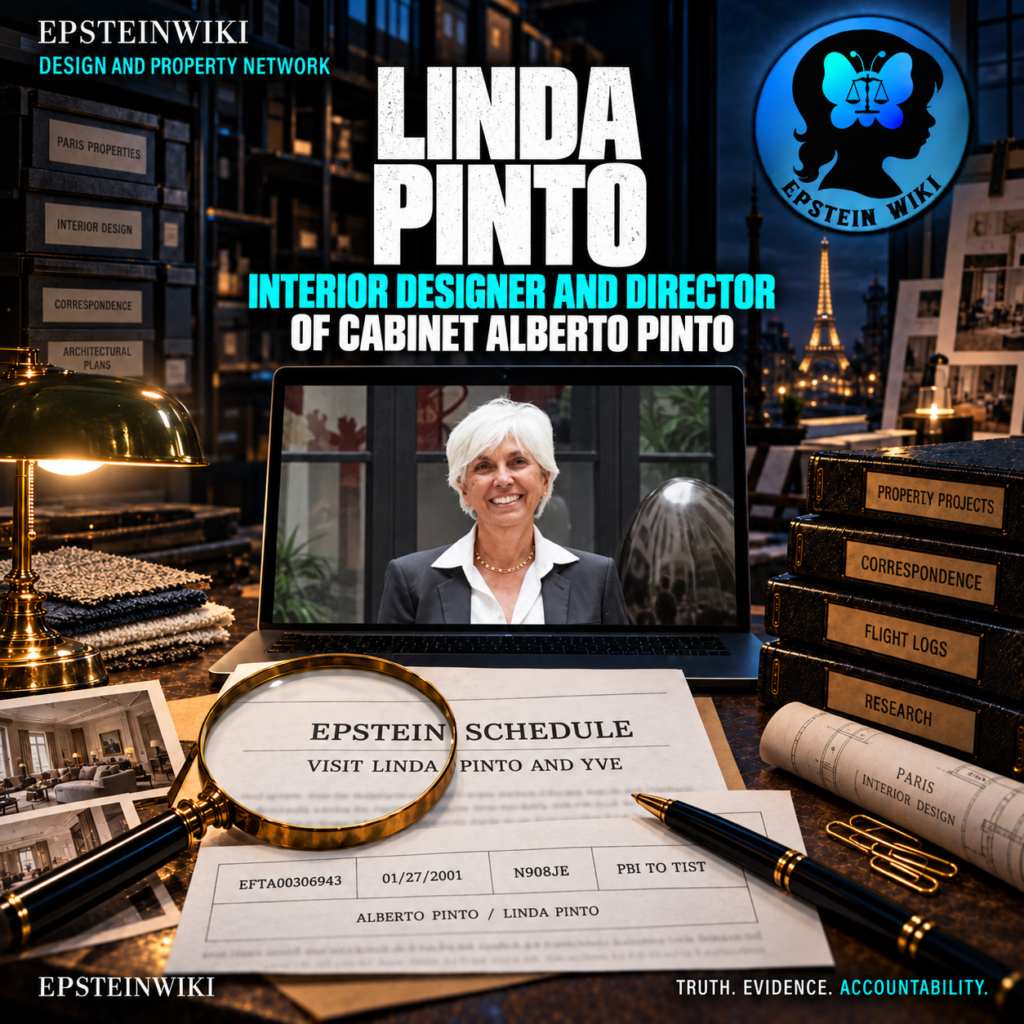
Linda Pinto is a Paris based interior designer who worked alongside her brother, Alberto Pinto, and assumed leadership of Cabinet Alberto Pinto after his death in 2012. The firm designed and furnished residences for royalty, billionaires, corporations, and political elites. Its clients also included Jeffrey Epstein.
The available record places Linda Pinto in Epstein’s orbit for roughly two decades. Flight logs show her on eight flight segments between 1998 and 2001. The final two documented segments placed her on the same aircraft as Epstein, Ghislaine Maxwell, Virginia Giuffre, Alberto Pinto, and others during a March 2001 trip through Europe and Morocco. Later records document meetings, correspondence, shipments, design proposals, auctions, and substantial payments to the Pinto firm.
The evidence does not establish that Linda Pinto participated in Epstein’s sexual abuse or trafficking. It does establish a long professional and social relationship that continued after Epstein’s 2008 conviction. It also establishes that by 2015 she had been confronted with Virginia Giuffre’s account of the 2001 trip, yet Cabinet Alberto Pinto continued accepting work and payments from Epstein.
The central investigative issue is therefore not whether Pinto appears in Epstein’s records. She appears repeatedly. The issue is what she knew, when she knew it, and why the relationship continued after Epstein’s criminal conduct and Giuffre’s allegations were public.
Who Was Linda Pinto?
Linda Pinto was born in Morocco and moved to Paris as a teenager. She eventually joined the interior design studio founded by her brother, Alberto Pinto. Her published professional biographies describe her as deeply involved in the studio’s client relationships, coordination, and visual direction. When Alberto died in 2012, Linda took control of the firm and continued operating it under his name.
Cabinet Alberto Pinto was not an ordinary decorating business. It worked at the highest end of the international luxury market. Its projects included palaces, private aircraft, yachts, hotels, and residences for clients whose wealth and public position demanded discretion. That combination of access, mobility, and confidentiality made the firm particularly valuable to Epstein, whose homes were both private residences and operational spaces within his social network.
Linda later left the firm. In reporting published in 2026, a spokesperson for the company said that she had departed approximately six months earlier and that the current business was no longer connected to her or to the associates named in the reporting.
Sources: Galerie profile of Alberto and Linda Pinto, Curbed investigation
How the Pinto Relationship With Epstein Began
The surviving public record does not identify a single document that marks Linda Pinto’s first introduction to Epstein. Flight records show that the relationship was established by April 1998. On April 24 of that year, she traveled from Teterboro to Palm Beach on an Epstein aircraft.
The relationship was both professional and social. Linda and Alberto traveled with Epstein. Epstein’s staff arranged meetings with Linda in Paris. Packages moved between his New York office and the Pinto office. Epstein asked assistants and business associates to contact her, visit her, or place her on his schedule. The Pinto firm produced concepts, purchased objects, managed installations, and billed for work at his properties.
This was not a single commission followed by a distant client relationship. The records indicate continuity across years, cities, employees, and properties.
The Eight Recorded Flight Segments
Flight records collected by Epstein Exposed identify eight segments under Linda Pinto’s name between 1998 and 2001.
- April 24, 1998, from Teterboro to Palm Beach.
- September 13, 1998, from Teterboro to Santa Fe.
- March 31, 1999, from Teterboro to Saint Thomas.
- March 31, 1999, from Saint Thomas to Palm Beach.
- April 2, 1999, from Palm Beach to Albuquerque.
- September 2, 1999, from Teterboro to Santa Fe.
- March 8, 2001, from Le Bourget in Paris to a European stop recorded as LEGR.
- March 8, 2001, from LEGR to Tangier, Morocco.
The first six segments show that Pinto traveled with Epstein well before the 2001 journey that later became important to Virginia Giuffre’s account. The destinations also overlap with major Epstein properties and travel hubs, including Palm Beach, New Mexico, and Saint Thomas.
The final two segments are especially significant because the passenger group included Epstein, Maxwell, Giuffre, Alberto Pinto, Linda Pinto, and Maxwell’s assistant Emmy Tayler. One segment also records architect Ricardo Legorreta and another passenger whose handwritten identification is uncertain.
The flight record proves co travel. It does not, by itself, prove what any passenger knew about abuse occurring within Epstein’s network.
Source: Epstein Exposed profile and flight index
The March 2001 Trip With Virginia Giuffre
The March 2001 journey is the most consequential event connecting Linda Pinto to the abuse allegations surrounding Epstein and Maxwell.
Giuffre said Epstein and Maxwell took her through Europe when she was seventeen. During that period, she said she was directed to have sex with Prince Andrew in London. The flight logs place Linda and Alberto Pinto with the group shortly before the London episode described by Giuffre.
According to later reporting, the group’s itinerary began in Morocco after a suggestion connected to Alberto Pinto that Epstein view a property there. A dinner included Epstein, Maxwell, Giuffre, Alberto Pinto, and Linda Pinto. The timing places that dinner shortly before the group traveled onward and before the encounter with Prince Andrew alleged by Giuffre.
This chronology makes Pinto a potentially important witness to the social presentation of Giuffre within the group. It raises questions about how Giuffre was introduced, whether her age was discussed, how she was treated by Epstein and Maxwell, and whether anything about the group dynamic caused concern.
It is important to be exact. Presence at a dinner and on an aircraft does not establish knowledge of trafficking. The evidentiary importance lies in Pinto’s proximity to Giuffre at a critical moment and in the possibility that she observed facts relevant to Giuffre’s age, status, and relationship with Epstein and Maxwell.
Sources: Curbed investigation, Epstein Exposed flight summary
What Linda Pinto Said About the Dinner
Pinto was confronted about the 2001 dinner years later. A Deutsche Bank review summarized her position. According to that record, she did not deny dining with Virginia Giuffre, then known as Virginia Roberts, but denied being aware of her age.
In a statement reported in 2015, Pinto said she did not know whether the young women around Epstein were nineteen, twenty two, or younger and had not suspected anything improper.
That response is significant for two separate reasons.
First, it confirms the underlying encounter rather than disputing the passenger group or dinner. Second, it defines Pinto’s defense as lack of knowledge, not lack of contact.
The statement does not resolve what visual or conversational clues were available during the trip. It also does not explain whether Giuffre was presented as an employee, student, masseuse, companion, or friend. Those details would matter when assessing what a reasonable adult in the group might have understood.
The bank review is especially valuable because it records how a major financial institution evaluated reputational and compliance concerns arising from Epstein’s relationships. It notes both Pinto’s denial of knowledge and the continuation of business after Epstein’s conviction and after the Giuffre issue had been raised.
Primary evidence: Deutsche Bank review, EFTA01681865
The Relationship Continued After Epstein’s Conviction
Epstein pleaded guilty in Florida in 2008 to state charges involving prostitution and a minor. He served a custodial sentence and became a registered sex offender. The public nature of the case changed the meaning of later professional relationships. After 2008, continued work for Epstein occurred with knowledge that he was a convicted sex offender, even if a particular service provider did not know the full scope of his conduct.
The Pinto relationship continued.
Emails and calendar records show Epstein and his staff arranging meetings with Linda in Paris after his release. Messages circulated through Lesley Groff, Epstein’s longtime assistant, and Richard Kahn, a senior financial employee. The communications were not limited to closing old invoices. They included proposed visits, coffee, design discussions, deliveries, travel, and new work.
In May 2010, Epstein told a correspondent that the person could contact Linda Pinto and film an apartment in Rio de Janeiro. In February 2011, he asked Kahn what had happened with Linda Pinto. In December 2012, shortly after Alberto Pinto’s death, Epstein asked an assistant to invite Linda for coffee.
The contacts accelerated into a visible series of appointments in 2013 and 2014. Records show an appointment at the Pinto office, a calendar entry at the Hotel de la Victoire address, Paris scheduling, expressions of thanks, and further travel coordination.
These communications show an active relationship after the conviction. They also show that Linda’s succession after Alberto’s death did not end Epstein’s access to the firm.
Primary evidence: Rio apartment email, EFTA01813807, Richard Kahn inquiry, EFTA01799562, coffee invitation, EFTA01977273, Pinto office appointment, EFTA02145001, calendar entry, EFTA02144371, Paris scheduling, EFTA02115682
Payments From 2015 Through 2018
The strongest financial summary appears in the Deutsche Bank review. It records that Cabinet Alberto Pinto received $2,873,001 from Epstein between November 2015 and December 2018 through accounts at the bank.
The timing matters. By 2015, Pinto had been asked publicly about Giuffre and the 2001 dinner. Epstein’s 2008 conviction was long established. The payments therefore came after both the criminal case and the public confrontation over Giuffre.
The sum also shows that the relationship was commercially substantial. This was not the occasional purchase of a decorative object. It represented a continuing stream of high value design activity.
The figure should be understood as the amount visible in the bank review for the stated period. It may not capture earlier payments, payments routed through other institutions, reimbursements, purchases made through intermediaries, or amounts paid to separate contractors working within the Pinto projects.
Primary evidence: Deutsche Bank review, EFTA01681865
The Properties and Projects
The documentary trail connects the Pinto firm to several parts of Epstein’s property network. These projects matter because Epstein’s residences were not passive displays of wealth. They were the settings in which he received guests, conducted business, and, according to victims and court records, committed abuse.
Avenue Foch in Paris
Epstein owned an apartment on Avenue Foch in Paris. Pinto related records include decorative work, budgets, invoices, and correspondence connected to the residence. A proposed 2015 budget exceeded €1.2 million. Separate documents refer to decorative items and project administration.
Primary evidence: 2015 decoration budget, EFTA00594090, decorative work record, EFTA02476653, project record, EFTA02353691, project record, EFTA02479529, project record, EFTA02479514
The Rio de Janeiro Apartment
In 2010, Epstein suggested that a correspondent contact Linda Pinto to film a Rio apartment. The message indicates that Pinto had sufficient responsibility or access to facilitate activity at the residence. It also shows Epstein treating her as a direct point of contact.
Primary evidence: Rio apartment email, EFTA01813807
Little Saint James and Great Saint James
The Virgin Islands projects were among the most important later commissions. A twenty page presentation from July 2016 proposed design concepts for Great Saint James. It included a living room, an office, VIP suites, and twin bedrooms. The room categories are notable because they show planning for both Epstein and guests.
A December 2016 invoice exceeded €3 million and related to work on Little Saint James and Great Saint James. The amount underscores the scale of the island commissions.
The Pinto firm’s role was not limited to drawing concepts in Paris. Associates traveled to the islands, coordinated work, and remained engaged close to Epstein’s 2019 arrest.
Primary evidence: Great Saint James design presentation, EFTA00624923, island project invoice, EFTA01060185
New York and Other Residences
Shipping records and design reporting connect the firm to Epstein’s New York base and wider property system. A March 2001 Federal Express invoice records a shipment from Epstein’s office at 457 Madison Avenue to Linda Pinto at the Alberto Pinto office in Paris. Another shipment followed in April 2001. Fax records from 2005 also show material sent from Epstein’s office to Alberto and Linda.
These records are mundane individually, but collectively they show an established channel between Epstein’s staff and the Pinto office.
Primary evidence: March 2001 shipment, EFTA00219433, April 2001 shipment, EFTA00219476, 2005 fax records, EFTA00257274
Auctions, Objects, and Procurement
Interior design for a client like Epstein involved more than choosing colors or furniture. The record shows the Pinto firm participating in the acquisition of objects through auctions and established art market channels.
Documents refer to purchases and purchase inquiries associated with auctions, including Sotheby’s. These records help explain how expensive objects moved into Epstein’s residences and how the design firm could act as a procurement layer between the client and sellers.
This role deserves scrutiny because provenance, invoicing, beneficial ownership, and delivery addresses can reveal more than the aesthetic purpose of an object. Auction records may identify who authorized a purchase, which entity paid, where an item was shipped, and whether a property project was active at a particular time.
The available documents establish procurement activity. They do not, without further transactional records, establish that Pinto knew of any financial misconduct or that any purchase was unlawful.
Primary evidence: auction purchase inquiry, EFTA02349967, Sotheby’s purchase record, EFTA02445811
The Confidential Envelope in 2016
In March 2016, Lesley Groff arranged for Valdson Cotrin to deliver a confidential envelope containing pictures to Linda Pinto. A follow up message confirmed delivery.
The emails establish the transfer and its confidential designation. They do not reveal, in the available summary, what the pictures showed or why ordinary shipping was not used.
This is precisely the kind of small operational detail that warrants additional document matching. Investigators should look for attachments, subsequent references to the images, project names, invoices generated immediately afterward, and calendar entries involving the same people. The significance of the envelope cannot be determined from the delivery messages alone.
Primary evidence: delivery arrangement, EFTA02058330, delivery confirmation, EFTA02058203
The People Who Maintained the Relationship
The records show a networked relationship rather than a simple exchange between two individuals.
Lesley Groff repeatedly acted as the scheduling and communications bridge. She arranged meetings, rescheduled appointments, coordinated deliveries, and conveyed that Linda wanted to see Epstein.
Richard Kahn handled financial and administrative matters and received direct inquiries from Epstein about Pinto.
Valdson Cotrin served as a courier for the confidential envelope in 2016.
James Cooper and Lionel Vilette, associates connected to the Pinto work, traveled to Little Saint James in June 2019. Their travel and their planned meeting at Linda Pinto’s office show that the design relationship extended through a professional team.
Karyna Shuliak, Epstein’s later companion, was included in a planned July 2019 meeting involving Epstein and the Pinto office.
Ghislaine Maxwell appears in the travel history and was present during the March 2001 trip involving Giuffre. Her presence connects the design relationship to the core social structure around Epstein during the period of alleged trafficking.
Primary evidence: Groff scheduling email, EFTA02115653, Groff message about Linda, EFTA01739075, 2019 associate travel, EFTA02290040, July 2019 meeting record, EFTA02315947
Activity Just Before Epstein’s 2019 Arrest
The relationship remained active until the final days before Epstein’s arrest.
James Cooper and Lionel Vilette traveled to Little Saint James in June 2019. A meeting was then scheduled for July 2, 2019, at Linda Pinto’s office with Epstein and Karyna Shuliak. Epstein was arrested on July 6.
The four day interval is striking, but it must not be overstated. A scheduled meeting close to an arrest does not imply foreknowledge of the criminal case. It does establish that the professional channel remained open at the end of Epstein’s freedom.
The June island trip may also help identify what work was still underway. Travel records, expense reports, photographs, project files, and invoices from this period could show whether the visit concerned construction, furnishing, maintenance, inventory, or unfinished design plans.
Primary evidence: June 2019 travel, EFTA02290040, July 2 meeting, EFTA02315947
Evidence Timeline
1998
Linda Pinto appears on Epstein aircraft records for trips to Palm Beach and Santa Fe.
1999
She travels on routes involving Teterboro, Saint Thomas, Palm Beach, Albuquerque, and Santa Fe.
March 2001
She travels with Epstein, Maxwell, Giuffre, Alberto Pinto, Emmy Tayler, and others from Paris through Europe to Morocco. A shipment is sent from Epstein’s New York office to her in Paris later that month.
April 2001
Another shipment is sent to Pinto in Paris.
September 2005
Epstein’s office sends faxes to Alberto and Linda Pinto.
2008 and 2009
Epstein is convicted, incarcerated, and released. The Pinto relationship continues afterward.
May 2010
Epstein identifies Linda as the contact for access to or filming of a Rio apartment.
2011 through 2014
Emails and calendars document continuing inquiries, coffee invitations, Paris appointments, office visits, and correspondence.
2015
Pinto is confronted about the 2001 dinner with Giuffre and denies knowing Giuffre’s age. A large decoration budget is proposed for the Paris property. The later bank summary dates millions of dollars in payments beginning in November.
2016
Groff arranges delivery of a confidential envelope containing pictures. The firm produces a major design presentation for Great Saint James. A later invoice for island work exceeds €3 million.
2015 through 2018
Deutsche Bank records $2,873,001 in payments from Epstein to Cabinet Alberto Pinto.
June and July 2019
Pinto associates travel to Little Saint James. Epstein and Shuliak are scheduled to meet at Linda’s office four days before Epstein’s arrest.
What the Evidence Establishes
The records support several firm conclusions.
Linda Pinto had a long relationship with Epstein that combined travel, social contact, and professional work.
She traveled on Epstein aircraft eight times between 1998 and 2001.
She was present with Virginia Giuffre during a March 2001 trip that preceded the London encounter alleged by Giuffre.
She did not deny dining with Giuffre but said she did not know Giuffre’s age or suspect abuse.
The Pinto firm continued working for Epstein after his 2008 conviction.
The relationship continued after Pinto was confronted in 2015 about Giuffre.
Deutsche Bank recorded nearly $2.9 million in payments to Cabinet Alberto Pinto from late 2015 through 2018.
The firm worked on multiple Epstein properties, including projects in Paris and the United States Virgin Islands.
Pinto associates remained active in Epstein related work in the weeks before his July 2019 arrest.
What the Evidence Does Not Establish
The public record does not establish that Linda Pinto participated in sexual abuse, recruitment, trafficking, or obstruction.
It does not establish that she knew Giuffre was seventeen during the 2001 trip.
It does not show that every room or object designed by the Pinto firm was connected to criminal activity.
It does not establish the contents or purpose of the pictures delivered in the confidential envelope.
It does not prove that the Pinto firm understood the full scale of Epstein’s conduct when it accepted later commissions.
No public record reviewed for this article shows that Linda Pinto was charged with a crime arising from her relationship with Epstein.
These limits are essential. The documentary record justifies scrutiny and further questions, but it does not justify converting association into criminal guilt.
Investigative Assessment
Linda Pinto is significant because her record connects several usually separate parts of the Epstein story.
She connects the early travel years to the later financial years. She connects Virginia Giuffre’s 2001 account to a wealthy adult social circle that encountered her in person. She connects Epstein’s residences to the specialists who shaped their private interiors. She also connects a prestigious design business to the ethical question of continuing lucrative work for a convicted sex offender.
The strongest criticism supported by the documents concerns continuation. Whatever Pinto knew in 2001, she knew by 2008 that Epstein had been convicted. By 2015, she also knew that Giuffre had placed her at a dinner during the consequential 2001 trip. The firm nevertheless continued working for Epstein and received millions of dollars through 2018.
That does not prove complicity in abuse. It does show that neither the conviction nor the Giuffre disclosure ended the commercial relationship.
The case also illustrates why service providers matter to network investigations. Architects, decorators, contractors, art advisers, pilots, accountants, and assistants can hold contemporaneous records that reveal how properties were used, who visited, when rooms were created, and which staff controlled access. Their files may provide corroboration even when they were not participants in the underlying crimes.
Questions That Still Need Answers
- Who introduced Linda and Alberto Pinto to Epstein?
- How was Virginia Giuffre introduced to the Pintos during the March 2001 trip?
- Did Linda speak directly with Giuffre, and did they discuss her age, work, education, or family?
- What did Linda observe about the relationship between Giuffre, Epstein, and Maxwell?
- Which Epstein properties did Linda personally visit?
- Did the Pinto firm retain photographs, floor plans, guest room schedules, contractor lists, shipping records, or access instructions for those properties?
- What were the pictures in the confidential envelope delivered in March 2016?
- Who approved the €1.2 million Paris budget and the invoice exceeding €3 million for island work?
- What services accounted for the $2,873,001 in payments recorded by Deutsche Bank?
- Did anyone at the firm conduct a client review after Epstein’s conviction?
- Why did the firm continue accepting commissions after Linda was confronted about Giuffre in 2015?
- What work were James Cooper and Lionel Vilette performing during their June 2019 visit to Little Saint James?
- What was on the agenda for the July 2, 2019 meeting with Epstein and Karyna Shuliak?
- Were law enforcement officials or civil litigants ever provided with the firm’s complete Epstein project files?
- Do auction houses, shippers, contractors, or insurers hold parallel records that can fill gaps in the Pinto archive?
Key Takeaways
Linda Pinto was not a passing name in an address book. She was a recurring traveler, designer, correspondent, and business contact.
Her presence on the March 2001 trip makes her a potentially important witness to how Virginia Giuffre was presented within Epstein and Maxwell’s social circle.
Her documented defense is that she did not know Giuffre’s age and did not suspect abuse.
The clearest ethical issue is the continuation of lucrative work after Epstein’s conviction and after Pinto learned of Giuffre’s allegation.
The Pinto firm’s project records could help reconstruct the physical environments of Epstein’s residences and the people who worked inside them.
Scrutiny should remain evidence based. The documents establish access, travel, work, money, and continuity. They do not establish that Linda Pinto committed a crime.
Primary EFTA Evidence
The most important released records include the following:
- EFTA01681865, Deutsche Bank review
- EFTA00594090, 2015 decoration budget
- EFTA00624923, Great Saint James design presentation
- EFTA01060185, island project invoice
- EFTA02290040, 2019 associate travel
- EFTA02315947, July 2019 meeting record
- EFTA01813807, Rio apartment email
- EFTA00219433, March 2001 shipment
- EFTA00219476, April 2001 shipment
- EFTA00257274, 2005 fax records
- EFTA01799562, Richard Kahn inquiry
- EFTA01977273, coffee invitation
- EFTA02145001, Pinto office appointment
- EFTA02144371, Hotel de la Victoire calendar entry
- EFTA02058330, confidential delivery arrangement
- EFTA02058203, confidential delivery confirmation
- EFTA02349967, auction purchase inquiry
- EFTA02445811, Sotheby’s purchase record
Sleuth and Investigative Sources
The evidence base for this article was assembled primarily through the Epstein document research ecosystem and then checked against original EFTA records.
Epstein Exposed: Linda Pinto provides the indexed flight history, communication timeline, and document references.
Epstein Data provides direct access to the cited EFTA records and is part of the document infrastructure associated with independent researcher R. Howard Stone.
Curbed: The Elite Design Firm That Built Jeffrey Epstein’s World provides the most detailed independent reporting on the Pinto firm, the 2001 trip, property projects, bank review, payments, and 2019 activity.
Galerie: Inside Alberto Pinto’s Paris Legacy provides professional background on Linda Pinto and the firm.
Automated document mention counts should be treated as discovery aids, not proof. Names can be repeated in duplicates, indexes, email chains, and unrelated records. The conclusions above rely on identifiable flights, messages, budgets, invoices, schedules, and financial review documents.
Related EpsteinWiki Topics
- Virginia Giuffre
- Ghislaine Maxwell
- Lesley Groff
- Richard Kahn
- Karyna Shuliak
- Little Saint James
- Great Saint James
- Jeffrey Epstein’s Paris apartment
- Jeffrey Epstein’s flight logs
- Deutsche Bank and Jeffrey Epstein
- The professional service network around Jeffrey Epstein