
Virginia Roberts Giuffre
Virginia Roberts Giuffre
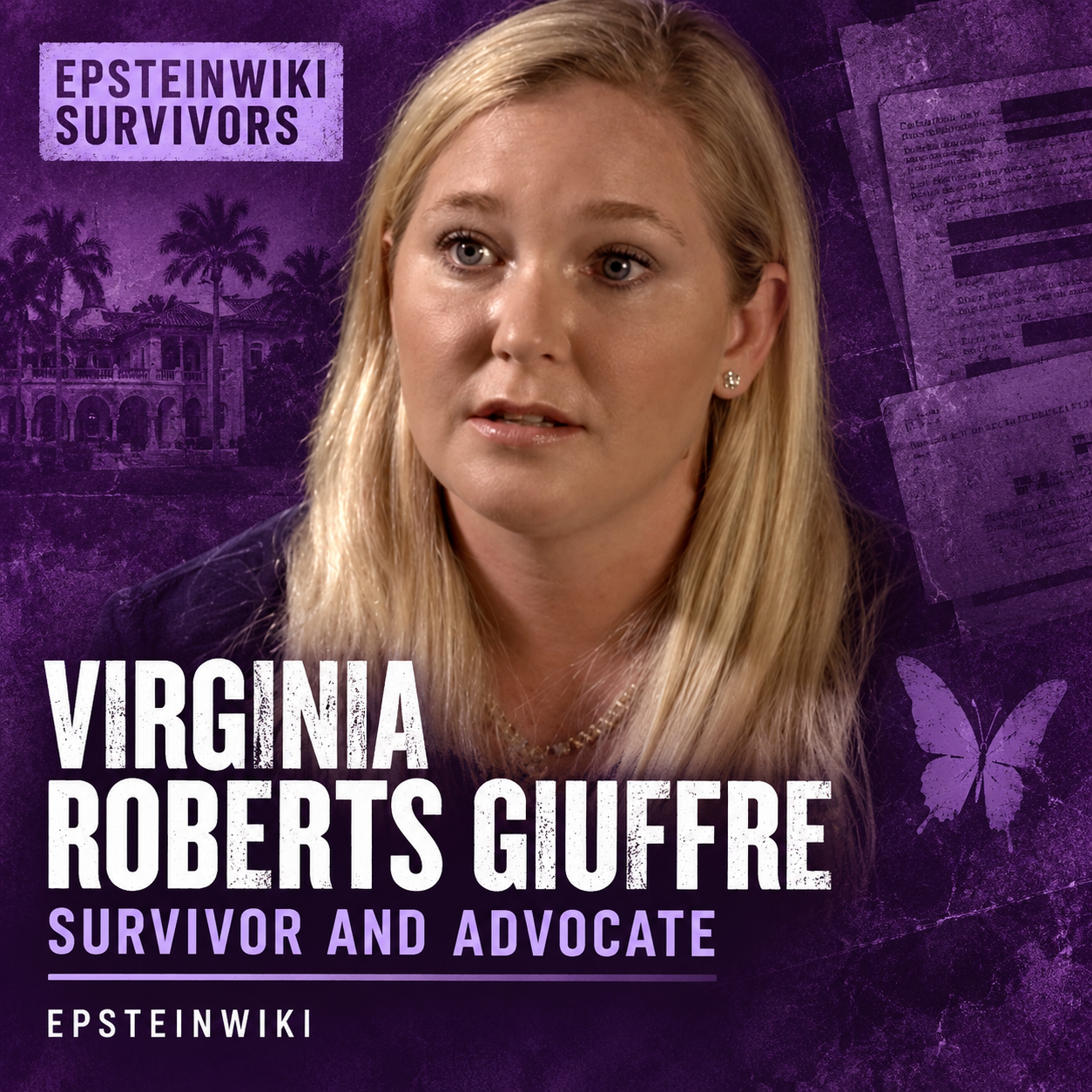
Virginia Louise Roberts Giuffre was a survivor of Jeffrey Epstein and Ghislaine Maxwell’s sex trafficking operation, a public advocate for survivors, and one of the most consequential witnesses in the history of the Epstein case.
Giuffre said Ghislaine Maxwell recruited her at Donald Trump’s Mar a Lago club when she was sixteen. She described being groomed, sexually abused, transported between Epstein’s properties, and directed to provide sexual services to Epstein and other powerful men.
Her testimony, photographs, travel records, litigation, and public advocacy helped expose the international scale of Epstein’s operation. She forced institutions, journalists, investigators, and members of the British royal family to confront allegations they had spent years ignoring or minimizing.
Giuffre died by suicide on April 25, 2025. She was 41.
Her posthumous memoir, Nobody’s Girl, was published on October 21, 2025.
Snapshot
Full name: Virginia Louise Roberts Giuffre
Birth name: Virginia Louise Roberts
Born: August 9, 1983
Died: April 25, 2025
Known legal designation: Jane Doe Number 3
Role in the Epstein record: Survivor, witness, civil plaintiff, and public advocate
Recruitment location: Mar a Lago in Palm Beach, Florida
Age at recruitment: Sixteen
Alleged recruiters: Ghislaine Maxwell and Jeffrey Epstein
Documented travel: Epstein aircraft records and government prosecution materials corroborate travel while she was a minor
Major litigation: Crime Victims’ Rights Act litigation, Giuffre v. Maxwell, and Giuffre v. Prince Andrew
Advocacy organization: Speak Out, Act, Reclaim, commonly known as SOAR
Memoir: Nobody’s Girl: A Memoir of Surviving Abuse and Fighting for Justice
Early Life and Vulnerability
Giuffre described experiencing sexual abuse long before she encountered Epstein and Maxwell.
Her early life included instability, periods away from home, and placement in environments where adults failed to protect her. By her teenage years, she was working at Mar a Lago in Palm Beach, where her father was employed as a maintenance manager.
Giuffre worked as a spa attendant and was interested in massage therapy. According to her account, she was reading a book about anatomy or massage when Maxwell approached her.
Maxwell presented an opportunity to earn money as a traveling massage therapist for a wealthy man. Giuffre said the offer appeared legitimate and potentially life changing.
Instead, it became the entry point into Epstein’s trafficking operation.
Recruitment at Mar a Lago
Giuffre said Maxwell approached her at Mar a Lago when she was sixteen.
Government records preserve multiple copies of an investigative account describing the recruitment. The records state that Giuffre’s father worked at the club and that Maxwell approached her while she was reading a massage or anatomy book.
The account appears in EFTA00208128, EFTA00210958, EFTA00269896, and EFTA01248965.
The documents describe Mar a Lago as the recruitment location. They do not accuse Donald Trump of participating in Giuffre’s recruitment or abuse.
Giuffre did not publicly accuse Trump of sexually abusing her.
Introduction to Jeffrey Epstein
Giuffre said Maxwell introduced her to Epstein at his Palm Beach residence.
The initial work was presented as massage therapy. According to Giuffre, the massages became sexualized, and Epstein began paying her while gradually normalizing sexual activity.
Giuffre described this as grooming rather than a freely negotiated adult relationship. She was a minor, Epstein was an adult in his late forties, and the arrangement involved money, travel, gifts, authority, and escalating sexual demands.
Government prosecution records later identified corroborating evidence.
A prosecution memorandum states that household employee Juan Alessi confirmed that Maxwell recruited the relevant young woman from Mar a Lago to massage Epstein.
The memorandum also states that flight records confirmed her travel with Epstein and Maxwell while she was seventeen.
That evidence appears in EFTA02731226.
The Massage for Dummies Book
The FBI retained a copy of Massage for Dummies that Giuffre provided to investigators in 2007.
The book became a physical piece of evidence supporting the massage related recruitment narrative.
The prosecution memorandum in EFTA02731226 states that the FBI still possessed the book. The same memorandum discusses phone records, flight records, Alessi’s account, and Giuffre’s earlier interviews.
The book alone does not prove every allegation. Its significance comes from its consistency with Giuffre’s description of how Maxwell noticed, approached, and recruited her.
Grooming and Sexual Abuse
Giuffre said Epstein and Maxwell trained her to satisfy Epstein’s sexual preferences.
She described repeated sexualized massages and an environment where abuse was treated as routine work. She also said Maxwell participated in sexual activity and exercised authority over young women within Epstein’s household.
Giuffre told investigators that Epstein paid her, bought gifts, arranged travel, and created expectations that she would remain available.
She said the operation mixed sexual abuse with luxury, employment language, travel, and promises of opportunity. That combination made the exploitation more difficult to recognize and escape.
The fact that Giuffre sometimes returned, accepted money, traveled, or followed instructions does not transform the exploitation of a minor into informed consent.
Travel Through Epstein’s Network
Giuffre said Epstein and Maxwell transported her between Palm Beach, New York, New Mexico, the United States Virgin Islands, Paris, London, and other locations.
Flight records and prosecution materials corroborate that she traveled aboard Epstein’s aircraft while underage.
Travel was a central mechanism of control. It separated her from familiar support systems and placed her inside residences controlled by Epstein, staffed by his employees, and visited by his associates.
Giuffre described being expected to massage Epstein, recruit other girls, and submit to sexual demands during this period.
Readers can examine related records through the Epstein Data flight network and the EpsteinWiki flight logs overview.
Recruitment of Other Girls
Giuffre acknowledged that Epstein pressured her to bring other girls into the massage system.
This is an important part of her account and should be understood within the dynamics of trafficking.
Trafficking operations often compel victims to perform tasks that help sustain the system. Money, grooming, dependency, fear, normalization, and the approval of controlling adults can all be used to turn exploited young people into recruitment channels.
Giuffre later spoke openly about this part of her history. She did not present herself as untouched by the operation’s coercive structure. She described how Epstein transformed victims into tools for reaching additional victims.
Her account helped investigators and the public understand why the Epstein operation could expand through referrals without every young recruiter functioning as an independent criminal organizer.
The Thailand Trip and Escape
In 2002, Epstein sent Giuffre to Thailand for massage training.
Giuffre said she was also instructed to locate another young woman for Epstein.
While in Thailand, she met Australian martial arts trainer Robert Giuffre. The two married, and Virginia did not return to Epstein.
She later described this decision as her escape from Epstein and Maxwell’s control.
Giuffre moved to Australia, started a family, and had three children. Her distance from Epstein did not end the psychological consequences of the abuse, but it allowed her to begin rebuilding her life.
First Contact With Investigators
The FBI interviewed Giuffre in August 2007.
A later prosecution memorandum states that she described being introduced to Epstein, massaging him approximately one hundred times, telling him her age, traveling, receiving gifts, scheduling massages, and being paid to pose for nude photographs.
The memorandum noted differences between her earlier and later accounts, including the amount of detail she initially provided about Maxwell.
Those differences became material used to challenge her credibility.
However, delayed disclosure, fragmented recall, minimization, and the gradual disclosure of an abuser’s full role are common in trauma narratives. Inconsistencies must be examined carefully, but they do not automatically erase corroborating travel records, witness accounts, photographs, or the central abuse narrative.
The government’s analysis appears in EFTA02731226.
Jane Doe Number 3
Giuffre was identified in major litigation as Jane Doe Number 3.
A January 2015 filing in the Crime Victims’ Rights Act case alleged that Epstein trafficked Jane Doe Number 3 to powerful men, including politicians, executives, foreign leaders, and a member of the British royal family.
The filing also alleged that Epstein required her to describe the encounters so that he could potentially use the information for blackmail.
The primary filing is EFTA00021553.
Other records documenting Jane Doe Number 3 include EFTA00067542.
The blackmail statement is an allegation contained in litigation. It is not a judicial finding that every described encounter occurred or that Epstein successfully blackmailed every person referenced.
Allegations Involving Prince Andrew
Giuffre alleged that Epstein and Maxwell trafficked her to Andrew Mountbatten Windsor, then known as Prince Andrew, on three occasions.
She described encounters in London, New York, and the United States Virgin Islands.
Giuffre said the first encounter occurred in London in March 2001, when she was seventeen. She said the group visited Tramp nightclub before returning to Maxwell’s London home.
A famous photograph shows Giuffre with Andrew while Maxwell stands in the background. Andrew disputed the authenticity or circumstances surrounding the photograph, although no credible evidence established that it was fabricated.
In a sworn declaration, Giuffre described Epstein and Maxwell making sexual jokes about Andrew. That declaration appears in EFTA00098456.
A government record containing broadcast material about the three alleged encounters appears in EFTA00045963.
Andrew denied Giuffre’s allegations.
The Prince Andrew Lawsuit
Giuffre sued Prince Andrew in the United States District Court for the Southern District of New York in August 2021.
She alleged sexual assault and intentional infliction of emotional distress.
Andrew sought dismissal of the case. Judge Lewis Kaplan rejected his attempt to end the lawsuit at that stage.
The parties announced a settlement in February 2022. Andrew did not admit liability. The settlement statement recognized Giuffre as an established survivor of abuse and stated that Andrew regretted his association with Epstein.
Andrew also agreed to make a substantial donation to Giuffre’s charity. The amount was not officially disclosed, although media reports offered estimates.
The settlement ended the civil case before depositions and trial.
A settlement is not a criminal conviction or a judicial finding that every allegation was proven. It also does not erase the allegations, the photograph, Andrew’s continued association with Epstein after Epstein’s conviction, or Andrew’s refusal to submit to the voluntary interview requested by United States investigators.
Evidence concerning that refusal and the government’s international legal request appears in EFTA00010321 and EFTA00022059.
Allegations Involving Other Men
Giuffre alleged that Epstein and Maxwell directed her to provide sexual services to other powerful men.
Names appearing in her allegations or in records summarizing them included Alan Dershowitz, Glenn Dubin, Bill Richardson, George Mitchell, Marvin Minsky, and Jean Luc Brunel.
The most commonly cited compilation is EFTA00022133. That document summarizes allegations from press reporting and litigation. It should not be misrepresented as an independent FBI finding.
A stronger primary source is the Jane Doe Number 3 filing in EFTA00021553.
The men who responded publicly denied wrongdoing. No criminal conviction resulted from Giuffre’s allegations against those individuals.
Alan Dershowitz and the Misidentification Statement
Giuffre accused Alan Dershowitz of sexual abuse. Dershowitz repeatedly and emphatically denied the allegation.
The dispute produced years of defamation litigation.
In November 2022, Giuffre and Dershowitz resolved their lawsuits. Giuffre stated that she recognized she may have made a mistake in identifying Dershowitz as one of the men to whom Epstein trafficked her.
She also acknowledged that Dershowitz had consistently maintained his innocence.
This resolution must be included in any accurate account. Giuffre’s earlier allegation should not be repeated without the later statement that she may have misidentified him.
The resolution concerned Dershowitz. It did not withdraw Giuffre’s allegations against Epstein, Maxwell, or Prince Andrew.
Giuffre v. Maxwell
In 2015, Giuffre sued Maxwell for defamation after Maxwell publicly described her allegations as false.
The case became one of the most important sources of documentary evidence in the Epstein investigation.
Depositions, emails, photographs, motions, and exhibits from Giuffre v. Maxwell exposed details of Maxwell’s relationship with Epstein and her role within his household.
The parties settled in 2017. Court records were subsequently unsealed in stages following litigation by news organizations and other parties.
The unsealing process continued for years. A major group of records was released in January 2024 under orders issued by Judge Loretta Preska.
The case is covered in the Giuffre v. Maxwell EpsteinWiki record.
Her Role in the Maxwell Case
Giuffre did not testify as one of the principal trial witnesses during Maxwell’s 2021 criminal trial.
However, her years of public allegations, litigation, document preservation, and pressure helped establish the broader factual and public context in which Maxwell was finally prosecuted.
Maxwell was convicted in December 2021 on five federal counts connected to the recruitment and trafficking of minors. She was sentenced in June 2022 to twenty years in prison.
Giuffre’s work should not be described as the sole cause of the conviction. The conviction rested on trial evidence and the testimony of the survivors who appeared before the jury.
Her contribution was nevertheless enormous. She helped keep Maxwell’s conduct in public view when powerful institutions had little interest in examining it.
Advocacy for Survivors
Giuffre transformed her experience into public advocacy.
She founded an organization initially known as Victims Refuse Silence. It later became Speak Out, Act, Reclaim, commonly known as SOAR.
The organization focused on supporting survivors of sexual assault and trafficking, improving prevention, and challenging the shame imposed on victims.
Giuffre repeatedly emphasized that survivors should be allowed to reclaim their identities and speak in their own names.
She voluntarily gave up the anonymity available to her as a Jane Doe. That decision exposed her to invasive reporting, legal attacks, online harassment, and death threats.
Her public advocacy also helped other survivors recognize grooming patterns and come forward.
Harassment and Retaliation
Giuffre faced sustained efforts to discredit her.
Epstein, Maxwell, their lawyers, supporters, and online commentators examined her personal history, relationships, memory, employment, and prior statements.
Released records show that Epstein discussed strategies for undermining her credibility and attempted to recruit people who could contradict her.
The government corpus also contains hundreds of threatening and abusive online messages directed at Giuffre.
Evidence concerning online threats appears in EFTA00027732.
Disputes about individual details remain relevant to evaluating specific allegations. They should not be used to erase the established facts that Epstein abused minors, Maxwell participated in recruiting minors, Giuffre entered Epstein’s network as a teenager, and records corroborate significant parts of her account.
Institutional Corroboration
A later federal prosecution memorandum examined the strengths and weaknesses of Giuffre’s potential testimony.
The memorandum identified corroboration that included the following evidence.
- Juan Alessi confirmed that Maxwell recruited her from Mar a Lago.
- Flight records confirmed that she traveled with Epstein and Maxwell while she was seventeen.
- The FBI retained the massage book associated with her recruitment account.
- Phone records confirmed relevant communications.
- Her testimony was consistent with evidence about Maxwell’s knowledge and methods.
This analysis appears in EFTA02731226.
The memorandum also identified inconsistencies and potential impeachment material. This is significant because it shows prosecutors evaluating her evidence rather than accepting every detail uncritically.
The 2026 Document Alteration Issue
An Epstein Data review reported that Giuffre’s name was removed repeatedly from a public Crime Victims’ Rights Act filing when the Justice Department reprocessed documents in its Epstein production.
The affected filing is EFTA00039421.
Giuffre had long identified herself publicly. Removing her name from an established public court record did not meaningfully protect her identity.
The alteration demonstrates a larger problem with inconsistent redaction practices. At the same time, other released records exposed sensitive information about survivors who had not chosen public identification.
The Epstein Data document alteration analysis provides the broader findings.
Death
Giuffre died by suicide at her farm in Western Australia on April 25, 2025.
Her family described her as a fierce advocate who had carried the lifelong consequences of sexual abuse and trafficking.
Western Australia police stated that the death was not considered suspicious.
Giuffre was survived by her three children.
Her death should not be used as material for unsupported conspiracy theories. No credible evidence has established that she was murdered or that her death resulted from outside criminal action.
Her family attributed her death to suicide and spoke directly about the unbearable psychological burden of lifelong trauma.
Nobody’s Girl
Giuffre completed a memoir with journalist Amy Wallace before her death.
Nobody’s Girl: A Memoir of Surviving Abuse and Fighting for Justice was published on October 21, 2025.
Giuffre left written instructions stating that she wanted the book released even if she died before publication.
The memoir provides her fullest account of childhood abuse, recruitment, trafficking, escape, advocacy, litigation, and the personal consequences of confronting powerful people.
It became an international bestseller and sold more than one million copies within approximately two months.
The book is available through Penguin Random House.
What the Evidence Establishes
The available evidence establishes the following facts.
- Giuffre entered Epstein’s network while she was a teenager.
- She was recruited while working at Mar a Lago.
- Juan Alessi confirmed Maxwell’s role in recruiting her to massage Epstein.
- Flight records document her travel with Epstein and Maxwell while she was underage.
- The FBI retained physical evidence associated with her massage training account.
- She was interviewed by the FBI in 2007.
- She appeared in litigation as Jane Doe Number 3.
- She sued Maxwell for defamation and obtained a settlement.
- She sued Prince Andrew and obtained a settlement without an admission of liability.
- She later stated that she may have misidentified Alan Dershowitz.
- She founded an organization supporting survivors.
- She died by suicide in April 2025.
- Her memoir was published posthumously in October 2025.
What Requires Careful Attribution
The following claims should be presented as allegations rather than adjudicated facts.
- Her allegations that Prince Andrew sexually assaulted her.
- Her allegations involving Bill Richardson, George Mitchell, Glenn Dubin, Marvin Minsky, Jean Luc Brunel, and other men.
- Her claim that Epstein required reports about sexual encounters for possible blackmail.
- Statements in press based accusation compilations that were not independent FBI conclusions.
- Details from her memoir that have not been independently corroborated.
Careful attribution does not mean the claims should be ignored. It means readers must be told whether a statement comes from sworn testimony, a court filing, a government memorandum, a press compilation, a settlement, or an adjudicated finding.
Why Virginia Giuffre Matters
Virginia Giuffre gave the Epstein case a human face that wealth and institutional secrecy could not easily erase.
She identified recruitment methods, locations, travel patterns, alleged perpetrators, and the social machinery that protected Epstein.
Her litigation created records that journalists and the public are still examining. Her willingness to appear publicly forced institutions to respond to allegations they had previously treated as disposable.
She was not a perfect witness because no human witness is perfect. She corrected one major identification, faced questions about other details, and lived with the complicated behavior produced by grooming and coercion.
None of that changes her central historical role.
She entered Epstein’s world as a teenager. She survived it. She named it. She spent years demanding that the people and institutions surrounding it be examined.
Key Takeaways
- Virginia Giuffre was recruited by Ghislaine Maxwell at Mar a Lago when she was sixteen.
- Government records corroborate important parts of her account, including recruitment, travel, telephone contact, and the massage related evidence.
- She alleged that Epstein and Maxwell trafficked her to Prince Andrew and other powerful men.
- Prince Andrew denied her allegations and settled her civil lawsuit without admitting liability.
- Giuffre later stated that she may have misidentified Alan Dershowitz.
- Her defamation lawsuit against Maxwell produced records that became central to public understanding of the Epstein network.
- She became one of the world’s most visible advocates for survivors of trafficking.
- She died by suicide in April 2025.
- Her posthumous memoir, Nobody’s Girl, preserved her account in her own words.
Epstein Data Evidence
- Search Epstein Data for Virginia Giuffre
- Search Epstein Data for Virginia Roberts
- Hear Virginia Giuffre in her own words
- EFTA00208128, investigative record describing recruitment at Mar a Lago
- EFTA00210958, additional copy of the recruitment account
- EFTA00269896, recruitment account in released court records
- EFTA01248965, Mar a Lago recruitment record
- EFTA02731226, prosecution memorandum assessing corroboration and testimony
- EFTA00021553, Jane Doe Number 3 filing
- EFTA00067542, Jane Doe litigation records
- EFTA00098456, Giuffre declaration concerning Prince Andrew
- EFTA00045963, released broadcast material concerning Giuffre’s allegations
- EFTA00022133, press based accusation compilation
- EFTA00010321, government correspondence concerning Andrew’s refusal of a voluntary interview
- EFTA00022059, international legal assistance request involving Prince Andrew
- EFTA00017042, correspondence disputing the cooperation record
- EFTA00022980, additional Andrew cooperation correspondence
- EFTA00027732, records concerning online threats directed at Giuffre
- EFTA00039421, Crime Victims’ Rights Act filing affected by later document processing
- Epstein Data Prince Andrew investigation
- Epstein Data unnamed persons investigation
- Epstein Data victim census
- Epstein Data document alteration analysis
- Epstein Data flight network
- Epstein Data full document search
Related EpsteinWiki Articles
- Jeffrey Epstein
- Ghislaine Maxwell
- Andrew Mountbatten Windsor
- Giuffre v. Maxwell
- Judge Loretta Preska
- Alan Dershowitz
- Glenn Dubin
- Bill Richardson
- George Mitchell
- Marvin Minsky
- Jean Luc Brunel
- Juan Alessi
- Mar a Lago
- Little Saint James
- Epstein Flight Logs
- Epstein Survivor Testimony
- Crime Victims’ Rights Act Litigation
- The Epstein List
- EpsteinWiki Evidence Index
Sources
- Virginia Giuffre’s posthumous memoir, Nobody’s Girl
- Associated Press report on Virginia Giuffre’s death and legacy
- The Guardian report containing the Giuffre family statement
- United States Attorney announcement of Ghislaine Maxwell’s conviction
- United States Attorney announcement of Maxwell’s sentence
- Epstein Data survivor interview collection
- Epstein Data prosecution memorandum EFTA02731226
- Epstein Data Jane Doe Number 3 filing EFTA00021553
- Epstein Data Giuffre declaration EFTA00098456