
Reid Garrett Hoffman
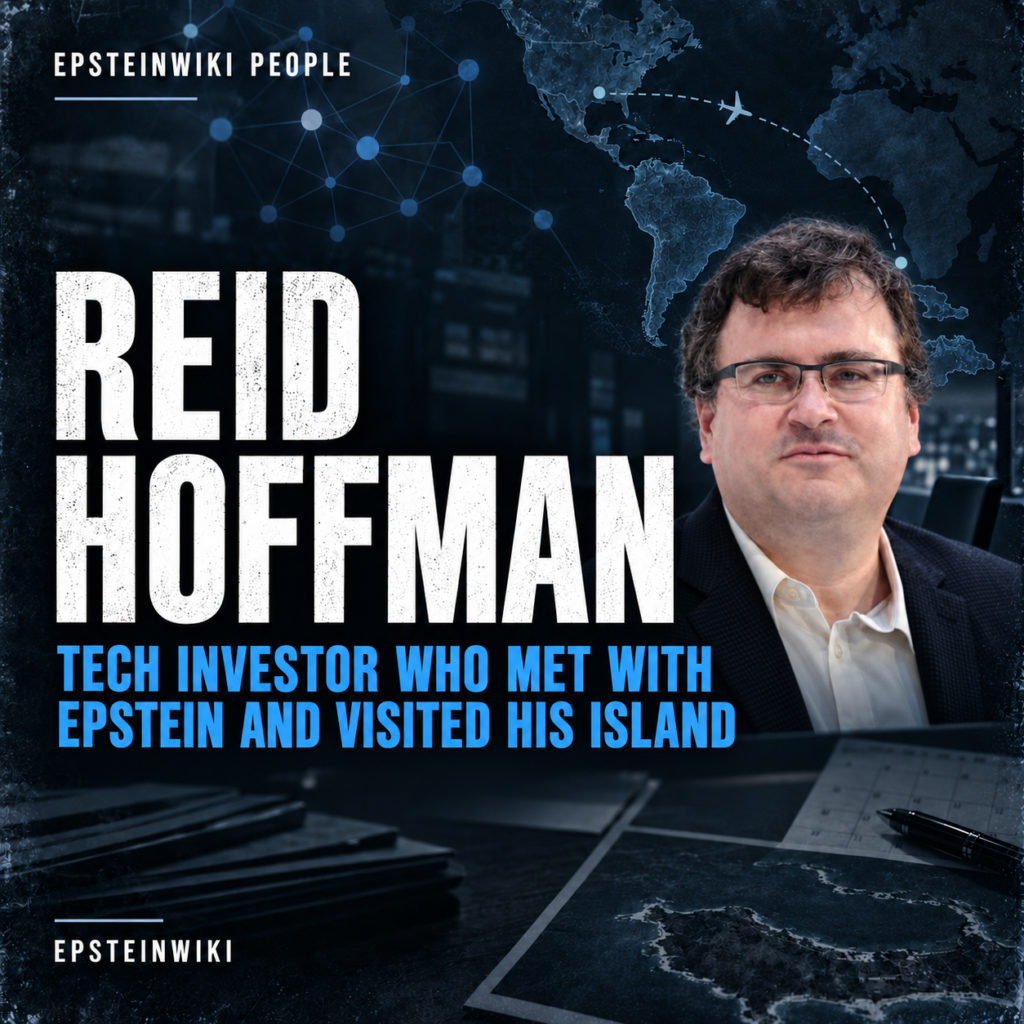
Snapshot
| Field | Documented information |
|---|---|
| Full name | Reid Garrett Hoffman |
| Born | August 5, 1967, in Palo Alto, California |
| Nationality | American |
| Principal occupations | Technology entrepreneur, investor, author, and political donor |
| Known for | Cofounding LinkedIn; early PayPal leadership; partnership at Greylock; technology and artificial intelligence investing |
| Documented Epstein connection | Direct emails, scheduled calls, in person meetings, a visit to Little Saint James, MIT fundraising activity, and cryptocurrency investment discussions after Epstein’s 2008 conviction |
| Documented period | At least 2013 through March 2018, with public disclosures and controversy continuing after 2019 |
| Principal intermediary | Joi Ito, then director of the MIT Media Lab |
| EpsteinWiki involvement level | Level 2 of 5: repeated documented association |
| Criminal charges connected to Epstein | None identified as of September 8, 2026 |
| Civil findings connected to Epstein | None identified as of September 8, 2026 |
| Public allegations by Epstein survivors | None identified as of September 8, 2026 |
| Key evidence caution | Presence in records and travel to an Epstein property establish association. They do not, by themselves, establish knowledge of or participation in Epstein’s sexual abuse or trafficking. |
Reid Hoffman is a major Silicon Valley investor whose documented relationship with Jeffrey Epstein occurred years after Epstein became a convicted sex offender. The public record includes direct correspondence, repeated meetings and calls, a visit to Epstein’s private island, fundraising activity connected to the MIT Media Lab, and discussions involving cryptocurrency investments. Hoffman initially described his contacts as limited and said in 2019 that his last interaction with Epstein was in 2015. In February 2026, he corrected that account and disclosed six additional meetings or calls extending through March 2018.
The evidence establishes a repeated, post conviction association and a relationship that was broader and lasted longer than Hoffman’s earliest public description suggested. It does not establish that Hoffman participated in Epstein’s abuse, trafficking, or procurement of victims. No Epstein survivor has publicly accused Hoffman of sexual misconduct, and no court has made such a finding.
Overview
Hoffman’s Epstein connection is significant for three reasons.
First, the relationship began after Epstein’s 2008 Florida conviction. Hoffman therefore was not dealing with a person whose criminal history was wholly unknown or unavailable. The relevant accountability question is what Hoffman and the institutions around him knew, what diligence they performed, and why Epstein continued to receive access to influential academic and technology networks.
Second, the relationship was not limited to a single accidental encounter. Records and Hoffman’s later disclosures describe direct email exchanges, scheduled calls, meetings in California and Massachusetts, a visit to Little Saint James, and cryptocurrency related coordination. Joi Ito and the MIT Media Lab were the central institutional bridge.
Third, Hoffman’s early public account proved incomplete. In 2019, he said his last interaction with Epstein occurred in 2015. In 2026, after additional records became public, he listed six later contacts through 2018. Correcting an earlier statement is relevant and should be recorded. It is not proof that the original error was deliberate, nor does it establish criminal conduct.
EpsteinWiki assigns Hoffman Level 2 under the Epstein Network Levels of Involvement Scale. This level reflects repeated documented association. It is not a label of guilt and should not be paraphrased as “client,” “co-conspirator,” or “participant in trafficking” without evidence supporting those claims.
Identity Verification
This article concerns Reid Garrett Hoffman, the American technology investor and LinkedIn cofounder. It does not concern Reed Hoffman, Paul Hoffman, or another person with a similar name.
Hoffman’s identity is independently established by his official biographies at Greylock and Microsoft, his public statements, and records that identify him by name and connect him with known colleagues such as Joi Ito. The misspelling “Reed Hoffman” appears frequently in informal discussion, but the correct spelling is Reid Hoffman.
The records should also be distinguished from third party references. A document in which someone asks Epstein to arrange a call with Hoffman is weaker evidence than a direct email from Hoffman, a confirmed calendar entry, or Hoffman’s own admission that a meeting occurred.
Background and Public Influence
Hoffman studied symbolic systems at Stanford University and philosophy at Oxford. He worked at Apple and Fujitsu, founded SocialNet, joined PayPal, and cofounded LinkedIn in 2002. Microsoft acquired LinkedIn in 2016. Hoffman became a prominent venture capital investor through Greylock and later cofounded artificial intelligence companies including Inflection AI and Manas AI.
His importance to the Epstein record is not based merely on celebrity. Hoffman occupied a position from which introductions, investments, and institutional validation could carry substantial weight. Epstein repeatedly sought legitimacy through elite science, finance, technology, and philanthropy circles. Association with people of Hoffman’s stature could help Epstein appear accepted after his conviction, even when no associate intended that result.
Hoffman has also been a major donor to Democratic candidates and causes. That political role has made him a frequent target of partisan claims about the Epstein files. Political conflict can motivate useful scrutiny, but it can also produce exaggerated labels and selective evidence. Every claim should therefore be tested against the underlying document rather than accepted because it favors or harms a political faction.
In June 2026, Reuters reported that Hoffman would leave Microsoft’s board at the end of his term and would not seek reelection at the company’s 2026 annual meeting. Microsoft said the departure did not result from a disagreement. That corporate development is part of his current biography, but the available company statement did not identify Epstein as the reason.
Documented Connection to Jeffrey Epstein
The relationship appears to have developed through Joi Ito after Ito became director of the MIT Media Lab. Public reporting and released records place the first introduction in 2013. Ito was cultivating donations for MIT while also interacting with Epstein on investments and technology projects.
Hoffman has described his own purpose as helping Ito raise money for MIT. That explanation is consistent with important parts of the record, including meetings that involved Ito and other academics. It does not explain every detail on its own. The cryptocurrency correspondence shows Hoffman participating in discussions that could affect Epstein’s investments, and the Little Saint James visit placed Hoffman at Epstein’s private property rather than only at an MIT event.
The following forms of contact are documented:
- Direct emails between Hoffman and Epstein.
- Skype calls entered in Epstein’s schedules.
- Meetings in Palo Alto and Cambridge.
- A 2014 trip to Little Saint James that Hoffman has acknowledged.
- A 2015 dinner in Palo Alto that Hoffman organized and to which Epstein and Ito were invited.
- Cryptocurrency discussions and an introduction to Blockstream cofounder Austin Hill.
- A reported instruction from Hoffman to increase Epstein’s Blockstream allocation from $50,000 to $500,000.
- Contacts continuing through a March 2018 Skype call involving Ito.
No single one of these items establishes criminal conduct. Together, they establish a recurring relationship that deserves a more precise description than a chance encounter.
Joi Ito, MIT, and the Institutional Bridge
Joi Ito served as director of the MIT Media Lab from 2011 until his resignation in 2019. Epstein had already pleaded guilty in Florida and registered as a sex offender before the relationship involving Ito, Hoffman, and Epstein developed.
MIT’s outside review by Goodwin Procter documented how the university accepted donations from Epstein after his conviction and, in some cases, tried to conceal his role. The report describes Epstein as a disqualified donor under MIT’s later terminology and examines the institutional failures that allowed his continued access. The report is essential context because Hoffman has consistently said his Epstein interactions related to helping Ito and MIT.
Hoffman told Axios in 2019 that Ito asked him to help repair the relationship between Epstein and MIT fundraising. Hoffman said that, by participating in fundraising activity, he helped repair Epstein’s reputation and perpetuate injustice. He expressed deep regret. That acknowledgement is important because it identifies reputational rehabilitation as a real effect even if it was not Hoffman’s intended goal.
The MIT context does not make the relationship harmless. Institutions can launder reputations when they accept money, provide access, and place a convicted offender among respected researchers and donors. It also does not turn everyone who participated in fundraising into a participant in Epstein’s crimes. The correct conclusion is narrower: elite institutional access helped normalize Epstein after his conviction, and Hoffman has accepted some responsibility for contributing to that process.
Chronological Timeline
2013
Public reporting places Hoffman’s introduction to Epstein in 2013 through Joi Ito. Epstein schedules include Skype appointments with Hoffman. EFTA00284786 contains a November 30, 2013 calendar entry for a Skype call with Reid Hoffman. EFTA00378897 and EFTA01937984 contain additional schedule references.
On December 19, 2013, cryptocurrency correspondence attributed to Hoffman advised caution about Bitcoin. The available record shows substantive technology discussion rather than a mere social reference.
2014
Cryptocurrency discussions continued. Hoffman and Epstein exchanged or participated in communications about Bitcoin, tax treatment, possible investments, and people working in digital currency. The principal released files include EFTA00375689 and EFTA00369148.
In November 2014, Epstein’s calendars placed Hoffman on a trip involving Fort Lauderdale and Little Saint James. Hoffman later acknowledged that he visited the island once and stayed overnight. He said the trip was connected to fundraising for MIT. The visit is an established association with an Epstein property. It is not, without additional evidence, proof of sexual misconduct or knowledge of abuse at the property.
2015
EFTA02518909 documents an introduction involving Hoffman, Epstein, and Austin Hill, a Blockstream cofounder, in a discussion of cryptography, authentication, and electronic cash technology.
EFTA01917472 contains Hill’s statement that “Reid” directed an increase in Epstein’s Blockstream allocation from $50,000 to $500,000. The document supports a direct role for Hoffman in the allocation decision. It does not, by itself, establish whose capital Hoffman controlled, the legal ownership structure, or whether Hoffman received compensation.
In July 2015, Hoffman emailed Epstein a collection of links and indicated that they expected to see each other in August. In August, Hoffman organized a Palo Alto dinner involving Ito and Epstein. Axios reported that invitees or attendees also included prominent technology figures. Each person’s presence must be established individually. A guest list or invitation is not proof that every named person attended.
EFTA02575363 records an invitation involving Hoffman and Ito around the Columbus Day period. It corroborates continuing social or professional coordination, but should not be used to infer activity beyond what the invitation states.
2016
Hoffman’s February 2026 disclosure identified several contacts that were absent from his 2019 account:
- April 8, 2016: an in person meeting in Palo Alto.
- April 29, 2016: a meeting with Epstein and Ito in Cambridge.
- June 20, 2016: a Skype call.
- June 25, 2016: a Skype call.
- July 24, 2016: a Cambridge meeting involving Ito and Harvard professor Martin Nowak.
Hoffman said these contacts related to MIT fundraising. The MIT outside report separately noted that Ito sought Hoffman’s advice in July 2016 about whether Epstein should attend a Media Lab conference with many participants. The disclosed record did not show Hoffman’s response.
2017
On March 16, 2017, Epstein sent Hoffman a proposal concerning a very large donor advised fund. Publicly released copies did not show a reply from Hoffman. The email establishes that Epstein pitched the idea. It does not establish that Hoffman accepted, funded, or implemented it.
EFTA00631402 contains Epstein’s question, “Are we out of the Reid bitcoin position?” The wording suggests that Epstein or his staff tracked a position by reference to Hoffman. The precise ownership, trading authority, and source of funds cannot be resolved from that sentence alone.
2018
Hoffman’s 2026 disclosure identified a March 24, 2018 Skype call with Epstein and Ito. This is the latest direct contact Hoffman has publicly acknowledged. It contradicts his 2019 recollection that the final contact occurred in 2015.
2019
After reporting exposed MIT’s hidden Epstein donations, Hoffman publicly apologized. He described his interactions as arising from Ito’s MIT fundraising efforts, said his last interaction had been in 2015, and acknowledged that his participation helped repair Epstein’s reputation.
2023
The Wall Street Journal reported on Epstein’s private schedules and emails, including Hoffman’s island trip and other planned contacts. Hoffman continued to state that the purpose of the relationship was MIT fundraising.
2025
Hoffman called for full release of the Epstein files. On November 17, 2025, he stated publicly that he supported World Without Exploitation in running a survivor focused advertisement during Monday Night Football. The statement establishes that he supported that advertisement. It does not disclose the exact amount, payment structure, contractual terms, or degree of editorial control.
ABC News reported that no Epstein victim had publicly accused Hoffman of wrongdoing. President Donald Trump directed the Justice Department to investigate Epstein’s relationships with Hoffman and other political or institutional figures. An instruction to investigate is not a charge and is not evidence that an offense occurred.
2026
In a February 2026 public statement, Hoffman disclosed the six post 2015 meetings and calls listed above. He said his earlier statement was based on an incomplete search and that he would disclose further contacts if additional records were found.
Hoffman also acknowledged publicly that his 2014 Little Saint James visit included an overnight stay. Reporting described a released photograph showing Hoffman seated with Epstein and Ito at the island. The image corroborates presence at the location but does not establish what occurred outside the photographed moment.
In June 2026, Hoffman announced that he would leave Microsoft’s board at the end of his term. Microsoft said the departure did not arise from a disagreement.
During 2026, Hoffman gave a combined $11.5 million to Lone Star Rising, the Super PAC supporting Democratic Texas Senate nominee James Talarico. The Texas Tribune reported that Hoffman had contributed roughly $77 million to candidates and committees since 2016 before the most recent quarterly spending.
Evidence Appearances
EFTA00284786
Evidence type: Calendar or schedule record.
How Hoffman appears: A November 30, 2013 entry lists a Skype call with Reid Hoffman.
What it establishes: Epstein’s operation scheduled a direct call with Hoffman at a specific time.
What it does not establish: The record does not preserve the substance of the call or prove that every scheduled appointment occurred.
Direct record: EFTA00284786
EFTA00378897
Evidence type: Schedule reminder.
How Hoffman appears: The document contains a reminder for a “Reid Hoffman Skype Date.”
What it establishes: A planned direct communication was entered into Epstein’s scheduling system.
What it does not establish: It does not reveal the topic, participants beyond those named, or whether the call was completed.
Direct record: EFTA00378897
EFTA01937984
Evidence type: Calendar entry.
How Hoffman appears: The schedule lists “Skype w/Reid Hoffman.”
What it establishes: Another planned direct call, corroborating repeated contact.
What it does not establish: It does not prove criminal, sexual, or financial activity.
Direct record: EFTA01937984
EFTA02127160
Evidence type: Scheduling correspondence.
How Hoffman appears: An assistant reports that Hoffman cannot take a proposed call and prefers Saturday morning.
What it establishes: Hoffman’s office or scheduling channel was actively coordinating a call.
What it does not establish: It does not identify the completed call’s content or establish that the rescheduled conversation occurred.
Direct record: EFTA02127160
EFTA00375689 and EFTA00369148
Evidence type: Cryptocurrency related correspondence.
How Hoffman appears: The records contain discussions involving Bitcoin, investment decisions, tax treatment, and introductions within the digital currency community.
What they establish: Hoffman was part of substantive discussions with Epstein and Ito about cryptocurrency related opportunities.
What they do not establish: They do not prove an unlawful transaction, an undisclosed partnership, or knowledge of Epstein’s criminal activity.
Direct records: EFTA00375689 and EFTA00369148
EFTA02518909
Evidence type: Introduction correspondence.
How Hoffman appears: Epstein and Hoffman are connected with Austin Hill for discussion of cryptographers, authentication, and electronic cash technology.
What it establishes: Hoffman functioned as an access point or connector in a technology investment discussion involving Epstein.
What it does not establish: It does not show that Hoffman knew how Epstein funded any resulting investment or that the introduction was unlawful.
Direct record: EFTA02518909
EFTA01917472
Evidence type: Investment allocation correspondence.
How Hoffman appears: Austin Hill writes that Reid directed the team to increase “your allocation” from $50,000 to $500,000 in the Blockstream seed round.
What it establishes: Hoffman influenced the size of an allocation associated with Epstein.
What it does not establish: The message alone does not establish the legal owner of the funds, a fiduciary relationship, compensation, or criminal intent.
Direct record: EFTA01917472
EFTA00631402
Evidence type: Financial or investment communication.
How Hoffman appears: Epstein asks whether “we” are out of “the Reid bitcoin position.”
What it establishes: Epstein’s operation used Hoffman’s name to identify a Bitcoin related position.
What it does not establish: It does not define “we,” identify the account, show the original investment agreement, or prove that Hoffman owned or managed the position.
Direct record: EFTA00631402
EFTA02575363
Evidence type: Invitation or scheduling correspondence.
How Hoffman appears: Hoffman is included in coordination involving Joi Ito around the Columbus Day period.
What it establishes: Continued social or professional planning among the named people.
What it does not establish: It does not prove attendance, criminal activity, or the purpose of any gathering beyond the text of the record.
Direct record: EFTA02575363
EFTA00625555
Evidence type: Third party request.
How Hoffman appears: Another person asks Epstein whether Hoffman can arrange a Skype meeting.
What it establishes: A third party perceived Epstein or Hoffman as capable of facilitating an introduction.
What it does not establish: It does not prove that Hoffman saw the request, agreed to it, or communicated with the requester.
Direct record: EFTA00625555
Interpreting the Epstein Data Mention Count
The Epstein Data entity page for Reid Hoffman aggregates thousands of text matches. A mention count is a discovery tool, not a count of meetings, crimes, or unique documents. Results may include duplicate productions, news clippings, contact lists, copied email chains, search indexes, and third party discussion. Each relevant file must be opened and evaluated in context.
Communications and Meetings
The most reliable meeting evidence combines several source types: Hoffman’s own admissions, contemporaneous emails, schedules, institutional records, and photographs. When those sources agree, confidence in the occurrence of a contact is high. Confidence about the purpose or substance may remain lower.
Hoffman’s disclosed contacts can be divided into four categories:
- MIT fundraising: Meetings and calls involving Joi Ito, Martin Nowak, or Cambridge are consistent with Hoffman’s explanation that he was helping MIT cultivate donors.
- Technology and investment: Bitcoin and Blockstream records show discussions with direct financial implications for Epstein.
- Social access: The Palo Alto dinner and invitation records show Epstein being included among prominent technology figures outside a conventional donor meeting.
- Property access: The Little Saint James visit gave Hoffman direct exposure to an Epstein residence and hospitality environment.
The record does not support treating all contacts as equivalent. An email containing a link is weaker than an acknowledged overnight visit. A calendar entry is stronger evidence of intent to meet than of what happened during the meeting. A photograph proves presence at one moment but not conduct outside the frame.
Travel and Little Saint James
Hoffman has acknowledged one trip to Little Saint James in November 2014 and has said that he stayed overnight. He characterized the visit as part of fundraising for MIT. Private schedules reportedly placed him in Fort Lauderdale before travel onward to the island.
This admission resolves the basic location question. It is appropriate to state that Hoffman visited Epstein’s private island after Epstein’s conviction. It is not appropriate to state that the visit itself proves sexual activity, abuse, trafficking, or knowledge of those crimes.
Researchers should seek the underlying aviation records, passenger manifests, expense records, photographs, calendar entries, and communications surrounding the trip. A private schedule is not automatically a certified flight log. A planned route and a completed flight are different facts. Hoffman’s admission and the reported island photograph independently strengthen the conclusion that the visit occurred.
The island was a site associated with survivor accounts and Epstein’s abuse network. For survivors, the presence of powerful visitors can carry a meaning beyond the visitor’s stated purpose because elite hospitality helped create an atmosphere of protection and legitimacy. That impact should be acknowledged without converting it into an unsupported allegation against a particular guest.
Cryptocurrency and Financial Connections
The cryptocurrency records are the least adequately summarized part of many public accounts of Hoffman and Epstein. They show more than casual curiosity.
Hoffman discussed Bitcoin with Epstein and Ito during a formative period for institutional cryptocurrency investment. The communications include caution about Bitcoin, discussion of tax treatment, introductions to people in the field, and the Blockstream allocation. Epstein Data’s cryptocurrency network investigation maps Epstein’s investments through conventional corporate and banking structures and identifies Hoffman as an important connector in the Blockstream portion of the network.
The strongest Hoffman specific financial record is EFTA01917472. Austin Hill said Hoffman instructed that Epstein’s allocation be raised tenfold, from $50,000 to $500,000. This supports the conclusion that Hoffman used influence within a deal to expand Epstein’s access.
The second important record is EFTA00631402, where Epstein asked whether “we” were out of “the Reid bitcoin position.” The phrase may refer to an investment introduced, advised, or informally labeled through Hoffman. It is insufficient to establish joint ownership. The necessary corroborating records would include subscription agreements, account statements, capitalization tables, wire instructions, tax forms, and correspondence identifying beneficial ownership.
No reviewed record shows that the Hoffman related crypto discussions were themselves unlawful. Their significance is relational and financial: they demonstrate that Hoffman was not only a name in an address book but also a participant in investment access and decision making that benefited Epstein.
The 2015 Palo Alto Dinner
Axios reported that Hoffman organized an August 2015 dinner in Palo Alto involving Epstein and Ito, with other prominent technology figures invited or present. The gathering matters because it placed Epstein in a respected social and professional setting seven years after his conviction.
Care is required when describing attendees. Invitations, planned guest lists, and completed attendance are different evidentiary categories. Unless a photograph, contemporaneous message, host confirmation, or attendee confirmation establishes presence, the article should use “invited” rather than “attended.”
The dinner illustrates how reputation repair can work without an explicit public relations campaign. Inclusion itself may communicate that a person remains acceptable within an elite network. Hoffman later acknowledged that his involvement in MIT fundraising helped repair Epstein’s reputation. That acknowledgement supports examination of the dinner as part of the same legitimizing environment, while stopping short of assuming that every guest knew Epstein’s full history.
Political Donations, Advocacy, and Influence
Hoffman is one of the most important Democratic donors of the Trump era. His political funding is relevant to understanding his public influence, the partisan attacks surrounding release of the Epstein files, and the government scrutiny directed at him. Political donations are lawful when made and reported in accordance with campaign finance rules. A donation is not evidence of participation in Epstein’s crimes.
No single public database provides a complete lifetime total. Federal records do not include every state contribution, nonprofit grant, advocacy expenditure, or donation by an affiliated organization. Names can also appear under different addresses or variations. The entries below are major documented examples, not a substitute for a transaction level audit.
| Period | Recipient or project | Amount documented | Evidence and context |
|---|---|---|---|
| 2017 | Democratic candidates and causes in Virginia | Approximately $3 million | Vox reported that Hoffman spent roughly $3 million during the Virginia election effort. The spending included candidates and political causes rather than one direct campaign check. |
| 2019 through early 2026 | Democratic Party of Wisconsin | $15.4 million total | Wisconsin Watch verified the total against state campaign finance records and reported that Hoffman was the state party’s largest donor. His recorded giving began in 2019. |
| 2020 | Election patience public information campaign | $1 million | Hoffman funded a digital advertisement urging voters to wait for complete vote counting. This was advocacy spending, not a contribution to a candidate committee. |
| 2022 | Mainstream Democrats PAC | At least $500,000 | Public campaign finance summaries report support for a PAC backing moderate Democratic primary candidates. |
| 2023 | SFA Fund, supporting Republican Nikki Haley | $250,000 | Hoffman’s adviser confirmed the contribution. The stated purpose was to help a Republican alternative defeat Donald Trump in the primary. |
| Late 2023 and January 2024 | Granite for America, supporting the Joe Biden New Hampshire write in effort | $2 million | FEC filings reported by Forbes showed that Hoffman supplied almost all funds raised by the PAC during its initial reporting period. |
| 2024 | Future Forward, supporting Joe Biden and later Kamala Harris | $10 million | The Financial Times reported a $10 million total to the leading presidential Super PAC. Earlier midyear reports listed $7 million because they reflected an earlier filing period. |
| 2024 | Republican Accountability PAC | $6 million | The Financial Times reported this funding for advertising featuring former Trump supporters who opposed his return to office. The group was Republican aligned in branding but opposed Trump. |
| January, February, and June 2026 | Lone Star Rising, supporting James Talarico for United States Senate | $11.5 million | The Texas Tribune reported contributions of $500,000 in January, $1 million in February, and $10 million in June. The $10 million payment was nearly 80 percent of the Super PAC’s second quarter receipts. |
Broader Political Infrastructure
After the 2016 election, Hoffman and political adviser Dmitri Mehlhorn developed a funding network commonly called Investing in US. It supported voter mobilization, media, research, technology, and organizations opposing Trump and Republican candidates. Hoffman also helped fund Democratic data infrastructure. These activities can involve grants or investments that do not appear as ordinary candidate contributions.
Hoffman’s political strategy has not always followed a simple party label. The Nikki Haley donation supported a Republican candidate, but his adviser said the purpose was defeating Trump. Funding for the Republican Accountability PAC likewise supported anti Trump messaging by Republicans and former Republicans. The overall pattern remains overwhelmingly supportive of Democrats, voting rights work, and organizations opposing Trump.
The Alabama Disinformation Controversy
One Hoffman funded organization became connected to an online influence experiment during Alabama’s 2017 special United States Senate election. The operation used deceptive tactics modeled on Russian interference. Hoffman said he did not know about the project before press reporting exposed it, condemned the tactics, and apologized for helping finance an organization that passed money to the effort.
This episode is relevant to assessing Hoffman’s political network and oversight. It establishes that money originating in his political funding system reached an operation using deceptive methods. It does not establish that Hoffman designed, approved, or knew of the specific tactics in advance. His public response denied prior knowledge and called for stronger controls.
Reported Totals and Their Limits
The Texas Tribune reported in July 2026 that Hoffman had given roughly $77 million to candidates and committees since 2016 before his most recent quarterly spending on the Texas Senate race. That figure is useful as a scale estimate, but it should not be presented as a complete lifetime total. It may exclude nonprofit grants, state records outside the reporting method, issue advocacy, and investments in political technology. It may also overlap with some of the specific entries above.
Researchers can audit federal contributions through the Federal Election Commission individual contribution database and should separately check state databases. Searches should include “Reid Hoffman,” “Reid Garrett Hoffman,” employer variations, known addresses, amendments, refunds, and memo entries. Super PAC contributions must be distinguished from direct candidate donations because federal law treats them differently and prohibits Super PAC coordination with candidates.
Relevance to the Epstein Record
Hoffman’s political donations help explain why Epstein related allegations involving him became intensely partisan. Trump allies have used Hoffman’s island visit and Epstein contacts to attack Democratic candidates who received his support. Hoffman, in turn, has funded litigation, candidates, and organizations opposing Trump and has described government scrutiny as retaliation.
The conflict of interests and political incentives on all sides make primary documents especially important. A candidate’s receipt of lawful support from Hoffman does not connect that candidate to Epstein. Hoffman’s opposition to Trump does not disprove his Epstein contacts. Trump’s direction that the Justice Department investigate Hoffman does not prove a crime. Each proposition requires its own evidence.
Allegations, Investigations, and Legal Status
As of September 8, 2026, EpsteinWiki identified no criminal charge, civil judgment, or public survivor allegation accusing Hoffman of participating in Epstein’s sexual abuse or trafficking.
In November 2025, President Trump directed the Department of Justice to investigate Epstein’s relationships with Hoffman and several other public figures. The directive followed intense political conflict about release of the files. It established that the executive branch requested investigative attention. It did not establish probable cause, an indictment, or guilt. No public Epstein related charge against Hoffman was identified by the date of this review.
In 2026, separate reporting described Justice Department scrutiny of Hoffman’s financial support for E. Jean Carroll’s litigation against Trump. That matter is legally and factually separate from Epstein. It should not be merged with the Epstein record merely because Hoffman and Trump are political adversaries.
Public figures including Elon Musk and members of the Trump family have called Hoffman an Epstein “client” or implied that his island visit proves criminal exposure. The released evidence reviewed for this article does not establish that Hoffman was a client of Epstein’s trafficking operation. “Client list” rhetoric is especially unreliable because the public Epstein corpus contains many different kinds of names: victims, employees, witnesses, lawyers, investigators, acquaintances, donors, recipients, and people mentioned only in news clippings.
The absence of a charge does not answer every ethical or institutional question. It does set an important legal boundary. The documented issue is repeated association and facilitation of access after conviction, not a proven role in sexual crimes.
Hoffman’s Responses and Exculpatory Information
Hoffman’s principal responses are:
- Joi Ito introduced him to Epstein for MIT fundraising.
- His contacts were connected to supporting MIT and the Media Lab.
- He visited Little Saint James once and stayed overnight as part of that effort.
- He regrets helping repair Epstein’s reputation.
- His 2019 statement that contact ended in 2015 was incorrect because his earlier record search was incomplete.
- He disclosed six later contacts through March 2018 after additional records surfaced.
- He has called for release of the full Epstein files with survivor identities protected.
Several facts weigh against unsupported claims of criminal participation:
- No Epstein survivor has publicly accused Hoffman of abusing or trafficking her.
- No reviewed court has found Hoffman liable for Epstein related misconduct.
- No reviewed charging document names Hoffman as an Epstein co-conspirator.
- Several meetings involved identifiable MIT officials or academics and are consistent with a fundraising purpose.
- A donor advised fund pitch sent by Epstein does not include a publicly released acceptance by Hoffman.
- A calendar entry or island photograph does not establish sexual conduct.
Ghislaine Maxwell reportedly told a Justice Department interviewer in 2025 that she had not seen Hoffman fly with Epstein or receive massages. Her statement is relevant because she was close to Epstein, but it is not independent exoneration. Maxwell is a convicted participant in Epstein’s trafficking scheme, her knowledge may be incomplete, and the statement does not address every meeting or trip.
World Without Exploitation and Survivor Advocacy Funding
On November 17, 2025, Hoffman wrote that he supported World Without Exploitation in airing an advertisement during Monday Night Football calling for full release of the Epstein files. The advertisement featured survivors and was timed during congressional debate over disclosure.
This is a documented act of financial or material support for survivor advocacy. The exact amount and arrangement were not disclosed in Hoffman’s post. Public estimates of television advertising prices are not proof of his individual payment because campaigns may use negotiated packages, donated services, pooled funding, or multiple funders.
The Butterfly Bureau examined the campaign and later questions about survivor advertising in Episode 6: Were Epstein Survivors Exploited Again?. Its receipts support attributing the Monday Night Football advertisement to Hoffman’s acknowledged support. They do not establish that Hoffman funded a separate 2026 Super Bowl advertisement. The funder of that later advertisement had not been publicly established in the materials reviewed by EpsteinWiki.
The distinction matters. Survivor advocacy should not become a vehicle for laundering the reputation of a donor, but suspicion alone cannot substitute for documented financial records. Useful transparency would include the donor agreement, amount, editorial control, fiscal sponsor records, survivor consent process, and confirmation of whether participants knew the source of funding.
What the Evidence Establishes
The available record establishes that:
- Hoffman had repeated direct contact with Epstein beginning around 2013.
- Those contacts occurred after Epstein’s 2008 conviction.
- Joi Ito and MIT fundraising were a central bridge in the relationship.
- Hoffman visited Little Saint James in 2014 and stayed overnight.
- Hoffman organized or participated in meetings that gave Epstein access to influential technology and academic networks.
- Hoffman took part in cryptocurrency discussions with Epstein and Ito.
- A Blockstream cofounder said Hoffman directed an increase in Epstein’s allocation from $50,000 to $500,000.
- Hoffman continued to have meetings or calls with Epstein through March 2018.
- Hoffman’s 2019 claim that contact ended in 2015 was incomplete and was corrected in 2026.
- Hoffman has acknowledged that his conduct helped repair Epstein’s reputation and has expressed regret.
- Hoffman supported a 2025 survivor advertisement calling for disclosure of the files.
What the Evidence Does Not Establish
The reviewed record does not establish that:
- Hoffman participated in Epstein’s sexual abuse or trafficking.
- Hoffman was a customer or “client” of Epstein’s trafficking operation.
- Hoffman knew about specific abuse occurring during his island visit.
- Every scheduled call or proposed meeting occurred.
- Every person invited to the 2015 Palo Alto dinner attended.
- Hoffman owned, managed, or profited from the “Reid bitcoin position.”
- The Blockstream allocation used Hoffman’s money.
- Hoffman accepted Epstein’s 2017 donor advised fund proposal.
- Hoffman’s support for survivor advocacy erased or resolved questions about his earlier association.
- Hoffman financed the separate 2026 Super Bowl advertisement.
Network and Institutional Significance
Hoffman’s role is best understood as a powerful connector. Epstein valued access to people who could confer intellectual, financial, and social legitimacy. Hoffman could introduce founders, influence investment allocations, gather technology leaders, and assist an elite university’s fundraising.
That kind of access is consequential even when no crime is alleged. After a wealthy offender is convicted, invitations and introductions can help him regain acceptance. They can also make institutions less likely to ask hard questions because respected people appear comfortable around him.
The record also demonstrates why Epstein’s network should not be drawn as a single undifferentiated web. Ito’s role as institutional intermediary, Hoffman’s role as investor and connector, Hill’s role in a specific company, and Epstein’s role as investor are distinct. Evidence should flow along documented relationships rather than through assumptions that everyone connected to one node shared the same knowledge or purpose.
Survivor Perspective and Institutional Harm
Survivor centered reporting asks not only whether an associate committed a crime, but also how elite access affected accountability. Epstein’s return to respected institutions after his conviction communicated that wealth and status could overcome conduct that would exclude less powerful people.
Hoffman’s apology addressed part of that harm by recognizing that his participation helped repair Epstein’s reputation. Accountability also requires a complete chronology, disclosure of financial arrangements, and honest correction of prior statements. Survivors and the public should not have to rely on piecemeal releases to learn that contact continued for years longer than first described.
At the same time, survivor centered reporting must not invent allegations in survivors’ names. No survivor should be used as implied authority for a claim she did not make. The accurate formulation is that Hoffman had a sustained post conviction relationship with Epstein and contributed to institutional access, while no survivor has publicly accused him of participating in abuse.
Sleuth Research and Public Narrative
Independent researchers have helped surface patterns that conventional articles often treat separately.
Epstein Data’s cryptocurrency investigation connects individual EFTA records into a financial chronology. Its most important Hoffman finding is the Blockstream allocation message. The report’s interpretation should still be checked against each underlying document. Analytical labels such as “joint position” may be reasonable hypotheses, but beneficial ownership requires financial records.
The Butterfly Bureau traced the documented funding acknowledgement for the 2025 Monday Night Football advertisement and separated it from unresolved claims about the later Super Bowl advertisement. That distinction prevents a known payment from being stretched into an unsupported claim about a different campaign.
Ellie Leonard’s chronology of Epstein file rhetoric documents repeated political and social media claims labeling Hoffman an Epstein client. The chronology is useful evidence of how the public narrative developed. The posts it collects are not proof that the labels are true.
These sleuth findings strengthen the article when they lead back to a primary document, an admission, or a clearly attributed public statement. They should not be treated as substitutes for those sources.
Reliability and Limitations
This article uses a source hierarchy:
- Court records, government releases, institutional reports, and original EFTA documents.
- Hoffman’s own public statements and admissions.
- Contemporaneous schedules, emails, photographs, and corporate records.
- Reporting by outlets that reviewed underlying records.
- Independent research that links directly to underlying evidence.
- Social media claims and partisan commentary, used only to document the claim or narrative.
Important limitations remain:
- The EFTA corpus contains duplicate, incomplete, redacted, and context poor records.
- Search counts can inflate apparent significance.
- Calendar entries show plans, not necessarily completed events.
- Press reports may describe documents that are not fully available in searchable form.
- Hoffman’s corrected disclosure depends partly on his own internal record search.
- Financial messages do not substitute for bank statements, subscription agreements, or beneficial ownership records.
- Absence of a public allegation is not proof that no undisclosed evidence exists. It is a statement about the reviewed public record.
This page should be updated if additional records clarify the 2014 island trip, the Blockstream allocation, the 2017 donor advised fund pitch, later calls, or the scope of any government investigation.
Fact Check
Last evidence review: September 8, 2026.
Name: Confirmed as Reid Garrett Hoffman.
Island visit: Confirmed by Hoffman’s admission and corroborating reporting. One 2014 visit with an overnight stay is acknowledged.
Relationship end date: Hoffman’s 2019 statement said 2015. His 2026 correction disclosed contacts through March 2018.
Criminal accusation: No public Epstein related criminal charge identified.
Survivor accusation: No public accusation by an Epstein survivor identified.
Blockstream involvement: Supported by direct released correspondence, especially EFTA01917472.
MIT fundraising explanation: Supported by Hoffman’s statements, the participation of Ito and academics, and the MIT context. It does not independently explain every financial or social contact.
World Without Exploitation advertisement: Hoffman publicly acknowledged supporting the November 17, 2025 Monday Night Football advertisement.
Super Bowl advertisement: No reviewed evidence establishes Hoffman as the funder of the separate 2026 advertisement.
“Epstein client” claim: Not established by the reviewed evidence.
Related People and Organizations
- Jeffrey Epstein
- Joi Ito
- Martin Nowak
- Austin Hill
- Adam Back
- Massachusetts Institute of Technology
- MIT Media Lab
- Blockstream
- Greylock
- World Without Exploitation
- Tides Center
- Ghislaine Maxwell
Related EpsteinWiki Pages
- Jeffrey Epstein
- Ghislaine Maxwell
- Virginia Giuffre
- Peter Thiel
- Noam Chomsky
- Marvin Minsky
- Harvard University and Jeffrey Epstein’s Purchase of Academic Legitimacy
- Organizations Supporting Jeffrey Epstein Survivors
- 2007 Non Prosecution Agreement
- Epstein Network Levels of Involvement Scale
Questions That Still Need Answers
- Who first proposed introducing Hoffman to Epstein, and what warnings were provided about Epstein’s conviction?
- What due diligence did Hoffman, Greylock, MIT, or the Media Lab perform before involving Epstein in fundraising and investment discussions?
- What was discussed during each Skype call and in person meeting from 2013 through 2018?
- Who traveled with Hoffman to Little Saint James in November 2014?
- Which aircraft carried him, and what do the complete passenger, crew, and expense records show?
- What meetings or activities occurred during the island stay?
- Who attended the August 2015 Palo Alto dinner, as distinct from who was merely invited?
- Why did Hoffman have authority or influence to increase Epstein’s Blockstream allocation?
- What entity supplied the $500,000, and who held beneficial ownership of the resulting interest?
- What did Epstein mean by “the Reid bitcoin position”?
- Did Hoffman reply to or act upon the 2017 donor advised fund proposal?
- What records caused Hoffman’s 2026 correction, and has his full calendar, email, and travel review been completed?
- Were there additional contacts after March 2018?
- What did Hoffman advise when Ito asked whether Epstein should attend the 2016 Media Lab conference?
- What was the exact amount and structure of Hoffman’s support for the 2025 World Without Exploitation advertisement?
- Did survivors featured in that campaign receive full disclosure about funding sources and editorial control?
- What is the status and scope of the Justice Department inquiry ordered in November 2025?
- Will MIT, Hoffman, Ito, Blockstream, and related entities release complete, privacy protected records that can resolve these questions?
- Will Hoffman publish a complete, reconciled ledger of his federal, state, nonprofit, and political technology funding so that overlapping public totals can be audited?
- Did any recipient of Hoffman’s political funding receive advance disclosure about his Epstein contacts beyond what was already public?
Sources
Primary and Institutional Sources
- MIT Goodwin Procter Report concerning Jeffrey Epstein’s interactions with MIT
- Reid Hoffman’s November 17, 2025 statement supporting the World Without Exploitation advertisement
- Reid Hoffman’s February 2026 disclosure of additional Epstein contacts
- Reid Hoffman’s public statement concerning his island visit
- Greylock biography of Reid Hoffman
- Microsoft biography of Reid Hoffman
- Epstein Data entity page for Reid Hoffman
- Epstein Data cryptocurrency network investigation
- EFTA00284786
- EFTA00378897
- EFTA01937984
- EFTA02127160
- EFTA00375689
- EFTA00369148
- EFTA02518909
- EFTA01917472
- EFTA00631402
- EFTA02575363
- EFTA00625555
Reporting and Independent Research
- Axios: Reid Hoffman apologizes for role in Epstein’s MIT ties
- ABC News: Hoffman’s Epstein ties face renewed scrutiny
- Fortune: Released records and Hoffman’s Epstein contacts
- Wall Street Journal: Epstein schedules and relationships
- Business Insider: Hoffman acknowledges overnight island visit
- Business Insider: Hoffman discloses additional meetings
- Reuters: Hoffman to leave Microsoft’s board
- Federal Election Commission individual contribution database
- Vox: Hoffman spent roughly $3 million on Virginia candidates and causes in 2017
- Axios: Hoffman’s $1 million election patience campaign
- Washington Post: $250,000 contribution to the Nikki Haley supporting SFA Fund
- Forbes: $2 million contribution to Granite for America
- Financial Times: Hoffman’s 2024 Future Forward and Republican Accountability PAC funding
- Wisconsin Watch: $15.4 million given to the Democratic Party of Wisconsin
- Texas Tribune: $11.5 million given to Lone Star Rising in 2026
- Reid Hoffman: Truth and Politics, response to the Alabama influence operation
- Butterfly Bureau Episode 6
- Ellie Leonard: A History of the Epstein Files, One Tweet at a Time