
Donald Trump Jr.
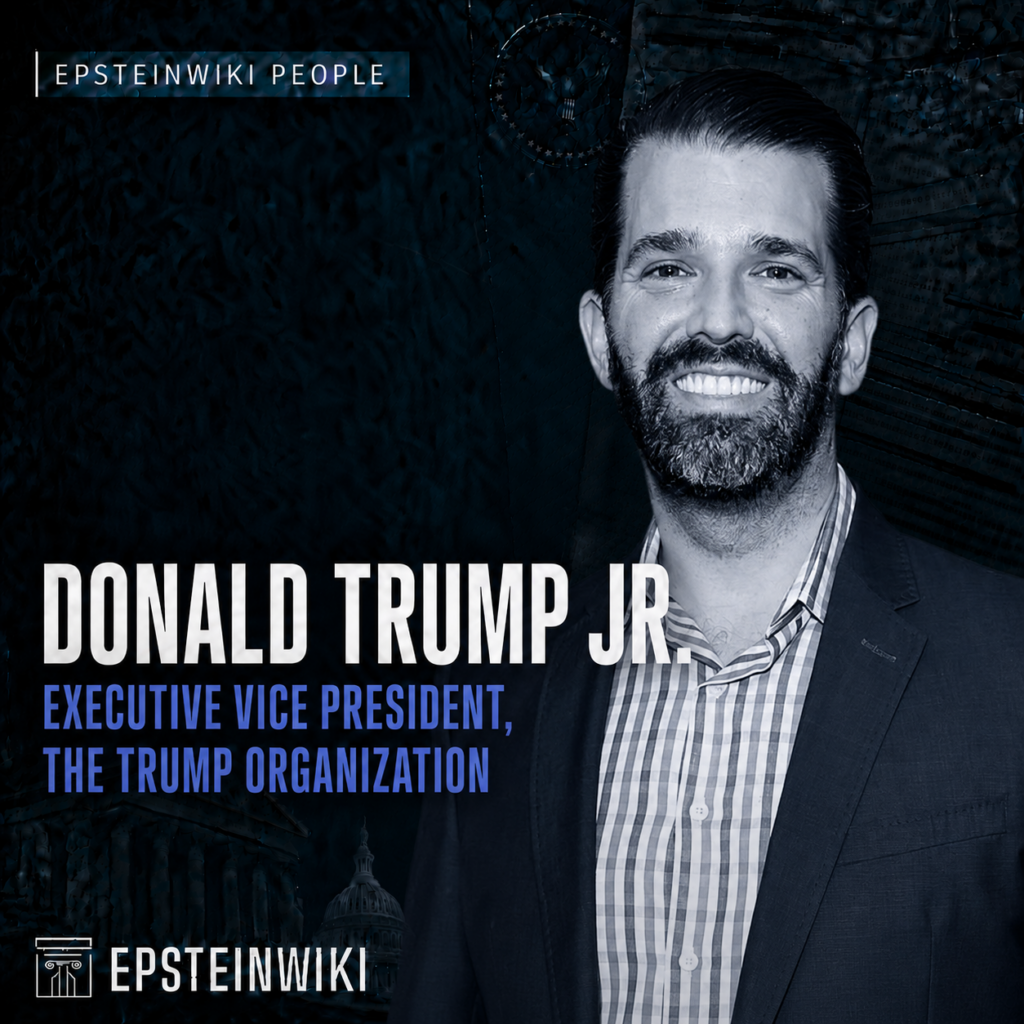
Donald Trump’s eldest son publicly demanded the release of an alleged Epstein client list, defended his father when scrutiny intensified, and is named in a federal file that records an unverified public allegation. The available record requires those facts to be reported together without pretending they carry the same evidentiary weight.
Snapshot
Full name: Donald John Trump Jr.
Born: December 31, 1977
Occupation: Business executive, political activist, author, media personality
Family: Eldest child of Donald J. Trump and Ivana Trump
Public role: Executive vice president of the Trump Organization and a prominent political surrogate for his father
Documented direct relationship with Jeffrey Epstein: No personal friendship, business relationship, direct correspondence, travel with Epstein, visit to Epstein’s island, or visit to an Epstein residence has been established in the public evidence reviewed for this profile
Documented relevance to the Epstein record: A 2016 email sent to Epstein says a mutual social contact planned to attend a UFC event with Donald Trump Jr. and Vanessa Trump. A 2018 exchange between Epstein and Steve Bannon mentions a joke made by Trump Jr. Neither document records direct contact between Trump Jr. and Epstein. A later FBI compilation records an unverified caller allegation naming Trump Jr. among people allegedly present at events. That file records an allegation received by the government, not a finding that the allegation was true.
Public statements: From 2023 through the 2024 presidential campaign, Trump Jr. repeatedly demanded release of what he called the Epstein client list, accused the government of hiding names, asserted that his father was not on an Epstein island list, and used the issue as a political attack against Democrats and federal institutions
Criminal status: Donald Trump Jr. has not been charged with an Epstein related crime. EpsteinWiki found no court judgment establishing that he participated in Epstein’s abuse or trafficking.
Why this page exists: Trump Jr. is relevant both as the adult son and political surrogate of a president with a documented social history involving Epstein, and as a public figure who helped turn the demand for Epstein disclosure into a campaign issue. His page must distinguish that political role from evidence of personal involvement.
Overview
Donald Trump Jr. occupies an unusual place in the Epstein record.
He is not documented in the same way as people who exchanged messages with Jeffrey Epstein, flew aboard Epstein’s aircraft, visited his homes, attended meetings in his calendars, received money from him, paid him, or appeared repeatedly in witness testimony. The public record reviewed for this profile does not establish that Trump Jr. had a personal relationship with Epstein.
His significance comes from four separate categories that are often collapsed online.
First, he was a member of the Trump family while his father and Epstein moved through overlapping social circles in New York and Palm Beach. Donald Trump Jr. was fourteen when his father and Epstein were filmed together at a 1992 party at Mar a Lago. During an interview connected to that footage, Donald Trump referred to his fourteen year old son while discussing the party. That comment is documentary evidence of what the elder Trump said. It is not evidence that Trump Jr. attended the event.
Second, Trump Jr. became one of the loudest political advocates for publication of an alleged Epstein client list. He demanded names, accused unnamed officials of protecting offenders, predicted that the government would prevent disclosure, and used the absence of prosecutions as evidence of institutional corruption. Those statements helped create expectations that his father’s second administration would disclose a definitive roster of offenders.
Third, when scrutiny turned toward his father, Trump Jr. shifted from generalized demands to categorical defenses. In January 2024 he said his father had never visited Epstein’s island, New Mexico ranch, or New York residence. In July 2025 he attacked reporting about a birthday message allegedly sent by his father to Epstein and said he had never seen his father doodle. His defense did not answer every documented question about the elder Trump’s relationship with Epstein, including their recorded social contact in Palm Beach and New York.
Fourth, Donald Trump Jr.’s name appears in released files. But appearances in files do not all mean the same thing. One email merely says that a man known to Epstein planned to attend a sporting event with Trump Jr. Another records Epstein and Steve Bannon reacting to a public joke by Trump Jr. A far more serious document summarizes a caller’s allegation that Trump Jr. and others were present at abusive events. That allegation is uncorroborated in the public record reviewed here. It cannot responsibly be presented as a proven event.
The central purpose of this article is therefore not to manufacture a direct Epstein relationship. It is to map what is documented, identify what remains unverified, and preserve the difference between a political statement, a third party mention, an investigative lead, and established evidence.
Who Is Donald Trump Jr.?
Donald John Trump Jr. is the eldest child of Donald Trump and Ivana Trump. He was born in New York City on December 31, 1977, attended the University of Pennsylvania, and later joined the Trump Organization. The company’s official biography describes him as an executive vice president involved in development, acquisitions, sales, branding, and other business functions.
He also became a major political surrogate for his father. He spoke at Republican conventions, campaigned across the country, developed a large social media audience, and promoted a style of politics built around distrust of federal law enforcement, the press, and the so called deep state.
That public role matters here. Trump Jr. was not merely a private relative commenting on a family controversy. He used the Epstein files as a campaign theme. His statements were distributed to millions of followers and repeated at political gatherings. They contributed to a public promise: powerful offenders would be exposed, hidden names would be released, and government protection would end.
Because he holds no formal position in the executive branch, Trump Jr. did not possess declassification authority and did not control Justice Department disclosures. Yet his influence inside Trump politics and his access to the president gave his promises and accusations more weight than those of an ordinary commentator.
Donald Trump Jr. Is Not Donald Trump
Any responsible profile must begin with the most important distinction.
Donald Trump Jr. and his father are separate people. Evidence concerning Donald Trump cannot simply be assigned to his son.
The elder Trump had a documented social association with Epstein. Photographs and video show the two men together. Donald Trump spoke warmly about Epstein in a 2002 New York magazine profile. Flight records have placed the elder Trump aboard Epstein’s aircraft on domestic trips. Epstein attended events at Mar a Lago, and Virginia Giuffre said Ghislaine Maxwell recruited her while she worked at the club.
Those facts establish a historical context surrounding the Trump family, Trump properties, and Epstein. They do not establish that Donald Trump Jr. knew about Epstein’s abuse, participated in it, or maintained his own relationship with Epstein.
The distinction is especially important because search results, social media posts, and large document databases often display the terms “Donald Trump,” “Donald Trump Jr.,” and “Trump” together. An automated entity list can make proximity look like connection. A document mentioning a father and son in the same paragraph can be indexed as evidence about both, even when the underlying statements are different in nature or reliability.
EpsteinWiki therefore evaluates every appearance by asking who created the record, what the record actually says, whether the writer had firsthand knowledge, whether the event can be corroborated, and whether the document records conduct or merely repeats a name.
The 1992 Mar a Lago Party
In November 1992, NBC recorded a party at Mar a Lago involving members of the Buffalo Bills and Miami Dolphins cheerleading squads. The footage, later aired by NBC News and described in detail by The Washington Post, shows Donald Trump and Jeffrey Epstein talking and laughing together.
The event is significant because it provides direct visual evidence that the elder Trump and Epstein socialized. It also generated the earliest known public reference connecting Donald Trump Jr. to an Epstein attended event, but only indirectly.
During an interview, host Faith Daniels asked Donald Trump how he would explain to his son that he was partying with NFL cheerleaders. Trump replied that his son could understand it and said the boy was fourteen. The apparent reference was to Donald Trump Jr., who was fourteen at the time.
The evidentiary boundary is clear.
The footage shows Donald Trump and Epstein. The interview records Donald Trump referring to his son. The available report does not say that Donald Trump Jr. was at the party, spoke to Epstein, saw the footage being recorded, or knew Epstein personally.
This distinction matters because the elder Trump’s remark has sometimes been paraphrased as though Trump Jr. participated in the event. The source does not establish that. The accurate conclusion is narrower: while discussing a party at which Epstein was present, Donald Trump invoked his fourteen year old son as someone who would understand his interest in the cheerleaders.
The remark may be relevant to the atmosphere in which Trump Jr. grew up and to the elder Trump’s public treatment of women. It is not proof of an Epstein relationship belonging to the son.
The Wider Trump Family Context
Donald Trump Jr. was a child and young adult during much of the period in which his father’s social association with Epstein was visible.
Epstein maintained a Palm Beach residence near Mar a Lago. He attended events at the club. Donald Trump and Epstein appeared together at New York and Palm Beach gatherings. By 2002, Donald Trump told New York magazine that he had known Epstein for fifteen years and described him as a “terrific guy,” while adding that Epstein liked beautiful women and that many were “on the younger side.”
The most consequential connection between an Epstein survivor and a Trump property concerns Virginia Giuffre. Giuffre said that Ghislaine Maxwell approached her while she was working as a teenager at the Mar a Lago spa around 2000. Maxwell recruited her to work as a masseuse for Epstein. Giuffre later became one of the most prominent survivors to expose the trafficking network.
No evidence reviewed for this profile establishes that Trump Jr. was involved in Giuffre’s recruitment or knew about it. But Mar a Lago is not incidental to the history. It was one of the places where Epstein and the Trump social world overlapped, and it was the workplace from which Maxwell recruited a teenager.
For congressional investigators, that creates legitimate institutional questions separate from accusations of personal wrongdoing. Who managed the club? What records survive? What policies governed recruitment of teenage workers? What did managers know about Maxwell approaching staff? When was Epstein restricted or removed, and why? Were incident reports created? Were employees interviewed after Epstein’s 2005 investigation or 2008 conviction?
Those questions concern the Trump Organization and Mar a Lago as institutions. Trump Jr.’s executive role in the family company may make his knowledge of record retention, corporate governance, or later internal review relevant even if he had no personal connection to Epstein.
No Established Personal Relationship With Epstein
The public evidence reviewed for this article does not establish that Donald Trump Jr. was Epstein’s friend, client, employee, adviser, business partner, passenger, guest, or correspondent.
EpsteinWiki did not identify a verified entry placing Trump Jr. on an Epstein flight. It did not identify direct email or text correspondence between the two men. It did not identify a calendar appointment showing a meeting. It did not identify a payment between them. It did not identify a verified photograph of them together. It did not identify testimony from a corroborated witness describing a personal relationship.
That is an evidence statement, not a declaration that no undisclosed evidence can exist. The government releases have been enormous, repetitive, imperfectly indexed, and at times badly redacted. New records may emerge, and existing scans may be difficult to search. Any future document must be evaluated on its own terms.
It is also important not to convert absence into exoneration. A database search cannot prove that two people never met. But it would be equally improper to convert family proximity into guilt. The responsible conclusion is that no direct relationship has been established in the reviewed public record.
Receipt: A 2016 UFC Email
One released email provides a limited social network connection.
In November 2016, Andrew Farkas wrote in an email sent to Jeffrey Epstein that he was going to UFC cage fights with Donald Trump Jr., Trump Jr.’s then wife Vanessa, Steve Stoute, Laure Stoute, Marty Edelman, and Norma Kamali. The record is available as EFTA01061782.
The email demonstrates several things.
It shows that Farkas, a person communicating with Epstein, was socially acquainted with Trump Jr. It shows that Epstein was informed about the planned outing. It adds one traceable connection within the wider network of people who moved through New York business, political, entertainment, and philanthropic circles.
It does not show that Epstein attended the event. It does not record Trump Jr. communicating with Epstein. It does not show that Trump Jr. knew the message was sent. It does not prove that Trump Jr. and Epstein were friends.
This is a useful example of why every receipt needs a description. A search result containing both names may look like direct correspondence. The actual document is a third party telling Epstein about plans involving Trump Jr.
Receipt: Epstein and Bannon Mention Trump Jr.
A separate released message archive records Jeffrey Epstein and Steve Bannon discussing politics and personalities in December 2018.
One message says Donald Trump Jr. had called his father a “regifter.” Epstein responded with a wordplay joke, and Bannon replied approvingly. The exchange appears in EFTA01615501, with the relevant text on the sixth page of the released sequence.
This document is significant because it shows Epstein and Bannon discussing Trump family commentary while Epstein was cultivating Bannon after Donald Trump’s election.
It is not evidence of communication between Epstein and Trump Jr. It appears to refer to something Trump Jr. said publicly or that reached Epstein through media or social channels. The document establishes that Epstein was following commentary about the president and his family. It does not establish that Trump Jr. supplied the comment to Epstein.
The broader Bannon relationship remains important. Epstein exchanged extensive messages with a former senior Trump strategist, discussing politics, media, foreign affairs, and reputation. Donald Trump Jr.’s isolated appearance in that archive is best understood as part of Epstein’s interest in Trumpworld, not proof that the president’s son belonged to Epstein’s personal circle.
Trump Jr. Demanded the “Client List”
Donald Trump Jr.’s clearest and most sustained Epstein role was political.
On July 8, 2023, he posted a demand that the entire Epstein client list be shown immediately. He asked why anyone would protect the people on it and suggested the answer was obvious. Snopes authenticated the post after it resurfaced during the 2025 dispute over the Trump administration’s handling of the files.
In January 2024, as records from the Giuffre v. Maxwell litigation were being unsealed, Trump Jr. continued the campaign. He said the public already knew about Bill Clinton and wanted all the other names the government was allegedly hiding. He predicted that something might happen to prevent the names from being released.
Ellie Leonard collected these statements and the surrounding political timeline in A History of the Epstein Files, One Tweet at a Time. Her chronology shows how Trump Jr. repeatedly framed the files as proof of a protected elite and portrayed disclosure as a test of whether government institutions served the public.
At a Turning Point USA event on June 15, 2024, Trump Jr. joked that he was on every list except the Epstein list. He contrasted his father’s criminal conviction in New York with the absence of prosecutions arising from what he called Epstein’s list and suggested that authorities were protecting offenders. TIME documented the statement as part of a larger review of promises made by Trump allies.
These statements were not casual references. They helped make disclosure a political commitment associated with the Trump movement.
The Problem With the Phrase “Client List”
Trump Jr. repeatedly used the phrase “Epstein client list” as though it described a known, singular government document identifying people who paid to abuse victims.
The public record is more complicated.
There are flight logs, address books, calendars, contact lists, photographs, financial records, police reports, deposition transcripts, emails, visitor records, witness statements, public tips, evidence inventories, and court exhibits. A person’s name can appear in one of those records for many reasons. Some people were employees. Some were victims. Some were witnesses, lawyers, investigators, reporters, medical providers, social contacts, relatives, or people discussed in news clippings. Some were accused of misconduct. Others appear without any allegation at all.
A contact book is not a customer ledger. A flight log is not proof of abuse. A calendar appointment establishes a planned or recorded interaction, not what happened during it. A public tip proves that a tip was received, not that it was true.
The Justice Department and FBI announced in July 2025 that their review did not identify an incriminating client list of the kind political figures had promised. That conclusion did not mean the files lacked important evidence. It meant the public had been encouraged to expect a single decisive object that may never have existed in that form.
Trump Jr.’s rhetoric therefore created two problems. It reduced a complex evidentiary archive to a mythical list, and it encouraged audiences to treat every named person as a client or offender. That approach can falsely accuse innocent people, expose victims, and distract from documentary evidence that actually deserves investigation.
From Disclosure Demands to Defending His Father
Trump Jr.’s statements became more defensive as public attention returned to his father.
On January 4, 2024, he asserted that Donald Trump had never been on Epstein’s island, at the New Mexico ranch, or at Epstein’s New York apartment. He said any such visit would have leaked immediately. He also accused Democrats of being disappointed that his father was not on an island list.
Even if the specific claim about those three properties were accurate, it did not address the documented relationship between the elder Trump and Epstein. They socialized at Mar a Lago and other events. The 1992 video exists. Trump praised Epstein in 2002. The question was never limited to whether Donald Trump visited Little Saint James.
In July 2025, The Wall Street Journal reported that a birthday album compiled for Epstein included a message bearing Donald Trump’s name and a drawing. Donald Trump denied creating it. Donald Trump Jr. responded that the language did not sound like his father and said that in forty seven years he had never seen him doodle. Mediaite preserved Trump Jr.’s statement.
The defense concerned Trump Jr.’s personal observation of his father’s habits. It was not a forensic examination of the document. Publicly available drawings attributed to Donald Trump also complicated the categorical suggestion that he did not doodle.
Congress later obtained and released the birthday book. The elder Trump continued to deny authorship. The dispute illustrates a recurring pattern in Trump Jr.’s Epstein commentary: broad certainty when accusing institutions or political enemies, followed by equally broad certainty when defending his father.
The 2025 Reversal and the Promise Trump Jr. Helped Create
After Donald Trump returned to office, Attorney General Pam Bondi, FBI Director Kash Patel, Deputy FBI Director Dan Bongino, and other administration allies faced demands to produce the files they had spent years describing as suppressed.
Bondi initially said an Epstein client list was on her desk for review. In July 2025, the Justice Department and FBI issued a memo saying their review found no incriminating client list, no credible evidence that Epstein blackmailed prominent people as part of his crimes, and no basis in the reviewed material to investigate uncharged third parties.
The announcement generated anger among Trump supporters. President Trump defended Bondi and criticized supporters who continued pressing the issue. TIME’s review specifically identified Donald Trump Jr. as one of the surrogates who had helped build expectations of a major disclosure.
Trump Jr. did not control the Justice Department. But he cannot be separated from the credibility problem. He told audiences that a list existed, that officials were hiding it, that the hidden names would be revealing, and that protection of offenders explained the secrecy. Once his father’s administration said the anticipated list did not exist, the burden shifted to the people who had promoted the claim.
A complete accounting would require Trump Jr. to explain what evidence he relied upon, which officials he believed were concealing records, whether anyone in the campaign briefed him, and whether he now accepts the government’s description of the evidence.
Congress Forced a Broader Release
The political dispute did not end with the July 2025 memo.
Congress passed the Epstein Files Transparency Act in November 2025 after sustained pressure from survivors, journalists, advocates, and lawmakers from both parties. President Trump signed it after initially resisting the release effort. The law required the Justice Department to publish broad categories of unclassified Epstein related materials while protecting victim identifying information and legally protected content.
The Justice Department’s first production drew criticism for delays, missing records, heavy redactions, and documents that temporarily disappeared. A much larger January 2026 release added millions of pages, images, and videos. The department said some released material could include fake or falsely submitted items because the production included information members of the public had sent to the FBI.
That warning is essential for understanding the file that names Donald Trump Jr.
The mere fact that a statement appears in a federal production does not mean the FBI verified it. The production law focused on responsiveness to the Epstein investigations, not on certifying every submitted claim as true.
Receipt: The FBI Tip Compilation That Names Trump Jr.
The most serious public document naming Donald Trump Jr. is EFTA01660651.
The document is an FBI compilation summarizing allegations or tips received through public reporting channels. One entry describes a caller’s claim about alleged events at Mar a Lago and names Donald Trump Jr., Ivanka Trump, Eric Trump, Elon Musk, Alan Dershowitz, Robert Shapiro, Ghislaine Maxwell, Jeffrey Epstein, and others.
The allegation is graphic and grave. This profile does not repeat unnecessary sexual detail. The material can be reviewed directly in the linked receipt, with appropriate caution for descriptions of child sexual abuse.
What the document establishes is limited but important: the government received or compiled an allegation in which Donald Trump Jr.’s name appeared.
What the document does not establish is equally important: it does not show that agents corroborated the caller’s account, identified supporting witnesses, verified dates, matched the story to travel or event records, obtained photographs, brought charges, or reached an investigative finding that Trump Jr. was present.
The same compilation contains a large number of extraordinary allegations involving many people and events. Some entries appear to be secondhand. Some lack contact information. Some combine unrelated names or claims. Inclusion in the compilation is not an endorsement by the FBI.
The allegation should not be erased merely because it is unverified. Investigative leads deserve appropriate review, especially when they concern possible child exploitation. But public reporting must not transform intake material into adjudicated fact.
The correct label is: an unverified allegation recorded in a federal file.
Why EFTA01660651 Is Not a Finding of Guilt
An FBI file can contain many kinds of information. Agents create reports about interviews, evidence seizures, laboratory results, subpoenas, surveillance, database checks, tips, and administrative actions. Each category has a different evidentiary value.
EFTA01660651 is not a charging document. It is not a sworn judicial finding. It is not a trial exhibit accompanied by authentication and cross examination. It is not a report stating that agents substantiated the allegation. It is not a confession. It is not a photograph or travel record.
It is a summary of information reported to the government.
Investigators should ask whether the original tip still exists, whether the caller was identified, whether agents made contact, whether the account was internally consistent, whether dates could be fixed, whether Mar a Lago event records exist, whether named witnesses were interviewed, and whether any portion was corroborated or disproved.
Until those questions are answered, the file cannot support a claim that Trump Jr. attended the alleged events. It supports only the claim that such an allegation entered the government’s records.
This standard protects everyone, including survivors. Treating every raw tip as proven encourages sensationalism and makes it easier for powerful people to dismiss the entire archive. Careful grading allows credible evidence to remain visible while uncertain material is investigated honestly.
A Common Misidentification: EFTA02158332
Another receipt, EFTA02158332, has circulated in searches involving the Trump family.
The document is a September 2012 email with a subject asking what Jeffrey Epstein thought about going to Mar a Lago after Christmas instead of going to his island. It concerns the elder Donald Trump and Epstein’s travel or social planning context. It does not name Donald Trump Jr. and does not contain the allegation summarized in EFTA01660651.
Confusing these document numbers creates a serious reporting error. The distinction is not cosmetic. One file is a contemporaneous scheduling communication. The other is a later compilation of public allegations. They have different dates, authors, purposes, and evidentiary value.
EpsteinWiki links both so readers can inspect the records rather than rely on screenshots or reposted descriptions.
Evidence Assessment
| Item | What it establishes | What it does not establish | Weight |
|---|---|---|---|
| 1992 Mar a Lago footage | Donald Trump and Epstein socialized at a party | That Donald Trump Jr. attended or met Epstein | Strong for the elder Trump relationship, none for a direct Trump Jr. relationship |
| Donald Trump’s 1992 interview remark | Donald Trump referred to his fourteen year old son while discussing the cheerleader party | That the son was present or knew Epstein | Strong evidence of the remark, weak evidence about Trump Jr. |
| EFTA01061782 | Andrew Farkas told Epstein he planned to attend a UFC event with Trump Jr. and others | Direct contact, friendship, or attendance by Epstein | Moderate evidence of an overlapping social contact |
| EFTA01615501 | Epstein and Bannon mentioned a comment attributed to Trump Jr. | Communication between Epstein and Trump Jr. | Strong evidence of a third party mention only |
| Trump Jr.’s 2023 and 2024 posts | He demanded disclosure, alleged concealment, and claimed a client list existed | That he possessed inside evidence or accurately described the files | Strong evidence of his public position |
| Trump Jr.’s January 2024 defense of his father | He denied that his father visited three Epstein properties | A complete absence of contact between Donald Trump and Epstein | Strong evidence of what Trump Jr. claimed |
| Trump Jr.’s July 2025 birthday book response | He rejected the reported message and said he had never seen his father doodle | Forensic proof about authorship | Strong evidence of his defense, limited evidence about the document |
| EFTA01660651 | The FBI compiled a public allegation naming Trump Jr. | That the allegation was corroborated or true | Strong evidence that an allegation was recorded, insufficient evidence of the alleged conduct |
| Absence from reviewed direct records | No personal Epstein relationship has been established in the reviewed material | That no meeting or undisclosed record could ever exist | Provisional negative finding |
What the Evidence Establishes
The evidence supports the following conclusions.
Donald Trump Jr. grew up inside a family and business environment in which his father socialized with Jeffrey Epstein.
Donald Trump referred to his fourteen year old son while discussing a 1992 Mar a Lago party attended by Epstein.
A person who communicated with Epstein said he planned to attend a 2016 UFC event with Trump Jr. and Vanessa Trump.
Epstein and Steve Bannon discussed a joke attributed to Trump Jr. in 2018.
Trump Jr. repeatedly promoted the existence and release of an alleged Epstein client list from 2023 through the 2024 campaign.
He accused government institutions of hiding names and protecting offenders.
He defended his father when Epstein related scrutiny intensified.
A federal release contains an FBI compilation of an unverified public allegation that names him.
No criminal charge or judicial finding concerning Trump Jr. and Epstein has been identified.
What the Evidence Does Not Establish
The evidence reviewed does not establish that Donald Trump Jr. was a client of Epstein.
It does not establish that he flew on Epstein’s aircraft.
It does not establish that he visited Little Saint James, Great Saint James, Zorro Ranch, Epstein’s Manhattan townhouse, or Epstein’s Paris residence.
It does not establish that he exchanged messages with Epstein.
It does not establish that he paid Epstein or received money from him.
It does not establish that he attended the 1992 Mar a Lago party.
It does not establish that he knew about Virginia Giuffre’s recruitment from Mar a Lago.
It does not establish that he participated in sexual abuse or trafficking.
It does not establish that every person named in an Epstein file was a client or offender.
It does not establish that Trump Jr. had access to a secret government list when he made his public claims.
Why Trump Jr.’s Political Rhetoric Matters
The Epstein scandal concerns more than famous names. It concerns institutional failure.
Federal prosecutors in Florida negotiated a nonprosecution agreement that protected Epstein and potential co-conspirators. Survivors were not told about the agreement before it was completed. Epstein received extraordinary work release privileges after pleading guilty in state court. Years passed before federal prosecutors in New York brought new charges. Ghislaine Maxwell was ultimately convicted, but many questions about facilitators, finances, recruitment, and institutional protection remain unresolved.
Against that history, demands for transparency were legitimate. Trump Jr. was right that the public deserved a fuller account and that powerful people should not receive protection.
But accountability requires precision. A slogan about a client list can direct attention toward a fantasy ledger while obscuring the real work: reconstructing recruitment chains, identifying payments, comparing travel and calendar records, reviewing prosecutorial decisions, tracing corporate support, and hearing survivors.
Trump Jr.’s rhetoric also became selective. He treated the appearance of political opponents in records as suspicious while treating scrutiny of his father as partisan or fabricated. A credible transparency standard cannot change according to whose name appears.
The same rule must apply to Bill Clinton, Donald Trump, Donald Trump Jr., Prince Andrew, Leon Black, and every other public figure: a name is a lead, not a verdict; a direct record deserves examination; an accusation must be labeled; corroboration matters; and survivors should not be used as props in partisan combat.
Survivor Centered Analysis
Survivors have repeatedly watched public debate turn their experiences into a contest over celebrity names.
That framing can cause several kinds of harm.
It can expose survivors while influential men remain protected by redactions. It can encourage harassment of people whose names appear innocently. It can spread graphic allegations without consent or context. It can reward political figures who promise spectacle but do not produce institutional reform. It can also make genuine evidence easier to dismiss when unverified claims are published as fact.
A survivor centered approach asks different questions.
Which recruitment methods were used? Who transported victims? Who scheduled appointments? Which employees saw young girls entering homes? Which banks processed suspicious payments? Which lawyers negotiated silence? Which prosecutors limited the investigation? Which institutions retained relevant records? What services were offered to survivors? What protections exist for people who come forward now?
Donald Trump Jr.’s public platform could have advanced those questions. Much of his rhetoric instead centered on a list and the partisan identities of people he expected to appear on it.
For oversight purposes, the goal should not be to embarrass a political family. It should be to determine what institutions knew, what evidence exists, why earlier systems failed, and whether current disclosure practices protect survivors while allowing accountability.
Timeline
December 31, 1977: Donald John Trump Jr. is born in New York City.
November 1992: NBC records Donald Trump and Jeffrey Epstein socializing at a Mar a Lago party. During a related interview, Donald Trump refers to his fourteen year old son as someone who could understand the cheerleader party. No reviewed source places Trump Jr. at the event.
Around 2000: Virginia Giuffre says Ghislaine Maxwell recruited her while she worked as a teenager at the Mar a Lago spa. No reviewed evidence establishes Trump Jr.’s knowledge or involvement.
2002: Donald Trump publicly praises Epstein in New York magazine and comments on Epstein’s interest in women “on the younger side.”
2005: Palm Beach police begin investigating Epstein after the family of a fourteen year old reports abuse.
2008: Epstein pleads guilty to Florida state charges and receives a widely criticized sentence with work release.
November 2016: Andrew Farkas tells Epstein that he plans to attend a UFC event with Donald Trump Jr., Vanessa Trump, and others. See EFTA01061782.
December 2018: Epstein and Steve Bannon exchange messages containing a joke about a comment attributed to Donald Trump Jr. See EFTA01615501.
July 2019: Federal prosecutors in New York arrest Epstein on sex trafficking charges.
August 2019: Epstein dies in federal custody. His death is ruled a suicide.
December 2021: A federal jury convicts Ghislaine Maxwell on sex trafficking related counts.
July 8, 2023: Trump Jr. publicly demands release of the entire alleged Epstein client list and asks why anyone would protect the people on it.
January 2 through 8, 2024: Trump Jr. posts repeatedly about the unsealing of Giuffre v. Maxwell records, alleges government concealment, attacks political opponents, and defends his father.
June 15, 2024: At a Turning Point USA event, Trump Jr. says he is on every list except the Epstein list and suggests authorities are protecting offenders.
July 2025: The Justice Department and FBI say their review found no incriminating client list and no basis in the reviewed material for investigations of uncharged third parties. The announcement conflicts with expectations promoted by Trump Jr. and other allies.
July 18, 2025: Trump Jr. attacks reporting about an alleged birthday message from his father to Epstein and says he has never seen his father doodle.
November 2025: Congress passes the Epstein Files Transparency Act. President Trump signs it.
December 2025: The Justice Department begins publishing records under the law amid disputes over redactions, omissions, and delays.
January 30, 2026: The Justice Department publishes millions of additional pages and warns that the production may include false or falsely submitted material sent to the FBI by members of the public.
2026: Researchers identify EFTA01660651 as an FBI compilation containing an unverified allegation that names Donald Trump Jr. The public record reviewed for this profile does not show that the allegation was corroborated.
Questions for Donald Trump Jr.
- Did you ever meet Jeffrey Epstein?
- If so, when, where, and under what circumstances?
- Did you ever speak with Epstein by telephone, email, text message, or through an intermediary?
- Did you ever attend an event at which Epstein was present?
- Were you present at the November 1992 Mar a Lago party recorded by NBC?
- Before Epstein’s 2005 investigation, what did you know about your father’s social relationship with him?
- When did you first learn that Epstein had attended events at Mar a Lago?
- When did you first learn that Virginia Giuffre said Maxwell recruited her while she worked at the Mar a Lago spa?
- Did the Trump Organization ever conduct an internal review of Epstein’s access to Mar a Lago?
- Did you participate in any review of visitor logs, membership records, security records, personnel files, or incident reports involving Epstein or Maxwell?
- What evidence did you rely upon when you demanded release of “all” of the Epstein client list in July 2023?
- Had any government official, campaign adviser, lawyer, journalist, or private investigator told you that a singular client list existed?
- Which government officials did you believe were protecting offenders?
- Did you possess nonpublic information about the contents of federal investigative files?
- Did anyone in your father’s 2024 campaign brief you about Epstein related records?
- Did you discuss Epstein disclosures with Kash Patel, Pam Bondi, Dan Bongino, J.D. Vance, or other future administration officials?
- Do you now accept the Justice Department’s statement that it did not find an incriminating client list?
- If not, what evidence supports your disagreement?
- Why did your public statements focus heavily on Bill Clinton and Democrats when your father’s own social history with Epstein was documented?
- What was the basis for your January 2024 statement that your father never visited Epstein’s New York residence?
- Did you review flight logs, visitor records, testimony, or other evidence before making that statement?
- Do you distinguish between appearing in a flight log, address book, calendar, email, tip, and proven criminal conduct?
- Do you agree that people named in raw files should not automatically be called clients or offenders?
- Did you attend the UFC event described in EFTA01061782?
- What was your relationship with Andrew Farkas at that time?
- Did you know Farkas was communicating with Epstein?
- Did Epstein attend the UFC event or any associated gathering?
- Were you ever told that Epstein and Steve Bannon discussed you or your father?
- Have you reviewed EFTA01660651?
- Have you or your attorneys asked the FBI whether the allegation naming you was investigated, corroborated, or closed?
- Would you consent to the release of nonvictim identifying investigative records showing how that tip was handled?
- Did you ever receive a request from Congress to preserve or produce Epstein related records?
- Would you voluntarily provide any responsive records in your possession to the House Oversight Committee?
- Do you support publication of a complete accounting of withheld files, with victim identifying information protected?
- Do you support independent review of redaction decisions affecting politically exposed people?
- What reforms do you support to prevent wealthy sex offenders from receiving secret or unusually favorable agreements?
- Do you support stronger record retention requirements for clubs, employers, banks, and corporate entities linked to trafficking investigations?
- Do you support funding and legal assistance for survivors whose private information was exposed in government releases?
Questions for the House Oversight Committee
- Has the Committee obtained the underlying tip or intake record summarized in EFTA01660651?
- Does the original record identify the caller, submission date, contact method, or location?
- Did the FBI interview the person who made the allegation?
- Did agents classify the tip as credible, not credible, unresolved, duplicative, or outside investigative scope?
- Were any claims in the tip corroborated by independent evidence?
- Were any claims disproved?
- Did investigators compare the allegation with Mar a Lago visitor records, event calendars, photographs, employment files, or security logs?
- Did investigators interview Donald Trump Jr., Ivanka Trump, Eric Trump, or other named people?
- Why was the allegation included in the federal production, and what metadata accompanied it?
- What controls distinguish raw public submissions from verified investigative findings in the released archive?
- Has the Committee requested Trump Organization and Mar a Lago records concerning Epstein and Maxwell?
- Has the Committee sought records concerning Virginia Giuffre’s employment and recruitment from the club?
- Has the Committee identified when Epstein joined, used, or lost access to Mar a Lago?
- Has the Committee requested testimony from former club managers, security staff, spa managers, or human resources employees?
- Has the Committee asked Donald Trump Jr. what information supported his public claims about a client list?
- Has the Committee preserved political communications in which Trump allies discussed using the Epstein issue during the 2024 campaign?
- Will the Committee publish an evidence guide distinguishing contacts, witnesses, victims, employees, accused individuals, and raw tip subjects?
- Will it provide document level links so the public can verify claims without relying on viral screenshots?
- What safeguards will prevent additional disclosure of survivor identities?
- Will survivors and their counsel be consulted before further releases?
Fact Check
Claim: Donald Trump Jr. is proven to have been an Epstein client.
Finding: Unsupported. No client ledger or verified evidence reviewed for this profile establishes that relationship.
Claim: Donald Trump Jr. appears in released Epstein related files.
Finding: True. His name appears in several records, but the contexts differ sharply.
Claim: An email shows Trump Jr. writing directly to Epstein.
Finding: Unsupported. EFTA01061782 is a third party email telling Epstein about plans involving Trump Jr.
Claim: Epstein and Steve Bannon discussed Trump Jr.
Finding: True. EFTA01615501 includes a brief reference to a joke attributed to Trump Jr. It does not show contact between Trump Jr. and Epstein.
Claim: Donald Trump Jr. demanded release of the Epstein client list.
Finding: True. He did so publicly in July 2023 and returned to the theme repeatedly in 2024.
Claim: Trump Jr. said his father had never visited Epstein’s island, ranch, or New York home.
Finding: True as a statement he made. The claim should not be expanded into a denial of all contact between Donald Trump and Epstein.
Claim: Donald Trump Jr. attended the 1992 Mar a Lago party with Epstein.
Finding: Not established. His father mentioned his fourteen year old son during a related interview, but the reviewed source does not place Trump Jr. at the party.
Claim: A federal document accuses Trump Jr. of being present at abusive events.
Finding: True, with a critical qualification. EFTA01660651 records an unverified public allegation. The document is not an FBI finding that the allegation was true.
Claim: EFTA02158332 contains the allegation against Trump Jr.
Finding: False. That file is a 2012 scheduling email about Mar a Lago. The allegation naming Trump Jr. appears in EFTA01660651.
Claim: Being named in an FBI file proves criminal conduct.
Finding: False. FBI files include raw tips, hearsay, investigative leads, administrative material, evidence, and verified findings. The type and provenance of each record must be assessed.
Claim: Trump Jr. has been charged with an Epstein related offense.
Finding: No such charge was identified in the reviewed record.
Claim: The Justice Department’s statement that no client list existed means there is no evidence worth investigating.
Finding: False. The absence of a singular list does not erase flight records, communications, financial transactions, testimony, institutional failures, or unresolved allegations.
Reliability and Limitations
This profile relies on released government records, direct document links, contemporaneous reporting, authenticated public statements, and research by independent Epstein file analysts.
The archive has serious limitations. Some files are duplicated. Some scans are poorly searchable. Some names are redacted inconsistently. Some records contain media clippings or public tips rather than original evidence. The Justice Department has acknowledged that material submitted by the public may be false. The department also exposed victim identifying information in portions of its release, causing additional harm.
Epstein Data is an independent research interface, not a government agency. Its document pages are valuable because they provide stable, searchable access and links to source files. Its analytical labels should be checked against the underlying documents.
Negative findings are provisional. Saying that no direct Trump Jr. relationship has been established means that the reviewed public evidence does not establish one. It does not claim omniscience over every unreleased, unindexed, or future record.
If additional authenticated records emerge, this page should be updated with the same evidence grading used here.
Related EpsteinWiki Pages
- Donald J. Trump
- Ivana Trump
- Ivanka Trump
- Eric Trump
- Jane Doe v. Donald Trump and Jeffrey E. Epstein
- How Trumpworld Turned the Andrew Tate Audience Into a Political and Financial Asset
Sources
- Epstein Data: EFTA01061782, email describing UFC plans involving Donald Trump Jr.
- Epstein Data: EFTA01615501, Epstein and Bannon messages mentioning Donald Trump Jr.
- Epstein Data: EFTA01660651, FBI compilation containing an unverified allegation naming Donald Trump Jr.
- Epstein Data: EFTA02158332, September 2012 Mar a Lago scheduling email
- United States Department of Justice Epstein Library
- Department of Justice: January 30, 2026 production announcement
- The Washington Post: The story behind the 1992 video of Trump and Epstein at Mar a Lago
- TIME: What Trump and his allies said about the Epstein files during the campaign
- Snopes: Authentication of Donald Trump Jr.’s July 2023 client list post
- Mediaite: Donald Trump Jr.’s response to the reported Epstein birthday message
- Associated Press: Justice Department release and the limits of the first production
- Associated Press: Pressure surrounding the Epstein Files Transparency Act
- Ellie Leonard: A History of the Epstein Files, One Tweet at a Time
- Ellie Leonard: Jeffrey Epstein and Steve Bannon, A Bromance for the Ages
- American Freakshow: Steve Bannon, Populist False Prophet
- EpsteinWiki: Donald Trump Jr.