
David H.C. Brigstocke
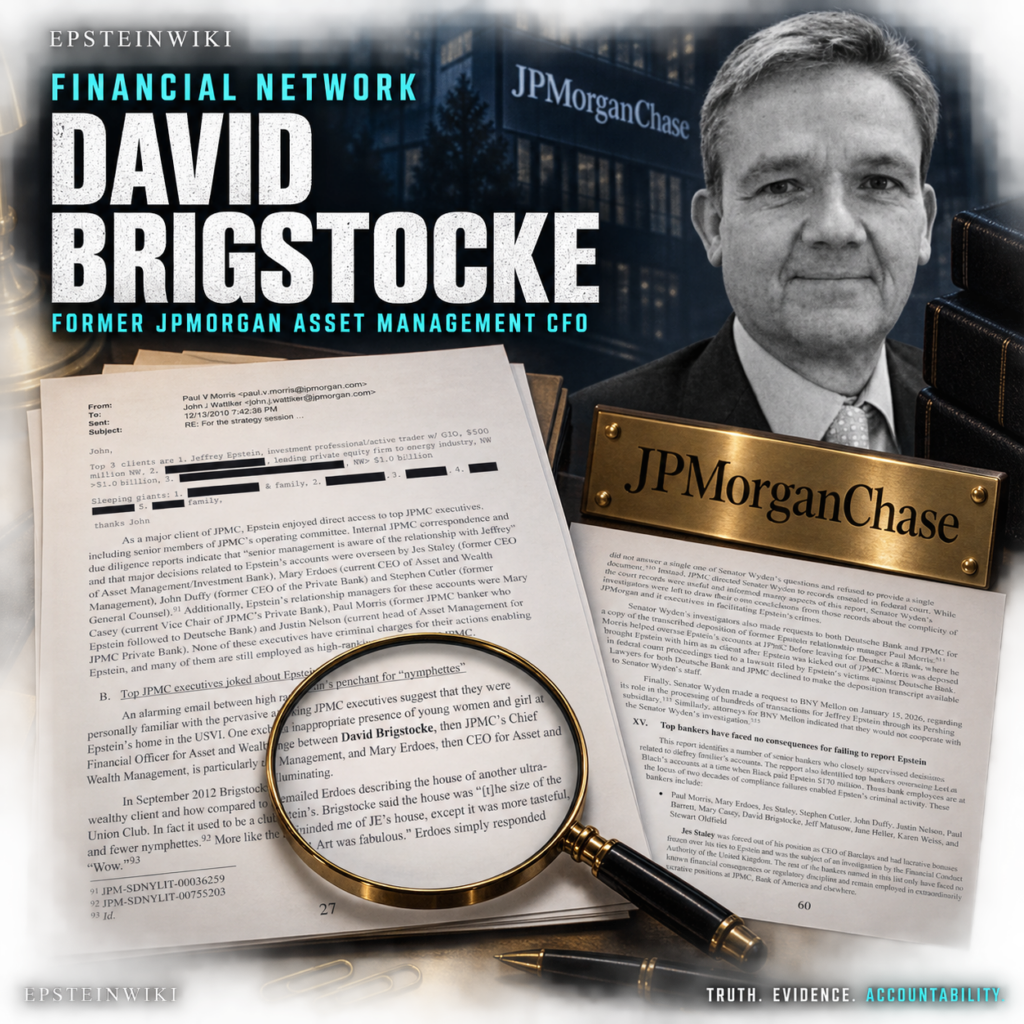
Former JPMorgan Asset and Wealth Management chief financial officer who received internal Highbridge communications involving Jeffrey Epstein and later compared another wealthy client’s home to Epstein’s house by referring to “fewer nymphettes.
Snapshot
Full name: David H.C. Brigstocke
Also known as: David Brigstocke, David H. C. Brigstocke
Professional title used by Magdalene College: The Honourable David Brigstocke
Profession: Chartered accountant and investment management executive
Education: MA in Mathematics, University of Cambridge; MSc in Management Science, Imperial College London
Early career: Chartered accountant with KPMG
Relevant employer: JPMorgan and affiliated investment management businesses
Relevant roles: Chief Financial Officer of JPMorgan Asset and Wealth Management; Global Chief Administrative Officer for Asset Management; Chief Executive Officer for Asset Management in Europe, the Middle East, and Africa
Documented Epstein connection: Recipient of 2004 and 2005 Highbridge communications involving Epstein and author of a September 2012 email comparing another client’s home to Epstein’s home
Later governance roles: Independent director associated with Franklin Templeton’s United Kingdom fund management board; Treasurer of the Magdalene College Foundation
Criminal status: No Epstein related criminal charge identified as of September 17, 2026
Civil status: Not named as an individual defendant in the survivor class action or United States Virgin Islands action against JPMorgan Chase
Regulatory status: No public Epstein related individual regulatory sanction identified as of September 17, 2026
Key Takeaways
- David H.C. Brigstocke was a senior JPMorgan Asset and Wealth Management executive whose role placed him close to Jes Staley during the period when Jeffrey Epstein was a major private bank client and was involved in discussions surrounding Highbridge Capital Management.
- A July 2004 Project Alpha working group list identifies Brigstocke as the Chief Financial Officer of JPMorgan Asset and Wealth Management. The same working group material lists Epstein’s Financial Trust Company and advisers among the external participants associated with the project.
- On February 15, 2005, a JPMorgan strategy executive sent Staley and Brigstocke a proposed five year Highbridge consulting arrangement for Epstein. The proposal contemplated a $100,000 annual fee and employee pricing on substantial investments, producing an estimated annual discount of approximately $2.1 million and an estimated present value of approximately $8 million.
- JPMorgan later acknowledged in litigation that the email contained a proposed consulting arrangement. The bank disputed whether the proposal represented any final arrangement. The released evidence establishes a proposal and Brigstocke’s receipt of it, not that the arrangement was executed.
- On September 12, 2012, Brigstocke described another wealthy client’s home to Mary Erdoes and wrote that it reminded him of Epstein’s home, except that it was more tasteful and had “fewer nymphettes.” Erdoes replied, “WOW.”
- The wording suggests familiarity with Epstein’s home and with the presence of young women or girls there. The Senate Finance Committee drew that inference in 2026. JPMorgan stated in litigation, however, that it had not identified Brigstocke as a visitor to Epstein’s home. No released visitor record reviewed for this article independently establishes when or where Brigstocke visited an Epstein property.
- Jes Staley identified Brigstocke in sworn interrogatory responses as one of the JPMorgan employees with knowledge regarding Staley’s relationship with Epstein. Staley did not include Brigstocke in his separate answer identifying people who interacted with Epstein or visited Epstein properties.
- Brigstocke’s email was written after Epstein’s 2008 conviction, imprisonment, sex offender registration, repeated compliance reviews, and internal efforts to remove him from the bank. The timing makes the language especially significant.
- The 2026 Senate Finance Committee staff report named Brigstocke among thirteen bankers who had faced no known individual financial consequence or regulatory discipline in connection with Epstein. That report is an investigative assessment, not a criminal charge, civil judgment, or regulatory finding.
- No evidence reviewed for this article establishes that Brigstocke participated in Epstein’s sexual abuse or trafficking. No public survivor accusation against Brigstocke personally was identified.
Overview
David H.C. Brigstocke appears in the Epstein record through a small but consequential group of documents. His importance does not arise from serving as Epstein’s relationship manager or from processing his daily transactions. It comes from his seniority, his proximity to Staley, his involvement in Highbridge discussions that included Epstein, and the language he used when comparing another wealthy client’s home to Epstein’s.
The documents create three distinct evidentiary periods. In 2004, Brigstocke was the Asset and Wealth Management chief financial officer and a named member of the Project Alpha working group addressing JPMorgan’s acquisition of an interest in Highbridge. Epstein and his advisers appeared in that project’s working materials. In 2005, Brigstocke received a detailed proposed consulting arrangement that would have compensated Epstein through Highbridge. In 2012, Brigstocke referred to young women or girls at Epstein’s home in a message to Erdoes.
Each episode must be assessed separately. The 2004 and 2005 documents concern Epstein’s business role around Highbridge. The 2012 email concerns what senior JPMorgan executives appeared to understand about Epstein’s social environment. The public record does not establish that Brigstocke managed Epstein’s accounts, approved his retention after conviction, or controlled the bank’s suspicious activity reporting.
The most serious interpretation was advanced by the United States Virgin Islands and later the Senate Finance Committee: that the email reflected senior executive knowledge of an environment associated with Epstein’s trafficking. JPMorgan disputed the legal significance of the message and argued that the evidence did not prove the bank knowingly participated in trafficking.
Identity and Education
The relevant person is David H.C. Brigstocke, a British born investment management executive and chartered accountant. His full initials appear in JPMorgan email addresses, Securities and Exchange Commission filings, and professional biographies.
Magdalene College identifies him as a member of its 1971 matriculation year. The college states that he earned an MA in Mathematics from the University of Cambridge and an MSc in Management Science from Imperial College London.
Brigstocke began his professional career as a chartered accountant with KPMG before moving into investment management. This accounting background is relevant to his later executive positions, which included financial control, administration, governance, and leadership responsibilities within a major global asset manager.
An SEC Form 3 filed in 2008 identified David HC Brigstocke as a vice president and officer of Bear Stearns during the transition following JPMorgan’s acquisition of the company. The filing helps confirm his full name and senior corporate status but does not concern Epstein.
JPMorgan Career
By 2014, industry reporting described Brigstocke as having worked for the JPMorgan group for approximately thirty years. His career spanned predecessor institutions and multiple leadership roles in investment and asset management.
Brigstocke served as Chief Financial Officer of JPMorgan Asset and Wealth Management. A July 2004 internal working group list preserved as EFTA02816401 identifies Jes Staley as the division’s chief executive and Brigstocke as its chief financial officer. This places Brigstocke immediately below or alongside the senior leadership responsible for the division’s strategic and financial management.
He later served as Global Chief Administrative Officer for Asset Management. In 2014, JPMorgan announced that he would succeed Peter Schwicht as Chief Executive Officer for Asset Management in Europe, the Middle East, and Africa after a transition period.
Public professional biographies also describe Brigstocke as a former managing director of J.P. Morgan Investment Management Inc. and a former chairman of a European JPMorgan asset management entity. These roles indicate a career centered on senior management and governance rather than private bank relationship coverage.
That distinction matters. The released records do not identify Brigstocke as Epstein’s private banker. His relevance comes from executive knowledge and participation in corporate discussions, not routine account servicing.
JPMorgan, Epstein, and Highbridge Capital Management
Highbridge Capital Management was a large hedge fund founded by Glenn Dubin and Henry Swieca. JPMorgan acquired a controlling interest in the firm through a transaction developed during 2004 and completed in stages.
Epstein had financial and personal relationships relevant to Highbridge. Released litigation materials state that he advised both JPMorgan and Highbridge concerning the acquisition. The parties later disputed how significant his role was and whether it created a benefit for JPMorgan.
Brigstocke’s position as Asset and Wealth Management chief financial officer placed him inside the acquisition working group. The working documents show that Staley and Brigstocke were among the senior executives receiving analysis about valuation, transaction structure, management incentives, and negotiations with Highbridge.
The presence of Epstein and his advisers in the Project Alpha working group list does not establish that every person on the list attended every meeting. It does show that JPMorgan’s transaction materials treated Epstein’s Financial Trust Company and advisers as participants relevant to the project.
The 2004 Project Alpha Working Group
The July 12, 2004 Project Alpha working group list in EFTA02816401 identifies Brigstocke as Asset and Wealth Management chief financial officer and Staley as the division’s chief executive.
The document also lists JPMorgan executives, corporate development personnel, lawyers, accountants, Highbridge officials, and outside advisers. Near the end, it includes Financial Trust Company and Advisers, identifies Jeffrey E. Epstein, and lists Darren Indyke and other legal advisers.
The organizational document establishes that Epstein’s office was recognized within the formal working group materials for the Highbridge transaction. It does not explain the precise scope of Epstein’s advisory role, the meetings he attended, or which internal participants communicated with him directly.
Another released exhibit, EFTA02811826, contains a June 16, 2004 email from James von Moltke to Staley and Brigstocke summarizing a meeting with Highbridge. It discussed valuation expectations, transaction structure, negotiations, and proposed next steps. The message did not name Epstein in the portion directed to Brigstocke, but the broader litigation record later connected Epstein to the acquisition discussions.
The email’s significance is structural. It confirms that Brigstocke was not merely listed on a static directory. He received substantive analysis about the acquisition at a senior decision making level.
Proposed 2005 Consulting Arrangement for Epstein
On February 15, 2005, William J. Shepherd, a vice president in JPMorgan Asset and Wealth Management strategy and development, sent Staley and Brigstocke an email titled “Highbridge consulting arrangement.” The original exhibit is EFTA02811823.
Shepherd described the proposal as a working model for a consulting arrangement involving Epstein. The proposed terms included:
- Epstein would be hired as a consultant by Highbridge.
- The arrangement would last five years.
- Epstein would receive a direct annual fee of $100,000.
- He would receive access to Highbridge employee pricing on investments up to one percent of Highbridge’s total assets under management.
- JPMorgan would treat certain consulting and fee waiver costs as extraordinary items for purposes of later Highbridge purchase calculations.
The email estimated that, with Highbridge managing $7 billion, discounted pricing on $70 million invested by Epstein would be worth approximately $2.1 million per year. It estimated the present value at approximately $8 million using a ten percent discount rate.
Shepherd also recorded that Epstein reportedly had between $200 million and $300 million mostly with D.B. Zwirn rather than Highbridge and approximately $35 million invested directly with Highbridge. The message questioned whether all of the larger sum represented Epstein’s own money or money belonging to clients.
The proposal is important because it shows JPMorgan executives considering a valuable formal relationship between Highbridge and Epstein. Brigstocke was a direct recipient.
The evidentiary limit is equally important. The email described a proposed arrangement, not an executed contract. In later litigation, JPMorgan acknowledged that the email set out a proposed consulting arrangement but disputed whether it represented any final advisory agreement. No executed contract or payment record reviewed for this article proves that the proposal became effective.
Evidence Chart
| Date | Record | Brigstocke’s documented position | What the record establishes | What it does not establish |
|---|---|---|---|---|
| June 16, 2004 | EFTA02811826 | Asset and Wealth Management chief financial officer receiving Highbridge transaction analysis | Brigstocke received senior level analysis concerning the Highbridge acquisition | The email excerpt does not establish direct contact between Brigstocke and Epstein |
| July 12, 2004 | EFTA02816401 | Asset and Wealth Management chief financial officer on the Project Alpha working group list | Epstein’s Financial Trust Company and advisers appeared in the transaction working group materials | The list does not prove attendance at every meeting or direct communication among every listed person |
| February 15, 2005 | EFTA02811823 | Direct recipient with Staley | Brigstocke received a detailed proposed Highbridge consulting arrangement for Epstein | No released record reviewed here proves that the proposal was executed |
| July 22, 2011 | EFTA02812001 | Copied on an unrelated transaction chain attached beneath a privileged message | His name appears in a thread that also contains a separate reference to Epstein offboarding | The structure does not prove Brigstocke received or read the later privileged offboarding note |
| September 12 and 13, 2012 | EFTA02811465 | Asset and Wealth Management chief financial officer communicating with Erdoes | Brigstocke compared another client’s home to Epstein’s and referred to fewer “nymphettes” | The email does not identify the young people, their ages, or when Brigstocke observed Epstein’s home |
| April 20, 2023 | EFTA02811664 | Named in Staley’s interrogatory response | Staley identified Brigstocke as a person with knowledge regarding Staley’s relationship with Epstein | Staley did not identify Brigstocke in the separate list of people who interacted with Epstein or visited his properties |
| July and August 2023 | Multiple litigation filings | Former executive discussed in the parties’ factual statements and expert materials | The parties agreed the 2012 email existed and that Brigstocke was the division’s CFO | They disputed the inference and legal significance attributed to the email |
| August 2026 | Senate Finance Committee report | Former senior JPMorgan executive | Senate staff treated the email as evidence of senior executive awareness and named Brigstocke among bankers warranting accountability | The report did not adjudicate a crime or impose an individual sanction |
The September 2012 Email to Mary Erdoes
The most important Brigstocke document is a two page litigation exhibit released as EFTA02811465. It preserves an email exchange between Brigstocke and Mary Erdoes on September 12 and 13, 2012.
The subject line was “Paulson.” Brigstocke initially told Erdoes that John sent his best wishes and had enjoyed the United States Open. Erdoes asked whether the location was an apartment. Brigstocke responded that it was a house, roughly the size of the Union Club, and had once been a club. He said it reminded him of Epstein’s house, but was more tasteful and had “fewer nymphettes.” He compared it to the Frick and praised the art. Erdoes replied, “WOW.”
The word Brigstocke used historically refers to a sexually attractive young woman or an underage girl. Its use in an Epstein comparison is not a neutral description of interior design. It associated Epstein’s home with multiple young females in a casual exchange between the division’s chief financial officer and chief executive.
The message was written four years after Epstein pleaded guilty to a state offense involving a minor, three years after his release from custody, and after multiple compliance concerns inside JPMorgan. By July 2011, general counsel Stephen Cutler had written that Epstein was not honorable and should not be a client. Yet Epstein remained at the bank when Brigstocke sent the email.
What the 2012 Email Suggests
The natural reading of Brigstocke’s comparison is that he had some familiarity with an Epstein residence and associated it with young women or girls. The Senate Finance Committee staff report said the exchange suggested that senior JPMorgan bankers were aware of the pervasive and inappropriate presence of young women or girls at Epstein’s home and may have witnessed the environment personally.
An expert report submitted for the Virgin Islands made a similar point. It said JPMorgan had not identified Brigstocke as someone who visited Epstein’s home, but argued that the comparison raised questions about whether he had seen conditions there.
The inference is strong but not complete proof. The email does not identify which Epstein home Brigstocke meant. It does not state when he was there, why he was there, or whether his knowledge came from a personal visit, photographs, descriptions from colleagues, or another source.
The record also does not identify the people Brigstocke described, their ages, or whether he saw abuse. The language is evidence of awareness of young females in Epstein’s environment. It is not, by itself, proof that Brigstocke knew any particular person was a victim or witnessed trafficking.
Staley’s 2023 Interrogatory Responses
In April 2023, Staley answered written questions in the Virgin Islands litigation. The responses were filed as an exhibit and released as EFTA02811664.
One interrogatory asked Staley to identify everyone at JPMorgan with knowledge regarding his relationship with Epstein. Subject to his objections, Staley listed a group of senior executives, bankers, lawyers, and risk personnel. The list included Brigstocke.
This is evidence that Staley believed Brigstocke possessed relevant knowledge about the Staley and Epstein relationship. It does not specify what Brigstocke knew, when he learned it, or whether that knowledge concerned banking, Highbridge, personal visits, or another matter.
The next interrogatory asked Staley to identify JPMorgan employees who interacted with Epstein, including visits to Epstein properties. Staley listed Erdoes, Cutler, Sandy Warner, Jack Kessler, John Duffy, and the banking team. He did not list Brigstocke.
The difference between the two answers is important. Staley connected Brigstocke to knowledge of the relationship but did not affirmatively identify him as someone who interacted with Epstein or visited an Epstein property. That omission does not prove Brigstocke never visited, but it prevents the 2012 email from being treated as a confirmed visitor log.
Litigation Arguments About the Email
The Virgin Islands relied on the Brigstocke email in its 2023 case against JPMorgan. It argued that the message was part of a pattern showing that senior bank executives knew or recklessly disregarded facts associated with Epstein’s trafficking.
JPMorgan did not dispute that Brigstocke was the Asset and Wealth Management chief financial officer in September 2012 or that the email contained the quoted language. The bank disputed the materiality of the message and rejected the Virgin Islands’ inference that it proved knowing or reckless participation in a trafficking venture.
The dispute appears in EFTA02814627 and related copies of the parties’ factual statements. Other briefs, including EFTA02809392 and EFTA02814964, used the email while arguing about institutional knowledge and liability.
The litigation settled before trial. As a result, no jury determined what Brigstocke knew or what inference should be drawn from the email. The settlement did not create an individual finding against him.
EFTA Appearance Index
The public corpus search identified Brigstocke in original JPMorgan records, Staley’s discovery responses, expert material, and repeated copies of court filings. Several EFTA files reproduce the same allegation or factual statement and therefore do not represent independent events.
| EFTA record | Record type | Relevance |
|---|---|---|
| EFTA02811465 | Original JPMorgan email exhibit | Brigstocke’s September 2012 comparison and Erdoes’s response |
| EFTA02811823 | Original JPMorgan email exhibit | Proposed 2005 Highbridge consulting arrangement for Epstein sent to Staley and Brigstocke |
| EFTA02811826 | Original email and transaction materials | June 2004 Highbridge meeting analysis sent to Staley and Brigstocke |
| EFTA02812001 | Original email chain | Brigstocke copied on an unrelated transaction thread beneath a separate Epstein offboarding reference |
| EFTA02816401 | Original Project Alpha working group list | Identifies Brigstocke as Asset and Wealth Management CFO and lists Epstein’s office among project participants |
| EFTA02811664 | Staley interrogatory responses | Identifies Brigstocke as a person with knowledge regarding Staley’s relationship with Epstein |
| EFTA02810334 | Expert material | Discusses the inference that the email reflected familiarity with Epstein’s home |
| EFTA02815995 | Duplicate or related expert material | Repeats the analysis of the 2012 email |
| EFTA02809392 | Virgin Islands summary judgment filing | Uses the email as evidence of senior executive knowledge |
| EFTA02815793 | Duplicate or related filing | Repeats the Virgin Islands argument concerning the email |
| EFTA02814627 | JPMorgan response to factual statement | Acknowledges the email and Brigstocke’s role while disputing materiality and inference |
| EFTA02815288 | Related factual statement filing | Repeats the parties’ positions concerning the email |
| EFTA02809437 | JPMorgan litigation filing | Addresses Highbridge and the 2012 email in the broader factual record |
| EFTA02812502 | Duplicate or related litigation filing | Repeats Highbridge and email evidence |
| EFTA02815839 | Duplicate or related litigation filing | Repeats the Highbridge chronology and the 2012 email |
| EFTA02814735 | JPMorgan response concerning Highbridge | Acknowledges the proposed 2005 consulting arrangement while disputing it was final |
| EFTA02815349 | Duplicate or related Highbridge filing | Repeats the Highbridge proposal and JPMorgan’s qualification |
| EFTA02814964 | Virgin Islands reply brief | Argues that Brigstocke and Erdoes had knowledge relevant to trafficking claims |
EFTA02812001 requires special caution. Brigstocke appears in the lower portion of an email chain concerning another transaction. A later message at the top refers to Cutler asking when Epstein would be removed from the bank. The released formatting does not establish that Brigstocke received the top message. It should not be cited as proof that he knew Cutler was demanding Epstein’s removal.
JPMorgan’s Continued Relationship With Epstein
JPMorgan served Epstein from approximately 1998 until 2013. After his 2008 conviction, the bank retained him under restrictions. Internal compliance personnel repeatedly questioned or opposed the relationship.
The 2026 Senate report said Epstein often held more than $140 million at JPMorgan and that more than $1 billion flowed through related accounts between 2003 and 2013. It estimated that the bank earned more than $8.1 million in fees connected to Epstein between 2009 and 2014.
By 2011, anti money laundering personnel had requested an exit. Cutler wrote that Epstein was not honorable and should not remain a client. The bank nevertheless retained him for approximately two additional years.
Brigstocke’s 2012 email belongs inside this institutional timeline. It shows that a senior division executive used language associated with the young females at Epstein’s home while the bank was still providing services. It does not show that Brigstocke controlled the retention decision or the account exit.
Suspicious Activity Reporting Context
The Senate Finance Committee reported that JPMorgan filed seven suspicious activity reports covering approximately $4.3 million in Epstein related activity before 2019. After Epstein’s 2019 arrest, the bank filed reports covering more than 5,000 transfers totaling approximately $1.3 billion.
Suspicious activity reports are alerts and do not establish that every transaction was criminal. The large difference between contemporaneous reporting and later retrospective reporting was central to congressional criticism of the bank.
No public evidence reviewed for this article establishes that Brigstocke prepared, approved, rejected, or suppressed a suspicious activity report concerning Epstein. His chief financial officer title alone should not be used to assign responsibility for private bank compliance or Bank Secrecy Act reporting without supporting records.
Civil Settlements and Institutional Consequences
Epstein survivors sued JPMorgan under federal trafficking law and related legal theories. The United States Virgin Islands brought a separate action alleging that the bank facilitated and financially benefited from Epstein’s trafficking enterprise.
In 2023, JPMorgan agreed to pay $290 million to settle the survivor class action. The settlement received final approval in November 2023. JPMorgan also agreed to pay $75 million to resolve the Virgin Islands litigation, including funds for charitable organizations, anti trafficking efforts, and legal fees.
The bank did not admit liability. It separately resolved claims against Staley through a confidential agreement.
Brigstocke was not an individual defendant in either case. His emails and role became public because they were produced and filed as evidence in the institutional litigation.
Senate Finance Committee Findings
The Senate Finance Committee staff report published in August 2026 highlighted the Brigstocke and Erdoes exchange as evidence concerning senior executive awareness. The report said the wording suggested familiarity with the presence of young women or girls at an Epstein home.
The staff named Brigstocke among thirteen bankers it said had closely supervised relevant decisions or occupied positions connected to serious compliance failures. It stated that, apart from Staley, the named bankers had faced no known individual financial consequence or regulatory discipline.
The list also included Erdoes, Cutler, John Duffy, Justin Nelson, Paul Barrett, Mary Casey, Jeff Matusow, Paul Morris, Jane Heller, Karen Weiss, and Stewart Oldfield.
The report called for further accountability and investigation. Its conclusions are politically and evidentially important, but they do not amount to a prosecution, regulatory order, or judicial finding against Brigstocke.
Career After the Documented Epstein Period
Brigstocke continued in senior asset management positions after the 2012 email. He became the JPMorgan Asset Management chief executive for Europe, the Middle East, and Africa during 2014.
In 2019, Franklin Templeton appointed him as an independent nonexecutive director to a United Kingdom fund management board. Current Franklin Templeton materials continue to list David Brigstocke among directors of the relevant authorized corporate director.
Magdalene College’s current public biography identifies him as Treasurer of the Magdalene College Foundation. It describes him as a former managing director of J.P. Morgan Investment Management Inc. and former JPMorgan Asset Management chief financial officer.
No public source reviewed for this article showed that these organizations had announced an investigation, suspension, or removal connected to the Epstein records as of September 17, 2026.
Relevant Timeline
1971: Brigstocke matriculates at Magdalene College, University of Cambridge, according to the college’s alumni designation.
After university: He qualifies as a chartered accountant with KPMG and moves into investment management.
By the 1980s: He begins the long JPMorgan group career that industry reporting later describes as spanning approximately thirty years by 2014.
June 16, 2004: James von Moltke sends Staley and Brigstocke analysis following a Highbridge meeting.
July 12, 2004: A Project Alpha working group list identifies Brigstocke as Asset and Wealth Management CFO and includes Epstein’s Financial Trust Company and advisers.
February 15, 2005: Shepherd sends Staley and Brigstocke a proposed five year Highbridge consulting arrangement for Epstein.
2008: Epstein pleads guilty in Florida to state offenses involving prostitution and a minor. JPMorgan retains him under restricted services.
2009: Epstein completes his custodial sentence and remains a JPMorgan client.
2011: JPMorgan compliance and anti money laundering personnel again seek to end the relationship. Cutler writes that Epstein should not remain a client.
September 12, 2012: Brigstocke sends Erdoes the email comparing another client’s home to Epstein’s and referring to fewer “nymphettes.”
September 13, 2012: Erdoes responds, “WOW.”
2013: JPMorgan ends the Epstein relationship.
2014: Brigstocke becomes JPMorgan Asset Management chief executive for Europe, the Middle East, and Africa after serving as global chief administrative officer.
2019: Franklin Templeton appoints Brigstocke to a United Kingdom fund governance board.
April 20, 2023: Staley identifies Brigstocke as a person with knowledge regarding Staley’s relationship with Epstein.
July and August 2023: The Brigstocke email and Highbridge records are filed publicly as exhibits and discussed in competing summary judgment submissions.
September 2023: JPMorgan agrees to a $75 million settlement with the Virgin Islands after previously agreeing to a $290 million survivor settlement.
August 2026: Senate Finance Committee staff publish their Wall Street and Epstein report, discuss the Brigstocke email, and include him in a list of thirteen bankers.
September 17, 2026: No public Epstein related charge, individual judgment, or regulatory sanction against Brigstocke is identified.
Legal and Evidentiary Limits
The released evidence establishes that Brigstocke received Highbridge communications involving Epstein and wrote the 2012 email. It also establishes that Staley considered him a person with knowledge regarding the Staley and Epstein relationship.
The evidence does not establish that Brigstocke managed Epstein’s private bank accounts, approved his retention after conviction, processed suspicious transactions, recruited victims, participated in abuse, or knowingly assisted trafficking.
The 2005 consulting terms were a proposal. No executed agreement or payment record reviewed for this article proves implementation.
The 2012 email strongly suggests familiarity with the environment at an Epstein home. It does not independently prove a visit, identify the home, date the observation, establish the ages of the people referenced, or show that Brigstocke witnessed criminal conduct.
The Virgin Islands, its expert, JPMorgan, and Senate staff offered competing interpretations. The civil cases settled without a trial resolving those interpretations.
No public survivor allegation against Brigstocke personally was identified. No Epstein related criminal charge, civil judgment, or individual regulatory sanction against him was identified as of September 17, 2026.
Why Brigstocke Matters to the Epstein Record
Brigstocke’s records challenge the claim that Epstein’s significance inside JPMorgan was confined to a small private banking team. The Highbridge materials reached senior divisional finance leadership. The later email circulated between the chief financial officer and chief executive of Asset and Wealth Management.
The records also show how institutional awareness can appear in informal language rather than a compliance memorandum. A casual comparison may reveal what an executive considered commonly understood even when formal records remain incomplete.
At the same time, accountability requires precision. The email warrants serious scrutiny, but it is not proof of every allegation advanced in litigation. The key unanswered questions concern the source of Brigstocke’s knowledge, any direct interaction with Epstein, and whether he reported or acted on what he understood.
Related EpsteinWiki Pages
- Jeffrey Epstein
- JPMorgan Chase
- Jes Staley
- Mary Erdoes
- Stephen M. Cutler
- John Duffy
- William J. Shepherd
- James von Moltke
- Highbridge Capital Management
- Glenn Dubin
- Henry Swieca
- Darren Indyke
- United States Virgin Islands v. JPMorgan Chase Bank
- Wall Street and Epstein Senate Finance Committee Report
Open Questions
- Did Brigstocke communicate directly with Epstein during the Highbridge acquisition process?
- Which Project Alpha meetings did Brigstocke and Epstein attend?
- Did the proposed 2005 Highbridge consulting arrangement become a signed contract?
- Did Epstein receive the proposed annual fee, employee pricing, or another form of compensation from Highbridge?
- What did Brigstocke understand about Epstein’s role as an adviser to both JPMorgan and Highbridge?
- Which Epstein residence did Brigstocke mean in his September 2012 email?
- Had Brigstocke personally visited the property, or was his comparison based on information from someone else?
- Who were the people he described with the term “nymphettes,” and what did he know about their ages?
- What did Brigstocke know about Epstein’s 2008 conviction and the bank’s subsequent compliance reviews?
- Did Erdoes or Brigstocke report, escalate, or discuss the 2012 message with legal or compliance personnel?
- Why did Staley identify Brigstocke as knowledgeable about his relationship with Epstein but not as someone who interacted with Epstein?
- Was Brigstocke interviewed, deposed, or questioned by regulators or congressional investigators?
- Do sealed or withheld JPMorgan records contain additional communications involving Brigstocke and Epstein?
- Did the JPMorgan board receive information about the 2012 email during later internal reviews?
Sources
- EFTA02811465, September 2012 Brigstocke and Erdoes email
- EFTA02811823, proposed Highbridge consulting arrangement for Epstein
- EFTA02811826, June 2004 Highbridge meeting analysis and Project Alpha materials
- EFTA02816401, July 2004 Project Alpha working group list
- EFTA02811664, Staley’s 2023 interrogatory responses
- EFTA02814627, JPMorgan response to the Virgin Islands factual statement
- EFTA02809392, Virgin Islands summary judgment submission
- EFTA02810334, expert material discussing the Brigstocke email
- United States Senate Finance Committee, How Wall Street Banks Enabled Jeffrey Epstein’s Sex Trafficking, August 2026
- Reuters, JPMorgan ignored Jeffrey Epstein’s “nymphettes,” Virgin Islands alleges, July 25, 2023
- Reuters, JPMorgan pays $75 million to settle lawsuit over Jeffrey Epstein ties, September 26, 2023
- Magdalene College, Magdalene College Foundation Board of Directors
- Franklin Templeton United Kingdom fund prospectus
- SEC Form 3 identifying David HC Brigstocke, June 2008