
Stephen M. Cutler
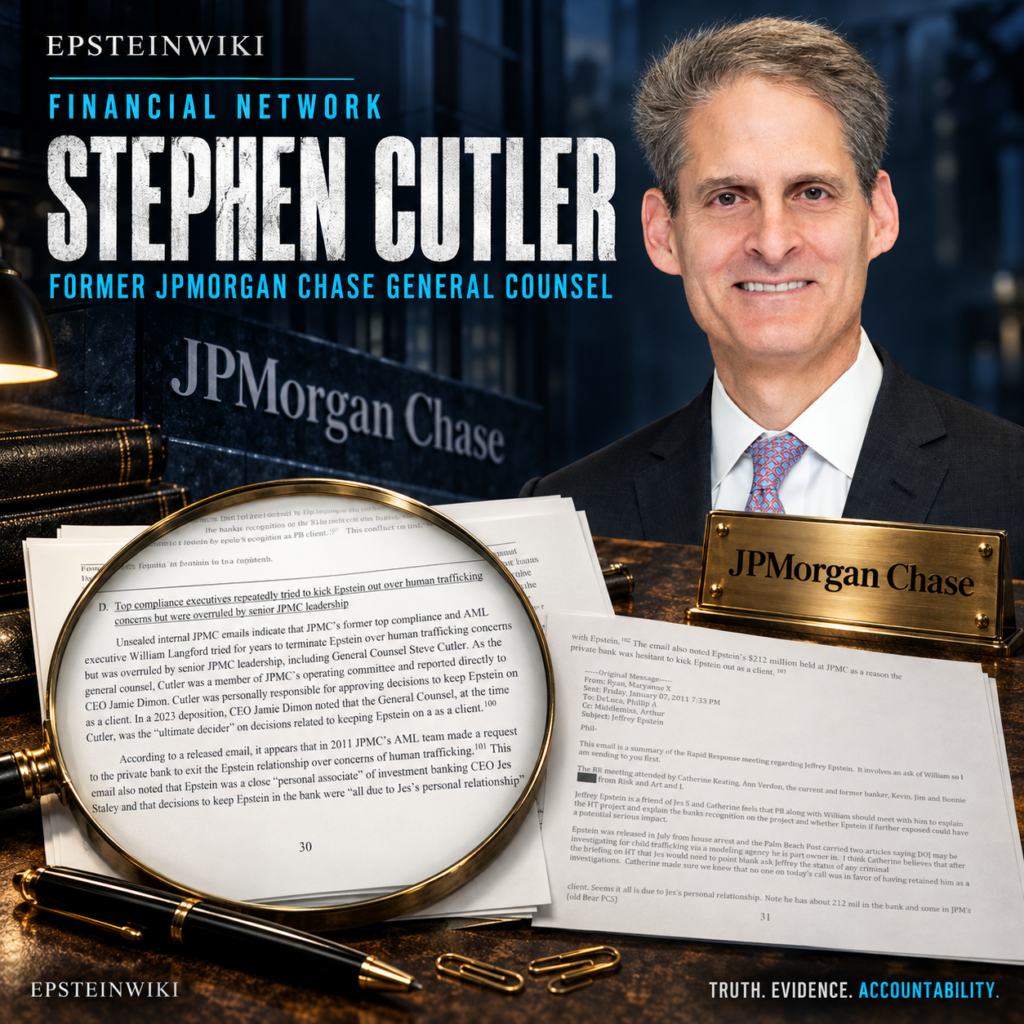
Former JPMorgan Chase general counsel and Securities and Exchange Commission enforcement director who participated in the bank’s decision to retain Jeffrey Epstein after his 2008 conviction, then wrote in 2011 that Epstein was not honorable and should no longer be a client.
Snapshot
Full name: Stephen M. Cutler
Also known as: Stephen Cutler, Steve Cutler
Profession: Lawyer and former financial regulator
Education: Yale University, BA; Yale Law School, JD
Federal service: Deputy Director and then Director of the Securities and Exchange Commission Division of Enforcement
SEC Enforcement Director: October 2001 to May 2005
JPMorgan Chase role: Executive Vice President and General Counsel
JPMorgan Chase tenure: February 2007 to 2018
Position in the Epstein relationship: Senior legal executive consulted on whether the bank should retain Epstein after his criminal conviction
Later employer: Simpson Thacher & Bartlett LLP
Epstein related criminal status: No criminal charge identified as of September 17, 2026
Epstein related civil status: Not an individual defendant in the survivor class action or United States Virgin Islands action against JPMorgan Chase
Individual regulatory status: No public Epstein related sanction against Cutler identified as of September 17, 2026
Key Takeaways
- Stephen M. Cutler was JPMorgan Chase’s general counsel when the bank reconsidered Jeffrey Epstein after Epstein pleaded guilty in Florida in 2008 to state offenses involving prostitution and a minor.
- An internal JPMorgan due diligence record states that Jes Staley conferred with Cutler and that the decision was made to keep Epstein as a private bank client, with limits on the services available to him.
- A 2010 compliance message said Epstein had been approved to remain after his conviction by Cutler. The author warned that keeping him could conflict with the bank’s public work against human trafficking.
- In 2011, anti-money laundering personnel again requested that the private bank exit Epstein. An internal message said no one on a risk call favored retaining him and attributed continued retention to Staley’s personal relationship with Epstein. The same message noted that Epstein held about $212 million at the bank.
- Cutler’s documented position changed. On July 20 and 21, 2011, he wrote that Epstein was not a person with whom the bank should do business, was not honorable, and should not be a client.
- JPMorgan nevertheless continued serving Epstein until 2013. The available public record does not fully establish who delayed or overrode the proposed exit after Cutler’s July 2011 messages.
- JPMorgan chief executive Jamie Dimon testified in 2023 that the company’s general counsel was the ultimate decision maker on client retention and could not be overridden by a businessperson. That testimony describes the office’s authority, but it does not prove that Cutler personally made every decision concerning Epstein.
- A Senate Finance Committee staff report published in 2026 argued that Cutler was personally responsible for approvals that kept Epstein at the bank and included him among thirteen bankers recommended for further investigation. A congressional staff recommendation is not a criminal charge, court judgment, or regulatory finding.
- Senator Ron Wyden sought records concerning two reported meetings between Cutler and Epstein at JPMorgan headquarters in the fall of 2011. JPMorgan did not provide the requested records, according to the Senate staff report. The meetings therefore remain an unresolved reported claim, not an established fact.
- No evidence reviewed for this article establishes that Cutler participated in Epstein’s sexual abuse or trafficking. No public survivor accusation against Cutler personally was identified.
Overview
Stephen M. Cutler held one of the most powerful legal positions at JPMorgan Chase during a critical period in the bank’s relationship with Jeffrey Epstein. He was the company’s general counsel, a member of its operating committee, and a direct report to chief executive Jamie Dimon. Before joining the bank, Cutler had led the Securities and Exchange Commission’s national enforcement program through major corporate fraud investigations.
His relevance to the Epstein record comes from internal bank documents, later litigation, deposition testimony, and congressional investigation. Those records place him in the approval chain after Epstein’s 2008 conviction. They also show that he later urged the bank to end the relationship.
The chronology matters. A description that says only that Cutler approved Epstein’s retention omits his later written opposition. A description that says only that he wanted Epstein removed omits his participation in the earlier retention decision. Both are documented, and the change between them is central to understanding his role.
The remaining gap is institutional. Cutler’s July 2011 messages appear categorical, but JPMorgan did not terminate Epstein until 2013. Public records do not provide a complete decision log showing who had authority at every stage, what action followed each message, or why the account remained open for roughly two more years.
Identity and Education
Stephen M. Cutler is an American lawyer who built his career in securities enforcement, corporate investigations, and senior financial institution management. He earned a bachelor’s degree summa cum laude from Yale University and a law degree from Yale Law School, where he served as an editor of the Yale Law Journal.
After law school, Cutler clerked for Judge Dorothy W. Nelson of the United States Court of Appeals for the Ninth Circuit. He also worked as a visiting fellow at the Center for Law in the Public Interest in Los Angeles.
Cutler then joined Wilmer, Cutler & Pickering in Washington, D.C. He became a partner and developed a practice involving securities enforcement and investigations. The firm later became Wilmer Cutler Pickering Hale and Dorr.
Securities and Exchange Commission Career
Cutler joined the SEC in January 1999 as deputy director of the Division of Enforcement. The Commission named him enforcement director in October 2001. His tenure coincided with the collapse of major public companies and a broad reassessment of corporate governance, accounting, research analyst conflicts, mutual fund practices, and the role of financial intermediaries.
The SEC credited Cutler with overseeing investigations involving Enron, WorldCom, Adelphia, Qwest, Tyco, HealthSouth, and other companies. During his time as director, the agency obtained more than $6 billion in penalties and disgorgement, according to its announcement of his departure. The agency also pursued banks and other financial institutions over their roles in corporate reporting failures.
Cutler left the SEC in May 2005. The significance of this background is not merely biographical. When he later became JPMorgan’s general counsel, he brought extensive experience in regulatory enforcement, institutional controls, reputational risk, and the responsibilities of financial intermediaries.
Joining JPMorgan Chase
JPMorgan Chase appointed Cutler general counsel in February 2007. He became an executive vice president, joined the operating committee, and reported to Jamie Dimon. The general counsel’s office oversaw legal risk across a global bank whose businesses included commercial banking, investment banking, asset management, and private banking.
Cutler arrived after JPMorgan had already begun serving Epstein. Public accounts vary on whether the relationship began in 1998 or 2000, but it lasted until 2013. Epstein became an unusually lucrative private bank client with direct access to senior executives and relationships spread across multiple parts of the institution.
Epstein’s primary champion at the bank was James Edward “Jes” Staley, a senior JPMorgan executive who exchanged more than 1,200 emails with Epstein between 2008 and 2012. Mary Erdoes, John Duffy, relationship managers, risk personnel, compliance staff, and legal executives also appeared in the internal record.
The Senate Finance Committee’s 2026 staff report described Epstein as part of a select group of major clients referred to internally as a “wall of cash.” It said internal records showed that significant decisions about Epstein were overseen by Staley, Erdoes, Duffy, and Cutler.
Epstein’s 2008 Conviction
Epstein pleaded guilty in Florida in June 2008 to procuring a person under eighteen for prostitution and soliciting prostitution. He was sentenced to eighteen months in county jail, served about thirteen months, and was required to register as a sex offender.
The conviction created an unmistakable customer risk issue for JPMorgan. It transformed allegations and press reports into a criminal judgment involving a minor. The bank conducted further due diligence and reviewed whether it should continue the relationship.
An internal due diligence record states that Staley conferred with Cutler and that the decision was made to keep Epstein as a private bank client. The bank restricted the relationship to banking and custody services and removed brokerage execution. The phrasing links Cutler directly to the retention decision, though it does not reproduce the entire discussion or identify every participant in the approval chain.
The record is available in released materials including EFTA02811055 and EFTA01481413. These records should be read as internal bank documentation, not as proof that Cutler knew the full scope of Epstein’s conduct.
The Post-Conviction Retention Decision
The decision to retain Epstein did not restore an ordinary relationship. Restrictions acknowledged that he presented elevated legal and reputational risk. Yet the bank continued to hold and move his money, maintain custody accounts, and provide private banking services after his conviction.
For Cutler, the decision is significant because the general counsel was responsible for protecting the institution from legal and reputational harm. The available record indicates that his office did not merely receive notice. He was consulted before the bank decided to keep Epstein.
The exact date and scope require caution. Some summaries describe the decision as occurring in late 2008, while later due diligence records repeat the earlier conclusion. The surviving records do not disclose a complete memorandum from Cutler setting out his reasoning. It is therefore possible to establish his participation and the resulting retention, but not every fact or legal judgment he considered.
It is also important to separate retention from endorsement. The record does not show Cutler defending Epstein’s conduct or denying the conviction. It shows a senior executive accepting continued banking under limits despite the conviction.
The 2010 Compliance Warning
JPMorgan personnel continued to raise concerns after Epstein left jail. In a 2010 exchange, compliance employee Maryanne Williamson described Epstein in harsh terms and questioned how retaining him could be reconciled with the bank’s participation in an anti-human-trafficking initiative.
Williamson wrote that Epstein had been approved to remain after his criminal conviction by Cutler. The reference is important for two reasons. First, it suggests that Cutler’s role was understood inside compliance as an approval, not simply an informal consultation. Second, it shows that personnel responsible for financial crime risk saw tension between the bank’s public commitments and its treatment of a wealthy client convicted of an offense involving a minor.
The Senate staff report cites JPMorgan litigation records JPM-SDNYLIT-00204777 and JPM-SDNYLIT-00157090 through JPM-SDNYLIT-00157094 for this exchange. Those source numbers originated in federal litigation and should not be confused with the later EFTA numbering system.
No public record reviewed for this article contains a response from Cutler to Williamson’s message. The record therefore establishes the compliance concern and her description of his earlier approval, but not what he knew about the message at the time or whether he took action in response.
The 2011 Anti-Money-Laundering Escalation
By 2011, the case for ending the relationship had intensified. New allegations linked Epstein to human trafficking, and anti-money-laundering personnel asked the private bank to exit him.
An internal message reported that the bank’s AML operations group had gone to a private bank risk meeting and requested that the relationship be terminated. The message said Catherine Keating made clear that no one on the call favored retaining Epstein and that the continued relationship seemed to be due to Staley’s personal connection with him. It also noted that Epstein had about $212 million at the bank.
The combination of personal sponsorship and revenue is central to the institutional record. It suggests that compliance concerns were considered alongside Epstein’s value as a client and Staley’s influence. It does not, by itself, identify the final decision maker at that moment.
The 2026 Senate report cited JPM-SDNYLIT-00152748_R for the escalation. Other released due diligence materials, including EFTA02811055, preserve the broader chronology of retention and review.
Cutler’s July 2011 Demand to Exit Epstein
Cutler’s documented position became unequivocal in July 2011. On July 20, he emailed Staley and Mary Erdoes about Epstein and wrote that he was not a person with whom the bank should do business. He described Epstein as not honorable and said that he should not be a client.
On July 21, Cutler repeated the position, again saying that Epstein was not a person with whom the bank should do business. The repetition indicates more than a casual expression of discomfort. It was a direct recommendation from the bank’s chief legal officer to senior business executives.
The messages were quoted publicly during Dimon’s 2023 deposition and reported by Reuters. They also appear in litigation materials released as EFTA02822837.
These emails materially qualify any claim that Cutler continuously favored retention. The record supports a change over time: he participated in an earlier decision to keep Epstein and later called for his removal.
The reason for that change is not fully documented in public materials. Possible factors include new allegations, repeated compliance escalations, growing reputational risk, or a reassessment of the earlier decision. Without a complete memorandum or testimony from Cutler, the motive should not be stated as fact.
Why Epstein Remained Until 2013
JPMorgan did not immediately implement the position expressed in Cutler’s July 2011 emails. Epstein remained a client for approximately two more years and continued generating substantial revenue.
In May 2012, an internal review ranked Epstein among the private bank team’s top twenty clients by revenue. A 2013 review placed him second among a group of ultra-high-net-worth clients and recorded more than $1.3 million in revenue during the first six months of that year. The Senate report estimated that JPMorgan earned more than $8.1 million in fees connected to Epstein between 2009 and 2014.
The public record does not supply a complete answer for the delay. It does not show a final written resolution to Cutler’s 2011 recommendation, a formal override by a named executive, or a clear timetable assigned by legal or compliance personnel.
That gap creates competing interpretations. Cutler’s title and Dimon’s later description of the general counsel’s authority suggest that he may have had power to force an exit. Cutler’s actual messages, however, show him advocating termination rather than resisting it. A fair account must hold both facts at once and avoid inventing an undocumented chain of command.
JPMorgan eventually terminated Epstein in 2013. Later records described repetitive cash activity and his personal history as creating unacceptable money laundering and regulatory risk. Epstein then moved his primary banking relationship to Deutsche Bank.
Jamie Dimon’s Testimony About Authority
In a May 26, 2023 deposition, Jamie Dimon testified that the ultimate decision maker in a client retention dispute would have been the company’s general counsel. He said that was true at the time and remained true, and that a businessperson could not override that person.
The testimony is relevant because Cutler held the office Dimon described. It strengthens the argument that Cutler had formal authority beyond that of an ordinary adviser. The Senate Finance Committee relied on it when assigning responsibility for the bank’s decisions.
The statement still has limits. Dimon was describing corporate authority in general while testifying years later. It does not identify each Epstein review, establish that Cutler received every escalation, or explain why a recommendation from Cutler in July 2011 did not produce a prompt exit.
Dimon also testified that he had trusted Cutler and Erdoes and believed they were trying to do the right thing. JPMorgan has said that senior executives would not have permitted Epstein to remain if they had known he was continuing to engage in sex trafficking.
Reported Meetings With Epstein
On October 20, 2025, Senator Ron Wyden sent JPMorgan a detailed set of questions about the bank’s handling of Epstein. One question referred to two reported meetings between Cutler and Epstein at JPMorgan headquarters in the fall of 2011. Wyden requested the dates, subject matter, participants, and related communications.
The inquiry did not itself prove that the meetings occurred. It asked the bank to confirm and document a reported event. According to the Senate staff report published in 2026, JPMorgan did not provide a substantive response or the requested underlying records.
Without meeting calendars, visitor logs, minutes, emails, or testimony, the meetings should be described as reported and unresolved. If they occurred, their timing would be significant because they would have followed Cutler’s July statements that Epstein should not remain a client.
The unanswered questions include whether the meetings concerned account termination, legal risk, personal business, or another subject; whether other bank personnel attended; and whether they affected the eventual decision to continue the relationship.
Suspicious Activity Reporting and Institutional Failures
JPMorgan’s handling of Epstein extended beyond client retention. Federal law and bank policy required monitoring and, when warranted, reporting of suspicious transactions.
The 2026 Senate staff report said JPMorgan filed seven suspicious activity reports covering approximately $4.3 million in Epstein related activity before 2019. After Epstein’s 2019 arrest, the bank conducted retrospective reviews and filed reports covering more than 5,000 transfers totaling approximately $1.3 billion.
The contrast does not mean every transaction in the later reports was criminal. Suspicious activity reports are alerts, not findings of guilt. It does demonstrate that the bank identified vastly more activity after public and legal pressure intensified than it reported while Epstein was a client.
No public document reviewed for this article shows that Cutler personally prepared, blocked, or approved a particular suspicious activity report. The reporting failures are part of the institutional context surrounding his client retention role, not proof of an individual Bank Secrecy Act violation by him.
Departure From JPMorgan and Later Career
Cutler served as JPMorgan’s general counsel through the financial crisis and years of major litigation and regulatory settlements. He later became vice chairman of the firm and remained at JPMorgan until 2018.
He then joined Simpson Thacher & Bartlett as a partner. His practice focused on government and internal investigations, regulatory matters, and crisis management. The Senate Finance Committee’s 2026 report stated that he retired from the firm in 2025.
Cutler’s later professional profile continued to emphasize the same expertise that made his JPMorgan role consequential: enforcement, investigations, regulatory judgment, and institutional risk.
Civil Litigation and Settlements
Epstein survivors brought a proposed class action against JPMorgan alleging that the bank knowingly benefited from and facilitated Epstein’s trafficking enterprise. The United States Virgin Islands separately sued the bank over its handling of Epstein.
In 2023, JPMorgan agreed to pay $290 million to settle the survivor class action. The court granted final approval in November 2023. The settlement resolved claims against the bank without a trial and without an admission of liability.
JPMorgan also agreed to pay $75 million to resolve the Virgin Islands action. The agreement allocated $30 million to charitable organizations, $25 million to anti-trafficking efforts, and $20 million for legal fees. The bank did not admit wrongdoing. It separately reached a confidential settlement with Staley.
Cutler was not an individual defendant in either action. Documents and testimony from the cases nonetheless made his role public, including the 2011 emails and testimony about the authority of the general counsel.
A settlement is not a verdict against every employee whose name appears in the record. The cases established significant financial and institutional consequences for JPMorgan while leaving individual legal responsibility to be assessed separately.
Senate Finance Committee Findings
Senator Wyden’s staff published a report in August 2026 examining how financial institutions served Epstein and handled suspicious activity. The report concluded that senior bank executives, not only relationship managers, were involved in consequential decisions.
The report said Cutler was personally responsible for approving decisions to keep Epstein as a client and emphasized his status as general counsel, operating committee member, and direct report to Dimon. It contrasted the bank’s internal knowledge with its limited contemporaneous suspicious activity reporting.
The staff included Cutler among thirteen bankers it said should face further criminal or regulatory investigation. It also criticized JPMorgan for failing to answer detailed questions and provide requested records.
These are congressional investigative conclusions and recommendations. The report did not charge Cutler with a crime, impose a penalty, or adjudicate a civil claim. As of September 17, 2026, no public record reviewed for this article showed an Epstein related criminal charge or individual regulatory sanction against him.
Relevant Timeline
January 1999: Cutler joins the SEC as deputy director of the Division of Enforcement.
October 2001: The SEC names him director of enforcement.
May 2005: Cutler leaves the SEC for private practice.
February 2007: JPMorgan Chase appoints Cutler executive vice president and general counsel.
June 2008: Epstein pleads guilty in Florida to state offenses involving prostitution and a minor.
Late 2008: An internal due diligence record states that Staley conferred with Cutler and that the bank decided to retain Epstein as a private bank client with restricted services.
2009: Epstein leaves county custody after serving approximately thirteen months.
2010: A compliance employee says Epstein was approved to remain after conviction by Cutler and questions the conflict with JPMorgan’s anti-human-trafficking work.
Early 2011: Due diligence and AML concerns escalate amid additional trafficking allegations.
July 20, 2011: Cutler writes to Staley and Erdoes that Epstein is not honorable and should not be a client.
July 21, 2011: Cutler repeats that Epstein is not a person with whom the bank should do business.
Fall 2011: Two meetings between Cutler and Epstein at JPMorgan headquarters were later reported. Their occurrence and substance remain unconfirmed in the public record.
2012: Epstein remains a major revenue producing private bank client.
2013: JPMorgan ends the Epstein relationship. Epstein moves his primary banking to Deutsche Bank.
2018: Cutler leaves JPMorgan and joins Simpson Thacher.
May 26, 2023: Dimon testifies that the general counsel was the ultimate decision maker on client retention and could not be overridden by a businessperson.
June 2023: JPMorgan agrees to a $290 million settlement with Epstein survivors.
September 2023: JPMorgan agrees to a $75 million settlement with the United States Virgin Islands.
October 20, 2025: Senator Wyden sends JPMorgan detailed questions about Cutler’s decisions, communications, and reported meetings with Epstein.
2025: Cutler retires from Simpson Thacher, according to the Senate staff report.
August 2026: Senate Finance Committee staff publish their Wall Street and Epstein report and recommend further investigation of Cutler and twelve other bankers.
Legal and Evidentiary Limits
The evidence establishes that Cutler participated in the decision to retain Epstein after his conviction and later called for his removal. It does not establish that Cutler participated in Epstein’s abuse, recruited victims, handled payments to victims, or knew the complete scope of the trafficking enterprise.
Internal records should be interpreted according to what they actually say. A due diligence statement that Staley conferred with Cutler supports consultation and shared involvement in the resulting decision. A compliance employee’s statement that Cutler approved retention supports how the decision was understood within the bank. Neither record reveals every conversation or piece of information available to him.
Cutler’s 2011 messages are direct evidence of his position at that time. They do not explain why the bank delayed termination, nor do they erase his earlier role.
Dimon’s testimony about general counsel authority is relevant but not conclusive proof of Cutler’s conduct in each review. The reported fall 2011 meetings remain unverified. The Senate staff report is an investigative assessment, not an adjudication.
No Epstein related criminal charge, individual civil judgment, or regulatory sanction against Cutler was identified as of the article date. Future document releases, testimony, or official findings could change the public record.
Why Cutler Matters to the Epstein Record
Cutler’s importance lies in institutional accountability. The Epstein banking controversy is sometimes framed as the product of a single relationship manager or Staley’s personal friendship. The documents show that the issue reached the bank’s top legal officer and other senior leaders.
His record also illustrates why chronology matters. Senior officials may approve risk at one stage and reverse course later. Accountability requires examining both decisions, the information available at each point, and whether a later warning produced effective action.
The unanswered question is not whether Cutler eventually objected. His words are clear. The question is how a bank whose chief legal officer said Epstein should not be a client continued the relationship until 2013.
Related EpsteinWiki Pages
- Jeffrey Epstein
- JPMorgan Chase
- Jes Staley
- Mary Erdoes
- John Duffy
- Maryanne Williamson
- Catherine Keating
- Mary Casey
- Paul Morris
- Jamie Dimon
- Stewart Martin Oldfield
- Deutsche Bank
- United States Virgin Islands v. JPMorgan Chase Bank
Open Questions
- What information did Cutler review before the post-conviction decision to retain Epstein?
- Did Cutler issue a formal legal approval, a recommendation, or a concurrence with a business decision?
- What new information caused him to demand Epstein’s removal in July 2011?
- Who received and acted on Cutler’s July 2011 messages?
- Was a formal account termination plan opened after those messages?
- Who decided that Epstein could remain until 2013, and on what grounds?
- Did Cutler meet Epstein at JPMorgan headquarters in the fall of 2011?
- If the meetings occurred, what was discussed and who else attended?
- Did JPMorgan’s board or a board committee receive notice of the retention dispute?
- Why did contemporaneous suspicious activity reports cover only a small fraction of the activity JPMorgan later flagged?
- What records remain nonpublic or withheld from congressional investigators?
Sources
- United States Senate Finance Committee, How Wall Street Banks Enabled Jeffrey Epstein’s Sex Trafficking, 2026
- Senator Ron Wyden, JPMorgan Chase Epstein inquiry, October 20, 2025
- Reuters, JPMorgan says Dimon never had discussions with former executive over Epstein, May 31, 2023
- Reuters, JPMorgan pays $75 million to settle lawsuit over Jeffrey Epstein ties, September 26, 2023
- SEC, Enforcement Director Stephen M. Cutler to Leave Commission, April 14, 2005
- EFTA02822837, litigation material containing the July 2011 Cutler email
- EFTA02811055, JPMorgan due diligence material
- EFTA01481413, JPMorgan due diligence material
- Government of the United States Virgin Islands v. JPMorgan Chase Bank, expert report of Edward Amador
- Government of the United States Virgin Islands v. JPMorgan Chase Bank, JPMorgan due diligence exhibit