
Apollo Global Management
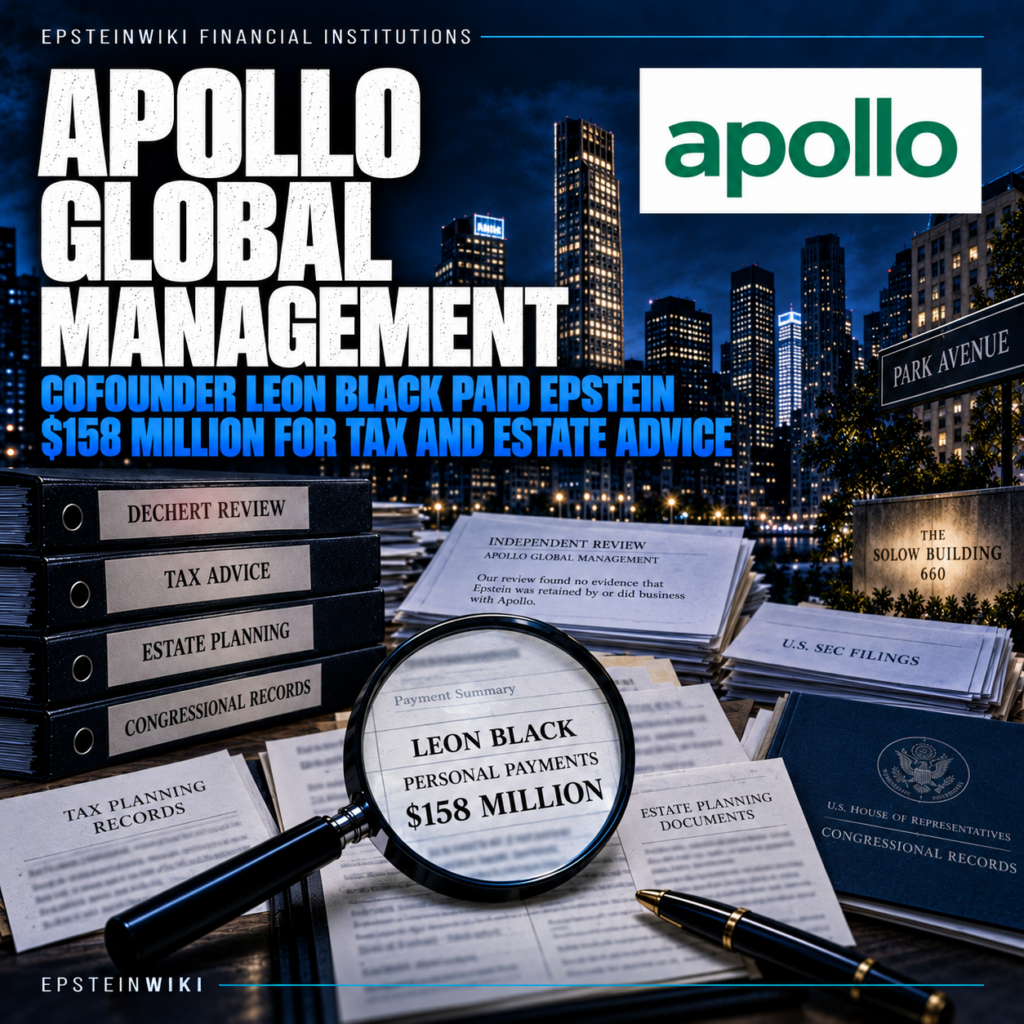
How a private relationship between Jeffrey Epstein and Apollo cofounder Leon Black reached into family office work, Apollo equity, executive calendars, corporate governance, and continuing congressional scrutiny
1. Snapshot
Apollo Global Management, Inc. is a publicly traded global alternative asset manager headquartered in New York. It was founded in 1990 by Leon Black, Josh Harris, Marc Rowan, and other former Drexel Burnham Lambert professionals. Marc Rowan is now chairman and chief executive officer. Apollo reported approximately $1.05 trillion in assets under management as of June 30, 2026, according to its second quarter 2026 results.
The central Epstein issue is not that Apollo has been proved to have hired Jeffrey Epstein. It has not. The central issue is that Apollo’s then chairman and chief executive, Leon Black, paid Epstein extraordinarily large sums while Epstein worked on Black family structures containing Apollo interests; Apollo personnel helped schedule meetings involving Epstein; Epstein communicated directly with Apollo cofounders; and an Epstein entity owned Apollo’s publicly traded stock. Apollo’s board commissioned Dechert LLP to investigate. The resulting January 2021 report said Black paid Epstein $158 million from 2012 through 2017, while a later Senate Finance Committee investigation identified approximately $170 million.
Entity specific assessment: Level 3 of 5, meaning substantial documented access, overlap, and institutional consequence, but no public finding that Apollo contracted with Epstein, paid him, invested fund assets with him, or knowingly assisted his crimes.
Evidence rule: Connection is not culpability; classify by sources.
2. Overview
Apollo matters to the Epstein record because the border between a founder’s private affairs and a powerful institution was unusually porous. Black was not a peripheral employee. He was Apollo’s cofounder, controlling public face, chairman, and chief executive. Epstein’s work concerned Black’s wealth, much of which derived from Apollo. Some correspondence moved through Apollo email accounts, assistants, offices, and family office personnel whose signatures gave Apollo’s headquarters as their address.
That does not erase legal distinctions. Black and his family entities were separate from Apollo. A meeting placed on an Apollo executive’s calendar is not proof of a completed meeting, a corporate mandate, or misconduct. Publicly purchased stock is not an investment in an Apollo managed fund. This article therefore tests each proposition separately.
Apollo’s institutional story has four phases. First came the private relationship, particularly the 2012 to 2017 payment period. Second came public disclosure and the board commissioned Dechert review in 2020 and 2021. Third came Black’s departure and Apollo’s governance transition. Fourth came renewed scrutiny after congressional inquiries and the release of more documents under the Epstein Files Transparency Act, including shareholder suits filed in 2026 that challenge Apollo’s prior public descriptions. Those suits remain allegations, not adjudicated facts.
3. Legal Identity and Corporate History
Apollo began operations in 1990 after Drexel Burnham Lambert collapsed. Its founders built a distressed debt and private equity business that expanded into credit, real assets, retirement services, and capital solutions. Apollo became publicly traded in 2011. Its current parent is Apollo Global Management, Inc., a Delaware corporation whose common stock trades on the New York Stock Exchange under APO.
Apollo’s official history records several structural milestones. The firm broadened beyond traditional buyouts, developed a major credit platform, and built a close strategic relationship with retirement services company Athene. In January 2022, Apollo completed an all stock merger with Athene and adopted a simplified corporate structure. The distinction among Apollo Global Management, Apollo Asset Management, Athene, individual funds, portfolio companies, and founder controlled family entities is essential. A document naming one should not automatically be attributed to all.
As of the 2026 proxy statement, the public parent operated through consolidated subsidiaries and was governed by a board elected by shareholders. Apollo’s principal executive offices were listed at 9 West 57th Street in New York, the same address that appears in some historical correspondence from Black family office personnel. Address overlap is evidence of operational proximity. It is not, by itself, evidence that the corporation was party to the underlying work.
4. Ownership, Control, and Leadership
During the years of Black’s documented payments to Epstein, Black was Apollo’s chairman and chief executive officer. He possessed immense economic influence and symbolic authority. Marc Rowan and Josh Harris were fellow cofounders and senior leaders. That concentration makes Apollo’s governance response relevant even when the payments came from Black or Black family entities.
Apollo announced in January 2021 that Rowan would succeed Black as chief executive. Black initially planned to remain chairman, but on March 21, 2021, he resigned from all Apollo positions. Apollo disclosed that transition in its filings, and Reuters reported that former Securities and Exchange Commission chair Jay Clayton would become nonexecutive chairman. Harris later left day to day responsibilities.
Apollo’s current leadership includes chairman and chief executive Marc Rowan, president Jim Zelter, and asset management co presidents Scott Kleinman and John Zito. The current leadership directory and 2026 proxy identify the responsible executives and directors. Current management should not be assigned Black’s conduct by association. It should be evaluated on what it knew, disclosed, investigated, corrected, and told investors.
5. Organizational Structure
Apollo is not one undifferentiated pool of assets. Its public parent oversees an asset management business and retirement services operations associated with Athene. Beneath those sit regulated subsidiaries, advisory entities, funds, special purpose vehicles, and portfolio investments. Apollo manages money for pension systems, insurers, sovereign entities, institutions, and individuals.
The Epstein record most often intersects with four legally distinct structures:
- Apollo Global Management and predecessor operating entities, where Black served as chairman and chief executive.
- Black Family Partners and related Black trusts or entities, which held economic interests connected with Apollo.
- Black’s family office personnel, some of whom worked from Apollo’s address or used signatures referencing Apollo.
- Epstein controlled entities, including Southern Trust Company, Financial Trust Company, and related accounts that received payments or held securities.
Investigators should preserve those labels. An email from “Black Family Partners, c/o Apollo Management” is stronger than a purely social contact because it documents institutional infrastructure. It is still not the same thing as an Apollo engagement letter, invoice, board authorization, or payment.
6. Background and Ordinary Operations
Apollo raises and manages investment vehicles, originates credit, acquires and finances businesses, and provides retirement income services through its broader group. Its scale gives it relationships with banks, regulators, public pension systems, elected officials, universities, labor funds, and governments. That reach explains why accuracy about its Epstein connection matters: overstatement can mislead millions of stakeholders, while understatement can conceal a governance failure at a systemically influential institution.
Apollo describes its contemporary strategy as investment grade private credit, equity, real assets, capital solutions, and retirement services. Its public disclosures include audited financial statements, risk factors, governance policies, and regulatory filings. These ordinary records provide the baseline against which unusual evidence should be tested.
There is no evidence that Epstein had a role in Apollo’s founding, investment committees, portfolio management, underwriting, or formal governance. The documented overlap is concentrated in Black’s private wealth planning, his Apollo derived economic interests, contacts with certain senior figures, use of Apollo based staff, and Epstein’s ownership of publicly traded shares.
7. Documented Connection to Jeffrey Epstein
The most authoritative corporate account is the Dechert report released by Apollo. The conflicts committee retained Dechert in October 2020. According to Apollo, reviewers examined more than 60,000 communications and interviewed more than 20 people.
Dechert concluded that Epstein advised Black on trust and estate planning, tax matters, philanthropy, and family office operations. It calculated payments of $158 million from 2012 through 2017. The report said Epstein was never retained by Apollo and never invested in an Apollo managed fund. It also said no Apollo executive other than Black retained Epstein for personal services.
The same report contains facts that prevent “no Apollo contract” from ending the inquiry. It states that Epstein attempted to ingratiate himself with senior Apollo executives and used Black to seek introductions. It records that Financial Trust Company bought 263,257 Apollo shares in the 2011 public offering and later transferred them to another Epstein entity. It also acknowledges that Black and relevant Apollo or family office personnel knew about Epstein’s 2008 conviction.
Released correspondence adds texture. EFTA01928186 is an April 2014 email from Black’s executive assistant, using an Apollo Management signature, asking Epstein whether he wanted lunch with Black. EFTA01755147 contains a confirmation that Black would have lunch at Epstein’s house. EFTA01754335 is a direct 2013 email from Josh Harris trying to reschedule an in person conversation. EFTA01755467 records Apollo assistants coordinating possible availability for Marc Rowan. These documents prove communications and scheduling. Unless corroborated, a scheduled appointment does not prove that a meeting occurred or establish its subject.
8. Timeline
| Date | Event | Evidentiary meaning |
|---|---|---|
| 1990 | Apollo is founded. | Establishes Black, Rowan, and Harris as institutional principals. |
| 2008 | Epstein pleads guilty in Florida to state prostitution related offenses, including an offense involving a minor. | By the later review’s account, Black and relevant personnel knew of the conviction. |
| March 2011 | Apollo completes its public offering. | Epstein’s Financial Trust Company purchases publicly traded shares. |
| 2012 to 2017 | Black and related entities pay Epstein $158 million according to Dechert, approximately $170 million according to Senate Finance. | Core financial relationship; amount differs by source scope and records reviewed. |
| March 2013 | Family office correspondence discusses Apollo rollup interests and values with Epstein. | Shows work on Black wealth that depended on Apollo interests. |
| August to November 2013 | Emails coordinate possible contacts between Epstein, Rowan, Harris, and Black. | Proves access and scheduling, not necessarily completed meetings or corporate work. |
| 2014 | Emails discuss Apollo tax receivable agreement calculations and ownership of Apollo units. | Shows detailed Apollo related data inside Black’s private planning work. |
| April 2017 | Dechert identifies Black’s last payment to Epstein. | End of documented payment period in that review. |
| Fall 2018 | Dechert says Black ended communications with Epstein. | Claimed termination date. |
| July 2019 | Epstein is arrested on federal sex trafficking charges. | Public scrutiny of associates intensifies. |
| October 2020 | Apollo’s conflicts committee retains Dechert. | Formal independent review begins. |
| January 25, 2021 | Apollo releases Dechert findings and announces Rowan as successor. | Institutional response and disclosure. |
| March 21, 2021 | Black resigns from all Apollo roles. | Ends his formal leadership. |
| January 2023 | Black resolves potential US Virgin Islands claims through a settlement without admitting liability. | Settlement states his payments partially funded Epstein’s Virgin Islands operations. |
| March 2025 | Senate Finance says its records show about $170 million in payments. | Challenges the completeness of the $158 million total. |
| February 2026 | Apollo sends clients and partners a renewed defense of its prior conclusions after new document releases. | Current institutional position. |
| March and April 2026 | Shareholders file federal securities class actions against Apollo and certain officers. | Allegations that prior public statements were misleading; no merits ruling yet. |
| August 2026 | Senate Finance publishes its report on bank compliance failures and Epstein financing. | Places Black’s payments in a broader financial network. |
| September 2026 | Black disputes House Oversight subpoenas in federal court after not appearing for a scheduled deposition. | Ongoing scrutiny of the former leader, not an adjudication against Apollo. |
9. Evidence Appearances
Apollo appears in the documentary record in several forms. Each form carries a different evidentiary weight.
Board commissioned report: EFTA02730996 is the direct Epstein Data copy of the Dechert report. It is highly useful for chronology, the stated scope of the review, payment calculations, and Apollo’s institutional position. Because Apollo’s board commissioned it and Dechert relied partly on material supplied by Black and Apollo, it is not the last word on every disputed fact.
Bank and transaction records: EFTA00027019 compiles transactions involving Black or related entities and Epstein connected accounts. It includes large transfers to Southern Trust Company. Bank records are strong evidence that money moved, but the memo line or surrounding explanation must be used to identify purpose.
Tax and estate correspondence: EFTA02033086 asks for an entity by entity account of ownership of 94 million Apollo units and tax allocations. EFTA01927852 discusses tax receivable agreement worksheets, including Apollo values. EFTA01896435 discusses interests converted during the Apollo rollup. These records directly connect Epstein’s compensated work for Black to Apollo derived assets.
Calendars and email: Messages bearing Apollo signatures document access, introductions, and scheduling. They should not be inflated into proof of agreement or completed conduct unless follow through records exist.
Securities statements: EFTA01556676 reports an Epstein entity holding 263,157 Apollo shares in 2012. That is evidence of public stock ownership, not participation in a fund managed by Apollo.
Witness and law enforcement material: EFTA00087968, EFTA00096366, and EFTA01246236 preserve allegations concerning Black. They establish that statements were made to investigators. They do not independently establish that every allegation is true, and they do not convert a claim against Black into a finding against Apollo.
10. Evidence Matrix
| Proposition | Best evidence | Status | Important limit |
|---|---|---|---|
| Black paid Epstein at least $158 million | Dechert report and bank records | Established | Later Senate review identified about $170 million. |
| Apollo itself retained Epstein | No contract, invoice, board approval, or Apollo payment identified | Not established | Work on Apollo related assets is not identical to a corporate engagement. |
| Epstein invested in Apollo managed funds | Dechert said he did not | Not established | He did hold publicly traded Apollo shares. |
| Apollo staff facilitated access | Emails from executive assistants and scheduling chains | Established | Administrative facilitation does not prove knowledge of wrongdoing. |
| Epstein worked on Black’s Apollo holdings | Tax, estate, and TRA correspondence | Established | The client described by Apollo was Black, not the firm. |
| Epstein contacted other Apollo cofounders | Direct and scheduling emails involving Harris and Rowan | Established | The subject and completion of every planned meeting are not established. |
| Apollo knew of Epstein’s 2008 conviction | Dechert account regarding Black and relevant personnel | Established within review record | Knowledge of a conviction is not proof of knowledge of later criminal activity. |
| Apollo knowingly financed Epstein’s crimes | No public court or regulator finding | Not established | A USVI settlement says Black’s payments partially funded Epstein’s operations. |
| Apollo’s prior statements violated securities law | Pending Feldman and Perez complaints | Alleged | Courts have not decided the merits as of September 8, 2026. |
11. Epstein Data Evidence Files
The following files are priority reading. They are linked to the page level record on Epstein Data, EpsteinWiki’s evidence partner.
- EFTA02730996, Dechert review: the full report commissioned by Apollo’s conflicts committee.
- EFTA00027019, Black and Rothschild group transactions: a transaction schedule showing multimillion dollar transfers to Southern Trust.
- EFTA02033086, Apollo unit ownership and estate planning: a request to detail ownership and tax allocation for 94 million Apollo units.
- EFTA01927852, TRA worksheets: tax receivable agreement calculations comparing values associated with Apollo and Empire.
- EFTA01896435, Apollo rollup interests: family office correspondence about converted interests and values.
- EFTA01928186, lunch inquiry: Black’s Apollo executive assistant asks Epstein about lunch.
- EFTA01755147, lunch confirmation: an Apollo signed message confirms lunch at Epstein’s house.
- EFTA01754335, Josh Harris email: Harris proposes an in person conversation at Epstein’s residence.
- EFTA01755467, Marc Rowan scheduling chain: assistants coordinate potential Rowan availability.
- EFTA01556676, Financial Trust securities statement: reports an Epstein entity’s Apollo public shareholding.
- EFTA00087968, FBI interview memorandum: records a witness allegation concerning Black.
- EFTA00096366, prosecutor interview notes: records additional allegations concerning Black.
- EFTA01246236, FBI interview: a longer witness account that requires allegation labeling and corroboration.
- EFTA02731485, investigative referral email: documents internal coordination about a Black related referral.
- EFTA02731636, referral follow up: documents further coordination, not a finding.
Readers should compare OCR against page images before quoting. OCR can garble names, numbers, symbols, and email addresses. See How to Vet Tips, Sources, and Whistleblowers and the Epstein Files Evidence Framework for the required workflow.
12. Key People Connected to the Organization
Leon Black: Apollo cofounder, former chairman, and former chief executive. Black acknowledged the advisory relationship and payments but has maintained that Epstein’s services were legitimate and valuable. He has denied sexual misconduct allegations. Black left Apollo in March 2021.
Jeffrey Epstein: Convicted sex offender who advised Black after his 2008 conviction, received the payments at issue, communicated with Apollo personnel and leaders, and held publicly traded Apollo shares through an entity.
Marc Rowan: Apollo cofounder and current chairman and chief executive. Released scheduling correspondence shows an effort to arrange contact with Epstein. Apollo said in February 2026 that Rowan had no personal or business relationship with Epstein and that interactions related to Black’s tax matters. The Reuters account noted that scheduled meetings do not prove all meetings occurred.
Josh Harris: Apollo cofounder and former senior executive. A released email documents his attempt to arrange an in person conversation with Epstein. The record cited here does not establish a retained advisory relationship.
Melanie Spinella and Elizabeth Irene: Executive assistants whose emails document scheduling through Apollo infrastructure. Their administrative role does not establish knowledge of the purpose or criminal context of Black’s relationship.
Black family office professionals: Ada Clapp, Eileen Alexanderson, Richard Joslin, and other advisers appear in correspondence concerning trusts, Apollo units, valuations, and tax matters. Their exact employer and client at the time should be checked document by document.
Apollo’s conflicts committee and Dechert LLP: The board committee commissioned the 2020 review. Dechert assembled the corporate account released in January 2021.
13. Financial Relationship
The financial relationship was between Black or Black related entities and Epstein or Epstein related entities. Dechert calculated $158 million paid from 2012 to 2017. Senate Finance later said Bank of America records showed approximately $170 million. The $12 million difference is not trivial. It demonstrates how a review’s source population and definitions affect totals.
Dechert said Epstein proposed and advised on strategies that could produce very large tax savings for Black and his family. It found signed and unsigned agreements from 2013, followed by more ad hoc arrangements. Critics, including Senator Ron Wyden, have argued that the compensation vastly exceeded ordinary professional fees and that Black has not adequately explained it. Black has defended the value and legitimacy of the advice.
The January 2023 USVI settlement resolved potential territorial claims without an admission of liability. It required a payment reported as $62.5 million and stated that money Black paid Epstein partially funded Epstein’s Virgin Islands operations. A settlement is not a criminal conviction or civil merits judgment. Its language is nevertheless material because it links a documented funding stream to Epstein’s operating capacity.
There is no identified Apollo corporate payment to Epstein in the sources reviewed here. Investigators should not relabel Black Family Partners, a trust, or Black personally as Apollo merely because an address, employee, or asset overlapped.
14. Communications and Meetings
The correspondence shows that Epstein could reach people near the top of Apollo. That is institutionally significant. It is not rare for a billionaire founder’s personal network to touch executive calendars, but Epstein’s status as a convicted sex offender makes the access a governance concern.
Three levels of proof should be kept separate:
- A message exists. This is established by the released email.
- A meeting was scheduled. This is established when assistants agree on a time or confirm plans.
- The meeting occurred and had a defined purpose. This generally requires a calendar completion record, follow up, participant account, travel record, or substantive correspondence.
The Harris email in EFTA01754335 is direct and substantive enough to establish intended contact. The Rowan chain in EFTA01755467 establishes scheduling activity. Apollo’s 2026 statement said Rowan’s interactions concerned Black’s tax matters and denied a personal or business relationship. A responsible account presents both the document and the response.
15. Properties, Assets, and Operations
Apollo’s 9 West 57th Street headquarters appears repeatedly in historical signatures. Black family office personnel used “c/o Apollo Management” or Apollo addresses while discussing private trusts and Apollo interests with Epstein. This matters because offices, systems, and staff can create institutional access even when the legal client is an individual.
Apollo equity was also a core asset in the planning work. EFTA02033086 refers to 94 million Apollo units and asks for ownership and tax allocation details. EFTA01927852 contains calculations concerning Apollo’s tax receivable agreement. These are not passing name mentions. They show Epstein receiving granular information about wealth tied to Apollo.
Separately, Epstein’s Financial Trust Company held public Apollo shares. The Dechert report gives 263,257 shares at the 2011 offering, while a later statement at EFTA01556676 appears to report 263,157. That 100 share discrepancy should be treated as a source difference requiring reconciliation, not silently harmonized. Neither number establishes that Apollo accepted Epstein as a private fund investor.
16. Lawsuits, Investigations, and Regulatory Actions
No public criminal charge has accused Apollo of participating in Epstein’s trafficking operation. No regulator or court has publicly found that Apollo retained Epstein or knowingly facilitated his crimes.
The principal institutional inquiry was the Dechert review. Senate Finance then pursued Black’s payments and the banks that processed them. Its August 2026 report focused on failures by JPMorgan Chase, Deutsche Bank, and Bank of America to identify or timely report suspicious activity. It used Black’s payments as a major case study in Epstein’s financing.
In 2026, investors filed Feldman v. Apollo Global Management, Inc., case 1:26-cv-01692, and Perez v. Apollo Global Management, Inc., case 1:26-cv-03550, in the Southern District of New York. Apollo’s SEC contingency disclosure says the complaints allege that statements made in 2021 and 2022, including that Apollo had never done business with Epstein, were materially false or misleading. Apollo says it will vigorously defend the cases. As of September 8, 2026, complaints are allegations and no public merits decision establishes liability.
The American Federation of Teachers and American Association of University Professors also sent the SEC a February 2026 request for investigation. A request to investigate is not confirmation that the SEC opened a case, much less a finding of wrongdoing.
17. Allegations and Responses
Allegations concerning Black include sexual assault, coercion, and abuse claims reported by women and preserved in court filings, journalism, and law enforcement interview records. Black has denied sexual misconduct. Some disputes have been dismissed, withdrawn, settled, or remain contested. Each requires its own procedural history. This organization page does not treat an allegation against Black as an allegation against every Apollo employee or fund.
Independent researchers have helped surface and organize records. Ellie Leonard’s “Back to Black” examines Black’s Epstein relationship and survivor centered materials. Bekah Day’s overview of names associated with continuing congressional scrutiny summarizes the competing payment totals, settlement, and allegations. These are useful research leads, not substitutes for the underlying interview, pleading, bank record, or official report.
Apollo’s February 2026 letter to clients and partners defended the Dechert review and the firm’s statements. Apollo has continued to distinguish Black’s private dealings from Apollo’s business. Any challenge to that position should specify whether it concerns legal contracting, use of resources, executive access, securities ownership, disclosure wording, or knowledge.
18. Court and Regulatory Findings
The record includes far fewer adjudicated findings than public debate often implies.
Established through official records: Epstein was convicted in Florida in 2008. Apollo’s board commissioned the Dechert review. Black paid Epstein or Epstein entities very large sums. Black resigned from Apollo. Black entered a USVI settlement without admitting liability. Shareholder suits were filed in 2026.
Not adjudicated against Apollo: No public judgment finds that Apollo hired Epstein, concealed a corporate engagement, financed trafficking, violated securities law through the challenged statements, or knowingly supplied resources for abuse.
Pending or investigative: The shareholder cases are pending. Congressional inquiries continue. The AFT and AAUP asked the SEC to investigate. Black’s September 2026 dispute with the House Oversight Committee concerns subpoena authority and his proposed testimony. Associated Press and Reuters reported that dispute. It is not a ruling on the underlying Epstein facts.
19. Institutional Response
Apollo’s strongest response was commissioning an outside review, publishing it as an SEC exhibit, changing leadership, and creating distance between Black and the firm. The review disclosed facts that were damaging to its founder, including the amount paid, knowledge of Epstein’s conviction, share ownership, and outreach to other executives. That degree of detail gives the report substantial evidentiary value.
The response also has limitations. Dechert was retained by an Apollo board committee, not a government investigator. Its $158 million total was later exceeded by bank records reviewed by Senate Finance. New releases produced additional communications that critics say complicate broad statements that Apollo never did business with Epstein. The question is partly semantic: a narrow legal statement about retention can be accurate while a broad public impression of total separation can still be incomplete.
Apollo’s current task is therefore continuing disclosure, preservation, and reconciliation. It should explain which systems were searched, which personal or family office repositories were unavailable, how the $12 million difference arose, which scheduled meetings occurred, and whether company resources used for Black’s private affairs were reimbursed or governed by policy.
20. Survivor Impact
The payments cannot be discussed only as a corporate governance problem. The USVI settlement expressly states that money Black paid Epstein partially funded his Virgin Islands operations. Epstein’s operations were the environment in which women and girls were recruited, exploited, transported, paid, and controlled.
That does not prove Black or Apollo knew how every dollar was used. It does mean the funding question is not abstract. Large payments after Epstein’s conviction increased his liquidity, status, and capacity. Survivors seeking a full financial accounting are asking who supplied resources, which institutions processed them, what warning signs were visible, and why intervention failed.
Responsible coverage should avoid publishing survivor identities where they remain protected, reproducing graphic claims unnecessarily, or presenting uncorroborated allegations as entertainment. See Contributor Safety Guide, Privacy Safeguards for Minors, and Volunteer Conduct Code.
21. What the Evidence Establishes
The evidence establishes that Black maintained a paid relationship with Epstein years after Epstein’s 2008 conviction. It establishes that the relationship was financially enormous and lasted through 2017. It establishes that Black’s private tax and estate work involved detailed Apollo equity, tax receivable, and ownership information.
It establishes that Apollo infrastructure was not wholly insulated. Executive assistants using Apollo accounts facilitated communications and calendars. Black family office personnel worked from or referenced Apollo’s headquarters. Epstein communicated with or sought meetings involving Harris and Rowan. Epstein also owned publicly traded Apollo shares through an entity.
It establishes institutional consequence. Apollo’s board investigated, Black left, leadership changed, clients received explanations, Congress examined the payments, unions sought regulatory review, and shareholders sued over disclosure language.
22. What Is Not Established
The public record reviewed here does not establish that Apollo signed an engagement with Epstein, paid him corporate funds, accepted him into an Apollo managed investment fund, gave him investment authority, or knowingly assisted his crimes.
It does not establish that every proposed meeting with Rowan, Harris, or Black occurred. It does not establish that every Apollo employee who appears in an email knew Epstein’s criminal history or understood the scope of his relationship with Black. It does not establish that current Apollo leadership shares responsibility for Black’s private conduct.
It also does not establish that the Dechert report resolved every material question. The payment total changed when Senate investigators reviewed a different record set. Released correspondence supplies additional detail. Pending litigation may test whether Apollo’s public wording accurately conveyed the known overlap. Until a court rules, those securities claims remain allegations.
23. Involvement Scale Assessment
Assessment: Level 3 of 5, substantial documented connection and institutional overlap.
Under the Epstein Network Levels of Involvement Scale, Level 3 fits an organization with repeated, documented operational overlap or meaningful access whose evidence does not establish knowing participation in Epstein’s crimes.
Apollo exceeds Level 2 because this was not a stray name, single social event, or passive directory entry. Its controlling leader paid Epstein over several years; Apollo related wealth was central to the work; staff and office infrastructure appear in the record; other cofounders were approached; and the fallout materially changed governance.
Apollo does not reach Level 4 on the current public record because no corporate retention, corporate payment, fund relationship, knowing facilitation, or adjudicated cover up has been established. Black’s personal assessment may differ from Apollo’s entity assessment because the evidence concerning him is more direct. The score measures documented connection, not guilt.
24. Network and Institutional Significance
Apollo illustrates how Epstein operated at the seam between personal wealth and institutional power. A founder’s tax planning could involve a public company’s equity, employees, offices, fellow executives, bankers, lawyers, trustees, and charitable structures without producing a conventional corporate contract. If investigators search only for invoices bearing “Apollo,” they can miss the operational network. If they treat every Apollo reference as a corporate act, they overstate it.
The case also shows why banks matter. Payments moved through regulated institutions that possessed anti money laundering obligations and detailed customer information. Senate Finance’s 2026 report argues that delayed or inadequate reporting allowed Epstein’s suspicious financial activity to remain insufficiently examined. Follow the money analysis must therefore track sender, account owner, intermediary bank, recipient entity, beneficial owner, stated purpose, and later use.
Apollo’s size amplifies the governance lesson. The firm manages pension, insurance, and institutional capital. Its disclosures affect investors and beneficiaries who had no role in Black’s personal decisions. Accurate accountability protects them too.
25. Reliability and Limitations
The Dechert report is detailed and contemporaneous with Apollo’s board response, but it is a commissioned review rather than compulsory discovery. Senate Finance had access to bank materials that produced a higher payment total, but its public reports reflect committee analysis and contain claims that Black disputes. EFTA emails are primary records for what was written, yet OCR errors and missing attachments can change meaning.
Witness interviews are primary evidence that a witness made a statement. They are not automatic proof of the events described. Settlements document agreed terms and risk resolution but usually do not adjudicate contested facts. Complaints describe a plaintiff’s theory and should never be summarized as a judgment.
This article uses sources available through September 8, 2026. Future discovery, amended complaints, congressional releases, or regulatory action may change the assessment. Version updates should preserve old wording and identify what new evidence caused any revision.
26. Fact Check
Fact checked through September 8, 2026.
True: Apollo was founded in 1990 and became publicly traded in 2011.
True: Black was Apollo’s chairman and chief executive during the documented payment period.
True with differing totals: Dechert identified $158 million; Senate Finance later identified approximately $170 million.
True: Released records show detailed work involving Black’s Apollo units and tax related interests.
True: Apollo employees or assistants facilitated some communications and scheduling.
True: An Epstein entity held Apollo’s publicly traded shares.
Unsupported as a settled fact: “Apollo hired Epstein.” The present record establishes Black’s engagement, not an Apollo contract.
Unsupported as a settled fact: “Apollo financed trafficking.” The USVI settlement links Black’s payments to Epstein’s operations, but no public ruling assigns knowing corporate financing to Apollo.
Misleading: “Dechert cleared everyone.” The report found no Apollo retention and no other executive engagement, but it disclosed significant access, share ownership, knowledge, and outreach. Later records and litigation continue to test the completeness of Apollo’s public account.
27. Questions That Still Need Answers
- What accounts, entities, and date ranges explain the difference between $158 million and approximately $170 million?
- Did every proposed meeting involving Rowan or Harris occur, and what records identify its purpose?
- Which Apollo systems, devices, archives, and custodians were searched by Dechert?
- Which personal or family office repositories were outside the review’s control?
- Did Apollo charge, reimburse, or formally approve staff time and office resources used for Black’s private planning?
- What compliance rules applied when employees learned that a convicted sex offender was advising the chairman and chief executive?
- Who approved Epstein connected entities as purchasers in the 2011 public offering, and what diligence was required?
- When did Apollo’s board first learn the total amount Black had paid?
- Did any Apollo investor, lender, regulator, or client ask about the relationship before public reporting?
- Will pending litigation produce additional documents or testimony that alters the entity level assessment?
28. Related People and Organizations
- Leon Black, Apollo cofounder and former chairman and chief executive
- Jeffrey Epstein, recipient of Black’s payments
- Marc Rowan, Apollo cofounder and current chairman and chief executive
- Josh Harris, Apollo cofounder and former senior executive
- Bank of America, bank used for payments examined by Senate Finance
- Deutsche Bank, Epstein’s bank during part of the relevant period
- JPMorgan Chase, Epstein’s earlier principal bank
- U.S. Virgin Islands Government, party to Black’s 2023 settlement
- U.S. Senate Finance Committee, investigator of Epstein financing and bank compliance
- U.S. House Oversight Committee, pursuing testimony and records
- Dechert LLP, law firm that conducted Apollo’s board commissioned review
29. Related EpsteinWiki Pages
- Epstein Financial Network
- Epstein Files Evidence Framework
- Epstein Network Levels of Involvement Scale
- Master Timeline
- Metadata Extracts
- How to Archive Web Pages and Social Media Posts So They Hold Up as Evidence
- How to Safely Share Information Without Amplifying Disinformation
- EpsteinWiki Investigative Standards
- EpsteinWiki OSINT Resource Directory
30. Source List
Corporate and regulatory records
- Apollo Global Management, conclusion and release of the Dechert review, January 25, 2021.
- Dechert LLP, Report of the Conflicts Committee of Apollo Global Management, January 2021.
- Apollo Global Management, 2026 proxy statement, April 24, 2026.
- Apollo Global Management, second quarter 2026 results, August 2026.
- Apollo Global Management, Corporate Political Activities Policy, updated June 1, 2026.
- Apollo Global Management, letter to clients and partners, February 18, 2026.
- Apollo Global Management, pending litigation disclosure, 2026.
Government and congressional records
- U.S. Senate Committee on Finance, new information on Black’s financing of Epstein operations, March 12, 2025.
- U.S. Senate Committee on Finance, letter referring Black related findings to House Oversight, June 4, 2026.
- U.S. Senate Committee on Finance, Looking the Other Way report, August 4, 2026.
- Government of the U.S. Virgin Islands and Leon Black, Settlement Agreement and Release, January 20, 2023.
EFTA records
- EFTA02730996, Dechert report.
- EFTA00027019, transaction schedule.
- EFTA02033086, Apollo unit ownership correspondence.
- EFTA01927852, TRA worksheets.
- EFTA01896435, Apollo rollup interests correspondence.
- EFTA01928186, Black lunch inquiry.
- EFTA01755147, lunch confirmation.
- EFTA01754335, Harris email.
- EFTA01755467, Rowan scheduling chain.
- EFTA01556676, securities statement.
- EFTA00087968, FBI interview memorandum.
- EFTA00096366, prosecutor notes.
- EFTA01246236, FBI interview.
- EFTA02731485 and EFTA02731636, referral coordination records.
Journalism and independent research
- Reuters, Apollo says Rowan had no business or personal relationship with Epstein, February 19, 2026.
- Reuters, Black sues House committee over Epstein investigation, September 3, 2026.
- Ellie Leonard, Back to Black.
- Bekah Day, A Crash Course Into the 14 Names.
Political activity and donations context
Apollo’s Corporate Political Activities Policy says the firm may hire public policy providers, participates in trade associations, and requires employees to disclose and preclear political contributions. It places board oversight with the Sustainability and Corporate Responsibility Committee and operational oversight with the public policy department. Federal Lobbying Disclosure Act records identify outside lobbying on Apollo’s behalf, including hospital management issues.
Personal donations by founders are not Apollo corporate donations. Public reporting and campaign finance records show Black historically gave to candidates and committees in both parties, with periods favoring Democratic or Republican recipients. Marc Rowan has also made large political contributions, including reported support for Trump aligned committees. Those records should be checked by donor name, spouse, employer field, recipient, date, and refund status in the Federal Election Commission database before a precise total is published.
In May 2026, the AFT and AAUP asked Apollo’s board to investigate allegations that Rowan used company resources for personal higher education advocacy. The unions’ claim is an allegation. It is relevant to the broader governance question of how Apollo separates a powerful leader’s private advocacy from corporate resources, but it is not evidence about Epstein and should not be used to imply such a link.