
Chip Packard: The Deutsche Bank Executive Who Approved Jeffrey Epstein as a Client
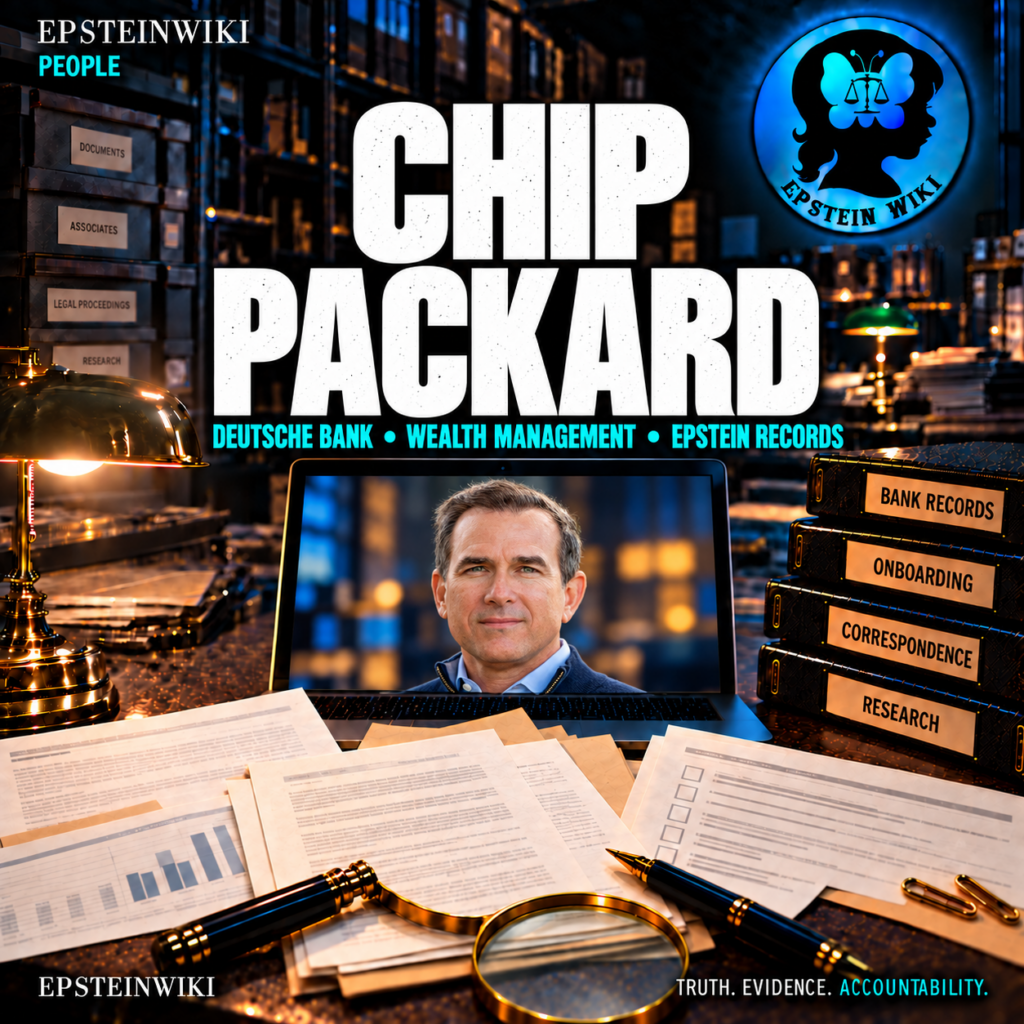
Charles “Chip” Packard is an American wealth management executive who led Deutsche Bank’s private wealth business in the Americas when the bank accepted Jeffrey Epstein as a client in 2013. Internal bank records identify Packard as a senior decision maker in the onboarding process. Deutsche Bank later told federal prosecutors that Packard was involved both in the decision to accept Epstein and in the January 2015 decision to continue the relationship after new concerns arose.
Packard did not personally manage Epstein’s daily banking. Paul Morris and other relationship personnel handled much of that work. Packard’s significance lies higher in the decision chain. He approved the relationship after Epstein’s conviction and prison sentence were known, celebrated the arrival of Epstein’s money, visited Epstein’s Manhattan townhouse during a reputational risk review, and became the named authority repeatedly cited by bank employees when later alerts appeared.
No public record reviewed for this article charges Packard with an Epstein related crime or accuses him of participating in Epstein’s sexual abuse. New York regulators made findings against Deutsche Bank, not Packard individually. The evidence concerns executive approval, risk governance, due diligence, and the institutional consequences of decisions made under his authority.
Snapshot
| Field | Details |
|---|---|
| Full name | Charles “Chip” Packard |
| Occupation | Wealth management executive and investment firm partner |
| Education | University of San Diego; law degree from Pepperdine University School of Law |
| Earlier firms | Donaldson, Lufkin & Jenrette; Credit Suisse |
| Deutsche Bank tenure | 2006 to early 2016 |
| Deutsche Bank roles | Managing Director; Co Head and later Head of Wealth Management Americas; member of the Deutsche Asset and Wealth Management Executive Committee |
| Current role | Partner and Global Head of Strategic Partnerships at Bridgewater Associates, according to Bridgewater’s 2026 biography |
| Epstein role | Senior executive involved in accepting Epstein as a Deutsche Bank client and later retaining the relationship |
| Key 2013 act | Communicated that the relationship could proceed without a full reputational risk committee review if client adoption found nothing further |
| Key 2015 act | Visited Epstein’s Manhattan home with Paul Morris during renewed review of abuse allegations |
| Criminal status | No Epstein related criminal charge located |
| Regulatory status | Deutsche Bank, not Packard individually, paid a $150 million New York regulatory penalty covering its Epstein relationship and other compliance failures |
Why Chip Packard Matters
Packard’s role sits at the point where known reputational risk became an institutional decision. Epstein had pleaded guilty in Florida in 2008 to prostitution related offenses, including procuring a person under 18 for prostitution. He had served jail time and was a registered sex offender before Deutsche Bank accepted him.
The bank knew this history. The onboarding memorandum summarized Epstein’s conviction, sentence, paid massages involving young women, and 17 civil settlements. At the same time, relationship manager Paul Morris projected that Epstein could bring $100 million to $300 million in assets and generate $2 million to $4 million in annual revenue.
Packard’s importance is therefore not based on social proximity. It is based on authority and process. The surviving records connect him to five critical stages:
| Stage | Packard’s documented role |
|---|---|
| Recruitment | Senior executive in the wealth division pursuing Epstein’s assets |
| Initial approval | Communicated that reputational review was unnecessary unless further KYC or AML work found new problems |
| Funding | Congratulated Paul Morris after approximately $180 million arrived |
| 2015 retention review | Visited Epstein’s home and questioned him about renewed allegations |
| Long term compliance effect | Later alerts were repeatedly cleared by reference to the Packard era approval |
Biography and Banking Career
 Bridgewater Associates identifies Packard as a graduate of the University of San Diego who earned a law degree from Pepperdine University School of Law. Bridgewater says he spent ten years in senior financial services positions at Donaldson, Lufkin & Jenrette and Credit Suisse before joining Deutsche Bank.
Packard joined Deutsche Bank in 2006 after working in equity capital markets and private banking at Credit Suisse. He became co head of Deutsche Bank’s United States private bank in 2009. His internal signature blocks identify him as a Managing Director and Co Head, then Head, of Wealth Management Americas. One such signature appears in EFTA01356504.
Packard was also a member of the Executive Committee for Deutsche Asset and Wealth Management, which Bridgewater says oversaw approximately $1.3 trillion for institutions and individuals. He resigned from Deutsche Bank in February 2016 and joined Bridgewater the following month.
As of September 2026, Bridgewater lists Packard as a partner and Global Head of Strategic Partnerships. The firm says he oversees client and commercial strategy across Asia Pacific and the Middle East and develops strategic relationships and tailored portfolio strategies.
Epstein Moves From JPMorgan to Deutsche Bank
Paul Morris had worked with Epstein at JPMorgan. After moving to Deutsche Bank, Morris promoted Epstein as a potentially lucrative client. The New York Department of Financial Services later reported that Morris projected $100 million to $300 million in asset flows and $2 million to $4 million in annual revenue.
JPMorgan forced Epstein out in 2013. Deutsche Bank was positioned to receive the assets. An internal record stated that Packard had reviewed and approved the onboarding and had obtained reputational and anti money laundering clearance. That document is EFTA01356888. It listed attachments titled “Jeffrey Epstein Clearance.pdf” and “Chip approval.pdf.”
The problem was not an absence of adverse information. The bank’s onboarding materials described Epstein’s conviction, prison sentence, and civil litigation. The issue was how decision makers treated that information.
The May 2013 Approval Email
On May 5, 2013, Packard sent the message that became the foundation for years of later approvals. According to the New York Department of Financial Services, Packard said he had spoken with John Caruso, then head of anti money laundering compliance for Deutsche Bank Americas, and Joseph Polizzotto, then general counsel for the Americas and chair of the Americas Reputational Risk Committee.
Packard wrote that neither official suggested the Epstein relationship required reputational risk review and that the bank could proceed as long as nothing further emerged through know your customer and anti money laundering client adoption.
The evidence requires two distinctions:
- Packard reported the views of Caruso and Polizzotto. The regulator said Deutsche Bank could not produce another record of that conversation.
- The full Americas Reputational Risk Committee did not meet to approve Epstein’s initial onboarding.
The May 2013 email became the bank’s durable approval instrument. Compliance officers cited it to clear later alerts, approve related entities, and justify continuing a relationship already classified as high risk.
Formal Onboarding and High Risk Classification
Deutsche Bank formally began its Epstein relationship on August 19, 2013 by opening brokerage accounts for Southern Trust Company Inc. and Southern Financial LLC. Over time, Epstein, his entities, and associates opened or funded more than 40 Deutsche Bank accounts.
The bank classified Epstein as high risk. It also designated him an “Honorary PEP” because of his connections to prominent political figures, although he was not initially classified as a conventional politically exposed person.
An internal system record states: “RDC Alert #1, Cleared & APPROVED by Chip Packard, AML Compliance, and Pat Harris.” That record appears in EFTA01409514. The text extraction is damaged in places, so the document image is the controlling source.
The New York regulator found that the bank’s enhanced monitoring was not tailored to the specific risks created by Epstein’s known history. The institution knew his prior conduct involved sexual abuse allegations and alleged co conspirators. Yet it did not adequately scrutinize payments to alleged co conspirators, young women, and women with Eastern European surnames.
The Arrival of Epstein’s Money
The business value of the relationship was visible in internal communications. In October 2013, approximately $180 million in Epstein assets arrived at Deutsche Bank. Packard responded to Paul Morris:
Congrats on getting Epstein funded!
The message appears in EFTA01450188.
By October 2014, Caroline Kitidis told Packard and others that an additional $62 million from Epstein would bring assets in their account to $220 million and total assets with the bank to $308 million. The message appears in EFTA01471268.
These figures are snapshots from internal messages. They should not be added together as separate, nonoverlapping totals without account level reconciliation. They do establish that the relationship became financially substantial.
Epstein as a Source of New Clients
Internal correspondence shows that Deutsche Bank personnel viewed Epstein not only as a client but also as a possible route to other wealthy people. In January 2014, Packard forwarded positive feedback from a call involving Epstein and asked which other accounts should involve Vinit Sahni. He suggested prospects including Eddie Stern, the Belfer family, and Bruce Kovner’s family office. The exchange appears in EFTA01345025.
The record does not prove that Epstein successfully recruited each person named. It shows that senior wealth executives considered using his relationships in business development.
An internal client list also identified the Butterfly Trust as an existing wealth management client associated with Jeffrey Epstein and Paul Morris. That material appears within EFTA01478894.
The Butterfly Trust and Repeated Reliance on the Approval
Deutsche Bank opened checking and money market accounts for the Butterfly Trust in January 2014. Beneficiaries included alleged Epstein co conspirators and women with Eastern European surnames. Bank personnel were told that beneficiaries were employees or friends.
The bank relied on Packard’s earlier approval email when opening the Butterfly Trust accounts. In October 2013, a compliance officer had already identified an alleged co conspirator as a trust beneficiary. The alert was cleared by citing Packard’s approval.
The New York regulator later found that Epstein used Butterfly Trust and other accounts to send more than 120 wires totaling $2.65 million to beneficiaries, including alleged co conspirators and women with Eastern European surnames. Stated purposes included hotel expenses, tuition, and rent.
These facts concern transactions and bank controls. They do not establish that every recipient participated in wrongdoing or that every payment had an unlawful purpose.
The January 2015 Due Diligence Visit
In late 2014 and early 2015, Deutsche Bank’s anti financial crime department escalated new concerns. An anti money laundering officer identified fresh press coverage, a federal appeals ruling concerning Epstein’s victims, and allegations involving powerful public figures.
Internal compliance personnel noted that by 2011, approximately 40 underage girls had come forward with allegations and that Epstein had settled at least 17 civil cases. They questioned whether Packard’s 2013 email could continue to support the relationship.
On January 22, 2015, Packard and Paul Morris visited Epstein at his Manhattan townhouse. According to the New York regulator, Packard asked Epstein about the truth of the recent allegations and appeared satisfied by Epstein’s response.
Deutsche Bank told the regulator it possessed no contemporaneous record describing the substance of the meeting. The bank was not aware of other investigative steps taken at that time beyond speaking with Epstein.
Epstein’s schedule also reflects an appointment involving Packard and Morris around this period. One example appears in EFTA00285067. A calendar entry can corroborate that a meeting was planned. It does not independently prove everything later said about the meeting.
The Decision to Continue Business as Usual
The Americas Reputational Risk Committee met on January 30, 2015. Bank policy required detailed minutes, but Deutsche Bank told the regulator that no minutes existed for this meeting.
A committee member later emailed Packard to say the group was “comfortable with things continuing” and noted that another member had mentioned “a number of sizable deals recently.” The following week, the head of compliance for the Americas wrote that the committee had agreed to “continue business as usual with Jeff Epstein” based on Packard’s due diligence visit.
The committee imposed conditions. The business was supposed to monitor further reputational developments and review unusual, suspicious, unusually large, or novel transactions. Yet the regulator found that the conditions were not communicated to all members of the relationship team or to the appropriate monitoring personnel.
This distinction matters. Packard did not act alone. A committee chose to continue the relationship. But Deutsche Bank later told prosecutors that Packard was involved in the decision to maintain it.
Deutsche Bank’s Statement to Federal Prosecutors
On December 24, 2019, lawyers for Deutsche Bank wrote to the United States Attorney for the Southern District of New York. The bank stated:
Mr. Packard was involved in the decision to onboard Mr. Epstein as a client, as well as the decision to maintain the relationship after concerns were raised in January 2015.
The statement appears in EFTA00016422. It begins on the first page and continues onto the second.
This is the clearest institutional description of Packard’s role. It is Deutsche Bank’s statement to prosecutors, not an independent criminal finding. Still, it directly connects Packard to both major decisions.
Continued Reputational Review in 2016
In January 2016, a proposed new Epstein related account returned to the bank’s reputational risk process. The email subject was “Jeffrey Epstein/Southern Financial LLC, Rep Risk Approval.” Packard was copied on the correspondence.
On January 19, a participant said there was no further guidance on whether the Americas Reputational Risk Committee would allow the new brokerage account. That message appears in EFTA01419226.
On January 21, the instruction was to obtain an updated Level II external due diligence report. That message appears in EFTA01373763. An internal explanation described the report as a Kroll background report costing approximately $800. That explanation appears in EFTA01365507.
The released thread shows a background report being requested. It does not establish whether the committee ultimately approved or rejected the account.
Packard Leaves Deutsche Bank
Packard resigned from Deutsche Bank in February 2016 and remained briefly during the transition. He joined Bridgewater Associates in March 2016.
His departure did not end the effect of the original approval. Deutsche Bank employees continued to cite it after both Packard and Caruso had left the institution. The approval operated like inherited permission. Later reviewers treated the prior decision as a reason to clear new alerts rather than reevaluate the relationship from the beginning.
The Missing Approval Record
During a 2018 periodic review of Prytanee LLC, an Epstein connected art investment entity, compliance personnel questioned whether the bank had adequate documentation of Packard’s approval.
A reviewer asked whether any memorandum accompanied the approval and recommended obtaining refreshed senior management approval if none existed. The reviewer wrote that the email did not explain exactly what had been discussed and approved. The exchange appears in EFTA01421293, with another copy in EFTA01415304.
Other questions in the thread included whether the bank could locate the full email chain proving that Packard’s approval actually referred to Epstein’s jail sentence and whether the approval concerned Prytanee specifically or Epstein and Southern Financial more broadly.
This record does not prove that Packard concealed a memorandum. It proves that bank employees could not readily locate documentation defining what his approval covered, even though they had relied on it for years.
Prytanee LLC
Prytanee LLC was described in Deutsche Bank files as an art investment company involving Epstein and Caroline Lang. The bank said the entity’s purpose was to acquire, own, and manage artwork for investment. The record described artwork and acquisition cash as its assets.
The Prytanee review is relevant because it exposed the continuing documentary weakness surrounding the original Packard approval. Caroline Lang is included only because the bank named her in the entity file. No reviewed record alleges wrongdoing by her.
The Approval Became a Compliance Shortcut
By 2018, internal compliance material said anti money laundering alerts were being cleared based on Packard’s email approval and its claimed support from senior management. One example appears in EFTA01299308. Another review noted the need to locate or refresh the approval in EFTA01430890.
The New York regulator found that Deutsche Bank’s monitoring failures continued well after Packard left. A March 2017 exchange about payments to a Russian model and a Russian publicity agent concluded that the activity was not suspicious because it was normal for Epstein.
That 2017 statement was not attributed to Packard. Its relevance is institutional. The bank had begun with a narrow approval, repeatedly relied on it, then normalized the very activity that should have triggered closer examination.
July 2019 Internal Postmortem
Seven days after Epstein’s July 2019 arrest, a Deutsche Bank managing director wrote an internal “Problem statement.” The writer used Epstein as the example of a borderline client whose clearances were repeatedly granted by referring back to the Packard and Caruso onboarding decision, even after both men had left the bank.
The message appears in EFTA01399467.
This was one manager’s internal lessons learned framing, not a formal legal conclusion. It is important because it describes how Deutsche Bank personnel understood the operational legacy of the 2013 approval.
Regulatory Findings Against Deutsche Bank
In July 2020, the New York Department of Financial Services issued a consent order covering Deutsche Bank’s relationship with Epstein and separate correspondent banking failures. The regulator imposed a $150 million penalty.
The department found that Deutsche Bank:
- Conducted business in an unsafe and unsound manner.
- Failed to maintain an effective and compliant anti money laundering program.
- Knew Epstein had pleaded guilty and served prison time for conduct involving a minor.
- Failed to tailor monitoring to the risks created by Epstein’s history.
- Failed to adequately examine payments to alleged co conspirators and numerous women.
- Relied heavily on an informal approval email rather than a documented reputational risk process.
- Failed to retain required minutes from the January 2015 committee meeting.
- Continued the relationship after a brief meeting with Epstein that produced no contemporaneous written record.
The consent order bound Deutsche Bank and its New York entities. It did not impose an individual fine or professional ban on Packard.
Civil Litigation and Settlement
Epstein survivors filed a class action against Deutsche Bank alleging that the institution knowingly benefited from and facilitated Epstein’s trafficking venture. A civil complaint identified Charles Packard as the head of wealth management who approved the relationship and participated in the 2015 review.
Deutsche Bank agreed in 2023 to pay $75 million to settle claims by Epstein survivors. A settlement is not a trial verdict, and the bank did not admit every allegation in the complaint. Packard was not the individual defendant ordered to pay that settlement.
The civil case remains important because discovery and pleadings helped expose how senior bank personnel handled Epstein after his conviction. Allegations from a complaint should be distinguished from regulatory findings and authenticated internal records.
The 2026 Senate Finance Committee Findings
The Senate Finance Committee staff report released in August 2026 examined how financial institutions handled Epstein’s suspicious transactions. The report concluded that major compliance failures at Deutsche Bank, JPMorgan, and Bank of America helped protect Epstein from timely federal scrutiny.
The report said Deutsche Bank retroactively flagged 1,140 wire transfers totaling $147 million in 2019. It also argued that the bank failed to report more than $250 million in suspicious Epstein related transfers in a timely manner.
The report’s findings concern Deutsche Bank as an institution and senior banking decisions across several years. It does not charge Packard with a crime. Packard’s 2013 onboarding approval and 2015 retention role provide essential background for understanding why the relationship existed long enough for later failures to occur.
Evidence Scale and Search Limitations
An Epstein Data corpus review found approximately 800 released documents containing the exact phrase “Chip Packard.” About 406 also contained Epstein’s name, while approximately 525 contained Epstein or a named Epstein entity.
Those numbers require caution:
- They are document search counts, not 800 separate Epstein interactions.
- Many records are duplicates, forwarding chains, attachments, and routine banking documents.
- Some records name Packard only in a signature block or distribution list.
- Some Epstein records omit his full name or contain damaged text extraction.
- A search for the surname alone is contaminated by Hewlett Packard, the Packard Foundation, and unrelated people.
The proper evidentiary method is to identify decisions, read the full chains, and cite the controlling pages. Raw name counts cannot establish responsibility.
Decision Chain
| Date | Event | Packard’s role | Evidence strength |
|---|---|---|---|
| Spring 2013 | Deutsche Bank evaluates Epstein as a prospective client | Senior wealth executive reviewing the relationship | Strong internal and regulatory record |
| May 5, 2013 | Packard sends approval email after speaking with legal and AML leaders | Communicates that full reputational review is unnecessary unless further issues emerge | Strong regulatory quotation and internal record |
| August 19, 2013 | Southern Trust and Southern Financial accounts open | Prior Packard approval used by compliance | Strong regulatory finding |
| October 2013 | Approximately $180 million arrives | Congratulates Morris on getting Epstein funded | Direct email |
| January 2014 | Butterfly Trust accounts open | Earlier approval cited again | Strong regulatory finding |
| October 2014 | Internal message reports $308 million total with bank | Recipient of asset growth update | Direct email |
| January 22, 2015 | Packard and Morris visit Epstein’s townhouse | Questions Epstein about renewed allegations | Strong regulatory finding, no contemporaneous meeting notes |
| January 30, 2015 | Reputational committee continues relationship | Packard’s visit used as basis for decision | Strong regulatory finding, missing committee minutes |
| January 2016 | New account receives reputational review | Copied on review and due diligence chain | Direct emails, outcome unclear |
| February 2016 | Packard resigns from Deutsche Bank | Leaves institution | Public employment record |
| March 2016 | Packard joins Bridgewater | New role | Official biography and contemporary reporting |
| 2018 | Compliance reviewers seek missing or refreshed approval | Original Packard approval still controlling later reviews | Direct internal correspondence |
| July 2019 | Deutsche Bank conducts internal lessons learned review | Onboarding decision cited as recurring source of later clearances | Direct internal email |
| December 2019 | Deutsche Bank writes to federal prosecutors | Bank formally identifies Packard’s role in onboarding and retention | Direct institutional statement |
| July 2020 | New York regulator fines Deutsche Bank $150 million | Packard identified in public reporting as Executive 1 | Official order plus corroborating reporting |
| 2023 | Deutsche Bank agrees to $75 million survivor settlement | No personal judgment against Packard | Court settlement reporting |
| August 2026 | Senate Finance report examines bank failures | Packard decisions provide onboarding context | Congressional report |
Network and Responsibility Map
| Person or body | Role in the Deutsche Bank relationship | Connection to Packard |
|---|---|---|
| Jeffrey Epstein | High risk client and registered sex offender | Client Packard approved and later interviewed |
| Paul Morris | Relationship manager who brought Epstein from JPMorgan | Worked with Packard on onboarding and attended townhouse visit |
| John Caruso | Head of AML Compliance Americas | Person Packard said supported proceeding without committee review |
| Joseph Polizzotto | General Counsel for the Americas and reputational committee chair | Person Packard said supported proceeding |
| Americas Reputational Risk Committee | Committee responsible for major reputation decisions | Did not formally review initial onboarding; continued relationship in 2015 |
| Haig Ariyan | Co leader in Americas wealth management | Appears with Packard in senior management correspondence |
| Caroline Kitidis | Senior wealth management executive | Reported asset growth and discussed leveraging Epstein introductions |
| Patrick Campion | Later senior wealth executive | Appears in subsequent management and approval records |
| Deutsche Bank compliance personnel | Reviewed alerts and periodic KYC files | Repeatedly cited or questioned the Packard approval |
| Southern Trust Company Inc. | Epstein entity and initial account holder | Opened after the 2013 approval |
| Southern Financial LLC | Epstein entity and initial account holder | Opened after the 2013 approval |
| Butterfly Trust | Epstein related trust account | Later onboarding relied on the original approval |
| Prytanee LLC | Epstein connected art investment entity | 2018 review exposed gaps in original approval documentation |
| Bridgewater Associates | Packard’s employer after Deutsche Bank | Not implicated in Deutsche Bank’s Epstein relationship |
What the Record Establishes
The public record establishes that:
- Packard held senior authority over Deutsche Bank’s Americas wealth management business.
- Deutsche Bank knew about Epstein’s conviction and related civil allegations before onboarding him.
- Packard communicated that the relationship could proceed without an initial full reputational risk committee review if KYC and AML adoption found nothing further.
- Compliance personnel treated Packard’s email as approval for Epstein and related accounts.
- Packard congratulated Paul Morris after substantial Epstein assets arrived.
- Packard and Morris visited Epstein’s townhouse during the January 2015 review.
- The bank had no contemporaneous notes describing the substance of that meeting.
- The reputational committee continued the relationship based substantially on that due diligence visit.
- Deutsche Bank told federal prosecutors that Packard participated in both onboarding and retention decisions.
- Employees continued relying on the Packard era approval after he left the bank.
- Later reviewers questioned whether the original documentation adequately explained what had been approved.
What the Record Does Not Establish
The reviewed public record does not establish that:
- Packard participated in Epstein’s sexual abuse or trafficking.
- Packard personally processed Epstein’s suspicious payments.
- Packard knew how any specific later transaction would be used.
- Packard acted alone in accepting or retaining Epstein.
- Packard personally ordered compliance staff to ignore the conditions imposed in 2015.
- Packard authored the 2017 statement that payments to a Russian model were normal for Epstein.
- Packard destroyed or concealed the missing approval documentation.
- Bridgewater Associates participated in Deutsche Bank’s Epstein relationship.
- A regulator or court imposed individual Epstein related liability on Packard.
Evidence Appearances
| Record | Description | Evidentiary value |
|---|---|---|
| EFTA01356504 | Packard signature block identifying senior Deutsche Bank role | Identity and title |
| EFTA01356888 | AML escalation stating Packard reviewed and approved Epstein onboarding | Initial approval |
| EFTA01409514 | Internal system record showing alert cleared and approved by Packard and compliance personnel | Operational use of approval |
| EFTA01450188 | Packard congratulates Morris after Epstein funding arrives | Direct executive message |
| EFTA01345025 | Packard asks which other accounts should be involved following favorable Epstein call | Business development context |
| EFTA01471268 | Message to Packard reporting additional $62 million and $308 million total assets | Scale of relationship |
| EFTA01478894 | Client and prospect material listing Epstein related Butterfly Trust | Client classification context |
| EFTA00285067 | Epstein calendar entry involving Packard and Morris | Planned meeting evidence |
| EFTA00016422 | Deutsche Bank letter to federal prosecutors describing Packard’s onboarding and retention roles | Strong institutional attribution |
| EFTA01419226 | January 2016 reputational risk email copying Packard | Continued review |
| EFTA01373763 | Instruction to obtain updated Level II due diligence | Review process |
| EFTA01365507 | Explanation of Kroll external due diligence report | Review process context |
| EFTA01421293 | 2018 review questioning scope and documentation of Packard approval | Documentation failure |
| EFTA01415304 | Duplicate or related Prytanee review material | Corroborating record |
| EFTA01299308 | Alerts cleared by reference to Packard approval and senior management | Long term compliance effect |
| EFTA01430890 | Reviewer seeks supporting memo or refreshed approval | Long term documentation issue |
| EFTA01399467 | July 2019 internal problem statement citing repeated reliance on Packard and Caruso decision | Institutional postmortem |
| EFTA01431121 | Image level record naming Packard despite damaged text extraction | Search limitation evidence |
| EFTA01431239 | Image level record naming Packard despite damaged text extraction | Search limitation evidence |
Related EpsteinWiki Entries
- Deutsche Bank
- Jeffrey Epstein
- Paul Morris
- Stewart Oldfield
- Southern Trust Company
- Butterfly Trust
- USVI v. Deutsche Bank
Research Assessment
Packard’s role was executive, consequential, and well documented. He was not simply copied on routine messages. He communicated the approval that allowed Deutsche Bank to accept a convicted sex offender without an initial formal reputational committee review. When allegations resurfaced, he personally joined the due diligence visit that helped persuade the bank to continue the relationship.
The deeper institutional failure was cumulative. An informal approval became a durable substitute for fresh judgment. Related accounts inherited it. Alerts referred back to it. Later reviewers could not clearly establish what it covered. Even after Packard left, employees continued using the approval as a reason to clear Epstein.
The evidence supports scrutiny of Packard’s decisions and the governance system around them. It does not support accusing him of participating in Epstein’s sexual crimes. The unresolved issue is accountability for the decision making that gave Epstein access to a major financial institution after his conviction and allowed that access to continue despite repeated warnings.
Sources
- New York Department of Financial Services, July 2020 Deutsche Bank consent order
- New York Department of Financial Services, penalty announcement
- United States Senate Finance Committee, How Wall Street Banks Enabled Jeffrey Epstein’s Sex Trafficking
- Bridgewater Associates, Chip Packard biography
- The Banker, bankers named in the Epstein files
- Financial Times, Deutsche Bank’s handling of Epstein
- Compliance Week, compliance and complicity at Deutsche Bank
- AdvisorHub, Packard joins Bridgewater
- AdvisorHub, Packard resigns from Deutsche Bank
- Epstein Data Wiki, Chip Packard
- R. Howard Stone research archive, German financial network
- United States Department of Justice, Epstein Library
- Reuters, final approval of the Deutsche Bank survivor settlement
- CourtListener, Doe 1 v. Deutsche Bank docket
Questions
- What precisely did Packard know about Epstein’s conviction and civil settlements before the May 2013 approval?
- Did Packard receive or review the full onboarding memorandum before communicating approval?
- What did Caruso and Polizzotto actually say during the undocumented conversation Packard summarized?
- Why did the initial onboarding bypass a formal Americas Reputational Risk Committee meeting?
- What questions did Packard ask Epstein during the January 22, 2015 townhouse visit?
- Why were no contemporaneous notes preserved from that visit?
- Why were no required minutes preserved from the January 30, 2015 committee meeting?
- Which “sizable deals” influenced the committee’s decision to continue the relationship?
- Did Packard know that later compliance alerts were being cleared by citing his original email?
- Was a fuller “Chip approval.pdf” or supporting memorandum ever created, and if so, where is it?
- Did the 2016 Level II due diligence report result in approval or rejection of the proposed account?
- Were regulators or prosecutors able to interview Packard about the onboarding and retention decisions?
- Did Deutsche Bank discipline Packard before his 2016 resignation, or did he leave for unrelated business reasons?
- Did Packard provide testimony or documents in the survivor class action against Deutsche Bank?
- What reforms prevent an informal executive email from functioning as permanent approval for a high risk client today?