
David Stern and Jeffrey Epstein
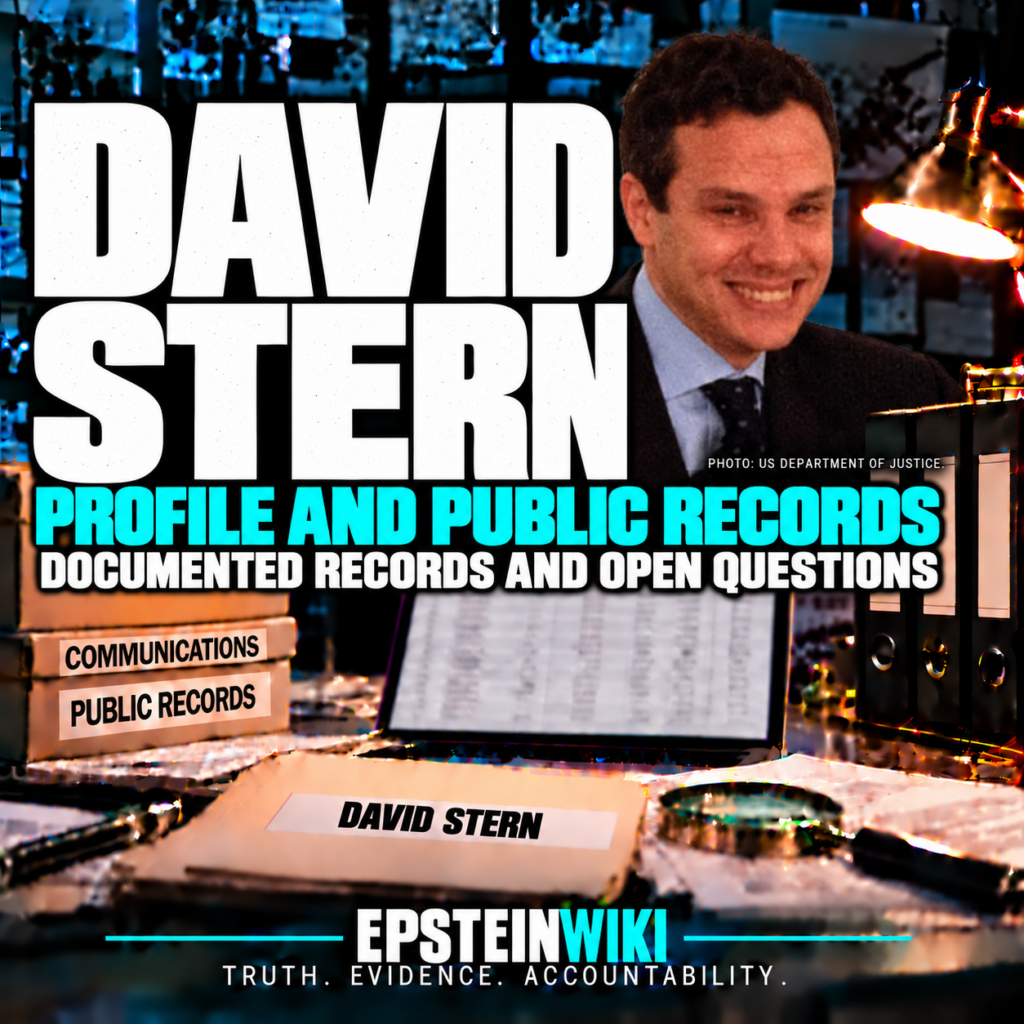
Snapshot
| Field | Summary |
|---|---|
| Identity | German businessman born in January 1978, identified in UK corporate filings; distinct from the former NBA commissioner |
| Principal business focus | China related investment advice, healthcare information and cross border business opportunities |
| Companies and institutions | Asia Gateway and Witan; China Medical Data Services; Pitch@Palace; Canoo and Monstera proposals; former St George’s House trustee and Cambridge Judge advisory board member |
| Earliest verified contact | A 10 May 2008 email, forwarded by Lesley Groff on 12 May, thanks Epstein for a meeting and invites participation in AGC Capital |
| Nature of the association | Sustained correspondence, proposed investments, introductions, transaction advice, royal business access and assistance with a China visa application |
| Continuing contact | Direct Stern correspondence verified into March 2019, with later Epstein introductions concerning Stern’s electric vehicle venture |
| Completed commercial activity | Informa confirms a 2011 investment and 2012 disposal; separate filings identify actual property purchasers and electric vehicle financiers without establishing an Epstein investment |
| Public responses and departures | Cambridge advisory board departure in February 2026; MSG Capital said he had never been its employee and no longer provided consulting services |
| Evidentiary limits | A pitch is not a completed investment, a calendar is not attendance, and association with Epstein is not proof of participation in his sexual offenses |
The May 2008 correspondence establishes a relationship that began before Jeffrey Epstein’s Florida guilty pleas and continued long afterward. David Stern sought investment, advice and introductions from Epstein while developing businesses connected with China. Later records place him between Epstein and Andrew Mountbatten-Windsor, then Prince Andrew, in commercial discussions and travel planning.
The 24 July 2010 proposal captures the intended division of labor particularly clearly: Stern proposed a private investment office serving wealthy clients, with Epstein choosing investments, Stern managing operations and Prince Andrew contributing access. The proposal does not prove that this business was formed. Other parts of Stern’s career, including his formal royal business appointments and an Informa investment, can be checked against independent corporate records.
The Justice Department’s historical review dates Epstein’s Florida guilty pleas to 30 June 2008. Stern’s later correspondence therefore matters as a record of continuing association after that conviction. The sources reviewed here do not establish that Stern participated in Epstein’s sexual crimes.
Identity and professional background
Companies House’s officer record identifies David Stern as a German national born in January 1978. The associated directorships connect him to the China consultancy and royal entrepreneurship businesses discussed in the emails. He should not be confused with David Joel Stern, the American basketball executive, or with other lawyers, investors and artists who share his name.
The AGC Capital presentation attached to the May 2008 email describes Stern as an Asia Gateway founder and chief executive with legal and commercial experience in China. His biography on printed page 10 claims a University of London degree in Law and Chinese Law, study at Shi-Da University, work involving Siemens and Deutsche Bank, and a China leadership role connected with Millennium Capital. These are representations in an investment presentation, rather than independent employment or university records.
The UK company record supplies a firmer legal chronology. Company 05579668 was incorporated as Asia Gateway Limited on 30 September 2005, became Witan Limited on 16 August 2012, and was dissolved on 8 October 2019. A broader business’s claimed founding in 2001 is different from the incorporation date of this particular UK entity.
The distinction between entities matters. The emails use Asia Gateway, AGC Capital, Witan and Witan Group in several settings. The UK consultancy, the Hong Kong healthcare holding company and the Beijing operating company should not be collapsed into one legal person. A discussion of using a new business name is also different from a filed corporate name change.
| Entity or institution | Verified role and dates | What the record establishes |
|---|---|---|
| Ermgassen & Co (UK) Limited | Director, 10 December 2004 to 13 November 2007 | Filed directorship, separate from any claimed earlier employment |
| Witan Limited, formerly Asia Gateway Limited | Director from 1 October 2005; company dissolved in 2019 | UK consultancy entity; its legal name changed in 2012 |
| Pitch@Palace CIC | Director, 14 April 2016 to 8 November 2019 | The community interest company had its own separate corporate history |
| Pitch@Palace Global Limited | Director, 15 February 2017 to 9 December 2019 | A different company from the CIC |
| St George’s House Trust | Director and trustee, 23 November 2016 to 22 November 2022 | A charity appointment at Windsor, independently recorded |
| Cambridge Judge Business School | Advisory board member from January 2018; departure reported in February 2026 | An advisory appointment, not a Cambridge University governing role |
The separate St George’s House filing verifies its appointment dates. The charity’s annual review lists Stern among its trustees. The university spokesperson’s confirmation supplies the Cambridge departure; the current official advisory board no longer lists him.
Witan’s control filing records Stern in the ownership band of 75 percent or more. That threshold is not an exact 100 percent ownership figure. Celestial Limited’s filing separately records a control interest within the greater than 25 percent and no more than 50 percent band as a member of a firm. Neither filing establishes Epstein’s ownership of those entities.
The May 2008 meetings and AGC Capital pitch
The first preserved AGC email was sent by Stern to Lesley Groff on 10 May 2008 and addressed in its body to Jeffrey. Stern thanked him for seeing him again the previous Friday, attached an AGC Capital overview and invited him to participate. Groff forwarded the message on 12 May. The meeting reference is stronger evidence of prior contact than an unaccepted appointment, although it does not identify their first introduction or prove an investment.
The 20 May follow-up in the same thread again refers to their meeting and presentation and asks for Epstein’s thoughts. The attached deck promoted a China focused private equity strategy. No subscribed capital, executed investment agreement or payment by Epstein into AGC was verified in these sources.
The forwarding date should not be mistaken for the date Stern wrote. His reference to meeting “again” also leaves the first introduction unresolved.
A proposed discreet London office and royal access
The 20 November 2009 email asks Epstein about a China fund idea and proposes establishing his London office while keeping his identity discreet. Stern wrote from Beijing and envisaged assembling a team. The message documents an ambition to build an ongoing business arrangement around Epstein, beyond a single investment request.
The February 2010 discussion refers to “JEDS” as Epstein’s proposed private London office while discussing a possible combination of 3i and ICG. The record contains Stern’s business claims and Epstein’s request for more company information. It does not establish that either listed company accepted an approach or that the combination happened.
The July 2010 private office proposal was explicitly presented as an idea for consideration. Stern envisaged London operations and a Beijing outpost serving high net worth clients, particularly Chinese clients. He proposed involving “PA” discreetly for his “aura and access,” assigning investment decisions to Epstein and daily management and client acquisition to himself. The royal context and surrounding correspondence identify PA as Prince Andrew. The proposal is evidence of how Stern wanted to use that relationship, not proof that Andrew accepted every term.
Green Park Serpentine and Andrew’s proposed business vehicle
The 17 May 2010 chain preserves Andrew writing to Stern about a proposed Green Park Group and referring to a “GURU,” understood in this correspondence as Epstein. Stern forwarded the exchange to Epstein. The message places Andrew himself in a discussion of a commercial structure, rather than relying exclusively on Stern’s account of what Andrew might want. Andrew suggested that the GURU and Stern might act as a “Ghost” for his upside in the proposed entity. That wording raises a question about the intended arrangement, without establishing its incorporation, final ownership or financial return.
The 23 June alternatives distinguish a new company called Serpentine from using the existing Asia Gateway business. Stern said Andrew wanted the accompanying letter sent. The related reply has Epstein instructing him to use Asia Gateway and Stern saying Andrew agreed. These were alternatives for structuring and presenting a venture. They should not be described as a sequence of legally registered name changes from Green Park to Serpentine to Asia Gateway.
The 1 July update reports a meeting with PA and discusses Sheffield Forgemasters and Aston Martin. Stern said he would take no action on those opportunities without Epstein’s approval. This adds a concrete example of Epstein’s advisory influence over Stern’s proposed activity in Andrew’s business circle; it does not prove either company appointed Stern or accepted a transaction.
RBS and Aston Martin information passed through Stern
The six page July 2010 forwarding chain shows Stern sending Epstein a chain containing Andrew’s forwarded correspondence. Andrew’s 25 July cover message says it was supplied as requested; Stern’s forward is dated 28 July. The underlying exchanges with investment banker Terence Allen discuss RBS, Drummonds, Coutts and Aston Martin, alongside other financing ideas.
The RBS portion recounts Andrew’s meeting with Stephen Hester and the head of retail banking, including discussion of Drummonds becoming more integrated with Coutts. The Aston Martin portion discusses management and shareholder tensions. The chain therefore supplies direct evidence of commercial information moving from Andrew through Stern to Epstein. It does not by itself establish which statements were accurate, whether each item was public or confidential, or whether Andrew obtained it through his trade envoy role rather than another relationship.
Andrew’s own travel discussion in the same chain says Stern was working with his office on September China plans, with separate private and official portions. This directly supports a coordinating role in the intended trip, while leaving actual attendance to be established separately.
The distinction is important to the later public debate about official information. A forwarded business discussion can establish transmission without establishing a criminal breach, a securities trade based on it or the recipient’s eventual profit. The reviewed official statements do not make a finding against Stern on those questions.
JPMorgan introductions and proposed roles
The February 2011 forwarded email preserves Jes Staley asking Stern how his encounter with the Morgan group had gone. Stern passed the message to Epstein. The reply chain shows Epstein advising that the opportunity needed a Chinese public presentation and Stern saying he would reply along the lines suggested.
The 28 February follow-up forwards Staley’s request that “Gaby” or someone on his team meet Stern. Stern asked Epstein whether to follow up after receiving no contact. His parenthetical identification of Gaby as JPMorgan Asia-Pacific executive Gaby Abdelnour is expressly his assumption in the message. This is evidence of a referral and Epstein’s involvement in managing it, not proof of an employment appointment.
The 5 March proposal sets out alternatives: a private Witan company with JPMorgan people on its board, a special situations role, or an advisory position connected with Staley. Epstein rejected part of the suggested structure. These contemplated titles must not be entered into Stern’s biography as actual JPMorgan jobs.
The September 2010 message illustrates the broader deal sourcing relationship. Stern said the head of Ernesto Bertarelli’s family office had asked for China hedge fund ideas and suggested approaching JPMorgan. It establishes what Stern told Epstein, without independently proving a mandate from Bertarelli or an eventual allocation.
The Deutsche Bahn fundraising effort
The February 2011 financing discussion puts a specific project behind the JPMorgan introductions. Lawrence Slaughter sent Stern materials on a proposed investment in DB Mobility Logistics. His example used €500 million for approximately 2.4 percent, with around 20 percent contemplated for sale. Epstein advised Stern about explaining the prospective co-investors and the scale of the proposed offering. These were illustrative fundraising terms, not evidence of subscribed capital.
The March translation chain shows Stern forwarding a Chinese presentation to Epstein, identifying errors in numeric units and translated bullet points, and asking whether the JPMorgan logo could be removed. The attached filename and the bankers’ discussion establish work on investor materials, beyond an introductory email. The chain does not show that Chinese investors approved the investment.
Deutsche Bahn’s own 2011 accounts, printed pages 8, 44 and 84, provide the ownership check: DB Mobility Logistics remained wholly owned within the group, and the German state held all shares in Deutsche Bahn AG. The contemplated stake sale should therefore not be presented as a completed Stern or Epstein investment in that year.
Bank acquisition proposals and the public court record
The September 2009 Financial Trust draft proposed presenting Epstein’s business as an independent private investment arm of JPMorgan and Stern as its European investment head. Epstein replied that they should talk instead. The rejected wording is not evidence that JPMorgan authorized that characterization or employed Stern in the proposed role.
The related Sal. Oppenheim chain shows Staley forwarding internal JPMorgan discussions to Epstein in August 2009. The communications concern the family’s interest in a possible partnership and Deutsche Bank’s competing process. They demonstrate access to live deal discussion, without establishing a completed Stern mandate or an Epstein investment. Deutsche Bank’s own financial report records its March 2010 acquisition. The correspondence must be read alongside that actual outcome.
The November 2010 Collins message has Stern reporting discussion of a banking partnership and the governance consequences of an exclusive arrangement. His March 2011 update says PA had vouched for him to Tim Collins. It is Stern’s report of an endorsement, rather than the original Andrew communication or evidence that Andrew knew every proposed Epstein role.
The September 2011 BHF pitch describes a possible Chinese investment in the Kleinwort Benson and BHF banking structure and proposes combining royal access with Chinese wealth. Stern supplied indicative asset, valuation and stake figures. These were pitch economics, not evidence that he owned the assets or had secured the investment.
Deutsche Bank’s 2014 annual filing records BHF’s sale in March 2014 to Kleinwort Benson Group and RHJ International. The final consideration was €347 million, consisting of cash and RHJ shares. No reviewed closing record establishes that Stern or Epstein participated in that completed acquisition.
The November 2016 message opens another banking episode. Stern thanked Epstein for seeing Stefan and said he would raise taking control of Deutsche Bank, potentially with Qatari shareholders. The message is evidence of a contemplated transaction and a reported meeting, not an acquisition agreement. Facing Finance’s account of the bank’s May 2026 AGM response says the bank declined to validate reports about the proposal, explaining that their underlying information did not come from the bank.
The JPMorgan communications review filed in Virgin Islands litigation independently corroborates Stern’s place in the banking network. Exhibit 191-4, pages 11 and 12, discusses the Desmond Shum introduction and a March 2011 call from Fang Fang. Page 18 records Epstein’s August 2011 proposal for an investment boutique with possible participants including Stern and Prince Andrew. This is a bank’s retrospective review produced in court, not a judicial finding against Stern.
Chinese capital and African investment proposals
The November 2010 SOCO chain shows Stern discussing a possible CNOOC acquisition of control in SOCO International and asking Epstein about economics and JPMorgan participation. The underlying replies offer evaluation and further discussion with financial advisers. They are narrower than Stern’s characterization of confirmed interest and do not establish an acquisition commitment.
The 21 November 2011 proposal describes a vehicle connecting Chinese capital with African parties through intermediaries rather than direct Chinese involvement. Stern linked it to their wealth management ambitions. The message is clear evidence of an intended commercial model; incorporation, funded investments and operational results remain unverified.
The December 2011 Luup discussion has Stern reporting that he arranged a meeting between Wu Zheng and David Reuben concerning mobile payments and a possible China joint venture. He then suggested relevance to Epstein’s African plans. The record establishes Stern’s report and proposal, not a completed venture or deployment of the technology.
Boyu and the wider investment pipeline
The 24 April 2011 fund email has a visibly named Stern sending Epstein marketing material for Boyu and describing Louis Cheung and Alvin Jiang as friends. The attachment is identified as a Boyu marketing presentation. Statements about his relationships and the fund’s fundraising are Stern’s representations; the email does not prove that those executives met Epstein or offered him a partnership.
The separately released March 2011 Boyu deck is marked as a draft. Its final page describes a US$1 billion target for Boyu Capital Fund I and an investment strategy centered on growth capital and state owned enterprises in Greater China. It is marketing material, not an Epstein subscription agreement or a list of actual investors. The matching subject matter and filename support its relevance, but the release does not independently authenticate every attachment relationship.
The October 2011 Hong Kong message says Stern intended to meet Tobias Brown, whom he described as building an Asian investment platform for John Elkann and the Agnelli family. It also refers retrospectively to someone he and Epstein had met in London, without identifying that person. The proposed Brown meeting and the earlier unspecified encounter must remain separate.
The February 2012 Israel Corporation proposal envisages approximately $3 billion to acquire a 45 percent position through public shares and Bank Leumi’s holding, followed by asset sales or relistings. Stern claimed to have discussed the idea privately with an owner. The source is a deal proposal, not evidence that Epstein provided $3 billion, that Leumi agreed to sell to him or that a take-private transaction closed.
Endemol and the circulation of deal information
The 9 March 2012 Endemol message passes Epstein a proposed investment of €100 million to €200 million alongside Cyrte, using senior debt to seek control of the television production business. The material describes its figures as highly confidential and identifies existing shareholders and creditors. Those figures describe a proposed distressed investment, not Stern’s own assets or a completed Epstein commitment.
The 22 March follow-up asks whether Epstein is interested and reproduces an unnamed friend’s update about Cyrte working with Apollo and purchasing debt. It demonstrates Stern circulating purported deal information through his personal network. It does not establish that every assertion was accurate or that Epstein traded on it.
Mediaset’s corporate history independently records its reduction and sale of its Endemol holding during the 2012 restructuring. Apollo’s SEC filing identifies its Endemol investment within Fund VII. Those records establish real corporate events around the opportunity, without establishing that Stern or Epstein financed or controlled the completed restructuring.
Informa and China Medical Data Services
The 18 March 2010 offer letter concerns an Informa investment in China Medical Data Services or its subsidiary. It sets out $3 million for 50.1 percent, up to $16 million in working capital and an approximately US$50 million business valuation based on future investment, projections and expected synergies. The acquisition and initial funding were conditional on specified Chinese government contracts and further documentation. The $50 million figure is not the cash price paid to Stern.
The draft subscription and shareholders agreement, particularly clause 5.6 and its investment milestones, explains the business model. It envisages collecting and standardizing information from local Chinese medical and social insurance systems, maintaining central and backup data warehouses, and developing commercial information products. The contemplated rights include Informa group publishing and services derived from the data, with provisions addressing Chinese legal concerns. These are planned contractual rights and technical milestones, not evidence that identifiable patient records were transferred abroad or that every collection center became operational. The financial accounts establish the investment and later impairment; operational records would be needed to establish what the system actually delivered.
Epstein’s 23 March reply reproduces the proposed terms and contains wording about nonvoting preference shares. The correspondence demonstrates his access to the negotiations. The released proposal alone would be insufficient to establish a completed transaction.
Informa’s 2011 annual report, printed page 97, resolves that important question: it records the acquisition of 50.1 percent of China Medical Data Services and its wholly owned Beijing subsidiary during 2011. Its year end accounts identify the remaining 49.9 percent as a non-controlling interest. This establishes that an investment occurred, while distinguishing its accounting year from the 2010 proposal.
The released contract papers sharpen the distinction between the early offer and later documentation. The separate sale and purchase instrument specifies US$2,487,500 for 50.1 percent and defines a further US$8,512,500 investment amount, with escrow and completion conditions. These are the amounts in that instrument, not the $3 million and $16 million shorthand of the earlier proposal. Its signature status was not authenticated in the inspected material, and a conditional agreement alone would not establish that money reached Stern.
The shareholders’ agreement copy is a different document. Its date and execution fields are blank in the inspected scan. It proposes initial company funding of $8.2 million, less earlier advances, and another $8 million subject to milestones. These versions should not be combined into one supposed payment total. An unsigned released copy also does not establish that an executed counterpart never existed.
Informa’s July 2011 interim report, note 13, supplies independent completion evidence: it lists the acquisition of 50.1 percent of CMDS during the first half of 2011 and says current-period acquisitions were paid in cash. Its combined purchase figures do not isolate each payment to Stern or each working capital advance.
The 8 April 2011 message has Stern reporting money in his own and the company’s accounts and additional funding to come. He used shorthand figures of “3m,” “8m” and another “8m,” without specifying currency in that email. His additional paper valuation claim is not an audited balance sheet and should not be treated as his verified net worth.
The January 2012 request for help concerns unwinding Informa’s equity position. Stern said he owned 49.9 percent and expected to acquire the balance. A passage labeled as the other side’s statement of the problem describes an accounting obstacle to a $2,487,500 share buyback. It is correspondence about a proposed method, not a court ruling that an illegal buyback occurred.
Informa’s 2012 accounts, printed pages 107 and 110, confirm disposal of the stake in 2012 and continuing loans to CMDS. The 2014 annual report, printed page 57, records a £13.5 million impairment of the CMDS loan receivable. This is a documented financial loss at Informa. It does not establish that Stern personally received £13.5 million, committed fraud or shared proceeds with Epstein.
| Figure | Proper interpretation |
|---|---|
| Approximately US$50 million | Conditional business valuation in the 2010 proposal |
| $3 million | Proposed consideration for a 50.1 percent stake |
| Up to $16 million | Proposed working capital, including conditional later advances |
| $2,487,500 | Stake value discussed during the 2012 buyback problem |
| £10.3 million | CMDS loans identified in Informa’s 2012 accounts |
| £13.5 million | CMDS loan impairment identified in Informa’s 2014 report |
Figures reported for several acquisitions or disposals together should not be assigned entirely to Stern’s company. The separate records establish a real enterprise and real financing problems, without establishing an Epstein beneficial interest.
The Richard Merkin financing proposal
The proposed CMDS term sheet describes a $5 million senior note to be purchased by an entity controlled by Richard Merkin. It identifies Stern as the owner of the Hong Kong company and requires a qualifying Chinese government contract before funds and the note would be released. The document marks its substantive investment terms as non-binding pending definitive agreements.
The July 2013 covering email asks Epstein to review a China Medical term sheet. It establishes consultation; it does not by itself prove that every separately released draft is the attachment sent that day.
The 21 December update says closing was scheduled for 26 December. The 3 January 2014 message says the deal still had not closed. The latter date is clear on the document image; descriptions dating it to March misread the source. The two messages are a useful warning against converting a scheduled closing into an actual payment. A completed Merkin investment was not verified in this review.
The December correspondence attached to a later draft shows that closing remained conditional. Goldston said on 18 December that it could proceed if the required ministry contract was delivered and Merkin accepted it; Stern said the next day that the contract would be signed the following day. A congratulatory reply therefore cannot by itself prove that either the government contract or the financing was already complete.
The 21 January 2014 message, titled “DRAFT Merkin,” extends the chronology. Stern sent Epstein a proposed response to Erez, saying Heritage considered the ministry contract insufficient and would not close. He disputed that position and argued that the earlier conditions had been met. This documents a contested closing and Epstein’s involvement in reviewing Stern’s response. It does not prove the draft was sent to Erez, establish that Epstein was Erez, or resolve whether a later financing ultimately occurred.
The Cantor Fitzgerald proposal for Andrew’s business circle
The 2 September 2013 chain shows Stern sending Epstein a proposed Cantor Fitzgerald term sheet involving “PA.” Stern questioned the terms, and Epstein recommended a counterproposal with a defined profit split, repayment of the initial loan from proceeds and changes to exclusivity. This was specific transaction advice conveyed through Stern.
The August draft term sheet describes Cantor Urramoor Asset Management and a proposed £1 million advance at 3.5 percent compounded interest. It also contemplates a ten year term and extensive exclusivity obligations. Its discussion status matters: it does not demonstrate that the advance was paid or the venture established.
The later November referral instrument takes a different form from the August joint venture proposal. It names Cantor Opportunities and Urramoor, identifies Stern among the representatives subject to its obligations, and includes a joinder for him. It contemplates a five year term and a share of referral fees while disclaiming a partnership or joint venture. The unfilled date and unverified execution leave it as proposed documentation, not proof of paid fees, the earlier £1 million advance or Epstein remuneration.
The Stern correspondence belongs alongside EpsteinWiki’s Howard Lutnick and Cantor coverage. It should not be confused with the independently documented AdFin investments discussed there. Different proposals and investments need their own execution evidence.
Pitch at Palace fundraising and corporate records
The CIC’s first filed report, covering the period to March 2016, identifies it as wholly owned by the Prince Andrew Charitable Trust and lists Witan Innovation Ltd among supporters. That supplies a filed Witan-related connection. It does not establish that Witan Innovation was the same legal company as Witan Limited, or that Epstein funded the programme.
The CIC’s 2019 accounts report £25,067 of aggregate director emoluments without identifying the recipient. They therefore cannot establish a payment to Stern. Global Limited’s separate accounts disclose £2,143,734 in cash and £917,778 in net assets at 30 March 2019, with substantial creditors and deferred income. Those are company figures, not Stern’s personal wealth. The public filing omits the profit and loss account and does not identify a particular Epstein transfer.
The two companies’ histories also separate Stern’s 2019 departures from later corporate endings. The CIC was dissolved in June 2021; Global Limited was dissolved in February 2026. Neither date should be substituted for his resignation date or treated as a criminal finding.
Introductions across the China and financial network
The April 2009 introduction has Epstein recommending that Stern connect with Nicole Junkermann, citing her German background, China activities and sports investment business. His personal description of Junkermann belongs to him; the business introduction does not independently establish every biographical or relationship claim he made.
The September 2013 introduction connects Stern with Joshua Cooper Ramo. Epstein described Stern as Prince Andrew’s China contact and Ramo as a Kissinger Associates partner working on China. The email establishes Epstein’s attempt to link them. It does not establish a resulting deal or confer an official government title on Stern.
The June 2016 Hoffman discussion shows Epstein suggesting Stern meet Reid Hoffman at a lunch involving PA and offering China expertise as the reason. Stern discussed his availability around a Windsor dinner. The exchange records an opportunity and proposed participation, without proving the lunch took place or that Hoffman accepted a business arrangement.
Evergrande and the CALA Homes proposal
Evergrande’s 5 June 2016 letter expresses interest in acquiring CALA Homes and names Liu Yishi and David Stern as contacts. It gives an indicative enterprise valuation of £650 million to £750 million, conditional on diligence, approvals and definitive documents. Its substantive offer is expressly non-binding. Being named as a contact is not proof that Stern was an Evergrande director or employee.
Legal & General’s March 2018 announcement provides an independently documented later outcome: it acquired the 52.1 percent of CALA it did not already own, for £315 million plus costs and adjustments. The full equity valuation was £605 million. That announcement should not be recast as completion of Stern’s earlier Evergrande proposal. Enterprise value and equity value are also different measures.
FBI field offices and Pentagon Center
The October 2015 email forwards Jonathan Fascitelli’s proposed acquisition of buildings occupied by the FBI in Baltimore and Richmond. Stern’s summary specifies $25 million of equity for an $80 million acquisition. The forwarded pitch describes passive ownership through Cayman vehicles and a wider pipeline of government leased properties.
The April 2016 follow-up forwards another Fascitelli proposal involving Department of Defense leased property in Arlington, with $116 million of equity required. The accompanying investment overview identifies Pentagon Center, two buildings about a mile south of the Pentagon, and states a $387 million acquisition cost with $271 million of financing.
The later Pentagon Center transaction is independently documented. A 2017 SEC securitization filing identifies the purchaser as LCPC Pentagon Property LLC, a $379.5 million purchase price, and indirect ownership of approximately 48.75 percent each for GIC and Korea Investment Corporation, with 2.5 percent for Beacon. The property’s two building areas match the earlier pitch. Beacon’s February 2017 announcement confirms the acquisition. Neither source identifies Stern or Epstein as a participant.
An independently announced Richmond purchase also supplies useful context: Easterly Government Properties said in December 2015 that it had acquired the city’s FBI field office. The complete Richmond attachment to Stern’s earlier pitch was not matched in this review, so that announcement cannot conclusively establish the disposition of every property in the proposed package.
These were proposed real estate investments in government leased buildings. The documents do not offer ownership of the FBI as an agency or the Pentagon headquarters. The $116 million is proposed equity, not the total property value. No completed purchase by Epstein or Stern was verified in these materials, and ownership of a leased building would not itself establish control of its government tenant or access to classified operations.
Electric vehicles and continued introductions through 2019
The April 2017 Monstera email describes a proposed $150 million fund and cites Faraday Future as a co-investment opportunity. Stefan Krause’s subsequent appeal, sent directly to Epstein with Stern copied, thanks him for a call and seeks help with Faraday’s proposed $1 billion Series A. The sender and role matter: this was Krause’s appeal within a shared business channel, not simply a Stern-authored pitch.
The May 2017 Lucid presentation proposed a Monstera purchase of a stake controlled by Jia Yueting, followed by participation in new financing. It was marked as a draft. Stern’s 12 May email discussed approximately 30 percent for $300 million; his 23 May message discussed a possible 15 to 30 percent purchase and anticipated Ford’s involvement. None establishes that Ford committed, that Monstera acquired the shares or that Epstein funded the proposal.
| Lucid figure | Source and meaning |
|---|---|
| About 30 percent for $300 million | Stern’s 12 May email proposal |
| Approximately 32 percent | Stake contemplated in the separate May draft deck |
| $333 million plus $128 million | Deck’s modeled secondary purchase and participation in a new round |
| Approximately $460 million | Rounded combined investment model in the deck, not a completed cash transfer |
| $400 million Series D | Proposed financing discussed in the deck and correspondence |
Lucid’s audited financing note establishes a different completed funding path. A 2018 agreement with Saudi Arabia’s Public Investment Fund was followed by $200 million received in April 2019 and $400 million in October 2019, with further tranches in 2020. The company also reports $60 million of share repurchases from Blitz Technology and LeSoar during September 2018 to December 2019. These are issuer-reported transactions, rather than completion of the 2017 Monstera model. The filing says Lucid repurchased the shares; it should not be rewritten as a direct purchase of those shares by PIF.
Faraday’s later SEC prospectus, printed page 121, separately identifies Season Smart, an Evergrande affiliate, as the source of an eventual funding arrangement. It records $800 million actually funded in 2018 and a December restructuring that released the remaining funding obligation. That confirms a real subsequent financing, without establishing that Stern or Epstein arranged it or received a fee.
The May and June 2018 health sensor chain documents follow-through on another introduction. Epstein connected Stern’s Los Angeles electric vehicle venture with Deepak Chopra on 22 May. Subsequent correspondence involved Oscar Talvitie and Poonacha Machaiah, a reported call, a proposed nondisclosure agreement and plans to meet the team. It establishes business discussion generated by the introduction; it does not prove a signed partnership or that the proposed sensor system was installed.
The 5 March 2019 message forwards material about Warren Buffett and electric cars and asks Epstein how to reach him. This provides direct Stern-authored evidence of continuing contact in 2019.
The June 2019 Teodorani messages and Jabor al-Thani thread concern further introductions for Stern’s car company. The message exports identify the recipients, with attribution to Epstein resting on the device and conversation context. They document efforts to generate interest, rather than completed meetings or investments.
The 30 June statement in the Jabor thread expressly disclaims a direct or indirect financial interest in the car company under discussion. That is Epstein’s contemporaneous representation, not an independently audited capitalization table. It is nevertheless important evidence against presenting his introductions as proof that he invested in the venture associated with Stern and Krause, known as Evelozcity and later Canoo.
The contemporary Canoo lawsuit reporting separately identifies Stern as an early investor based on a complaint filed in 2019. That is evidence concerning Stern’s role, with the complaint’s allegations kept distinct from court findings. It does not establish an investment by Epstein.
Canoo’s January 2021 registration statement, printed page 124, provides stronger evidence of the venture’s actual financing. It reports approximately $158 million of equity purchases by DD Global and $40 million by Remarkable Views between December 2017 and May 2019. This supports the rough scale of the company discussed in Epstein’s 2019 introductions, while shareholder loans and later financing prevent treating $198 million as a complete lifetime capital total.
The filed ownership chain attributes control of DD Global and Champ Key to Pak Tam Li through DE Capital. It does not identify that block as Stern’s personal beneficial ownership. These filings neither quantify Stern’s reported founding investment nor prove that an earlier or smaller indirect interest was impossible. Canoo’s January 2025 filing records the company’s later Chapter 7 liquidation filing. That corporate outcome does not establish responsibility by Stern or Epstein for the failure.
Royal travel arrangements and the China visa advice
The 6 September 2011 email has Stern describing plans to accompany PA to China in October, including Shanghai, Guangzhou, Shenzhen and Hong Kong, followed by other travel. He said he had arranged most meetings outside the official mayoral and gubernatorial engagements and would remain in the background. This is Stern’s own account of his intended function, separate from a formal government appointment.
The 21 October exchange shows Stern asking whether to travel separately because his name would appear on flight records if he joined PA’s chartered aircraft. Epstein told him it was acceptable to fly with him. The message establishes a concern about visibility and advice about a proposed journey; it does not establish that Stern boarded the aircraft or explain his reason beyond what he wrote.
The 3 May 2012 exchange reports that the New York consulate had refused a tourist visa application. The correspondent said the criminal record question had been answered yes and that charges and an indictment had been disclosed, but also said the consulate would not explain its refusal. The record therefore does not prove the reason for refusal.
The 12 May visa correspondence records the subsequent advice. A message signed David, within a chain addressing David Stern and discussing his invitation letter, recommends a business visa application through Paris and advises against declaring previous refusal or criminal charges on the form. It expressly leaves the decision to Epstein. This is evidence of advice to omit material information, not proof that a false application was submitted, that a visa was issued or that Andrew knew of the advice.
The April 2012 island exchange has Stern discussing whether to travel from Los Angeles after a Merkin meeting or instead fly from London to the island. Epstein’s reply agrees with the latter suggestion. The exchange documents a prospective visit; it does not establish a completed journey.
The September 2018 office schedule lists two Stern appointments on 24 September and a plan to use an apartment as a base during his New York day. It provides evidence of expected personal access, without independently confirming either appointment or an overnight stay.
The May 2012 accommodation exchange adds retrospective evidence of personal access. Stern asked whether he could stay with Epstein “again” rather than book a hotel. That supports an earlier stay, while leaving its date and location unidentified. Epstein’s agreement to the proposed new stay does not independently establish that it occurred.
The February 2018 Tokyo message and the next day’s Palau email are stronger than advance itineraries: Stern described himself as already in Tokyo with PA on 10 February and in Palau on a friend’s boat with PA on 11 February. These are contemporaneous first-person travel reports. His observation that Paul Allen’s boat was nearby does not establish that they boarded it or met Allen, and neither message places Epstein on the trip.
No verified passenger manifest naming this Stern aboard Epstein’s aircraft, or reliable confirmation of his presence on Little Saint James, was established in the sources examined here. Royal travel planning should not be treated as an Epstein aircraft log. Nor does failure to find a record establish that a journey never happened.
Sarah Ferguson and the personal channel to Andrew
The November 2009 correspondence places Stern in communication with Sarah Ferguson about her business prospects. The chain quotes a Stern message addressing her as the Duchess, a reply concerning commercial contacts and activity in Palm Beach, and Epstein’s advice about pursuing opportunities. This supports a concrete professional assistance role around Ferguson before Stern’s later Pitch@Palace appointments.
The August financial exchange also preserves Sarah writing to David Stern about work on finances. Its top forwarding sender is redacted, so the visible nested exchange should be distinguished from an independently attributable forwarding action. The correspondence does not by itself establish what Stern was paid, whether a debt was discharged or what authority he held over Ferguson’s finances.
Ferguson’s February 2010 email, copied to Stern, distinguishes a proposed Omega/G03 arrangement from a QVC opportunity. Stern’s March QVC summary tells Epstein that nothing had been signed and explicitly qualifies his knowledge because he was not directly involved. He describes ornaments, proposed sales royalties and staged advances. The QVC and supplements discussions should therefore not be merged into one completed product deal.
The June Hartmoor correspondence credits Stern with introducing an adviser and helping compile accounts as a group sought details of the business’s closure, creditors and escrow. It places him within the financial restructuring effort. The inspected sender and signoff are redacted, so this copy should not be presented as a visibly signed Ferguson letter. It does not establish that the requested report was delivered, creditors were paid or a contemplated adviser meeting occurred.
The earlier Pegasus forward shows a visibly named Stern passing Epstein bank questions about creditors, cash flow and payroll in November 2009. Together the records show repeated financial coordination, while leaving the actual payments, professional mandates and eventual settlement of liabilities to be established separately.
The May 2012 London and Paris chain shows Epstein asking Stern to accompany an unnamed woman in both directions. Stern discussed train times and said he was waiting to hear from her. The exchange expands the record of his logistical assistance beyond business meetings, but does not establish completed travel, the woman’s age, coercion or the purpose of the journey.
The October 2013 dinner suggestion shows Epstein using Stern as a channel for a proposed introduction of a female friend to Andrew in London. The document contains the suggestion, not Stern’s response, Andrew’s acceptance or a report of a completed dinner. It does not establish a sexual encounter.
The 8 November 2011 email provides direct evidence of the relationship’s informal tone. A visibly identified Stern mixes a sexualized joke with a request to meet and says he does not want to proceed with developments without Epstein. The combination shows deference and familiarity. It does not identify a victim, establish anyone’s age or prove participation in abuse.
Some public compilations attribute other crude messages to Stern despite redacted or absent sender fields. Those attributions should not be silently converted into facts. The visibly named correspondence already provides a substantial record without reconstructing protected identities or assuming that every reply in a chain belongs to the same person.
Advice about Andrew’s public defense
The 4 January 2015 exchange shows Stern answering “Understood” to an Epstein message suggesting that Andrew’s representatives attack an accuser’s credibility. Epstein’s underlying assertions were advocacy by an interested party. The email is evidence of the suggested strategy and Stern’s acknowledgment, not independent proof that the allegations were false or that Stern implemented the plan.
This material belongs beside EpsteinWiki’s Andrew arrangement records, which distinguish survivor allegations, denials, proposed introductions and completed events. Financial advice, social arrangements and defense discussions were different parts of the same communication channel and require separate evidentiary treatment.
Later business activity and current status
Hanam City’s official 2023 newsletter confirms a meeting with Stern on 18 May about a possible Sphere venue and the city’s K-Star World project. The municipal host described him as vice chairman and reported that discussions would continue. It establishes the meeting and public use of the title, rather than an executed construction project, a particular employment contract or any Epstein involvement.
The public Canton governance proposal supplies a later digital-assets episode. Created in March 2025, it describes Monstera as a Witan Group subsidiary and Stern as Witan chairman. Its history records approval in May 2025 and withdrawal on 6 May 2026, without stating a reason. The conditional validator rewards proposed in the document are not evidence of tokens paid, earned income or completed customer onboarding. The 2025 Monstera FZE applicant should not automatically be treated as the same legal entity as the 2017 mobility fund proposal.
The applicant biography is also not a substitute for corporate records. It repeats career claims, including a simplified 2010 CMDS sale date and institutional affiliations that later changed. Informa’s accounts, Cambridge’s response and MSG’s statement remain the more specific sources for those points.
Public responses and institutional consequences
The February 2026 Cambridge report quotes a school spokesperson confirming Stern’s resignation from the Judge Business School advisory board with immediate effect. The departure was first reported on 6 February. It should be described as a resignation rather than an established disciplinary finding.
St George’s House’s own 2022 and 2023 review says Stern completed six years on its board in November 2022. That predates the 2026 document disclosures. It must not be grouped with the Cambridge departure as if both happened in response to the same reporting.
ITV’s 18 February 2026 inquiry addresses a further career claim. Although public promotional material had described Stern as an MSG vice chairman, MSG Capital told ITV he had never been a company employee and no longer provided consulting services. The statement addresses employment and consulting status; it does not by itself establish that every public use of the vice chairman title was fabricated. The municipal record above independently shows that a public host used it. ITV reported that Stern did not respond to its request for comment.
The university’s current advisory roster no longer lists him. Neither absence from a website nor departure from a board is a criminal judgment. No substantive personal response from Stern to the specific correspondence examined here was located in the reviewed material; that is a finding about this review rather than a claim that no response exists anywhere.
Government scrutiny and what it does not establish
Thames Valley Police’s 22 May 2026 statement confirmed a continuing misconduct in public office investigation following the February arrest of a man in his sixties from Norfolk. The statement does not name Stern or announce charges against him.
The parliamentary answer of 30 June 2026 is directly relevant to his name. Jeremy Corbyn asked whether Andrew’s trade envoy expense, hospitality, gift and travel records referred to Epstein, Stern and several proposed or actual business entities. Chris Bryant, answering for the Department for Business and Trade, declined to provide details because of the live police investigation. The question’s list is not proof that all those records exist, and the answer does not identify Stern as a suspect.
The reviewed May and June 2026 official statements document scrutiny of Andrew’s public role and associated records at those dates. They do not establish a judicial finding that Stern committed misconduct, trafficking, fraud or espionage. Responsibility for another person’s proven crimes cannot be assigned through a shared address book, photograph, introduction or business proposal.
Timeline
| Date | Documented development | Evidence |
|---|---|---|
| May 2008 | Stern thanks Epstein for meeting and pitches AGC Capital; Groff forwards the messages | Public Yahoo thread |
| April 2009 | Epstein recommends a business introduction to Nicole Junkermann | EFTA00748642 |
| November 2009 | Stern proposes a discreet London office and China fund | EFTA00768945 |
| March to July 2010 | Informa terms reach Epstein; Stern proposes a private office involving PA | EFTA00747181, EFTA00737122 |
| May to July 2010 | Green Park and Asia Gateway proposals; Andrew business correspondence forwarded to Epstein | EFTA02423759, EFTA00747312, EFTA00736900 |
| 2011 | JPMorgan discussions, China travel planning and completed Informa acquisition | EFTA01798252, EFTA00665877, Informa report |
| March 2012 | Endemol restructuring proposals circulated | EFTA01997190, EFTA01989436 |
| May 2012 | Reported China visa refusal followed by advice on a further application | EFTA00541352, EFTA02308215 |
| 2012 | Informa disposes of its CMDS equity stake while retaining loan exposure | Informa accounts |
| 2013 | Merkin financing and Cantor proposals; Ramo introduction | EFTA02673727, EFTA01958916, EFTA01955820 |
| 3 January 2014 | Stern says the Merkin transaction still has not closed | EFTA01940537 |
| 21 January 2014 | Merkin closing dispute remains under discussion in a draft sent to Epstein | EFTA01147588 |
| January 2015 | Stern acknowledges Epstein’s suggested public defense strategy | EFTA01747912 |
| 2015 and 2016 | Government leased property pitches; Evergrande CALA proposal | EFTA02671775, EFTA00698791, EFTA00620135 |
| 2016 and 2017 | Formal appointments to Pitch@Palace companies and St George’s House | Corporate appointments, charity appointment |
| 2017 | Faraday and Lucid investment proposals | EFTA01048952, EFTA00610227 |
| February 2018 | Stern reports being in Tokyo and Palau with PA | EFTA02527724, EFTA00887777 |
| 2018 | Chopra introduction produces further discussion; New York appointments scheduled | EFTA01040351, EFTA00285597 |
| March to June 2019 | Direct Stern email and further car company introductions | EFTA02632786, EFTA01617553, EFTA01617958 |
| November 2022 | St George’s House board service ends | Institutional annual review |
| May 2023 | Hanam City confirms a Sphere-related meeting with Stern | Municipal newsletter |
| May 2025 to May 2026 | Monstera Canton proposal approved, then withdrawn without a stated reason | Proposal history |
| February to June 2026 | Cambridge resignation, corporate response and parliamentary reference to a live investigation | Cambridge response, MSG response, Parliament |
What the evidence establishes
The strongest conclusion is a sustained, substantive relationship. Stern repeatedly brought Epstein business opportunities, sought his advice, passed information and used his introductions. The exchanges reach beyond ceremonial contact or a name appearing in a directory. Epstein’s role included reviewing transaction terms and supporting attempts to obtain access to investors, corporate executives and royal networks.
The financial outcomes vary. Informa’s acquisition, disposal and impairment are independently documented, as are later property acquisitions and electric vehicle financing by identified investors. Other records concern offers, draft structures, investment models or introductions. Those different outcomes cannot be combined into a single supposed Epstein investment portfolio.
| Opportunity | Independently documented outcome | Remaining limit |
|---|---|---|
| CMDS and Informa | First-half 2011 acquisition, 2012 disposal and later loan impairment | Each final payment and Epstein’s financial interest remain unestablished |
| DB Mobility Logistics | Still wholly owned within Deutsche Bahn in the 2011 accounts | Proposed Chinese stake sale was not a completed investment that year |
| Pentagon Center | February 2017 acquisition through the disclosed GIC, KIC and Beacon structure | No reviewed record identifies Stern or Epstein in that acquisition |
| Lucid | PIF agreement, subsequent funding tranches and company share repurchases | No reviewed record completes the earlier Monstera proposal |
| Faraday Future | Evergrande affiliate funding and later restructuring | No established Stern or Epstein arranging fee or investment |
| Canoo | Filed 2017 to 2019 financing and January 2025 Chapter 7 filing | Stern’s precise personal investment and any Epstein interest remain unresolved |
| Evidence type | What it can establish | What it cannot establish alone |
|---|---|---|
| Named correspondence | A sender made a statement, request or proposal | That the underlying claim was true or the request was completed |
| Investment deck or term sheet | Proposed pricing, structure and participants | A signed deal, paid funds or final beneficial ownership |
| Company filing or annual report | Registered appointment, disclosed ownership band or reported transaction | Every off-record adviser’s role or every individual’s knowledge |
| Schedule or travel discussion | Planned access, appointment or journey | Attendance, boarding or arrival |
| Court-filed bank review | What the bank’s review recorded and the material produced in litigation | A judgment that every entry proves an offense |
| Public response | What an institution or spokesperson said | Independent resolution of all disputed facts |
This profile covers the principal connections and transactions supported by the cited records. It does not claim to catalogue every message in the releases. Repeated productions of the same email, OCR variants of Stern’s name and database identity errors make raw search totals unsuitable as counts of meetings or independently corroborated events.
The public Yahoo material was searched separately from the EFTA correspondence. A broader search of the 17,441-record October 2026 snapshot, using Stern’s name and relevant business variants, still identified the two May 2008 AGC messages as the pertinent matches. Their linked presentation was inspected. Other surname matches referred to different people or unrelated uses of the word. This is a bounded finding about that snapshot, not a count of Stern’s emails across all released collections.
Questions the public record still leaves open
- Who first introduced Stern to Epstein, and when did their initial meeting occur?
- Did Epstein invest in AGC, Witan, CMDS or any other Stern vehicle, receive fees, or hold an interest through an intermediary? Which executed agreements and bank records would establish that?
- What became of the proposed private office, China wealth management and African investment structures?
- Did the Merkin financing ever close after the January 2014 dispute, and on what final terms?
- What formal responsibilities, compensation and reporting arrangements governed Stern’s work for Andrew and Ferguson?
- Which remaining scheduled appointments and island proposals occurred, beyond the prior stay and journeys Stern described in his own emails?
- Was a further China visa application submitted following the May 2012 advice, and what did it disclose?
- What role did Stern play, if any, in implementing the public defense suggestions he received from Epstein?
- Which healthcare data centers, products and licenses became operational, and what data was actually collected or transferred?
- What further findings will follow the UK investigation described in the May and June 2026 official statements?
Sources
Released correspondence and transaction documents
- Public Yahoo AGC thread: Stern’s 10 and 20 May 2008 messages, Groff’s forwards and the attached AGC Capital presentation, especially printed page 10.
- EFTA00768945, EFTA01824161, EFTA00737122: China fund, proposed London office and July 2010 royal access proposal.
- EFTA01798533, EFTA01798252, EFTA01987283, EFTA00905495, EFTA00756752: Staley referrals, proposed JPMorgan roles and China investment introductions.
- EFTA00739187, EFTA00738280, EFTA01980338, EFTA01779226, EFTA00682939, EFTA01062393: Sal. Oppenheim, Collins, BHF and Deutsche Bank proposals.
- EFTA01979689, EFTA02522551, EFTA02007134: SOCO outreach, African vehicle and mobile payments discussion.
- EFTA01122050, clause 5.6 and investment milestones; EFTA00761618, EFTA00747181, EFTA01872991, EFTA01843781: Informa proposal, Epstein review, Stern’s funding update and buyback discussion.
- EFTA02674224, EFTA02673727, EFTA01940900, EFTA01940537: Merkin term sheet and closing chronology.
- EFTA01958916, EFTA01107738: Cantor Urramoor draft and Epstein’s advice.
- EFTA00748642, EFTA01955820, EFTA02461989: Junkermann, Ramo and Hoffman connections.
- EFTA00620135, pages 1 to 4: Evergrande’s 5 June 2016 CALA expression of interest.
- EFTA02671775, EFTA00698791, EFTA00698802: FBI field office and Pentagon Center real estate proposals.
- EFTA00696433, EFTA01048952, EFTA00610227, EFTA02650036, EFTA02649486: Monstera, Faraday and Lucid investment materials.
- EFTA01040351, EFTA02632786, EFTA01617553, EFTA01617958: health sensor introduction, Buffett inquiry and June 2019 car company introductions. The financial interest disclaimer is on page 4 of EFTA01617958.
- EFTA00665877, EFTA02017164, EFTA00541352, EFTA02308215: royal travel plans and China visa correspondence.
- EFTA00647844, EFTA01884286, EFTA00285597, page 5: island proposals and New York scheduling.
- EFTA01820460, EFTA00769453, EFTA00872353, EFTA00687422, EFTA01747912: Ferguson business advice, dinner suggestion, personal tone and defense strategy.
- EFTA02423759, EFTA02411953, EFTA00747312, EFTA02410642, EFTA00736900: Green Park, Serpentine, Asia Gateway and commercial information passed through Stern.
- EFTA00663913, EFTA00905142: Deutsche Bahn investment terms and Chinese presentation correspondence.
- EFTA02688656, EFTA01088956, EFTA01773851, EFTA02550095: Boyu, the proposed Brown meeting and Israel Corporation proposal.
- EFTA01997190, EFTA01989436: Endemol proposals in March 2012.
- EFTA01119516, EFTA01147590, EFTA01147588, EFTA01141453: separate Informa sale instrument, conditional Merkin correspondence and dispute, and later Cantor referral draft.
- EFTA01880635, EFTA02527724, EFTA00887777, EFTA02016813: prior-stay reference, Tokyo and Palau reports, and proposed London to Paris assistance.
- EFTA02430134, EFTA00762499, EFTA00750300, EFTA00769300: Ferguson’s separate opportunities, QVC status, Hartmoor and Pegasus financial correspondence.
Corporate institutional court and government records
- Companies House appointments; Witan record; Witan ownership band; Celestial control record.
- St George’s House appointment record; institutional 2017 and 2018 review and 2022 and 2023 review; Cambridge Judge current advisory board.
- Informa annual reports: 2011, printed pages 97 and 123; 2012, printed pages 107 and 110; 2014, printed page 57.
- Deutsche Bank second quarter 2010 report; 2014 SEC annual filing; Legal & General CALA announcement, 13 March 2018.
- USVI v JPMorgan, June 2023 court exhibit collection, Document 191-4, exhibit pages 11, 12 and 18, Bates JPM-SDNYLIT-00902007, 00902008 and 00902014.
- DOJ Office of Professional Responsibility executive summary, November 2020; Thames Valley Police statement, 22 May 2026; UK parliamentary answer, 30 June 2026.
- Informa first-half 2011 results, note 13; Deutsche Bahn 2011 financial statements, printed pages 8, 44 and 84.
- Pentagon Center SEC transaction disclosure, printed pages 32 to 36; Beacon acquisition announcement; Easterly Richmond acquisition announcement.
- Canoo January 2021 S-1, printed pages 124 to 128; DD Global ownership filing; Canoo January 2025 bankruptcy filing.
- Lucid’s 2021 convertible preferred stock note; Faraday August 2021 S-1, printed page 121.
- Pitch@Palace CIC filing history and Global Limited history, with individual accounts linked above; Hanam City’s 2023 newsletter; Canton CIP-0052 history.
Reporting responses and related coverage
- Poets&Quants, 9 February 2026, with the Cambridge spokesperson’s confirmation; ITV, 18 February 2026, with MSG Capital’s response.
- Facing Finance’s published AGM questions and responses, 29 May 2026; Los Angeles Business Journal, 9 October 2019, on the Canoo complaint.
- Discovery reporting includes Rye Howard-Stone’s bank proposal research, Kait Justice’s China healthcare records discussion and Sean O’Kane’s electric vehicle investigation. The document findings above were checked against the cited records rather than adopted from those articles’ interpretations.
- Related EpsteinWiki articles: Andrew arrangement records, Howard Lutnick and Cantor and Jes Staley arrangement records.