
Ramsey Elkholy
Snapshot
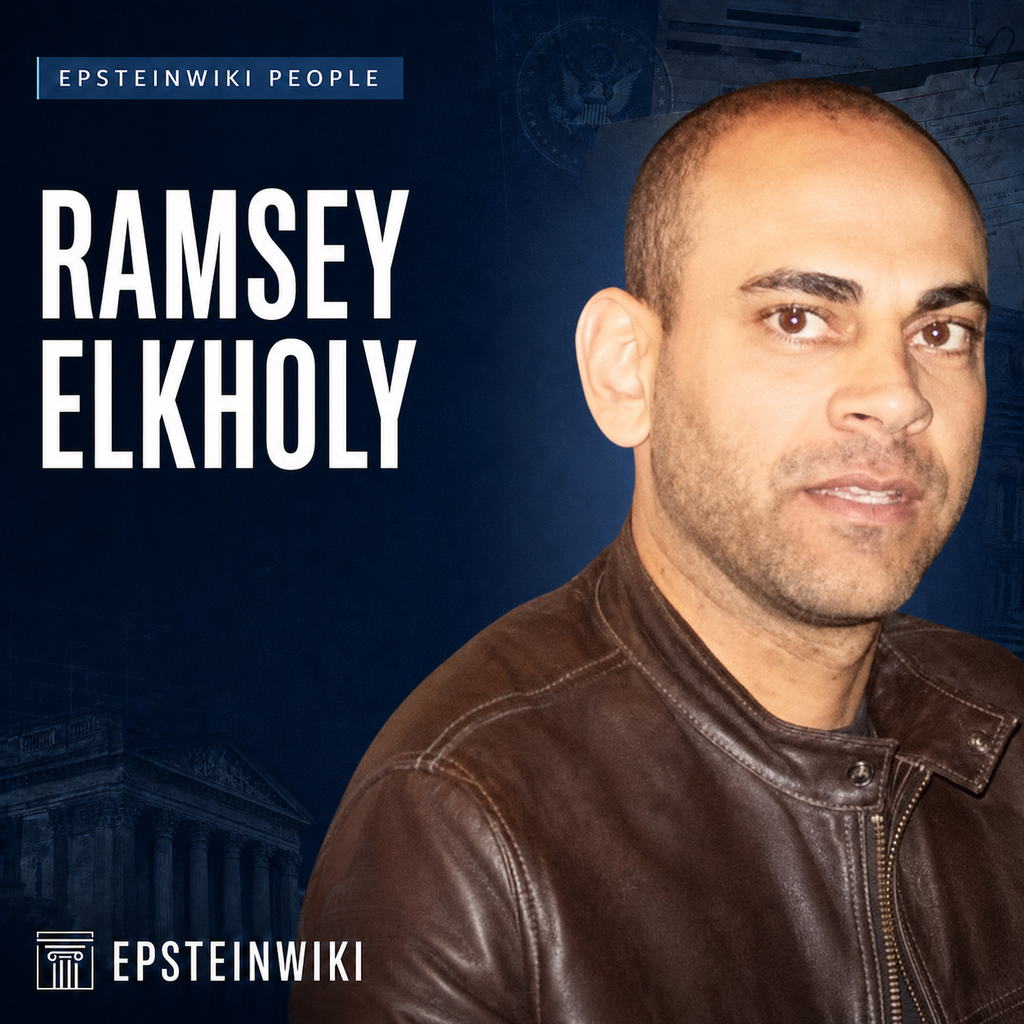
Ramsey Elkholy is an American former modeling manager, anthropologist, musician, producer, and founder of the music collective Monotronic.
Elkholy became part of Jeffrey Epstein’s network through the modeling industry. He told The Washington Post that a model introduced him to Epstein in Manhattan around 2006. Released emails show extensive correspondence beginning no later than 2008 and continuing into the final years of Epstein’s life.
The records are significant because Elkholy repeatedly discussed introducing young adult models and other women to Epstein after Epstein’s 2008 conviction for offenses involving prostitution and a minor.
The correspondence includes:
- Photographs and descriptions of models.
- Discussions about arranging visits to Epstein’s Manhattan townhouse.
- References to presenting meetings as castings or career opportunities.
- Comments demonstrating awareness of Epstein’s preference for unusually young women.
- Explicit suggestions that Epstein have sex with particular women.
- Offers to scout women for Epstein in Europe.
- Communications involving models in Russia, Ukraine, Latvia, the Czech Republic, Slovakia, Brazil, and other countries.
- Proposed modeling and publishing ventures that Elkholy linked to access to women.
- Requests that Epstein use his relationships with fashion designers, political contacts, and influential people to help Elkholy or his models.
- Discussions involving Jean Luc Brunel and women moving through Epstein’s modeling network.
Elkholy told The Washington Post that he introduced five or six models to Epstein, that the women were adults, and that he chaperoned them when they visited Epstein’s townhouse.
The newspaper found emails discussing potential meetings with at least two dozen women, including one who was 18. The available records do not establish how many proposed meetings occurred.
Elkholy has denied wrongdoing. He said he never worked for Epstein, never received money from Epstein, did nothing illegal, and did not know that Epstein was exploiting women. He described his explicit emails as vulgar efforts to impress Epstein rather than accurate accounts of what happened.
No public record reviewed for this article shows that Elkholy has been criminally charged in connection with Epstein.
The emails nevertheless provide unusually direct evidence of how modeling contacts were used to bring young women into Epstein’s orbit after his conviction.
Who Is Ramsey Elkholy?
Ramsey Elkholy was born in New York City around 1980.
He has worked as a modeling manager, anthropologist, guitarist, producer, songwriter, and technology investor.
By the early 2000s, Elkholy was operating a New York modeling scouting and management business called i Management. According to Amy Brittain’s 2026 investigation for The Washington Post, the business promised personal attention to models who might otherwise become lost within larger agencies.
Elkholy estimated that he represented at least 80 models during nearly two decades in the industry. He told the newspaper that he earned approximately $250,000 to $300,000 annually through commissions.
He said models sometimes stayed without paying rent at the Fifth Avenue apartment he shared with his girlfriend. Some remained there for weeks or months while attending castings.
Elkholy later completed a doctorate in anthropology at the University of Manchester.
His academic work included approximately two years of field research among the Orang Rimba of Sumatra. He published Being and Becoming: Embodiment and Experience Among the Orang Rimba of Sumatra in 2016. The book has been reviewed in the Journal of Anthropological Research and the Journal of the Anthropological Society of Oxford.
Elkholy founded Monotronic in 2016. His official biography describes him as a guitarist, producer, songwriter, and anthropologist.
His academic and musical careers are not themselves evidence of involvement in Epstein’s conduct. They matter because Elkholy’s public identity after leaving modeling was substantially different from the role documented in the released Epstein correspondence.
How Elkholy Met Epstein
Elkholy told The Washington Post that a model friend introduced him to Epstein in Manhattan around 2006.
According to Elkholy, the woman suggested visiting her friend Jeffrey. Elkholy declined to identify her publicly.
At the time, Elkholy was preparing doctoral research concerning the Orang Rimba. He said Epstein surprised him by appearing familiar with the community and its language.
Elkholy later wondered whether Epstein had researched his interests before the meeting.
The relationship apparently developed through a combination of intellectual conversation, modeling contacts, access to influential people, and personal favors.
Publicly available emails show direct communications before and after Epstein’s 2008 conviction. An October 2009 exchange records Elkholy adding Epstein as a Facebook contact, but it was not the beginning of their acquaintance.
What Elkholy Says Epstein Told Him
Elkholy said Epstein described his Florida legal problems as the result of a girl lying about her age during a massage and parents attempting to extort him.
That description closely resembles explanations Epstein gave to other associates when confronted about the Palm Beach investigation.
Epstein pleaded guilty in June 2008 to two Florida state charges, including one involving a minor. His guilty plea, jail sentence, and sex offender registration were matters of public record.
Elkholy told The Washington Post that he did not know Epstein was a sex offender.
The emails place Elkholy in regular contact with Epstein after his release from jail. They also contain comments showing that Elkholy understood Epstein preferred very young women.
Those facts do not necessarily prove that Elkholy knew the full scope of Epstein’s trafficking operation. They make the claimed lack of knowledge about Epstein’s sexual interests and legal history an important question.
A Relationship Documented Across Years of Emails
The precise number of documents varies depending on whether researchers count duplicate productions, forwarded chains, attachments, individual pages, or direct messages.
The released corpus contains hundreds of communications involving Elkholy and Epstein. Some databases report more than one thousand direct or duplicated appearances across the production.
The correspondence spans approximately a decade.
The volume matters because this was not a passing social encounter. Elkholy repeatedly communicated with Epstein about:
- Particular women.
- Modeling opportunities.
- International scouting.
- Travel.
- Fashion industry contacts.
- Personal relationships.
- Investments.
- Publishing ventures.
- Potential joint businesses.
- Access to influential people.
- Introductions involving other members of Epstein’s network.
- Women whom Elkholy thought Epstein would find attractive.
The evidence therefore documents a sustained relationship.
The 2008 Casting Email
One of the earliest concerning exchanges dates to February 2008.
According to a released email discussed by Digital Music News, Elkholy told Epstein’s assistant Lesley Groff that he could not send a serious model to Epstein’s residence without giving her a professional reason.
He said that he had told the model the meeting involved Express and had not mentioned Limited Brands.
The importance of the email is not that a modeling opportunity was necessarily impossible. Epstein had genuine connections to Leslie Wexner, Limited Brands, Victoria’s Secret, and the modeling industry.
The concern is that Elkholy acknowledged giving the woman a reason for the visit that may not have reflected the actual purpose.
A legitimate casting ordinarily identifies the client, campaign, agency, or decision maker. The email instead suggests that a brand name was used to persuade a model to attend a private meeting.
The document establishes what Elkholy said about the invitation. It does not establish what happened after the model arrived or whether a meeting occurred.
Epstein’s Release and the Proposed “Gift”
Epstein was released from jail in 2009 and remained subject to house arrest restrictions.
In an October 2009 email, Elkholy described a model as a possible gift for Epstein upon his return.
The exchange is preserved in EFTA00772061.
Elkholy described the model in explicitly sexual terms and urged Epstein to meet her before she left the country.
He portrayed her as the best woman he had sent to Epstein.
The language is important because Elkholy was not merely proposing a neutral portfolio review. He described the woman according to Epstein’s presumed sexual interest and presented her arrival as something intended for Epstein’s enjoyment.
Elkholy later told The Washington Post that he was ashamed of the language and had been trying to impress Epstein.
“Twenty Three Is on the Old Side”
Another 2009 message concerned a 23 year old model.
Elkholy described her as attractive and proposed arranging a casting. He added that he understood 23 might be old by Epstein’s standards.
The exchange appears in EFTA00885529.
The statement directly indicates that Elkholy believed Epstein preferred women younger than 23.
Elkholy’s awareness of that preference does not by itself prove he knew Epstein was abusing minors. It does show that age was part of his selection and presentation of women to Epstein.
Putting casting in quotation marks also raises questions about whether the proposed meeting was an authentic professional evaluation or a social introduction presented as one.
The 18 Year Old College Student
Released records show Elkholy discussing an 18 year old Russian college student he said he had met at an Apple Store.
The exchange appears in EFTA00744124.
The message was sent on a date when Elkholy and Epstein were also discussing Ruslana Korshunova, a young model who had died two years earlier.
The woman in the Apple Store exchange was legally an adult. Her age remains significant because she was at the lowest boundary of adulthood and was being discussed with a man already convicted of an offense involving a minor.
The record establishes that Elkholy proposed or discussed introducing the woman. It does not establish that she met Epstein.
Models as Sexualized Inventory
Across the correspondence, women were frequently described through their bodies, ages, nationalities, willingness, perceived vulnerabilities, and possible sexual interest.
Elkholy used descriptions that included:
- Height and body type.
- Hair color.
- Nationality.
- Whether a woman needed money.
- Whether she lacked housing.
- Whether she was alone in New York.
- Whether she was sexually experienced.
- Whether she was shy or conservative.
- Whether she might provide a lingerie presentation.
- Whether Epstein would want to have sex with her.
This language reduced professional models and acquaintances to possible experiences for Epstein.
Elkholy told The Washington Post that the messages were crude talk designed to win Epstein’s approval. That explanation addresses his intention in writing but does not erase the function of the communications.
The emails supplied Epstein with information he could use to select, contact, or meet particular women.
Housing as Leverage
One 2009 exchange described a tall model as an exceptional physical specimen and discussed the possibility of providing her with somewhere to stay during visits to New York.
Elkholy suggested that housing could serve as an effective angle because the woman would no longer have an apartment.
Housing was a serious vulnerability for international and early career models. A young woman travelling for castings could depend on managers, agencies, friends, or clients for a place to sleep.
Epstein’s properties and associated apartments repeatedly operated as sites where professional, educational, financial, and social promises overlapped with sexual access.
The correspondence does not prove that the proposed housing arrangement occurred. It documents Elkholy identifying the woman’s housing situation as something that could help persuade her.
The Lingerie Show Message
In a 2011 email, Elkholy said that he wanted a woman to give Epstein a lingerie presentation and that Epstein had been patient with her.
The message is preserved in EFTA01860040.
A lingerie presentation could theoretically occur within a legitimate modeling context. The surrounding communications make the stated purpose less clear because Elkholy also discussed the woman in sexual terms.
The document proves that he encouraged a sexualized presentation for Epstein.
It does not establish whether the woman agreed, whether she understood the intended context, or whether the event occurred.
“Please Just Try Her in Bed”
Another 2011 exchange contains one of Elkholy’s most explicit communications.
Elkholy encouraged Epstein to have sex with a woman described as needing money. He continued pressing the point after Epstein showed little interest.
The exchange is preserved in EFTA00990313.
Elkholy later told The Washington Post that the woman was present when he wrote at least part of the exchange and that the message was sarcastic.
The public record does not independently confirm that explanation.
Even if the woman was present, the language demonstrates that Elkholy understood Epstein as someone to whom women could be proposed for sex.
The reference to financial need is particularly important. Financial vulnerability can affect the freedom with which a person makes decisions, even when the person is legally an adult.
The document does not establish that Epstein had sex with the woman or that Elkholy received anything in return.
Elkholy’s Explanation for the Introductions
Elkholy said he believed Epstein could help models obtain valuable work.
Epstein had relationships with:
- Leslie Wexner.
- Limited Brands.
- Victoria’s Secret.
- Fashion designer Vera Wang.
- Jean Luc Brunel.
- Models and modeling agencies.
- Photographers, entertainers, and wealthy clients.
Elkholy earned commissions when his models obtained work. A major campaign could substantially increase both a model’s earnings and the manager’s income.
He told The Washington Post that this commercial incentive explained why he wanted models to meet Epstein.
That explanation is plausible as one component of the relationship. It does not explain why so many messages described women according to Epstein’s sexual preferences or proposed sex, lingerie, housing pressure, and deceptive professional pretexts.
The business and sexual functions were not always separate in the correspondence.
Vera Wang and Fashion Industry Access
Elkholy repeatedly asked Epstein to use fashion industry relationships to help models.
In one message, he requested what he called an enormous favor involving a model he wanted considered by Vera Wang’s organization.
The communication appears in EFTA00876236.
Epstein had known Vera Wang for years. Released communications show members of Wang’s circle describing him as close to the family.
There is no evidence that Wang knew Elkholy was presenting women to Epstein in sexualized communications. A request that Epstein arrange a professional introduction does not establish wrongdoing by the designer or her staff.
The exchange demonstrates why Epstein’s social capital was useful. A modeling manager could present access to Epstein as possible access to major fashion opportunities.
Jean Luc Brunel
French modeling agent Jean Luc Brunel was a central figure in Epstein’s modeling network.
Epstein financially supported Brunel’s MC2 Model Management. Brunel was later accused by multiple women of sexual abuse and trafficking related conduct. He denied wrongdoing and died in French custody in 2022 before his criminal case reached trial.
Elkholy’s emails show awareness of and contact involving Brunel.
In a November 2013 exchange, Epstein told Elkholy that two women had visited and that Brunel met them. Elkholy asked how the meeting went. The message is preserved in EFTA00685162.
Another communication referred to Brunel and Elkholy travelling or socializing in Riga. That record appears in EFTA02562736.
These communications place Elkholy within the same international modeling environment used by Epstein and Brunel to meet young women.
They do not establish that Elkholy knew the full allegations against Brunel or participated in Brunel’s alleged crimes.
European Scouting
Elkholy travelled extensively through European modeling markets.
His correspondence with Epstein referenced Prague, Moscow, Slovakia, Latvia, Hungary, France, Germany, and other locations.
In EFTA00900217, Elkholy wrote from Slovakia and characterized the location according to the abundance of attractive women. The same chain discussed travel through Prague, Paris, and Moscow.
Other communications described scouting in Russia and keeping Epstein’s preferences in mind.
The international dimension is important because young models often moved across borders with limited money, uncertain visa status, temporary housing, and dependence on agents.
The records do not establish that every scouting trip was conducted for Epstein. They show that Elkholy repeatedly connected his travel and scouting work with Epstein’s interest in women.
Latvia and Saint Tropez
In August 2011, Epstein informed Elkholy that he would be in France.
Elkholy was in Riga, Latvia, where he discussed women he had met and identified a Latvian model who expected to spend time in Saint Tropez.
Epstein encouraged the woman to contact him. Messages followed concerning photographs, accommodations, and whether she had female friends in Paris whom Epstein might enjoy meeting.
The sequence was examined in Le Monde’s investigation into Epstein’s activities in Saint Tropez.
This episode demonstrates the practical mechanics of the network:
- Elkholy identified a model in one country.
- Epstein was informed of her travel to another country.
- Contact information was exchanged.
- Epstein asked for photographs.
- Epstein sought access to the woman’s friends.
The emails establish the introduction chain. They do not establish that abuse occurred during the resulting communications.
The Czech Model Discussions
In December 2014, Elkholy told Epstein that he was trying to bring a Czech woman to see him.
The exchange is preserved in EFTA01002520 and EFTA02356578.
Related scheduling messages show Epstein’s staff coordinating appointments with Elkholy. EFTA00363709 contains one such request for Elkholy to visit Epstein at his Manhattan home.
These records show that the introduction process sometimes involved Epstein’s staff and formal scheduling.
A calendar entry or appointment request does not establish what happened during the meeting. It does establish access to Epstein’s residence and the involvement of his assistants in managing that access.
Proposed Dinner With David Blaine
In 2014, Epstein asked Elkholy about models who might join him and magician David Blaine for dinner in Paris.
Elkholy proposed that the women first meet at Epstein’s residence so they would perceive Epstein as the more important participant. He also suggested that Blaine could mention knowing Elkholy so the women would believe Elkholy’s account.
Emails indicate that Epstein postponed the trip because of illness. No evidence located by The Washington Post established that the dinner occurred.
A representative for Blaine said the communications were between other people using his name and that Blaine neither arranged nor attended the proposed gathering.
The episode illustrates how celebrity names could be used to increase the credibility or appeal of an invitation even when the celebrity did not know about the plan.
It does not establish misconduct by Blaine.
Personal Favors and Proposed Scouting Trades
Elkholy also sought personal favors from Epstein.
In 2015, he asked whether Epstein could arrange a White House tour for a woman and her mother. Elkholy promised to return the favor.
In 2016, while interested in a Ukrainian model, Elkholy offered to devote time and energy to scouting in Europe if Epstein helped him.
Elkholy later said that he was not employed by Epstein and was merely telling him what he wanted to hear.
The exchange is still relevant because it shows Elkholy presenting access to women and scouting services as something that could be exchanged for Epstein’s influence.
No released contract establishes that Epstein hired Elkholy as an employee or independent contractor.
The absence of a contract does not make the communications insignificant. Informal exchange was one of Epstein’s preferred methods of obtaining access and loyalty.
The Russian Painter
In 2015, Elkholy sought Epstein’s help while pursuing a Russian painter.
The initial request appears in EFTA02361985.
Epstein later asked what had happened with Elkholy’s “artist prey.” That follow up appears in EFTA00855335.
The wording is Epstein’s, not a formal description of the woman or her relationship with either man.
The woman was approached as a romantic interest rather than as a modeling recruit. The exchange demonstrates that Elkholy also used Epstein as an adviser and possible facilitator in his private relationships.
Anna Iaryn
In 2016, Elkholy discussed Ukrainian model Anna Iaryn with Epstein.
Elkholy described having a romantic interest in her and asked Epstein for assistance. He offered to reciprocate through a European scouting trip or other effort.
Iaryn told The Washington Post that she had met Elkholy several times and regarded him as a kind friend. She said she did not know that he had a romantic interest in her.
She described the released messages as disturbing.
Iaryn separately knew Epstein after his assistant Svetlana Pozhidaeva attempted to recruit her to give massages. Pozhidaeva later publicly identified herself as an Epstein survivor.
The available evidence does not show that Elkholy participated in those massage recruitment attempts.
The episode matters because it reveals overlapping personal, modeling, and recruitment channels surrounding the same woman.
Brazil, L’Officiel, and Joy Models
By 2016 and 2017, Elkholy and Epstein discussed possible investments connected to Brazilian fashion and modeling.
The communications referenced:
- A Brazilian modeling agency.
- Joy Models.
- The fashion publication L’Officiel.
- Possible beauty competitions.
- Monthly access to models seeking covers or contracts.
- The ability to move selected women to the United States, France, or the Caribbean.
In EFTA00816365, Elkholy described a proposed Brazilian contest or scouting structure involving a very large pool of applicants across multiple cities.
He told Epstein that the venture could provide access to women and allow selected participants to be flown to other locations.
Other messages discussed whether investment in a fashion publication would be profitable. Epstein advised caution about print media.
Elkholy responded with explicit language linking possible ownership to a continuing supply of women.
The correspondence indicates that the business opportunity was evaluated partly for access rather than solely for investment return.
No evidence reviewed for this article establishes that Elkholy and Epstein ultimately acquired Joy Models or L’Officiel.
The Brazilian Publisher
Later communications suggest that Elkholy decided direct ownership was unnecessary or too difficult.
He told Epstein that he had developed influence with a Brazilian publisher and could pay to secure photo shoots for particular models.
The discussion again connected control over fashion opportunities with access to women.
The distinction between legitimate promotion and personal leverage is critical. Paying for a genuine photo shoot is not inherently unlawful. Using career opportunities to create sexual access or induce women to attend misleading meetings raises different concerns.
The emails do not establish the terms of every photo shoot or whether any woman was coerced.
They demonstrate that Elkholy and Epstein discussed the fashion system as a mechanism through which women could be selected and approached.
Ruslana Korshunova
Ruslana Korshunova was a successful Kazakhstani model who died in Manhattan in June 2008 at age 20. Authorities ruled her death a suicide.
Flight records show that Korshunova travelled on Epstein’s aircraft to Little Saint James in 2006 when she was 18.
Elkholy began managing her after that trip. He said he did not arrange her introduction to Epstein and only learned after her death that she and Epstein had known each other.
He told The Washington Post that Epstein described their relationship as dating and appeared distraught after her death.
Elkholy later participated in matters associated with Korshunova’s modeling affairs or estate accounting.
The fact that Elkholy managed Korshunova does not establish that he knew about her earlier travel with Epstein.
Her death should not be attributed to Epstein or Elkholy without evidence establishing causation. The presently available record establishes her island trip, her later professional relationship with Elkholy, the men’s communications about her, and Elkholy’s denial that he facilitated their meeting.
The Reported Polish Model Account
A Polish model reportedly told The Wall Street Journal that Elkholy introduced her to Epstein and that Epstein subsequently exploited her during a relationship lasting several months.
The Washington Post could not independently identify the woman or verify the complete account.
Elkholy said he was uncertain which model the report concerned. He argued that he should not be blamed if an adult woman independently entered a relationship with Epstein.
The model’s reported account is relevant because it concerns possible harm following an Elkholy introduction.
It remains a reported survivor account rather than an adjudicated finding against Elkholy.
No evidence reviewed for this article establishes that Elkholy knew Epstein would exploit the woman when he introduced them.
Elkholy’s Response
Elkholy gave an extensive interview to The Washington Post in 2026.
He said:
- He introduced only five or six models to Epstein.
- He always accompanied models during visits to the Manhattan townhouse.
- All of the models were adults.
- The women wanted career opportunities.
- He believed Epstein could help them obtain valuable work.
- He expected commissions if his models succeeded.
- Epstein never paid him.
- He did not work for Epstein.
- Many proposed meetings never happened.
- His explicit messages were foolish attempts to impress Epstein.
- He did not know Epstein was exploiting women.
- No model he introduced complained directly to him about Epstein.
- He was completely certain that he had done nothing illegal.
Elkholy expressed shame about his language and said the emails presented a distorted picture of events.
These denials and explanations are part of the evidentiary record and should be included alongside the emails.
They do not eliminate the need to examine how professional access, sexualized descriptions, financial vulnerability, and deceptive invitations operated together.
Criminal and Civil Status
No public record reviewed for this article establishes that Elkholy has been arrested, indicted, or convicted for conduct connected to Epstein.
No court has adjudicated him to be a participant in Epstein’s trafficking conspiracy.
He has not been identified as a defendant in the major survivor lawsuits concerning Epstein’s estate, JPMorgan, or Deutsche Bank based on the records reviewed here.
The absence of charges does not determine whether every action reflected good judgment or complied with modeling industry ethics.
It means the article must distinguish documentary evidence of introductions from a legal finding of trafficking or conspiracy.
Modeling as an Epstein Recruitment Channel
The Elkholy correspondence illustrates why the modeling industry was so useful to Epstein.
Young models often faced:
- International travel.
- Uncertain immigration or visa status.
- Temporary housing.
- Dependence on agents and managers.
- Pressure to attend private castings.
- Large power differences.
- Financial insecurity.
- Competition for scarce campaigns.
- Requests to socialize with wealthy clients.
- Difficulty distinguishing genuine career opportunities from predatory invitations.
Epstein possessed real connections to powerful people within fashion and retail. That allowed fraudulent or ambiguous opportunities to appear credible.
The system did not require every modeling professional to understand Epstein’s complete criminal operation. It required enough people to keep suggesting women, arranging meetings, forwarding photographs, and presenting Epstein as someone who could help their careers.
Elkholy’s emails document one part of that access system after Epstein’s conviction.
Why the Post Conviction Timing Matters
Much of the most concerning correspondence occurred after Epstein’s 2008 guilty plea.
By then:
- Epstein had been publicly arrested.
- He had pleaded guilty to offenses including one involving a minor.
- He had served jail time.
- He was a registered sex offender.
- His interest in young women was part of the public record.
- Elkholy was making comments about women being young enough for Epstein.
The timing does not automatically establish that Elkholy knew Epstein continued committing crimes.
It substantially weakens any portrayal of Epstein as an ordinary wealthy fashion contact without known sexual risk.
What the Emails Prove
The emails prove that Elkholy repeatedly:
- Identified women he thought Epstein would find attractive.
- Sent or discussed photographs.
- Proposed meetings.
- Used sexually explicit language.
- Discussed women according to age.
- Referred to Epstein preferring women younger than 23.
- Proposed an 18 year old woman.
- Discussed women who needed housing or money.
- Encouraged a woman to perform in lingerie.
- urged Epstein to have sex with a particular woman.
- Used fashion opportunities to support invitations.
- Offered scouting work in exchange for favors.
- Communicated with Epstein about international modeling markets.
- Discussed business ventures partly in terms of access to women.
- Continued communicating with Epstein after his conviction.
The emails do not independently prove that each woman met Epstein, that sexual activity occurred, or that Elkholy understood every aspect of Epstein’s criminal conduct.
What the Evidence Establishes
The available record establishes that:
- Elkholy worked as a modeling manager in New York.
- He met Epstein around 2006, according to his account.
- He communicated with Epstein over approximately a decade.
- He introduced adult models to Epstein.
- He acknowledged introducing five or six models.
- The emails discussed at least two dozen potential female contacts.
- At least one woman discussed was 18.
- Elkholy knew Epstein preferred very young women.
- He used explicitly sexual language when describing women.
- He sometimes presented meetings as castings or fashion opportunities.
- He sought professional benefits for models through Epstein’s contacts.
- He expected commissions if models obtained work.
- He offered Epstein international scouting assistance.
- He communicated with or about Jean Luc Brunel.
- He discussed women in European and Brazilian modeling markets.
- He and Epstein discussed possible modeling and publishing investments.
- Elkholy denied knowing that Epstein was exploiting women.
- Elkholy denied working for or receiving payment from Epstein.
- Elkholy has not been criminally convicted in connection with Epstein.
What the Evidence Does Not Establish
The available record does not establish that:
- Every proposed meeting occurred.
- Every woman described in an email met Epstein.
- Every casting opportunity was fraudulent.
- Elkholy introduced minors to Epstein.
- The women introduced by Elkholy were legally incapable of consenting.
- Elkholy received payment from Epstein.
- Elkholy held a formal position within Epstein’s organization.
- Elkholy knew the complete scope of Epstein’s trafficking operation.
- Elkholy participated in every Jean Luc Brunel activity mentioned in the emails.
- Elkholy arranged Ruslana Korshunova’s island trip.
- Epstein or Elkholy caused Korshunova’s death.
- Elkholy knew that Epstein would exploit the Polish model described in later reporting.
- Every sexually explicit email described an event that actually occurred.
- Elkholy and Epstein completed the proposed Brazilian acquisitions.
- Elkholy has been found liable for trafficking in a civil judgment.
- Appearance in thousands of document pages means thousands of distinct interactions.
Investigative Assessment
Ramsey Elkholy’s importance to the Epstein record does not come from celebrity or institutional power.
It comes from access.
Elkholy worked in an industry populated by young women whose careers depended on introductions, private meetings, travel, housing, photographs, and promises of major campaigns.
Epstein possessed the contacts necessary to make those promises appear plausible.
The emails show Elkholy repeatedly combining professional opportunity with Epstein’s sexual interests. Women were described as models, romantic interests, possible sexual partners, scouting discoveries, and participants in proposed business ventures.
Elkholy’s defense is that the messages were vulgar performance rather than evidence of criminal conduct. He says the women were adults, many meetings never occurred, he chaperoned those who visited, and he believed Epstein could advance their careers.
Those claims may limit what can responsibly be concluded about individual encounters.
They do not change the broader pattern documented in his own words: he understood that Epstein wanted access to very young women, supplied information about women, proposed meetings, discussed vulnerabilities, and continued doing so after Epstein’s conviction.
The record warrants further investigation into which meetings occurred, what the women were told, whether any career opportunities materialized, whether Epstein later contacted them privately, and whether the women experienced conduct they did not report to Elkholy.
Key Takeaways
- Ramsey Elkholy was a New York modeling manager before becoming an anthropologist and musician.
- He said a model introduced him to Epstein around 2006.
- Their correspondence continued for approximately a decade.
- Elkholy admitted introducing five or six adult models to Epstein.
- Released emails discuss potential meetings involving at least two dozen women.
- Elkholy demonstrated awareness that Epstein preferred unusually young women.
- He discussed an 18 year old and described 23 as potentially old for Epstein.
- Some invitations were presented as castings or fashion opportunities.
- Elkholy used sexualized descriptions and sometimes encouraged Epstein to have sex with particular women.
- He identified financial need and housing as relevant circumstances.
- He offered international scouting work in exchange for Epstein’s assistance.
- He communicated with Epstein about Jean Luc Brunel and international modeling contacts.
- He discussed Brazilian modeling and publishing ventures partly as sources of access to women.
- Elkholy denied wrongdoing, knowledge of exploitation, employment by Epstein, or payment from Epstein.
- No public record reviewed for this article shows an Epstein related criminal charge against Elkholy.
Related EpsteinWiki Articles
- Jeffrey Epstein
- Ghislaine Maxwell
- Jean Luc Brunel
- Leslie Wexner
- Lesley Groff
- Nadia Marcinkova
- Sarah Kellen
- Little Saint James
- Victoria’s Secret and Jeffrey Epstein
- MC2 Model Management
- The Modeling Industry and Jeffrey Epstein
- Epstein’s Recruitment Network
- David Blaine
- How to Read an Epstein Document
Primary Epstein Data Evidence
- EFTA00772061 contains the 2009 message proposing a model as a gift following Epstein’s return.
- EFTA00885529 contains the exchange describing a 23 year old as potentially old for Epstein.
- EFTA00744124 concerns an 18 year old Russian college student.
- EFTA00876236 concerns Elkholy’s request that Epstein help obtain a Vera Wang opportunity.
- EFTA01860040 contains the lingerie presentation discussion.
- EFTA00990313 contains Elkholy’s explicit encouragement that Epstein have sex with a particular woman.
- EFTA00900217 documents Elkholy’s European travel and sexualized comments about women in Slovakia.
- EFTA00363709 contains scheduling correspondence concerning a visit to Epstein’s residence.
- EFTA01002520 concerns an attempted introduction involving a Czech woman.
- EFTA02356578 contains related December 2014 scheduling correspondence.
- EFTA00685162 concerns a meeting involving women and Jean Luc Brunel.
- EFTA02562736 references Elkholy and Brunel in Riga.
- EFTA00816365 concerns a proposed Brazilian modeling project and access to applicants.
- EFTA02361985 concerns Elkholy’s request for help involving a Russian painter.
- EFTA00855335 contains Epstein’s follow up concerning the painter.
- EFTA00911253 contains correspondence involving Elkholy and modeling industry contacts.
- EFTA00911188 contains additional correspondence about a woman discussed with Epstein.
- EFTA00766813 contains an Elkholy request to bring a woman to meet Epstein.
- EFTA02098647 contains scheduling correspondence involving Elkholy and Epstein.
- Epstein Data search for Ramsey Elkholy provides access to the broader released document corpus.
The EFTA identifiers document particular communications. Duplicate productions and forwarded email chains can inflate the number of apparent appearances. Each document should be reviewed individually before researchers calculate the total number of distinct contacts.
Investigative and Professional Sources
- The Washington Post investigation into Elkholy’s modeling introductions
- Digital Music News investigation into the Elkholy emails
- Le Monde investigation into Epstein’s Saint Tropez network
- Ramsey Elkholy’s official biography
- Ramsey Elkholy’s anthropology publications
- Oxford record for the review of Being and Becoming
- University of Chicago Press review of Being and Becoming
- United States Department of Justice Epstein Library