
Sergey Brin
Snapshot
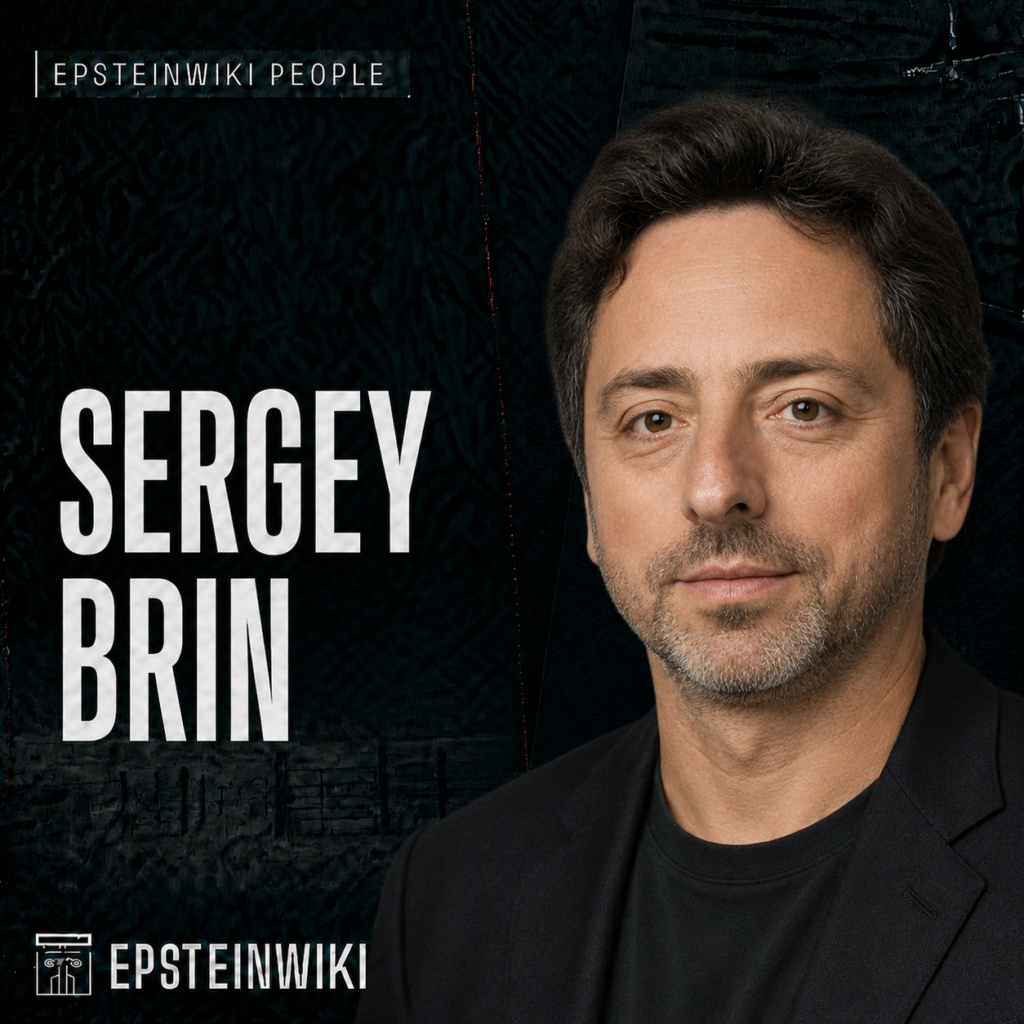
Sergey Brin is a computer scientist, technology executive, and co founder of Google. He later served as president of Alphabet, Google’s parent company, and remains closely associated with the companies he created with Larry Page.
Released Jeffrey Epstein records document several connections involving Brin, Ghislaine Maxwell, JPMorgan Chase, and the Edge Foundation’s technology and science gatherings.
The clearest evidence includes:
- Emails between Brin and Maxwell concerning a proposed April 2003 dinner at Epstein’s Manhattan townhouse.
- A survivor’s account that she encountered Brin and his then fiancée, Anne Wojcicki, during a 2007 visit to Epstein’s private island, Little Saint James.
- Reporting based on court records stating that Epstein advised Brin in 2007 about a tax planning trust for his children.
- JPMorgan litigation records identifying Brin and Google as clients Epstein referred to the bank.
- Photographs and event records placing Brin at technology and intellectual gatherings also attended by Epstein.
- A 2023 subpoena seeking Brin’s records concerning Epstein and JPMorgan.
The available evidence establishes social and financial contact. It does not establish that Brin participated in Epstein’s sexual abuse, trafficking operation, or other criminal conduct.
As of September 2, 2026, Brin is not publicly known to have been charged with or convicted of an offense arising from his contacts with Epstein or Maxwell.
Identity and Google Career
Sergey Mikhailovich Brin was born in Moscow in 1973 and emigrated to the United States with his family as a child.
According to his official Google biography, Brin earned an honors degree in mathematics and computer science from the University of Maryland and a master’s degree in computer science from Stanford University.
Brin met Larry Page while studying at Stanford. Their research into organizing and ranking information on the internet led to the creation of Google.
Google was incorporated in 1998. Brin served as the company’s president of technology and later became president of Alphabet when the holding company was created in 2015. He stepped down from that executive role in December 2019 but remained a board member, controlling shareholder, and employee.
Brin’s wealth, technical reputation, and access to the emerging Silicon Valley economy made him valuable to financiers, philanthropists, conference organizers, and social intermediaries seeking relationships with technology leaders.
Epstein and Maxwell were among the people who attempted to cultivate those networks.
The Earliest Documented Contact
The earliest direct correspondence presently identified between Brin and Maxwell dates from April 2003.
EFTA00578854 contains an email exchange concerning Brin’s expected visit to New York on April 15 and 16.
Maxwell discussed a possible dinner at Epstein’s Manhattan residence. She described dinners at Epstein’s home as casual and relaxed.
Brin replied that he expected to be in New York and asked Maxwell to determine what worked for her and Epstein. He also suggested that he might bring Google chief executive Eric Schmidt.
The exchange establishes that:
- Brin and Maxwell communicated directly.
- Maxwell was arranging a proposed meeting involving Brin and Epstein.
- Epstein’s Manhattan townhouse was being used to host prominent technology contacts.
- Brin was sufficiently receptive to suggest including another senior Google executive.
The email does not by itself prove that the dinner occurred. A proposed invitation must be distinguished from an attended event unless a calendar, photograph, guest list, testimony, or later message confirms the meeting.
Ghislaine Maxwell’s Role
Maxwell functioned as a social intermediary for Epstein.
Her correspondence with Brin is consistent with the wider documentary record in which she organized dinners, introduced people, circulated invitations, and helped Epstein gain access to prominent figures in business, science, technology, politics, and society.
The 2003 Brin exchange predates the Palm Beach investigation that began in 2005. Epstein had not yet been publicly charged or convicted of a sexual offense.
That timing matters when evaluating what Brin or other invited guests might reasonably have known in 2003.
The email nevertheless establishes that Maxwell was connecting Brin directly to Epstein’s household and social network several years before Epstein’s 2008 Florida conviction.
The Proposed Manhattan Dinner
The proposed dinner is important because Epstein’s Manhattan townhouse was not simply a private residence.
The property served as a meeting site for financiers, academics, politicians, entertainers, technology executives, and other prominent visitors. Survivors and employees also described sexual abuse and massage activity occurring within the residence.
A person’s presence at the townhouse does not prove knowledge of everything that occurred there.
In Brin’s case, the surviving email proves that a dinner was contemplated. It does not identify every prospective guest, establish what would have been discussed, or demonstrate that Brin witnessed criminal activity.
Any claim that Brin attended the April 2003 dinner should therefore identify corroborating evidence rather than treating the invitation as proof of attendance.
The Reported Visit to Little Saint James
A survivor’s account places Brin and Anne Wojcicki on Epstein’s private island in 2007.
The witness told investigators that Epstein had coerced her to travel to Little Saint James and sexually abused her there. She said that she encountered Brin and Wojcicki while the couple were visiting the island.
The account was discussed in later reporting after additional Justice Department records became public. The New York Times reporting summarized by The Verge described Brin and Wojcicki as visitors to the island during this period.
The evidence requires careful classification.
The witness’s account establishes that she identified Brin and Wojcicki as people she encountered on the island. It does not establish that they witnessed her abuse, knew she had been coerced, or participated in Epstein’s sexual conduct.
Sarah Ransome’s 2016 Emails
Separate unsealed records contain statements made by survivor Sarah Ransome in emails sent to journalist Maureen Callahan in 2016.
Ransome said she had photographs of herself with Brin and Wojcicki on the island. She described the couple as visiting for the day and said Brin wanted to use new kite surfing equipment.
The emails became public during later releases from the Giuffre v. Maxwell litigation.
Ransome’s statement is evidence that she made the identification and described the circumstances of the visit. It is not equivalent to a judicial finding.
Her proposed photographs were not initially published with the email. The statement should therefore be evaluated alongside later photographic releases, investigative records, and any available metadata.
Ransome has also acknowledged that some claims she made while communicating with reporters were fabricated. That history does not automatically invalidate every part of her account, but it makes independent corroboration especially important.
Later Photographic Evidence
Later document releases included photographs identified by researchers as depicting Brin within materials associated with Epstein.
Images catalogued as EFTA01158783, EFTA01158802, EFTA01158803, EFTA01158807, EFTA01158808, and EFTA01158809 have been indexed as containing Brin.
Some published photographs appear to place Brin at a tropical property associated with Epstein. Other images show him at Edge Foundation events rather than at an Epstein residence.
A photograph can establish physical appearance at a location or event when the date, setting, and identity are reliably confirmed. It cannot independently establish what a person knew, what occurred outside the frame, or whether criminal conduct took place during the visit.
Researchers should avoid merging photographs from Little Saint James, Edge events, conferences, and unrelated social gatherings into a single undocumented occasion.
Timing of the Island Visit
The reported island visit occurred in 2007, according to the witness accounts and subsequent reporting.
That year was a critical period in the Epstein investigation.
Palm Beach police had begun investigating Epstein in 2005. A Florida grand jury indicted him in 2006 on a state prostitution charge. Federal prosecutors were also examining whether stronger charges were warranted.
Epstein signed his controversial federal non prosecution agreement in September 2007. He pleaded guilty to Florida state charges in June 2008.
The precise date of Brin’s reported visit is therefore important. A visit early in 2007 would have occurred after Epstein had been publicly investigated and indicted but before his guilty plea.
The available material reviewed for this article does not establish what Brin knew about the Palm Beach investigation when he visited.
Anne Wojcicki
Anne Wojcicki is a biotechnology entrepreneur and co founder of the genetic testing company 23andMe.
She and Brin married in May 2007 and later divorced. Accounts describing her as Brin’s fiancée during the Little Saint James visit suggest that the visit occurred before their marriage or reflect how the witness remembered the relationship.
Wojcicki’s presence is relevant because Epstein developed a sustained interest in genetics, biotechnology, reproductive science, heredity, and human enhancement.
However, the fact that Wojcicki founded a genetics company does not establish that the island visit concerned genetics or that 23andMe entered a relationship with Epstein.
The reported visit and the later scientific interests must be evaluated separately unless a primary document directly connects them.
Epstein’s Tax Planning Advice
Court records reported by The Wall Street Journal state that Epstein advised Brin in 2007 about creating a tax planning trust for Brin’s children.
The proposed vehicle was a grantor retained annuity trust, commonly called a GRAT.
A GRAT allows a person to transfer appreciating assets into a trust while retaining scheduled annuity payments. Depending on asset performance and how the trust is structured, value remaining after the trust term may pass to beneficiaries with reduced gift or estate tax consequences.
The reporting stated that Epstein introduced Brin to JPMorgan bankers who could structure the trust.
This is significant because it shows Epstein functioning as more than a social acquaintance. He was providing or attempting to provide financial and estate planning assistance to Brin.
The record does not establish that the trust was illegal. GRATs are established estate planning instruments used by many wealthy families.
Why the Tax Trust Matters
The trust discussion helps explain Epstein’s value to both Brin and JPMorgan.
For wealthy clients, Epstein could offer introductions, tax planning ideas, and access to private banking personnel.
For JPMorgan, Epstein could provide relationships with exceptionally valuable clients.
For Epstein, those referrals strengthened his position within the bank and reinforced his claimed identity as a trusted adviser to billionaires.
The trust discussion also occurred in 2007, while Epstein faced serious legal exposure in Florida.
The surviving evidence does not establish whether Brin knew the full extent of the investigation, whether the proposed GRAT was completed, or how much Epstein contributed to the final structure.
It does establish that Epstein was involved in discussions concerning Brin’s family wealth planning.
Epstein Referred Brin to JPMorgan
The strongest financial evidence appears in the civil litigation brought by the Government of the United States Virgin Islands against JPMorgan Chase.
The territory alleged that Epstein referred Brin and Google to JPMorgan around 2003.
EFTA02811664 contains sworn interrogatory material from former JPMorgan executive Jes Staley identifying Brin and Google among the clients Epstein referred to the bank.
EFTA02809437 contains deposition related material stating that Epstein referred Brin to JPMorgan.
EFTA02811696 contains a Rule 56.1 statement filed in the USVI litigation. It states that Brin became a JPMorgan Private Bank client in 2004 and describes Epstein as having referred Brin and Google.
These records support the conclusion that Epstein played an intermediary role between Brin and JPMorgan.
The Scale of Brin’s JPMorgan Relationship
The USVI filings described Brin’s relationship with JPMorgan as one of the largest relationships within the bank’s private banking operation.
According to EFTA02811696, a July 2014 JPMorgan record valued the overall Brin relationship at more than $4 billion.
The filings also refer to meetings involving Brin’s family office, Bayshore Global, and senior JPMorgan figures.
This does not mean that Epstein controlled Brin’s assets or remained involved in every part of the banking relationship.
It establishes that a referral associated with Epstein developed into an extremely valuable relationship for JPMorgan.
The scale of the account helps explain why the USVI examined Epstein’s referrals while investigating whether the bank had financial incentives to retain him as a client.
The USVI Statement of Facts
EFTA02809353 contains a statement of facts filed by the United States Virgin Islands.
The filing asserted that Epstein brought ultra wealthy clients to JPMorgan, including Brin, Leslie Wexner, Glenn Dubin, and others. The territory argued that Epstein’s referrals generated substantial fees and strengthened his institutional value to the bank.
A statement of facts filed by a litigant is not automatically a judicial finding.
It records the territory’s evidentiary position and identifies documents, testimony, and internal bank records that the government believed supported its case.
The filing should therefore be described as a civil allegation supported by cited evidence, not as a criminal judgment against Brin.
Epstein as an Adviser to the Google Founders
Some internal JPMorgan material described Epstein as an adviser to the Google founders.
Reporting on the court records noted that bank personnel used this characterization while discussing Epstein’s value as a source of wealthy clients.
The phrase is significant because it reflects how Epstein presented himself or was understood within the bank.
It does not establish the scope of any advisory relationship with Brin or Larry Page.
Epstein may have offered tax ideas, introductions, investment opinions, or general financial advice. The surviving public record does not show that he held an official Google position, exercised corporate authority, or advised Google on its search technology or business operations.
A bank’s internal label should not be expanded beyond the evidence supporting it.
The 2023 Brin Subpoena
In March 2023, the United States Virgin Islands issued a subpoena to Brin in connection with its lawsuit against JPMorgan.
The Wall Street Journal reported that the territory sought communications and documents concerning Brin’s relationship with Epstein and the bank.
The subpoena was part of a wider discovery effort involving wealthy people whom Epstein may have introduced to JPMorgan. Other recipients included Thomas Pritzker, Mortimer Zuckerman, and Michael Ovitz.
The Guardian’s report on the subpoenas likewise described the requests as part of the banking inquiry.
A subpoena is a demand for potentially relevant evidence. It is not an accusation that the recipient committed a crime.
What the Subpoena Could Establish
The USVI had several possible reasons to seek Brin’s records.
The territory was examining:
- Whether Epstein referred valuable clients to JPMorgan.
- Whether the bank considered those referrals when deciding to retain Epstein.
- What services JPMorgan provided to Epstein’s contacts.
- Whether Epstein remained involved with clients after making an introduction.
- Whether bank executives understood Epstein’s role as a financial adviser.
- Whether communications involving Brin corroborated internal JPMorgan records.
The subpoena did not establish that Brin knew JPMorgan was processing transactions connected with Epstein’s trafficking operation.
It also did not establish that Brin had information about abuse merely because his financial records were relevant to the bank’s incentive structure.
The JPMorgan Settlement
The USVI litigation ended in 2023 when JPMorgan agreed to pay $75 million.
The settlement included funds for charitable organizations, law enforcement initiatives, and mental health services for survivors. JPMorgan did not admit liability.
The bank separately agreed to pay $290 million to settle a class action brought on behalf of Epstein survivors.
Because the USVI case settled before trial, a jury did not decide every disputed allegation concerning the bank, Epstein’s referrals, or the conduct of individual executives.
The Brin related evidence remains important documentary material, but it should not be represented as a verdict against Brin.
Jes Staley’s Congressional Testimony
Brin’s name arose again during the 2026 congressional interview of former JPMorgan executive Jes Staley.
In the official House Oversight transcript, committee counsel stated that Staley had previously testified under oath that Epstein referred more than twenty five people and entities to JPMorgan.
The list included Sergey Brin and Google.
This exchange corroborates the presence of Brin within the bank referral record.
The congressional transcript does not establish that Staley personally handled every aspect of Brin’s accounts or that Brin knew about Staley’s extensive communications with Epstein.
It confirms that the Brin referral remained relevant during later congressional scrutiny of Epstein’s financial network.
The Edge Foundation Network
Brin also appears in records connected with the Edge Foundation, an intellectual and technology network organized by literary agent John Brockman.
Edge events brought together scientists, investors, writers, and technology executives. Epstein funded or attended some Edge activities and used the organization to obtain access to prominent people.
EFTA00261202 is a compilation of Edge material containing references to Brin, Larry Page, Jeff Bezos, Craig Venter, and other technology and science figures.
Brin’s appearance in an Edge archive does not by itself establish a personal relationship with Epstein. Some records are event lists, photographs, articles, or retrospective compilations involving hundreds of names.
The significance comes from combining the Edge material with Maxwell’s direct email, the island account, and the JPMorgan records.
Early Edge Events
The Edge compilation includes records of gatherings during Google’s early growth.
One entry concerns a February 2005 event before the annual Edge Billionaires’ Dinner. Brin and Larry Page appear alongside Craig Venter and John Brockman.
Other records place Brin within the broader group of technology leaders who attended Edge dinners during the 2000s.
Epstein’s access to Brockman and Edge gave him entry into a network that included many of the most influential figures in science and technology.
Attendance at an Edge event does not mean every guest knew Epstein personally or understood his financial support for the organization.
The 2011 Billionaires’ Dinner
Photographs released by the House Oversight Committee show Brin at the 2011 Edge Billionaires’ Dinner.
The images are catalogued as HOUSE_OVERSIGHT_084236, HOUSE_OVERSIGHT_084252, and HOUSE_OVERSIGHT_084255.
The EpsteinWiki evidence page, Photographs of Sergey Brin at the 2011 Edge Billionaires’ Dinner, identifies Brin in photographs from the event.
One image shows Brin seated beside or speaking with New York Times columnist David Brooks. Other records place Epstein at the gathering.
The event occurred after Epstein’s 2008 conviction and release from custody.
This makes the dinner different from the proposed 2003 townhouse meeting. By 2011, Epstein’s conviction was public.
What the Dinner Photographs Prove
The photographs establish that Brin attended the Edge event and appeared within the same gathering as Epstein.
They do not establish:
- How long Brin spoke with Epstein.
- Whether Brin attended because of Epstein or because of Edge.
- Whether Brin knew Epstein funded Edge activities.
- Whether the men discussed business, finance, science, or personal matters.
- Whether Brin knew about abuse that had not yet become public.
- Whether any criminal conduct occurred at the dinner.
The photographs are network evidence. They should not be treated as evidence of sexual misconduct.
Post Conviction Contact
The 2011 dinner demonstrates at least one documented period of social proximity after Epstein’s conviction.
This does not necessarily establish a close friendship.
Large invitation only gatherings can place people in the same room without creating a substantial personal relationship. However, the event cannot be dismissed as a pre investigation encounter because Epstein’s criminal record was already public.
The relevant investigative question is not merely whether Brin appeared at the event. It is whether other records demonstrate direct post conviction communication, private meetings, financial reliance, or continuing advisory work.
The public record currently provides stronger evidence of direct contact before the conviction than after it.
Proposed Money and Power Seminars
Epstein’s files contain planning documents for proposed seminars concerning money and power.
Brin appeared on a possible invitation list alongside Jeff Bezos, Bill Gates, Daniel Kahneman, Eric Schmidt, Peter Thiel, Larry Page, and other prominent people.
An invitation list establishes that Epstein or his staff considered inviting someone. It does not establish that the person received the invitation or attended the proposed event.
The list remains useful because it shows the type of network Epstein sought to assemble.
He consistently attempted to position himself between scientific prestige, technology wealth, private banking, philanthropy, and political influence.
Scientific Email Lists
Brin appears on group correspondence involving members of Epstein’s science and technology network.
EFTA01976399 includes Brin on a distribution list with figures including George Church, Craig Venter, Brian Eno, Jeff Skoll, Sebastian Thrun, and Max Tegmark.
EFTA01977641 contains another group message listing Brin with Paul Allen, Richard Dawkins, Sebastian Thrun, Max Tegmark, and Epstein.
These records establish shared participation in a communication network.
They do not establish that Brin personally communicated with every recipient, endorsed Epstein’s scientific interests, or knew how Epstein funded individual researchers.
A recipient list can show network proximity without proving a direct bilateral relationship.
The 2002 Monterey Plane Account
A separate anecdotal account places Brin and Larry Page aboard or inspecting Epstein’s aircraft during a technology gathering in Monterey.
Writer Michael Wolff described the Google founders and other Google personnel visiting Epstein’s plane during a 2002 trip associated with the TED conference.
The account includes a story about Page and Brin joking or brainstorming about a proposed Google branded product.
Versions of the story appear in materials preserved among Epstein related records, including House Oversight material concerning the Monterey account.
This is a narrative account rather than a flight manifest.
It does not establish that Brin travelled on Epstein’s aircraft, visited an Epstein property, or entered a business agreement with him.
Flight Records
The public flight databases reviewed for this article do not identify Brin as a confirmed passenger on Epstein’s aircraft.
That distinction matters because visiting an aircraft on the ground is not the same as flying aboard it.
The island account also does not, without a corresponding manifest, establish how Brin and Wojcicki travelled to Little Saint James. Visitors could reach the island by helicopter, boat, or aircraft to Saint Thomas followed by another form of transportation.
Researchers should not convert the Monterey story or island visit into a claimed Epstein flight unless a manifest identifies Brin as a passenger.
Larry Page and Google
Larry Page appears alongside Brin in several Epstein related records because the two men created Google together and attended some of the same technology gatherings.
The evidence concerning each man must still be evaluated separately.
The Maxwell email was sent directly to Brin. The island account identifies Brin and Wojcicki. The JPMorgan records identify both Brin and Google, while other filings state that Epstein may have referred or attempted to refer Page.
A reference to “the Google founders” can obscure these distinctions.
Evidence establishing contact with Brin should not automatically be attributed to Page. Likewise, a document mentioning Google as a corporate client does not prove that every Google executive knew Epstein.
Eric Schmidt
Brin’s April 2003 message suggested that he might invite Eric Schmidt to the proposed dinner at Epstein’s townhouse.
At the time, Schmidt was Google’s chief executive.
This establishes that Brin considered bringing Schmidt to the gathering. It does not establish that Schmidt attended.
Schmidt appears separately in other Epstein related event records and correspondence. Those materials require independent analysis.
The Brin email should therefore be described as a proposed introduction rather than proof of a completed Epstein meeting involving Schmidt.
Google as a Corporate Referral
The JPMorgan litigation distinguished between Brin as an individual client and Google as an institutional relationship.
That distinction is important.
An individual founder’s private wealth management can involve family trusts, investment accounts, estate planning, and a family office. A corporate relationship can involve cash management, financing, securities services, executive banking, and other institutional products.
The public filings do not establish that Epstein controlled Google accounts or made decisions for the company.
They establish that JPMorgan records associated Epstein with referrals involving Brin and Google.
Any claim about a formal Epstein role within Google would require substantially stronger evidence.
Documentary Scale
Brin’s name appears in hundreds of Epstein related files and database entries.
Raw mention totals can be misleading.
A single article, event program, recipient list, or court filing may be duplicated across many pages and productions. Documents may also mention Brin only as a Google founder or as one name within a long list of technology executives.
The most significant records are not necessarily the documents with the highest number of names.
For Brin, the strongest evidence consists of:
- Direct correspondence with Maxwell.
- Witness accounts placing him at Little Saint James.
- Photographic and event evidence.
- JPMorgan referral records.
- The reported tax planning discussion.
- The subpoena issued during the USVI banking litigation.
These categories should be prioritized over raw document counts.
No Public Accusation of Sexual Misconduct
The witnesses and documents reviewed for this article do not publicly accuse Brin of sexually abusing a survivor or participating in Epstein’s trafficking operation.
The Little Saint James evidence places him at a location where Epstein abused women and girls.
That fact warrants scrutiny, particularly because a survivor said she encountered him there. It does not establish that Brin knew she was being abused.
The difference between presence and participation is essential.
A responsible account should document the visit without converting it into an unsupported accusation.
What the Evidence Establishes
The available evidence establishes that:
- Brin communicated directly with Maxwell in April 2003.
- Maxwell proposed a dinner involving Brin and Epstein at Epstein’s Manhattan townhouse.
- Brin expressed interest in coordinating the dinner and suggested that Eric Schmidt might attend.
- The email does not conclusively prove the dinner occurred.
- A survivor’s account places Brin and Wojcicki on Little Saint James in 2007.
- Sarah Ransome separately said she met Brin and Wojcicki during a day visit involving kite surfing equipment.
- Later photographic releases contain images identified as depicting Brin within Epstein related materials.
- Court records state that Epstein referred Brin and Google to JPMorgan around 2003.
- Brin became a JPMorgan Private Bank client in 2004.
- JPMorgan later described the Brin relationship as holding more than $4 billion.
- Reporting based on court records states that Epstein advised Brin about a tax planning trust in 2007.
- The proposed trust was intended to benefit Brin’s children.
- Epstein introduced Brin to JPMorgan bankers in connection with the trust planning.
- The USVI subpoenaed Brin for records concerning Epstein and JPMorgan in 2023.
- Brin attended Edge Foundation events within a network that also included Epstein.
- House Oversight photographs place Brin at the 2011 Edge Billionaires’ Dinner.
- The 2011 event occurred after Epstein’s 2008 conviction.
- Brin appeared on technology and science group correspondence that also included Epstein.
- Brin’s name reappeared during the 2026 congressional examination of Jes Staley’s Epstein referrals.
- No publicly identified court judgment reviewed for this article found Brin liable for participating in Epstein’s trafficking operation.
What the Evidence Does Not Establish
The available evidence does not establish that:
- Brin attended every dinner discussed with Maxwell.
- Eric Schmidt attended the proposed April 2003 dinner.
- Brin knew about Epstein’s sexual abuse in 2003.
- Brin witnessed abuse during the reported island visit.
- Brin knew that any woman he encountered on Little Saint James had been coerced or trafficked.
- Brin participated in sexual abuse or trafficking.
- Every claim made in Ransome’s 2016 emails was accurate.
- Brin travelled on Epstein’s aircraft.
- The proposed GRAT was illegal.
- Epstein controlled Brin’s family trust or investment accounts.
- Epstein exercised authority within Google.
- Google approved Epstein’s conduct.
- Every Google executive knew about Epstein’s referrals.
- Attendance at an Edge dinner established a close friendship with Epstein.
- Inclusion on an email list proves direct communication with every recipient.
- A photograph proves knowledge of criminal activity.
- A subpoena means that Brin was accused of a crime.
- The USVI settlement created a judicial finding against Brin.
- Brin was charged with an Epstein related offense.
- The public files establish the complete scope of Brin’s contact with Epstein or Maxwell.
Investigative Assessment
Brin’s appearance in the Epstein record is more substantial than an incidental name on an invitation list.
The direct Maxwell correspondence, reported island visit, tax planning advice, JPMorgan referral, and later Edge event photographs demonstrate several different forms of contact.
The financial evidence is especially important. Epstein helped connect Brin to JPMorgan, advised him about a family wealth planning structure, and benefited institutionally from being regarded as a source of valuable clients.
The island evidence requires a different analysis. A survivor placed Brin and Wojcicki at Little Saint James during a period when Epstein was abusing women there. That evidence establishes presence, not complicity.
The 2011 Edge dinner demonstrates that Brin remained within at least one social environment accessible to Epstein after Epstein’s conviction. It does not establish that Brin attended at Epstein’s invitation or maintained a close post conviction relationship with him.
The most defensible classification is that Brin was a documented social and financial contact whose relationship with Epstein included a banking referral, reported tax advice, and appearances within Epstein connected elite networks.
Any accusation that Brin knowingly assisted Epstein’s criminal conduct would require evidence not established by the records reviewed for this article.
Key Takeaways
- Brin and Maxwell exchanged direct emails in 2003.
- Maxwell sought to arrange a dinner with Brin at Epstein’s Manhattan townhouse.
- Brin suggested that Google chief executive Eric Schmidt might join the proposed dinner.
- A survivor’s account places Brin and Anne Wojcicki on Little Saint James in 2007.
- The island evidence establishes a reported visit, not participation in abuse.
- Epstein referred Brin and Google to JPMorgan.
- Brin became a JPMorgan Private Bank client in 2004.
- The Brin relationship later involved more than $4 billion, according to JPMorgan litigation records.
- Epstein reportedly advised Brin about a tax planning trust for his children.
- The trust discussion shows a financial advisory connection rather than merely social proximity.
- The USVI subpoenaed Brin during its JPMorgan litigation.
- A subpoena is an evidence request, not a criminal charge.
- Brin attended Edge Foundation gatherings within a network also accessible to Epstein.
- House photographs place Brin at the 2011 Edge Billionaires’ Dinner.
- No public record reviewed for this article establishes that Brin participated in Epstein’s trafficking operation.
Related EpsteinWiki Articles
- Jeffrey Epstein
- Ghislaine Maxwell
- Witness Statements and Depositions Litigation
- Photographs of Sergey Brin at the 2011 Edge Billionaires’ Dinner
- Billionaires Dinner Photographs Associated With Epstein, Brin, and David Brooks
- David Brooks
- How to Read an Epstein Document
- JPMorgan Chase Epstein Litigation
- Little Saint James
- Epstein Science and Technology Network
Primary Court and Government Sources
- Government of the United States Virgin Islands v. JPMorgan Chase Bank federal docket
- Jes Staley House Oversight transcript
- United States Department of Justice Epstein Library
- Giuffre v. Maxwell federal docket
- Official Sergey Brin biography from Google
- House Oversight release of Epstein records
Primary Epstein Data Evidence
- EFTA00578854 contains the April 2003 correspondence between Brin and Maxwell concerning a proposed dinner at Epstein’s townhouse and the possible inclusion of Eric Schmidt.
- EFTA02811664 contains Jes Staley’s sworn interrogatory identifying Brin and Google among clients referred to JPMorgan by Epstein.
- EFTA02809437 contains deposition related material stating that Epstein referred Brin to JPMorgan.
- EFTA02809353 contains the USVI statement of facts describing Epstein’s referrals of wealthy clients to JPMorgan.
- EFTA02811696 contains the USVI Rule 56.1 statement addressing the Brin and Google referrals, Brin’s private bank relationship, and the reported value of that relationship.
- EFTA00261202 contains a compilation of Edge Foundation records and references involving Brin, Larry Page, Craig Venter, Jeff Bezos, and other technology and science figures.
- EFTA00254398 contains photographic material indexed as depicting Brin.
- EFTA01158783 contains photographic material identified as depicting Brin.
- EFTA01158802 contains additional photographic material identified as depicting Brin.
- EFTA01158803 contains additional photographic material identified as depicting Brin.
- EFTA01158807 contains additional photographic material identified as depicting Brin.
- EFTA01158808 contains additional photographic material identified as depicting Brin.
- EFTA01158809 contains additional photographic material identified as depicting Brin.
- EFTA01976399 contains group correspondence connecting Brin with members of Epstein’s wider science and technology network.
- EFTA01977641 contains a recipient list including Brin, Epstein, Paul Allen, Richard Dawkins, Max Tegmark, and Sebastian Thrun.
- EFTA02396208 contains Edge science and technology event material referencing Brin and other prominent participants.
- EFTA00018466 contains reporting preserved within the released files concerning Google’s founders, technology gatherings, and Epstein’s access to those networks.
Each photographic and compilation document should be evaluated page by page. An automated identification, search hit, or appearance in a multipage archive should not be treated as conclusive without inspecting the underlying image or text.
Reporting and Investigative Sources
- Wall Street Journal report on Epstein’s tax planning advice to Brin
- Wall Street Journal report on the Brin subpoena
- Guardian report on the USVI subpoenas
- Washington Post report on Epstein’s JPMorgan referrals
- Associated Press report on the JPMorgan settlement
- The Verge report on Brin, Maxwell, and Little Saint James
- Guardian investigation of Epstein’s Silicon Valley network
- Wired report on the House Oversight photograph release
- EpsteinWiki evidence page for the 2011 Brin photographs
- Rye Howard Stone’s science network audit
Investigative databases and sleuth reports can help identify documents and relationships. Their classifications should be checked against the primary records before publication.

