
Michael Segal
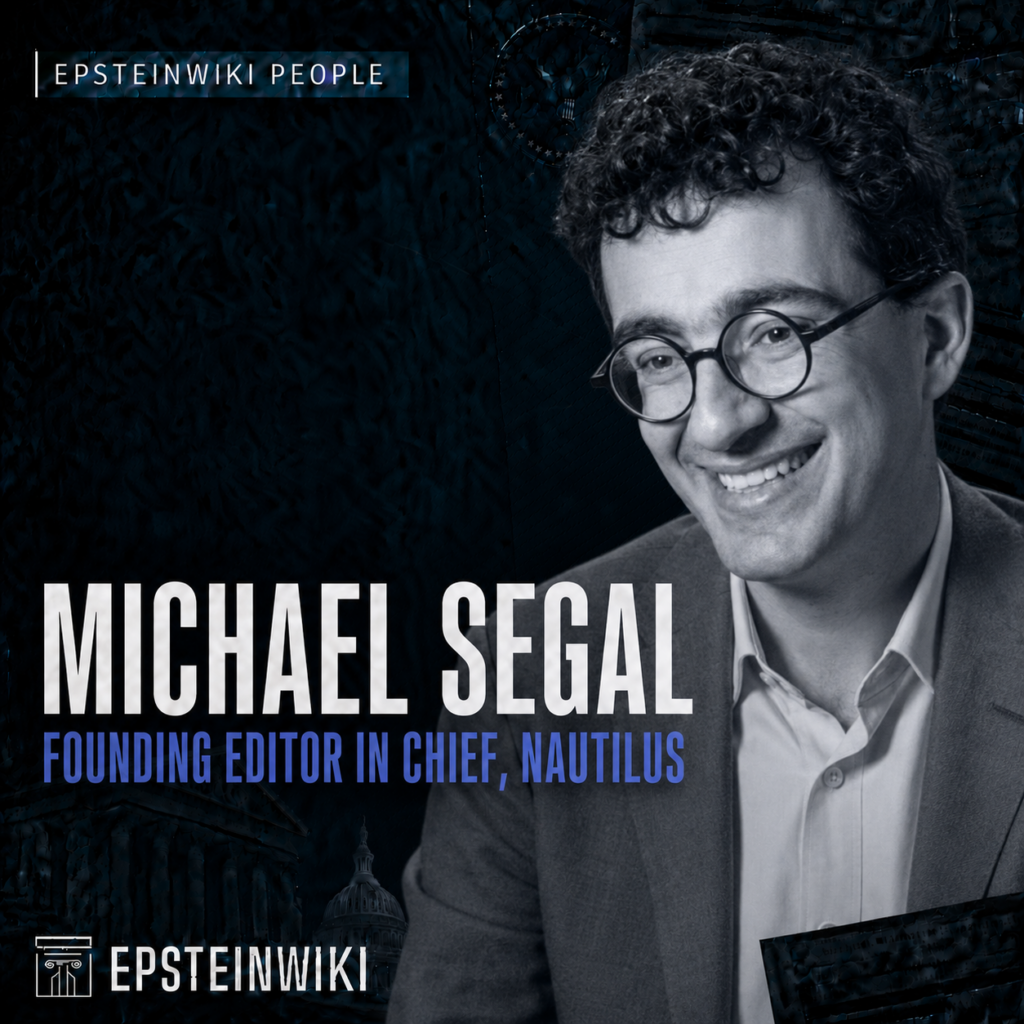
The founding editor in chief helped build an acclaimed science magazine whose publisher sought money from Jeffrey Epstein after his conviction. The released record connects Segal to Nautilus editorial work and nonprofit governance, but does not presently show that he personally solicited Epstein, met him, or knew about the donation campaign.
Michael Segal’s name appears in the Jeffrey Epstein files because material from Nautilus, the science magazine he helped build and edit, reached Epstein’s archive.
That fact requires investigation. It also requires precision.
Segal was the founding editor in chief of Nautilus. He shaped its editorial identity, wrote and edited material, represented its education program, and served for a time as secretary of the nonprofit NautilusThink. The publication won major awards and developed a distinctive model that connected science with philosophy, culture, art, and narrative journalism.
The surviving record also shows that Nautilus publisher John Steele pursued Jeffrey Epstein as a donor and possible investor. Steele first sent a sponsorship pitch to Epstein’s foundation in 2014. In 2017, former Treasury secretary and Harvard president Lawrence Summers introduced Steele to Epstein. Steele then met Epstein for lunch at Epstein’s Manhattan townhouse and continued seeking financial support for months. Epstein ultimately agreed to give NautilusThink $25,000.
That donation was made nine years after Epstein pleaded guilty in Florida to offenses involving a minor.
The available evidence does not establish that Segal arranged the introduction, attended the lunch, requested the money, communicated directly with Epstein about funding, or knew that Epstein was being cultivated. It does establish that Segal held an important editorial role at the institution that accepted the contribution and that some of his work was included in materials retained in Epstein’s files.
For oversight purposes, the proper question is not whether proximity alone proves wrongdoing. It does not. The proper questions are who knew about the approach to Epstein, who approved it, how the money was recorded and spent, what due diligence occurred, whether Epstein sought influence or access, and whether the organization later gave a complete account of the relationship.
This profile separates the evidence about Michael Segal from the evidence about John Steele, NautilusThink, and Jeffrey Epstein. It identifies what the released documents establish, what remains unverified, and what investigators should ask next.
Executive Snapshot
| Field | Documented information |
|---|---|
| Full name | Michael Segal |
| Primary role | Founding editor in chief of Nautilus |
| Later role | Editor at large after the publication’s 2019 acquisition |
| Education | PhD in electrical engineering from the Massachusetts Institute of Technology; BS in physics from the University of Alberta |
| Prior employment | Senior editor at Nature Nanotechnology |
| Nonprofit role | Secretary of NautilusThink in publicly available early tax filings |
| Epstein connection | Segal’s name and editorial work appear in Nautilus materials preserved in the Epstein files |
| Documented fundraiser | John Steele, publisher and editorial director of Nautilus |
| Documented connector | Lawrence Summers introduced Steele to Epstein in 2017 |
| Documented contribution | $25,000 from Epstein linked Gratitude America to NautilusThink in 2017 |
| Personal solicitation by Segal | Not established in the reviewed record |
| Personal meeting between Segal and Epstein | Not established in the reviewed record |
| Allegation of sexual misconduct by Segal | None identified in the reviewed sources |
| Core oversight issue | Whether Segal or other leaders knew about, approved, recorded, used, or later disclosed Epstein’s support |
| Last checked | September 3, 2026 |
Identity and Career
Michael Segal is a science editor whose professional background combines physics, engineering, and journalism.
A Nautilus presentation preserved in the federal Epstein release identifies him as editor in chief and states that he previously served as a senior editor at Nature Nanotechnology. It lists a doctorate in electrical engineering from the Massachusetts Institute of Technology and a bachelor’s degree in physics from the University of Alberta. The same professional history appears in contemporary publishing announcements and author biographies.
Segal’s scientific training matters to the history of Nautilus. The magazine was not designed as a conventional news publication organized around daily discoveries. Its editorial concept was thematic. Each issue explored one broad subject through several disciplines, often placing physics beside biology, philosophy, psychology, art, and culture.
Segal helped translate that concept into an editorial product. An early profile of the publication described its 2013 launch and highlighted a first issue that included Segal’s interview with mathematician Benoit Mandelbrot. Later accounts described Segal as the founding editor and editor in chief.
His current Nautilus author page identifies him as editor at large. That title followed a change in ownership announced in 2019, when Kevin Berger became editor in chief and Segal moved into the editor at large role.
These facts establish Segal as more than a contributor whose name happened to appear in a magazine. He was a senior editorial leader from the publication’s beginning. They do not, by themselves, establish responsibility for fundraising decisions made by the publisher or the nonprofit board.
Building Nautilus
Nautilus launched in 2013 with an ambitious promise: to reconnect fields of knowledge that modern publishing often separated.
The magazine organized issues around large subjects rather than academic departments. Its articles explored scientific questions alongside their historical, philosophical, and cultural implications. The visual presentation was unusually elaborate for a science publication, and the organization developed digital, print, and education products.
The model gained substantial recognition. Nautilus publicity materials cited audience growth, print circulation, newsletter subscriptions, and awards. The publication later announced a copublishing relationship with the MIT Press for its print edition. Its journalism attracted prominent scientists and writers, and the magazine developed a reputation for polished long form storytelling.
Segal occupied the central editorial position during that growth. A presentation later preserved in the Epstein files lists the senior staff as John Steele, publisher and editorial director; Michael Segal, editor in chief; Kevin Berger, features editor; and other operational, art, production, and financial personnel.
This division of titles is important. Steele combined publishing, business, and editorial authority. Segal led the editorial operation. Berger oversaw features. The structure does not answer who knew about every donor or investment approach. It does show that Steele, rather than Segal, was publicly identified as publisher.
The magazine’s acclaim also created something Epstein repeatedly sought: association with science, ideas, institutions, and respected intellectuals. A contribution to a celebrated science publication could offer more than charitable impact. It could also provide prestige and a route into a community of editors, researchers, writers, and donors.
That potential reputational value makes the donation worthy of scrutiny even though $25,000 was small compared with some of Epstein’s other gifts.
NautilusThink and Segal’s Governance Role
The publication was associated with NautilusThink, Inc., a New York nonprofit organization recognized as tax exempt in 2014.
Public tax data identify John Steele as president and treasurer in the organization’s early years. Gayil Nalls was listed as vice president. Michael Segal was listed as secretary in the publicly available 2014 and 2015 filing data, with no compensation reported for that officer position.
A nonprofit secretary is ordinarily a governance role, but a title alone does not reveal the actual distribution of power. The secretary may maintain minutes and corporate records, participate in board action, certify resolutions, or perform a narrower formal function. The organization’s governing documents, board minutes, consent resolutions, donor policies, and internal correspondence are needed to determine what Segal actually did.
The distinction between editorial employment and nonprofit governance is central to this profile. Segal could have had deep authority over content while having limited control over fundraising. He also could have received financial or governance information through his officer role. The currently public record does not resolve which description is more accurate during the 2017 Epstein solicitation.
The tax figures show why financial leadership was consequential. NautilusThink reported substantial revenue during its early period, followed by deficits and growing liabilities. Public data show revenue of about $3.4 million in 2015, followed by revenue of about $2 million and expenses of about $2.8 million in 2016. For 2017, the organization reported about $1.3 million in revenue and about $2 million in expenses, with liabilities exceeding $1.7 million and negative net assets.
Those figures do not prove desperation caused the approach to Epstein. They do document financial pressure at the institution during the period when Steele was pursuing him.
Investigators should obtain the complete tax filings rather than rely only on public summaries. They should also determine whether Segal remained an officer in 2017, whether he attended meetings concerning the organization’s finances, and whether the Epstein gift appeared in board materials or donor reports.
The Funding Model Before Epstein
Nautilus began with major philanthropic backing.
Reporting by Undark described an initial two year grant of approximately $5 million from the John Templeton Foundation, followed by additional support. The relationship drew scrutiny because the foundation has long funded work involving science, philosophy, religion, and questions of meaning.
In 2014, journalist Paul Raeburn revisited his concern about the funding after Segal contacted him. According to Raeburn’s account, Segal said the grant was made at arm’s length and that the foundation exercised no direct control over editorial decisions. Raeburn wrote that he had seen no evidence that the foundation was directing a religious or ideological agenda through the magazine.
That episode is relevant for two reasons.
First, it shows that Segal understood questions about donor influence and publicly defended editorial independence. Second, it provides a useful standard for examining the later Epstein contribution. Did Nautilus apply comparable scrutiny to Epstein? Was the gift treated as unrestricted? Was any editorial access offered? Did anyone document protections against donor influence?
The available material does not show that Epstein controlled an article, selected a subject, or dictated an editorial decision. It does show that Steele promoted the magazine’s intellectual network and content while pursuing Epstein’s support.
Financial support and editorial influence are not the same thing. A responsible investigation must test for influence without assuming it.
The 2014 Sponsorship Pitch Reaches Epstein
The earliest clearly identified solicitation in the reviewed federal release dates to August 2014.
In EFTA01165132, John Steele forwarded information about Nautilus to Jeffrey Epstein and an associate connected to Epstein’s foundation. The pitch described the publication, its audience, its education ambitions, and its search for institutional or corporate sponsors.
Duplicate or related copies appear as EFTA00626051 and EFTA02689766. Multiple copies do not represent multiple independent events. They are best understood as repeated preservation of the same or closely related communication in the released corpus.
The 2014 approach occurred after Epstein’s 2008 Florida conviction and registration as a sex offender. It therefore raises a straightforward due diligence question: what did Steele and the organization know about the person they were approaching?
The communication is attributed to Steele. It does not show Segal sending the pitch. Segal’s editorial leadership and the publication’s work were part of what Steele was promoting, but being featured in an institutional pitch is not proof that an editor authorized or knew about the recipient.
The reviewed record does not show that the 2014 approach produced a contribution. The documented $25,000 gift came later, after a renewed 2017 introduction.
The Nautilus Education Materials in Epstein’s Files
One of the clearest direct appearances of Michael Segal in the released evidence is a Nautilus Education booklet.
EFTA00805732 is a 39 page document presenting science text sets intended for classroom use. It combines magazine articles with lesson plans and teacher guides. The subjects include astronomy, space travel, chemistry, fuels, genetics, human health, and cancer research.
The introductory letter is signed by Michael Segal as editor in chief. It explains that the program was designed to connect science and literacy and to help teachers use narrative science material under Common Core and Next Generation Science Standards. It also says Nautilus was looking for partners interested in using and further developing the content.
This document establishes several facts.
It establishes Segal’s title. It establishes his public role in explaining and promoting the education program. It establishes that Nautilus was seeking partners for that program. It establishes that the booklet was retained in the material later released from Epstein’s files.
It does not establish who sent the booklet to Epstein. It does not establish that Segal addressed it to Epstein. It does not establish that Segal met Epstein, sought money from him, or knew that he possessed it. A promotional document can enter an archive through a publisher, intermediary, attachment, print mailing, or forward without the named editor communicating with the ultimate recipient.
The document is nevertheless important because it shows what Nautilus may have been offering potential supporters: not only a magazine, but a developing education platform with access to teachers, students, scientific content, and institutional partners.
The education program should therefore be included in any subpoena or voluntary document request concerning Epstein related funding discussions.
The Fundraiser Was John Steele, Not Michael Segal
The strongest evidence of active cultivation concerns John Steele.
Steele was identified in Nautilus materials as publisher and editorial director. Contemporary reporting describes him as the publication’s founder. His background included senior positions in media and investment related organizations.
According to reporting based on later released emails, Steele made the 2014 approach, accepted a 2017 introduction from Lawrence Summers, met Epstein at his Manhattan townhouse, discussed financial models, sent financial information, asked for donations or investment, and continued following up into 2018.
No equivalent record has been identified for Segal.
That does not remove Segal from every governance question. A founding editor in chief and nonprofit officer may have had knowledge relevant to donor acceptance and institutional decision making. But the difference between possible knowledge and documented solicitation must remain visible.
Attributing Steele’s actions to Segal would be inaccurate. Ignoring Segal’s formal roles would also be incomplete.
The purpose of an evidence based profile is to hold both propositions at once.
Lawrence Summers Opens the 2017 Door
The successful approach began through Lawrence Summers.
Summers is a former Treasury secretary and former president of Harvard University. He had a longstanding relationship with Epstein that continued after Epstein’s conviction. Reporting on the released correspondence says Summers introduced Steele to Epstein in 2017 and praised Epstein’s wealth, power, and intellect while making the connection.
Within days, Steele met Epstein for lunch at Epstein’s Manhattan townhouse.
The introduction illustrates how Epstein’s network functioned. He did not need to cold call every institution. Prominent intermediaries could bring editors, academics, executives, and nonprofit leaders into his home and his orbit. Each introduction could reinforce the appearance that he remained an acceptable participant in elite intellectual life.
The reviewed evidence does not show that Segal requested Summers’s help or participated in the introduction. Investigators should determine whether Summers knew Segal through Nautilus, whether Segal was informed of the meeting, and whether the editorial staff discussed the risks of accepting support from Epstein.
Summers later held a small passive ownership interest after the 2019 acquisition, according to reporting about the transaction. That later interest does not prove that he controlled editorial coverage or donor decisions. It does make the full history of his role relevant to an institutional review.
The Townhouse Lunch and Funding Courtship
The 2017 lunch was not an incidental encounter in a public setting. It took place at Epstein’s Manhattan residence, a property repeatedly associated with his social, financial, and criminal world.
Reporting based on the email record describes a sustained effort by Steele after that meeting. From July 2017 through June 2018, Steele proposed several possible forms of support, including donations and investments reportedly reaching as high as $1.2 million.
Epstein examined the publication’s financial position and declined to invest. His comments reportedly praised the curation and worth of the magazine while questioning its audience, page views, and publishing model.
Steele continued sending content, business information, and updates. The relationship he offered was not framed only as a check. Reporting indicates that he also presented social and intellectual connections as part of the value surrounding Nautilus.
This is exactly why the complete correspondence matters. A donor relationship can involve access, introductions, reputation, event invitations, editorial attention, or association even when no explicit quid pro quo appears.
The present record does not show that Segal joined the lunch, received the financial discussion, or offered access. Those questions remain open because senior editorial and governance personnel may have been copied, briefed orally, or included in internal meetings not yet public.
The $25,000 Contribution
On November 28, 2017, Steele asked Epstein for $25,000 to support a print issue. The email chain preserved as EFTA00943882 records Epstein’s agreement.
Tax reporting later identified a $25,000 contribution from Gratitude America to NautilusThink in 2017. Gratitude America was an Epstein linked charitable vehicle.
The contribution was real. It was not merely a proposed gift that never arrived.
The amount was modest relative to NautilusThink’s total annual expenses, but context matters. The nonprofit reported a large annual deficit, substantial liabilities, and negative net assets. At the same time, contributors were complaining about overdue compensation.
The donation also carried reputational significance. Epstein had already been convicted. His status was public. An acclaimed science publication accepted money connected to him while he continued using philanthropy and intellectual patronage to maintain social legitimacy.
Nothing in the reviewed material establishes that the $25,000 purchased a specific article or favorable coverage. Nothing establishes that Segal received the funds personally. The gift was made to NautilusThink, not to Segal.
Investigators should obtain the bank record, deposit record, donor acknowledgment, general ledger entry, restricted fund record, board approval, and expenditure trail. They should determine whether the money actually funded the print issue described in the request and whether Segal had any role in choosing or editing that issue.
What Steele Said in 2019 and What Later Emails Added
When The Daily Beast reported on Gratitude America in 2019, Steele acknowledged meeting Epstein in 2017. He described Epstein as someone who liked the magazine and made a one time donation. Steele said that was the extent of the relationship.
The later email reporting added substantial context.
It described the earlier 2014 pitch, the Summers introduction, the townhouse lunch, multiple proposed funding structures, financial discussions, repeated content sharing, and continued follow up after the $25,000 contribution.
Those details do not necessarily prove that Steele’s 2019 statement was knowingly false. His phrase may have referred narrowly to the number of completed donations rather than the full history of contact. But the compressed description did not convey the duration and intensity of the courtship revealed by the correspondence.
Segal should not be assigned Steele’s public statement. No reviewed source shows Segal making it.
The discrepancy is still relevant to Segal’s institutional profile because a publication’s later transparency is a leadership question. Investigators should ask whether Segal learned of the 2019 press inquiry, reviewed any proposed response, or knew that Steele had continued contacting Epstein.
Financial Crisis and Unpaid Contributors
The Epstein approach occurred during a serious financial crisis at Nautilus.
In 2017, Undark reported that freelance writers and illustrators had experienced long delays in payment. Steele acknowledged that the organization was operating under severe pressure and owed money to contributors. Staff reportedly took pay reductions, and uncertainty surrounded the publication’s funding relationships.
By 2019, reporting placed the amount owed to contributors above $186,000. A union settlement later produced payments for some writers, though reports indicated that not every contributor had been fully paid.
These facts matter because the $25,000 Epstein gift was not accepted by an institution with limitless resources. NautilusThink was running deficits and carrying significant liabilities. Leaders had strong incentives to find donors and investors.
Financial need explains why a publisher might intensify fundraising. It does not excuse inadequate due diligence. It also does not prove that every senior editor knew the identity of every donor.
Segal’s position should be investigated through records rather than assumption. Did he participate in budget meetings? Did he know contributors were unpaid? Did he know Steele was asking Epstein for money? Was the promised print issue within Segal’s editorial control? Were any freelancers paid from the contribution? Was the donation unrestricted revenue that supported general operations?
The answers could clarify whether Segal was a decision maker, an informed participant, or an editor insulated from the fundraising process.
Segal’s Editorial Authority Versus Fundraising Authority
An editor in chief ordinarily exercises substantial authority over content. A publisher ordinarily controls business operations, revenue, partnerships, and fundraising. In a small organization, however, those roles often overlap.
The public record shows Segal defending editorial independence in the context of Templeton Foundation funding. It shows him representing the Nautilus Education product. It shows him listed as a nonprofit secretary in early filings. It shows him in the senior staff presentation preserved in Epstein’s files.
The public record does not disclose the internal approval process for donors.
That gap should not be filled by speculation. It should be filled by board minutes, budgets, donor databases, email accounts, messaging records, and testimony.
Investigators should distinguish at least four possible forms of authority:
- Authority to solicit a donor.
- Authority to accept or reject a contribution.
- Authority to allocate donated money.
- Authority to protect editorial decisions from donor influence.
Segal may have held some of these powers and not others. The documents reviewed for this profile do not establish the answer.
Scientific Content Forwarded Into Epstein’s Archive
The released files include additional Nautilus content beyond the education booklet and business presentation.
EFTA02514092 preserves material involving a Nautilus article and discussion of a provocative Richard Dawkins argument about the ethics and scientific consequences of creating a human and chimpanzee hybrid. Segal’s name appears in the forwarded editorial material associated with the item.
The evidence shows that Nautilus content circulated into Epstein’s network. It is consistent with Epstein’s well documented interest in genetics, evolution, reproduction, and controversial scientific ideas.
It does not show that Segal endorsed Epstein’s interests, collaborated with him, or wrote for his benefit. Editors routinely circulate stories to colleagues, contributors, publicists, and readers. A forwarded editorial email can reach a recipient several steps removed from its author.
Any attempt to interpret this item should reconstruct the complete email chain. Investigators should identify the original sender, every forward, all recipients, the dates, any attachment, and whether Epstein replied. The subject matter may explain why the article interested Epstein, but subject matter alone cannot establish a relationship with the editor.
The 2019 Acquisition and Segal’s Changed Role
In 2019, Nautilus announced that it had been acquired by an investor group described as admirers or superfans of the publication.
The announcement said John Steele would remain publisher and editorial director. Kevin Berger became editor in chief. Michael Segal became editor at large. NautilusThink remained a nonprofit associated with science and education initiatives.
Reporting on the acquisition identified Lawrence Summers among the investors. Later reporting described his interest as small and passive.
The transaction occurred after the Epstein contribution and after the period of repeated fundraising contact. It therefore raises questions about representations made to buyers. Did acquisition due diligence identify the Epstein donation? Were investors told about the correspondence? Did Summers disclose his role in making the introduction? Were outstanding debts to freelancers listed accurately?
No reviewed evidence shows that Segal controlled the sale or concealed the donation. His role change is nonetheless part of the institutional timeline and may help identify which records he retained or which meetings he attended.
Disambiguation: The Magazine Is Not Epstein’s Nautilus, Inc.
The word “Nautilus” appears elsewhere in Epstein related records as the name of a corporate entity connected to his properties in the United States Virgin Islands.
That entity is not the science magazine and is not NautilusThink.
For example, EFTA00018778 concerns allegations involving Epstein controlled companies, including an entity called Nautilus, Inc. It should not be cited as evidence about Michael Segal or the publication.
This distinction is essential for database work. A simple text search for “Nautilus” can merge unrelated entities and create false connections. Each record must be checked for addresses, officers, context, and corporate identity before it is attributed to the magazine.
Survivor Perspective and Institutional Harm
There is no identified survivor allegation against Michael Segal in the reviewed record.
That fact should be stated plainly.
The relevance of this story is institutional. Epstein used money, introductions, intellectual patronage, and association with respected organizations to rehabilitate his reputation after his conviction. Every institution that accepted his support contributed, intentionally or not, to the appearance that he remained welcome among serious thinkers and leaders.
For survivors, the problem is larger than the amount of any single contribution. A $25,000 gift can become a credential. A townhouse lunch can become a bridge to another institution. A respected magazine can become part of a donor’s presentation of himself as a patron of science rather than a convicted offender.
This does not mean that Nautilus journalism served Epstein’s criminal conduct. No reviewed evidence proves that. It means the institution had a responsibility to examine whom it treated as an acceptable benefactor.
Accountability should also protect innocent employees and contributors. Writers who were owed money did not choose the organization’s donors. Editors who were not informed of fundraising contacts should not be treated as participants. Survivors should not have to bear the burden of proving what institutional records can answer.
The appropriate response is transparent production of those records, careful testimony, and a clear separation between documented conduct and inference.
Evidence Appearances
| Evidence ID | Approximate date | Record type | Segal’s exact appearance | What it establishes | What it does not establish |
|---|---|---|---|---|---|
| EFTA00797032 | Circa 2016 or later | Nautilus presentation | Listed as editor in chief, with prior employment and education | Segal’s senior editorial role and professional biography; the organization’s programs, staff, audience claims, and education plan | That Segal prepared the copy for Epstein, sent it to him, met him, or knew he possessed it |
| EFTA00805732 | Undated | Nautilus Education booklet | Introductory letter signed by Segal as editor in chief | Segal represented the education program and Nautilus sought partners to develop it | That the appeal was directed to Epstein or that Segal personally sought his support |
| EFTA01165132 | August 30, 2014 | Email and sponsorship pitch | Segal is part of the institution and editorial product being promoted, but Steele is the documented sender | Steele approached Epstein’s circle regarding sponsorship and education expansion | Personal participation by Segal in the solicitation |
| EFTA00626051 | August 30, 2014 | Duplicate or related email copy | Same institutional context | Corroborates preservation of the Steele approach in the corpus | A separate solicitation event or a Segal communication |
| EFTA02689766 | August 30, 2014 | Duplicate or forwarded copy | Same institutional context | Additional documentary copy of the 2014 approach | A separate donation or direct Segal contact |
| EFTA00943882 | November 28 to 29, 2017 | Email chain | No demonstrated personal solicitation by Segal | Steele requested $25,000 for a print issue and Epstein agreed | That Segal made the request, received the money personally, or promised editorial influence |
| EFTA02514092 | Undetermined from reviewed copy | Forwarded editorial material | Segal’s name appears with Nautilus material about a Richard Dawkins article | Nautilus editorial content associated with Segal circulated into Epstein’s archive | A personal relationship, collaboration, endorsement, or knowledge of the final recipient |
The evidence table is intentionally conservative. An appearance in a released file is not automatically proof of contact. The route by which each document entered the archive must be reconstructed.
What the Evidence Establishes
The reviewed evidence establishes the following:
- Michael Segal was the founding editor in chief of Nautilus and a senior figure in the publication’s editorial development.
- Segal previously worked as a senior editor at Nature Nanotechnology and held advanced scientific degrees.
- Public nonprofit filing data list Segal as secretary of NautilusThink in at least 2014 and 2015.
- Segal signed the introductory letter in a Nautilus Education booklet now present in the released Epstein corpus.
- A Nautilus presentation in the files identifies Segal, other senior staff, audience information, products, and education ambitions.
- John Steele approached Epstein’s foundation about support in 2014.
- Lawrence Summers introduced Steele to Epstein in 2017.
- Steele met Epstein at Epstein’s Manhattan townhouse and pursued financial support over an extended period.
- Epstein agreed to a $25,000 request in November 2017.
- Public reporting and tax information identify a corresponding $25,000 Gratitude America contribution to NautilusThink.
- NautilusThink was experiencing serious financial pressure during the fundraising period.
- Writers and illustrators reported overdue payments while the organization sought new support.
- Steele’s brief 2019 public description omitted much of the contact later described in released emails.
- Segal later became editor at large when the publication changed ownership in 2019.
What the Evidence Does Not Establish
The reviewed evidence does not establish the following:
- That Michael Segal sexually abused, trafficked, recruited, or exploited anyone.
- That any survivor accused Segal of misconduct.
- That Segal had a personal friendship or social relationship with Epstein.
- That Segal visited Epstein’s Manhattan residence, Palm Beach property, New Mexico ranch, Paris residence, or private islands.
- That Segal flew on an Epstein aircraft.
- That Segal requested the 2017 donation.
- That Segal arranged the Summers introduction.
- That Segal attended Steele’s lunch with Epstein.
- That Segal knew about the 2014 or 2017 approaches when they occurred.
- That Segal approved the contribution.
- That Segal personally received any Epstein money.
- That Epstein dictated, commissioned, edited, suppressed, or altered Nautilus journalism.
- That the education booklet was created for Epstein.
- That Segal sent the booklet or business presentation to Epstein.
- That the $25,000 contribution financed criminal activity.
- That Nautilus personnel other than those documented in the correspondence knew the full extent of Steele’s pursuit.
Absence of public evidence is not proof that an event did not occur. It is a limit on what can responsibly be claimed today.
Detailed Timeline
Before 2013
Segal studies physics at the University of Alberta and earns a doctorate in electrical engineering from the Massachusetts Institute of Technology. He later works as a senior editor at Nature Nanotechnology.
2013
Nautilus launches as a thematic science magazine. Segal serves as founding editor in chief. Early coverage highlights his interview with Benoit Mandelbrot and the publication’s effort to connect science with philosophy, culture, and art.
August 2013
Indexed descriptions of the Epstein email corpus refer to forwarded Nautilus related material associated with Segal. The exact transmission path and meaning require review of the underlying chain before any direct contact can be claimed.
2014
NautilusThink receives federal tax exempt recognition. Public filing data identify Steele as president and treasurer, Nalls as vice president, and Segal as secretary.
Segal contacts journalist Paul Raeburn concerning criticism of John Templeton Foundation funding. Raeburn reports that Segal described the grant as arm’s length and denied direct foundation control over editorial work.
August 30, 2014
Steele sends or forwards a Nautilus sponsorship pitch to Epstein and his foundation circle. The communication discusses institutional or corporate sponsorship and expansion of education work. No completed Epstein contribution has been identified from this approach.
2015
Public tax data again list Segal as secretary of NautilusThink. The nonprofit reports approximately $3.4 million in revenue and $2.57 million in expenses.
2016
Nautilus and the MIT Press announce a print copublishing relationship. Segal is identified as editor in chief and a former senior editor at Nature Nanotechnology.
NautilusThink reports about $2.02 million in revenue and $2.82 million in expenses. Liabilities rise and net assets become negative.
April 2017
Undark reports that Nautilus has fallen behind in paying numerous freelance writers and illustrators. Steele acknowledges severe financial strain.
2017
Lawrence Summers introduces Steele to Epstein. Steele meets Epstein for lunch at Epstein’s Manhattan townhouse and begins a sustained financial courtship.
November 28 to 29, 2017
Steele requests $25,000 to fund a Nautilus print issue. Epstein agrees. The chain is preserved as EFTA00943882.
December 2017
Reporting on the later email release says Steele sends Epstein an article about the magazine’s unpaid contributor controversy and continues the relationship.
2017 tax year
NautilusThink reports approximately $1.31 million in revenue and $2.03 million in expenses, with liabilities near $1.78 million and negative net assets. Gratitude America reports a $25,000 contribution to NautilusThink.
First half of 2018
Steele continues contacting Epstein with material and proposals. Later reporting says Epstein does not appear to respond to several final approaches.
April 2019
The Daily Beast reports the $25,000 Gratitude America contribution. Steele says he met Epstein in 2017 and describes one completed donation as the extent of the relationship.
July 2019
Federal prosecutors charge Epstein with sex trafficking related offenses. He dies in federal custody the following month.
October and November 2019
Nautilus announces an acquisition by an investor group. Steele remains publisher and editorial director, Berger becomes editor in chief, and Segal becomes editor at large. Reporting continues to examine unpaid contributor claims and the Epstein donation.
2026
Broader federal releases and reporting expose more detail about Steele’s pursuit of Epstein, including the 2014 pitch, Summers’s introduction, the townhouse lunch, financial proposals, and extended follow up.
September 3, 2026
This profile is checked against the cited public record. No reviewed source establishes that Segal personally solicited Epstein or met him.
Questions for House Oversight
Questions for Michael Segal
- When did you first learn that John Steele or NautilusThink had approached Jeffrey Epstein or an Epstein linked foundation?
- Did you know in 2014 that Steele sent a sponsorship pitch to Epstein’s circle?
- Did Steele consult you before using Nautilus editorial work, audience data, staff biographies, or education plans in donor presentations?
- Did you authorize the circulation of the Nautilus Education booklet to Epstein or his representatives?
- Do you know who sent the education booklet into Epstein’s network?
- Did you communicate directly with Epstein, his assistants, his foundation, Gratitude America, or any intermediary acting for him?
- Did you ever meet Epstein in person?
- Did you ever attend a meal, meeting, event, salon, or conference with Epstein?
- Did you know that Lawrence Summers introduced Steele to Epstein in 2017?
- Were you informed before or after Steele’s lunch at Epstein’s Manhattan townhouse?
- Did Steele brief you on Epstein’s reaction to Nautilus financial data or its publishing model?
- Did you review any investment proposal prepared for Epstein?
- Did you know that Steele sought amounts as high as approximately $1.2 million?
- Did you know about the request for $25,000 to fund a print issue?
- Did you edit or supervise the issue that the contribution was said to support?
- Did you participate in deciding whether NautilusThink should accept the money?
- Did you know in 2017 that Epstein had pleaded guilty in 2008 to offenses involving a minor?
- What donor review or ethics policy applied at the time?
- Did you raise any objection to accepting support from Epstein?
- Did Epstein or anyone acting for him request editorial access, advance copies, favorable treatment, article placement, introductions, invitations, or recognition?
- Were any articles proposed, selected, edited, delayed, or promoted because of Epstein’s interests?
- Did you discuss the contribution with Kevin Berger or other editors?
- As a former nonprofit secretary, did you receive board minutes, financial reports, donor lists, or contribution acknowledgments?
- What were your actual duties as secretary of NautilusThink?
- On what date did your service as secretary begin and end?
- Did you attend board meetings in 2017 or 2018?
- Did those meetings discuss financial distress, unpaid contributors, Epstein, Gratitude America, or prospective investors?
- Were you involved in the organization’s response to the 2019 press inquiry about Epstein’s donation?
- Did you review or approve Steele’s statement that one donation was the extent of the relationship?
- When did you learn that the correspondence reflected a longer courtship?
- Did the 2019 acquisition due diligence address the Epstein donation or correspondence?
- What relevant records remain in your possession or control?
Questions for John Steele
- Who identified Epstein as a prospective sponsor in 2014?
- What due diligence did you conduct before the first approach?
- Which employees, officers, board members, and advisers approved or knew about that approach?
- Why did you renew the effort in 2017?
- What exactly did Lawrence Summers tell you about Epstein?
- Who attended the townhouse lunch?
- What subjects were discussed at the lunch?
- Did Epstein ask for access to editors, writers, scientists, students, or advisers?
- What financial models and amounts did you propose?
- What financial records did you provide to Epstein?
- Did those records disclose debts owed to contributors?
- Why did Epstein decline an investment?
- What was promised in exchange for the $25,000 contribution?
- Was the contribution restricted to a particular print issue?
- Who selected, edited, and approved that issue?
- Which internal personnel were told the identity of the donor?
- Why did you continue contacting Epstein after the contribution?
- Did you offer social or intellectual introductions as part of the relationship?
- Why did your 2019 description omit the 2014 pitch and extended 2017 to 2018 courtship?
- Did you tell Segal about any part of the relationship?
- Did you delete, withhold, or lose any responsive records?
Questions for Lawrence Summers
- Why did you introduce Steele to Epstein after Epstein’s conviction?
- What did you know about NautilusThink’s financial condition?
- Did Steele ask you specifically for access to Epstein’s money?
- Did you discuss Segal or Nautilus editorial personnel with Epstein?
- Did you attend or follow up on the townhouse meeting?
- Did you receive any benefit, compensation, ownership opportunity, or consideration connected to the introduction?
- Did your later ownership interest arise from relationships formed during this period?
- Did you disclose the Epstein introduction during the 2019 acquisition process?
Questions for NautilusThink and Successor Organizations
- Produce every email, message, calendar entry, donor record, board minute, and financial record concerning Epstein, Gratitude America, Summers, or any Epstein intermediary.
- Produce the complete donor acceptance policy in effect from 2013 through 2019.
- Identify every officer and director serving when the 2017 gift was solicited, accepted, deposited, and spent.
- Identify the account into which the $25,000 was deposited.
- Produce the donor acknowledgment and any tax receipt.
- State whether the gift was restricted or unrestricted.
- Trace every expenditure charged against the gift.
- Identify the print issue said to have been supported.
- State whether any portion paid writers, illustrators, printers, editors, executives, or debts.
- Identify every Nautilus document sent to Epstein and the sender of each document.
- Explain how EFTA00797032 and EFTA00805732 entered Epstein’s possession.
- Produce all communications involving Segal that mention Epstein or Gratitude America.
- Produce all communications involving Steele and Segal about donors, financial distress, or the 2019 press inquiry.
- State whether Epstein was thanked publicly or privately.
- State whether he received subscriptions, event invitations, advisory status, introductions, or access to contributors.
- Identify every other donation or payment from an Epstein controlled or Epstein linked entity.
- Explain whether the 2019 buyers were informed about the donation and correspondence.
- State whether any promised donation of equivalent funds to a charity serving vulnerable young people was completed, and produce proof.
- Preserve all remaining records and provide a sworn explanation for any missing material.
Reliability and Limitations
This profile relies on federal document releases, nonprofit filing data, institutional biographies, contemporary journalism, and later reporting based on disclosed email correspondence.
Several limitations apply.
First, the released corpus contains duplicates. Multiple EFTA identifiers can preserve the same underlying pitch or attachment. Duplicate records should not be counted as separate contacts.
Second, some documents are undated or lack the full transmission chain. A name in an attachment does not prove that the named person sent the document to Epstein.
Third, nonprofit filing summaries do not always display every officer, schedule, donor restriction, or internal approval. The original returns and corporate records are necessary for a complete governance analysis.
Fourth, press reports based on email collections may describe documents that should ultimately be checked in full. Where this profile relies on reported characterization, it says so.
Fifth, the absence of a public record does not establish that no private communication exists. It limits the claim that can be made from currently available evidence.
Sixth, NautilusThink, the science magazine, and Epstein’s unrelated Virgin Islands company called Nautilus, Inc. must not be merged.
The most reliable conclusion is therefore narrow: Segal was an important Nautilus editor and early nonprofit officer whose work appears in the released files, while Steele is the person the public evidence identifies as actively courting and obtaining Epstein’s support.
Fact Check
| Claim | Verification status | Basis |
|---|---|---|
| Segal was founding editor in chief of Nautilus | Verified | Nautilus biographies, contemporary profiles, publishing announcements, and EFTA00797032 |
| Segal was the founder of Nautilus | Not supported as phrased | Contemporary reporting identifies John Steele as founder and publisher; Segal was founding editor in chief |
| Segal worked at Nature Nanotechnology | Verified | Nature material, publisher biography, and EFTA00797032 |
| Segal holds MIT and University of Alberta degrees | Verified | EFTA00797032 and contemporary biography |
| Segal served as secretary of NautilusThink | Verified for early filing years | Public 2014 and 2015 nonprofit filing data |
| Segal personally solicited Epstein | Not established | Reviewed solicitation records identify Steele |
| Segal met Epstein | Not established | No reliable reviewed source documents a meeting |
| Segal knew about the $25,000 gift when it was accepted | Unresolved | Requires internal records or testimony |
| Steele approached Epstein’s circle in 2014 | Verified | EFTA01165132 and related copies |
| Summers introduced Steele to Epstein in 2017 | Reported from released correspondence | Semafor account based on emails |
| Steele met Epstein at his Manhattan townhouse | Reported from released correspondence | Semafor account and Steele’s earlier acknowledgment of a meeting |
| Epstein agreed to give $25,000 | Verified | EFTA00943882 |
| NautilusThink received $25,000 from Gratitude America | Verified through public reporting and charity records | The Daily Beast, Undark, and charity reporting |
| Epstein controlled Nautilus editorial content | Not established | No reviewed evidence shows editorial control |
| Nautilus owed contributors money during the period | Verified | Undark reporting and later settlement coverage |
| The magazine is the same entity as Epstein’s Nautilus, Inc. | False | They are unrelated entities |
| A survivor accused Segal of abuse | Not identified | No such allegation was located in the reviewed sources |
Last checked: September 3, 2026.
Related People and Organizations
John Steele
Founder, publisher, and editorial director of Nautilus. The released and reported correspondence identifies Steele as the person who pursued Epstein’s support.
Lawrence Summers
Former Treasury secretary and former Harvard president. He introduced Steele to Epstein in 2017 and later held a reported passive interest in the publication’s successor ownership group.
Jeffrey Epstein
Financier and convicted sex offender who cultivated relationships with scientists, universities, foundations, and intellectual publications. He agreed to a $25,000 contribution to NautilusThink in 2017.
Gratitude America
Epstein linked charitable organization through which the documented $25,000 NautilusThink contribution was reported.
NautilusThink, Inc.
New York nonprofit associated with Nautilus and its education initiatives. It is the reported recipient of the contribution.
Nautilus Magazine
Science and culture publication launched in 2013. It should not be confused with Epstein’s unrelated Virgin Islands corporate entity called Nautilus, Inc.
Kevin Berger
Features editor during Segal’s tenure as editor in chief and later editor in chief after the 2019 acquisition.
John Templeton Foundation
Major early funder of Nautilus. Earlier public discussion of the foundation prompted Segal to address editorial independence.
MIT Press
Publishing institution that announced a copublishing relationship with the Nautilus print edition in 2016.
Conclusion
Michael Segal belongs in the Nautilus branch of the Epstein record, but the evidence must be described with discipline.
He was the founding editor in chief. He helped create the editorial product that Steele promoted to funders. He signed an education booklet preserved in Epstein’s files. He was listed as secretary of NautilusThink in early nonprofit filings. These are real and relevant institutional connections.
The released evidence presently identifies John Steele, not Segal, as the fundraiser who pursued Epstein. Steele made the early pitch, accepted the Summers introduction, visited Epstein’s townhouse, provided business information, requested money, and continued following up. Epstein gave $25,000 through a linked charity.
No reviewed evidence shows that Segal abused anyone, helped Epstein commit crimes, met Epstein, or personally asked him for money. No reviewed evidence shows that Epstein controlled Nautilus journalism.
The unresolved issue is knowledge and governance.
Did the founding editor in chief and nonprofit secretary know that his publisher was cultivating a convicted sex offender? Did he approve the gift? Did he edit the issue it supported? Did Nautilus apply the same principles of donor independence that Segal had previously invoked in response to questions about another foundation? Did the organization later provide a complete account?
Those questions can be answered through records and testimony. Until then, the responsible conclusion is neither exoneration by silence nor guilt by association.
It is a documented institutional connection with a significant unanswered chain of accountability.
Sources
- EFTA00797032, Nautilus presentation and senior staff biographies
- EFTA00805732, Nautilus Education text sets booklet
- EFTA01165132, John Steele’s 2014 Nautilus sponsorship approach
- EFTA00626051, related copy of the 2014 approach
- EFTA02689766, related copy of the 2014 approach
- EFTA00943882, $25,000 request and Epstein’s agreement
- EFTA02514092, forwarded Nautilus editorial material
- EFTA00018778, unrelated Epstein company Nautilus, Inc. reference
- EpsteinWiki, Nautilus Education Text Sets booklet evidence entry
- EpsteinWiki, existing Michael Segal Nautilus entry
- United States Department of Justice, Epstein Library
- Semafor, Science magazine founder courted Epstein for cash, emails show
- The Daily Beast, Jeffrey Epstein Has a Secret Charity. Here’s Who It Gave Money To
- New York Magazine, The Wisdom of Jeffrey Epstein’s Edge Foundation Answers
- Undark, Award Winning Nautilus Enters Rough Waters
- Undark, Nautilus Magazine, Freelancers, Pay, and the Superfans Acquisition
- ProPublica Nonprofit Explorer, NautilusThink Inc.
- Nautilus author page for Michael Segal
- Nautilus, 2019 acquisition announcement
- MIT Press and Nautilus copublishing announcement
- Nature, Michael Segal author material
- Knight Science Journalism at MIT, early Nautilus profile
- Knight Science Journalism at MIT, follow up on Nautilus funding
- Science for the People, The State of Science Journalism
- MediaPost, Nautilus acquisition and restructuring