
J.D. Vance
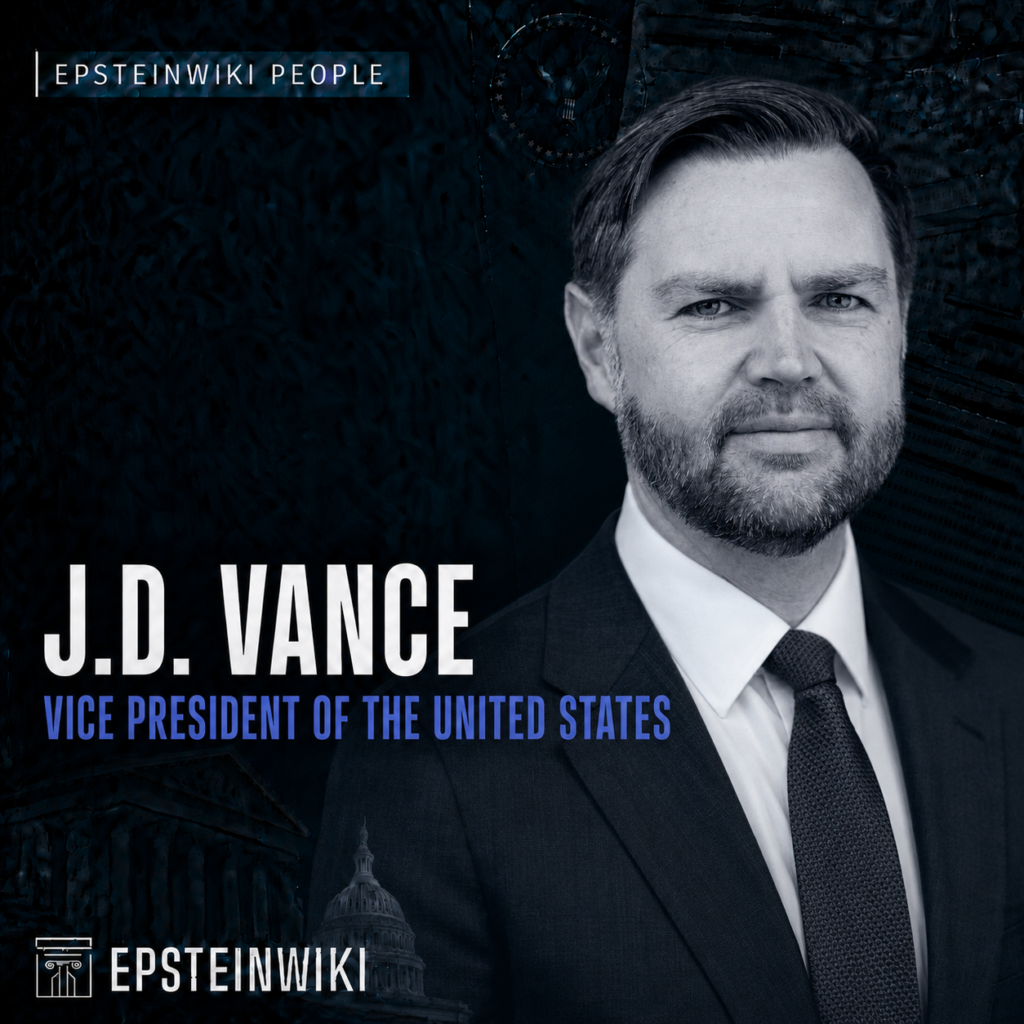
The vice president has not been shown to belong to Jeffrey Epstein’s personal network. His significance comes from his promises of disclosure, his defense of the administration’s handling of the files, reported internal strategy meetings, and the questions Congress says he should answer under oath.
Snapshot
- Full name: James David Vance
- Born: August 2, 1984
- Public role: Vice President of the United States since January 20, 2025
- Previous roles: United States senator from Ohio, author, attorney, and venture capitalist
- Epstein relationship established by the reviewed record: None
- Flight log evidence: No verified entry placing Vance aboard an Epstein aircraft has been identified in the sources reviewed for this article
- Address book evidence: No verified entry for Vance in Epstein’s published address books has been identified in the sources reviewed for this article
- Financial evidence: No verified payment, investment, donation, or business transaction between Vance and Epstein has been established in the reviewed record
- Document appearances: Primarily records created after Epstein’s death, including government media briefings about Vance’s public statements and reported role in the administration’s response
- Why he matters: Vance publicly called for release of an Epstein “list,” later defended the administration against accusations that it was shielding records, reportedly participated in senior White House discussions about the controversy, and was named in a House Oversight request for sworn testimony
- Central caution: A document mentioning Vance is not evidence that Vance knew Epstein. The timing, author, purpose, and contents of each record must be examined
Overview
J.D. Vance belongs on EpsteinWiki for a reason that differs sharply from the reason many financiers, politicians, academics, attorneys, and social figures appear here.
The reviewed public record does not establish that Vance met Jeffrey Epstein, traveled with him, visited one of his properties, communicated with him, received money from him, or participated in his crimes. Epstein died in 2019, before Vance entered the United States Senate and more than five years before Vance became vice president.
Vance’s relevance is governmental.
Before the 2024 election, Vance told an audience that the government needed to release the Epstein list. After taking office, he defended the administration’s handling of the records, said officials were not shielding anything, and argued that disclosure required time because victim identities had to be protected. He was then linked through press reporting and congressional correspondence to internal discussions about managing the political crisis surrounding the files.
In June 2026, the ranking Democrat on the House Committee on Oversight and Government Reform formally requested Vance’s testimony. The request followed reporting that Vance had presided over meetings in the White House Situation Room concerning the Epstein records and possible ways to contain the controversy. Vance later appeared to acknowledge that such meetings occurred, although he did not confirm every detail attributed to him.
In July 2026, Vance said the administration had “absolutely screwed up” its communications about the files. He blamed overpromising, criticized the handling of the supposed client list, and said the government should have released everything it lawfully could after protecting victim information. He continued to reject the claim that officials had intentionally concealed evidence.
This article examines those statements and records without collapsing political controversy into proof of criminal conduct. It distinguishes four separate questions:
- Did Vance have a personal relationship with Epstein?
- What did Vance promise the public before taking office?
- What role did Vance play in the administration’s handling of the files?
- What should Congress ask him under oath?
The available evidence gives a clear answer to the first question: no personal relationship has been established. The remaining questions require much more scrutiny.
Who Is J.D. Vance?
J.D. Vance is the forty ninth vice president of the United States. The White House biography of Vance describes his upbringing in Middletown, Ohio, his military service, education, legal career, writing, and political rise.
Vance served in the United States Marine Corps, graduated from Ohio State University and Yale Law School, worked in law and venture capital, and became nationally known through his memoir Hillbilly Elegy. Ohio voters elected him to the United States Senate in 2022. Donald Trump selected him as his running mate in 2024.
His position matters because the vice president sits close to the center of executive decision making. Once questions arose about whether the Justice Department and White House were fulfilling disclosure promises, Vance was no longer merely a commentator. He was a senior official in the administration responsible for responding to those questions.
That institutional role is the foundation of his EpsteinWiki entry.
No Personal Relationship With Epstein Has Been Established
The distinction between an Epstein associate and an official involved in handling Epstein records is essential.
The reviewed evidence does not establish that Vance belonged to Epstein’s social, financial, political, or professional network. No verified flight log reviewed for this article places Vance on Epstein’s aircraft. No verified address book entry reviewed for this article lists him. No correspondence between Vance and Epstein has been established. No photograph of the two men together has been authenticated. No witness identified in the cited sources says that Vance visited Epstein’s homes or islands.
The absence of identified evidence is not proof that no contact could ever have occurred. It is a statement about the present evidentiary record. If additional records are released, this conclusion should be revisited.
For now, describing Vance as an “Epstein associate” would be unsupported.
His inclusion here rests instead on public promises, executive branch conduct, internal government records, and congressional oversight.
The 2024 Promise to “Release the Epstein List”
During an October 2024 appearance on comedian Theo Von’s podcast, Vance said, “Seriously, we need to release the Epstein list. That is an important thing.” The statement was later documented in The Guardian’s review of Vance’s changing public posture.
The phrase “Epstein list” was politically powerful but evidentially imprecise.
There are several different bodies of Epstein related records: aircraft logs, address books, calendars, emails, photographs, court filings, investigative reports, financial records, interview memoranda, grand jury material, prison records, and evidence inventories. A person’s name can appear in one of those records for many reasons. Appearance alone does not establish knowledge of, participation in, or responsibility for a crime.
In July 2025, the Justice Department and FBI said their review found no incriminating formal “client list.” The agencies’ conclusion did not mean that no additional records existed. It meant that investigators said they had not found the particular artifact that political rhetoric had led many people to expect.
Vance’s 2024 promise therefore created two obligations.
First, the administration needed to disclose lawfully releasable records. Second, it needed to explain honestly what those records were and were not. A binder, contact list, calendar entry, or flight log is not automatically a list of offenders.
That difference became central to the controversy that followed.
The “Phase 1” Binders and the July 2025 Reversal
In February 2025, Attorney General Pam Bondi gave selected conservative influencers binders labeled as an initial phase of Epstein file disclosure. Much of the material was already public. The presentation encouraged expectations that a larger, more revealing release would follow.
Bondi had also said material concerning an Epstein client list was sitting on her desk for review. The administration later said no incriminating client list had been found. The Associated Press account of the reversal described the conflict between the earlier promises and the Justice Department’s later position.
On July 7, 2025, the Justice Department and FBI issued a memorandum stating that their review had found no incriminating client list, no credible evidence that Epstein blackmailed prominent people, and no basis to investigate uncharged third parties based on the material reviewed. The memorandum also said no additional disclosure was warranted at that time.
That announcement collided with the expectations created by campaign rhetoric, Bondi’s statements, and the binder event. Many supporters who had been promised disclosure concluded that the administration was retreating.
Vance’s public role became more important at that moment. He had personally endorsed disclosure before the election. He now had to defend an administration that appeared to be narrowing its promise.
“We’re Not Shielding Anything”
At an event in Canton, Ohio, on July 28, 2025, Vance was asked whether the administration was protecting anyone connected to Epstein.
“We’re not shielding anything,” he said, according to ABC News.
Vance said President Trump had directed the attorney general to release credible information and locate additional credible material. He emphasized that the government needed time to compile records and protect victims’ identities.
The victim privacy concern was legitimate. Epstein files contain names and identifying details of survivors, witnesses, employees, family members, and people with no demonstrated connection to criminal conduct. Release without careful review can retraumatize survivors and falsely implicate innocent people.
But Vance’s absolute assurance created a testable claim. If the administration was shielding nothing, Congress could reasonably ask what categories of material were being withheld, who ordered each withholding, which legal authority supported it, and whether political consequences influenced any decision.
The proper standard is not indiscriminate publication. It is maximum lawful transparency with rigorous protection for survivors and uninvolved private citizens.
What the Epstein Data Receipts Actually Show
Searches of the released material produce documents containing Vance’s name. Those results require context.
Two direct Epstein Data receipts are particularly relevant:
- EFTA00163687 is an internal FBI news briefing that summarizes press reporting from July 2025. It says Vance spent a weekend mediating tensions involving Bondi, FBI Director Kash Patel, and then Deputy Director Dan Bongino after the Justice Department memorandum triggered public backlash.
- EFTA01656356 is another FBI news briefing. It summarizes reporting about a disputed birthday message attributed to Trump and records Vance’s public criticism of The Wall Street Journal for publishing its story without showing the administration the document in advance.
These are authentic government records in the released corpus, but their evidentiary character is limited. They are media monitoring documents. They show that federal personnel collected and circulated reporting about the vice president’s public and reported actions. They do not establish that the FBI independently verified every assertion in the underlying news coverage.
They also do not connect Vance to Epstein before Epstein’s death.
This is precisely why a responsible evidence page must identify document type. An internal FBI news brief is not the same thing as an FBI interview report, an authenticated email between principals, a financial record, or sworn testimony.
Other search results contain Vance’s name only incidentally, including contemporary political comments embedded in correspondence created long after Epstein died. Those mentions should not be converted into claims of association.
The Disputed August 2025 Strategy Meeting
In early August 2025, multiple news organizations reported that Vance would host senior administration officials at the vice presidential residence to discuss the Epstein controversy. Reported invitees included Bondi, Patel, Deputy Attorney General Todd Blanche, and White House Chief of Staff Susie Wiles.
Reuters reported that the planned dinner was canceled after news of it became public. A spokesperson for Vance denied that such a meeting had been scheduled. Vance himself called the report fake news.
The story did not end there. Later reporting said a meeting occurred at the White House rather than at the residence. Democracy Now summarized CNN’s subsequent account, which described Vance as leading a gathering of senior officials.
The public record therefore contains three distinct propositions:
- Reporters said a meeting was planned at the vice presidential residence.
- Vance’s office denied that account, and Vance denied the reported residence event.
- Later reporting said a related meeting occurred at the White House.
Those propositions should not be merged into a single uncontested fact. The location, participants, timing, agenda, records created, and decisions reached remain appropriate subjects for oversight.
The Maxwell Interview and Transfer
On July 24 and July 25, 2025, Deputy Attorney General Todd Blanche interviewed Ghislaine Maxwell. Maxwell was serving a twenty year federal sentence for sex trafficking related offenses. On August 1, she was transferred from a low security federal prison in Florida to a minimum security prison camp in Texas.
The timing drew intense scrutiny. Critics asked whether Maxwell received favorable treatment in return for information helpful to the administration or President Trump. Publicly available evidence cited in this article does not establish such an agreement.
That limitation matters. A close sequence of events can justify questions, subpoenas, preservation demands, and testimony. Timing by itself does not prove a quid pro quo.
The oversight questions are nevertheless substantial:
- Who proposed interviewing Maxwell?
- What did officials hope to learn?
- Did anyone discuss whether Maxwell might make statements concerning Trump?
- Was clemency, transfer, custody classification, or any other benefit discussed before the interview?
- What communications occurred between the White House, Justice Department, Bureau of Prisons, and Maxwell’s attorneys?
- Did Vance participate in any of those discussions?
The answers should come from records and sworn testimony, not inference alone.
The Situation Room Reporting
The most consequential claims about Vance emerged in June 2026.
On June 10, The New York Times published reporting about internal White House meetings concerning the Epstein files. The next day, Representative Robert Garcia, ranking member of the House Oversight Committee, sent a formal letter requesting testimony from Vance and other senior officials.
Garcia’s letter said Vance reportedly presided over meetings in the White House Situation Room. It alleged that officials discussed how to contain the political damage from the Epstein controversy. It also said Vance described the issue as a “huge problem,” proposed tactical responses, and was the first participant to suggest an interview with Maxwell. According to the letter’s description of the reporting, Vance hoped Maxwell would say that Trump had not participated in wrongdoing.
These are serious allegations, but their status must be stated accurately. The letter is an official congressional document. That makes the demand for testimony official. It does not transform every factual assertion quoted from press reporting into a proven committee finding.
Garcia characterized the meetings as part of a cover up and raised the possibility of a quid pro quo involving Maxwell. Those are Garcia’s allegations. No court judgment cited here has found that Vance participated in a cover up or corrupt agreement.
The significance of the letter lies in what it asks Congress to do next: obtain testimony, records, and a public accounting from officials with direct knowledge.
Vance Appears to Acknowledge the Meetings
On June 16, 2026, Vance appeared on The View. During the interview, he referred to “these Situation Room meetings” while discussing the difficulty of releasing records that might require court authorization. ABC News reported that his language appeared to acknowledge the meetings.
That statement is important but incomplete.
It supports the conclusion that Situation Room discussions about the records occurred. It does not, standing alone, confirm the reported agenda, every participant, every proposal, or the alleged motive to protect Trump.
Vance should therefore be asked to identify:
- Every meeting he attended concerning Epstein or Maxwell
- The date and location of each meeting
- Every attendee
- All briefing material, notes, messages, and decision memoranda
- Every proposed disclosure or withholding
- Every discussion of Maxwell’s interview, custody, transfer, clemency, or public statements
- Every conversation about political consequences for Trump or the administration
The public has received fragments. Oversight can establish the full record.
The July 2026 Admission
In July 2026, Vance told Joe Rogan that the administration had “absolutely screwed up” communications surrounding the Epstein files. The Associated Press reported that Vance specifically criticized the expectations created around a client list and the distribution of the Phase 1 binders.
Vance said officials should have released all lawfully disclosable material from the beginning after protecting victim information. He continued to defend Bondi’s intentions and rejected the accusation that the administration had deliberately hidden evidence.
This was a meaningful concession, but it was not an admission of a cover up.
The distinction is simple:
- Vance admitted that the administration badly mishandled its public communications.
- He did not admit that officials concealed records for a corrupt purpose.
- His explanation does not resolve what happened inside the administration.
Congress should test whether the failure was merely communicative or whether communications obscured substantive decisions about what to release, when to release it, and whose interests to consider.
The Peter Thiel Connection
Vance’s professional and political relationship with billionaire investor Peter Thiel is a relevant network intersection, but it must not be misrepresented.
Vance worked at Mithril Capital, a firm cofounded by Thiel, and later launched Narya Capital with backing from prominent technology investors. Axios reported that Narya’s backers included Thiel. CBS News reported that Thiel contributed $15 million to the super political action committee supporting Vance’s 2022 Senate campaign.
Thiel had his own documented contacts with Epstein. Reuters reported that schedules released by congressional Democrats showed planned meetings between Epstein and Thiel from 2014 through 2019, although the schedules did not prove every planned meeting occurred. Other released communications further documented a relationship between the two men.
This creates an indirect connection:
- Vance had a major professional and political relationship with Thiel.
- Thiel had documented contact with Epstein.
- No evidence cited here establishes that Vance met Epstein through Thiel, knew about Thiel’s Epstein contacts, or participated in them.
The connection is appropriate to document because network analysis identifies pathways through which people, money, and influence move. It is not appropriate to present adjacency as guilt.
American Freakshow’s examination of Thiel, Epstein, and secrecy provides independent analysis of this wider network. Its conclusions should be evaluated against the primary records it cites.
Political Claims About Democrats and Bill Clinton
In August 2025, Vance argued that Democrats had failed to act on the Epstein records while controlling the federal government. He also repeated Trump’s claim that former President Bill Clinton visited Epstein’s island many times.
Political accountability should apply across party lines. Officials from every administration should be asked what records they possessed, what investigative decisions they made, and why material was or was not released.
But that principle does not excuse inaccurate claims.
Clinton has acknowledged traveling on Epstein’s aircraft in connection with foundation work and has denied visiting Little Saint James. Publicly released flight records document travel on Epstein’s aircraft, but the sources cited here do not establish the repeated island visits claimed by Trump and echoed by Vance. Travel with Epstein warrants scrutiny. It does not authorize invention of destinations unsupported by the logs.
The same rule applies to Vance: the record should be neither minimized nor inflated.
Evidence Assessment
| Evidence category | What the reviewed record shows | What it does not show |
|---|---|---|
| Epstein flight logs | No verified Vance entry identified in the reviewed sources | No basis to claim Vance flew on an Epstein aircraft |
| Epstein address books | No verified Vance listing identified in the reviewed sources | No basis to describe him as a contact from the books |
| Direct communications | No authenticated Epstein and Vance exchange identified | No demonstrated personal relationship |
| Financial records | No verified Epstein payment or transaction involving Vance identified | No demonstrated financial relationship |
| Government records | FBI news briefings mention Vance in connection with 2025 media coverage | The briefings do not independently prove every press claim they summarize |
| Public statements | Vance called for release, denied shielding, and later admitted a communications failure | Those statements do not by themselves prove either transparency or concealment |
| Internal meetings | News reports and a congressional letter place Vance in Epstein strategy discussions; Vance appeared to acknowledge Situation Room meetings | The complete agendas, records, motives, and decisions remain undisclosed |
| Maxwell matters | Reporting and congressional correspondence connect internal discussions to an interview strategy | No public evidence cited here proves a benefit was exchanged for favorable testimony |
| Peter Thiel | Vance had a documented professional and political relationship with Thiel, who had documented Epstein contacts | No evidence cited here establishes that Vance knew Epstein through Thiel |
What the Evidence Establishes
The available record establishes that:
- Vance publicly supported release of Epstein related information before the 2024 election.
- He used the politically popular phrase “Epstein list” even though that phrase did not identify a clearly defined evidentiary document.
- He defended the administration in July 2025 and said it was not shielding information.
- Internal FBI media briefings recorded press coverage of his role in managing administration conflict and his response to the Trump birthday letter story.
- Multiple news organizations reported senior administration meetings about the Epstein controversy.
- Vance denied the reported meeting at his residence.
- Later reporting placed a related meeting at the White House.
- A formal House Oversight letter requested Vance’s testimony about reported Situation Room meetings and proposals involving Maxwell.
- Vance later used language that appeared to acknowledge Situation Room meetings about the records.
- He subsequently admitted that the administration badly mishandled its communications while denying intentional concealment.
- His political patron Peter Thiel had documented contacts with Epstein, but no evidence cited here connects Vance personally to those contacts.
What the Evidence Does Not Establish
The reviewed record does not establish that:
- Vance knew Epstein.
- Vance traveled on Epstein’s aircraft.
- Vance visited an Epstein property.
- Vance appears in Epstein’s address books as a personal contact.
- Vance received money from Epstein or conducted business with him.
- Vance participated in Epstein’s trafficking crimes.
- Vance personally ordered the unlawful concealment or destruction of records.
- Vance offered Maxwell clemency, a prison transfer, or another benefit.
- Maxwell’s transfer resulted from a corrupt agreement.
- Every allegation quoted in Representative Garcia’s letter has been independently proven.
These limitations do not remove the need for oversight. They define what oversight must determine.
Why Vance Matters to Congressional Oversight
The vice president’s relevance is not symbolic. If the reporting is accurate, Vance was positioned at the intersection of political strategy, law enforcement policy, public messaging, and decisions concerning release of government records.
Congress has legitimate reasons to investigate whether executive officials:
- Made disclosure decisions according to law rather than political convenience
- Preserved all responsive records
- Protected survivors without using privacy as a blanket excuse for withholding unrelated material
- Accurately described what investigators found
- Considered benefits for Maxwell in connection with her cooperation
- Sought favorable public statements about the president
- Coordinated public messaging that concealed material facts
- Complied fully with the Epstein Files Transparency Act
Vance may possess direct knowledge about each subject. That does not make him guilty of misconduct. It makes him a potentially important witness.
Sworn testimony would also give Vance an opportunity to correct inaccurate reporting, explain his decisions, identify legal constraints, and place documentary evidence into the record.
Survivor Centered Analysis
The files are not political props. They concern the abuse and trafficking of girls and young women, the failure of powerful institutions, and decades of delayed accountability.
Any release process must begin with survivor safety. Names and identifying details should be redacted where disclosure could expose survivors, confidential witnesses, or uninvolved private people. Agencies should notify survivors before releases that may affect them. Congress should create secure procedures for reviewing unredacted material when necessary.
But survivor protection must be specific and evidence based. It should not become a slogan used to withhold broad categories of records about official conduct, prosecutorial decisions, financial networks, or institutional failures.
The administration’s communications failure mattered because it turned survivors’ records into a cycle of promises, influencer binders, partisan accusations, and reversals. Vance’s own admission recognizes part of that damage. The next step is a complete accounting of the decisions behind the messaging.
Survivors deserve more than another promise to release a list. They deserve a process that tells the truth about what exists, protects them from exposure, and makes responsible institutions answer for what they did.
Timeline
- October 2024: Vance says the government needs to release the Epstein list during an appearance with Theo Von.
- January 20, 2025: Vance becomes vice president.
- February 2025: Bondi distributes Phase 1 binders to selected influencers after publicly raising expectations about a client list.
- July 7, 2025: The Justice Department and FBI state that their review found no incriminating client list and announce no further disclosure at that time.
- July 2025: An FBI news briefing records reporting that Vance mediated tensions among senior Justice Department and FBI officials over the fallout. See EFTA00163687.
- July 17, 2025: Vance attacks The Wall Street Journal’s reporting about a birthday message attributed to Trump. The response appears in EFTA01656356.
- July 24 and July 25, 2025: Blanche interviews Maxwell.
- July 28, 2025: Vance says the administration is not shielding anything and defends the time required to protect victims.
- August 1, 2025: Maxwell is transferred to a minimum security prison camp.
- August 2025: Reports describe a planned strategy meeting involving Vance and senior officials. Vance denies the residence meeting. Later reporting says a related meeting occurred at the White House.
- November 2025: Congress passes legislation compelling broader release of Epstein related records, and President Trump signs it.
- June 10, 2026: The New York Times reports on White House Situation Room meetings concerning the Epstein files.
- June 11, 2026: Representative Garcia requests sworn testimony from Vance and other senior officials.
- June 16, 2026: Vance appears to acknowledge Situation Room meetings while discussing the release process on The View.
- July 2026: Vance says the administration absolutely screwed up its communications but denies an intentional cover up.
Questions for J.D. Vance and Congressional Investigators
- Did Vance ever meet, communicate with, or receive a message from Jeffrey Epstein, directly or through an intermediary?
- Did Vance know before 2019 that Peter Thiel had met or communicated with Epstein?
- Did any work Vance performed at Mithril Capital or elsewhere involve a person, entity, investment, or transaction connected to Epstein?
- What specific records did Vance mean when he said in 2024 that the government should release the Epstein list?
- Who briefed Vance after the election about the quantity and categories of Epstein related records held by the federal government?
- When did Vance first learn that the Justice Department said it had found no incriminating client list?
- Did Vance review or approve any plan connected to the Phase 1 binders?
- Did Vance know before those binders were distributed that much of their content was already public?
- What did Vance mean when he said the administration was not shielding anything?
- What categories of records did he know were being withheld at the time?
- Which officials did Vance contact during the July 2025 dispute involving Bondi, Patel, and Bongino?
- What instructions, recommendations, or requests did he give them?
- Did Vance attend an Epstein strategy meeting in August 2025?
- Was a meeting initially planned for the vice presidential residence and later moved to the White House?
- Why did Vance publicly deny the reported meeting, and precisely which part of the report was he denying?
- How many Situation Room meetings concerning Epstein or Maxwell did Vance attend or lead?
- Who attended each meeting, and were attendance logs preserved?
- Were minutes, notes, briefing papers, electronic messages, or decision memoranda created?
- Did Vance describe the Epstein controversy as a huge problem, and if so, was he referring to law enforcement, survivor protection, public trust, or political damage?
- Did Vance propose that Maxwell be interviewed?
- Did he suggest Tucker Carlson or any other media figure as an interviewer?
- Did he express hope that Maxwell would make a statement clearing Trump of wrongdoing?
- Did anyone discuss a pardon, commutation, transfer, custody change, or other benefit for Maxwell?
- Was Vance consulted before Maxwell’s transfer to a minimum security prison camp?
- What communications did the Office of the Vice President have with the Justice Department, FBI, Bureau of Prisons, or Maxwell’s lawyers?
- Did any official discuss delaying or limiting releases because of potential political harm to Trump or another person?
- What did Vance learn that led him to say in 2026 that the administration had absolutely screwed up its communications?
- Which parts of the failure were merely communicative, and which involved underlying policy or disclosure decisions?
- Does Vance believe the Justice Department has released every record required by the Epstein Files Transparency Act?
- If not, what remains withheld, under which legal authority, and on whose order?
- Will Vance preserve and produce all official and personal communications concerning Epstein, Maxwell, file releases, the birthday book, and congressional oversight?
- Will Vance testify under oath and permit a public video recording of that testimony?
Fact Check
Claim: J.D. Vance was part of Epstein’s personal network.
Assessment: Unsupported by the evidence reviewed for this article.
Claim: Vance appears in the released corpus, so he must have known Epstein.
Assessment: False reasoning. The identified documents are largely records created after Epstein’s death that discuss Vance’s public role.
Claim: Vance promised to release the Epstein list.
Assessment: Supported. He used that language publicly in 2024.
Claim: The government possessed a verified master client list.
Assessment: Not established. The Justice Department and FBI said they found no incriminating formal client list.
Claim: Vance admitted participating in a cover up.
Assessment: Unsupported. He admitted a serious communications failure and denied intentional concealment.
Claim: Vance denied every White House meeting about Epstein.
Assessment: Misleading. He denied reporting about a residence meeting, while later language appeared to acknowledge Situation Room meetings.
Claim: Vance proposed interviewing Maxwell so she could clear Trump.
Assessment: Reported by The New York Times and repeated in an official congressional letter, but not independently established by a public transcript or sworn testimony from Vance.
Claim: Maxwell received a prison transfer in exchange for favorable statements.
Assessment: Unproven. The timing warrants investigation, but the cited public evidence does not establish an exchange.
Claim: Vance’s relationship with Peter Thiel proves a connection to Epstein.
Assessment: Unsupported. It establishes network adjacency, not personal contact or wrongdoing.
Claim: Bill Clinton visited Epstein’s island dozens of times.
Assessment: Not established by the flight records cited in public reporting. Clinton flew on Epstein’s aircraft but denies visiting the island.
Reliability and Limitations
This article relies on official government records, direct Epstein Data document pages, congressional correspondence, public statements, and reporting by established news organizations. Each category has different evidentiary weight.
Official records prove that a government document exists and says what it says. They do not necessarily prove every underlying allegation. Congressional letters can establish requests, quotations, and the positions of their authors, but allegations in a letter remain allegations until supported by evidence. Press reports can reveal events and sources not yet public, but anonymous source claims should be tested through records and testimony.
The Epstein Data receipts cited here are especially easy to misunderstand. They are FBI media briefing documents created years after Epstein died. Their appearance in the Epstein release does not turn Vance into a predeath Epstein contact.
This page should be updated when meeting records, sworn testimony, White House communications, Justice Department files, Bureau of Prisons records, or additional Epstein related documents become public.
Related EpsteinWiki Pages
- J.D. Vance
- Peter Thiel
- Pam Bondi
- Ghislaine Maxwell
- Robert Garcia Requests Testimony on Alleged Epstein Files Coverup
Sources
- White House biography of Vice President J.D. Vance
- House Oversight Democrats: Garcia demands testimony from Vance and senior administration officials
- House Oversight letter requesting testimony
- ABC News: Vance appears to acknowledge Situation Room meetings
- Associated Press: Vance says the administration screwed up communications
- Associated Press: Justice Department says no client list was found
- ABC News: Vance says the administration is not shielding anything
- Reuters: Reported Vance residence meeting was canceled and denied
- Democracy Now: Later report places an Epstein strategy meeting at the White House
- The Guardian: Vance’s release promise and later political claims
- Epstein Data receipt EFTA00163687
- Epstein Data receipt EFTA01656356
- Axios: Vance, Narya Capital, and Peter Thiel
- CBS News: Peter Thiel’s financial support for Vance
- Reuters: Released Epstein schedules involving Peter Thiel
- Ellie Leonard: A History of the Epstein Files, One Tweet at a Time
- Ellie Leonard: Analysis of the Epstein Files Transparency Act and Maxwell interview
- American Freakshow: Conspiracy and Cover Up, From Dallas to Jeffrey Epstein
- American Freakshow: Peter Thiel, Epstein, and secrecy