
Arif Naqvi
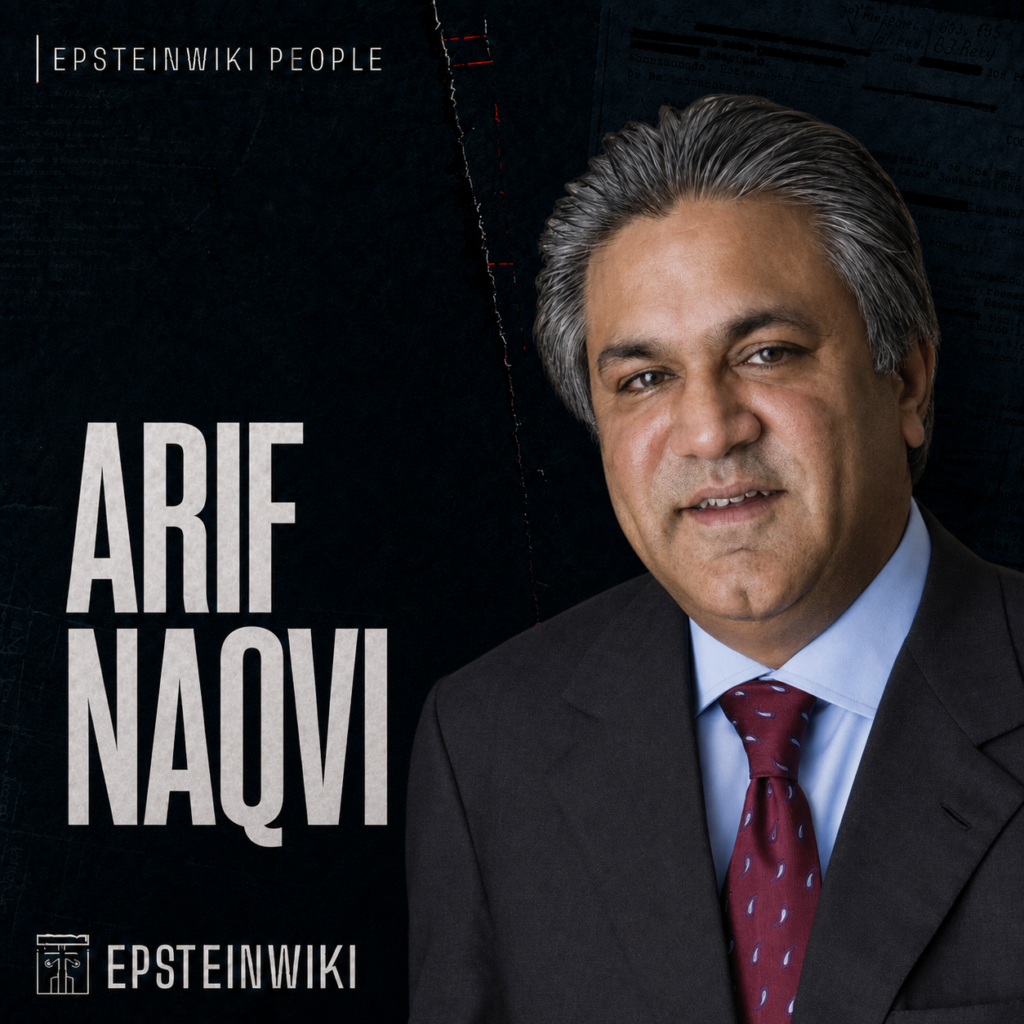
Snapshot
Arif Masood Naqvi is a Pakistani businessman who founded the Dubai based Abraaj Group. Before its collapse in 2018, Abraaj managed more than $13 billion and promoted itself as a leading investor in emerging markets and global development.
Naqvi appears once in the presently identified Jeffrey Epstein correspondence.
In June 2019, prominent criminal defense lawyer Reid Weingarten asked an email account used by Epstein whether he should represent Naqvi. The message is preserved in HOUSE_OVERSIGHT_033513, a document released by the United States House Committee on Oversight and Government Reform.
The message was sent after Naqvi had been arrested in London on United States fraud charges and while he was fighting extradition. It was also sent less than three weeks before Epstein’s July 2019 federal arrest.
The document establishes that Weingarten sought Epstein’s opinion about possible representation of Naqvi. It does not establish that Naqvi communicated with Epstein, met Epstein, retained Weingarten, or knew that Weingarten had consulted Epstein.
Naqvi’s wider legal history is substantial but separate. United States prosecutors accused him and other Abraaj executives of racketeering, securities fraud, wire fraud, money laundering, and related offenses. The Securities and Exchange Commission filed a civil enforcement action alleging misuse of more than $230 million from an Abraaj health fund. Naqvi has denied the United States criminal allegations.
The Dubai Financial Services Authority separately imposed a penalty of approximately $135.6 million and restrictions on Naqvi. Its Financial Markets Tribunal upheld those measures in 2023.
No publicly identified evidence reviewed for this article connects Naqvi with Epstein’s sexual abuse or trafficking operation.
Identity and Career
Arif Masood Naqvi was born in Karachi in 1960. He attended Karachi Grammar School and later studied at the London School of Economics.
His early career included work at Arthur Andersen, American Express, and the Olayan Group. He later established the investment company Cupola in Dubai.
Naqvi founded Abraaj Capital in 2002. The business expanded through investments across Africa, Asia, Latin America, Turkey, Central Asia, and the Middle East.
Abraaj Capital combined with Aureos Capital in 2012 and became the Abraaj Group.
A 2013 Yale School of Management interview described Abraaj under Naqvi as managing approximately $7.5 billion through offices across several continents. The firm later reported more than $13 billion under management.
Naqvi became a prominent advocate for investing in businesses that could produce both financial returns and social benefits.
He appeared at international conferences, cultivated relationships with governments and development institutions, and joined philanthropic initiatives associated with some of the world’s wealthiest individuals.
Those activities explain why his legal troubles attracted the attention of prominent lawyers and international financial institutions. They do not establish a personal relationship with Epstein.
The Abraaj Group
Abraaj invested in companies operating in developing and emerging economies.
The firm raised money from pension funds, sovereign institutions, development agencies, charitable foundations, and other institutional investors. Its investments included health care, infrastructure, consumer businesses, energy, education, and financial services.
Abraaj presented itself as a bridge between international capital and markets that larger Western investment firms sometimes considered difficult to enter.
The company also promoted a social investment model. Naqvi argued that profitable investment could contribute to development, employment, medical access, and poverty reduction.
This narrative gave Abraaj access to institutions interested in combining development goals with private investment.
The company’s standing collapsed after investors began questioning how money committed to an international health fund had been handled.
The Abraaj Growth Markets Health Fund
The Abraaj Growth Markets Health Fund was created to invest in hospitals, clinics, and other health care businesses in developing economies.
The fund received commitments from institutions that included the Bill and Melinda Gates Foundation, the International Finance Corporation, the United States government development finance system, and British development institutions.
The original SEC complaint stated that the fund reached commitments of $850 million in 2016. A United States governmental entity later committed an additional $150 million through a financing agreement.
The fund’s investors expected their money to remain available for approved health care investments.
According to the SEC, more than $230 million was instead transferred from the health fund to Abraaj Investment Management and Abraaj Holdings. The SEC alleged that the money was used to address corporate cash shortages and other purposes unrelated to the health fund.
These are allegations in a civil complaint. They should not be described as a criminal conviction against Naqvi.
Investor Questions and Abraaj’s Collapse
Investors began demanding information about the location of uninvested health fund capital in 2017.
The SEC alleged that Abraaj reports represented that substantial amounts remained available in fund bank accounts when much of the money had been transferred elsewhere.
The complaint also alleged that Abraaj temporarily used money from an outside loan to make the fund’s balance appear stronger at a financial reporting date.
Investors eventually retained investigators and accounting specialists to trace the money.
The resulting dispute damaged confidence throughout Abraaj. Creditors, investors, and regulators began examining the firm’s finances and governance.
Abraaj Holdings and Abraaj Investment Management entered provisional liquidation proceedings in the Cayman Islands in June 2018.
The collapse affected portfolio companies, employees, investors, and development projects across multiple countries. Other investment firms later acquired portions of Abraaj’s investment platform and portfolio.
The SEC Enforcement Action
On April 11, 2019, the United States Securities and Exchange Commission charged Naqvi and Abraaj Investment Management in the Southern District of New York.
The SEC litigation release alleged that Naqvi and the firm misappropriated money from the Abraaj Growth Markets Health Fund, mixed fund assets with Abraaj corporate money, and issued false or misleading information to investors.
The SEC alleged that the defendants violated anti fraud provisions of the Investment Advisers Act.
The original complaint alleged that:
- More than $230 million was transferred from the health fund.
- Naqvi possessed substantial control over the relevant Abraaj entities.
- Naqvi held signatory authority over major bank transfers.
- Investor reports failed to disclose the transfers and resulting conflicts of interest.
- Money was later returned after investors demanded information.
The amended SEC complaint expanded the civil allegations.
A complaint records what an enforcement agency alleges. Unless resolved through a judgment, admission, or settlement containing findings, it should not be represented as a final determination of liability.
The United States Criminal Case
Federal prosecutors separately charged Naqvi and other former Abraaj executives.
The case is recorded as United States v. Naqvi, No. 1:19-cr-00233 in the United States District Court for the Southern District of New York.
The superseding indictment contained sixteen counts involving alleged racketeering, securities fraud, wire fraud, money laundering, and conspiracies.
Prosecutors alleged that senior Abraaj executives misrepresented the firm’s financial condition, inflated its investment record, misused investor money, and concealed liquidity problems.
Naqvi has denied wrongdoing and has not entered a guilty plea in the United States case.
Several other former Abraaj executives followed different legal paths.
Former managing partner Mustafa Abdel Wadood pleaded guilty to criminal charges and agreed to cooperate with federal prosecutors. The Dubai Financial Services Authority’s account of his case states that he admitted standing by while Abraaj’s financial health and record were falsely presented.
Another person’s guilty plea does not constitute a conviction of Naqvi. Prosecutors may use cooperating witnesses against another defendant, but the defendant retains the right to contest their testimony and the government’s evidence.
Arrest in London
British authorities arrested Naqvi in April 2019 in response to the United States request for extradition.
He initially remained in custody. A British court later released him under unusually restrictive bail conditions.
Contemporary reporting described a £15 million security arrangement, electronic monitoring, surrender of travel documents, and a continuous curfew at his London residence.
The criminal charges and arrest created an immediate need for specialist defense representation in both Britain and the United States.
That legal context is essential when interpreting the June 2019 Epstein email.
The record does not show Naqvi independently approaching Epstein. It shows a lawyer asking Epstein a question about whether the lawyer should accept Naqvi as a client.
The June 2019 Reid Weingarten Email
The central Epstein related evidence is HOUSE_OVERSIGHT_033513.
The document contains an email chain dated from June 1 through June 17, 2019. It was among the Epstein estate records released by the House Committee on Oversight and Government Reform.
On June 17, Reid Weingarten asked the account identified as “J” whether he wanted to represent “Arif Naqvi the founder of Abraaj.”
The message was directed to Epstein’s jeevacation email address. The chain contains a confidentiality footer identifying the material as the property of “JEE.”
The same chain includes an earlier discussion in which Weingarten considered appearing on Donny Deutsch’s television program to discuss “the Jeffrey I know.” It also contains references to Weingarten being in London while the recipient was in Paris.
The document therefore provides strong contextual support for identifying “J” as Jeffrey Epstein.
The document does not preserve a response to Weingarten’s question about Naqvi.
Reid Weingarten’s Relationship With Epstein
Reid Weingarten is a prominent American criminal defense lawyer whose practice has included major fraud, corruption, and regulatory cases.
Weingarten represented Epstein during earlier negotiations arising from the federal investigation in Florida. He also appeared as one of Epstein’s lawyers after Epstein was arrested in New York in July 2019.
His professional biography describes him as a nationally recognized criminal defense and trial lawyer.
By June 2019, Weingarten and Epstein were communicating about legal, media, and personal matters.
The Naqvi message is significant because Weingarten did not merely mention a public news story. He asked Epstein for an opinion about whether to undertake a particular representation.
That suggests Weingarten considered Epstein’s view relevant to his professional decision.
It does not establish why Weingarten asked Epstein, what information Epstein possessed, or whether Epstein had any relationship with Naqvi.
Did Weingarten Represent Naqvi?
HOUSE_OVERSIGHT_033513 does not establish that Weingarten accepted Naqvi as a client.
The email is framed as a question about possible representation. No reply appears in the released document.
A lawyer can investigate a potential client, discuss possible representation, and ultimately decline the engagement. A question about representation is not proof of a completed attorney and client relationship.
The publicly reviewed materials do not establish that:
- Epstein recommended accepting or declining the case.
- Naqvi knew Weingarten consulted Epstein.
- Naqvi authorized the consultation.
- Weingarten shared confidential information about Naqvi.
- Epstein supplied legal or financial assistance to Naqvi.
- Weingarten ultimately represented Naqvi.
Further evidence would be required before any of those conclusions could be published as fact.
Why the Timing Matters
Weingarten sent the Naqvi message on June 17, 2019.
Naqvi had been arrested approximately two months earlier. The SEC case and federal criminal prosecution were already public.
Epstein was arrested in New York on July 6, 2019, less than three weeks after the message.
The email therefore belongs to the final period of Epstein’s life, when he remained in contact with lawyers, advisers, media figures, and other influential people despite his 2008 Florida conviction.
The timing shows that Epstein was still being treated as a sounding board by an experienced defense lawyer.
It does not show that Naqvi entered Epstein’s social circle or participated in Epstein’s activities.
The Bill Gates Connection Requires Care
Abraaj’s relationship with the Bill and Melinda Gates Foundation creates a possible source of confusion.
The Gates Foundation invested approximately $100 million in the Abraaj Growth Markets Health Fund and later participated in efforts to determine how fund money had been used.
Epstein separately cultivated a relationship with Bill Gates after Epstein’s Florida conviction.
Those are two documented relationships:
- Abraaj and the Gates Foundation had an institutional investment relationship.
- Epstein and Bill Gates had a separate personal and philanthropic relationship.
The existence of both relationships does not establish that Epstein introduced Naqvi to Gates, influenced the Gates Foundation’s investment, participated in the health fund, or received money from Abraaj.
No identified communication reviewed for this article shows Epstein discussing Naqvi with Gates.
The June 2019 Weingarten email should not be used to merge separate networks without documentary support.
Impact Investing and Elite Networks
Naqvi’s rise depended partly on his ability to build relationships with international investors, development agencies, political leaders, charitable foundations, and prominent business figures.
He attended events associated with the World Economic Forum, the United Nations, global health initiatives, and major investment conferences.
He also joined the Giving Pledge, an initiative established by Bill Gates, Melinda French Gates, and Warren Buffett. Reporting in 2024 stated that Naqvi had been removed from the Giving Pledge community.
Membership in the same philanthropic or international networks as people who also knew Epstein does not establish contact with Epstein.
Elite institutions often include thousands of overlapping participants. A reliable network analysis requires direct communications, confirmed meetings, financial records, travel evidence, or testimony.
For Naqvi, the presently identified Epstein evidence remains the single Weingarten email.
Dubai Financial Services Authority Findings
The Dubai Financial Services Authority conducted a separate regulatory investigation into Abraaj.
In January 2022, the regulator announced enforcement action against Naqvi and former Abraaj executive Waqar Siddique.
The DFSA imposed a penalty of $135,566,183 on Naqvi and prohibited and restricted him from performing functions in or from the Dubai International Financial Centre.
The regulator stated that Naqvi was knowingly involved in misconduct that included misuse of investor money, misleading investors, and the concealment of financial problems.
Naqvi referred the decision to the Financial Markets Tribunal.
In January 2023, the DFSA announced that the Financial Markets Tribunal upheld its action against Naqvi.
This is more than an allegation in a complaint. It is a regulatory decision upheld through the applicable tribunal process.
It is still not an Epstein related finding.
Naqvi’s Challenges to the Regulatory Proceedings
Naqvi sought to delay the Dubai regulatory proceedings while the United States criminal case remained unresolved.
In Arif Naqvi v. Dubai Financial Services Authority, the Dubai International Financial Centre court refused permission for judicial review of the decision allowing the regulatory case to continue.
Naqvi argued that participating in the regulatory process could prejudice his defense in the United States criminal case.
The court concluded that he had not demonstrated the required risk of serious injustice.
The decision also emphasized that regulatory and criminal proceedings apply different procedures, evidence rules, and standards of proof.
That distinction remains important. A regulatory finding does not eliminate the presumption of innocence applicable to unresolved criminal charges.
The Extradition Proceedings
Naqvi opposed extradition from Britain to the United States.
His lawyers argued that Britain was the more appropriate place for any prosecution and raised concerns about prison conditions, mental health care, and suicide risk.
Some of the extradition evidence referred to the Metropolitan Correctional Center in Manhattan, where Epstein died in August 2019.
The reference to Epstein in those proceedings concerned United States detention conditions. It was not evidence of a relationship between Epstein and Naqvi.
A British judge approved Naqvi’s extradition in 2021. The British government subsequently authorized the extradition.
In March 2023, the High Court rejected another challenge. Reuters reported that the court found no material change in the prison conditions previously considered and concluded that Naqvi’s suicide risk could be managed.
The publicly available material reviewed for this article does not establish that a United States trial has produced a verdict against Naqvi.
Cayman Islands Litigation
Abraaj’s collapse produced litigation in the Cayman Islands, where major Abraaj entities and funds had been organized.
One dispute concerned loans made by businessman Hamid Jafar after meetings with Naqvi in late 2017.
In 2025, a Cayman Islands judgment rejected claims that an Abraaj health fund was responsible for alleged representations made by Naqvi.
A summary of the judgment states that the court determined Naqvi was not acting on behalf of the health fund during the relevant discussions.
The decision illustrates why Abraaj, its funds, its investors, and Naqvi must not automatically be treated as a single legal entity.
It has no demonstrated connection to Epstein.
The Email Is Network Evidence, Not Misconduct Evidence
HOUSE_OVERSIGHT_033513 is useful as evidence about Epstein’s advisory network.
It shows that:
- Weingarten was discussing possible legal representation with Epstein.
- Naqvi’s name entered their correspondence.
- The discussion occurred during a major international fraud and extradition case.
- Epstein remained a professional sounding board for a prominent lawyer shortly before his arrest.
The document does not accuse Naqvi of sexual misconduct or participation in Epstein’s crimes.
It also does not prove a direct connection between Naqvi and Epstein.
The most accurate classification is a third party legal reference.
No Identified Direct Correspondence
The public record reviewed for this article does not contain an identified email sent by Naqvi to Epstein or by Epstein to Naqvi.
No authenticated message reviewed here shows them discussing:
- Abraaj investments
- The health fund
- Bill Gates
- Legal strategy
- Travel
- Political contacts
- Women or girls
- Epstein’s properties
- Charitable projects
- Financial transactions
The absence of an identified message does not prove that no communication ever occurred.
It does mean that a direct correspondence relationship should not be asserted without additional evidence.
No Identified Travel or Property Evidence
No flight manifest reviewed for this article places Naqvi aboard an Epstein aircraft.
No calendar entry reviewed here schedules a meeting between Naqvi and Epstein.
No photograph reviewed here places them together.
No staff message reviewed here arranges a visit by Naqvi to Epstein’s residences in New York, Florida, New Mexico, Paris, or the United States Virgin Islands.
No financial record reviewed here shows a payment between Naqvi, Abraaj, and Epstein.
The distinction between absence of evidence and evidence of absence remains important. The current public record supports a limited conclusion, not an absolute one.
No Identified Abuse Allegation
No survivor testimony reviewed for this article accuses Naqvi of sexual abuse, trafficking, recruitment, or facilitation.
No criminal charge reviewed here alleges that Naqvi participated in Epstein’s sexual offenses.
No civil judgment reviewed here holds Naqvi liable for conduct connected with Epstein’s abuse.
Naqvi’s appearance in an email associated with Epstein should therefore not be described as evidence that he was an Epstein client, trafficking participant, or sexual associate.
His separate financial and regulatory cases are serious. They do not convert a third party email reference into evidence of sexual misconduct.
What the Evidence Establishes
The available evidence establishes that:
- Arif Naqvi founded and controlled the Abraaj Group.
- Abraaj grew into a major private equity firm focused on emerging markets.
- The Abraaj Growth Markets Health Fund received commitments from international foundations and development institutions.
- Investors questioned the location and use of health fund money.
- Abraaj entered liquidation proceedings in 2018.
- The SEC filed a civil enforcement case alleging misuse of more than $230 million from the health fund.
- United States prosecutors charged Naqvi and other Abraaj executives with financial offenses.
- Naqvi was arrested in London in April 2019.
- Naqvi has denied the United States criminal allegations.
- Some former Abraaj executives pleaded guilty and agreed to cooperate with prosecutors.
- The Dubai Financial Services Authority imposed a penalty of approximately $135.6 million and restrictions on Naqvi.
- The Financial Markets Tribunal upheld the DFSA measures.
- British courts approved Naqvi’s extradition to the United States.
- On June 17, 2019, Reid Weingarten asked Epstein’s email account whether he should represent Naqvi.
- The question appears in HOUSE_OVERSIGHT_033513.
- The document does not preserve Epstein’s answer to the Naqvi question.
- The email was sent less than three weeks before Epstein’s July 2019 arrest.
- Weingarten had represented Epstein and remained in communication with him.
- No identified court finding connects Naqvi with Epstein’s trafficking operation.
- No identified survivor statement reviewed here accuses Naqvi of Epstein related abuse.
What the Evidence Does Not Establish
The available evidence does not establish that:
- Naqvi knew Epstein.
- Naqvi met Epstein.
- Naqvi communicated directly with Epstein.
- Naqvi asked Weingarten to consult Epstein.
- Naqvi knew that Weingarten had consulted Epstein.
- Epstein recommended that Weingarten represent Naqvi.
- Weingarten accepted Naqvi as a client.
- Epstein supplied Naqvi with legal advice.
- Epstein invested in Abraaj.
- Abraaj transferred money to Epstein.
- Epstein influenced the Gates Foundation’s investment in Abraaj.
- Epstein introduced Naqvi to Bill Gates.
- Naqvi visited an Epstein property.
- Naqvi travelled on an Epstein aircraft.
- Naqvi participated in Epstein’s trafficking operation.
- Naqvi recruited women or girls for Epstein.
- The United States criminal charges have resulted in a conviction of Naqvi.
- Another Abraaj executive’s guilty plea establishes Naqvi’s guilt.
- A reference to Epstein’s jail during extradition proceedings proves a personal connection.
- A shared presence within international business or philanthropic networks proves direct contact.
Investigative Assessment
Arif Naqvi’s appearance in the Epstein archive is limited but revealing.
The evidence does not currently support describing Naqvi as a personal Epstein associate. It supports describing him as the subject of a legal representation question sent to Epstein by one of Epstein’s lawyers.
The stronger finding concerns Epstein and Weingarten. The message shows that an experienced criminal defense lawyer sought Epstein’s opinion about a major potential client while Epstein remained under increasing public scrutiny.
That consultation raises legitimate questions about Epstein’s continuing influence within legal and financial networks after his Florida conviction.
It does not answer those questions. The released chain contains no response to the Naqvi inquiry and no explanation of why Epstein’s view was sought.
Naqvi’s separate legal record must be presented accurately. United States criminal accusations remain charges unless proven at trial or admitted through a plea. The SEC action contains civil allegations. The Dubai regulatory proceedings produced findings and penalties upheld by the Financial Markets Tribunal.
The most defensible classification is that Arif Naqvi is a third party reference within Epstein’s legal correspondence. Any claim of a deeper relationship requires evidence beyond HOUSE_OVERSIGHT_033513.
Key Takeaways
- Naqvi founded the Abraaj Group and became a major figure in emerging markets investment.
- Abraaj collapsed after investors questioned the use of money from a global health fund.
- United States authorities brought civil and criminal proceedings involving Naqvi.
- Naqvi has denied the United States criminal allegations.
- Dubai regulators imposed a major financial penalty and professional restrictions.
- British courts approved his extradition to the United States.
- Reid Weingarten asked Epstein whether he should represent Naqvi in June 2019.
- The email does not show whether Epstein answered.
- It does not establish that Weingarten ultimately represented Naqvi.
- It does not establish direct contact between Naqvi and Epstein.
- The Gates Foundation’s Abraaj investment does not prove that Epstein connected Naqvi with Bill Gates.
- No identified evidence reviewed here links Naqvi to Epstein’s sexual abuse or trafficking.
- The document is best understood as evidence about Epstein’s legal advisory network.
- Naqvi’s financial cases and the Epstein reference must remain analytically separate.
- Any stronger claim requires additional correspondence, meeting records, financial evidence, travel records, or testimony.
Related EpsteinWiki Articles
- Jeffrey Epstein
- Reid Weingarten
- Bill Gates
- Abraaj Group
- HOUSE_OVERSIGHT_033513
- Witness Statements and Depositions Litigation
- Epstein’s Legal Team
- How to Read an Epstein Document
- House Oversight Epstein Releases
- Epstein’s Financial Network
Primary Government and Court Sources
- United States v. Naqvi federal docket
- SEC litigation release concerning Arif Naqvi and Abraaj Investment Management
- Original SEC complaint
- Amended SEC complaint
- DFSA action against Arif Naqvi and Waqar Siddique
- Financial Markets Tribunal decision upholding the DFSA action
- Arif Naqvi v. Dubai Financial Services Authority
- Related Dubai court ruling concerning the regulatory proceedings
- DFSA action concerning Mustafa Abdel Wadood
- House Oversight release of additional Epstein estate records
- Reuters report on Naqvi’s 2023 extradition challenge
Primary Epstein Data Evidence
- HOUSE_OVERSIGHT_033513 contains the June 2019 email chain in which Reid Weingarten asked Epstein’s email account whether he should represent Arif Naqvi, founder of Abraaj.
The document contains the only presently identified direct reference to Naqvi in Epstein’s released correspondence reviewed for this article.
It does not contain a response to the representation question, a message from Naqvi, or evidence of a meeting between Naqvi and Epstein.
Sleuth and Research Sources
- EpsteinWiki analysis of HOUSE_OVERSIGHT_033513
- EpsteinGraph Arif Naqvi profile
- EpsteinGraph document record for HOUSE_OVERSIGHT_033513
- Epstein Project copy of HOUSE_OVERSIGHT_033513
These resources assist with document discovery and network mapping. Their conclusions should be checked against the released document and official court records before publication.