
Frederic Fekkai
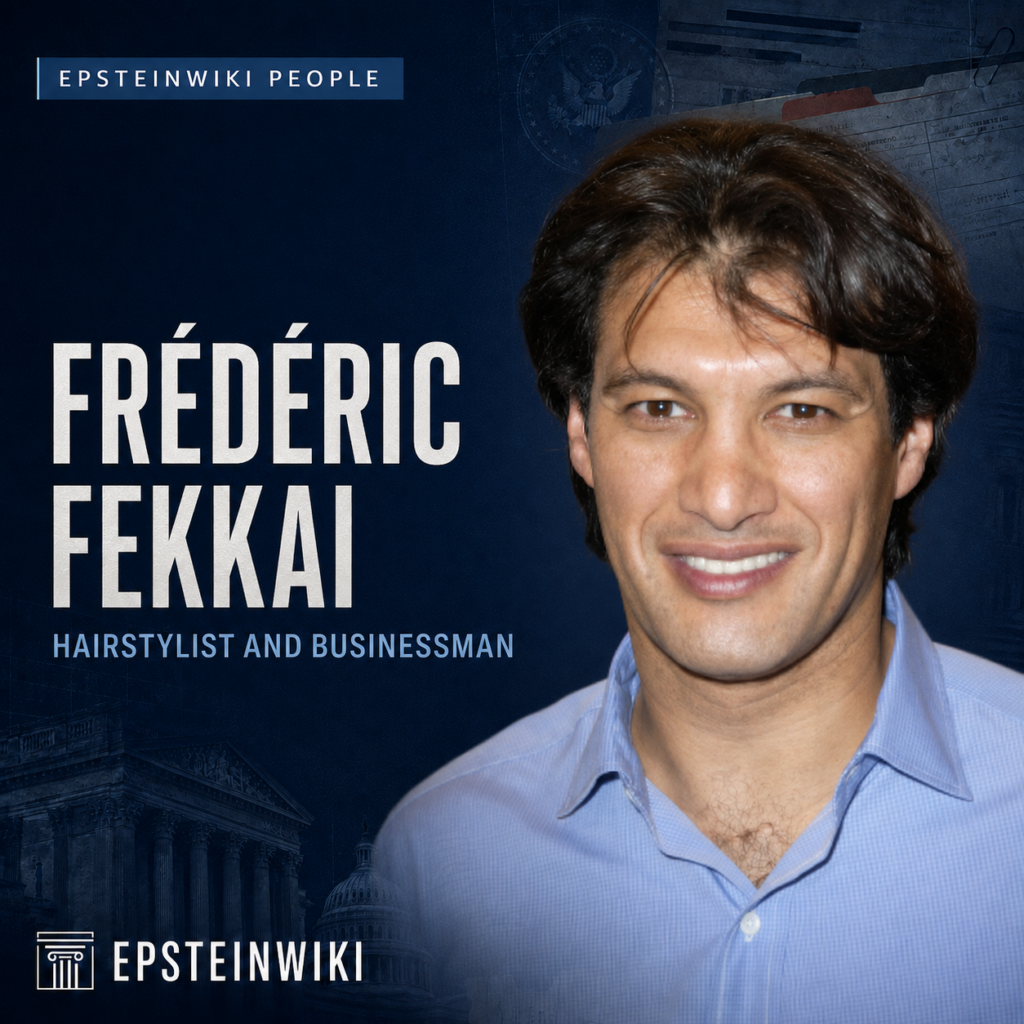
Snapshot
Frédéric Fekkai is a French celebrity hairstylist and beauty entrepreneur whose relationship with Jeffrey Epstein is documented through flight records, social correspondence, salon appointments, financial receipts, witness testimony, congressional evidence, and records showing direct personal contact.
The evidence extends far beyond the contact book reference described in earlier versions of this article.
Fekkai appears in records documenting:
- Travel from the United States Virgin Islands on Epstein’s aircraft
- Social invitations involving Epstein and Ghislaine Maxwell
- Direct correspondence with Epstein
- Extensive salon appointments arranged and paid for by Epstein
- A request to use the massage room inside Epstein’s Manhattan residence
- Testimony from Johanna Sjoberg that she heard Epstein ask whether someone could find girls for Fekkai in Hawaii
- Sarah Kellen’s 2026 congressional testimony alleging that Fekkai sexually assaulted her in Maui and subsequently introduced her to Epstein
- A June 2026 congressional referral asking the Justice Department to investigate Kellen’s allegations
Fekkai has categorically denied abusing or assaulting Kellen. His representative also denied that he introduced her to Epstein, said Fekkai knew nothing about Epstein’s trafficking, and maintained that he never participated in illegal conduct.
As of September 1, 2026, no publicly identified criminal charge or judicial finding has established that Fekkai committed an Epstein related offense. The congressional referral is a request for investigation, not a determination of guilt.
Who Is Frédéric Fekkai?
Frédéric Fekkai is a hairstylist, salon operator, and beauty industry entrepreneur born in Aix en Provence, France.
According to the official Fekkai company history, he was raised in Aix en Provence and trained in Paris before building his career in the United States.
Fekkai became known for adapting hairstyles to individual clients rather than imposing a single signature look. In 1989, Bergdorf Goodman invited him to establish a salon within the New York department store. The salon helped make Fekkai one of the most prominent stylists serving celebrities, fashion figures, executives, and wealthy social clients.
His reputation expanded beyond personal styling into branded salons and luxury hair products. The Cosmetic Executive Women biography of Fekkai describes the Bergdorf Goodman salon as a major turning point in his development into an international beauty entrepreneur.
Fekkai’s elite clientele and luxury salons placed him within the same New York fashion, business, and social environment in which Epstein cultivated relationships with models, financiers, designers, politicians, photographers, and wealthy families.
The Fekkai Business Empire
Fekkai opened his first namesake salon during the late 1980s and introduced a luxury hair product collection during the 1990s.
His salons became known for expensive cuts, styling services, beauty treatments, and a clientele drawn from entertainment, fashion, finance, and politics.
Private equity firm Catterton Partners acquired the brand before selling it to Procter and Gamble. Jones Day’s transaction record confirms that Procter and Gamble acquired Frédéric Fekkai and Company from Catterton in May 2008.
Contemporary industry reporting valued the transaction at more than $400 million, although the formal acquisition announcement did not publicly disclose the price.
Procter and Gamble later sold the business. In 2018, Fekkai and Cornell Capital created Blue Mistral and reacquired the namesake company. The acquisition announcement said Blue Mistral would operate both Fekkai Brands and Bastide, the Provençal beauty company led by Fekkai and his wife, Shirin von Wulffen.
This ownership timeline matters when evaluating events at Fekkai salons. The person whose name appears over the door was not necessarily the owner or operator during every period documented in Epstein’s records.
How Fekkai Entered Epstein’s Social Network
The exact date and circumstances of the first meeting between Fekkai and Epstein have not been established conclusively.
The available evidence nevertheless shows that their relationship existed by the late 1990s or approximately 2000 and extended beyond a single professional appointment.
Fekkai was romantically associated with Johnson and Johnson heiress Elizabeth “Libet” Johnson. Epstein also had a financial and property relationship with Johnson, including authority connected with a Colorado ski property.
Fekkai, Johnson, architect Peter Marino, Alexander Fekkai, and Audrey Blaise appear together on a June 25, 2000 passenger record for a flight from the United States Virgin Islands to Teterboro, New Jersey. The Epstein Data entity profile for Fekkai connects him with the other passengers appearing on that record.
The combination of air travel, social invitations, later direct emails, and access to Epstein’s Manhattan residence demonstrates a continuing personal association. It cannot accurately be reduced to the presence of a telephone number in an address book.
Travel on Epstein’s Aircraft
Flight records place Fekkai aboard Epstein’s aircraft.
A June 25, 2000 manifest lists Elizabeth Johnson, Frédéric Fekkai, Alexander Fekkai, Audrey Blaise, and Peter Marino on a flight from the airport serving St. Thomas in the United States Virgin Islands to Teterboro, New Jersey.
The record is significant because St. Thomas was the airport used by travelers visiting Epstein’s Little Saint James property. A flight from St. Thomas does not independently establish that every passenger stayed on Little Saint James, but it places the passengers within Epstein’s Virgin Islands travel network.
Additional reproduced flight records identify Frédéric and Alexander Fekkai among passengers traveling with Epstein, Maxwell, Sarah Kellen, and others from New York to Paris on June 27, 2002. Related records place the group on a later flight from Paris to Toulon.
Flight logs establish recorded travel. They do not establish what occurred before, during, or after a flight, and they do not by themselves prove criminal conduct.
Social Invitations and Direct Contact
Fekkai appears in Epstein and Maxwell’s social correspondence.
EFTA02332573 contains a 2003 message in which Maxwell wrote that Epstein had invited “Fred Fekkai” and permitted him to invite another person. The document places Fekkai within Epstein and Maxwell’s social scheduling rather than merely documenting a salon transaction.
Records also connect Fekkai with a November 2010 event at the Boom Boom Room in New York. Reporting based on released emails describes Epstein asking Fekkai whether Prince Andrew would attend a gathering held for Fekkai.
A later direct email shows that the relationship continued.
In EFTA01020465, Fekkai wrote to Epstein in October 2018, asked whether he was in New York, and proposed coffee. This communication occurred approximately ten years after Epstein pleaded guilty in Florida and became a registered sex offender.
The record does not reveal whether the proposed meeting happened. It does establish that Fekkai was comfortable contacting Epstein directly and proposing an in person meeting in 2018.
Epstein’s Account at Fekkai Salons
Epstein maintained a longstanding relationship with Fekkai salons and paid for services provided to employees, assistants, associates, guests, and women within his network.
A 2005 profile reported that Epstein maintained a charge account at Frédéric Fekkai for the unlimited use of his personal assistants. Salon appointments were presented as one of the benefits of working for him.
The later EFTA production contains extensive scheduling records, receipts, and communications supporting the existence and continued use of that account.
Representative records include:
- EFTA00354950, containing a December 2014 receipt from the Fifth Avenue Fekkai salon
- EFTA00454240, containing a June 2017 salon receipt
- EFTA00458910, containing a September 2017 salon receipt
- EFTA00438630, containing a forwarded Fekkai salon receipt within Epstein’s administrative correspondence
- EFTA02210409, documenting a reservation made with a stylist named Patrick at the Fifth Avenue salon for two women
- EFTA02127910, containing correspondence about an appointment with Patrick at Fekkai’s salon
- EFTA00667899, containing a request connected with sending a woman to Frédéric Fekkai so she would look beautiful that night
- EFTA02086613, documenting a December 2014 blowout arranged after a medical appointment and paid for as part of Epstein’s personal scheduling system
The volume of correspondence indicates that the salon was a recurring component of Epstein’s patronage and gift network.
The records do not show that Fekkai personally performed every service, knew the identity of every client, or reviewed every payment. Many appointments were handled by reception staff, assistants, and other stylists.
The Salon as Part of Epstein’s Perks System
Epstein regularly paid for services designed to reward, impress, influence, or alter the appearance of people within his network.
Salon appointments appeared alongside hotel spas, massages, beauty treatments, medical consultations, clothing, travel, accommodation, and social invitations.
A Bloomberg Law investigation found hundreds of messages documenting salon services arranged for Epstein, women associated with him, and influential professional contacts.
One example involved former White House counsel Kathryn Ruemmler. Epstein paid for beauty and wellness services that included a blowout at the Fekkai salon. During her 2026 congressional interview, Ruemmler said she had received services at the salon but had never met Fekkai and would not recognize him.
That distinction is important. A person receiving a service at a branded salon does not necessarily have a relationship with the founder.
The larger pattern nevertheless demonstrates how Epstein used luxury services as part of his relationship management. The salon functioned as one recurring destination in that system.
Reports From Former Salon Employees
In 2019, former Fekkai employees told The Daily Beast that Epstein continued visiting the salons after becoming a registered sex offender.
The former employees alleged that Epstein brought groups of young women into the New York salon, paid for their services, and had women sit on his lap and touch his hair. Employees also said Fekkai stylists made house calls to Epstein’s Palm Beach residence.
These accounts came from former employees speaking to a news organization. They were not trial findings.
A spokesperson for Fekkai Brands responded that the company had been sold by the time of Epstein’s 2008 conviction and that Fekkai was not involved in the salons during the relevant period.
The spokesperson also said neither Fekkai nor the then current management team knew about the reported conduct and that Fekkai never witnessed the behavior underlying Epstein’s conviction.
The corporate ownership distinction may explain why salon staff continued serving Epstein without direct involvement from Fekkai. It does not erase the earlier personal relationship between the two men, their recorded travel, or their later direct contact.
Fekkai’s Request to Use Epstein’s Massage Room
One of the most significant records concerns the massage room inside Epstein’s Manhattan residence.
During Lesley Groff’s June 2026 congressional interview, investigators presented an email dated November 18, 2010. Groff was told that the record carried the Bates number EFTA02414378.
In the email, Groff wrote that Fekkai had texted her asking whether he could use Epstein’s massage room at 10 in the morning with his own masseuse.
Groff testified that she did not remember the request. She said she had no separate memory of Fekkai generally asking to use the room and did not recall other men in Epstein’s network making similar requests.
The document is important for several reasons.
First, it shows Fekkai communicating with Epstein’s staff about personal access to the Manhattan residence.
Second, the request concerned a room that became central to survivor accounts and the criminal allegations against Epstein.
Third, the email was sent after Epstein’s Florida conviction and registration as a sex offender.
The document does not establish that sexual activity or abuse occurred during the requested use. It establishes that Fekkai requested access to the room and that Epstein’s staff processed the request.
Johanna Sjoberg’s Deposition
Johanna Sjoberg gave sworn testimony in May 2016 during Giuffre v. Maxwell.
Sjoberg testified that she heard Epstein speaking on the telephone and saying that Fekkai was in Hawaii before asking whether someone could find girls for him.
The exchange became widely reported after another group of Giuffre v. Maxwell records was released in January 2024.
The statement is evidence of what Sjoberg said she personally heard Epstein say. It does not establish who was on the other end of the call, whether Fekkai knew about the statement, what Epstein meant by “girls,” or whether anyone acted on the request.
The language is nevertheless significant when considered with Sarah Kellen’s later testimony that she first met Fekkai in Hawaii and was introduced to Epstein through him.
Sjoberg’s account and Kellen’s account are separate pieces of testimony given approximately ten years apart. The factual overlap does not automatically prove either account, but it creates an important area for investigation.
Sarah Kellen’s 2026 Congressional Testimony
Sarah Kellen appeared voluntarily for a transcribed interview before the House Committee on Oversight and Government Reform on May 21, 2026.
The official transcript is linked through the House Oversight release. A searchable copy is also indexed in the Epstein Data congressional deposition archive.
Kellen described herself as a victim of Epstein and Maxwell who was abused, controlled, and isolated while also working inside Epstein’s organization.
She testified that she met Fekkai at a Neiman Marcus makeup counter in Honolulu in late 2000 or early 2001. According to Kellen, a makeup artist introduced them while Fekkai was promoting his hair product line.
Kellen said Fekkai told her that he wanted her to participate in a hair show in Maui. She traveled to Maui but alleged that no hair show existed.
She testified that Fekkai placed her in his hotel room and that she lacked the money necessary to obtain another room or travel home. Kellen alleged that he sexually assaulted her that night.
Kellen further testified that Fekkai offered to introduce her to his friend Jeffrey Epstein, whom Fekkai allegedly represented as a Victoria’s Secret model scout.
According to Kellen, Epstein later flew her to Los Angeles for what she understood to be a modeling appointment at the Shutters on the Beach hotel. She said Epstein reviewed her portfolio while lying on a bed and directed her to undress.
Kellen testified that she did not immediately begin working for Epstein following that encounter. She said a woman at the W Hotel in Honolulu later approached her about an assistant position with a wealthy couple. That couple was Epstein and Maxwell.
Kellen eventually traveled to Little Saint James and accepted employment inside Epstein’s organization.
The Alleged Introduction to Epstein
Kellen’s testimony makes Fekkai relevant to the origins of her relationship with Epstein.
She did not claim that Epstein facilitated the alleged incident in Maui because, according to her chronology, the incident occurred before she met Epstein.
She alleged instead that Fekkai introduced her to Epstein afterward.
When asked whether she believed Epstein knew about the alleged abuse, Kellen said she believed he would have known because Epstein was not actually a Victoria’s Secret scout despite allegedly being presented that way.
The testimony describes a sequence:
- A makeup counter introduction in Honolulu
- A promised hair show in Maui
- An alleged assault in Fekkai’s hotel room
- Fekkai’s offer to introduce Kellen to Epstein
- Epstein’s alleged presentation as a Victoria’s Secret scout
- A hotel room casting in Los Angeles
- Kellen’s later recruitment into Epstein and Maxwell’s household
This chronology is based on Kellen’s testimony. It has not been adjudicated in a criminal or civil trial against Fekkai.
Fekkai’s Denial
Fekkai has denied Kellen’s allegations.
A representative said Fekkai was astonished by the testimony and maintained that he never abused or assaulted anyone. The representative also said:
- Fekkai never took advantage of Kellen
- Fekkai did not introduce Kellen to Epstein
- Fekkai never participated in illegal behavior
- Fekkai knew nothing about Epstein’s trafficking or abuse
- Fekkai did nothing wrong
The denial directly conflicts with Kellen’s account of the Maui trip and introduction.
Fekkai’s position must be reported alongside the allegation because no court has resolved the conflict.
The House Oversight Referral to the Justice Department
On June 4, 2026, House Oversight Chairman James Comer and Representatives Clay Higgins, William Timmons, Andy Biggs, and Lauren Boebert sent a letter to Acting Attorney General Todd Blanche.
The official referral letter asked the Justice Department to investigate allegations involving Fekkai and former Miami Beach mayor Philip Levine.
The letter described Fekkai as a close friend of Epstein and said he played a role in Epstein’s grooming methods by routinely providing salon services to women at Epstein’s instruction.
The Committee asked the Justice Department to use all available investigative tools, including immunity for certain witnesses.
Chairman Comer expressly stated that the Committee is not a law enforcement agency and does not determine guilt or innocence. The referral therefore represents a request for a criminal investigation rather than a criminal charge or congressional finding.
As of September 1, 2026, no public Justice Department announcement identified a charge, declination, or completed investigation concerning Fekkai.
Ghislaine Maxwell, Modeling, and Victoria’s Secret
The claimed Victoria’s Secret connection is an important part of Kellen’s testimony.
Epstein had a longstanding financial relationship with Leslie Wexner, whose business empire included Victoria’s Secret. Epstein also maintained relationships with fashion executives, photographers, models, and modeling agent Jean Luc Brunel.
Kellen told Congress that the presentation of Epstein as a Victoria’s Secret scout appeared plausible because she knew Epstein was connected with Wexner and Ed Razek, a prominent Victoria’s Secret executive.
There is no evidence that Victoria’s Secret formally employed Epstein as a model scout.
The claim that Epstein had access or influence through Wexner’s business network appears in multiple survivor accounts. That broader context explains why a young aspiring model might have believed that Epstein could arrange legitimate opportunities.
Kellen’s testimony alleges that Fekkai helped establish that impression by offering to introduce her to Epstein as a Victoria’s Secret model scout. Fekkai denies introducing her to Epstein.
The L Brands and Catterton Connection
The corporate history of Fekkai Brands also intersected with companies associated with Wexner’s commercial network.
Catterton Partners invested in Fekkai’s business before selling it to Procter and Gamble. L Capital, an investment operation associated with the luxury goods sector, later combined with Catterton to form L Catterton. L Brands also maintained investment relationships within the broader Catterton structure.
That history creates an indirect commercial intersection among Fekkai’s brand, luxury investment capital, and Wexner’s business world.
It does not prove Epstein arranged the investment, controlled Fekkai’s company, or used L Brands money to finance criminal conduct.
The relevant point is that the beauty, fashion, investment, modeling, and Victoria’s Secret environments were not isolated worlds. They contained overlapping personal and commercial relationships that Epstein repeatedly exploited for access and credibility.
The Elizabeth Johnson Connection
Fekkai’s former relationship with Elizabeth “Libet” Johnson provides another possible path through which he and Epstein became acquainted.
Johnson was an heiress to the Johnson and Johnson family fortune and had financial and property dealings involving Epstein.
In 1998, Johnson transferred an interest in a Colorado ski property into a structure that granted Epstein substantial authority over the property. Epstein retained an interest connected with the property until his death.
Fekkai was reportedly Johnson’s partner during part of the period when she knew Epstein.
The June 2000 flight record listing Johnson, Fekkai, Alexander Fekkai, Audrey Blaise, and Peter Marino supports the existence of a shared social circle.
The record does not establish whether Johnson introduced Fekkai to Epstein or whether their connection arose through a different part of New York society.
The Evidence From EpsteinWiki Sleuths
EpsteinWiki sleuth Ellie Leonard documented Fekkai’s presence across flight records, the black book, social events, and salon scheduling in The Men Named by Sarah Kellen.
Leonard highlighted:
- Fekkai’s flight appearances
- His black book entry
- His presence in Giuffre v. Maxwell material
- Salon appointments arranged for women in Epstein’s network
- His connection to Epstein’s 2010 social calendar
- Kellen’s identification of Fekkai during her congressional appearance
Tara Palmeri first reported the identities Kellen supplied during her closed congressional interview in The Three Men Sarah Kellen Identified in Epstein Abuse Testimony.
Palmeri also reported that Epstein maintained an account at the salon, sent assistants and survivors there, arranged house calls, and exchanged social communications with Fekkai.
These sleuth and journalistic accounts are valuable for locating evidence, but the underlying transcripts, EFTA records, flight logs, and congressional documents remain the primary sources for factual conclusions.
Important Evidence Distinctions
The Fekkai record now contains several different evidentiary categories.
A flight log establishes that a person was recorded as a passenger. It does not establish what occurred at a destination.
A salon receipt establishes that a service was billed. It does not establish that Fekkai personally provided or knew about the service.
An email establishes that a particular communication appears in the released record. It does not prove every factual assumption contained in the message.
Sjoberg’s deposition establishes that she testified under oath that she heard Epstein ask whether girls could be found for Fekkai. It does not establish what Fekkai knew.
Kellen’s congressional transcript establishes that she formally alleged Fekkai assaulted her and introduced her to Epstein. It does not constitute a conviction or judicial finding.
The congressional referral establishes that lawmakers considered the allegations serious enough to request a Justice Department investigation. It is not an indictment.
Fekkai’s denial establishes his stated position. It does not independently resolve the factual dispute.
What the Evidence Establishes
The available public record establishes that:
- Fekkai had a documented personal and professional relationship with Epstein.
- Fekkai appears in Epstein’s contact records.
- Flight records place Fekkai within Epstein’s aircraft and Virgin Islands travel network.
- Fekkai appeared in social scheduling involving Epstein and Maxwell.
- Fekkai directly contacted Epstein in 2018 and proposed meeting for coffee.
- Epstein maintained a longstanding account at Fekkai salons.
- Epstein’s staff regularly scheduled and paid for salon services for women and professional contacts.
- Former salon employees said Epstein brought groups of young women to the salons after his conviction.
- A 2010 email records Fekkai asking to use the massage room in Epstein’s Manhattan residence with his masseuse.
- Sjoberg testified that she heard Epstein ask whether someone could find girls for Fekkai in Hawaii.
- Kellen testified that Fekkai assaulted her in Maui after inviting her to a hair show that allegedly did not exist.
- Kellen testified that Fekkai subsequently offered to introduce her to Epstein as a Victoria’s Secret model scout.
- Fekkai has denied the allegation and denied introducing Kellen to Epstein.
- House members referred Kellen’s allegations to the Justice Department in June 2026.
- No public court judgment has resolved the allegation.
What the Evidence Does Not Establish
The available record does not establish that:
- Every person who visited a Fekkai salon knew Epstein.
- Fekkai personally provided every service Epstein purchased.
- Fekkai knew about every appointment placed on Epstein’s salon account.
- Every person appearing on a flight manifest visited Little Saint James.
- A flight on Epstein’s aircraft proves participation in criminal conduct.
- The request to use Epstein’s massage room proves that abuse occurred in the room on that occasion.
- Sjoberg knew whether Fekkai was aware of Epstein’s telephone request.
- Kellen’s allegations have been proven in court.
- The congressional referral constitutes a criminal charge.
- The Justice Department has publicly completed its review of the referral.
- Fekkai has been convicted of an Epstein related crime.
- Corporate investment links prove that Wexner, L Brands, or Catterton financed criminal activity through Fekkai Brands.
Investigative Assessment
The evidence no longer supports characterizing Fekkai as a peripheral person whose name merely appeared in an address book.
His relationship with Epstein included documented travel, invitations, salon patronage, direct communication, access to Epstein’s residence, and continued contact after Epstein’s Florida conviction.
The most serious development is Kellen’s testimony.
Her allegation should not be converted into a finding of guilt, but it cannot responsibly be omitted from an updated article. Her account describes Fekkai as both an alleged abuser and the person who introduced her to Epstein under a false modeling pretext.
That alleged sequence deserves particular scrutiny because it connects the beauty industry, modeling aspirations, the Wexner and Victoria’s Secret aura surrounding Epstein, and Kellen’s eventual recruitment into Epstein and Maxwell’s organization.
Sjoberg’s earlier testimony about Epstein wanting someone to find girls for Fekkai in Hawaii is independently relevant. It does not prove Kellen’s account, but the geographic and social overlap makes the two accounts important to examine together.
The extensive salon records also demonstrate that beauty services were not incidental to Epstein’s operations. They formed part of a larger system of appearance management, rewards, gifts, access, and influence.
The unresolved questions include:
- When and how Fekkai first met Epstein
- How often Fekkai traveled with Epstein or visited his properties
- Who attended the alleged Maui trip described by Kellen
- Whether travel, hotel, salon, telephone, or product promotion records corroborate Kellen’s chronology
- What happened after Fekkai allegedly offered to introduce Kellen to Epstein
- Whether Fekkai knew Epstein was not a legitimate Victoria’s Secret scout
- Why Fekkai requested access to Epstein’s massage room in 2010
- Whether federal investigators interviewed Fekkai after the congressional referral
- Whether additional witnesses can corroborate or contradict Kellen’s allegations
Those questions require investigation and primary evidence rather than speculation.
Key Takeaways
- Fekkai’s Epstein connection is documented through far more than a black book entry.
- Flight records place him in Epstein’s Virgin Islands and international travel network.
- Epstein maintained an extensive account at Fekkai salons and paid for services for people throughout his network.
- Former salon employees reported concerning behavior by Epstein inside the salons after his conviction.
- Fekkai requested access to Epstein’s Manhattan massage room in 2010.
- Sjoberg testified that she heard Epstein ask whether girls could be found for Fekkai in Hawaii.
- Kellen alleged that Fekkai assaulted her in Maui after offering her a place in a hair show that allegedly did not exist.
- Kellen testified that Fekkai then introduced her to Epstein as a supposed Victoria’s Secret model scout.
- Fekkai categorically denies abusing Kellen or introducing her to Epstein.
- House members referred Kellen’s allegations to the Justice Department in June 2026.
- A referral is not a charge, conviction, or finding of guilt.
- As of September 1, 2026, no publicly identified judicial proceeding has resolved the allegation.
- Epstein Data provides direct access to emails, receipts, scheduling records, and congressional evidence connected with Fekkai.
- The strongest responsible description is that Fekkai was a documented Epstein associate who is now the subject of a disputed sexual assault allegation referred by members of Congress to the Justice Department.
Related EpsteinWiki Articles
- Jeffrey Epstein
- Ghislaine Maxwell
- Sarah Kellen
- Johanna Sjoberg
- Leslie Wexner
- Giuffre v. Maxwell
- House Oversight Committee Investigation
- Sarah Kellen DOJ Referral
- House Republicans Refer New Epstein Related Sexual Assault Allegations
- Lesley Groff Congressional Testimony
Primary Epstein Data Evidence
- Frédéric Fekkai entity profile indexes his flight and documentary connections.
- EFTA02332573 contains Maxwell’s message stating that Epstein invited Fred Fekkai and permitted him to invite another person.
- EFTA02414378 is the email identified during Lesley Groff’s testimony concerning Fekkai’s request to use Epstein’s massage room with his masseuse.
- EFTA01020465 contains Fekkai’s October 2018 email asking Epstein whether he was in New York and proposing coffee.
- EFTA02210409 documents a Fekkai salon reservation for two women.
- EFTA02127910 contains scheduling correspondence concerning Patrick at Fekkai’s salon.
- EFTA00667899 contains a request associated with sending a woman to Fekkai so she would look beautiful that evening.
- EFTA00354950 contains a December 2014 receipt from the Fifth Avenue salon.
- EFTA00454240 contains a June 2017 salon receipt.
- EFTA00458910 contains a September 2017 salon receipt.
- EFTA00438630 contains a forwarded receipt from the Fifth Avenue salon.
- EFTA02086613 documents a blowout arranged within Epstein’s appearance and appointment system.
- EFTA00098755 contains a prosecution planning and background record relevant to people associated with Epstein’s massage environment.
- Epstein Data congressional deposition archive provides access to Sarah Kellen’s and Lesley Groff’s congressional transcripts.
Primary Government and Court Sources
- House Oversight release concerning Kellen’s allegations
- June 4, 2026 DOJ referral letter
- Lesley Groff congressional transcript
- Giuffre v. Maxwell federal docket
- Sjoberg deposition excerpts
- DOJ Epstein Library
EpsteinWiki Sleuth and Investigative Sources
- Ellie Leonard, The Men Named by Sarah Kellen
- Tara Palmeri, The Three Men Sarah Kellen Identified in Epstein Abuse Testimony
- Epstein Data congressional deposition archive
- The Daily Beast investigation into Epstein’s Fekkai salon visits
- Bloomberg Law investigation into salon services paid for by Epstein
- ABC News report on the congressional referral and Fekkai’s denial