
John Paulson
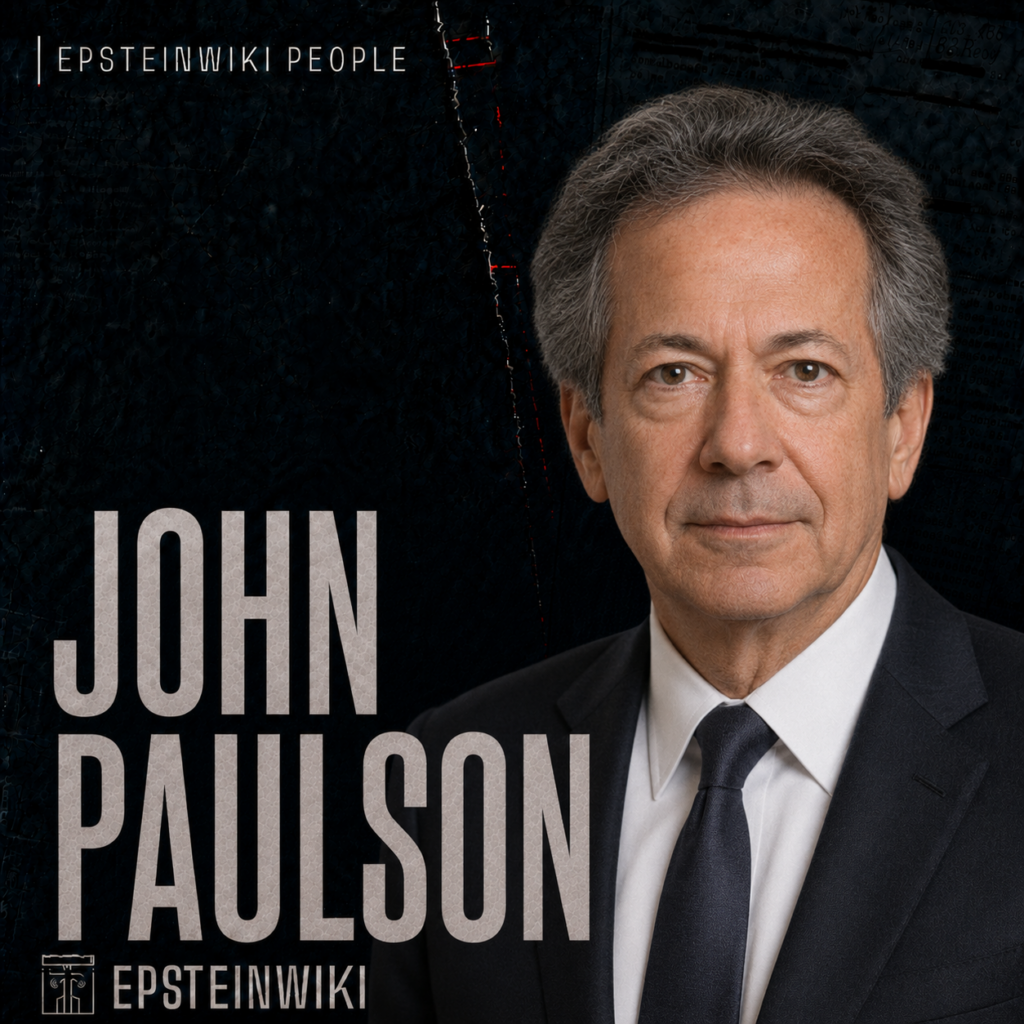
John Paulson appears in Jeffrey Epstein’s contact book and in released emails involving charitable solicitations, Epstein’s attempts to arrange a telephone call, an offer of hurricane assistance, and a $50,000 donation honoring Howard Lutnick. Paulson denies that any relationship with Epstein existed. The records document contact pathways and attempted communication, but they do not establish social visits, shared travel, criminal conduct, or knowledge of Epstein’s abuse.
Snapshot
John Alfred Paulson is an American investor and the founder of Paulson & Co. He became internationally known after his funds earned billions of dollars by betting against the United States housing market before the 2007 financial crisis.
Paulson appears in the Jeffrey Epstein record through several categories of evidence:
- An entry for “Paulson, John” in Epstein’s contact book.
- A 2010 email in which Epstein suggested that a journalist could contact John Paulson about an economic argument.
- A 2013 charitable event solicitation addressed to Epstein and issued under the names of Paulson and two other event leaders.
- September and October 2017 emails documenting Epstein’s unsuccessful attempts to arrange a call with Paulson.
- A November 2017 UJA Federation fundraising appeal signed by Paulson and directed to Epstein through Lesley Groff.
- An outgoing email from Epstein addressed to John Paulson announcing a $50,000 contribution honoring Howard Lutnick.
- Internal instructions suggesting that the contribution should be delivered through Paulson.
Paulson’s spokesperson has denied that Paulson had a relationship with Epstein. The spokesperson specifically denied meals, drinks, parties, visits to Epstein’s properties, flights on Epstein’s aircraft, and travel to Epstein’s island.
No reviewed survivor testimony accuses Paulson of sexual misconduct. No reviewed court record establishes that he participated in Epstein’s trafficking operation.
Who Is John Paulson?
According to John Paulson’s NYU Stern biography, Paulson graduated from New York University in 1978 and later received an MBA from Harvard Business School.
He founded Paulson & Co. in 1994. The firm became widely known after making a highly profitable bet against securities connected to the subprime mortgage market.
Paulson is also a major donor to universities and charitable institutions. In 2015, Harvard announced a $400 million gift from Paulson to support its engineering and applied sciences school. In 2022, New York University announced a $100 million gift connected to the John A. Paulson Center.
His prominence in finance, philanthropy, and political fundraising brought renewed attention to his appearance in Epstein’s contact book after Representative Thomas Massie publicly named him in September 2025.
The Epstein Contact Book Entry
The strongest early evidence is a contact book page containing an entry for “Paulson, John.”
The contact book page, EFTA02779389, lists two New York telephone numbers beside the name. The released version does not provide an address, employer, email address, or descriptive note that independently establishes the person’s identity.
Public reporting and Representative Massie have identified the entry as belonging to hedge fund manager John Paulson. Paulson’s spokesperson responded to that identification rather than claiming the entry referred to a different person.
However, the page alone does not explain:
- Who supplied the contact information.
- When Epstein obtained it.
- Whether Epstein ever used the numbers.
- Whether Paulson knew Epstein possessed the information.
- Whether the entry represented a personal, business, charitable, or indirect contact.
- Whether the numbers remained current when later communications occurred.
A contact book is an investigative lead. It is not a list of criminal participants, clients, or people who knew about Epstein’s abuse.
Thomas Massie Publicly Names Paulson
In September 2025, Representative Thomas Massie discussed Paulson during the campaign for greater disclosure of the Epstein files.
Massie said Paulson was in Epstein’s contact book. He also identified Paulson as a major Republican donor who was helping fund political advertising against him.
Massie did not say that the contact book entry proved Paulson committed a crime. He described the entry as an example of information that could embarrass or implicate powerful people if the complete Epstein files were released.
That distinction matters. The word “implicate” can be interpreted broadly, but Massie did not present evidence that Paulson participated in Epstein’s sexual abuse or trafficking operation.
The political conflict between Massie and Paulson also provides necessary context. Paulson was supporting efforts to defeat Massie while Massie was using Paulson’s contact book appearance to argue that politically connected donors could have an interest in limiting disclosure.
The underlying contact book entry is real. Massie’s theory about why records were being withheld was an argument, not an established finding.
Paulson’s Public Denial
A Paulson spokesperson issued a broad response to Massie’s remarks.
According to Mediaite’s report on the exchange, the spokesperson said Paulson had never shared a meal or drink with Epstein. The statement also denied that Paulson attended Epstein’s parties, visited his residences, traveled on his aircraft, or visited his island.
The spokesperson said a relationship with Epstein never existed “at any level or of any kind.”
The released evidence reviewed for this article does not contradict the specific denials concerning:
- Meals or drinks.
- Parties hosted by Epstein.
- Visits to Epstein’s residences.
- Travel on Epstein’s aircraft.
- A visit to Little Saint James.
- Participation in Epstein’s crimes.
No John Paulson passenger entry was located in Epstein Data’s consolidated flight database.
The broader denial of a relationship at any level requires more careful analysis. The documents show charitable outreach bearing Paulson’s name, an outgoing email from Epstein to Paulson, and repeated attempts by Epstein’s office to arrange a telephone call.
Those records establish contact pathways and attempted communications. Whether they amount to a personal “relationship” depends on facts that the documents do not resolve.
Epstein’s 2010 Reference to Paulson
A September 2, 2010 email shows Epstein invoking Paulson’s name during a discussion with New York Times financial correspondent Landon Thomas Jr.
In EFTA01984355, Thomas asked Epstein for prominent financial figures who might agree with an economic argument Epstein was advancing.
Epstein named several people and suggested that Thomas could contact Paulson.
The record establishes that Epstein believed Paulson was a possible source for the journalist. It does not establish that:
- Epstein had already spoken with Paulson.
- Paulson agreed with Epstein.
- Epstein possessed authority to speak for Paulson.
- Thomas contacted Paulson.
- Paulson participated in the email discussion.
Epstein frequently invoked prominent names to strengthen his credibility. His assertion that someone could be contacted should not be treated as proof of a personal relationship without confirming evidence.
The 2013 AJC Solicitation
A September 12, 2013 email, EFTA00383700, invited Epstein to an American Jewish Committee event honoring Matthew Bronfman.
The sender display line listed Stan Bergman, Philip Milstein, and John Paulson. The message was addressed to Jeffrey Epstein and invited him to attend the November 2013 event at the Four Seasons Restaurant in New York.
The message included automated instructions allowing recipients to remove themselves from AJC mailing lists. That language suggests an institutional fundraising or event mailing rather than a personal message individually written by Paulson.
The document establishes that:
- Epstein was included in an AJC event solicitation.
- Paulson’s name appeared as one of the leaders associated with the invitation.
- The message was sent after Epstein’s 2008 Florida conviction.
It does not establish that Paulson personally selected Epstein as a recipient, wrote the email, communicated with him, or knew that the mailing had reached him.
The distinction between an institutional solicitation and personal correspondence is essential.
Epstein Tries to Obtain Paulson’s Number in September 2017
The most revealing communication sequence began in September 2017.
A September 25 email, EFTA02223095, shows someone from Epstein’s office asking an Apollo Global Management contact named Melanie Spinella for John Paulson’s telephone number.
Spinella supplied a number in EFTA02223216. The publicly released evidence does not establish that Paulson authorized her to provide it.
The fact that Epstein’s office needed to request the number is notable. It suggests that Epstein or his staff did not have reliable direct contact information readily available, despite the older contact book entry.
This weighs against assuming a close or regularly maintained relationship.
Epstein Offers Supplies and Helicopter Assistance
After obtaining the telephone number, Epstein instructed Groff to arrange a call.
In EFTA02348930, Epstein told Groff to inform Paulson that he was sending supplies to the Virgin Islands and had a helicopter available if Paulson needed assistance.
Groff reported that she left a message with Paulson’s assistant, identified as Marsha.
The message was sent shortly after Hurricane Maria devastated Puerto Rico and affected transportation and infrastructure throughout the Caribbean. The initials “PR” in later correspondence likely refer to Puerto Rico, although the document does not define them.
This record establishes that:
- Epstein wanted to speak with Paulson.
- Epstein offered supplies and helicopter assistance.
- Groff left a message with Paulson’s assistant.
- The contact concerned conditions in or near the Caribbean.
It does not establish that:
- Paulson requested Epstein’s assistance.
- Paulson accepted the offer.
- Paulson returned the call.
- A telephone conversation occurred.
- Epstein transported supplies for Paulson.
- Paulson visited the Virgin Islands.
The record documents Epstein’s outreach, not reciprocal communication.
Paulson Did Not Return Epstein’s Calls
Several later emails document the failure of Epstein’s outreach.
A September 29 reminder in EFTA02597867 states that Groff had called twice to arrange a conversation. She reported that she had also told Paulson’s assistant about Epstein’s supplies and helicopter.
Groff wrote that she had not heard back.
A separate September 29 calendar reminder, EFTA02225402, instructed Epstein’s office to call Paulson again.
On October 3, EFTA02593789 records Groff telling Epstein that Paulson’s office still had not returned her calls. She asked whether she should leave another message about supplies and a possible telephone appointment.
This sequence is important because it documents nonresponse.
The records support the following conclusions:
- Epstein was actively pursuing contact.
- His staff made repeated calls.
- Paulson’s assistant received at least one message.
- Paulson’s office did not return the calls during the documented period.
- No completed telephone conversation appears in the reviewed chain.
This evidence supports Paulson’s position that he did not maintain an active personal relationship with Epstein. At the same time, it shows that Epstein believed there was some reason to attempt contact.
The November 2017 UJA Fundraising Appeal
The documentary trail resumed in November 2017.
A UJA Federation fundraising email, EFTA00462552, promoted the organization’s December 2017 Wall Street Dinner honoring Howard Lutnick and Lee Fixel.
The underlying message was issued from an address bearing Paulson’s name and was signed by him in his capacity as chairman of UJA Federation’s Wall Street and Financial Services Division.
The invitation was forwarded by Lesley Groff to Epstein.
The appeal told the recipient that, as a close friend of the Lutnicks, he should have an opportunity to support the event. It offered sponsorship levels ranging from $5,000 to $150,000.
A more complete copy of the chain appears in EFTA02229721.
The wording indicates that the solicitation was directed toward Epstein as someone the fundraising operation regarded as close to the Lutnick family. It does not necessarily establish that Paulson personally held or verified that opinion.
The message contains institutional formatting, event registration language, multiple sponsorship levels, and UJA staff contact information. Those features are consistent with a fundraising campaign that may have been prepared or distributed by organizational staff under Paulson’s name.
The evidence does not show whether Paulson personally selected Epstein, reviewed the recipient list, or knew Groff had forwarded the appeal to him.
Epstein Announces a $50,000 Contribution to Paulson
The UJA solicitation prompted Epstein to authorize a $50,000 contribution.
In EFTA00965121, Epstein forwarded the invitation to his accountant, Richard Kahn, with the instruction “50k.”
A separate email chain provides stronger evidence of direct contact. In EFTA02568209, an earlier message from Epstein is shown as addressed to John Paulson. Epstein wrote that $50,000 was coming from him and expressed concern about conditions in Puerto Rico.
This is the clearest released record of Epstein sending a message directly to Paulson.
However, the chain does not contain a written response from Paulson.
The evidence establishes:
- Epstein sent an email addressed to John Paulson.
- Epstein announced a $50,000 contribution.
- The contribution was associated with the UJA event honoring Lutnick.
- Epstein included a brief reference to Puerto Rico.
- The message later reached a UJA representative.
It does not establish:
- Who opened the email.
- Whether Paulson personally read it.
- Whether Paulson replied.
- Whether Paulson and Epstein discussed the contribution.
- Whether the message was handled entirely by charitable staff.
Internal Instructions to Route the Check Through Paulson
Epstein’s employees discussed how to deliver the contribution.
In EFTA00958981, Richard Kahn asked whether the check should be delivered to UJA, Paulson, Lutnick, or someone else.
Epstein answered “paulson.”
The longer chain in EFTA02229720 shows Kahn asking Groff to obtain Paulson’s address so a check from Gratitude America could be delivered.
These were internal instructions from Epstein and his staff. They do not prove that Paulson agreed to receive the money personally.
The distinction is significant. Epstein’s instruction to route a charitable contribution through Paulson shows how Epstein wanted the transaction handled. It does not establish Paulson’s consent or participation.
UJA Confirms Epstein’s Donation
A November 14, 2017 message confirms that the contribution reached the charitable event operation.
In EFTA02568209, David Rattner thanked Epstein for the donation made in honor of Lutnick. Rattner asked whether Epstein wanted to purchase an advertisement, attend the event, or reserve a table.
This email confirms that:
- Epstein made the promised contribution.
- The contribution was recognized by an event representative.
- The donation honored Lutnick.
- Epstein was invited to expand his participation.
The record does not show Paulson thanking Epstein, attending with him, or communicating personally about the donation.
It is possible that Paulson or his office passed Epstein’s message to UJA staff. It is also possible that event staff independently received notice of the gift. The released chain does not identify the exact route.
What the 2017 Emails Mean
The September and November emails must be read together.
In September, Epstein repeatedly tried to reach Paulson. Paulson’s office did not return the calls.
In November, a fundraising appeal signed by Paulson reached Epstein through Groff. Epstein then sent a $50,000 contribution and addressed a short message to Paulson.
These facts support a narrow conclusion: there was an institutional and attempted communication channel connecting Epstein, Paulson’s office, and charitable event organizers.
The records do not establish a friendship or social relationship.
They also do not fully support a claim that no connection existed “at any level or of any kind.” A fundraising appeal signed by Paulson reached Epstein, and Epstein sent a message addressed to Paulson. Still, neither record proves that Paulson personally initiated or reciprocated the communication.
The specific denials about meals, parties, properties, aircraft, and the island remain consistent with the evidence reviewed here.
Lower Value and Incidental References
Numerous other documents contain Paulson’s name without demonstrating contact with Epstein.
Examples include:
- Newsletters about Paulson’s investments.
- Market reports listing Paulson funds.
- Articles discussing Paulson’s housing market trade.
- A 2009 message from a third party saying Paulson sounded optimistic at another person’s gathering.
- An email from Andrew Farkas saying he was about to meet Paulson.
- An email discussing Paulson’s Harvard donation.
- A political event mailing list containing both Paulson and Epstein.
These documents show that Epstein followed financial news and moved within overlapping political, charitable, and investment circles. They do not prove a relationship with Paulson.
They should not be added together to inflate the apparent weight of the evidence.
No Documented Epstein Flight
No John Paulson passenger entry was located in the consolidated Epstein Data flight database reviewed for this article.
That absence is consistent with Paulson’s denial that he traveled on Epstein’s aircraft.
Flight records are incomplete and contain spelling problems, omitted passengers, and inconsistent manifests. Therefore, the absence of a name cannot prove that a person never flew on an Epstein controlled aircraft.
In this case, however, there is no identified flight record contradicting Paulson’s denial.
No Verified Property Visit
No reviewed photograph, visitor log, scheduling record, flight manifest, or firsthand survivor account places Paulson at:
- Epstein’s Manhattan residence.
- Epstein’s Palm Beach residence.
- Little Saint James.
- Great Saint James.
- Zorro Ranch.
- Epstein’s Paris apartment.
This is consistent with the spokesperson’s denial that Paulson visited Epstein’s residences or island.
The contact book and charitable emails should not be used to claim a property visit without additional evidence.
No Survivor Allegation Against Paulson
No reviewed survivor testimony accuses Paulson of sexual assault, trafficking, recruitment, facilitation, or knowingly participating in Epstein’s abuse.
No reviewed criminal filing identifies him as an Epstein coconspirator.
No reviewed civil judgment finds him liable for conduct connected to Epstein.
Paulson’s inclusion in EpsteinWiki is based on documented contact information, charitable correspondence, attempted communications, and the later public controversy. It is not based on an accusation of sexual misconduct.
Evidence Assessment
| Evidence | What it establishes | Evidentiary weight |
|---|---|---|
| Contact book entry | Epstein possessed telephone information under the name “Paulson, John” | Moderate |
| 2010 Landon Thomas email | Epstein suggested Paulson as a possible financial source | Low |
| 2013 AJC solicitation | Epstein received an institutional invitation bearing Paulson’s name | Low |
| September 2017 call attempts | Epstein repeatedly tried to arrange contact with Paulson | High for attempted contact |
| Paulson office nonresponse | Paulson’s office did not return the documented calls | High |
| November 2017 UJA appeal | A fundraising solicitation signed by Paulson reached Epstein | Moderate |
| Epstein’s message to Paulson | Epstein sent an email addressed to Paulson announcing a contribution | Moderate |
| $50,000 donation | Epstein’s charity funded a UJA event honoring Lutnick | High |
| Internal check routing | Epstein wanted the check routed through Paulson | Moderate for Epstein’s intent |
| Paulson’s denial | Paulson denies any relationship, visit, flight, meal, drink, or party | Material response |
| Flight and property review | No reviewed record places Paulson on Epstein’s aircraft or properties | Important limitation |
What the Records Establish
The available evidence establishes that:
- The name “Paulson, John” appears in Epstein’s contact book.
- Epstein possessed or sought telephone information for Paulson.
- Epstein suggested Paulson as a possible source for a financial journalist.
- Epstein received institutional charitable messages bearing Paulson’s name.
- Epstein tried repeatedly to arrange a call with Paulson in September 2017.
- Paulson’s office did not return the documented calls.
- A UJA fundraising solicitation signed by Paulson reached Epstein in November 2017.
- Epstein authorized a $50,000 donation in response.
- Epstein sent a message addressed to Paulson about the contribution.
- A UJA representative later thanked Epstein.
- Paulson has publicly denied that a relationship existed.
What the Records Do Not Establish
The available evidence does not establish that:
- Paulson and Epstein were friends.
- Paulson met Epstein socially.
- Paulson ate or drank with Epstein.
- Paulson attended an Epstein party.
- Paulson visited an Epstein residence.
- Paulson visited Little Saint James.
- Paulson flew on an Epstein aircraft.
- Paulson returned Epstein’s September 2017 calls.
- Paulson personally selected Epstein for either charitable solicitation.
- Paulson personally wrote the fundraising emails.
- Paulson knew about Epstein’s trafficking operation.
- Paulson committed or facilitated a crime.
- The contact book was a list of Epstein’s criminal clients.
Timeline
Before the mid 2000s: An entry for “Paulson, John” appears in Epstein’s contact book.
September 2, 2010: Epstein suggests to journalist Landon Thomas Jr. that he could contact John Paulson about a financial argument.
March 2012: Paulson and Epstein appear among the recipients of a broader political event mailing. The document does not show communication between them.
September 12, 2013: Epstein receives an AJC event solicitation issued under the names of Stan Bergman, Philip Milstein, and John Paulson.
September 25, 2017: Epstein’s office obtains a telephone number for Paulson through an Apollo Global Management contact.
September 25, 2017: Epstein instructs Groff to arrange a call and offer supplies and helicopter assistance.
September 29, 2017: Groff reports that she has called twice without receiving a response.
October 3, 2017: Groff reports that Paulson’s office still has not returned her calls.
November 8, 2017: Groff forwards Epstein a UJA Federation appeal signed by Paulson.
November 8, 2017: Epstein authorizes a $50,000 contribution and sends a message addressed to Paulson.
November 9, 2017: Epstein instructs Kahn to route the check through Paulson. Kahn asks Groff to obtain an address.
November 14, 2017: UJA representative David Rattner thanks Epstein for the donation and asks whether he wants an advertisement, table, or event attendance.
September 2025: Representative Massie publicly identifies Paulson as a person listed in Epstein’s contact book.
September 2025: Paulson’s spokesperson denies that any relationship existed.
Epstein Data Evidence Index
- EFTA02779389: Contact book entry for “Paulson, John”
- EFTA01984355: Epstein suggests John Paulson as a source for Landon Thomas
- EFTA00660497: Paulson and Epstein appear on a larger political mailing list
- EFTA00383700: AJC solicitation issued under Paulson and other event leaders’ names
- EFTA02223095: Epstein’s office requests Paulson’s telephone number
- EFTA02223216: Apollo contact supplies a telephone number
- EFTA02348930: Epstein directs Groff to arrange a call and offer assistance
- EFTA02225402: Reminder to call Paulson again
- EFTA02597867: Groff reports two unanswered calls
- EFTA02593789: Groff reports that Paulson’s office has not returned her calls
- EFTA00462552: UJA Wall Street Dinner appeal signed by Paulson
- EFTA00965121: Invitation forwarded to Kahn with Epstein’s $50,000 instruction
- EFTA00958981: Kahn asks where the donation should be delivered
- EFTA02229720: Epstein directs that the check be routed through Paulson
- EFTA02568209: Epstein’s outgoing message to Paulson and UJA confirmation
- John Paulson document search
Key Takeaways
John Paulson’s name appears in Epstein’s contact book, but a contact entry is not evidence of criminal conduct.
The strongest communication evidence comes from 2017. Epstein repeatedly tried to arrange a call, but Paulson’s office did not respond. A later institutional fundraising appeal signed by Paulson reached Epstein, who donated $50,000 and sent a short message addressed to Paulson.
The documents create a limited tension with Paulson’s assertion that no relationship existed at any level. They do not contradict his more specific denials concerning meals, parties, property visits, flights, or travel to Epstein’s island.
No reviewed evidence accuses Paulson of participating in Epstein’s crimes.
Related EpsteinWiki Pages
- Jeffrey Epstein
- John Paulson
- Howard Lutnick
- Howard Lutnick Congressional Witness Brief
- Lesley Groff
- Lesley Groff Congressional Testimony
- Thomas Massie and the Epstein Files
Editorial Note
This article distinguishes Epstein’s contact book, Epstein’s unilateral outreach, institutional fundraising correspondence, confirmed donations, public denials, and evidence of reciprocal contact.
A person’s appearance in an address book does not establish friendship, criminality, or knowledge of Epstein’s abuse. An unanswered call documents Epstein’s attempt to make contact, not the recipient’s participation. A charitable solicitation signed by a prominent campaign chair may have been written and distributed by institutional staff.
The article should be updated if direct correspondence from Paulson, telephone records, meeting calendars, sworn testimony, visitor records, photographs, or additional flight evidence becomes public.
Sources
- Epstein Data contact book evidence, EFTA02779389
- Epstein Data September 2017 outreach, EFTA02348930
- Epstein Data unanswered call report, EFTA02597867
- Epstein Data October 2017 reminder, EFTA02593789
- Epstein Data UJA appeal, EFTA00462552
- Epstein Data donation routing chain, EFTA02229720
- Epstein Data outgoing message and donation confirmation, EFTA02568209
- Mediaite report containing Massie’s remarks and Paulson’s response
- Newsmax report on Massie’s statement and Paulson’s denial
- Harvard announcement of Paulson’s 2015 gift
- New York University announcement of Paulson’s gift
- John Paulson biography at NYU Stern