
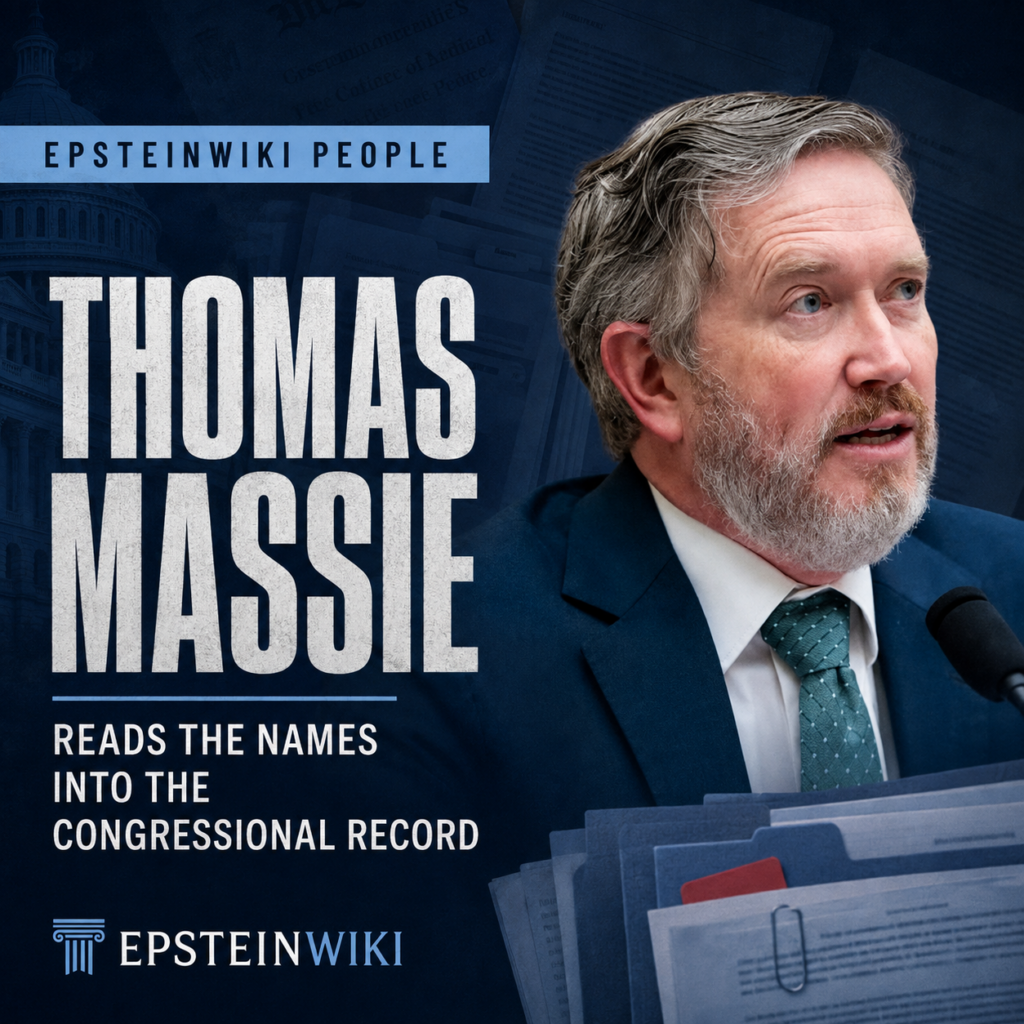
Thomas Massie
Snapshot
| Field | Details |
|---|---|
| Full name | Thomas Harold Massie |
| Born | January 13, 1971 |
| Political affiliation | Republican |
| Congressional service | U.S. representative for Kentucky’s Fourth Congressional District, November 2012 through January 2027 |
| Education | Bachelor’s degree in electrical engineering and master’s degree in mechanical engineering, Massachusetts Institute of Technology |
| Epstein-related role | Congressional transparency advocate and coauthor of the Epstein Files Transparency Act |
| Principal legislative partner | Representative Ro Khanna, Democrat of California |
| First bill | H.R. 4405, Epstein Files Transparency Act |
| First discharge petition | Filed September 2, 2025 |
| House passage | November 18, 2025, by 427 votes to 1 |
| Enacted | November 19, 2025, as Public Law 119-38 |
| Second bill | H.R. 9694, Epstein Files Transparency Act II |
| Second discharge effort | Began August 31, 2026 |
| Network status | No substantiated evidence identified that Massie belonged to Epstein’s social, financial, or trafficking network |
Thomas Massie did not enter the Epstein record through a flight log, an address book, a dinner invitation, or a financial transaction. He entered it through a parliamentary weapon most members of Congress rarely use successfully: a discharge petition.
Working with Democratic Representative Ro Khanna, Massie forced House leaders to allow a vote on legislation requiring the Department of Justice to publish its unclassified Jeffrey Epstein records. The resulting law passed the House almost unanimously and was signed by President Donald Trump on November 19, 2025.
The vote was decisive. The disclosure that followed was not.
The Justice Department eventually published millions of pages, images, and videos, but it missed the law’s thirty day deadline, employed extensive redactions, and acknowledged identifying more than six million potentially responsive pages while publicly releasing approximately 3.5 million. DOJ maintained that the withheld material consisted of duplicates, privileged records, statutory exceptions, unrelated material, and information requiring protection. Massie and Khanna argued that the department had violated both the language and purpose of the law.
Massie’s Epstein record is therefore not a story about association with Jeffrey Epstein. It is a story about Congress trying to compel disclosure from the executive branch, the weaknesses of a transparency statute without a direct enforcement mechanism, and the dangers of treating every name appearing in a massive investigative archive as proof of criminal conduct.
Who Is Thomas Massie?
Thomas Harold Massie is an engineer, inventor, farmer, and Republican politician from Kentucky. According to his official congressional biography, he earned a bachelor’s degree in electrical engineering and a master’s degree in mechanical engineering from the Massachusetts Institute of Technology.
Before entering Congress, Massie served as judge executive of Lewis County, Kentucky. He won a special election to the House in 2012 and represented Kentucky’s Fourth Congressional District beginning in November of that year.
Massie developed a reputation as a libertarian leaning Republican willing to oppose his party’s leadership on government spending, surveillance, foreign military intervention, and executive power. That independence placed him in conflict with President Donald Trump and Republican leaders well before the Epstein files became a defining issue.
On May 19, 2026, Massie lost the Republican primary for his congressional seat to Trump endorsed challenger Ed Gallrein. Gallrein received approximately 54.9 percent of the vote, while Massie received approximately 45.1 percent, according to reported Kentucky primary results. Massie nevertheless remained a member of Congress through the end of his term and continued pursuing Epstein disclosure legislation.
Massie’s Actual Connection to the Epstein Case
The available evidence supports a specific and limited description of Massie’s connection to Jeffrey Epstein:
- Massie became a congressional advocate for releasing government records about Epstein and Ghislaine Maxwell.
- He questioned federal officials about alleged recipients of trafficked victims and about the government’s failure to investigate or identify additional participants.
- He coauthored the Epstein Files Transparency Act with Representative Ro Khanna.
- He used a discharge petition to force the bill onto the House floor.
- After enactment, he accused DOJ of failing to comply with the law.
- He introduced follow up legislation intended to give survivors, state prosecutors, and members of Congress the ability to sue for compliance.
- He publicly identified people he believed should be investigated, while speaking on the House floor.
A search of Epstein Data’s index of Republican House members returns Massie’s name in records categorized as news material. That is not evidence that he appeared in Epstein’s personal network. Epstein Data itself distinguishes news references from evidence of personal contact.
No reliable evidence reviewed for this article places Massie on Epstein’s aircraft, in Epstein’s address books, at Epstein’s properties, or in direct correspondence with Epstein.
The July 2025 Crisis Over the Epstein Files
In July 2025, the Department of Justice and FBI issued a memorandum describing the government’s review of Epstein related material. The administration’s handling of the files generated bipartisan criticism, particularly after earlier public promises suggested that substantial new information would be released.
Massie and Khanna responded legislatively.
On July 15, 2025, they introduced H.R. 4405, the Epstein Files Transparency Act. Massie’s official announcement described the proposal as a bipartisan effort to require the attorney general to release unclassified records relating to Epstein, Maxwell, their associates, and the government’s investigations.
The bill was designed to prevent political sensitivity, embarrassment, or reputational harm from becoming a basis for withholding records. It also attempted to protect survivors by permitting redaction of victim identifying information.
This distinction mattered. The bill did not demand an unfiltered data dump containing survivors’ names, medical information, addresses, or sexual abuse images. It demanded disclosure of government records subject to defined privacy and investigative protections.
What H.R. 4405 Required
The enacted law required the attorney general to publish, in a searchable and downloadable format, unclassified DOJ records concerning:
- Investigations and prosecutions of Jeffrey Epstein.
- Investigations and prosecutions of Ghislaine Maxwell.
- Epstein’s detention and death.
- Flight logs, travel records, manifests, and customs records.
- Individuals identified in connection with Epstein’s criminal activity.
- Entities described as having known or alleged connections to Epstein’s trafficking or financial networks.
- Immunity agreements, nonprosecution agreements, plea agreements, and sealed settlements.
- Internal decisions about whether to investigate or charge Epstein or other people.
- Records concerning the destruction, alteration, concealment, removal, or loss of evidence.
- Communications and investigative material held by DOJ, the FBI, and United States attorney offices.
The complete enacted text is available as Public Law 119-38.
The law expressly prohibited withholding or redacting records solely because their release would cause embarrassment, reputational harm, or political sensitivity.
It permitted withholding or redaction for narrower reasons, including:
- Survivor identifying information and personal privacy.
- Child sexual abuse material.
- Images depicting death, physical abuse, or injury.
- Material that could jeopardize an active federal investigation.
- Properly classified national security information.
The act also required written justification for redactions and required the attorney general to report those justifications to Congress.
The First Discharge Petition
House leadership did not promptly schedule Massie and Khanna’s proposal for a vote. Massie therefore turned to a discharge petition, a House procedure that can bring a measure to the floor over the objections of committee chairs and party leaders.
On September 2, 2025, Massie filed Discharge Petition No. 9.
A discharge petition requires 218 signatures, representing a majority of the full House. Signatures are public, which means members cannot privately support the effort while publicly deferring to leadership.
Massie’s petition gradually assembled a coalition of Democrats and a smaller number of Republicans. Survivors and advocates publicly urged lawmakers to sign. The pressure made the issue more difficult for congressional leaders to contain through committee proceedings or promises of future review.
The petition ultimately obtained the required 218 signatures.
That achievement did not itself enact the bill. It broke the procedural blockade and made a floor vote effectively unavoidable.
Survivors Were Central to the Pressure Campaign
The discharge effort gained force from survivors who appeared publicly with lawmakers and demanded that Congress stop treating the Epstein investigation as a partisan contest.
Their position was not simply that the government possessed more records. It was that survivors had repeatedly been denied information about:
- Who participated in their exploitation.
- Which allegations federal investigators corroborated.
- Why certain people were not charged.
- Whether financial institutions, employers, recruiters, assistants, or intermediaries were investigated.
- Why the 2007 federal nonprosecution agreement protected potential co-conspirators.
- What evidence remained sealed or heavily redacted.
Massie and Khanna cited these unresolved questions when arguing that normal committee requests were inadequate. A committee can ask an agency for records. A statute can impose a legal duty to disclose them.
The later dispute demonstrated the limitation of even that approach: a legal duty is difficult to enforce when the law does not clearly identify who may sue or what remedy a court may order.
The House Vote
On November 18, 2025, the House considered H.R. 4405 under suspension of the rules.
The bill passed by 427 votes to 1, with five members not voting. The official result appears in House Roll Call 289.
| Vote | Total |
|---|---|
| Aye | 427 |
| No | 1 |
| Present | 0 |
| Not voting | 5 |
Representative Clay Higgins of Louisiana cast the only vote against the bill.
Massie’s statement following passage credited the discharge petition with forcing the vote.
The overwhelming final margin can obscure how difficult it was to obtain the vote. Once the petition reached 218 signatures and public opposition became politically costly, many lawmakers who had not helped force the bill onto the floor voted for it.
Senate Passage and Enactment
The Senate passed the measure by unanimous consent on November 19, 2025. President Trump signed it the same day.
The legislation became Public Law 119-38.
The date of enactment started a thirty day disclosure clock. DOJ’s deadline was therefore December 19, 2025.
The law’s enactment was Massie and Khanna’s clearest achievement in the Epstein matter. Congress had converted years of demands, lawsuits, news investigations, survivor statements, and voluntary disclosures into an affirmative statutory obligation.
What followed became a dispute over the meaning of compliance.
The December 19 Deadline
On December 19, 2025, DOJ began publishing material and sent a letter to Congress. The department did not release all responsive records by the deadline.
Massie said the initial production “grossly fails” to comply with the law. He objected to the limited scope of the first release, extensive redactions, and DOJ’s indication that additional publication would continue after the statutory deadline.
DOJ maintained that the review was unusually large and that lawyers had to protect survivors, comply with court orders, remove child sexual abuse material, and separate responsive records from unrelated information.
These concerns were real, but they did not change the statutory deadline. Congress had required publication within thirty days, not publication whenever the department completed its review.
The disagreement was therefore not merely political:
- DOJ’s position: The department had to conduct a careful, legally compliant review and could continue publishing material after the deadline.
- Massie and Khanna’s position: DOJ could not rewrite the deadline or expand the law’s withholding provisions through administrative interpretation.
DOJ’s January 2026 Production
On January 30, 2026, DOJ announced that it had published more than three million additional pages. The department said its cumulative production included approximately:
- 3.5 million pages.
- More than 2,000 videos.
- Approximately 180,000 images.
The department’s announcement is preserved in its January 30, 2026 press release.
DOJ also acknowledged that its collection process had identified more than six million pages as potentially responsive. Its letter concerning implementation of the act explained that not every collected page was released.
DOJ said withheld material included:
- Duplicates.
- Records unrelated to Epstein or Maxwell.
- Material protected by recognized privileges.
- Information covered by the act’s statutory exceptions.
- Child sexual abuse material.
- Survivor identifying information.
- Records affected by court orders.
- Material whose publication could interfere with investigations.
Massie disputed DOJ’s claim of compliance. He argued that millions of pages remained unavailable and that the department was invoking privileges and redactions more broadly than the statute permitted.
The public releases can be searched through the DOJ Epstein Library. DOJ warns that handwritten records and some image based documents may not be reliably searchable.
Why “Six Million Pages” Does Not Automatically Mean “Three Million Secret Files”
The numbers require care.
DOJ said it collected more than six million potentially responsive pages. It did not say that every one of those pages was a unique, relevant record proving criminal conduct.
A collection of that size can contain:
- Multiple copies of the same email.
- Attachments reproduced in several investigative files.
- Search warrant returns containing unrelated data.
- Administrative records.
- News clippings.
- Public tips that were never corroborated.
- Photographs used in identification procedures.
- Privileged attorney communications.
- Survivor information.
- Contraband that cannot legally be published.
Massie’s claim that DOJ continued withholding more than three million files expressed his interpretation of the department’s noncompliance. DOJ described the difference as the result of deduplication, responsiveness review, legal restrictions, and permitted withholding.
The unresolved issue is not whether six million minus 3.5 million equals approximately 2.5 million pages. It is what those withheld pages contain, which legal justification applies to each category, and whether DOJ provided the documentation Congress required.
Congressional Review of Unredacted Records
In February 2026, selected members of Congress were allowed to inspect less redacted or unredacted material in a controlled DOJ reading room.
Massie and Khanna used that access to compare concealed names and passages with the public versions. They argued that some redactions protected people from scrutiny rather than protecting survivors or active investigations.
Reading room access, however, presented its own problems:
- Members could inspect material but had limited ability to copy, search, or independently preserve it.
- A name appearing in an investigative file did not necessarily identify a suspect.
- Documents could contain raw allegations, unverified tips, photo arrays, witness mistakes, or information investigators rejected.
- Publicly naming someone without explaining the underlying document could produce a false implication of criminal conduct.
Those dangers became clear during the February naming controversy.
The Six Names Read on the House Floor
On February 10, 2026, Representative Ro Khanna read six names on the House floor after he and Massie examined less redacted DOJ material:
- Les Wexner.
- Sultan Ahmed bin Sulayem.
- Salvatore Nuara.
- Zurab Mikeladze.
- Leonic Leonov.
- Nicola Caputo.
The disclosure was initially presented as evidence that DOJ had concealed names connected to the Epstein investigation. Subsequent reporting found that four of the six men had no apparent relationship with Epstein. Their photographs reportedly appeared in law enforcement identification arrays shown to witnesses.
The Guardian later corrected its reporting to explain that the mere presence of those names in the files did not establish an Epstein connection.
This episode is essential to understanding the archive.
A person can appear in an Epstein related file because:
- Investigators considered the person a suspect.
- A witness mentioned the person.
- The person appeared in an address book or travel record.
- Investigators used the person’s photograph as a filler in a photo array.
- A public tipster supplied the name.
- A news article mentioning the person was preserved as an exhibit.
- The document later determined that the person was not involved.
Khanna, rather than Massie, read the six names. Massie participated in the broader review and transparency campaign, but the act of reading them should not be misattributed to him.
The incident does not eliminate the case for transparency. It demonstrates why disclosure must include context, page relationships, document provenance, and investigative disposition.
Massie’s Questioning of FBI Director Kash Patel
During congressional questioning in September 2025, Massie challenged FBI Director Kash Patel over the claim that investigators had not identified credible evidence implicating additional people.
Massie referred to survivor accounts and investigative records that, he said, described at least twenty men to whom Epstein allegedly trafficked victims. He described categories including bankers, billionaires, a politician, a musician, a film producer, a car company owner, and a magician.
American Freakshow documented that exchange in “The Trump-Epstein Files”, while also examining customs records and Epstein’s post-conviction international travel.
Massie’s questioning established that he challenged Patel’s representation of the evidence. It did not establish the guilt of every unnamed person fitting those descriptions.
The existence of an allegation in an FBI file is evidence that the allegation was received or recorded. It is not automatically proof that investigators corroborated it.
The Epstein Files Transparency Act II
On July 15, 2026, Massie, Khanna, Representative Teresa Leger Fernández, Senator Jeff Merkley, and Senator Ben Ray Luján announced new legislation intended to address weaknesses in the original law.
The House proposal was introduced as H.R. 9694, the Epstein Files Transparency Act II.
According to Massie’s official announcement and bill summary, the measure would:
- Allow state attorneys general, district attorneys, other authorized state officials, survivors, and members of Congress to sue the attorney general over unlawful withholding, redaction, delay, concealment, removal, or failure to publish records.
- Give survivors access to complete records concerning themselves or the harm they reported, including relevant FBI FD-302 interview reports.
- Apply existing federal criminal penalties to officials who knowingly conceal, destroy, falsify, withhold, or misrepresent records.
- Require DOJ to provide state and local prosecutors with unredacted records needed for investigations, prosecutions, or court proceedings.
- Establish secure procedures for state prosecutors to review properly classified material.
- Prevent DOJ from using common law privileges, including the deliberative process privilege, to defeat disclosure requirements.
The central change was standing. The original law ordered the attorney general to disclose records but did not give every affected party a clearly defined right to bring an enforcement lawsuit. EFTA II attempted to identify who could sue and what conduct could be challenged.
The Second Discharge Petition
Massie’s July 2026 announcement stated that a discharge petition would be circulated if the House failed to act on EFTA II within seven legislative days.
On August 31, 2026, Massie began collecting signatures for that petition. As with the first effort, 218 signatures would be required to force consideration over the objections of House leadership.
The second effort differed from the first in an important respect. The original petition sought disclosure. The new petition sought enforcement authority.
By August 31, the petition had only just begun. Claims that it had already reached 218 signatures confuse it with the successful 2025 petition.
Massie’s August 31, 2026 House Floor Speech
On August 31, 2026, Massie escalated the dispute by naming fourteen people on the House floor whom he described as Epstein co-conspirators who should be investigated and prosecuted.
He named:
| Person named by Massie | Relevant caution |
|---|---|
| Jes Staley | Former JPMorgan and Barclays executive with extensive documented communications with Epstein. He has disputed allegations of knowledge or participation in trafficking. |
| Leon Black | Paid Epstein substantial fees for tax and estate planning services after Epstein’s 2008 conviction. Black has denied knowledge of or participation in Epstein’s crimes. |
| Les Wexner | Epstein formerly managed Wexner’s finances and held unusually broad authority over his affairs. Wexner has denied knowledge of Epstein’s crimes. |
| David Copperfield | Appears in witness accounts and investigative material. Copperfield has denied wrongdoing and denied having a substantive relationship with Epstein. |
| Lapo Elkann | Italian businessman whose name appears in Epstein related records and correspondence. Appearance in records is not itself proof of criminal conduct. |
| Tom Pritzker | Businessman whose communications and contacts with Epstein have drawn scrutiny. Pritzker has denied wrongdoing. |
| Glenn Dubin | Longtime Epstein associate whose name appears in civil allegations and investigative records. Dubin has denied wrongdoing. |
| Frédéric Fekkai | Hairstylist and businessman connected socially to members of Epstein’s circle. No Epstein related criminal conviction was identified. |
| Edoardo Teodorani-Fabbri | Business figure appearing in records connected to Epstein’s international social network. No Epstein related criminal conviction was identified. |
| Jean-Luc Brunel | Modeling agent accused by numerous women of sexual abuse and recruitment. He died in French custody in 2022 before trial and was not convicted. |
| Daniel Siad | Businessman appearing in Epstein related communications and reporting about international recruitment networks. Allegations require separate corroboration. |
| Ramsey Elkholy | Businessman whose relationship with Epstein appears in documentary releases. No Epstein related criminal conviction was identified. |
| Andrew Mountbatten-Windsor, formerly Prince Andrew | Virginia Giuffre accused him of sexual assault. He denied her allegations and settled her civil lawsuit without admitting liability. |
| Lesley Groff | Former Epstein employee whose role has appeared in civil litigation and survivor allegations. She has denied participating in trafficking or abuse. |
Massie’s speech was a congressional accusation and a demand for investigation. It was not a criminal indictment, judicial finding, jury verdict, or substitute for admissible evidence.
The Guardian’s report on the speech noted denials from several of the people Massie named and described Massie as an outgoing member of Congress after his primary defeat.
Massie’s Accusation Against Andrew Mountbatten-Windsor
Massie went beyond calling for investigation when discussing Andrew Mountbatten-Windsor. He asserted that Andrew had committed sex crimes in the United States.
That statement should be distinguished from the established legal record.
What is established:
- Virginia Giuffre alleged that Epstein and Maxwell trafficked her to Andrew.
- Giuffre filed a civil lawsuit against Andrew in federal court in New York.
- Andrew denied her allegations.
- The parties reached a settlement in 2022.
- The settlement did not include an admission of liability.
- Andrew has not been convicted in the United States of an Epstein related sex crime.
Massie’s declaration was therefore his allegation and interpretation of the evidence. It was not a criminal finding.
Massie’s Accusation Against Lesley Groff
Massie also singled out former Epstein employee Lesley Groff, asserting that she was not a victim and that she conspired with Epstein to traffic women.
Groff’s role has been examined in civil complaints, survivor accounts, employment records, emails, calendars, and litigation concerning Epstein’s organization. She has denied knowingly participating in sex trafficking.
The distinction between employee, facilitator, witness, victim, and conspirator cannot be resolved simply from a person’s job title or proximity to Epstein. Establishing criminal conspiracy ordinarily requires evidence that a person knowingly agreed to participate in an unlawful plan.
Massie’s statement may justify renewed scrutiny of the underlying records. It does not by itself satisfy that legal standard.
The Speech or Debate Clause
Statements made by members of Congress as part of legitimate legislative activity may receive protection under the Constitution’s Speech or Debate Clause.
This protection exists so that legislators can debate, investigate, and introduce legislation without intimidation by the executive branch or private litigation.
It does not mean that a statement made on the House floor is true.
For EpsteinWiki purposes, the correct formulation is:
Massie identified fourteen people on the House floor whom he said should be investigated and prosecuted.
The incorrect formulation is:
Congress established that the fourteen people were Epstein’s co-conspirators.
Congress made no such adjudication, and Massie’s speech did not produce one.
What Massie Accomplished
Massie’s work produced several measurable results.
He Created a Bipartisan Legislative Coalition
Massie and Khanna crossed party lines on an issue that both Republican and Democratic administrations had failed to resolve.
He Forced a Recorded Vote
The discharge petition prevented House leaders from indefinitely delaying the bill. Every representative eventually had to decide whether to support or oppose disclosure.
He Helped Enact a Federal Disclosure Law
Public Law 119-38 created a legal obligation that did not previously exist.
He Helped Produce a Massive Public Archive
Whatever its defects, the DOJ production made millions of pages, images, and videos publicly accessible.
He Exposed the Enforcement Gap
The dispute over DOJ compliance showed that a transparency mandate can fail if no party has an unambiguous right to obtain judicial enforcement.
He Kept Survivor Demands Before Congress
Massie repeatedly tied the legislative campaign to survivors’ demands for records, accountability, and investigation of additional participants.
Limits and Criticisms of Massie’s Approach
Massie’s campaign also presents significant concerns.
Public Naming Can Outrun the Evidence
The February 2026 photo array controversy showed how easily a name in an investigative file can be misinterpreted.
“Co-conspirator” Is a Legal Conclusion
Massie used the term broadly in his August 2026 floor speech. In a criminal case, conspiracy requires proof of a knowing agreement to participate in unlawful conduct. Association, communication, employment, or payment alone does not establish that agreement.
The Original Law Lacked a Clear Enforcement Mechanism
Public Law 119-38 imposed duties but did not provide the direct enforcement rights later proposed in EFTA II.
Page Counts Can Be Politically Misleading
Describing every withheld page as a suppressed “file” can imply that each page contains unique incriminating evidence. Large federal collections contain duplicates, administrative material, contraband, privileged records, and unrelated data.
Congressional Access Is Not a Substitute for Contextual Publication
Allowing lawmakers to read less redacted material in a secure room can reveal improper redactions, but it can also encourage isolated disclosures without the surrounding investigative context.
Timeline
| Date | Event | Evidence |
|---|---|---|
| November 2012 | Massie enters the U.S. House representing Kentucky’s Fourth District. | Official biography |
| July 15, 2025 | Massie and Khanna introduce H.R. 4405, the Epstein Files Transparency Act. | Massie announcement |
| September 2, 2025 | Massie files Discharge Petition No. 9. | House Clerk petition record |
| September 2025 | Massie questions FBI Director Kash Patel about alleged recipients of trafficked victims. | American Freakshow report |
| November 18, 2025 | House passes H.R. 4405 by 427 votes to 1. | House Roll Call 289 |
| November 19, 2025 | Senate passes the measure by unanimous consent. President Trump signs it. | Public Law 119-38 |
| December 19, 2025 | Statutory disclosure deadline arrives. DOJ begins publication but does not complete the release. | DOJ disclosure portal |
| December 27, 2025 | Ellie Leonard publishes a review of the first major released volume. | Breakdown of Volume 1 |
| January 30, 2026 | DOJ announces publication of approximately 3.5 million pages. | DOJ announcement |
| February 10, 2026 | Khanna reads six previously redacted names on the House floor after reviewing DOJ material with Massie. | Guardian report and correction |
| May 19, 2026 | Massie loses the Republican primary to Ed Gallrein. | AP report |
| May 27, 2026 | American Freakshow publishes a chronology of DOJ’s handling of the files and the Massie-Khanna bill. | Pam Bondi’s Swan Song |
| July 15, 2026 | Massie and bipartisan partners introduce H.R. 9694, the Epstein Files Transparency Act II. | Official announcement |
| August 31, 2026 | Massie begins a second discharge effort and names fourteen alleged co-conspirators on the House floor. | Guardian report |
| January 2027 | Massie’s House term is scheduled to end. | Consequence of the May 2026 primary result |
Evidence Matrix
| Claim | Evidence level | Finding |
|---|---|---|
| Massie personally knew Epstein | No substantiated evidence identified | Not established |
| Massie flew on Epstein’s aircraft | No reliable flight record identified | Not established |
| Massie appears in Epstein Data | Yes, in indexed news material | Established, but not evidence of association |
| Massie coauthored H.R. 4405 | Congressional and official records | Established |
| Massie filed the 2025 discharge petition | House Clerk record | Established |
| The petition obtained 218 signatures | House Clerk and legislative record | Established |
| The House passed the bill 427 to 1 | Official roll call | Established |
| Trump signed the bill on November 19, 2025 | Public law record | Established |
| DOJ released approximately 3.5 million pages | DOJ statement and public archive | Established |
| DOJ identified more than six million potentially responsive pages | DOJ letter | Established |
| Every unreleased page contains relevant evidence | No supporting proof | Not established |
| DOJ fully complied with Public Law 119-38 | Disputed by Massie and Khanna | Unresolved legal and factual dispute |
| Massie named fourteen alleged co-conspirators | House floor speech and contemporaneous reporting | Established |
| All fourteen were proven co-conspirators | No court or jury finding covering the group | Not established |
| Massie introduced EFTA II | Official legislative announcement | Established |
| The second petition had 218 signatures on August 31, 2026 | No | Not established |
What Is Established
- Massie and Khanna introduced the Epstein Files Transparency Act.
- Massie successfully used a discharge petition to overcome resistance to a House vote.
- The House passed the act by 427 votes to 1.
- The Senate passed it by unanimous consent.
- President Trump signed it on November 19, 2025.
- The law required disclosure within thirty days and prohibited redaction based solely on embarrassment, reputational harm, or political sensitivity.
- DOJ missed the deadline for completing publication.
- DOJ later published approximately 3.5 million pages and said it had collected more than six million potentially responsive pages.
- Massie and Khanna rejected DOJ’s claim of full compliance.
- Massie introduced legislation designed to give survivors, state prosecutors, and members of Congress direct enforcement rights.
- Massie named fourteen people on the House floor whom he believed should be investigated and prosecuted.
- Massie lost his May 2026 Republican primary but remained in Congress through the end of his term.
What Is Not Established
- There is no substantiated evidence that Massie was a member of Epstein’s network.
- A reference to Massie in an Epstein Data document does not establish personal contact with Epstein.
- DOJ’s collection of six million potentially responsive pages does not mean six million unique incriminating records exist.
- Every DOJ redaction has not been proven improper.
- DOJ’s claim of complete compliance has not been independently demonstrated merely by the volume released.
- Every person Massie named has not been charged with or convicted of an Epstein related crime.
- Appearance in a photograph, contact book, email, flight record, witness statement, or investigative file does not alone establish participation in trafficking.
- The House floor speech did not legally determine that the named people were co-conspirators.
Open Questions
- How many unique responsive records remain unpublished after deduplication?
- How many pages were withheld under each statutory exception?
- Did DOJ provide Congress with a document specific justification for every redaction, as required by the act?
- Which asserted privileges appear in the text of the law, and which were created through DOJ interpretation?
- How many records remain subject to sealing orders or grand jury secrecy?
- Has DOJ separated uncorroborated tips from corroborated investigative findings in its public index?
- Which allegations against additional participants were investigated, and what was the disposition of each investigation?
- Will a court find that survivors, members of Congress, or state prosecutors already possess standing to enforce Public Law 119-38?
- Will EFTA II receive 218 discharge petition signatures before Massie leaves Congress?
- Will DOJ or state prosecutors investigate the people Massie named, and will any investigation produce charges?
- Can the government publish document level redaction codes without exposing survivors?
- Why were some names redacted when their appearance resulted only from photo arrays or other nonincriminating investigative procedures?
Key Findings
Thomas Massie’s significance to the Epstein record is legislative, not social.
He helped convert a long running demand for disclosure into federal law. He successfully used a discharge petition to overcome House leadership, secured an almost unanimous vote, and helped create the largest official public release of Epstein related government records to date.
The resulting archive did not settle the case. It exposed a second conflict over deadlines, redactions, privileges, duplicate records, victim protection, and judicial enforcement.
Massie’s later floor speech intensified pressure on DOJ, but it also created a separate evidentiary responsibility. Calling someone a co-conspirator is not the same as proving conspiracy. The people he named must be evaluated individually, using underlying documents, corroborated testimony, financial records, litigation, and criminal findings rather than the authority of a congressional speech.
Massie’s record demonstrates both the power and the limits of congressional transparency campaigns. Congress can compel a vote. It can enact a disclosure law. It can question officials and expose questionable redactions. Without a workable enforcement mechanism, however, it may still be unable to make the executive branch disclose what the law requires.
Relevant Sleuth Reporting
Only reporting directly relevant to Massie’s legislation, DOJ compliance, or the resulting document releases is included here.
- American Freakshow: The Trump-Epstein Files documents Massie’s questioning of FBI Director Kash Patel and places it within the larger fight over unidentified alleged recipients of trafficked victims.
- American Freakshow: Pam Bondi’s Swan Song provides a chronology of DOJ statements, the July 2025 departmental memorandum, the Massie-Khanna legislation, the discharge campaign, and the later dispute over disclosure.
- Ellie Leonard: Breakdown of Volume 1 of the Latest Epstein Files reviews material released after the transparency law took effect and helps document what the public production actually contained.
- Ellie Leonard: Epstein Update With Ellie Leonard, Cliff Schecter, and Kait Justice discusses the continuing files controversy following the first law and during the period surrounding EFTA II.
- R. Howard Stone, Document Zero: Sleuthsletter, August 10, 2026 tracks document based investigations, DOJ compliance disputes, and researchers testing claims against Epstein Data receipts.
No Bekah Day or Lisa Tait article was included solely to satisfy a source list. Their work should be linked when it directly supports a claim about the specific person, document, or legislative event under discussion.
Primary Receipts
- Thomas Massie official biography
- Massie and Khanna announce the Epstein Files Transparency Act
- House Clerk, Discharge Petition No. 9
- House Roll Call 289, November 18, 2025
- Massie statement following House passage
- Public Law 119-38, official PDF
- Public Law 119-38, GovInfo record
- DOJ Epstein Library
- DOJ disclosures and letters to Congress
- DOJ January 30, 2026 publication announcement
- DOJ implementation letter describing more than six million potentially responsive pages
- Massie announces the Epstein Files Transparency Act II
- Epstein Data index of Republican House members
Related EpsteinWiki Articles
- Jeffrey Epstein
- Ghislaine Maxwell
- Epstein Files Transparency Act
- Ro Khanna
- Pam Bondi
- Kash Patel
- Alex Acosta
- Les Wexner
- Leon Black
- Jes Staley
- David Copperfield
- Tom Pritzker
- Glenn Dubin
- Jean-Luc Brunel
- Prince Andrew
- Lesley Groff
- Sultan Ahmed bin Sulayem
- The Epstein Files
- Department of Justice Handling of the Epstein Investigation
- Jeffrey Epstein Flight Logs
- The 2007 Nonprosecution Agreement
Sources
- U.S. Representative Thomas Massie
- House Clerk discharge petition record
- House Clerk roll call record
- GovInfo, Public Law 119-38
- Department of Justice Epstein Library
- Department of Justice disclosure records
- Associated Press report on Massie’s 2026 primary defeat
- Guardian report on Massie’s August 2026 floor speech
- Guardian correction concerning four names with no apparent Epstein ties
- Epstein Data
- American Freakshow
- Ellie Leonard, The Panicked Writer
- R. Howard Stone, Document Zero