
John C. Whitehead, Jeffrey Epstein, and the Institutional Record
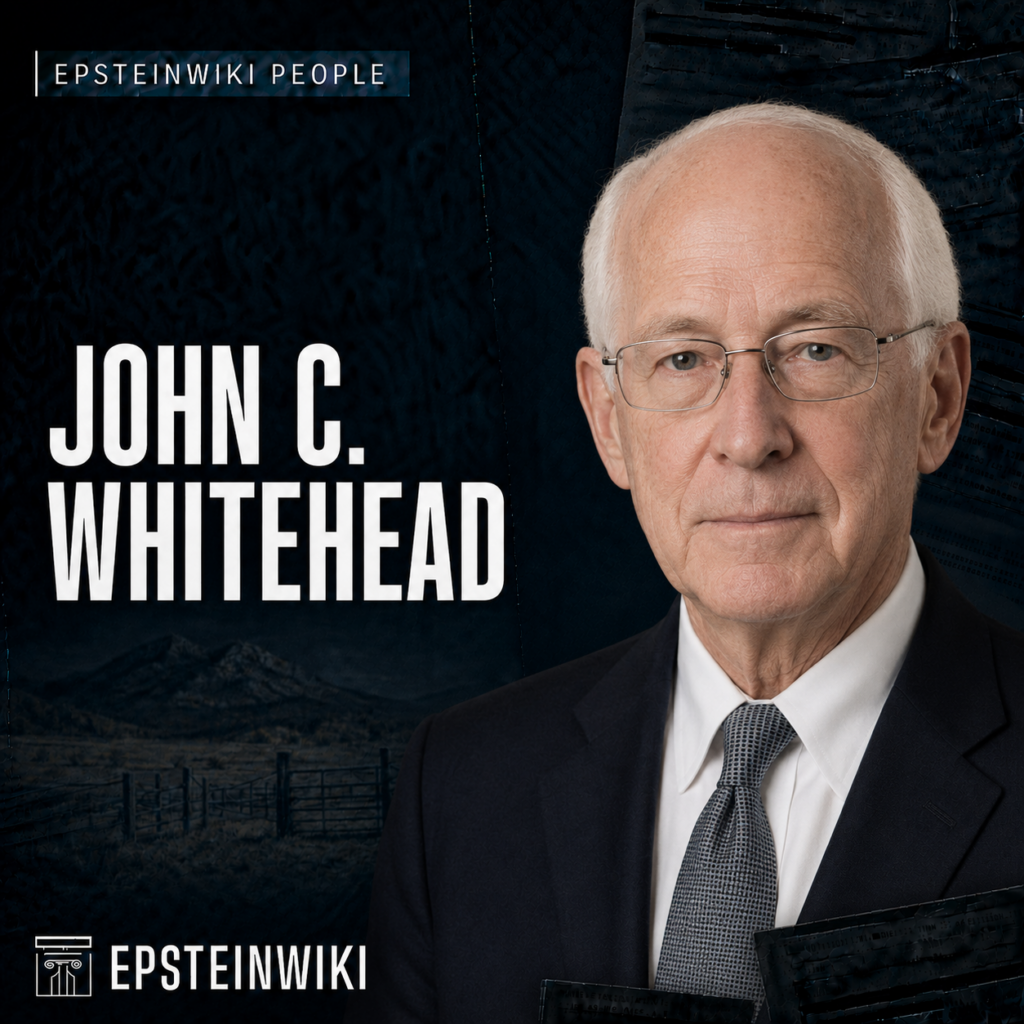
Snapshot
John Cunningham Whitehead was an American investment banker, diplomat, philanthropist, and civic leader. He spent thirty seven years at Goldman Sachs, ultimately serving as cochairman and cosenior partner. He later served as United States Deputy Secretary of State under President Ronald Reagan.
Whitehead also chaired or served on the governing bodies of major financial, educational, diplomatic, and charitable institutions. These included the Federal Reserve Bank of New York, Rockefeller University, the Asia Society, the International Rescue Committee, the United Nations Association, and the Lower Manhattan Development Corporation.
Earlier versions of this article stated that there was no documented connection between Whitehead and Jeffrey Epstein.
That conclusion requires revision.
A Rockefeller University trustee roster from the 1990s lists both Whitehead and Epstein on the university’s board. Released federal records also preserve a 2002 list of contributors to Bill Richardson’s campaign in which Epstein was listed as contributing $50,000 and a John C. Whitehead of New York was listed as contributing $5,000.
These records establish institutional overlap and appearance within the same political finance document. They do not establish a personal friendship, coordinated donations, a financial relationship, or participation by Whitehead in Epstein’s criminal activity.
The reviewed record contains no verified direct correspondence between Whitehead and Epstein, no confirmed private meeting, no authenticated photograph of them together, and no evidence that Whitehead travelled on Epstein’s aircraft or visited an Epstein property.
The most accurate classification is therefore that Whitehead and Epstein occupied overlapping institutional and political finance environments, while the extent of any direct personal contact remains unknown.
Whitehead died on February 7, 2015. He was never charged with or publicly accused of participating in Epstein’s sexual abuse or trafficking operation.
Identity
John Cunningham Whitehead was born on April 2, 1922, in Evanston, Illinois.
He attended Haverford College and served in the United States Navy during World War II. His military service included participation in the Normandy landings and operations in southern France, Iwo Jima, and Okinawa.
After receiving an MBA from Harvard Business School in 1947, Whitehead joined Goldman Sachs.
He should not be confused with:
- John W. Whitehead, the constitutional lawyer associated with the Rutherford Institute.
- John C. Whitehead, the environmental economist associated with Appalachian State University.
- Jim Whitehead, whose contact information appears separately in Epstein’s address book.
- Jamie Whitehead, whose name appears in Epstein’s address book as a contact associated with Senator John Kerry.
The identity distinctions matter because database searches can merge people who share a surname or initials.
Goldman Sachs Career
Whitehead joined Goldman Sachs in 1947 and became a partner in 1956.
In 1976, he and John L. Weinberg became cochairmen and cosenior partners. Goldman Sachs credits them with expanding the firm’s international business and formalizing important elements of its investment banking organization.
The official Goldman Sachs history describes Whitehead and Weinberg as joint leaders who helped transform the partnership into a more global financial institution.
Whitehead retired from Goldman Sachs in 1984.
His career preceded Epstein’s rise as a prominent private financial adviser. The fact that both men worked in finance does not demonstrate that Epstein worked for Whitehead, received business from him, or inherited part of Whitehead’s Goldman network.
No reviewed record identifies Whitehead as an Epstein client or Epstein as Whitehead’s financial adviser.
Deputy Secretary of State
President Ronald Reagan appointed Whitehead as Deputy Secretary of State in July 1985.
The State Department’s official historical record states that Whitehead entered office on July 9, 1985, and served until January 20, 1989.
Whitehead therefore served under President Reagan and Secretary of State George Shultz. He did not serve as Deputy Secretary of State under President George H. W. Bush, whose presidency began on the day Whitehead’s appointment ended.
Whitehead concentrated heavily on relations with Central and Eastern Europe during the final years of the Cold War. He advocated economic and diplomatic engagement intended to encourage political liberalization and human rights reforms.
President Reagan awarded him the Presidential Citizens Medal in 1989.
No reviewed State Department record connects Whitehead’s government service to Epstein.
AEA Investors
After leaving government, Whitehead became chairman of AEA Investors.
AEA originated as an investment organization created for the interests of prominent industrial families and business leaders. Whitehead’s position placed him at the intersection of private equity, family wealth, international business, and public policy.
The Rockefeller University roster discussed below identified Whitehead as chairman of AEA Investors.
That title helps confirm the identity of the Whitehead listed in the university record. It does not show that AEA invested with Epstein or that Epstein performed services for the firm.
No reviewed record establishes an AEA transaction involving Epstein.
Federal Reserve Bank of New York
Whitehead became a Class C director of the Federal Reserve Bank of New York in January 1995.
A Federal Reserve Bank announcement states that he began serving as chairman in January 1996 and was redesignated chairman and Federal Reserve Agent for 1998.
This role placed Whitehead at the center of the New York financial establishment during part of the period when Epstein was building his public identity as a wealthy financial adviser.
Institutional prominence is not evidence of a relationship. The reviewed record does not show Whitehead using the Federal Reserve Bank to assist Epstein or Epstein exercising influence over Whitehead’s responsibilities there.
Rockefeller University Board Overlap
The clearest documented institutional overlap between Whitehead and Epstein occurred at Rockefeller University.
A surviving Rockefeller University trustee roster lists:
- Jeffrey Epstein, identified as president of J. Epstein & Company.
- John C. Whitehead, identified as chairman of AEA Investors.
Both names appear within the university’s Board of Trustees section.
The roster was produced during the period when Torsten Wiesel served as university president and Richard M. Furlaud chaired the board. Rockefeller University records establish that this leadership configuration existed during the 1990s.
This evidence changes the earlier description of Whitehead as having only abstract proximity to Epstein. They were listed as trustees of the same institution.
The record does not establish:
- How frequently Whitehead attended trustee meetings.
- How frequently Epstein attended trustee meetings.
- Whether they served on the same committees.
- Whether they spoke privately.
- Whether Whitehead supported Epstein’s appointment.
- Whether Whitehead knew how Epstein obtained his wealth.
- Whether they conducted financial business together.
A common board position creates a plausible opportunity for contact. It does not prove that contact occurred.
Why Rockefeller University Mattered to Epstein
Rockefeller University gave Epstein access to an elite scientific and philanthropic environment.
Its trustees included prominent financiers, corporate executives, scientists, lawyers, and members of influential New York families. Membership allowed Epstein to appear alongside established figures whose careers and reputations were far more substantial than his own publicly documented financial record.
The trustee roster described Epstein simply as president of J. Epstein & Company. It did not explain his clients, investment performance, or source of wealth.
Whitehead represented precisely the kind of institutional figure whose presence strengthened a board’s credibility. He had led Goldman Sachs, served at the State Department, and chaired major civic organizations.
The shared roster therefore illustrates an important feature of Epstein’s rise. He entered institutions where proximity to respected people could strengthen his own image.
It does not establish that those people personally vouched for him.
The Bill Richardson Campaign Contribution List
A second connection appears in released federal records concerning contributions to Bill Richardson’s 2002 campaign for governor of New Mexico.
EFTA02729084 and EFTA02729085 preserve part of an Albuquerque Tribune compilation based on campaign finance reports filed with the New Mexico Secretary of State.
The article described contributors who gave between $5,000 and $99,999 to the campaign of Democratic Governor elect Bill Richardson.
The list identified:
Jeffrey E. Epstein, Stanley, Investor
It reported a cumulative contribution of $50,000.
The reference to Stanley appears to identify Stanley, New Mexico, near Epstein’s Zorro Ranch. The document does not clarify whether the amount came through one payment or several contributions.
Farther into the same compiled list, EFTA02729100 identified:
John C. Whitehead, New York, N.Y., Retired
It reported a contribution of $5,000.
The name, city, retired status, prominence, and political activity are consistent with John Cunningham Whitehead. However, the newspaper compilation does not include a middle name, address, birth date, or employer that independently eliminates every possible namesake.
The identification is strong but should still be described according to what the document actually supplies.
What the Richardson List Proves
The contribution list establishes that Epstein and a New York contributor identified as John C. Whitehead appeared within the same public compilation of Richardson campaign donors.
It also establishes that Epstein’s reported contribution was ten times larger than the amount attributed to Whitehead.
The list does not establish that:
- Whitehead and Epstein donated together.
- One introduced the other to Richardson.
- They attended the same fundraiser.
- They discussed the campaign.
- Whitehead knew Epstein had contributed.
- Epstein knew Whitehead had contributed.
- Either contribution was illegal.
- The two men shared a political project.
Campaign donor lists often contain hundreds of people, companies, unions, tribes, and political organizations whose contributions were made independently.
The evidentiary significance lies in shared political finance geography, not proof of coordination.
Why the Contribution List Appears in the Epstein Files
The Richardson contribution list was not private correspondence between Epstein and Whitehead.
It was a newspaper compilation derived from public campaign finance reports. Copies later entered law enforcement and litigation productions associated with Epstein.
The pages carry several numbering systems, including federal EFTA numbers and earlier investigative or litigation stamps. Duplicate copies appear in different released datasets.
The same section is also preserved under the earlier Bates sequence beginning around EFTA00203644.
A document’s inclusion in the Epstein files does not mean that every person named in it was investigated for Epstein related wrongdoing.
In this instance, the list was relevant because it documented Epstein’s political contribution. Whitehead appeared incidentally as one of many other donors reported by the newspaper.
Shared Philanthropic Environments
Whitehead and Epstein also appeared in some of the same broad New York philanthropic environments.
A Rockefeller University document provides the strongest example because it identifies both men as trustees rather than merely listing them among donors.
Other institutional publications, including donor reports and benefit materials, sometimes contain both names within long lists of supporters. Such lists may contain hundreds or thousands of people.
A shared donor publication can establish that both people supported an institution. It ordinarily cannot establish that they met, communicated, or coordinated their gifts.
Researchers should assign greater significance to the common Rockefeller University board than to appearance in unrelated donor rolls.
The Morgan Library Donor Record
A Morgan Library and Museum donor report includes both Whitehead and Epstein among supporters of the institution.
The record demonstrates common participation in New York cultural philanthropy.
It does not identify a joint gift or relationship between them.
Museum donor reports are especially vulnerable to overinterpretation because large institutions often publish extensive lists covering many unrelated individuals, families, foundations, and corporations.
The document is useful for ecosystem mapping but weak evidence of personal contact.
Whitehead Remained Active After 2000
An earlier version of this article stated that Whitehead retired from active public life before Epstein’s post 2000 network building became visible.
That statement was inaccurate.
Whitehead retired from Goldman Sachs in 1984 and left the State Department in 1989, but he remained highly active in public, financial, and philanthropic institutions.
Following the September 11 attacks, Whitehead became the founding chairman of the Lower Manhattan Development Corporation. The corporation’s 2006 announcement concerning his departure describes his leadership of housing, business recovery, memorial, and redevelopment initiatives.
He also served as chairman of the World Trade Center Memorial Foundation and continued holding philanthropic and advisory positions.
The National September 11 Memorial biography lists his leadership of organizations including the Federal Reserve Bank of New York, Harvard Board of Overseers, International Rescue Committee, United Nations Association, Haverford College, and Asia Society.
Whitehead therefore remained institutionally active during years when Epstein was cultivating financial, academic, and philanthropic contacts.
Address Book Confusion
Public copies of Epstein’s address book contain Whitehead references, but the entries do not establish a contact for John Cunningham Whitehead.
One entry identifies Jamie Whitehead as an assistant or contact associated with Senator John Kerry. The Jamie Whitehead black book index describes the entry as a way to reach Kerry.
A separate entry identifies Jim Whitehead and supplies telephone numbers.
Neither entry should automatically be attributed to John C. Whitehead.
The address book therefore does not currently provide verified contact information for the former Goldman Sachs chairman.
This is a useful example of why surnames and assistant entries must be checked against the complete page before being assigned to a public figure.
No Verified Flight Record
The reviewed public flight log indexes do not identify John Cunningham Whitehead as a passenger on Epstein’s aircraft.
That absence does not prove that the men never met. It establishes only that no authenticated passenger entry reviewed for this article places Whitehead on a recorded Epstein flight.
The Jamie Whitehead and Jim Whitehead address book references should not be used to imply air travel by John C. Whitehead.
No reviewed record places Whitehead on Little Saint James, at Zorro Ranch, at Epstein’s Palm Beach residence, or at Epstein’s Manhattan townhouse.
No Direct Correspondence Located
The reviewed released corpus does not contain a verified email, letter, fax, or telephone message exchanged directly between Whitehead and Epstein.
No reviewed calendar entry schedules a private meeting between them.
No reviewed financial statement identifies Epstein as paying Whitehead, AEA Investors, or a Whitehead controlled entity.
No reviewed record identifies Whitehead as an Epstein client, adviser, attorney, executor, trustee, employee, or business partner.
Those absences distinguish Whitehead from figures whose relationships with Epstein are documented through direct emails, appointments, payments, travel, or continuing personal communications.
Goldman Sachs Does Not Create a Personal Link
Epstein operated within Wall Street circles and maintained relationships with bankers, investors, and financial executives.
Whitehead’s earlier leadership of Goldman Sachs is relevant background, but it does not by itself connect him personally to Epstein.
Epstein began working at Bear Stearns during the 1970s. Whitehead was leading Goldman Sachs during part of that period, but the firms were competitors and no reviewed source identifies a transaction or working relationship between the two men.
Later relationships between Epstein and individual Goldman Sachs figures cannot be retroactively attributed to Whitehead without evidence.
Institutional lineage is not personal responsibility.
No Evidence of Criminal Participation
Nothing in the reviewed record establishes that Whitehead participated in Epstein’s sexual abuse, trafficking, recruitment, or concealment of crimes.
No survivor account reviewed for this article accuses Whitehead of sexual misconduct.
No criminal indictment, civil judgment, deposition, or FBI interview summary reviewed for this article identifies him as a participant in Epstein’s abuse operation.
The Rockefeller University board overlap raises legitimate questions about how Epstein obtained institutional credibility. It does not establish that Whitehead knew about conduct that had not yet become publicly documented.
The Richardson donor list likewise concerns campaign finance rather than sexual misconduct.
What the Evidence Establishes
The available evidence establishes that:
- John Cunningham Whitehead was a former Goldman Sachs leader, Deputy Secretary of State, investment executive, and civic official.
- Whitehead served as Deputy Secretary of State under President Ronald Reagan from July 1985 through January 1989.
- He remained active in financial, civic, and philanthropic institutions after 2000.
- Whitehead and Epstein were listed as trustees of Rockefeller University during the 1990s.
- The Rockefeller roster identified Whitehead with AEA Investors and Epstein with J. Epstein & Company.
- The common board created an institutional opportunity for contact.
- Released federal records preserve a 2002 Richardson campaign contribution list naming Epstein and a John C. Whitehead of New York.
- Epstein was reported as contributing $50,000.
- The John C. Whitehead entry was reported as contributing $5,000.
- The Whitehead donor entry appears consistent with John Cunningham Whitehead, although the newspaper list does not provide a unique identity marker.
- The contribution list entered the Epstein record because it documented Epstein’s political financing.
- Whitehead remained a significant public figure during the period when Epstein was cultivating elite institutions.
- Address book entries for Jamie Whitehead and Jim Whitehead do not establish contact information for John C. Whitehead.
- Whitehead died on February 7, 2015.
- He was not publicly charged with an Epstein related offense.
What the Evidence Does Not Establish
The available evidence does not establish that:
- Whitehead and Epstein were friends.
- They met privately.
- They communicated directly.
- Whitehead introduced Epstein to Rockefeller University.
- Whitehead sponsored Epstein’s trustee appointment.
- They attended the same Rockefeller University meeting.
- They served on the same trustee committee.
- Whitehead and Epstein coordinated their Richardson contributions.
- They attended the same Richardson fundraiser.
- Whitehead knew about Epstein’s $50,000 contribution.
- Epstein knew about Whitehead’s reported $5,000 contribution.
- Whitehead used Epstein as a financial adviser.
- AEA Investors conducted business with Epstein.
- Whitehead travelled on Epstein’s aircraft.
- Whitehead visited an Epstein residence or island.
- Whitehead participated in sexual abuse or trafficking.
- Whitehead knew about Epstein’s criminal conduct before it became public.
- A common institutional affiliation proves personal association or wrongdoing.
Investigative Assessment
The evidence supports a more precise conclusion than either complete association or complete separation.
Whitehead and Epstein were not merely people who happened to work somewhere within the vast American financial system. A Rockefeller University roster placed them on the same board of trustees.
That is a documented institutional connection.
The Richardson campaign record supplies an additional overlap. Both names appeared within the same public compilation of major contributors, although nothing in the document shows coordination.
These records matter because Epstein repeatedly sought credibility through respected institutions and established public figures. Rockefeller University gave him a formal position beside distinguished scientists, financiers, diplomats, and philanthropists.
Whitehead’s presence on the board contributed to the institution’s prestige. The surviving record does not show that he personally extended that prestige to Epstein or understood Epstein’s private conduct.
The current evidence therefore supports classifying Whitehead as an institutional overlap figure rather than a documented Epstein associate.
Further research should focus on Rockefeller University trustee minutes, committee rosters, attendance records, correspondence, and appointment materials from the period when both men served.
Without those records, stronger claims would exceed the evidence.
Key Takeaways
- Whitehead was a major Wall Street, diplomatic, and philanthropic figure.
- He served as Deputy Secretary of State under Ronald Reagan, not George H. W. Bush.
- He remained publicly and institutionally active after 2000.
- Whitehead and Epstein appeared on the same Rockefeller University trustee roster.
- That roster establishes institutional overlap but not a personal relationship.
- Epstein and a John C. Whitehead of New York appeared in the same 2002 Richardson campaign contribution compilation.
- Epstein was listed at $50,000 and Whitehead at $5,000.
- The donor list does not establish coordinated contributions.
- Jamie Whitehead and Jim Whitehead entries in Epstein’s address book should not be assigned to John C. Whitehead.
- No verified direct correspondence between Whitehead and Epstein has been located.
- No reviewed flight record places Whitehead on Epstein’s aircraft.
- No evidence reviewed for this article implicates Whitehead in Epstein’s sexual crimes.
- The strongest remaining research question concerns what Rockefeller University records may show about board attendance and trustee interaction.
- Whitehead is best classified as an institutional overlap figure, not a proven operational participant in Epstein’s network.
Related EpsteinWiki Articles
- Jeffrey Epstein
- Bill Richardson
- Rockefeller University and Jeffrey Epstein
- Financial Institutions and Epstein
- Jeffrey Epstein Financier History
- Epstein’s Black Book
- Political and Intelligence Connections
- Elite Philanthropy Power Networks
- How to Read an Epstein Document
- Witness Statements and Depositions Litigation
Primary Institutional and Historical Sources
- State Department biography of John C. Whitehead
- Goldman Sachs history of John Whitehead and John Weinberg
- Federal Reserve Bank of New York announcement concerning Whitehead
- Rockefeller University trustee roster naming Whitehead and Epstein
- Lower Manhattan Development Corporation announcement concerning Whitehead
- National September 11 Memorial biography
- Haverford College memorial biography
- Global Commission on Drug Policy biography
- Morgan Library and Museum donor report
- Jamie Whitehead black book index
Primary Epstein Data Evidence
- EFTA02729084 preserves the opening section of the Richardson campaign contribution list and identifies the purpose of the compilation.
- EFTA02729085 lists Jeffrey E. Epstein of Stanley as a $50,000 contributor.
- EFTA02729100 lists John C. Whitehead of New York as a $5,000 contributor.
- EFTA00203644 is an earlier produced copy of the contribution list section identifying Epstein.
- EFTA00203645 contains the continuation of the Epstein contribution entry.
- EFTA00203660 is an earlier produced copy of the page containing the John C. Whitehead entry.
These pages document campaign contribution reporting. They do not document direct communication between Whitehead and Epstein.