
Martin Nowak and Jeffrey Epstein
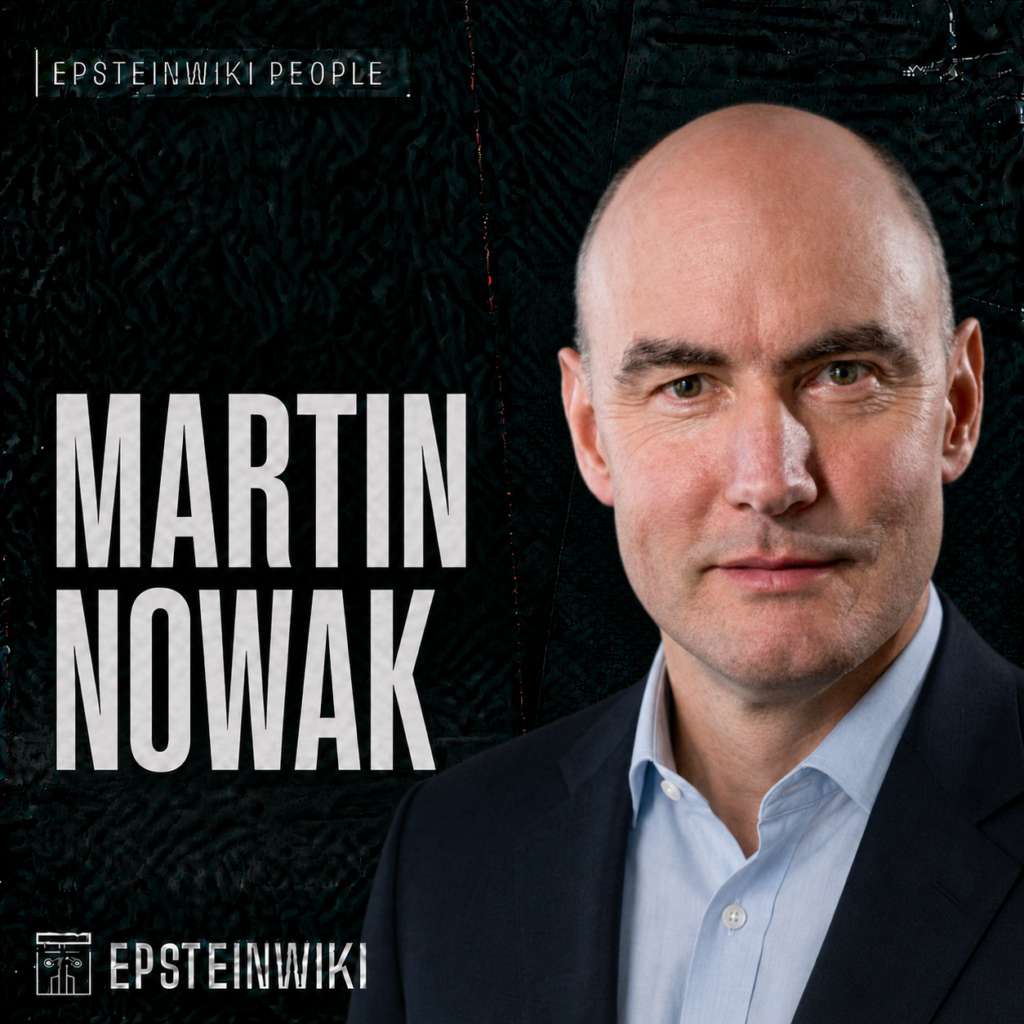
Snapshot
Martin Andreas Nowak is an Austrian born mathematician and theoretical biologist known for research on evolutionary dynamics, cooperation, infectious diseases, cancer, and mathematical biology.
Nowak became one of Jeffrey Epstein’s most important academic relationships. Epstein supported Nowak before Harvard recruited him and provided Harvard with $6.5 million in 2003 to establish the Program for Evolutionary Dynamics, commonly called PED, under Nowak’s direction.
The relationship continued after Epstein’s 2008 conviction for soliciting prostitution from a minor. Harvard’s 2020 institutional investigation found that Epstein visited PED more than forty times between 2010 and 2018, retained unrestricted access credentials, used an office known within the program as “Jeffrey’s Office,” and held meetings with academics and public figures in the program’s Harvard Square facilities.
The investigation also found that Nowak approved the use of PED’s Harvard website to promote Epstein, including a dedicated “Friends” page requested because connecting Epstein’s name to a Harvard domain would improve internet search results. The promotional material repeated a false claim that Epstein had given Harvard $35 million.
Harvard further concluded that Nowak knowingly approved false information supplied to the John Templeton Foundation concerning the source of matching funds for a grant.
Harvard sanctioned Nowak in 2021, closed PED, and restricted his ability to supervise students, researchers, and new grants for two years. The university restored his privileges in March 2023.
Large federal document releases in 2026 disclosed additional emails, invitations, travel arrangements, photographs, and personal exchanges. Harvard placed Nowak on paid administrative leave in February 2026 and opened another formal investigation. In March 2026, Nowak resigned from the Austrian Academy of Sciences while its ethics committee was reviewing his Epstein relationship.
Released trust documents reportedly named Nowak as a proposed beneficiary of $5 million from Epstein’s estate. A beneficiary designation proves that Epstein intended to provide money. It does not establish that Nowak requested, knew about, accepted, or ultimately received the proposed bequest.
As of September 2, 2026, no public result of Harvard’s renewed investigation has been identified. Nowak has not been publicly charged with an Epstein related crime, and the reviewed records do not establish that he participated in Epstein’s sexual abuse or trafficking operation.
Background and Scientific Career
Nowak was born in Vienna, Austria, in 1965.
He studied biochemistry and mathematics at the University of Vienna and received his doctorate in 1989. His doctoral research addressed mathematical strategies within the prisoner’s dilemma, a foundational model used in game theory.
Nowak later worked at the University of Oxford, where he developed mathematical approaches to infectious diseases, evolutionary biology, and cooperation. He subsequently led a theoretical biology group at the Institute for Advanced Study in Princeton.
Harvard recruited Nowak in 2003. He became Professor of Mathematics and Biology and directed the Program for Evolutionary Dynamics.
His research has addressed:
- Evolutionary game theory
- The evolution of cooperation
- Viral dynamics
- Cancer evolution
- Language evolution
- Mathematical descriptions of biological systems
His Harvard faculty biography describes him as a professor working on the mathematical analysis of evolutionary processes, infection, cancer, cooperation, and human language.
Nowak is the author or coauthor of books including Virus Dynamics, Evolutionary Dynamics, and SuperCooperators.
His scientific accomplishments are distinct from the institutional and ethical questions raised by his relationship with Epstein.
Epstein’s Support Before Harvard
Epstein’s support for Nowak began before the creation of PED.
Harvard’s investigation found that Epstein had previously supported Nowak’s work at the Institute for Advanced Study. When Harvard recruited Nowak, Epstein became involved in financing the new Harvard program.
The relationship provided Epstein with more than an opportunity to support scientific research. It connected him to an academic whose work crossed mathematics, biology, medicine, psychology, and evolutionary theory.
Nowak, in turn, gained access to a wealthy patron who was willing to provide flexible funding and introduce other donors.
This exchange of money, access, and intellectual prestige became the foundation of their long relationship.
The $6.5 Million Harvard Gift
In 2003, Epstein gave Harvard $6.5 million to establish the Program for Evolutionary Dynamics under Nowak’s direction.
The gift was the largest part of the $9.179 million Harvard determined Epstein had donated to the university between 1998 and 2007.
The money enabled Harvard and Nowak to lease and maintain separate offices at One Brattle Square in Cambridge. Unlike an ordinary department office located deep within a controlled university building, the PED facility occupied leased space in Harvard Square.
Contemporary reporting described the gift as part of a proposed $30 million commitment. Harvard’s investigation found no institutional record establishing that Epstein made such a pledge.
The verified gift was $6.5 million.
This distinction matters because Epstein later used inflated claims about his Harvard giving to strengthen his public image.
The Program for Evolutionary Dynamics
PED brought together researchers working across mathematics, biology, physics, medicine, and other disciplines.
Its intellectual focus was the use of mathematical models to understand evolutionary processes. Its physical offices also became an important meeting location within Epstein’s academic network.
The facility provided Epstein with something particularly valuable: a Harvard associated setting where he could assemble scientists, academics, donors, and public figures.
Harvard’s investigation concluded that Epstein commonly selected the dates and guest lists for meetings at PED. On some occasions, Nowak invited academics whom he believed Epstein would find interesting.
Meetings usually concerned science and scholarship. Epstein also used PED for occasional dinners.
The scientific nature of the conversations does not resolve the institutional question. Epstein had no formal Harvard affiliation after withdrawing as a visiting fellow in 2006, yet the program continued allowing him extraordinary access.
Epstein’s 2006 Arrest and 2008 Conviction
Epstein was arrested in Florida in 2006 following the Palm Beach investigation into allegations that he sexually abused underage girls.
In 2008, he pleaded guilty to state charges including soliciting prostitution from a person under eighteen. He served approximately thirteen months under unusually permissive work release conditions and was required to register as a sex offender.
Harvard stopped accepting direct donations from Epstein after his conviction. University records indicate that President Drew Faust had made that decision no later than November 2008.
Nowak nevertheless maintained his relationship with Epstein.
Harvard’s investigation stated that Nowak knew Epstein was a registered sex offender. That knowledge is relevant to the decision to continue giving Epstein access to Harvard facilities.
The report did not find that Nowak participated in Epstein’s sexual crimes.
More Than Forty Visits After Conviction
Harvard’s investigators estimated that Epstein visited PED more than forty times between 2010 and 2018.
The estimated visits were distributed across the period as follows:
- Four visits in 2010
- Five visits in 2011
- Two visits in 2012
- Three visits in 2013
- Four visits in 2014
- Eight visits in 2015
- Nine visits in 2016
- Five visits in 2017
- Six visits in 2018
The records were not precise enough to identify every visit, and Harvard could not fully reconstruct visits before 2010.
Epstein generally met scientists and scholars from Harvard and other institutions. Political figures occasionally attended.
The meetings frequently occurred on weekends. The report found that Epstein was routinely accompanied by women described as being in their twenties who acted as his assistants.
Harvard found no evidence that Epstein engaged with students during these meetings. He attended part of one Nowak undergraduate mathematics class but reportedly left before it ended and did not interact with the students.
“Jeffrey’s Office”
PED maintained an office commonly known as “Jeffrey’s Office.”
Epstein and his assistants possessed a key to the room. Epstein brought in a rug and placed photographs on its walls. A Harvard telephone line in the office was identified with him until PED removed it in 2017 as a cost saving measure.
Nowak told investigators that the room was essentially a visitor office that was only nominally called Epstein’s.
Other people working at PED understood the arrangement differently. Harvard’s report said that office space was scarce and that employees generally believed the room was reserved for Epstein when he visited.
Epstein did use the office during his visits.
Calling the room “Jeffrey’s Office” did not create an official appointment. It did, however, reflect the privileged status PED afforded someone who no longer had any formal Harvard affiliation.
Unrestricted Access to Harvard Facilities
Before 2017, Nowak authorized PED to provide Epstein and his assistants with proximity cards for the One Brattle Square building.
They also received the code used to enter PED’s offices and a key to Epstein’s designated room.
This arrangement allowed Epstein and his staff to enter the facility without Nowak or another Harvard employee accompanying them.
Harvard installed a more restrictive identification system in 2017. Non Harvard visitors seeking continuing access were supposed to receive temporary identification numbers, provide photographs, and have a legitimate business, educational, or research reason to enter the space.
PED’s chief administrative officer instead obtained unassigned visitor cards and sent two of them to Epstein’s assistant. She informed Nowak that this was easier than arranging a renewable identification card that would require Epstein to be photographed.
Nowak did not respond to that message.
Harvard concluded that the administrative officer, with Nowak on notice, circumvented the new security system and permitted Epstein to retain unrestricted access.
The report placed ultimate responsibility for Epstein’s access with Nowak as PED’s director.
Meetings With Academics and Public Figures
Epstein used PED as a place to expand and maintain his intellectual network.
A scheduling record preserved in EFTA02136463 states that Epstein held meetings at Martin Nowak’s institute at One Brattle Square. Other records document assistant coordination, guest lists, dinners, and efforts to assemble particular academics.
In EFTA00439957, Epstein’s staff asked Nowak to contact “Hopkins” for a dinner. The surviving message documents an effort to use Nowak’s academic contacts while arranging Epstein’s gathering.
EFTA00371375, EFTA02116375, EFTA02291342, and EFTA00472538 preserve additional correspondence concerning Epstein’s meetings and visits involving Nowak.
A scheduling email establishes that a meeting was proposed or arranged. It does not prove everything discussed or establish misconduct by every invited person.
The larger pattern nevertheless shows that PED functioned as a recurring institutional venue for Epstein rather than the site of one incidental visit.
Epstein Introduced Other Donors
Harvard stopped accepting direct gifts from Epstein, but Epstein continued helping Nowak obtain money from other donors.
Between 2010 and 2015, donors whom Epstein introduced to Nowak provided $7.5 million in unrestricted support for his work.
The gifts identified by Harvard were:
- $500,000 from the Falconwood Foundation in 2010
- $2 million from Leon and Debra Black in 2011
- $4 million from Leon and Debra Black in 2014
- $1 million from the Black Family Foundation in 2015
Nowak acknowledged that he had no preexisting relationship with Falconwood or the Blacks and understood that Epstein had interested them in his research.
Harvard found no evidence that the donated money secretly came from Epstein. The donors denied that Epstein directed their gifts.
The evidence therefore establishes Epstein’s role as an introducer and fundraising intermediary. It does not establish that the later gifts were disguised transfers of Epstein’s money.
Harvard Development Officials Knew of Epstein’s Role
Epstein’s post conviction involvement was not confined to a private arrangement between Epstein and Nowak.
Harvard’s investigation found that development personnel knew Epstein was helping obtain donations for Nowak and Harvard Medical School professor George Church. Some officials encouraged those efforts.
In 2014, a Harvard Medical School development employee thanked Epstein for helping expedite a gift. As late as February 2017, a Faculty of Arts and Sciences development employee reportedly encouraged Nowak to approach the Blacks or Epstein again for financial support.
This institutional knowledge does not excuse Nowak’s decisions.
It does show that Harvard’s relationship with Epstein cannot be explained entirely through the actions of one professor. University employees knew he continued operating as a fundraising intermediary after Harvard stopped accepting his direct donations.
The Templeton Foundation Grant
In 2014, PED sought a $3 million grant from the John Templeton Foundation.
The foundation was prepared to provide half the requested amount but required confirmation that PED had secured matching funds from another source.
PED already possessed money from the Black donations that could have supported the project. Instead of obtaining confirmation from Harvard or the Blacks, Nowak sought a letter involving Epstein.
Epstein’s Enhanced Education foundation supplied a letter claiming it had established a gift for PED and that Nowak’s administrative team intended to apply those funds to the proposed project.
Harvard found that this representation was false.
Enhanced Education had not funded PED, and the original $6.5 million Epstein gift had already been spent. PED therefore could not apply those Epstein funds to work scheduled for 2016 through 2018.
A later grant report again identified Enhanced Education as the source of additional funding.
Harvard concluded that Nowak and PED’s chief administrative officer supplied false information to the Templeton Foundation. The report further concluded that Nowak knowingly approved the false representation.
Harvard stated that it was unclear whether the precise identity of the funding source affected the foundation’s decision, because PED possessed sufficient money from other donors.
That uncertainty does not change the finding that the information provided was inaccurate.
Using Harvard’s Website to Rehabilitate Epstein
Beginning in 2013, Epstein’s publicist asked PED to connect Epstein’s foundations to the program’s Harvard website.
The purpose was explicit. The publicist said that Epstein was trying to increase the visibility of his foundation websites and that a link from Harvard would be helpful.
Nowak approved the request.
PED placed links to Epstein controlled websites on its Harvard pages. Those sites falsely claimed that Epstein had established PED with a $35 million gift.
The verified amount was $6.5 million.
In 2014, Epstein’s publicist asked for a full page about him on the PED website. The page included his photograph, biographical material, and links to his foundation sites.
Epstein was placed under a tab labeled “Friends.” He was the only person identified as a friend of the program.
The publicist specifically explained that associating Epstein with a Harvard address would help his Google search results.
Nowak approved the page.
This was not merely an acknowledgment of a past donor. Harvard found that Epstein was attempting to use the university’s reputation and internet authority to improve his own public image after his conviction.
Survivor Advocates Forced Removal of the Page
In 2014, an organization representing sexual assault survivors contacted Harvard and PED about the Epstein page.
PED removed the page after those complaints.
The record is significant because the objection did not originate from Harvard’s existing oversight systems. Survivor advocates recognized the reputational laundering problem and challenged the university.
Harvard’s 2020 report found no evidence that senior university leadership knew about the Epstein page before the complaints.
It also found that Nowak approved the promotional material and allowed Epstein to use Harvard’s web domain to spread false information about his donations.
The episode demonstrates how academic prestige could be converted into reputation management.
Scientific and Personal Acknowledgments
Nowak publicly thanked Epstein in Evolutionary Dynamics: Exploring the Equations of Life.
The book’s preface thanked Epstein for ideas and for allowing Nowak to participate in what Nowak described as Epstein’s passionate pursuit of knowledge.
Epstein also received several pages connected with Nowak’s scientific work in the 2003 birthday album assembled by Ghislaine Maxwell.
The Harvard Crimson’s review of the released birthday album identified Nowak among the Harvard affiliates who contributed material.
A published acknowledgment establishes that Nowak credited Epstein with intellectual influence. It does not establish that Epstein was qualified as a scientist or made a verifiable research contribution.
It does show that Nowak presented the relationship as more than a conventional donor interaction.
Visits to Epstein’s Properties
Released correspondence shows that Nowak visited Epstein outside Harvard.
Emails concern stays at Epstein controlled residences, travel on his aircraft, and proposed visits to Little Saint James.
In 2009, Epstein assistant Lesley Groff told Nowak that his proposed dates worked and that he might use an Epstein apartment and Jaguar during a visit.
In February 2010, Nowak thanked Epstein after a trip and described flying from New York to Boston on Epstein’s aircraft as a transformative experience.
Later records concern travel to the United States Virgin Islands and proposed stays at Epstein’s island.
These records establish travel, hospitality, and personal familiarity. They do not establish that Nowak witnessed or participated in criminal conduct at an Epstein property.
Because Little Saint James was a documented site of sexual abuse, confirmed visits are relevant to reconstructing Epstein’s network. Presence alone is not proof of participation in that abuse.
The 2013 Island Visit
Reporting based on released communications identifies a 2013 visit by Nowak to Epstein’s island.
The available records should be evaluated according to the specific itinerary, travel confirmation, and participants rather than through generalized statements that everyone visiting the island committed a crime.
A visit establishes that Nowak accepted Epstein’s hospitality after the 2008 conviction.
It does not establish what Nowak observed, which areas of the property he entered, or whether he knew about abuse occurring there.
The post conviction timing remains institutionally significant. Epstein was already a registered sex offender when Nowak continued visiting his properties and facilitating his access to Harvard.
The New York Apartment and Aircraft
Nowak’s communications show that Epstein’s hospitality extended beyond academic meetings.
Epstein and his assistants offered lodging, ground transportation, and aircraft travel.
A 2017 email preserved in EFTA02233977 shows Nowak asking whether Epstein would be in New York during the first week of January because Nowak hoped to visit him.
The message was sent years after Epstein’s conviction and demonstrates that Nowak continued personally seeking contact.
EFTA00710177 preserves further direct correspondence from Nowak to Epstein in 2012.
These documents make it difficult to classify the relationship as merely a historical donor connection that ended with the original Harvard gift.
Invitation to Nowak’s Concord Home
Soon after purchasing a home in Concord, Massachusetts, in 2017, Nowak contacted Epstein’s assistant about a possible visit.
According to The Concord Bridge, Nowak asked whether Epstein still planned to visit him and noted that the house was close to the airport Epstein commonly used.
The message documents a personal invitation into Nowak’s home.
The surviving evidence does not establish that Epstein accepted the invitation or that the visit occurred.
Even as a proposal, the invitation supplies further evidence that their relationship extended beyond formal university fundraising.
The “Spy” and “Torture” Exchange
A March 2014 email drew widespread attention after its release.
Nowak wrote to Epstein that “our spy” had been captured after completing her mission. Epstein responded by asking whether Nowak had tortured her.
The exchange is preserved in EFTA00984937.
The words are disturbing when isolated from context. The document does not identify a real woman, an actual spy, a mission, a detention, or an act of torture.
Nowak later published an explanation on his personal website. He said his message referred to a line from the computer game Civilization II that he sometimes remembered after solving a mathematical problem. He said he did not know what prompted Epstein’s response.
That explanation is Nowak’s account. The underlying email establishes the language used, while the available record does not establish that an actual person was captured or harmed.
The exchange should not be converted into a literal torture allegation without corroborating evidence.
Messages With Ghislaine Maxwell
A released 2002 message shows Nowak thanking Maxwell for her hospitality.
Nowak apologized for causing worry, said he was happy that he had not killed anyone, and wrote that his perspective on life had changed.
The surviving message does not explain the event that prompted those statements.
It establishes personal familiarity with Maxwell and an incident serious enough for Nowak to apologize. It does not, without additional evidence, establish that anyone was injured or identify what occurred.
Maxwell later recalled Nowak as one of the scientists within Epstein’s Harvard centered intellectual network during her 2025 Justice Department interview.
Her recollection is evidence of the social and academic connection. It is not proof that Nowak participated in Maxwell’s criminal conduct.
Photographic Evidence
House and Justice Department releases contain photographs placing Nowak at meetings with Epstein and other people in the academic network.
The EpsteinWiki evidence set Photographs and Email Documenting a Meeting at Harvard Connected to Martin Nowak’s Institute combines images with contemporaneous correspondence.
Photographs can establish that specific people appeared together in a particular setting.
They do not reveal every subject discussed, establish what each person knew, or prove that everyone shown participated in the same conduct.
In Nowak’s case, the photographs corroborate the documentary record showing repeated personal meetings rather than a relationship conducted entirely through intermediaries.
The 2020 Harvard Investigation
Following renewed scrutiny after Epstein’s 2019 arrest and death, Harvard conducted an institutional investigation into his university connections.
The official Harvard report found that:
- Epstein gave Harvard $9.179 million before the university stopped accepting his money.
- The $6.5 million PED gift was his largest Harvard donation.
- Epstein maintained a relationship with Nowak for approximately fifteen years.
- Epstein visited PED more than forty times after his release from custody.
- Epstein and his assistants possessed access cards, entry codes, and an office key.
- PED maintained an office identified with Epstein.
- Nowak approved promotional material that Epstein used to improve his reputation.
- PED repeated false statements about Epstein’s financial support.
- Nowak knowingly approved false information supplied to a grant making foundation.
- Responsibility for Epstein’s unrestricted access ultimately rested with Nowak.
The report recommended that Harvard refer the findings for possible disciplinary action.
Harvard’s 2021 Sanctions
In March 2021, Harvard determined that Nowak had violated university policies and professional standards.
The university closed the Program for Evolutionary Dynamics.
For two years, Nowak was prohibited from:
- Serving as principal investigator on new grants or contracts
- Supervising new graduate students
- Supervising new undergraduate researchers
- Supervising new postdoctoral fellows
- Taking on certain additional research responsibilities
The sanctions did not terminate Nowak’s faculty appointment.
Harvard concluded that discipline was warranted for his facilitation of Epstein’s access, use of the Harvard website, and conduct connected with the Templeton grant.
The institutional finding was not a criminal conviction.
Restoration of Privileges in 2023
Harvard restored Nowak’s advising and research privileges in March 2023 after the two year disciplinary period.
The Harvard Crimson reported that his sanctions had been lifted and that he could again supervise students and pursue research responsibilities.
The restoration did not reverse the findings in Harvard’s 2020 report or declare that the original conduct had not occurred.
It meant that the imposed disciplinary period had ended.
PED itself remained closed.
The 2026 Federal Document Release
The federal document releases of 2026 disclosed a much larger record of Nowak’s communication with Epstein.
Search totals vary because databases count documents, pages, email duplicates, attachments, and name mentions differently. News organizations reported thousands of records containing Nowak’s name.
The important issue is the documentary pattern rather than a single search total.
The released material includes:
- Direct emails
- Assistant scheduling
- Academic meeting arrangements
- Travel proposals
- Property visits
- Aircraft hospitality
- Personal invitations
- Photographs
- Communications with Maxwell
- Continued contact close to Epstein’s 2019 arrest
The scale and duration of these records prompted Harvard to revisit whether the university possessed all relevant evidence during its earlier review.
Renewed Harvard Investigation and Paid Leave
On February 25, 2026, Harvard placed Nowak on paid administrative leave.
The Harvard Crimson reported that a panel of the Faculty Conduct Committee reviewed newly released evidence and recommended a formal investigation.
The inquiry concerns whether Nowak violated Harvard policies, Faculty of Arts and Sciences rules, or professional standards.
Harvard arranged coverage for Nowak’s teaching and advising duties.
Paid administrative leave is not a final disciplinary finding. It removes or limits an employee’s duties while an institution investigates.
As of September 2, 2026, Harvard’s public faculty directory continued identifying Nowak as a professor, but no public final decision in the renewed investigation was located.
Resignation From the Austrian Academy of Sciences
The Austrian Academy of Sciences opened its own review after the 2026 releases.
On March 26, 2026, the academy announced that Nowak had resigned his membership.
Its ethics committee had been close to completing an investigation that could have led to a hearing and a membership vote concerning exclusion.
Nowak’s resignation ended the membership review before the academy issued a final recommendation.
The resignation establishes an institutional consequence. It does not establish what the committee would have concluded.
The Proposed $5 Million Bequest
A version of Epstein’s estate planning documents reportedly designated $5 million for Nowak.
The 1953 Trust became public through Virgin Islands court records and later document releases.
A trust designation can reveal how Epstein valued a relationship. It does not establish that the proposed beneficiary requested the gift, knew about it, accepted it, or received the money.
Epstein’s estate was subjected to taxes, litigation expenses, survivor compensation, and settlements. Amounts described in planning documents therefore should not automatically be treated as completed distributions.
The proposed bequest nevertheless suggests that Epstein regarded Nowak as a personally significant beneficiary shortly before his death.
Nowak’s Public Response
Nowak told The Concord Bridge in February 2026 that he regretted ever meeting Epstein and believed Epstein had manipulated many people.
He has also stated that he did not understand the complete extent of Epstein’s crimes until 2019.
The public record complicates that defense without disproving every part of it.
Nowak knew Epstein was a registered sex offender. He continued hosting him at Harvard, visiting him, using his fundraising connections, and seeking personal contact. Knowledge of the conviction is not identical to knowledge of the full trafficking operation, but it means the relationship continued after serious criminal conduct was publicly established.
Nowak’s statements should be included as his explanation rather than treated as an independent factual finding.
Survivor Centered Assessment
The central issue is not merely that a professor accepted money from a disreputable donor.
Epstein used academic relationships to surround himself with respected scientists, gain access to university facilities, meet influential people, and rebuild his reputation after his conviction.
PED gave him a Harvard associated office, unrestricted access, recurring meetings, a dedicated promotional page, and introductions to scholars.
Survivor advocates recognized the harm of Harvard lending its prestige to a registered sex offender and forced the removal of the promotional page in 2014.
The documentary record does not establish that Nowak participated in Epstein’s sexual abuse. It does establish that he helped preserve Epstein’s institutional access and intellectual legitimacy after the conviction.
That distinction permits accurate accountability without overstating the evidence.
What the Evidence Establishes
The available evidence establishes that:
- Martin Nowak is a mathematician and theoretical biologist.
- Epstein supported Nowak before Harvard recruited him.
- Epstein gave Harvard $6.5 million in 2003 to establish PED under Nowak’s direction.
- The verified gift was not $30 million or $35 million.
- PED’s separate Harvard Square offices were maintained partly through flexible donor funding.
- Nowak continued his relationship with Epstein after Epstein’s 2008 conviction.
- Epstein visited PED more than forty times between 2010 and 2018.
- Epstein used PED for meetings with academics and occasional public figures.
- Epstein commonly selected meeting dates and guests.
- Epstein and his assistants possessed building cards, entry codes, and an office key.
- PED maintained a room commonly called “Jeffrey’s Office.”
- Nowak knew Epstein was a registered sex offender.
- Epstein introduced donors who provided $7.5 million for Nowak’s work.
- Harvard found no evidence that those later donations secretly came from Epstein.
- Nowak approved promotional links and a dedicated Epstein page on PED’s Harvard website.
- Epstein’s publicist explicitly sought the Harvard page to improve Epstein’s internet reputation.
- The promotional material repeated a false claim about the size of Epstein’s Harvard donations.
- Survivor advocates objected, and PED removed the page in 2014.
- Harvard concluded that Nowak knowingly approved false information supplied to the Templeton Foundation.
- Nowak visited Epstein properties and accepted hospitality and aircraft travel.
- Nowak contributed material to Epstein’s 2003 birthday album.
- Nowak publicly thanked Epstein in a scientific book.
- Harvard sanctioned Nowak and closed PED in 2021.
- Harvard restored his advising and research privileges in 2023.
- Harvard placed him on paid administrative leave and opened a renewed investigation in February 2026.
- Nowak resigned from the Austrian Academy of Sciences during an ethics review in March 2026.
- Estate planning records reportedly designated $5 million for Nowak.
- Nowak has expressed regret and said Epstein manipulated people.
- Nowak has not been publicly convicted of an Epstein related offense.
What the Evidence Does Not Establish
The available evidence does not establish that:
- Epstein gave Harvard $30 million or $35 million for PED.
- Every proposed donation materialized.
- Money donated by the Blacks or Falconwood secretly belonged to Epstein.
- Every scheduled PED meeting occurred.
- Every person attending PED knew about Epstein’s abuse.
- The women accompanying Epstein to PED were minors.
- Epstein interacted with Harvard students during his recurring PED meetings.
- Nowak participated in Epstein’s sexual abuse.
- Nowak recruited women or girls for Epstein.
- Nowak witnessed abuse at Little Saint James or another Epstein property.
- The “spy” email concerned an actual detained person.
- The “torture” response proves that anyone was harmed.
- The unexplained 2002 message to Maxwell proves that anyone was killed or injured.
- Nowak knew the full scope of Epstein’s trafficking operation.
- Harvard’s restoration of Nowak’s privileges erased its earlier findings.
- Paid administrative leave is a final judgment of misconduct.
- Resignation from the Austrian Academy proves what its ethics committee would have concluded.
- Nowak requested the proposed $5 million bequest.
- Nowak knew he had been listed as a beneficiary.
- Nowak received $5 million from Epstein’s estate.
- A name appearing thousands of times represents thousands of separate interactions.
- Academic discussion makes Epstein a qualified scientist.
Investigative Assessment
Nowak was not an incidental academic whose name appeared once in an Epstein address book.
The documentary record shows a long relationship combining scientific discussion, personal hospitality, travel, fundraising, introductions, institutional access, and reputation management.
Epstein’s $6.5 million gift gave Nowak resources to build PED. Nowak then helped give Epstein something money alone could not guarantee: continuing access to Harvard’s prestige and intellectual community.
The relationship persisted after Epstein’s conviction. Epstein entered PED without normal supervision, used a designated office, assembled academics, and benefited from a Harvard web page explicitly requested to improve search results.
Harvard’s own investigation found policy violations and a knowing false representation to a grant making foundation. Those are institutional findings, not speculative guilt by association.
The available evidence does not establish that Nowak participated in sexual trafficking or abuse. It does establish that he functioned as one of Epstein’s most durable academic legitimizers and helped maintain his access to elite scientific networks after his criminal conviction.
The unresolved question is whether the 2026 releases reveal additional conduct beyond what Harvard evaluated when it imposed the original sanctions. Harvard’s renewed investigation must be judged by its eventual findings, not by the existence of paid leave alone.
Key Takeaways
- Epstein financed the creation of Nowak’s Program for Evolutionary Dynamics with a $6.5 million Harvard gift.
- Nowak’s relationship with Epstein began before Harvard and continued after Epstein’s conviction.
- Epstein visited PED more than forty times between 2010 and 2018.
- PED gave Epstein unrestricted access credentials and an office known as “Jeffrey’s Office.”
- Epstein used the facility to meet academics and public figures.
- Nowak approved a Harvard web page that Epstein’s publicist sought for reputation management.
- The page repeated false claims about Epstein’s donations.
- Survivor advocates prompted its removal.
- Epstein introduced donors who provided $7.5 million for Nowak’s work.
- Harvard did not find that those donors were secretly transferring Epstein’s money.
- Harvard found that Nowak knowingly approved false information supplied to the Templeton Foundation.
- Nowak visited Epstein properties and accepted personal hospitality.
- The “spy” and “torture” exchange is authentic, but the available evidence does not show that it described an actual victim.
- Harvard sanctioned Nowak and closed PED in 2021.
- Harvard restored his privileges in 2023.
- Newly released evidence led to another investigation and paid leave in 2026.
- Nowak resigned from the Austrian Academy of Sciences during an ethics review.
- Epstein reportedly proposed leaving Nowak $5 million.
- The available evidence does not establish that Nowak committed a sexual offense.
- The record supports describing Nowak as a major academic facilitator of Epstein’s access and reputation.
Related EpsteinWiki Articles
- Jeffrey Epstein
- Ghislaine Maxwell
- Harvard University
- Epstein and Harvard University
- Harvard University and Jeffrey Epstein’s Purchase of Academic Legitimacy
- Lawrence Summers
- Stephen M. Kosslyn
- George Church
- Joscha Bach
- Joi Ito
- Leon Black
- The Most Dangerous Thing Psychologists Gave Jeffrey Epstein Was Credibility
- How to Read an Epstein Document
- Photographs and Email Documenting a Meeting at Harvard Connected to Martin Nowak’s Institute
Primary Institutional and Government Sources
- Harvard Report Concerning Jeffrey Epstein’s Connections to Harvard
- Harvard President’s Statement on the Epstein Report
- Martin Nowak Harvard faculty biography
- Harvard Crimson report on the 2021 sanctions
- Harvard Crimson report on the restoration of privileges
- Harvard Crimson report on the 2026 administrative leave
- Austrian Academy of Sciences announcement of Nowak’s resignation
- The 1953 Trust filed in the United States Virgin Islands
- House Oversight release of the Epstein birthday album
- Justice Department Epstein Library
Primary Epstein Data Evidence
- EFTA00984937 contains the March 2014 “spy” and “torture” exchange. The language is authentic, but the document does not identify an actual person or establish that anyone was harmed.
- EFTA02233977 contains Nowak’s December 2017 request to visit Epstein in New York.
- EFTA02136463 identifies Martin Nowak’s institute at One Brattle Square as a location where Epstein held meetings.
- EFTA00439957 contains an assistant request that Nowak contact “Hopkins” for an Epstein dinner.
- EFTA00371375 contains 2014 correspondence concerning Epstein and meeting arrangements involving Nowak.
- EFTA02116375 documents repeated scheduling changes concerning an Epstein visit.
- EFTA02291342 contains further assistant correspondence concerning Epstein and Nowak.
- EFTA00472538 preserves April 2018 meeting correspondence involving Epstein and Nowak.
- EFTA00710177 contains direct correspondence sent by Nowak to Epstein in February 2012.
- EFTA00575456 contains scheduling material linking Epstein, Nowak, Joscha Bach, and Karyna Shuliak.
- EFTA02233977 image analysis provides a searchable transcription of Nowak’s request to visit Epstein.
Each document should be evaluated according to what it actually contains. A scheduling record proves that an event was proposed or placed on a calendar. It does not automatically prove that the event occurred.
EpsteinWiki Sleuth and Investigative Sources
- Rye Howard Stone’s Science Network Comprehensive Audit
- EpsteinWiki investigation of Harvard and Epstein’s purchase of academic legitimacy
- EpsteinWiki photographic evidence connected with Nowak’s institute
- The Nation investigation into Epstein and Harvard
- The Concord Bridge investigation into Nowak’s personal invitation to Epstein
- Inside Higher Ed review of Nowak’s appearances in the 2026 files
These sources provide investigative synthesis. Conclusions should be checked against Harvard’s report and the linked EFTA documents.
