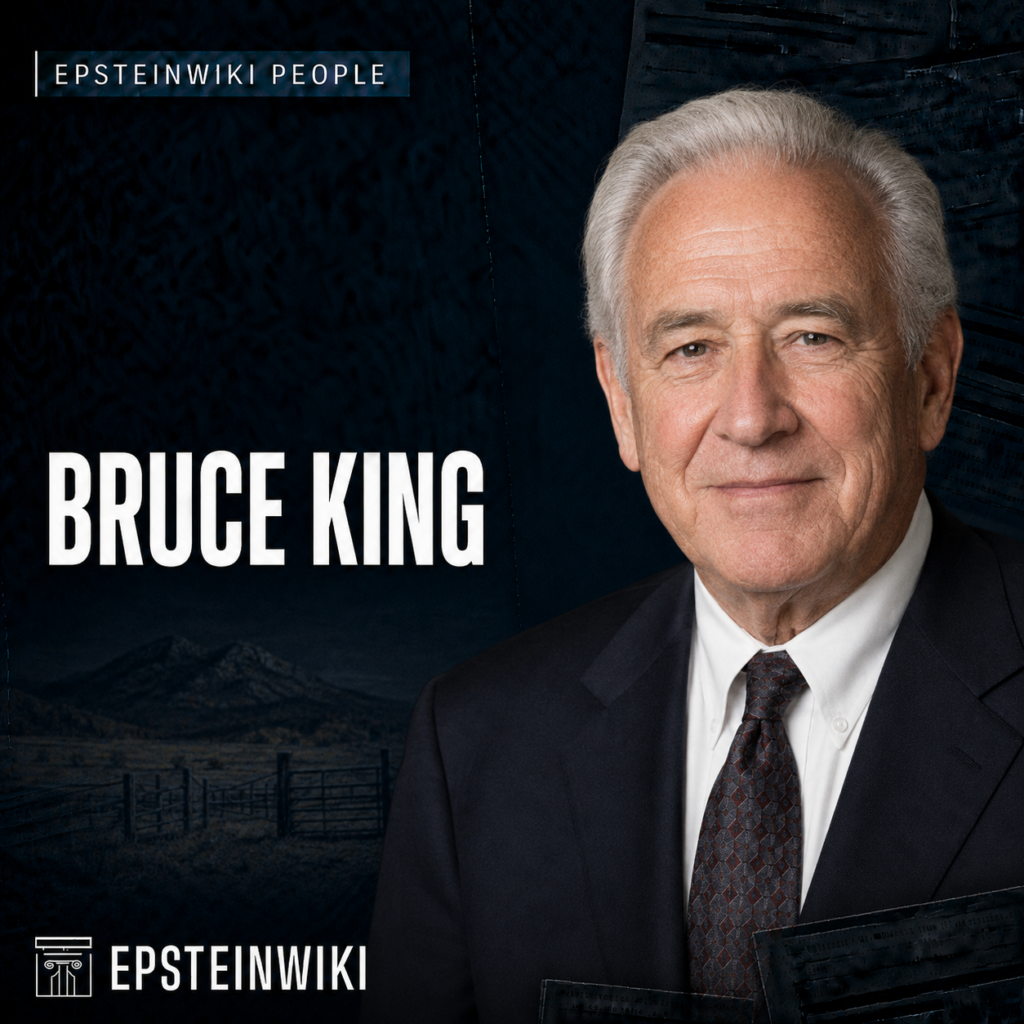
Bruce King
Snapshot
Bruce King was a New Mexico rancher, businessman, legislator, and three term Democratic governor. He served as governor from 1971 to 1974, from 1979 to 1982, and from 1991 to 1994, making him the longest serving governor in the state’s history.
King enters the Jeffrey Epstein record principally through the 1993 sale of King family land near Stanley, New Mexico. Epstein acquired approximately 7,600 acres from King and other members of the family while King was serving his third term as governor. Epstein placed the property in the Zorro Trust and developed it into the compound known as Zorro Ranch.
The transaction is documented in property records, New Mexico State Land Office material, the released Epstein files, and the August 2026 interim report of the New Mexico Survivors’ Truth Commission. The official report states that Bruce King and his brothers Don and Sam King sold the property, that then state representative Rhonda King acted as the family’s realtor, and that attorney John J. Kelly assisted with the transaction.
Bruce King also appeared in Epstein’s address book with four telephone numbers and a Santa Fe address. A 2009 email stated that Zorro Ranch employees planned to attend King’s funeral service.
These records establish a real estate transaction and continuing contact information. They do not establish that King participated in Epstein’s sexual abuse, knew how Epstein would later use the property, received campaign contributions from Epstein, or used his office to protect him.
King died in November 2009. He was never charged with an Epstein related offense, and the presently available public record contains no judicial finding that he facilitated Epstein’s crimes.
Early Life and Ranching Background
Bruce King was born near Stanley, New Mexico, on April 6, 1924.
According to the National Governors Association biography and a New Mexico legislative memorial honoring King, he served in the United States Army field artillery during the Second World War and later attended the University of New Mexico.
After leaving the Army in 1946, King and his brothers worked with their parents to develop the family ranching business. The enterprise became known as the King Brothers Ranch. Bruce handled cattle, his brother Sam managed farming, and his brother Don operated the trucking component.
The family’s agricultural and commercial holdings became central to King’s public identity. He frequently presented himself as a working rancher whose political judgment came from rural New Mexico rather than from a professional political class.
That background is important to understanding the later Epstein transaction. The land Epstein purchased was not an unrelated investment King acquired while serving as governor. It came from the King family’s longstanding ranching operation near King’s hometown.
Political Career
King began his political career on the Santa Fe County Commission in 1954.
He entered the New Mexico House of Representatives in 1959 and served five consecutive terms. He was elected speaker of the House for three terms and later chaired the state Democratic Party.
In 1969, King served as president of New Mexico’s second constitutional convention.
He won his first gubernatorial election in 1970 and served from 1971 through 1974. He returned to office from 1979 through 1982 and again from 1991 through 1994.
The terms were separated because the New Mexico Constitution did not then permit a governor to succeed himself in the manner later allowed by state law.
King’s third term placed him in office when his family sold the future Zorro Ranch property to Epstein in 1993.
King sought another term in 1994 but lost to Republican Gary Johnson. He subsequently withdrew from elective politics while remaining an influential figure in New Mexico public life.
The King Family Land
The King family controlled extensive ranch property near Stanley, approximately thirty miles south of Santa Fe.
The land included privately owned parcels as well as interests connected with state and federal agricultural or grazing leases. This mixed ownership structure was common in Western ranching, where a single operating property could include private land, state trust land, federal leases, easements, and water rights.
The portion acquired by Epstein became the core of Zorro Ranch.
The New Mexico Survivors’ Truth Commission interim report states that the ranch eventually comprised 7,621.74 acres, although the Commission had not determined whether Epstein acquired every acre in a single transaction.
The property’s isolation later became one of its defining features. Epstein constructed a large residence, guest buildings, employee housing, an aircraft facility, and extensive communications infrastructure.
Those later improvements were made under Epstein’s ownership. They should not be attributed to the King family merely because the family previously owned the underlying land.
The 1993 Sale to Jeffrey Epstein
On March 1, 1993, Epstein acquired the property that became Zorro Ranch from Bruce King and his brothers Don and Sam King.
The acquisition is documented in EFTA00310887, a large property packet containing a special warranty deed and later transfer records. Epstein used an Ohio entity called the Zorro Trust to hold the property.
The New Mexico Survivors’ Truth Commission identified Bruce King as a seller and noted that he was the sitting governor when the transaction occurred.
Then state representative Rhonda King acted as the realtor for the King family. Released deposition material connected with EFTA01110271 helped establish her role.
Epstein later transferred the ranch from the Zorro Trust to Cypress, Inc., a Virgin Islands corporation under his control. That later transfer occurred in December 2011 and did not involve Bruce King, who had died two years earlier.
The 1993 transaction gave Epstein control over the private land that became the center of his New Mexico operation. It did not give him unrestricted ownership of every adjoining state or federal parcel. Some areas remained subject to leases and land use conditions.
Conflicting Accounts of the Purchase Price
Published accounts disagree about what Epstein paid for the property.
Reuters reviewed county records and reported that Gary King, Bruce King’s son and one of the parties to the sale, said Epstein paid approximately $3.75 million. Gary King described that figure as fair market value based on New Mexico State University research.
Several other sources have repeated figures near $12 million or $12.3 million. Alisa Valdes Rodriguez cited archival reporting about King family business debts and described a $12.3 million transaction involving approximately 7,500 acres.
The publicly available extracts from the deed packet establish the transfer but do not conclusively resolve whether the larger figure represented the land price, a broader restructuring, assumed obligations, additional property interests, or a later reporting error.
The safest conclusion is that the precise consideration remains disputed in public accounts.
The article should not present either $3.75 million or $12.3 million as conclusively proven without the complete closing statement and associated financial records.
King Family Financial Pressure
Independent research has examined the financial circumstances surrounding the sale.
In her investigation of the Zorro Ranch money trail, Alisa Valdes Rodriguez reported that King family businesses faced approximately $21 million in outstanding loans during 1993. She argued that the family reorganized assets and sold a substantial portion of its ranch holdings to address those obligations.
That reporting offers a possible economic explanation for why the family sold the land.
The surviving primary records reviewed for this article establish the property transfer but do not independently prove every element of the reported debt figure or demonstrate that Epstein personally resolved the family’s complete financial position.
Financial pressure also does not by itself establish corruption. Families and businesses routinely sell real property to reduce debt.
The timing remains relevant because Epstein acquired a large and exceptionally private property from the family of a sitting governor.
The Role of John J. Kelly
Attorney John J. Kelly participated in the acquisition.
According to the Truth Commission report, Kelly acted as Epstein’s attorney in fact on March 15, 1993, when he executed the state land lease component of the transaction.
Kelly later became United States Attorney for the District of New Mexico and served in that position from 1993 until 2001.
In a 2026 statement summarized by the Commission, Kelly said the King family asked him to assist with a real estate transaction involving an out of state buyer. He said the buyer turned out to be Epstein and that he did not recall encountering Epstein again after the transaction.
Kelly also said he had no knowledge of Epstein’s criminal conduct until it became public through press coverage.
Some independent researchers state that Bruce King personally introduced Epstein to Kelly. The official interim report supports the narrower conclusion that the King family asked Kelly to assist. It does not establish which individual family member made the introduction.
The distinction matters. A family request is not necessarily proof of a personal introduction by Bruce King.
Kelly’s later federal appointment raises legitimate questions about the early network through which Epstein established himself in New Mexico. The available record does not establish that the appointment was connected to Epstein or that Kelly later interfered with an Epstein investigation.
The State Land Component
The property was not limited to land conveyed through the private deed.
State Land Office records show that Epstein’s operation also depended on grazing leases, agricultural interests, a waterline right of way, and federal land assignments.
The Truth Commission’s interim report states that Kelly executed the state lease component of the acquisition shortly after the March 1993 private transfer.
The broader State Land Office record is preserved in EFTA01305252. It documents the complicated combination of private acreage and public lease interests associated with Zorro Ranch.
In November 1993, the State Land Office notified Epstein that a lease payment was late. That notice appears in EFTA00101506.
In 1994, Ghislaine Maxwell signed a sworn appraisal concerning grazing and agricultural land. The appraisal identified her as a disinterested person and stated a per acre value for the relevant land. Related material appears in EFTA00030804.
These later lease matters concerned Epstein, Maxwell, and state administrators. They do not establish that Bruce King controlled Epstein’s compliance after the sale.
Bruce King in Epstein’s Address Book
Bruce King appears in Epstein’s address book.
The public black book index entry for Bruce King identifies him as governor of New Mexico and reports four telephone numbers and one Santa Fe address.
An address book entry establishes that Epstein or his staff retained contact information for King. Multiple numbers can indicate that the contact was considered useful or that several routes of communication were available.
It does not prove how often Epstein and King spoke, when the information was added, or whether every number remained current.
The entry is more significant when considered with the property transaction. King was not merely a public figure whose name appeared without context. His family had completed a major land sale to Epstein.
Even so, the available address book evidence does not reveal the content of their conversations or establish an agreement beyond the documented transaction.
The 2009 Funeral Message
Bruce King died on November 13, 2009, at the age of eighty five.
A released email preserved in EFTA02435333 stated that Zorro Ranch employees planned to attend King’s funeral service.
The message suggests that the ranch staff regarded King’s death as locally significant and that a continuing social or community connection existed between the ranch operation and the King family.
It does not establish that every employee attended, that Bruce King maintained a personal relationship with the employees, or that the funeral participation was coordinated by Epstein himself.
King was a former governor, prominent local rancher, and major figure in the Stanley community. Attendance by nearby ranch staff could have reflected ordinary respect for a well known local leader.
The record is nevertheless relevant because it shows that the connection created by the 1993 land transaction had not disappeared entirely from the ranch’s institutional memory.
What Epstein Built on the Property
Epstein transformed the property after purchasing it.
The compound eventually included a 28,636 square foot principal residence, guest buildings, employee residences, stables, a pool, aircraft facilities, communications equipment, and tightly controlled access.
Flight records and witness accounts indicate that Epstein spent several weeks each year at the ranch. His employees managed transportation, security, maintenance, communications, animals, guests, and household services.
The ranch became one of Epstein’s principal residences alongside his properties in Manhattan, Palm Beach, Paris, and the United States Virgin Islands.
None of those later developments should be treated as proof that Bruce King knew what Epstein intended to build when the sale occurred.
The property did not yet contain the later mansion when Epstein acquired it. The major residential construction and operational system were developed under Epstein’s control.
Abuse at Zorro Ranch
Federal records establish that Zorro Ranch later became a location connected with sexual abuse.
The Maxwell indictment preserved in EFTA01659394 alleged that a minor was groomed at Epstein’s New Mexico residence in 1996. It described Maxwell providing the minor with an unsolicited massage while the minor was topless.
A different survivor stated during federal sentencing proceedings that Epstein flew her to Zorro Ranch when she was fifteen in 2004 and sexually molested her there.
The 2026 Truth Commission reported that the available evidence supported accounts involving at least five women and girls at the ranch between 1996 and 2012. The Commission emphasized that its interim report was not a final adjudication and that allegations concerning named people should not be treated as findings unless expressly identified as such.
An FBI interview preserved in EFTA00090036 records the account of a reflexologist who worked intermittently at the property from approximately 1999 through 2008. The witness described young women arriving, restrictions on access inside the house, staff secrecy, and a stated preference for attractive service providers.
The evidence that Epstein and Maxwell abused or groomed minors at the ranch makes the property’s origin historically important.
It does not establish that the people who sold the undeveloped land in 1993 knew that abuse would occur there.
The First Documented Abuse Came After the Sale
The Truth Commission’s chronology places the first presently documented incident involving a minor at the ranch in 1996.
That was approximately three years after the King family transaction.
This timeline is important in both directions.
It shows that Epstein established a property in New Mexico and used it relatively early within the period later examined in the Maxwell prosecution.
It also means that the presently identified abuse evidence does not establish that such conduct at Zorro Ranch was known to Bruce King when the land was sold.
Later misconduct on property does not automatically create responsibility for a former owner. Evidence would be required to show prior knowledge, continued control, assistance, concealment, or another legally relevant connection.
No such finding against Bruce King appears in the records reviewed for this article.
Bruce King and His Son Gary King
Bruce King’s relationship with Epstein must be distinguished from the later relationship involving his son, Gary King.
Gary King was a party to the 1993 land transaction according to county record based reporting. He later served as New Mexico attorney general from 2007 through 2014.
Epstein contributed $15,000 to Gary King’s 2006 campaign and supplied another $35,600 through associated entities during King’s unsuccessful 2014 campaign for governor. The 2014 money was returned after press reporting identified the Epstein connection.
Released records also show that Gary King met Epstein in 2010 and that Epstein helped arrange a 2014 campaign flight to Washington.
The Truth Commission reported that it had found no evidence that Gary King investigated Epstein while serving as attorney general. Gary King has said he received no information concerning crimes by Epstein and did not knowingly use an Epstein connected aircraft.
Those events occurred after Bruce King left office and, in several instances, after his death.
They can be examined as evidence of Epstein’s continuing access to the King family and New Mexico political networks. They should not be attributed to Bruce King as though father and son were the same actor.
Bill Richardson Was Not the Seller
One released deposition introduced confusion about the ownership history.
Epstein employee Larry Morrison recalled that part of the property had belonged to Bill Richardson and that Richardson sold it to Epstein.
The Truth Commission compared that recollection with the documentary record and concluded that there was no evidence Richardson owned or sold the property. The deed evidence identifies the King family as the seller.
The conflicting testimony appears in material associated with EFTA01110312.
This is a useful example of why documentary evidence should be separated from witness memory. Morrison’s statement proves what he recalled. It does not override the recorded property transaction.
Richardson had a separate and extensively documented relationship with Epstein. That later relationship should not be used to rewrite the ownership history of Zorro Ranch.
The King Family’s Remaining Land
Reporting indicates that members of the King family continued to own land near Zorro Ranch after the 1993 sale.
This geographic relationship contributed to the ranch’s isolation. Large neighboring agricultural holdings reduced casual public access and limited the number of people likely to observe daily activity at the property.
The existence of neighboring King family land does not prove that family members monitored Epstein, approved his conduct, or knew who entered the ranch.
Rural landowners can share property boundaries without sharing operations or knowledge.
The proximity remains a legitimate subject for continued investigation because it may help identify witnesses, access routes, historic fencing, lease arrangements, and people familiar with changes to the property.
Any claim that surrounding land was deliberately used to conceal Epstein’s crimes would require evidence beyond a map showing adjoining ownership.
The 2019 Investigation Failure
Epstein was arrested on federal sex trafficking charges in July 2019.
The New Mexico Attorney General’s Office had begun examining activities connected with Zorro Ranch, but federal prosecutors in the Southern District of New York asked the state to cease its trafficking investigation and provide the material it had collected.
The ranch was not fully searched in 2019.
Bruce King had been dead for nearly ten years by that point. He played no role in the decision to halt the state investigation or in the federal failure to search the property.
The institutional questions concern later federal and state officials, investigative agencies, prosecutors, land administrators, and people responsible for preserving evidence after Epstein’s arrest.
Connecting King to those later failures solely because his family sold the land would distort the chronology.
The 2026 Search and Truth Commission
New Mexico reopened its criminal investigation into Zorro Ranch in February 2026.
State investigators conducted the first known full property search in March 2026. Cadaver dogs and ground penetrating radar were used. The Truth Commission reported that no human remains had been found as of March 24.
The New Mexico House also created a bipartisan Survivors’ Truth Commission through a unanimous vote. Its mandate includes sexual abuse, trafficking, institutional failures, political influence, financial irregularities, and the handling of public land connected with the ranch.
The Commission issued its 119 page interim report on August 5, 2026.
The report contains the clearest official reconstruction of the King family transaction presently available. It identifies the sellers, the realtor, the Zorro Trust, Kelly’s role, and the state lease component.
The report expressly states that its contents are not final findings and may be corrected as additional evidence emerges. Its final report is scheduled for the end of 2026 unless the Commission extends its work.
Questions Raised by the Transaction
The 1993 transaction raises several legitimate historical questions:
- How did Epstein identify the King family property?
- Who first introduced Epstein to the King family?
- Which member of the family retained John J. Kelly?
- What was the complete financial consideration for the land and associated interests?
- Did the transaction include assumption of debts or obligations not visible in the deed?
- What state approvals were required to transfer the lease interests?
- Did King participate in any official action affecting those approvals?
- How frequently did Bruce King communicate with Epstein after the sale?
- Why did Epstein retain several telephone numbers for King?
- Did neighboring landowners observe unusual activity at the ranch?
These are investigative questions rather than conclusions.
The presently available evidence answers some parts of the transaction but does not prove corruption, advance knowledge of abuse, or an exchange of official favors.
EpsteinWiki Sleuth Analysis
Independent researchers have played a substantial role in renewing attention to Bruce King and the origins of Zorro Ranch.
Alisa Valdes Rodriguez’s Zorro Ranch money investigation connects the property sale with reported financial pressure on King family businesses. Her later article concerning Gary King and the New Mexico Children’s Foundation examines the transaction as the beginning of a longer relationship between Epstein and members of the King family.
Valdes Rodriguez argues that Bruce King introduced Epstein to John J. Kelly. The official interim report establishes that the King family requested Kelly’s assistance but does not identify Bruce personally as the family member who made the request. The narrower official formulation should be used unless additional primary evidence resolves the point.
Julie K. Brown’s reporting on the delayed Zorro Ranch search examines the property’s evidentiary importance and the failure to search it after Epstein’s 2019 arrest.
Rye Howard Stone’s Zorro Ranch investigation reconstructs the acquisition, corporate structure, staffing, communications systems, and evidence trail using linked EFTA documents. The report identifies EFTA00310887 as the principal deed and transfer packet.
Debilyn Molineaux’s Epstein and King investigation examines the relationship as a question of political access, money, and influence.
These investigations help connect records that otherwise appear in separate property, campaign, email, and law enforcement files. Their interpretations should remain attributed, especially where they allege motives, protection, intelligence activity, or corruption not established by a court or completed government investigation.
What the Evidence Establishes
The available evidence establishes that:
- Bruce King was a rancher and three term governor of New Mexico.
- King was serving his third gubernatorial term when his family sold land to Epstein in 1993.
- Bruce King and his brothers Don and Sam King were identified as sellers.
- Epstein acquired the property through the Zorro Trust.
- The acquired land became the central privately owned portion of Zorro Ranch.
- Then state representative Rhonda King acted as realtor for the King family.
- John J. Kelly assisted with the transaction and executed the state land lease component as Epstein’s attorney in fact.
- Bruce King appeared in Epstein’s address book with four telephone numbers and a Santa Fe address.
- A 2009 email stated that Zorro Ranch employees planned to attend King’s funeral.
- Epstein developed the property into a large private compound after the sale.
- Federal records later documented abuse and grooming connected with Zorro Ranch.
- The first presently documented abuse at the ranch occurred after the King family sale.
- Bruce King died in November 2009.
- The New Mexico Survivors’ Truth Commission examined the King family transaction in its 2026 interim report.
- Public accounts disagree about the precise purchase price.
- Bruce King was never publicly charged with an Epstein related crime.
What the Evidence Does Not Establish
The available evidence does not establish that:
- Bruce King participated in Epstein’s sexual abuse or trafficking operation.
- King knew in 1993 that Epstein would abuse women or girls at the property.
- King designed, operated, or controlled Zorro Ranch after the sale.
- King knew the identities or ages of people Epstein later brought to the ranch.
- King personally introduced Epstein to John J. Kelly.
- Kelly’s appointment as United States Attorney was connected with Epstein.
- King used his gubernatorial office to approve or accelerate the transaction.
- Epstein received favorable terms because King was governor.
- The King family deliberately surrounded Epstein’s property to conceal criminal activity.
- Bruce King received Epstein campaign contributions.
- Bruce King was responsible for contributions Epstein later made to Gary King.
- Bruce King participated in Gary King’s later meetings, campaign financing, or aircraft arrangements.
- Funeral attendance by Zorro Ranch employees proves a criminal or financial relationship.
- An address book entry proves misconduct.
- Bill Richardson owned or sold the property to Epstein.
- The approximately $12 million purchase figure is conclusively established.
- The approximately $3.75 million purchase figure is conclusively established by the deed packet alone.
- The 2026 interim report represents a final adjudication of every issue it discusses.
Investigative Assessment
Bruce King’s significance to the Epstein record is narrow but consequential.
His family supplied the land that allowed Epstein to establish a remote New Mexico compound. The transaction occurred while King was governor and brought Epstein into contact with an established political and ranching family.
The property later became a location where federal records documented grooming and sexual abuse. It also became part of a wider network involving state leases, aircraft access, employees, political donors, scientists, lawyers, and public officials.
Those later events make the original transaction worthy of careful scrutiny. They do not retroactively prove that the sellers knew what Epstein would do.
The strongest evidence concerning Bruce King consists of the deed history, the Truth Commission’s reconstruction, Kelly’s statement, the address book entry, and the funeral email. These records establish access and a substantial real estate relationship. They do not currently establish criminal facilitation.
The unresolved purchase price, the reason Kelly was selected, the extent of any contact after 1993, and the relationship between the sale and King family debts remain valid subjects for documentary investigation.
The most defensible description is that Bruce King was the sitting governor and principal member of the ranching family that sold Epstein the land that became Zorro Ranch. Any stronger conclusion should identify the precise evidence on which it depends.
Key Takeaways
- Bruce King was New Mexico’s longest serving governor.
- His family sold Epstein approximately 7,600 acres near Stanley in 1993.
- The sale occurred during King’s third term as governor.
- Epstein acquired the land through the Zorro Trust.
- Rhonda King acted as the family’s realtor.
- John J. Kelly assisted with the transaction and state lease interests.
- Public reports disagree about the purchase price.
- Bruce King appeared in Epstein’s address book.
- Ranch employees reportedly planned to attend King’s 2009 funeral.
- Epstein built the principal Zorro Ranch compound after acquiring the land.
- Federal records later documented sexual abuse and grooming at the property.
- The present record does not establish that Bruce King knew abuse would occur.
- Gary King’s later financial and political relationship with Epstein must be assessed separately.
- Bill Richardson did not sell the ranch despite one witness’s mistaken recollection.
- The 2026 Truth Commission report is interim rather than final.
- No publicly identified court judgment found Bruce King liable for facilitating Epstein’s crimes.
Related EpsteinWiki Articles
- Jeffrey Epstein
- Ghislaine Maxwell
- Properties of Jeffrey Epstein: Zorro Ranch New Mexico
- Zorro Ranch Entities and Jeffrey Epstein
- Zorro Ranch Investigation
- New Investigation into Jeffrey Epstein’s Zorro Ranch
- New Mexico Sues the Justice Department Over Zorro Ranch Records
- Epstein’s New Mexico Political Money Trail
- Bill Richardson
- Witness Statements and Depositions Litigation
- How to Read an Epstein Document
- Black Book Disclosure Litigation
Primary Government and Historical Sources
- New Mexico Survivors’ Truth Commission interim report
- New Mexico House Special Investigatory Committee
- National Governors Association biography of Bruce King
- New Mexico legislative memorial honoring Bruce King
- Reuters investigation of Epstein’s New Mexico political relationships
- Associated Press report on the 2026 Zorro Ranch search
- Guardian investigation of Zorro Ranch records
- Scripps News investigation of Epstein’s New Mexico network
- Bruce King black book index entry
Primary Epstein Data Evidence
- EFTA00310887 contains the special warranty deed and property transfer packet associated with Zorro Ranch.
- EFTA01110271 contains deposition material associated with the ranch transaction and Rhonda King’s role as realtor.
- EFTA01110312 contains testimony in which an Epstein employee incorrectly recalled Bill Richardson as the property seller.
- EFTA01305252 contains the extensive New Mexico State Land Office lease record for Zorro Ranch.
- EFTA00101506 contains the November 1993 notice concerning a late state lease payment.
- EFTA00030804 contains state land material associated with Maxwell’s sworn appraisal.
- EFTA02435333 contains the 2009 email stating that Zorro Ranch employees planned to attend Bruce King’s funeral.
- EFTA01659394 contains the Maxwell indictment describing conduct involving a minor at Epstein’s New Mexico residence.
- EFTA00090036 contains the FBI interview of a reflexologist who worked at Zorro Ranch.
- EFTA01648851 contains federal search warrant material describing photographic discs marked with references to Zorro Ranch.
EpsteinWiki Sleuth Sources
- Alisa Valdes Rodriguez: Zorro Ranch Follow the Money
- Alisa Valdes Rodriguez: Gary King and the Epstein Record
- Alisa Valdes Rodriguez: Bodies at Zorro Ranch
- Julie K. Brown: What Will Investigators Find at Zorro Ranch?
- Rye Howard Stone: Zorro Ranch Investigation Part Two
- Debilyn Molineaux: Epstein and King
- Mitchell Epner: The Jeffrey Epstein Zorro Ranch in New Mexico
These sources provide investigative synthesis and identify relationships requiring further research. Their conclusions should be checked against the deed records, EFTA documents, official Truth Commission material, and complete campaign or property records before publication.