
Gary King
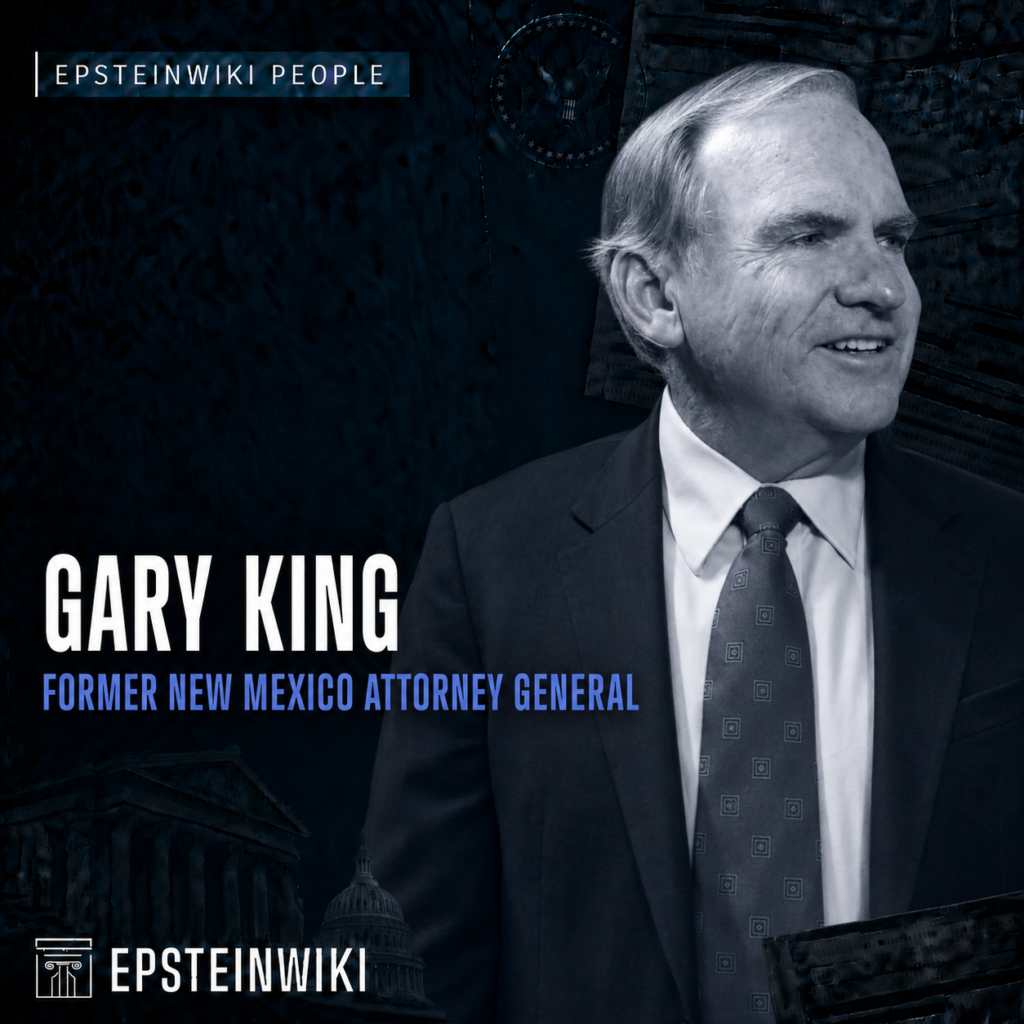
Former New Mexico Attorney General Gary King received campaign support connected to Jeffrey Epstein across three election cycles, met Epstein after his 2008 conviction, and used a charter arranged through an Epstein company during his 2014 campaign for governor. The public record documents access and financial support, but it does not establish that King participated in Epstein’s crimes or influenced New Mexico’s sex offender registration decision.
Snapshot
Full name: Gary Kenneth King
Also known as: Gary K. King
Born: September 29, 1954, in Stanley, New Mexico
Died: Not applicable
Nationality and citizenship: United States
Occupation and public role: Attorney, scientist, former New Mexico legislator, former New Mexico Attorney General, and former candidate for Congress and governor
EpsteinWiki classification: Political and law enforcement associate; campaign contribution recipient; documented meeting and travel connection
Documented Epstein connection: Campaign contributions from Epstein, people in his professional circle, and Epstein controlled entities; a 2010 meeting in Santa Fe; a 2014 fundraising request; and a September 2014 charter arranged through JEGE LLC
Legal status: King has not been charged with an Epstein related crime. No court has found that he participated in Epstein’s abuse, trafficking, or financial crimes. The New Mexico Survivors’ Truth Commission reported in August 2026 that it had found no evidence King investigated or prosecuted Epstein while serving as Attorney General.
Relevant period: 1993 to 2014, with renewed public scrutiny in 2026
Primary locations: Stanley, Moriarty, Santa Fe, and Albuquerque, New Mexico; Washington, District of Columbia
Associated organizations: New Mexico Office of the Attorney General; Gary King 2014; King for Congress; New Mexico Children’s Foundation; Zorro Trust; JEGE LLC; Maple Inc.; Neptune LLC; FT Real Estate; Laurel Inc.; Nautilus Inc.
Known Epstein Data profile: Epstein Data search results for Gary King
Key EFTA records: 2010 meeting arrangement; 2014 fundraising letter; companies or trusts email; charter request; charter financing instruction; passenger manifest; 2014 newspaper report preserved in bank files; documented Laurel refund
Related cases and investigations: Florida investigation and prosecution of Jeffrey Epstein; New Mexico Survivors’ Truth Commission; reopened New Mexico investigation into alleged crimes at Zorro Ranch
Content warning: This page discusses sexual abuse and trafficking allegations involving minors.
Key takeaway: The records establish a sustained political and logistical connection between Gary King and Epstein’s circle. They also create serious questions about judgment, disclosure, campaign finance, and institutional inaction. They do not, by themselves, prove that King participated in Epstein’s crimes or used his office to protect him.
Overview
Gary King served as New Mexico’s Attorney General from January 1, 2007, through January 1, 2015. That period covered Epstein’s 2008 Florida conviction, his return to New Mexico after completing custody and supervision in 2010, and years in which survivors have alleged abuse at Zorro Ranch.
King’s connection to Epstein was not a single photograph, a stray address book entry, or an isolated donation. The public record contains several distinct forms of contact.
Federal campaign data records donations to King’s 2004 congressional campaign from Epstein, Ghislaine Maxwell, Darren Indyke, and Eric Gany. A company called Zorro Trust contributed $15,000 to King’s 2006 campaign for Attorney General. King said at the time that he planned to return it after Epstein was charged in Florida.
In August 2010, an employee using an official New Mexico Attorney General email address arranged a meeting between King and Epstein at Jinja in Santa Fe. The meeting occurred after Epstein’s conviction and nine days after the New Mexico Department of Public Safety formally told Epstein that he did not have to register under state law for his Florida offense.
In 2014, Epstein’s records show renewed contact. A campaign letter addressed to Epstein thanked him for a personal commitment to raise $50,000. When Darren Indyke noticed that King’s campaign emphasized crimes against children and asked whether an Epstein contribution could generate press attention, Epstein replied, “good catch, lets use co s or trusts.” Contributions then arrived from companies associated with Epstein.
That same campaign asked about using Epstein’s plane for a trip from Santa Fe to Washington. Epstein’s staff arranged a charter through JEGE LLC. A trip sheet names King, Deb Haaland, and three campaign staff members as passengers. State campaign records reviewed by journalists show that the campaign reported paying the charter company.
These records establish access, political support, and coordination. They make King’s public explanations an important part of the story. They do not establish a corrupt bargain, participation in trafficking, or intervention in the registration decision.
Identity Verification
This page concerns Gary Kenneth King, the New Mexico politician and attorney, not the Harvard political scientist of the same name and not the television personality Gary King.
The New Mexico Secretary of State election archive identifies Gary K. King as the Democratic candidate in the 2004 congressional race, the winner of the 2006 and 2010 Attorney General races, and the Democratic nominee for governor in 2014.
The National Association of Attorneys General lists Gary K. King as New Mexico Attorney General from 2007 through 2014. The New Mexico Children’s Foundation currently lists Gary King of Moriarty as its president.
The records discussed on this page repeatedly connect the same identity to New Mexico government addresses, campaign committees, Moriarty, Santa Fe, and the title Attorney General. The identity match is strong.
Background
King is the son of Bruce King, who served three terms as governor of New Mexico. Gary King earned a bachelor’s degree in chemistry from New Mexico State University, a doctorate in organic chemistry from the University of Colorado Boulder, and a law degree from the University of New Mexico.
He served in the New Mexico House of Representatives and later worked in law, environmental consulting, and the United States Department of Energy. He ran for Congress in 2004, won election as Attorney General in 2006, won reelection in 2010, and became the Democratic nominee for governor in 2014.
Child protection and human trafficking were visible parts of King’s public record. During the 2014 governor’s race, his campaign website promoted his Internet Crimes Against Children work and promised stronger laws protecting children. That page became part of the Epstein correspondence when Indyke assessed the press risk of an Epstein contribution.
King is now retired from electoral politics. The New Mexico Children’s Foundation lists him as president of its board.
Documented Connection to Jeffrey Epstein
The connection developed across family property, campaign finance, a personal meeting, and travel arrangements.
In 1993, Epstein acquired the land that became Zorro Ranch from entities associated with the King family. A limited power of attorney in the federal production identifies King Brothers Ranch, King Land and Cattle Company, and Pine Canyon Ranch Inc. as sellers to Zorro Trust. The New Mexico Truth Commission states that Bruce King and his brothers Don and Sam King sold the property and that then Representative Rhonda King acted as realtor. Reuters later reported that Gary King was also a party to the sale. The available transaction excerpt linked here names the family entities rather than Gary King individually, so his precise personal role should be established from the complete closing file before it is described more specifically.
The political money trail is clearer. Federal campaign records show that Epstein, Maxwell, and Indyke each contributed $4,000 to King for Congress in 2004. Eric Gany, an accountant associated with Epstein’s office, contributed another $2,000. In 2006, Zorro Trust contributed $15,000 to King’s Attorney General campaign.
After King took office, the records show a confirmed meeting in 2010. Four years later, they show direct fundraising communication, contributions from Epstein associated companies, and a charter organized through Epstein’s office for King’s campaign travel.
Timeline
February and March 1993: Zorro Trust purchased land from King family entities. The property became Zorro Ranch. The transaction record identifies the selling entities. The New Mexico Truth Commission interim report identifies Bruce, Don, Sam, and Rhonda King in the transaction.
June through September 2004: Federal campaign data records two $2,000 contributions each from Epstein, Maxwell, and Indyke to King for Congress. Gany contributed $2,000.
August 2006: Zorro Trust contributed $15,000 to King’s Attorney General campaign. After Epstein was charged in Florida, King told the Santa Fe New Mexican that he planned to return the money and said he did not think he had ever met Epstein personally. The article is preserved in EFTA01713378.
January 1, 2007: King took office as New Mexico Attorney General.
February 8, 2007: FBI agents interviewed a Zorro Ranch manager. The FBI record says Epstein spent about fifty days a year at the ranch and sometimes brought or locally hired masseuses. The interview ended after the manager received a call from the “main office.” Reuters found no evidence that King knew about this federal inquiry, and King said the Justice Department did not inform his office.
June 30, 2008: Epstein pleaded guilty in Florida to procuring a person under eighteen for prostitution and soliciting prostitution. He became a registered sex offender.
July 23, 2010: The New Mexico Department of Public Safety notified Epstein that he was required to register with the sheriff in the county where he intended to reside. See EFTA00728275.
July 27 and July 30, 2010: Attorney Peter Schoenburg argued that Epstein’s Florida conviction did not match a qualifying New Mexico offense. See EFTA00727954 and EFTA00730001.
August 19, 2010: The Department of Public Safety reversed its initial position and told Epstein that state law did not require registration for the Florida conviction, while warning that federal requirements might still apply. See EFTA00731095.
August 20, 2010: Elisa Wood, writing from a New Mexico Attorney General email address, confirmed a meeting between Epstein and King at Jinja in Santa Fe for August 28. See EFTA00779086.
August 26, 2010: Epstein’s records noted that King’s assistant changed the meeting time from 3:30 to 4:30. See EFTA00895604.
August 28, 2010: King and Epstein met in Santa Fe. King later told Reuters they drank tea, discussed Epstein’s relationship with the Santa Fe Institute, and spoke about the death of Bruce King.
June 5, 2014: Epstein instructed an assistant that he wanted to speak with King. A separate reminder included King’s law office and cell numbers. See EFTA00368401 and EFTA00368426.
June 5, 2014: An Epstein assistant told King’s assistant Victoria that Epstein wanted to support King’s campaign for governor. See EFTA00368431.
June 13, 2014: Groff forwarded a campaign letter addressed to Epstein. The letter thanked him for his “personal commitment to raise $50,000.00” and was signed “Gary King.” See EFTA00367925.
June 17, 2014: Indyke sent Epstein a screenshot of King’s campaign page about crimes against children and asked whether accepting Epstein’s contributions risked additional news coverage. Epstein responded, “good catch, lets use co s or trusts.” See EFTA00870192.
July through September 2014: King’s campaign received more than $35,000 from companies sharing Epstein’s Virgin Islands address, according to a contemporary Santa Fe New Mexican article preserved in EFTA01296377.
August 21, 2014: An Epstein assistant reported that King wanted to discuss using Epstein’s plane for a September trip from Santa Fe to Washington and offered to pay fuel and airport costs. See EFTA00364267.
August 25, 2014: Epstein instructed staff to organize the trip and wrote that King could pay “11.6” while “we can arrange to pay through two diffent entities 10 4.” The wording appears to divide an estimated charter cost, but the precise financial meaning has not been conclusively established. See EFTA00364043.
August 25, 2014: A charter quote named JEGE LLC as the client and listed a total of $22,060.90. Related correspondence identified King as the lead passenger. See EFTA00364041 and EFTA00364053.
September 8, 2014: A trip information sheet recorded a charter from Santa Fe to Washington Dulles. The listed passengers were Gary King, Deb Haaland, Scott Tillman, Chris Khoury, and Kaleigh Hubbard. King’s finance director, Chris Khoury, communicated directly with Epstein accountant Richard Kahn about the flight. See EFTA00363159.
September 9, 2014: The Santa Fe New Mexican reported contributions totaling more than $35,000 from businesses using Epstein’s address. King’s campaign said improper contributions would be returned or donated to charity.
October 27, 2014: Banking records show a $5,000 check from Gary King 2014 credited to Laurel Inc. This establishes at least one refund. See EFTA01271585.
August 5, 2026: The New Mexico Survivors’ Truth Commission reported that it had found no evidence King took action as Attorney General to investigate or prosecute Epstein.
Evidence Appearances
2004 federal campaign records
Date: June through September 2004
Type: Federal campaign finance data
How King appears: Candidate whose committee received contributions from Epstein, Maxwell, Indyke, and Gany
What it establishes: Epstein, Maxwell, and Indyke each gave $4,000. Gany gave $2,000.
What it does not establish: It does not establish an illegal contribution, an agreement, or knowledge of later criminal conduct.
Direct source: Federal Election Commission 2004 individual contribution data
2006 contribution report
Date: August 16, 2006
Type: Newspaper report preserved in the federal production
How King appears: Recipient of a $15,000 Zorro Trust contribution
What it establishes: King publicly said he planned to return the money after Epstein was charged and said he did not think he had met Epstein personally.
What it does not establish: The article alone does not prove whether the refund was completed.
Direct source: EFTA01713378
2010 meeting email
Date: August 20 through August 28, 2010
Type: Email and scheduling record
How King appears: The New Mexico Attorney General scheduled to meet Epstein at Jinja in Santa Fe
What it establishes: The meeting was arranged using an official government email address and later occurred, according to King and the Truth Commission.
What it does not establish: It does not reveal the complete discussion and does not establish intervention in Epstein’s registration status.
Direct sources: EFTA00779086 and EFTA00895604
2014 fundraising letter
Date: June 5, 2014, forwarded June 13, 2014
Type: Campaign fundraising communication
How King appears: Signatory of a letter thanking Epstein for friendship, support, and a commitment to raise $50,000
What it establishes: Epstein received a highly personalized solicitation bearing King’s name and campaign address.
What it does not establish: The redacted sender metadata does not independently prove King personally drafted or sent the electronic copy.
Direct source: EFTA00367925
2014 press risk email
Date: June 17, 2014
Type: Email between Darren Indyke and Epstein
How King appears: Candidate whose child protection platform caused Indyke to raise concern about press coverage
What it establishes: Indyke explicitly raised the reputational risk of an Epstein contribution, and Epstein instructed him to use companies or trusts.
What it does not establish: It does not prove that King knew about this private exchange or approved the use of multiple entities.
Direct source: EFTA00870192
2014 contribution checks and reporting
Date: July through September 2014
Type: Checks, bank records, and campaign reporting
How King appears: Payee and recipient campaign
What it establishes: A JEGE LLC check for $5,200 and a Neptune LLC check for $5,200 were made payable to Gary King for Governor. Contemporary reporting identified more than $35,000 from businesses using Epstein’s address.
What it does not establish: The checks do not by themselves establish illegality, a quid pro quo, or King’s knowledge of the ownership and control of every entity.
Direct sources: JEGE check, Neptune check, and contemporaneous contribution report
2014 charter records
Date: August 21 through September 8, 2014
Type: Emails, quote, coordination record, and passenger manifest
How King appears: Requesting traveler, lead passenger, and named passenger
What it establishes: King’s side asked Epstein’s office about air travel. Epstein’s personnel organized a charter billed through JEGE LLC. King and four others traveled from Santa Fe to Washington.
What it does not establish: The records do not conclusively show who ultimately bore each portion of the cost. State records cited by Reuters and New Mexico Political Report show that the campaign reported paying the charter company.
Direct sources: EFTA00364267, EFTA00364043, EFTA00364041, EFTA00364053, EFTA00363159, and EFTA00310528
Communications
The surviving communications show that Epstein had direct routes into King’s political operation.
In June 2014, Epstein told an assistant that he wanted to speak with King. Groff contacted King’s assistant Victoria and said Epstein wanted to support King’s run for governor. The campaign letter that followed thanked Epstein for friendship and a $50,000 fundraising commitment.
In August, the travel request moved through the same channel. An assistant told Epstein that King was returning his call and wanted to discuss using his plane. Epstein then directed Kahn and pilot Larry Visoski to organize the flight. Khoury coordinated directly with Kahn on the day of travel.
These are not records of accidental proximity. They show functioning communication between the campaign and Epstein’s office. What they do not show is every conversation between King and Epstein, the full context of the $50,000 commitment, or whether King saw Indyke’s warning and Epstein’s companies or trusts instruction.
Travel and Location Records
The best documented trip occurred on September 8, 2014. The charter trip sheet lists JEGE LLC as the client, a Hawker 800XP as the aircraft, and Gary King as the first passenger. Deb Haaland, Scott Tillman, Chris Khoury, and Kaleigh Hubbard were also listed.
The route was Santa Fe Municipal Airport to Washington Dulles. New Mexico Political Report reviewed campaign finance records showing a $22,060 expenditure to Injet. Reuters likewise reported that King’s campaign paid for the flight.
The distinction between Epstein’s own aircraft and an outside charter matters. The correspondence shows that King initially asked about using Epstein’s plane. The final aircraft was a charter arranged by Epstein’s personnel through JEGE LLC. The evidence therefore supports “Epstein arranged charter” more precisely than “Epstein’s private jet.”
No travel record reviewed for this page places King at Zorro Ranch. King told Reuters he never visited the property. Claims that he attended private events there require a specific primary record before they should be treated as established.
Financial and Professional Connections
The 2004 congressional campaign
Federal Election Commission data for King for Congress records $4,000 from Epstein, $4,000 from Maxwell, $4,000 from Indyke, and $2,000 from Gany. The combined $14,000 establishes that several people associated with Epstein supported King’s federal campaign.
The contributions were publicly reported federal donations. Their existence does not establish a crime or concealed source.
The 2006 Attorney General campaign
Zorro Trust gave $15,000 to King’s campaign. King publicly promised to return it after Epstein was charged. A 2014 newspaper report said the money had been returned. Reuters reported in March 2026 that King said he did not return it because he was not aware of wrongdoing in 2006.
Those accounts conflict. A bank record, campaign expenditure report, or cancelled refund check is needed to resolve them.
The 2014 governor campaign
The Santa Fe New Mexican reported $35,600 from six companies using Epstein’s Virgin Islands address: JEGE LLC, Maple Inc., Neptune LLC, FT Real Estate, Laurel Inc., and Nautilus Inc. The report was preserved in a Deutsche Bank review file.
The timing and internal emails give the contributions added significance. Indyke raised press concerns because of King’s crimes against children platform. Epstein then directed him to use companies or trusts. That instruction came after the campaign letter explained that separate corporations could each contribute up to the state limit if they were not formed solely for giving.
The record proves that Epstein and Indyke discussed using multiple entities and that associated entities then contributed. It does not prove King was part of that discussion or that any entity was unlawfully created solely to evade contribution limits.
Refunds
A FirstBank record shows that Gary King 2014 issued a $5,000 check to Laurel Inc. on October 27, 2014. Reuters reported that the 2014 funds were returned to Epstein companies three days after the press report. The available bank record establishes at least one refund, but its October date does not match a return three days after September 9.
The complete refund ledger has not been published in the records reviewed here. The status of the remaining contributions should be verified through campaign expenditures and receiving bank statements.
The charter
Epstein wrote that King could pay “11.6” and that “we” could pay “10 4” through two entities. The outside charter quote totaled $22,060.90. Two contributions from JEGE and Maple totaling $10,200 arrived near the trip, according to campaign records cited by New Mexico Political Report.
The numerical proximity is notable, but it remains an inference. The campaign reported paying Injet. The present record does not conclusively prove that the contributions reimbursed part of the charter or that the campaign knowingly used contribution funds for a concealed subsidy.
The 2010 Registration Decision and Meeting
The timing deserves scrutiny because it is close and because King was the state’s chief legal officer.
On July 23, 2010, the New Mexico Department of Public Safety told Epstein he had to register. His lawyer challenged that conclusion. On August 12, the state sex offender registration program manager told a sheriff’s detective, “I guess” Epstein was not required to register under New Mexico law. Epstein completed a registration form on August 17. The Department of Public Safety formally reversed its initial position on August 19.
On August 20, an employee using a New Mexico Attorney General address confirmed King’s August 28 meeting with Epstein. The email referred to a telephone arrangement and supplied King’s cell number. King acknowledges that the meeting occurred.
The sequence raises an obvious question: did anyone in King’s office discuss the registration matter with the Department of Public Safety, the sheriff, Epstein, or Epstein’s lawyers?
No public record reviewed here answers yes. The Truth Commission’s statutory analysis concluded that Epstein’s Florida offense, involving a seventeen year old, did not match the New Mexico offense defined at the time because the relevant state provision covered a child from thirteen through sixteen. The Commission separately discussed the King meeting but did not report evidence that King caused or influenced the Department’s decision.
The responsible conclusion is therefore limited. The timing is documented and warrants records review. A causal connection is not established.
Allegations and Legal Proceedings
King has faced public allegations that he protected Epstein, concealed financial ties, knew about abuse at Zorro Ranch, or used his office to prevent scrutiny. These claims have appeared in political commentary, local reporting, and independent investigations.
The most consequential survivor related claim reported by The Pugilist concerns a 2009 interrogatory response in Palm Beach civil litigation. The publication reports that an anonymous plaintiff included King among many people she believed had knowledge of Epstein’s finances and sexual exploitation. This is an attributed allegation from a civil discovery response. It is not a judicial finding that King possessed such knowledge, and the basis for including his name must be evaluated from the complete filing and case record.
The New Mexico Truth Commission is examining institutional failures surrounding Zorro Ranch. It has authority to obtain records but is not a criminal court. Its August 2026 interim report said it had found no evidence that King investigated or prosecuted Epstein. That finding concerns the absence of documented official action. It is not, standing alone, proof that King knowingly protected Epstein.
No criminal charge or civil judgment reviewed for this page accuses King of participating in Epstein’s trafficking operation.
Denials, Responses, and Exculpatory Information
King told Reuters that he met Epstein only once. He described tea at Jinja, condolences after his father’s death, and a brief discussion of the Santa Fe Institute.
He said he never visited Zorro Ranch. No travel or visitor record reviewed for this page disproves that statement.
King said the Justice Department never told his office about the 2007 FBI inquiry at the ranch. Reuters reported that it found no evidence he knew about the federal probe.
He said he personally told Epstein that his campaign would not accept contributions after Epstein’s conviction. King characterized the later fundraising letters as routine mailings to past donors that he did not know had been sent to Epstein.
Regarding the 2014 charter, King said that if he had known of Epstein’s involvement, he would have asked staff to use another charter company. This response is difficult to reconcile with the email reporting that King wanted to discuss “using your plane” with Epstein. Still, the final aircraft was an outside charter, and the records do not show what details staff gave King about its booking or billing.
King has not been shown to have participated in Epstein’s sexual abuse or trafficking. The Dechert style distinction used in other Epstein cases applies here as well: documented association is not proof of criminal participation.
Court Findings and Legal Status
No court has found Gary King liable or guilty for conduct connected to Epstein.
No public criminal charge reviewed for this page names King as a participant in Epstein’s trafficking operation.
No court ruling reviewed here finds that King interfered with sex offender registration, directed law enforcement to stand down, received a bribe, or entered a corrupt exchange for campaign support.
The 2004 federal contributions appear in public campaign records. The 2006 and 2014 contributions were publicly reported in New Mexico campaign disclosures. Questions about source, entity control, refunds, and the charter’s final economics remain factual and regulatory questions unless an authorized agency or court reaches a legal conclusion.
What the Evidence Establishes
Documented facts
- King was New Mexico Attorney General from 2007 through 2014.
- His family entities sold the property that became Zorro Ranch to Zorro Trust in 1993.
- Epstein, Maxwell, Indyke, and Gany contributed to King’s 2004 congressional campaign.
- Zorro Trust contributed $15,000 to King’s 2006 Attorney General campaign.
- King met Epstein in Santa Fe on August 28, 2010, after Epstein’s conviction.
- A 2014 campaign letter addressed to Epstein thanked him for a $50,000 fundraising commitment.
- Indyke raised the risk of press coverage, and Epstein instructed him to use companies or trusts.
- Epstein associated companies contributed more than $35,000 to King’s 2014 governor campaign, according to contemporary campaign reporting.
- King’s campaign sought air travel through Epstein’s office, and JEGE LLC was listed as the charter client.
- King, Haaland, and three campaign staff members were named on the passenger manifest.
- At least $5,000 was returned to Laurel Inc.
- The Truth Commission found no evidence that King investigated or prosecuted Epstein while Attorney General.
Attributed allegations
- An anonymous civil plaintiff reportedly identified King as a person she believed had knowledge of Epstein’s finances and sexual exploitation.
- Independent commentators have alleged that King protected Epstein or knowingly concealed the relationship.
These allegations have not been adjudicated against King.
Disputed facts
- Whether the 2006 Zorro Trust contribution was returned.
- Whether all 2014 contributions were returned.
- How much King personally knew about Epstein’s role in arranging the 2014 charter.
- Whether Gary King personally participated in the 1993 ranch sale beyond the involvement of King family entities.
Reasonable inferences
- Epstein remained recognized within King’s political fundraising network after his conviction.
- Epstein and his advisers were conscious that public identification of his support could damage King.
- Epstein’s office had practical access to King’s campaign and could coordinate calls, money, and transportation.
These are evidence based inferences, not court findings.
Not established
- That King participated in Epstein’s abuse or trafficking.
- That King knew about the 2007 FBI interview while it was occurring.
- That King caused the 2010 registration reversal.
- That campaign contributions purchased an official act.
- That the charter arrangement violated campaign finance law.
- That every public allegation about King and Zorro Ranch is accurate.
Network and Institutional Significance
King matters to the Epstein record because his roles overlapped.
He was a member of the political family that sold the land used for Zorro Ranch. He received political support connected to Epstein over multiple campaigns. He was New Mexico’s chief legal officer after Epstein became a convicted sex offender. His office arranged a meeting with Epstein. His governor campaign later accepted money from Epstein associated companies and used travel organized through Epstein’s staff.
None of those facts alone establishes corruption. Together, they show how Epstein maintained access to public figures through ordinary channels: family familiarity, political giving, personal meetings, staff relationships, company checks, and logistical favors.
The institutional question is broader than King’s personal culpability. New Mexico did not conduct a known investigation of alleged abuse at Zorro Ranch during King’s tenure. Federal agents visited the property in 2007, but Reuters found no evidence King knew. The Department of Public Safety made the state registration decision, but the Attorney General meeting followed immediately afterward. The evidence is fragmented across agencies, campaign files, bank records, and Epstein’s own communications.
That fragmentation is precisely why a complete public accounting matters.
Survivor Perspective and Impact
The central harm in this story is not a campaign reporting dispute. It is the alleged abuse of girls and young women at a remote property that operated for years without a complete state investigation.
The Truth Commission’s timeline states that the first documented abuse at Zorro Ranch began in 1996 and that a fifteen year old was taken there and sexually abused in 2004, based on records tied to the Maxwell prosecution and sentencing. It also summarizes allegations that another survivor was taken to the ranch several times from 2007 through 2010.
For survivors, the question is not merely whether every contribution complied with the technical rules. It is whether political access, social familiarity, and fragmented authority helped create an environment in which Epstein faced too little scrutiny.
This page does not assign to King knowledge that the current evidence does not prove. It does recognize why survivors and the public are entitled to ask what the state’s chief legal officer knew, what information reached his office, why he met Epstein after the conviction, and why his campaign later welcomed support linked to Epstein.
Media Coverage and Public Statements
Reuters reported in March 2026 that King denied wrongdoing, said he had minimal contact with Epstein, denied knowing Epstein’s role in the charter, and said his office was never told about the 2007 federal inquiry. Reuters found no evidence that King knew of that inquiry. It also reported that the campaign paid for the charter and returned the 2014 contributions.
New Mexico Political Report documented the charter, passenger manifest, campaign expenditure, and contributions near the time of the trip. A second investigation connected the fundraising letter to Indyke’s press concern and Epstein’s instruction to use companies or trusts.
KOB interviewed King about the newly released records. His initial explanation placed responsibility for arranging the flight with staff and former Governor Bill Richardson. The underlying emails show direct coordination between King’s campaign and Epstein’s office, although they do not prove what King was told about the final outside charter.
Independent journalist Alisa Valdes Rodriguez examined King’s current child advocacy role in The Pugilist and later reported on the 2009 civil interrogatory. Her reporting has surfaced important questions and primary record leads. Some conclusions in those articles go beyond what the presently verified records establish, so this page attributes them rather than adopting them as findings.
Reliability and Limitations
The strongest evidence on this page consists of official campaign data, contemporaneous emails, checks, bank records, a passenger manifest, FBI records, and the New Mexico Truth Commission report.
Several limitations remain.
Some EFTA records contain optical character recognition errors. Check images and financial amounts should be reviewed against the page image, not only extracted text.
The 2006 refund accounts conflict. The 2014 refund record is incomplete in the public materials reviewed here.
The 2010 timing is documented, but timing alone does not prove influence. No communication has been located showing King or his staff intervening in the Department of Public Safety decision.
The campaign letter bears King’s name, but the sender metadata is redacted. It is therefore possible that staff generated or transmitted the letter through a standard fundraising process.
The charter communications show Epstein’s involvement in arranging travel, but the final allocation of costs is unresolved.
Independent reporting is useful for leads and context. Claims from commentary or civil allegations are not treated as adjudicated fact.
Unanswered Questions and Further Investigation
- Did anyone in King’s office communicate with the Department of Public Safety, the Santa Fe County Sheriff, or Epstein’s counsel about the registration issue before the August 19, 2010 decision?
- What official purpose, if any, did the August 28, 2010 meeting serve, and do King’s calendar, briefing materials, notes, visitor records, or archived email preserve a fuller account?
- Who initiated the meeting, and what did the phrase “the arrangement we spoke about on the telephone” refer to?
- Was the $15,000 Zorro Trust contribution from 2006 actually returned? If so, when, to whom, and through which account?
- Were all six Epstein associated company contributions from 2014 returned? The Laurel refund is documented, but where are the corresponding records for JEGE, Maple, Neptune, FT Real Estate, and Nautilus?
- Who drafted, approved, and sent the campaign letter thanking Epstein for a $50,000 fundraising commitment?
- Did King or senior campaign staff know of Indyke’s concern about press coverage or Epstein’s instruction to use companies or trusts?
- How was the $22,060.90 charter ultimately paid? What did Epstein mean by paying “10 4” through two entities, and did nearby company contributions have any connection to the trip?
- What information, if any, did federal authorities share with the Attorney General’s office after the 2007 interview at Zorro Ranch?
- Did King’s office receive any survivor complaint, law enforcement referral, civil filing, tip, or intelligence concerning Epstein between 2007 and 2014?
- What was Gary King’s precise legal and financial role in the 1993 ranch transaction? Reuters called him a party to the sale, while the available federal excerpt identifies King family entities as sellers.
- Why did a campaign built partly around protecting children continue to treat Epstein as a fundraising contact after his 2008 conviction?
- Will the Truth Commission obtain testimony from King, his 2010 scheduler, his 2014 assistant, his campaign finance director, Epstein’s surviving staff, and the officials who handled the registration decision?
Fact Check
Identity: Verified through state election records, former Attorneys General records, campaign documents, and current nonprofit records.
Attorney General tenure: Verified. January 1, 2007, through January 1, 2015.
1993 ranch sale: Verified as a sale from King family entities to Zorro Trust. Gary King’s individual role remains incompletely documented in the primary material reviewed here.
2004 contributions: Verified in Federal Election Commission bulk data.
2006 Zorro Trust contribution: Verified through contemporaneous reporting. Refund status is disputed.
2010 meeting: Verified by official email records, King’s acknowledgment, and the Truth Commission report.
Connection between meeting and registration decision: Not established.
2014 $50,000 letter: Verified as a campaign letter addressed to Epstein and signed in King’s name. Personal authorship is not independently established.
Companies or trusts instruction: Verified as a communication from Epstein after Indyke raised press concerns. King’s knowledge of that exchange is not established.
2014 company contributions: Verified through check images, contemporaneous campaign reporting, and bank records.
2014 charter and passengers: Verified through emails, charter documents, and a passenger manifest.
Campaign payment for charter: Reported by Reuters and New Mexico Political Report from state campaign records.
2014 refunds: At least one $5,000 Laurel refund is verified. Complete repayment of all contributions has not been independently established from the bank records reviewed here.
Criminal participation by King: Not established.
Last checked: September 3, 2026
Related People and Organizations
- Jeffrey Epstein
- Ghislaine Maxwell
- Darren K. Indyke
- Richard Kahn
- Deb Haaland
- Bruce King
- New Mexico Department of Public Safety
- Santa Fe County Sheriff’s Office
- New Mexico Survivors’ Truth Commission
- New Mexico Children’s Foundation
- Zorro Trust
- JEGE LLC
- Laurel Inc.
Related EpsteinWiki Pages
- Properties of Jeffrey Epstein: Zorro Ranch New Mexico
- Zorro Ranch Entities and Jeffrey Epstein
- Epstein’s New Mexico Political Money Trail
- New Investigation into Jeffrey Epstein’s Zorro Ranch
- Zorro Ranch Investigation
- New Mexico Sues the Justice Department Over Zorro Ranch Epstein Files
- Darren Indyke: Jeffrey Epstein’s Lawyer, Trustee, Financial Signatory, and Estate Coexecutor
Source List
Primary and official sources
- New Mexico Survivors’ Truth Commission interim report
- New Mexico Secretary of State election history for Gary K. King
- Federal Election Commission 2004 individual contribution data
- New Mexico Children’s Foundation board
- 1993 Zorro Trust transaction record, EFTA00065856
- 2006 contribution coverage, EFTA01713378
- 2007 FBI Zorro Ranch interview file, EFTA01688746
- Initial New Mexico registration letter, EFTA00728275
- Registration argument, EFTA00727954
- Supplemental registration argument, EFTA00730001
- New Mexico registration decision, EFTA00731095
- Gary King meeting arrangement, EFTA00779086
- Meeting time change, EFTA00895604
- Epstein asks to speak with King, EFTA00368401
- Call reminder with King contact information, EFTA00368426
- Campaign support contact, EFTA00368431
- Campaign fundraising letter, EFTA00367925
- Press risk and companies or trusts email, EFTA00870192
- King charter request, EFTA00364267
- Epstein charter financing instruction, EFTA00364043
- Charter quote and coordination, EFTA00364041
- Lead passenger correspondence, EFTA00364053
- Campaign and Epstein office coordination, EFTA00363159
- Passenger manifest, EFTA00310528
- JEGE LLC check, EFTA01292978
- Neptune LLC check, EFTA01348769
- 2014 contribution report preserved in bank records, EFTA01296377
- Laurel Inc. refund record, EFTA01271585
Reporting and independent investigations
- Reuters investigation of Epstein’s New Mexico political relationships
- New Mexico Political Report investigation of the 2014 charter
- New Mexico Political Report investigation of the fundraising record
- KOB interview with Gary King
- The Pugilist investigation of King and the New Mexico Children’s Foundation
- The Pugilist investigation of the 2009 civil interrogatory