
Governor John de Jongh
Snapshot
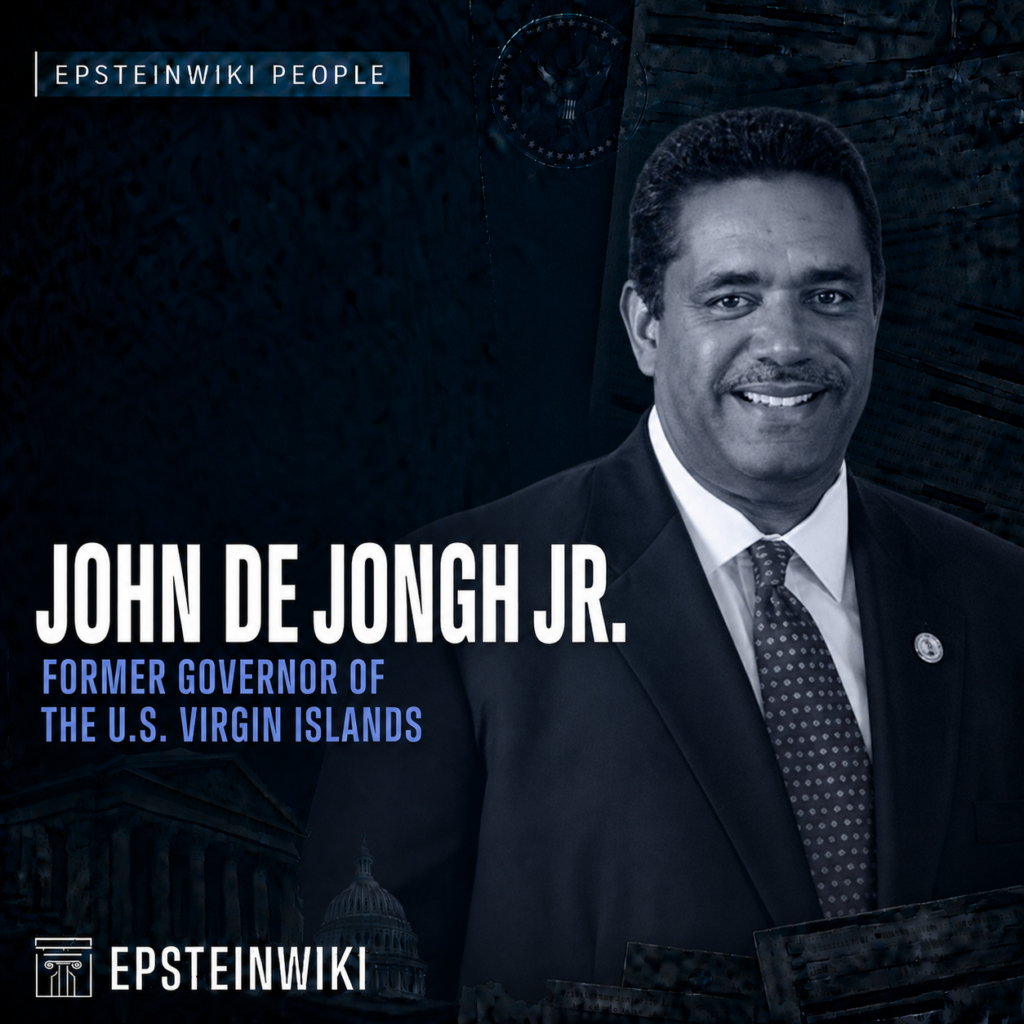
John Percy de Jongh Jr. served as Governor of the United States Virgin Islands from January 2007 until January 2015.
His administration coincided with an important period in Jeffrey Epstein’s relationship with the territory. During those years, Epstein operated companies receiving substantial Virgin Islands tax benefits, maintained Little Saint James as a private residence, registered locally as a sex offender, and continued bringing girls and young women to the islands.
The connection between Epstein and the de Jongh administration was unusually personal. Cecile de Jongh, the Governor’s wife and First Lady, worked for Epstein’s Virgin Islands businesses. Court records describe her as an office manager, compliance employee, accountant, and director associated with Financial Trust Company and Southern Trust Company.
Released emails and litigation exhibits show that Epstein paid educational expenses benefiting members of the de Jongh family, made political and charitable contributions, communicated with Cecile de Jongh about government officials and legislation, and received assistance navigating territorial agencies.
John de Jongh personally approved extensions of Economic Development Commission benefits for Epstein businesses in 2009 and 2013. A litigation expert later reported that no procedure was used to examine or manage the potential conflict created by the First Lady’s employment and the financial benefits received by the family.
JPMorgan Chase argued during 2023 litigation that the de Jongh family and other Virgin Islands officials helped Epstein acquire political access and favorable treatment. The Virgin Islands government answered that the bank was selecting and mischaracterizing evidence to divert attention from its own banking relationship with Epstein.
A separate civil action filed by six Epstein survivors named John de Jongh as a defendant and alleged that Virgin Islands political officials helped make the territory a safe haven for Epstein. The claims against de Jongh were dismissed in March 2025 because the New York court lacked personal jurisdiction over him. The court did not conduct a trial or determine whether the allegations against him were true.
The public evidence establishes a close institutional and financial relationship between Epstein, the de Jongh household, and the territorial government. It does not establish that John de Jongh personally participated in sexual abuse or that he was convicted of an Epstein related offense.
Political and Professional Background
John Percy de Jongh Jr. was born on Saint Thomas in 1957 and graduated from Antioch College with a degree in economics.
Before becoming Governor, he worked in banking, economic development, public finance, real estate, and financial consulting. His positions included Commissioner of Finance, executive director of the Virgin Islands Public Finance Authority, and an executive role with Chase Manhattan Bank.
The National Governors Association profile of John de Jongh records that he took office on January 1, 2007, and served until January 5, 2015. He was elected as a Democrat and completed two terms.
His administration promoted economic diversification, tourism, energy conservation, early childhood programs, and use of the Virgin Islands Economic Development Commission program to attract businesses.
That economic development system was also central to Epstein’s financial presence in the territory.
Epstein’s Virgin Islands Operations
Epstein purchased Little Saint James in 1998 and used the island as a residence, social venue, and location where survivors reported sexual abuse and trafficking.
His Virgin Islands companies included Financial Trust Company and Southern Trust Company. These entities received Economic Development Commission benefits that sharply reduced qualifying territorial taxes.
The benefits were intended to encourage local employment, investment, and economic activity. In exchange, a beneficiary was required to satisfy employment, residency, investment, and charitable contribution requirements.
Epstein presented his businesses as producing financial, scientific, and informatics work. Later investigations questioned whether the companies conducted the activities described in their applications and whether they supplied the economic benefits promised to the territory.
The Government of the Virgin Islands ultimately alleged in its civil action against the Epstein estate that Epstein used a network of companies to conceal and support criminal activity.
That litigation ended in a settlement rather than a trial establishing every allegation.
Cecile de Jongh’s Employment by Epstein
Cecile René de Jongh was First Lady throughout John de Jongh’s two terms as Governor.
At the same time, she worked for Epstein and his Virgin Islands companies.
EFTA00003149 is a released organizational record identifying Cecile de Jongh within Epstein’s Saint Thomas business administration. Other court records described her as Epstein’s office manager, compliance employee, head accountant, and a director of Financial Trust Company.
In the 2025 decision addressing survivor claims, the court noted that the plaintiffs alleged Cecile de Jongh worked for Financial Trust Company or Southern Trust Company from 2000 through 2019. The court also observed that the parties repeatedly described her as an Epstein employee.
Released correspondence shows that she handled:
- Company administration
- Economic Development Commission compliance
- Property and staff matters
- Meetings with territorial officials
- Charitable contribution planning
- Immigration and education arrangements
- Responses to regulators
- Communications concerning legislation
- Political introductions
- Epstein’s relationships with government departments
A Deutsche Bank presentation released as EFTA01681865 identified a substantial payment from Southern Trust Company associated with Cecile de Jongh.
JPMorgan alleged that she received approximately $200,000 in salary and bonuses during 2007, the year her husband became Governor. The exact amount and characterization of every payment should be verified against the underlying payroll and banking records.
Her employment does not automatically prove that John de Jongh knew the contents of every email or every task she performed. It does establish that Epstein employed the sitting Governor’s wife while seeking government benefits and regulatory assistance.
Tuition Payments for the de Jongh Family
Released emails and payment records show that Epstein paid college expenses benefiting children of the de Jongh family.
A June 2009 exchange contained tuition invoices connected with American University, Elon University, Skidmore College, and Wake Forest University. The combined request totaled approximately $70,000 and included expenses for de Jongh family members and children associated with another Virgin Islands political and accounting figure.
Epstein described the payments as a personal favor and compared the experience to having children of his own in college.
Additional 2011 correspondence cited in the JPMorgan litigation concerned a Skidmore College tuition invoice of approximately $25,000.
The payments are significant because they benefited the household of a sitting Governor while Epstein’s companies depended on territorial tax approvals and regulatory decisions.
They do not by themselves prove a contractual exchange between Epstein and John de Jongh.
John de Jongh was questioned about the tuition records during his 2023 deposition. Released portions of that testimony appear in EFTA02813457.
The deposition documents what de Jongh was asked and how he responded under oath. It should be read with the exhibits because selected excerpts may not contain every qualification or explanation.
Political and Charitable Payments
JPMorgan’s court filings alleged that Epstein made several payments benefiting de Jongh political or governmental interests.
The filings described:
- A contribution associated with the Governor’s Special Events Fund
- Tuition payments that reduced the family’s educational expenses
- Political contributions and support
- Charitable contributions selected with advice from territorial contacts
- A possible offer of financial assistance when de Jongh later faced an unrelated territorial prosecution
Local reporting on the unredacted filing stated that Cecile de Jongh told Epstein that his educational assistance allowed family resources to be redirected toward John de Jongh’s political campaign.
These statements appeared in adversarial litigation filed by JPMorgan while the bank was defending itself against the Virgin Islands government. They should therefore be presented as claims supported by cited documents, not as neutral findings made after trial.
Epstein’s donations also served his Economic Development Commission obligations and public image. A charitable payment could therefore provide tax compliance, political access, favorable publicity, or a combination of those benefits.
The fact that a school or children’s organization received Epstein money does not establish that its staff knew about his conduct.
Economic Development Commission Approvals
Epstein’s companies received major benefits through the Virgin Islands Economic Development Commission program.
A 2023 expert report filed in the JPMorgan litigation stated that John de Jongh ultimately approved Economic Development Commission benefits for Financial Trust Company in 2009 and Southern Trust Company in 2013.
The relevant portion is preserved in JPMorgan litigation Exhibit 90.
The expert reported that the approvals occurred while:
- Cecile de Jongh worked for Epstein’s companies
- Epstein paid her compensation
- Epstein paid expenses benefiting the de Jongh family
- Epstein’s businesses sought large tax reductions
- Territorial agencies possessed information relevant to Epstein’s conviction and business representations
The expert said she found no procedure used by the territory to investigate or manage the potential conflict.
The report cited John de Jongh’s deposition testimony that no special conflict measures were put in place.
An expert report is analysis prepared for litigation. It is not itself a verdict. The JPMorgan case settled before the expert’s conclusions could be tested before a jury.
The underlying approval records nevertheless establish that gubernatorial action formed part of the process through which Epstein’s businesses retained valuable tax benefits.
The Estimated Value of Epstein’s Tax Benefits
JPMorgan argued that Epstein received more than $300 million in tax incentives from the Virgin Islands over approximately two decades.
Other analyses produced smaller estimates depending on the years, companies, and tax categories counted. Former Attorney General Denise George estimated that the Southern Trust arrangement alone may have saved Epstein tens of millions of dollars.
The exact total remains disputed.
The central point does not depend on one number. Epstein’s territorial tax treatment was extremely valuable, and the continuation of those benefits depended on local administrative and political decisions.
A responsible account should distinguish between:
- Taxes Epstein actually paid
- Credits or exemptions claimed
- Benefits approved but not fully used
- Estimates prepared by litigants
- Amounts recovered through later settlements
Sex Offender Registration and Monitoring
Epstein was required to register as a sex offender in the Virgin Islands after his 2008 Florida conviction.
Released correspondence shows that Epstein communicated with Cecile de Jongh about proposed Virgin Islands sex offender legislation. He sought provisions that would reduce restrictions on travel, protect information about his companions, and distinguish between different classifications of offenders.
Cecile de Jongh forwarded proposed language and said she would communicate his suggestions.
JPMorgan cited later correspondence in which she discussed working with senators and Attorney General Vincent Frazer to obtain favorable discretion after the legislation did not develop as Epstein wanted.
The records establish that Epstein was given an opportunity to comment privately on legislation directly affecting him.
They do not establish that John de Jongh personally drafted the legislation or adopted every change Epstein requested.
Denise George’s FBI Interview
Former Virgin Islands Attorney General Denise George was interviewed by the FBI in October 2023.
The interview summary is preserved in EFTA00129035.
According to the FD 302, George said she believed former Attorney General Vincent Frazer initially intended to require Epstein to report like other registered offenders but later authorized a waiver.
The report states that George believed Frazer was pressured by Governor John de Jongh.
George also said she believed Epstein moved assets into the Virgin Islands because of his relationship with de Jongh and that Epstein’s Economic Development Commission activity required investigation.
These are serious statements, but their evidentiary category must be preserved.
An FD 302 records what agents understood a witness to have said. It is not a verbatim transcript, and George’s belief is not equivalent to an FBI finding that the alleged pressure occurred.
The record does not show a criminal judgment determining that John de Jongh improperly pressured Frazer.
Visas and University Arrangements for Young Women
JPMorgan alleged that Cecile de Jongh helped arrange student visas, employment, and educational programs for women connected with Epstein.
One released exchange concerned special classes at the University of the Virgin Islands. Cecile told Epstein that the program was being structured around the women and asked whether they should proceed.
The same body of litigation alleged that Epstein made a donation to the university during the relevant period.
These records require careful language. They establish that Cecile de Jongh assisted with education and immigration logistics for women in Epstein’s network.
Whether every woman was an identified trafficking survivor, whether university officials understood Epstein’s purpose, and whether John de Jongh knew the circumstances must be evaluated separately.
The public documents do not establish that John de Jongh personally processed a visa or directed a university to create a fraudulent program.
Government Access Through the First Lady
Correspondence described in the JPMorgan litigation presents Cecile de Jongh as an intermediary between Epstein and the Virgin Islands government.
She communicated with him about customs officials, regulators, senators, agency heads, candidates, and attorneys general. She advised him about donations and relationships that could produce political access.
JPMorgan characterized her as Epstein’s primary conduit for distributing money and influence through the territorial government.
That is the bank’s litigation characterization. It was disputed by the Virgin Islands, which accused JPMorgan of attempting to shift responsibility for its own continued banking relationship with Epstein.
The underlying communications nevertheless show that Epstein’s access was not confined to ordinary applications submitted at arm’s length. He possessed a direct channel through the Governor’s household.
John de Jongh’s Direct Contact With Epstein
John de Jongh also communicated directly with Epstein.
EFTA00968097 preserves a November 2017 email sent from John de Jongh to an Epstein email address with the subject “Thanks.”
The existence of the message establishes direct contact after de Jongh left office. The available page does not by itself provide enough context to determine the complete reason for the thanks or the value of any favor involved.
Calendar records, deposition exhibits, and testimony provide additional evidence that the two men were acquainted.
The documentary record concerning John de Jongh is less extensive than the record concerning Cecile. Researchers should not automatically attribute every action taken by Cecile to her husband without evidence connecting him to that action.
At the same time, the combination of direct contact, family benefits, gubernatorial approvals, and Cecile’s unusual employment creates legitimate questions about conflicts, disclosure, and oversight.
The 2023 Deposition
John de Jongh was deposed in May 2023 during Government of the United States Virgin Islands v. JPMorgan Chase Bank.
He was questioned about:
- His relationship with Epstein
- Cecile de Jongh’s employment
- Tuition payments
- Economic Development Commission approvals
- Conflict procedures
- Government contacts
- Epstein’s political and charitable contributions
- The territorial response to Epstein’s sex offender status
The deposition is important because it records de Jongh’s sworn answers rather than a reporter’s summary or a lawyer’s description.
Only portions became readily accessible through filed exhibits. Any analysis should identify whether it relies on the full transcript or a selected excerpt.
A deposition establishes what the witness said under oath. It does not mean that the judge or jury accepted every answer as accurate.
The JPMorgan Litigation
The Virgin Islands sued JPMorgan Chase in December 2022, alleging that the bank knowingly benefited from and facilitated Epstein’s trafficking operation.
JPMorgan responded by arguing that the territorial government had unclean hands and had itself enabled Epstein.
The bank relied heavily on the relationships involving Cecile de Jongh, John de Jongh, other governors, senators, regulators, and Economic Development Commission officials.
The Virgin Islands said JPMorgan was attacking the territory to obscure evidence that the bank had processed Epstein transactions while possessing extensive information about him.
Both sides had strategic reasons for emphasizing the other institution’s failures.
The litigation generated a major documentary record, including depositions from John de Jongh, Cecile de Jongh, former Governor Kenneth Mapp, Governor Albert Bryan Jr., banking employees, and territorial officials.
The case settled in September 2023. JPMorgan agreed to pay the Virgin Islands $75 million, including funding allocated to services addressing trafficking and victim support. The settlement contained no admission of liability.
Because the case settled, a jury did not determine the disputed allegations concerning the de Jongh administration.
The Survivor Lawsuit Against Virgin Islands Officials
In November 2023, six anonymous Epstein survivors filed Doe v. Government of the United States Virgin Islands.
The complaint named the territorial government and several political figures, including John de Jongh, Cecile de Jongh, Kenneth Mapp, Vincent Frazer, Celestino White, Carlton Dowe, and Stacey Plaskett.
The plaintiffs alleged that officials helped create a safe haven in which Epstein could transport, exploit, and abuse women and girls.
John de Jongh denied liability and moved to dismiss.
In a March 2025 opinion, the court dismissed the claims against John de Jongh because it lacked personal jurisdiction over him in New York.
The court found that allegations involving money transferred from a New York bank account did not establish sufficient New York contact by de Jongh.
This was a jurisdictional ruling. It did not determine that the survivors’ factual allegations were false, and it did not find de Jongh liable.
The claims against Cecile de Jongh were dismissed on a different ground. The court concluded that releases signed in connection with earlier Epstein estate compensation covered people who had worked for Epstein.
The Unrelated Residence Expenditure Case
After leaving office, John de Jongh faced territorial charges concerning public money spent on security improvements at his private residence while he was Governor.
The charges were dismissed with prejudice in 2016 after an agreement involving repayment of government funds.
Those proceedings were not an Epstein trafficking prosecution.
They become relevant to this article only because JPMorgan later alleged that Epstein was willing to provide de Jongh financial assistance during the dispute.
An offer of assistance does not establish that a loan was completed. The residence case must not be misrepresented as an Epstein related conviction.
Epstein Sleuth Investigations
Independent researchers have examined the de Jongh family as a central part of Epstein’s Virgin Islands network.
The Epstein Data report USVI Financial Services Legislation traces how Epstein, his attorneys, and political intermediaries continued pursuing favorable territorial legislation after the de Jongh administration. It also documents Cecile de Jongh’s continuing role in arranging access to Governor Kenneth Mapp.
Ashleigh Alauren’s investigation They Knew reviews court exhibits concerning Virgin Islands officials, Epstein’s companies, and the political environment surrounding Little Saint James.
Rick Elizondo’s The Women in the Room: The Machinery Part 2 examines relationships among Cecile de Jongh, Epstein employees, accountants, and political operations.
The investigation The First Lady Who Ran Errands for a Monster assembles emails and public records concerning Cecile de Jongh’s employment and government access.
The One Woman Speaking John de Jongh index highlights tuition payments and references to the former Governor within the released files.
These investigations are useful for identifying connections across large document collections. Their language and conclusions remain independent research and should be verified against the underlying emails, court exhibits, and government records.
What the Evidence Establishes
The available evidence establishes that:
- John de Jongh served as Governor of the United States Virgin Islands from 2007 until 2015.
- Epstein maintained major business, property, and political interests in the territory during those years.
- Cecile de Jongh worked for Epstein while serving as First Lady.
- Epstein paid substantial compensation connected with Cecile de Jongh’s work.
- Epstein paid educational expenses benefiting members of the de Jongh family.
- John de Jongh approved Economic Development Commission benefits for Epstein businesses in 2009 and 2013.
- No special conflict procedure was identified during John de Jongh’s deposition.
- Epstein communicated with Cecile de Jongh about territorial legislation affecting his sex offender obligations.
- Cecile de Jongh helped Epstein communicate with officials and navigate territorial agencies.
- Cecile assisted with education and immigration arrangements for women connected with Epstein.
- John de Jongh communicated directly with Epstein.
- John de Jongh was deposed during the Virgin Islands litigation against JPMorgan.
- Denise George told the FBI she believed de Jongh pressured Attorney General Frazer concerning an Epstein reporting waiver.
- George’s statement was recorded in an FD 302 rather than adjudicated at trial.
- JPMorgan accused the de Jongh family and other officials of helping Epstein obtain influence and favorable treatment.
- The Virgin Islands disputed JPMorgan’s characterization.
- The JPMorgan case settled without a jury verdict.
- Epstein survivors later sued John de Jongh and other Virgin Islands officials.
- The claims against John de Jongh were dismissed for lack of personal jurisdiction in New York.
- The dismissal did not constitute a factual finding that every allegation was false.
What the Evidence Does Not Establish
The available evidence does not establish that:
- John de Jongh personally sexually abused an Epstein survivor.
- John de Jongh personally recruited women or girls for Epstein.
- Every woman assisted through a university or visa process was a trafficking victim.
- John de Jongh knew the contents of every message exchanged between Cecile and Epstein.
- Every political or charitable payment represented a bribe.
- Epstein’s payment of tuition proves a specific agreement to exchange government action for money.
- John de Jongh personally drafted the sex offender legislation discussed with Epstein.
- Denise George’s belief that de Jongh pressured the Attorney General constitutes an FBI finding.
- Every Economic Development Commission official knew Epstein’s business representations were inaccurate.
- The approval of tax benefits proves knowledge of Epstein’s trafficking operation.
- The estimated $300 million value of Epstein’s tax benefits is undisputed.
- The JPMorgan settlement established the truth of every allegation made by either side.
- The survivor lawsuit produced a verdict against John de Jongh.
- The New York court dismissed the claims after deciding their factual merits.
- John de Jongh was convicted of an Epstein related offense.
- The unrelated residence expenditure case resulted in a criminal conviction.
Investigative Assessment
John de Jongh’s importance to the Epstein record arises from the convergence of public authority, private family benefits, and regulatory decisions.
The Governor’s wife was not merely a social acquaintance listed in an address book. She was a paid Epstein employee who managed local business and government relationships while serving as First Lady.
At the same time, Epstein paid expenses benefiting the Governor’s family, sought access to officials, commented on laws directly affecting him, and depended on gubernatorial approval for valuable tax benefits.
Those facts created an evident conflict risk. The absence of a documented procedure for disclosure, recusal, or independent review is therefore significant.
The evidence against John de Jongh personally remains different from the evidence concerning Cecile. Her emails document direct operational activity. The public record concerning him consists primarily of official approvals, family benefits, deposition testimony, direct but limited correspondence, allegations made during litigation, and Denise George’s reported belief concerning political pressure.
That record supports describing de Jongh as a central government figure within Epstein’s Virgin Islands political environment.
It does not presently support stating as established fact that he knowingly participated in Epstein’s trafficking operation.
The unresolved investigative question is not simply whether de Jongh knew Epstein. It is whether the Governor understood the extent to which Epstein’s money, his wife’s employment, and territorial decision making had become intertwined, and what actions he took to protect the public from that conflict.
Key Takeaways
- John de Jongh governed the Virgin Islands during a critical period of Epstein’s territorial activity.
- His wife worked for Epstein throughout the administration.
- Epstein paid expenses benefiting the de Jongh family.
- De Jongh approved valuable tax benefits for Epstein businesses.
- The record does not identify a special conflict review or recusal process.
- Epstein was allowed to communicate indirectly about legislation governing his sex offender status.
- Cecile de Jongh acted as an intermediary between Epstein and territorial officials.
- Denise George later told the FBI she believed de Jongh pressured an Attorney General concerning Epstein’s reporting obligations.
- That statement records George’s belief and is not an adjudicated finding.
- JPMorgan used the de Jongh relationship to argue that the Virgin Islands government helped Epstein.
- The Virgin Islands accused JPMorgan of shifting responsibility for its own conduct.
- The banking case settled without a trial.
- Survivors sued John de Jongh, but the claims were dismissed for lack of New York jurisdiction.
- The dismissal did not resolve the underlying factual allegations.
- No public court judgment reviewed for this article found John de Jongh liable for participating in Epstein’s trafficking operation.
Related EpsteinWiki Articles
- Jeffrey Epstein
- Little Saint James
- Cecile de Jongh
- Governor Kenneth Mapp
- Governor Albert Bryan Jr.
- Denise George
- Vincent Frazer
- Stacey Plaskett
- Government of the U.S. Virgin Islands v. JPMorgan Chase
- Territory of the U.S. Virgin Islands v. Epstein Estate
- Economic Development Commission Tax Benefits
- Southern Trust Company
- Financial Trust Company
- Witness Statements and Depositions Litigation
- How to Read an Epstein Document
Primary Court and Government Sources
- National Governors Association profile of John de Jongh
- Virgin Islands election archive entry for John de Jongh
- Government of the United States Virgin Islands v. JPMorgan Chase docket
- Department of Justice JPMorgan court record archive
- JPMorgan litigation Exhibit 90
- Doe v. Government of the United States Virgin Islands docket
- March 2025 dismissal opinion
- Virgin Islands complaint against the Epstein estate
- Virgin Islands Epstein estate probate archive
- Reuters report on the Virgin Islands and JPMorgan allegations
- Washington Post report on Cecile de Jongh and Epstein
- Virgin Islands Consortium report on the unredacted JPMorgan filing
- Elon News Network report on the tuition records
Primary Epstein Data Evidence
- EFTA00003149 identifies Cecile de Jongh within Epstein’s Virgin Islands business administration.
- EFTA01681865 contains a Deutsche Bank presentation discussing notable payments connected with Epstein’s entities, including material associated with Cecile de Jongh.
- EFTA02813457 contains a filed exhibit with John de Jongh deposition material from the JPMorgan litigation.
- EFTA00968097 preserves a November 2017 email from John de Jongh to Epstein with the subject “Thanks.”
- EFTA00129035 is the FBI interview summary recording Denise George’s statements concerning Epstein, John de Jongh, Vincent Frazer, and Economic Development Commission activity.
- EFTA02600402 contains a later released record indexed to John de Jongh.
- EFTA00276786 contains an Epstein personnel roster identifying Cecile de Jongh with Virgin Islands government related responsibilities.
- EFTA01852880 documents Cecile de Jongh arranging a proposed Epstein meeting with gubernatorial candidate Kenneth Mapp.
- EFTA01746665 contains Cecile de Jongh’s later briefing for Epstein concerning Governor Mapp and territorial government issues.
Each document should be classified according to what it is. An email establishes a communication. A deposition establishes sworn testimony. An FD 302 establishes what agents recorded from an interview. A litigation exhibit does not automatically represent a judicial finding.