
Denise George
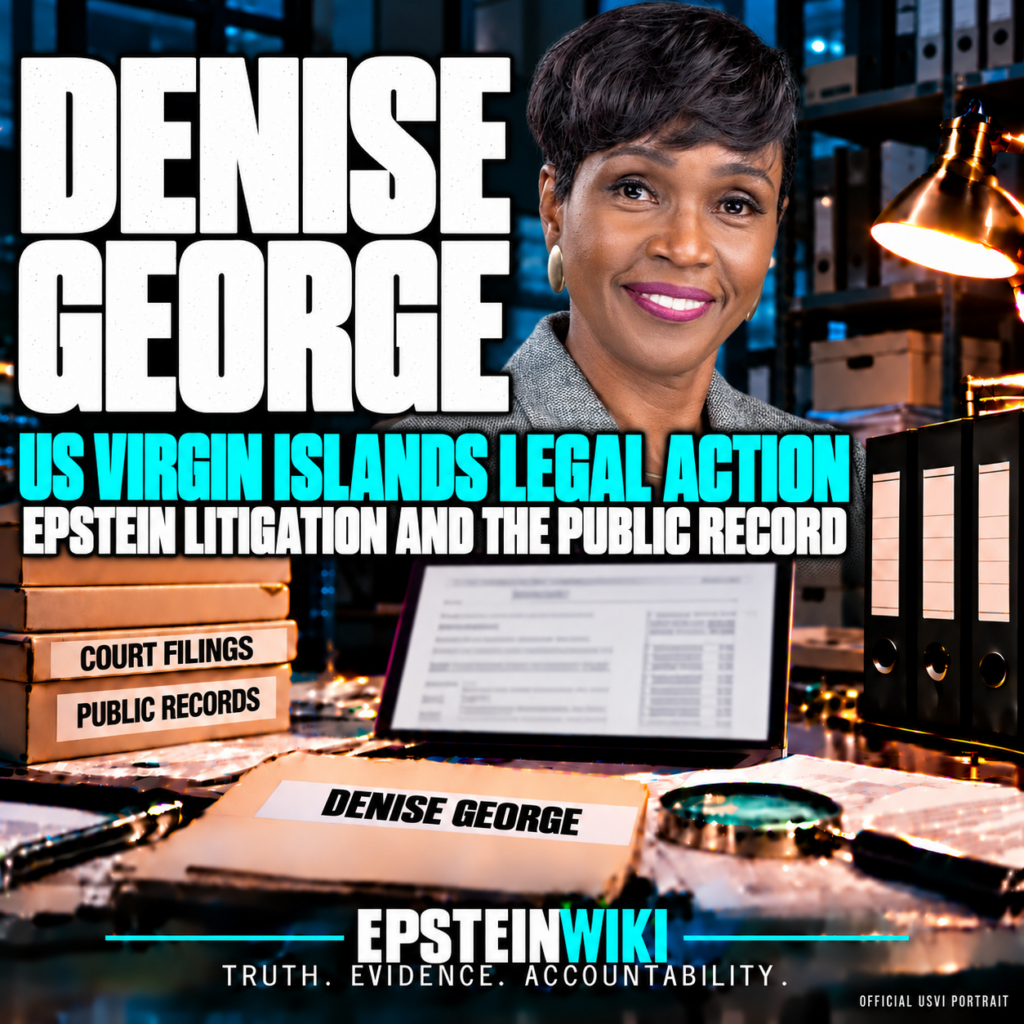
Snapshot
| Field | Documented information |
|---|---|
| Public identity | Denise N. George, also known as Denise George-Counts, a Virgin Islands lawyer and former territorial Attorney General |
| Appointment | Nominated by Governor Albert Bryan Jr. on March 28, 2019; confirmed by the Legislature in May 2019 |
| End of tenure | Removed on December 31, 2022; Carol Thomas-Jacobs became Acting Attorney General |
| Principal Epstein work | Led the territorial civil case against Epstein’s estate and associated defendants; negotiated compensation safeguards; initiated the JPMorgan action |
| Estate resolution | $105 million cash, half the Little St. James sale proceeds, and $450,000 for environmental remediation, announced in November 2022 |
| Bank case | Government of the United States Virgin Islands v. JPMorgan Chase Bank, N.A., filed December 27, 2022, in the Southern District of New York |
| Later evidence | July 2023 deposition testimony and an October 2023 FBI interview released in 2026 address her decisions and allegations of political pressure |
| Central distinction | Documented enforcement decisions, contested civil allegations, sworn testimony, and an FBI interview summary carry different evidentiary weight |
| Last checked | October 7, 2026 |
Denise George’s December 27, 2022 complaint placed JPMorgan Chase’s financial relationship with Jeffrey Epstein before a federal court. It followed the territorial case against Epstein’s estate, which had produced a major settlement the previous month. Her work made her a central public official in the effort to pursue assets and institutions after Epstein’s death.
The Associated Press reported her removal days after the bank filing. That sequence is established. The explanation requires a fuller record: the governor later cited communication problems, George described political pressure, and an FBI interview preserved her allegations. None of those sources supplies a judicial finding that JPMorgan procured her dismissal or that the four day interval alone proves its cause.
Important Points
- George’s principal Epstein cases were civil enforcement actions. They were separate from the federal criminal prosecutions of Epstein and Ghislaine Maxwell.
- In June 2019, she required Epstein to keep obeying existing travel notification conditions while his lawyers supplied evidence supporting a requested waiver.
- Her later enforcement record does not erase the questions about why territorial authorities had not opened a local criminal investigation while Epstein was alive.
- The estate settlement’s tax recovery was part of the announced financial resolution. It should not be added again as a separate $80 million award.
- The private compensation program, the estate settlement with the government, and the later JPMorgan settlement were different proceedings with different recipients.
- George filed the JPMorgan case before her dismissal. Successor attorneys general continued it, and Ariel Smith announced its September 2023 settlement.
- Her FBI interview is evidence of what she reported to an agent. It is not an FBI determination that each allegation was true.
- The estate defendants and JPMorgan denied wrongdoing. Their settlements did not produce criminal convictions or trial verdicts on the disputed allegations.
Professional Background and Appointment
George’s professional biography identifies her as a St. Thomas native who earned a bachelor’s degree in radio, television and film at the University of Maryland, College Park, and a law degree at Howard University in 1984. She worked as a television reporter before law school. Her legal career included judicial clerkships, private practice, territorial prosecution and service as senior staff attorney at the Virgin Islands Port Authority.
Government House’s March 28, 2019 announcement describes her as an eighteen year veteran of the territorial Justice Department. Her assignments included criminal and civil litigation, juvenile and family matters, and leadership of the White Collar Crime and Public Corruption Division. The announcement also credits her with helping write the territory’s first criminal child abuse and neglect statute.
Contemporary reporting on the May 14 legislative session lists George among the nominees confirmed that day. Government House subsequently scheduled her ceremonial swearing in for June 17. Nomination, legislative confirmation and the public ceremony are separate events; a single appointment date should not collapse them.
Bryan’s appointment announcement also proposed greater independence for attorneys general through a six year term and removal protections. It described proposed legislation, rather than demonstrating that those protections had already become law. That distinction matters when discussing the governor’s later removal of George.
The 2019 Travel Waiver Request
EFTA02636006 records Erika Kellerhals’s reaction to George’s nomination on March 28, 2019. Writing to Epstein and Darren Indyke, Kellerhals expressed optimism about the effect on Epstein’s registration issues and said she would contact the governor again. The message documents the lawyer’s expectation. It does not show that George promised favorable treatment or knew about the email.
George’s June 2, 2019 correspondence provides the direct record of her response. Epstein’s lawyers sought reconsideration of travel requirements imposed by Acting Attorney General Carol Thomas-Jacobs in March. George said she needed reliable proof of frequent international travel for business or another legitimate purpose before considering a waiver. She requested the supporting material for the earlier waiver and subsequent documentation.
The same exchange in EFTA02809037 records her instruction that the existing domestic and international conditions remain in force during that review. This was a refusal to relax the rules on the material then presented. The letter did not announce a permanent prohibition on considering any future application. Followup correspondence shows the lawyers discussing what evidence to provide and requesting a meeting.
Her July 20, 2023 deposition explains the distinction between her own decision and the earlier waiver granted by Vincent Frazer. George said she found nothing satisfactory to justify a waiver for Epstein. However, she declined to declare Frazer’s decision improper because she did not know everything he had considered. A travel notification waiver also differed from Epstein’s underlying sex offender tier classification.
The Erika Kellerhals profile covers counsel’s wider role in Epstein’s territorial affairs. The correspondence here should be read as a specific regulatory dispute, with George’s actual response distinguished from the expectations expressed by Epstein’s side.
What George Said About Investigating Epstein in 2019
The Virgin Islands Daily News’s account of her tenure reproduces her position in July 2019: the department had not received a criminal complaint that she considered sufficient to initiate a territorial investigation. The newspaper questioned her about an allegation of abuse on Little St. James in a New York civil lawsuit. George said such reporting, without an appropriate complaint, was insufficient. This contemporary position belongs in her record alongside the later lawsuits.
George’s July 17, 2023 testimony supplies more context. She described reading reports, seeking information, severe staffing shortages and her view that she could not proceed on rumor alone. She also described deferring when she believed federal authorities were investigating. When asked how she knew of that investigation, she acknowledged that she had inferred it rather than learned it with certainty.
The territory’s August 2023 court response relied on that testimony to defend its earlier conduct. It argued that information had not reached territorial authorities in a form sufficient to trigger an investigation and that the government deferred to the federal case after Epstein’s arrest. Those were the territory’s litigation positions, not a court ruling that every earlier warning had been handled adequately.
The record therefore supports two questions at once: what George’s office achieved after Epstein’s death, and whether territorial authorities could have acted sooner. Recovering money through a later civil case does not itself answer the second question. Conversely, criticism of earlier inaction does not negate the subsequent enforcement work.
The January 2020 Civil Case Against the Estate
The original January 15, 2020 complaint opened Government of the United States Virgin Islands v. Estate of Jeffrey E. Epstein, No. ST-20-CV-14, in the territorial Superior Court. George used the Criminally Influenced and Corrupt Organizations Act, usually called CICO, to pursue an alleged enterprise rather than a living criminal defendant. The pleading sought financial and equitable remedies against the estate and related entities.
The territorial court’s public case collection preserves motions over asset liens, dismissal and financial discovery. These records show the practical work behind the case: preserving property, contesting the defendants’ legal arguments and seeking information from financial institutions. A subpoena establishes that records were sought; it does not establish that the recipient participated in trafficking.
The second amended estate complaint developed the government’s theory that Epstein’s companies, properties and financial arrangements sustained trafficking and concealed its proceeds. It alleged that Southern Trust Company obtained valuable economic development benefits through false representations about its business. The government pursued recovery for the public as well as remedies intended to protect victims and prevent assets from being dissipated.
The Southern Trust Company article addresses that company’s separate financial and tax history. The estate litigation article covers the territorial action in greater procedural detail. George’s role was to lead that government case, not to act as personal counsel for every survivor.
Compensation Safeguards and the Asset Dispute
The Attorney General’s May 29, 2020 announcement records an agreement in principle over the proposed Epstein Victims’ Compensation Program. George had objected to the original design and the breadth of its releases. Her office agreed to permit a portion of restrained estate funds to be used once safeguards were negotiated with estate and victims’ counsel.
- An independent victim advocate would assist the process.
- Dedicated resources would preserve the position of people who declined an award or did not participate.
- Information supplied in claims would be protected from disclosure to the estate for use against claimants.
- The announced arrangement included counseling and referral access.
- The probate court would approve the administrative budget, with monthly reporting on claims and awards.
EFTA00037538 contains a contemporaneous federal email chain forwarding coverage of the agreement. Federal personnel asked how the proposed FBI Victim Services role would operate and whether the New York office had been involved. The chain corroborates circulation of the announcement while also showing that operational details were being questioned. It is not proof that every advertised service had already been implemented.
Bloomberg reported a renewed asset dispute in February 2021 after the compensation program encountered a cash shortage. George requested a broader freeze, and lawyers for more than two dozen women sought to join that effort. The episode illustrates the tension between preserving assets, paying claims and managing an estate whose holdings were not all immediately available as cash.
Contemporary reporting on the Manhattan property sale states that the probate judge rejected George’s requested freeze for lack of standing. Sale proceeds then helped replenish the compensation program. Her request and the court’s response should be distinguished from the separate CICO liens, which remained an important part of the territorial civil case.
The compensation program’s August 9, 2021 announcement reported nearly $125 million in awards to approximately 150 eligible claimants and more than $121 million actually paid to those who accepted. It said 92 percent of eligible claimants accepted offers. Jordana Feldman administered the program independently. George negotiated protections around it; she did not determine each individual award. The program’s figures also should not be confused with the government’s later $105 million estate settlement.
Adding Indyke and Kahn as Individual Defendants
The February 2021 second amended complaint named Darren Indyke and Richard Kahn personally as well as in their estate and trust capacities. It alleged extensive control over Epstein’s entities and transactions, cash arrangements, and assistance with coerced marriages intended to secure immigration status. Those were serious civil allegations requiring proof. The pleading’s characterization of the men as central participants was the government’s position, not a criminal verdict.
Reuters reported the defendants’ response when the estate case settled: counsel said the resolution contained no admission of liability, and Indyke and Kahn denied wrongdoing. A profile of the prosecutor should preserve that response rather than convert the allegations she brought into established criminal findings.
The Darren Indyke profile and the Richard Kahn profile examine their separate documentary records. Their roles as estate fiduciaries, their personal conduct alleged in the litigation and the settlement of government claims are distinct issues.
The November 2022 Estate Settlement
The Attorney General’s settlement announcement described a resolution with the estate, Indyke, Kahn and ten Epstein entities. The release was dated November 30, 2022, and appeared on the department’s website on December 1. Its principal monetary terms were $105 million in cash, half the proceeds from selling Little St. James and $450,000 for environmental remediation around Great St. James.
Reuters’s contemporaneous account confirms that recovery of more than $80 million in tax benefits was included in the settlement. It was not an additional award to be stacked on top of $105 million. The agreement also did not transfer both islands directly to the territorial government; the estate was to sell them to independent purchasers.
The official announcement’s noncash provisions included winding down the estate’s territorial business operations and supplying documents for continuing investigations. The government’s Little St. James proceeds were reserved for a trust supporting residents affected by sexual assault, trafficking and related abuse. Another portion of the settlement supported Justice Department operations and enforcement. These different purposes matter when evaluating later spending.
The estate’s response published by the Virgin Islands Consortium said the coexecutors intended to fulfill the settlement and wind down remaining territorial activities consistently with their fiduciary responsibilities. The settlement ended the specified government claims against the named defendants. It did not establish that every survivor’s separate claim or every potential claim against an outside institution had been extinguished.
Little Saint James was central to both the abuse allegations and the asset recovery. The amount owed from its eventual sale depended on the settlement’s allocation to that island. A combined sale price for two islands cannot automatically be treated as the price of Little St. James alone.
The December 27, 2022 JPMorgan Complaint
The original federal complaint alleged that JPMorgan supplied financial services that enabled and concealed Epstein’s trafficking operation. It focused on cash withdrawals, payments, warning signs and the bank’s financial incentive to retain a valuable client. George brought the action for the territorial government under the federal Trafficking Victims Protection Act and territorial statutes, requesting damages, penalties, restitution and injunctive relief.
Paragraph 3 of the complaint states that George’s office presented findings to JPMorgan in September 2022. The filing therefore followed an investigation and an earlier approach to the bank. The complaint did not specify a $190 million total demand. That frequently repeated figure belongs to the government’s later litigation position, after George’s removal.
The 2022 JPMorgan complaint article separates the original pleading from later amendments. The case was brought in the Southern District of New York as No. 1:22-cv-10904 and proceeded before Judge Jed S. Rakoff. George was the territorial Attorney General, not a federal prosecutor or a New York district attorney.
Removal and the Competing Explanations
The January 1, 2023 Virgin Islands Daily News report records Bryan’s confirmation that he had relieved George of her duties and installed Carol Thomas-Jacobs in an acting capacity. His initial public statement supplied no reason. The removal occurred on December 31, four days after the JPMorgan complaint.
Matthew Goldstein’s January 6 New York Times report described earlier friction, citing people briefed on the matter. One said Bryan believed George had not kept him adequately informed. Bryan spokesman Richard Motta said accounts identifying the JPMorgan case as the reason were not entirely accurate. The article distinguished those reported tensions from the inference that arose from the timing alone.
Later Virgin Islands Consortium reporting attributed a communication explanation directly to Bryan. He said he learned of the JPMorgan suit through the press while his administration was trying to establish a relationship with the institution. This is evidence of the governor’s stated rationale. It does not independently establish whether that explanation was complete or whether anyone at the bank influenced him.
George’s January 2023 public statement defended bringing the case and urged that it continue regardless of the wealth or influence of those involved. She also thanked Bryan for appointing her and the Legislature for confirming her. Her departure did not end the government’s action against JPMorgan.
A precise account can identify the timing, the governor’s explanation and George’s allegations without assigning a proven motive. The reviewed records contain no judicial finding that the bank ordered or arranged her firing. Nor does the absence of such a finding dispose of the questions about political interference that her testimony and later interview raised.
The July 2023 Depositions
The Virgin Islands Consortium’s August 2023 deposition coverage reported George’s account that Bryan alerted her to Epstein’s waiver request and encouraged her to consider it. She regarded his intervention as troubling. The same reporting noted her testimony that he asked for a decision without telling her what that decision must be. Those qualifications are important when describing the exchange.
The filed July 20 excerpts show George describing her explanation to Bryan that proof was required before she would consider a waiver. She testified that he replied by thanking her and that she recalled no further communication on that issue before litigation. Those excerpts also show her refusing to speculate about whether the earlier attorney general’s waiver had been politically influenced.
JPMorgan’s summary judgment statement used George’s earlier public position about investigative thresholds in its defense. The government’s response disputed the bank’s broader attribution of fault and explained its position about complaints, evidence and federal deference. A party’s statement of facts remains an advocacy document, even when it quotes a witness. It is not itself a judicial finding.
The FBI Interview Released in 2026
EFTA00129035 is a four page FBI interview report covering George’s October 2, 2023 interview in St. Thomas, entered on October 6. It records a complaint she requested to make. The report states that it contains no FBI recommendations or conclusions. Its provenance establishes that an agent recorded her account, not that the Bureau verified every assertion.
George’s account of the estate investigation alleges that Bryan initially supported pursuing Epstein’s assets but later pressed her to end the case quickly. She described questions about interviews, document requests and filings, and an instruction to settle for $80 million using a proposed mediator. She also said she believed Carlton Dowe had been sent to persuade her. These remain attributed allegations about pressure, rather than findings of obstruction.
The Virgin Islands Consortium’s January 30, 2026 coverage placed the interview in the newly released federal records and reported that Bryan declined an official comment. The article also discussed separate material concerning campaign donations. Such material must not be merged into George’s interview or treated as corroboration simply because it appeared in the same news story.
The interview was conducted in 2023, not 2026. Its later publication made the account more accessible; it did not change when George gave it or convert it into a new prosecutorial conclusion. The four page record contains no adjudication of why she lost her job. Any claim that it proves a particular person caused her removal exceeds what the document establishes.
What Happened to the JPMorgan Case After George Left
Rakoff’s May 1, 2023 opinion explained why the federal trafficking theory could proceed while territorial claims failed at the pleading stage. In particular, the court found the CICO allegations inadequate to establish the bank’s participation in an enterprise with the required common purpose. That ruling addressed the legal sufficiency of allegations, not a trial determination of the full historical record.
The May 8 order on the second amended complaint left Counts One and Five, the federal trafficking claims, in the case while dismissing Counts Two through Four. The later complaint included an obstruction theory. The government’s entire original complaint therefore did not survive unchanged, but the bank also did not obtain dismissal of the whole case.
Attorney General Ariel Smith announced the $75 million settlement on September 26, 2023. The department identified support for local charities, public safety and a $10 million mental health fund for Epstein survivors. The announcement also described measures addressing customer due diligence, trafficking reports, account termination, training and transaction monitoring.
Reuters reported that JPMorgan admitted no wrongdoing and that the $75 million consisted of $30 million for charitable organizations, $25 million to combat trafficking and $20 million for the territory’s lawyers. The bank’s separate $290 million survivor class settlement was a different case. George deserves credit for initiating the territorial bank action, while the settlement itself was concluded under successor leadership.
Rakoff’s October 18, 2023 closing order granted the dismissal requests after reviewing the settlements and denied pending motions, including the competing summary judgment motions, as moot. The resolution avoided the scheduled trial. Neither side obtained a trial verdict establishing all of its accusations against the other.
Separate Resolutions and Proper Attribution
The executed Leon Black agreement is dated January 20, 2023, after George’s dismissal, and was signed for the territory by Acting Attorney General Carol Thomas-Jacobs. It provided a $62.5 million settlement of potential territorial claims. George later said discussions had begun during her tenure. Her investigative role and the successor’s execution of the agreement should both be identified accurately.
| Proceeding | Amount or result | George’s documented role |
|---|---|---|
| Private Epstein compensation program | Nearly $125 million offered in awards; more than $121 million paid by August 2021 | Negotiated safeguards and monitored the estate dispute; Feldman administered awards |
| Territorial estate case | $105 million cash, island sale share and environmental payment | Led the government action and reached the 2022 settlement |
| Territorial Leon Black resolution | $62.5 million, January 2023 | Investigative work and discussions preceded her removal; Thomas-Jacobs signed |
| Territorial JPMorgan action | $75 million, September 2023 | Filed the action; successors continued and settled it |
| JPMorgan survivor class action | $290 million, a separate resolution | Not the same government lawsuit and not her personal settlement |
Verified Appearances in the Released Records
| Record | What it contains | What it establishes |
|---|---|---|
| EFTA02636006 | Kellerhals email to Epstein and Indyke, March 28, 2019 | Counsel’s favorable expectation about George’s appointment; no promise or response from George |
| EFTA02809037, pages 175 and 176 | June 2019 regulatory correspondence preserved in JPMorgan docket 194-27 | George required supporting evidence and maintained existing travel conditions during review |
| EFTA00037538 | June 2020 federal email chain forwarding compensation program coverage | Circulation of the negotiated safeguards and questions about the proposed FBI service role |
| EFTA00129035 through EFTA00129038 | October 2, 2023 interview, four consecutive Bates pages | George’s recorded allegations and recollections, with no FBI conclusions |
| JPMorgan docket 283-11 | July 17, 2023 deposition excerpts | Her account of investigative decisions, resources and federal deference |
| JPMorgan docket 283-12 | July 20, 2023 deposition excerpts | Her waiver reasoning and account of communications with Bryan |
A person’s appearance in an Epstein record can arise from enforcement, litigation or news coverage. George’s appearance in these records is primarily as a public official, litigant and witness. Duplicate copies of an email or pleading do not create additional independent incidents. An attached newspaper article also retains its status as reporting when it becomes a court exhibit.
Evidence Timeline
| Date | Event | Source |
|---|---|---|
| March 28, 2019 | Bryan nominates George; Kellerhals emails Epstein about the appointment | Government House; EFTA02636006 |
| May 14, 2019 | Legislature confirms her nomination | Contemporary confirmation report |
| June 2, 2019 | George requires supporting proof and continued compliance with travel terms | EFTA02809037 |
| July 2019 | She explains why no territorial criminal investigation has been opened | Daily News account |
| January 15, 2020 | Territorial estate complaint filed | Original complaint |
| May 29, 2020 | Compensation safeguards agreement announced | Attorney General release |
| February 2021 | Second amended complaint names Indyke and Kahn individually | Second amended complaint |
| August 9, 2021 | Compensation program announces its claims results | Program announcement |
| November 30, 2022 | Estate settlement publicly announced | Reuters |
| December 27, 2022 | JPMorgan complaint filed | Docket 1 |
| December 31, 2022 | George removed from office | New York Times |
| July 17 and 20, 2023 | George gives deposition testimony | First session; Second session |
| September 26, 2023 | JPMorgan settlement announced under Ariel Smith | Official release |
| October 2, 2023 | George gives the FBI interview | EFTA00129035 |
| October 18, 2023 | Court grants dismissal and closes the bank action | Closing order |
| January 30, 2026 | Local reporting identifies the interview in the federal release | Virgin Islands Consortium |
Independent Research and Further Reading
- Ellie Leonard’s JPMorgan email series provides a route into correspondence relevant to the banking relationship that became the subject of the government’s lawsuit.
- Butterfly Bureau’s Jes Staley analysis examines later public testimony and documents concerning the bank relationship. Its interpretations should be distinguished from the underlying testimony and court findings.
- Rye Howard Stone’s research on the estate after Epstein’s death identifies repeated copies of compensation coverage in the released files. Duplicate news copies are useful for locating a record, but do not independently corroborate its allegations.
Key Takeaways
- George’s most concrete contribution was the use of territorial civil enforcement to preserve assets, obtain a substantial estate settlement and pursue a major bank.
- Her contemporaneous waiver correspondence is stronger evidence of her regulatory decision than later descriptions of what she supposedly did.
- Her record includes an earlier reluctance to initiate a local investigation and later testimony explaining that position. Both belong in an accountable history.
- The government, survivors, estate fiduciaries and compensation administrator had different legal roles. Their claims, awards and settlements must be kept separate.
- Her dismissal remains a subject for evidence based scrutiny. The chronology, the governor’s public explanation and her allegations can be reported without claiming an unproven cause.
Outstanding Accountability Questions
- What contemporaneous communications fully document the decision to remove George, including the relationship between the JPMorgan filing and earlier disputes?
- What records corroborate or contradict each specific allegation in her October 2023 FBI interview?
- What further action, if any, followed the FBI interview, and what public records establish the result?
- What evidence was available to territorial authorities before Epstein’s death, and how did they assess each warning or complaint?
- Which documents did the estate supply under the settlement’s cooperation terms, and what investigations did those documents support?
- How were restricted island proceeds and the other settlement funds separately received, allocated and spent?
Related EpsteinWiki Articles
- U.S. Virgin Islands Government
- Virgin Islands Government Litigation
- Territory of the U.S. Virgin Islands v. Epstein Estate
- Survivor Compensation Fund Litigation
- Government of the United States Virgin Islands v. JPMorgan Chase Bank, N.A.: 2022 Complaint
- JPMorgan Chase
- Jes Staley
- Leon Black
Sources
- Denise George, professional biography. Education and professional history.
- Government House, nomination announcement. March 28, 2019; background and proposed independence legislation.
- Virgin Islands Consortium, confirmation of Bryan nominees. May 15, 2019, reporting the preceding day’s legislative session.
- Government House, cabinet swearing in schedule. June 13, 2019.
- EFTA02636006. March 28, 2019 Kellerhals email; original page inspected.
- JPMorgan docket 194-27. June 20, 2023 filing; June 2019 correspondence at PDF pages 174 through 178. Released counterpart: EFTA02809037.
- Government of the Virgin Islands v. Estate of Jeffrey E. Epstein, original complaint. January 15, 2020.
- Virgin Islands Judiciary, ST-20-CV-14 public file collection. Motions, liens and financial discovery.
- Second amended estate complaint, reproduced as JPMorgan docket 1-1. Pleading dated February 10, 2021; filed as the bank complaint’s exhibit in December 2022.
- Virgin Islands Attorney General, compensation safeguards announcement. May 29, 2020.
- EFTA00037538. Federal email chain of June 1 and 2, 2020, with compensation program coverage.
- Bloomberg, Epstein accusers seek to freeze estate assets. February 6, 2021.
- The Business Times, Manhattan property sale and asset freeze ruling. March 12, 2021; New York Times reporting.
- Epstein Victims’ Compensation Program, conclusion of claims process. August 9, 2021; later filed as Maxwell docket 734-6.
- Virgin Islands Department of Justice, estate settlement announcement. Release dated November 30, 2022; website publication December 1.
- Jonathan Stempel, Reuters, estate settlement. November 30, 2022; payment terms and defendants’ denial.
- Virgin Islands Consortium, estate settlement and counsel’s response. November 30, 2022.
- Government of the United States Virgin Islands v. JPMorgan, docket 1. Original complaint, December 27, 2022.
- Suzanne Carlson, Virgin Islands Daily News, Bryan terminates Attorney General Denise George. January 1, 2023; preserved as JPMorgan docket 226-23.
- Associated Press, U.S. Virgin Islands fires attorney general. January 3, 2023.
- Matthew Goldstein, New York Times, tensions preceding the firing. January 6, 2023; copy hosted by George.
- Virgin Islands Consortium, debate over electing attorneys general. February 10, 2023; reports Bryan’s communication explanation.
- Virgin Islands Consortium, George calls for continuation of the bank case. January 9, 2023.
- Denise George, July 17, 2023 deposition excerpts. JPMorgan docket 283-11, filed August 14, 2023.
- Denise George, July 20, 2023 deposition excerpts. JPMorgan docket 283-12, filed August 14, 2023.
- Janeka Simon, Virgin Islands Consortium, unsealed deposition reporting. August 18, 2023.
- JPMorgan statement of material facts. Docket 224, July 24, 2023.
- Virgin Islands counterstatement. Docket 269, August 7, 2023.
- FBI FD-302, EFTA00129035 through EFTA00129038. Interview October 2, 2023; entry October 6, 2023.
- Ernice Gilbert, Virgin Islands Consortium, newly released George interview. January 30, 2026.
- Judge Jed S. Rakoff, opinion and order. May 1, 2023, JPMorgan docket 130.
- Judge Jed S. Rakoff, second amended complaint order. May 8, 2023, JPMorgan docket 135.
- Virgin Islands Department of Justice, JPMorgan settlement announcement. September 26, 2023.
- Reuters, JPMorgan settlement. September 26, 2023; amounts and no admission.
- Judge Jed S. Rakoff, closing order. October 18, 2023, JPMorgan docket 348.
- Virgin Islands and Leon Black, executed settlement. January 20, 2023; published by the Senate Finance Committee.
- Sian Cobb, St. Thomas Source, George discusses her tenure. September 25, 2023.
- Ellie Leonard, Follow the Money: The JP Morgan Emails. Independent banking correspondence research.
- Butterfly Bureau, Jes Staley’s Epstein Story Collapsed Under the Weight of the Receipts. August 27, 2026; contextual analysis.
- Rye Howard Stone, What Happened to the Estate After Epstein Died. Independent document research; duplicate compensation coverage locator.