
Jay Lefkowitz and the Legal Campaign That Kept Jeffrey Epstein Out of Federal Court
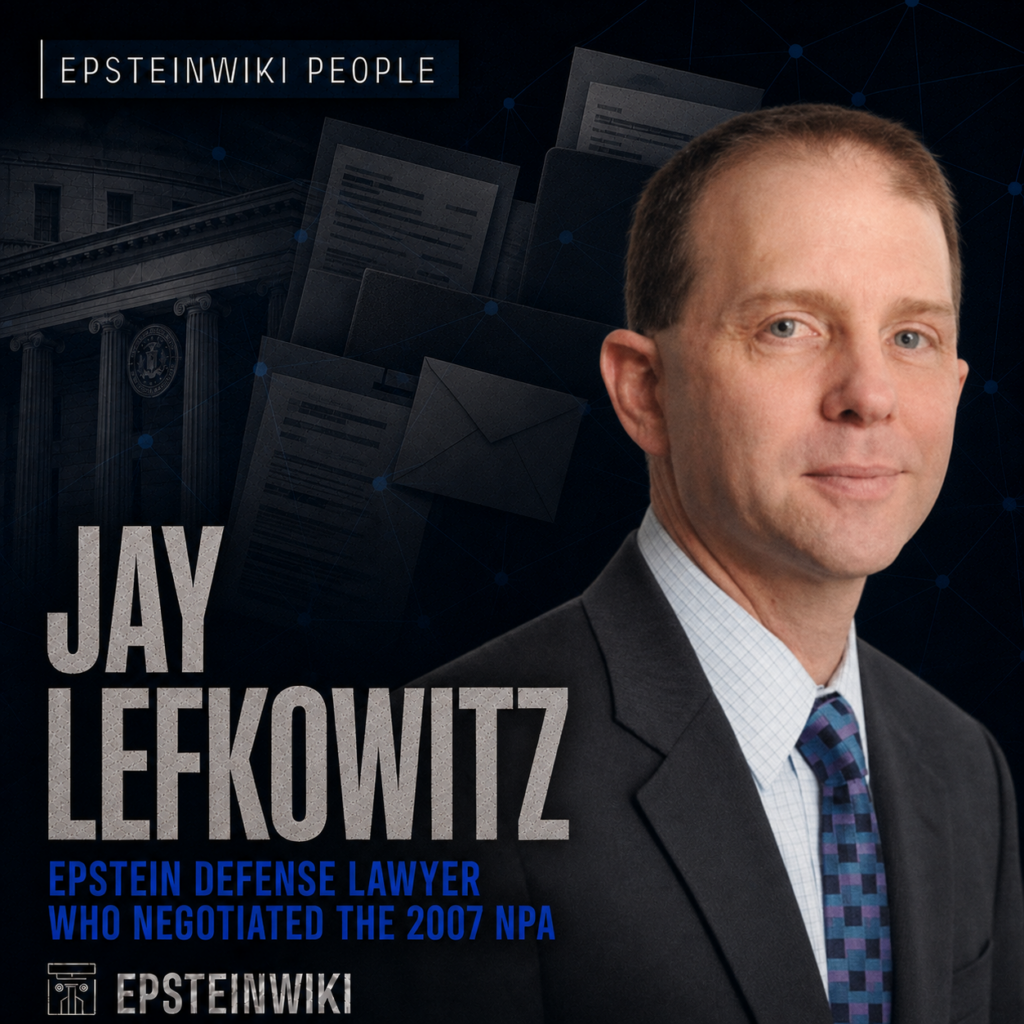
The former White House official helped negotiate Epstein’s secret agreement, pressed prosecutors to stop contacting survivors, escalated the case through Main Justice, and continued representing Epstein after his conviction
Jeffrey Epstein did not escape a federal courtroom because his lawyers quietly found one clever loophole.
He paid for a campaign.
That campaign disputed federal jurisdiction, negotiated a secret nonprosecution agreement, opposed survivor notification, sought repeated review by senior Justice Department officials, fought sex offender restrictions, and pressured journalists who continued reporting after Epstein’s conviction.
Jay P. Lefkowitz was one of its central lawyers.
Lefkowitz arrived with a résumé designed to command attention. He had served under two Republican presidents, worked in the White House, and become a partner at Kirkland & Ellis. He knew Alexander Acosta from Acosta’s earlier employment at that firm.
The documentary record places Lefkowitz inside the decisive negotiations. Assistant United States Attorney A. Marie Villafaña drafted the final agreement mainly with him. He pressed for a shorter sentence, disputed the requirement that Epstein plead to a registrable offense, proposed limits affecting survivors’ civil recovery, and later helped take Epstein’s arguments to senior officials in Washington.
He also objected when federal officials contacted survivors. A federal judge later found that the government violated survivors’ rights by failing to confer with them before executing the agreement and by misleading them about whether federal prosecution remained possible.
Lefkowitz continued representing Epstein after the guilty plea. He challenged Epstein’s classification as a level three sex offender and pressured news organizations over coverage. Records reported in 2026 also document personal access, including a family invitation and a request to use Epstein’s helicopter.
Everyone accused of a crime has the right to counsel. That principle does not require the public to ignore what elite representation accomplished or how long the relationship continued. This dossier documents those functions without alleging that Lefkowitz committed Epstein’s crimes, bribed a prosecutor, or violated a disciplinary rule.
Lefkowitz helped convert a developed federal child exploitation investigation into a prolonged private negotiation in which Epstein’s lawyers received access, review, and influence that survivors never received.
Snapshot
Full name: Jay P. Lefkowitz
Born: November 20, 1962
Profession: Lawyer, former senior government official, and law school lecturer
Epstein role: Senior member of Epstein’s defense team during and after the Florida federal investigation
Firm during the representation: Kirkland & Ellis LLP
Documented negotiating role: The Justice Department’s Office of Professional Responsibility reported that Villafaña drafted the final nonprosecution agreement mainly with Lefkowitz
Documented survivor notification role: He objected to federal contacts with survivors and later represented that Acosta had agreed not to contact victims, potential witnesses, or their lawyers
Main Justice role: He and other defense lawyers sought review from the Criminal Division, the Office of the Deputy Attorney General, and potentially the Attorney General
Post conviction representation: Continued legal work included Epstein’s New York sex offender classification, press response, and a later engagement connected to efforts to unwind the Florida agreement
Post conviction personal contact: Released communications reported by the Financial Times and other outlets document an invitation to a family bar mitzvah and proposed use of Epstein’s helicopter
Current professional status: Retired from Kirkland & Ellis in 2026. His current firm biography lists him as a retired litigation partner. His own website also states that he retired after more than three decades at the firm.
Public discipline check: No published disciplinary order against Jay P. Lefkowitz was located in the sources reviewed for this dossier. Records concerning attorney Jon A. Lefkowitz are about a different person and must not be attributed to Jay P. Lefkowitz.
EpsteinWiki involvement level: 4 of 5
What the level means: Direct, sustained, and consequential professional participation in the legal system that protected Epstein. It is not a finding of criminal guilt.
Who is Jay Lefkowitz?
Lefkowitz’s current professional biography describes a career spanning private litigation, government service, and teaching.
He graduated from Columbia University and Columbia Law School. His public service included positions in the administrations of George H. W. Bush and George W. Bush. He served as director of Cabinet Affairs, deputy executive secretary of the Domestic Policy Council, general counsel of the Office of Management and Budget, deputy assistant to the president for domestic policy, and United States special envoy for human rights in North Korea.
He later became a prominent appellate and commercial litigator at Kirkland & Ellis. The firm’s current biography identifies him as a retired litigation partner with experience in major commercial, regulatory, and Supreme Court disputes.
His public standing mattered to Epstein’s defense.
Alexander Acosta later described Epstein as having assembled an army of legal stars. Lefkowitz was valuable not merely because he could draft an argument. He had worked inside presidential administrations, understood federal bureaucracy, practiced at an elite national firm, and could communicate with officials as a peer.
Acosta had also worked as a Kirkland & Ellis associate in the 1990s. That professional overlap is documented and relevant to access. It is not proof that Acosta secretly favored a former colleague. The Justice Department’s Office of Professional Responsibility found no evidence that the prosecutors acted because of wealth, status, associations, or another improper consideration.
Epstein could purchase representation by lawyers who knew how federal decisions moved and who could ask senior officials to reconsider the work of career prosecutors.
The federal case Lefkowitz entered
The Palm Beach Police Department began investigating Epstein after the family of a fourteen year old girl reported that he had paid her for a massage. Detectives identified a much wider pattern involving teenage girls, paid massages, sexual conduct, and recruitment by other girls and employees.
Federal investigators opened their own case in 2006. The Justice Department’s official executive summary states that the lead assistant United States attorney submitted an eighty two page prosecution memorandum and a draft indictment containing sixty counts in May 2007.
The potential charges involved conspiracy, enticement of minors, interstate travel for illicit sexual conduct, and sex trafficking of minors.
EFTA01249021 documents the recruitment structure involving paid massages. EFTA00081180 contains a court account of the allegations and the system used to recruit underage girls.
The proposed indictment did not guarantee conviction. Prosecutors had concerns about jurisdiction, witness availability, trauma, credibility attacks, and unsettled legal questions. But this was a developed federal investigation with identified survivors, a prosecution memorandum, and proposed charges. That is what the defense campaign was built to stop.
Lefkowitz joined as pressure intensified
According to the full Office of Professional Responsibility record, Epstein added Kenneth Starr and Jay Lefkowitz to his defense team in August 2007. Both were affiliated with Kirkland & Ellis. Acosta knew them through his earlier work at the firm.
Their arrival followed a July 31 meeting at which prosecutors offered to end the federal investigation if Epstein accepted state convictions, incarceration, sex offender registration, and a mechanism for survivor compensation.
The negotiations that followed were not casual.
EFTA00009116 contains Acosta’s Office of Professional Responsibility interview and his description of the stature and tactics of Epstein’s defense team. EFTA00009016 contains testimony concerning the negotiations and defense contacts.
Villafaña’s contemporaneous communications show that the parties considered several possible structures, including a federal plea and a state only resolution. The Office of Professional Responsibility found that, during the final period, Villafaña drafted the nonprosecution agreement mainly with Lefkowitz.
That makes Lefkowitz more than a lawyer whose name appeared on a team letter. He was one of the principal people across the table while the agreement took shape.
What Lefkowitz negotiated
The parties fought over incarceration, sex offender registration, survivor compensation, immunity, and federal control. The Office of Professional Responsibility record describes Lefkowitz pressing for twelve months while prosecutors sought more. The compromise produced eighteen months of county jail followed by twelve months of community control.
The defense also resisted a plea to an offense requiring Epstein to register as a sex offender. Prosecutors refused to abandon that requirement. Villafaña told supervisors that she expected Lefkowitz to try to talk them out of a registrable offense and argued that the defense should not be allowed to retreat from its own earlier offer.
The compensation mechanism generated another dispute. Prosecutors wanted identified survivors to retain access to claims under federal law. Villafaña objected that one defense proposal would bind the girls to a trust fund and require them to surrender federal rights.
Lefkowitz pushed for terms favorable to Epstein, and prosecutors rejected some of them. The final agreement still required a registrable state conviction and provided a path for survivor claims.
It also gave Epstein extraordinary protection.
The signed agreement stopped federal prosecution in South Florida for the investigated conduct, suspended the federal grand jury process, anticipated that the document would remain outside the public record, and protected named and unnamed potential coconspirators from federal charges in the district.
The agreement was signed on September 24, 2007. Villafaña signed for the government. Acosta approved the resolution. Epstein and members of his defense team approved and signed it for the defense.
The coconspirator protection
The final agreement promised that the United States would not institute criminal charges against any potential coconspirator of Epstein, including four named women.
That language mattered far beyond Epstein.
It surrendered prosecutorial authority before any public trial established what other people had done. The wording later became the basis for Ghislaine Maxwell’s effort to dismiss her federal prosecution in New York.
The historical record does not establish that Lefkowitz personally invented the final coconspirator clause. Acosta testified that he did not remember its origin. The Office of Professional Responsibility concluded that the clause received little analysis and no substantive discussion inside the United States Attorney’s Office.
Immunity for other people was part of the negotiations. One proposed agreement addressed the liability of Epstein and coconspirators, and the OPR record describes Lefkowitz proposing broad language affecting Epstein’s assistants and employees.
It would therefore be inaccurate to say that one surviving email proves Lefkowitz alone authored the final protection. It would be equally inaccurate to portray the protection as unrelated to the defense negotiations in which he was a principal participant.
Survivors were the people outside the room
The most disturbing imbalance was not hidden.
Epstein’s lawyers received meetings, drafts, telephone calls, extensions, revisions, and access to decision makers. Survivors did not receive meaningful consultation before the agreement was executed.
Lefkowitz’s role in that imbalance is documented.
Judge Kenneth Marra’s 2019 opinion recounts that Lefkowitz told Acosta’s office that federal agents and prosecutors should not contact identified individuals to inform them of the resolution. The opinion also states that the office never conferred with survivors about a nonprosecution agreement before signing it.
The Office of Professional Responsibility record quotes Villafaña telling the defense that three survivors had received general information after the agreement was signed, that Lefkowitz raised objections, and that further notifications stopped.
This does not establish that Lefkowitz violated the Crime Victims’ Rights Act. The statutory duties belonged to the government, not Epstein’s defense lawyer. A defense attorney may seek confidentiality when it benefits a client.
It does establish that survivor silence was useful to Epstein’s strategy and that his lawyer affirmatively objected when federal officials began communicating.
Judge Marra later found that the government violated the Crime Victims’ Rights Act by failing to confer with survivors before executing the agreement. He also found that later government letters misled survivors into believing federal prosecution remained possible.
The appellate history must be stated accurately. In 2021, the en banc Eleventh Circuit held that the Crime Victims’ Rights Act did not authorize the freestanding civil action used to seek relief before a federal criminal charge existed. That ruling limited the remedy. It did not find that survivors had been included in the original process.
The private breakfast with Acosta
On October 12, 2007, Lefkowitz met Acosta for breakfast at the West Palm Beach Marriott.
The meeting became a symbol because a defense lawyer obtained private access to the United States attorney while survivors remained uninformed. Its legal significance is narrower than some accounts claim.
The agreement had already been signed more than two weeks earlier. The Justice Department’s Office of Professional Responsibility examined contemporaneous messages and witness accounts and concluded that the breakfast did not create the original agreement, materially change it, affect the sentence, or cause the later work release arrangement.
In an October 23 letter, Lefkowitz represented that Acosta had made three commitments: not to interfere with the state prosecutor’s handling of the case, not to contact victims or potential witnesses and their counsel, and not to intervene in Epstein’s state sentence.
Acosta later said Lefkowitz had mischaracterized the conversation. The Office of Professional Responsibility found a draft government response rejecting any gag order and saying the office would not agree to such a promise. It could not determine that the draft was sent.
After reviewing the surrounding record, OPR concluded that the supposed concessions were either positions Acosta had already taken or were not established as material new benefits. A later addendum clarified attorney fees in a way favorable to Epstein, but OPR found that it did not materially impede survivors’ ability to pursue damages.
Lefkowitz arranged and attended the private meeting. He later memorialized what he said Acosta promised. The evidence does not establish that the meeting produced the original sweetheart deal or Epstein’s work release.
The agreement did not end the defense campaign
The signed document was not the end of Epstein’s resistance. It became another object of dispute.
For approximately nine months, Epstein’s lawyers tried to change terms, contest the government’s interpretation, and persuade senior Justice Department officials that federal prosecution was inappropriate.
EFTA00013749 shows Lefkowitz asking prosecutors to delay a letter while remaining signatures were gathered for an addendum. EFTA00013698 and EFTA00013801 are part of the Kirkland & Ellis correspondence concerning the agreement and disputes with federal prosecutors.
The defense attacked the legal and factual basis of the federal case. EFTA00013811 contains a Kirkland & Ellis submission to the Office of the Deputy Attorney General. It portrayed Epstein as a successful businessman and philanthropist, disputed federal jurisdiction, argued that evidence did not establish that he targeted minors, and claimed some girls had misrepresented their ages.
EFTA00176111 contains a December 2007 transmission from Starr to Acosta with a lengthy substantive submission authored by Lefkowitz. The defense challenged the investigation, the government’s conduct, and the legal basis for prosecution.
EFTA00067343 contains a point by point Kirkland response accusing prosecutors of false or misleading characterizations. EFTA00067353 contains a defense summary of alleged prosecutorial misconduct.
These allegations were defense arguments, not findings by a court or neutral investigator.
The escalation through Main Justice
Epstein’s defense team did not accept the local prosecutors’ answer.
It sought review from the Justice Department’s Criminal Division and the Office of the Deputy Attorney General. The lawyers argued that the Florida matter was fundamentally a state case and that federal intervention was legally unsupported.
At one point, Lefkowitz indicated that the defense might seek further review by the Deputy Attorney General or Attorney General if it could not resolve the dispute with Acosta.
The Child Exploitation and Obscenity Section examined the matter. Later, the Office of the Deputy Attorney General reviewed extensive written submissions from the defense and prosecution. On June 23, 2008, that office told Starr and Lefkowitz that intervention was not warranted. It added that federal prosecution was appropriate even if senior officials substituted their own judgment for Acosta’s.
Senior officials entertained the appeal and reviewed the record, but ultimately refused to stop the local office from enforcing the agreement.
Epstein pleaded guilty in state court one week later.
From legal defense to reputation defense
Epstein completed less than thirteen months in custody, much of it under extraordinary work release. He then tried to resume the life of a wealthy philanthropist and adviser.
Lefkowitz continued to serve him.
In 2010 and 2011, as Conchita Sarnoff and the Daily Beast reported on Epstein’s Florida deal, Lefkowitz sent letters challenging the coverage and warning about possible defamation.
EFTA01733842 contains a draft describing Epstein as having completed his sentence and returned to philanthropy and financial advising. The draft asked editors to review the accuracy and intensity of reporting about him.
The Daily Beast’s 2026 reconstruction reports that Lefkowitz questioned claims that Epstein had been investigated for sex trafficking, demanded delay and review, and warned the publication about allegedly defamatory criminal accusations.
Sending a demand letter to a news organization is not inherently unlawful or unethical. Lawyers regularly challenge reporting they believe is false. No source reviewed for this dossier shows that a court sanctioned Lefkowitz over these letters.
Functionally, a lawyer who helped secure Epstein’s agreement later used the authority of an elite firm to challenge journalists exposing it and to present Epstein as having returned to a respectable life.
Fighting the level three sex offender designation
Lefkowitz also represented Epstein in New York proceedings concerning his sex offender risk classification.
The New York appellate decision in People v. Epstein identifies Kirkland & Ellis and Lefkowitz as counsel for Epstein. The court unanimously affirmed Epstein’s classification as a level three sex offender.
The decision found clear and convincing evidence supporting the risk assessment. Lefkowitz had not performed one narrow negotiation and left. He continued defending Epstein after the public knew he had pleaded guilty to an offense involving a minor.
The 2013 effort involving the NPA
Legal Business reporting on the 2026 document release identified a June 2013 Kirkland & Ellis engagement letter signed by Lefkowitz. The letter described a $50,000 retainer for work connected to private litigants’ effort to unwind the nonprosecution agreement.
The work placed Lefkowitz on the side of preserving Epstein’s legal protection against private challenges. The source establishes the engagement and retainer, but not the final fee, complete scope, or amount Lefkowitz personally received.
The distinction matters because firm billing is not personal income. EFTA02413703 has been identified in document based research as a Kirkland billing summary. Bloomberg Law reported that Epstein paid Kirkland more than $3.1 million between 2008 and 2011. That was firm revenue, not proven personal compensation to Lefkowitz.
The Ramaz donation
Four months after the September 2007 agreement, tax records listed a $500,000 donation from an Epstein controlled foundation to the Ramaz School in Manhattan.
The Forward’s detailed investigation reported that Lefkowitz’s three children attended Ramaz, that he was a prominent member of the connected religious community, and that he later served on the school’s board. The school said it did not know the foundation’s funding source when it accepted the gift.
The Times of Israel and Jewish Telegraphic Agency account confirms the amount through foundation tax records and reports that Ramaz used the money for an educational program.
No reviewed record establishes that Lefkowitz requested the donation, controlled it, received the money, traded legal services for it, or even knew about the gift when it was made. The Forward explicitly reported that his knowledge of the donation was unclear.
Epstein’s foundation gave $500,000 to a school closely connected to Lefkowitz shortly after the agreement. The relationship deserves disclosure. The available evidence does not establish a quid pro quo.
The personal relationship after conviction
The 2026 releases added evidence that the relationship extended beyond courtroom filings and formal correspondence.
The Financial Times reported that emails showed Lefkowitz inviting Epstein to his son’s bar mitzvah and seeking use of Epstein’s helicopter for an anniversary trip to the Hamptons. The proposed helicopter use was discussed in May 2011, less than two years after Epstein left custody.
These records do not prove that Lefkowitz knew about crimes beyond the conduct publicly resolved in Florida. They do show that his association with Epstein did not end when the legal matter became morally uncomfortable or publicly embarrassing.
By 2011, Epstein was not merely an accused client entitled to a defense. He was a convicted sex offender whose state conviction involving a minor had been affirmed as sufficient to support the highest New York risk classification.
Continued social access after that point is relevant to judgment, professional boundaries, and the larger system through which Epstein recovered elite legitimacy.
Retirement and 2026 accountability
Lefkowitz retired from Kirkland & Ellis in 2026 after more than three decades at the firm.
His official personal website confirms the retirement. Kirkland’s current biography identifies him as a retired partner.
News reports connected the timing to renewed scrutiny generated by the released Epstein records. In a statement reported at the time, Lefkowitz defended the principle that even people accused of heinous conduct deserve representation but said he would not have taken the Epstein matter had he known what later became public. Kirkland expressed regret for its representation.
The public knew by 2008 that Epstein had pleaded guilty to procuring a minor for prostitution. By 2011, Lefkowitz was still representing him in the level three sex offender litigation and communicating socially. The relevant question is therefore not only what became public in 2019 or 2026. It is what was already known when the professional and personal relationship continued.
Columbia and other institutional roles
Lefkowitz has also taught Supreme Court advocacy at Columbia Law School and held advisory or trustee positions in prominent educational and policy organizations.
Current organizational pages identify him with the boards or advisory structures of the Manhattan Institute, the Tikvah Fund, Commentary, and other institutions. These affiliations document influence and reputation. They are not evidence that those organizations participated in Epstein’s legal defense.
Reporting in 2026 also identified Lefkowitz as part of Columbia University’s outside legal team during negotiations that produced a federal resolution requiring $200 million in payments to the federal government and a separate $21 million Equal Employment Opportunity Commission settlement.
Columbia’s official resolution page confirms the amounts and July 2025 agreement. Columbia’s public materials do not specify Lefkowitz’s personal compensation. News reports say the university declined to disclose whether he or Kirkland was paid for that work.
The appointment prompted criticism after the expanded Epstein record became public. Criticism of Columbia’s choice is not a legal finding against Lefkowitz.
Complaints, discipline, and identity protection
No published disciplinary order, criminal charge, or civil judgment finding professional wrongdoing by Jay P. Lefkowitz was located in the reviewed sources.
That statement has an important limitation. Public databases generally disclose final discipline, not every confidential complaint. The absence of a published order does not prove that no complaint was ever submitted.
Researchers must also avoid a serious identity error.
New York disciplinary decisions involving Jon A. Lefkowitz concern a different lawyer with a different first name, admission history, and registration number. Those proceedings must not be added to Jay P. Lefkowitz’s dossier.
The Epstein controversy itself produced criticism, institutional questions, and reputational consequences. The Justice Department’s Office of Professional Responsibility reviewed prosecutorial conduct, not whether Epstein’s private defense lawyers violated professional rules. Its conclusion that federal prosecutors did not commit professional misconduct is not an ethics clearance for every member of the defense team.
At the same time, no evidence reviewed here supports claiming that Lefkowitz was disbarred, suspended, criminally charged, or judicially sanctioned because of the Epstein representation.
Financial and political interests
Lefkowitz spent more than three decades as a senior partner at a highly profitable global law firm. His complete compensation, assets, debts, retirement arrangement, and personal net worth are not publicly established in the sources reviewed here.
The released Epstein billing records document money paid to Kirkland & Ellis for firm work. They do not establish what portion was credited or distributed to Lefkowitz personally.
Public reporting also identifies Lefkowitz as a political donor. A Forward review of the 2024 Republican primary reported $26,600 in donations to committees associated with Nikki Haley. Political contributions are lawful and are included here to document public affiliations, not to suggest an Epstein connection.
The Manhattan Institute’s current board page lists Lefkowitz as a trustee. The Tikvah Fund’s board page also lists him. Commentary’s author page identifies him as a board member and contributor.
These positions show the institutional standing that survived the Epstein representation for years. They do not establish that any named organization financed, directed, or knew about his work for Epstein.
What the evidence proves
- Lefkowitz was a senior and consequential member of Epstein’s defense team.
- He joined the matter before the final agreement was signed.
- Villafaña drafted the final nonprosecution agreement mainly with Lefkowitz.
- He negotiated over incarceration, the registrable offense, survivor compensation, federal charges, and protection affecting other potential defendants.
- He objected to survivor notifications after the agreement and represented that Acosta had agreed not to contact victims or potential witnesses.
- He arranged and attended the October 2007 private breakfast with Acosta.
- The breakfast occurred after the agreement was signed and was not proven to have created the original deal, changed the sentence, or caused work release.
- He helped produce submissions challenging federal jurisdiction, the evidence, prosecutors, and the continued federal role.
- The defense obtained review at multiple levels of the Justice Department, although senior officials ultimately refused to intervene.
- Lefkowitz continued representing Epstein after his state conviction.
- He represented Epstein in the unsuccessful challenge to New York’s level three sex offender classification.
- He sent letters challenging media coverage that exposed Epstein’s agreement and public record.
- He participated in later legal work connected to efforts to preserve or unwind disputes around the NPA.
- Epstein’s foundation gave $500,000 to Ramaz, a school closely connected to Lefkowitz, shortly after the agreement.
- Released communications document personal contact after Epstein’s conviction, including a family invitation and proposed helicopter use.
- Lefkowitz retired from Kirkland & Ellis in 2026 amid renewed scrutiny of the released records.
What the evidence does not prove
- It does not prove that Lefkowitz committed Epstein’s sexual crimes.
- It does not prove that he knew every fact investigators later established.
- It does not prove that he bribed Acosta or another government official.
- It does not prove that Acosta approved the agreement because he previously worked at Kirkland & Ellis.
- It does not prove that the private breakfast created the September 2007 agreement.
- It does not prove that Lefkowitz caused Epstein’s work release.
- It does not prove that he alone drafted the coconspirator protection.
- It does not prove that every defense allegation against prosecutors was true.
- It does not prove that he requested, directed, or personally benefited from the Ramaz donation.
- It does not prove that firm billing was paid directly to Lefkowitz.
- It does not prove that press demand letters were unlawful.
- It does not establish a published bar discipline order against him.
- It does not connect the disciplinary history of Jon A. Lefkowitz to Jay P. Lefkowitz.
- It does not establish that Lefkowitz’s nonprofit or political affiliations participated in Epstein’s defense.
What remains missing
- The complete unredacted drafting history of every agreement and addendum.
- A definitive document identifying who proposed the final wording of the coconspirator clause.
- Complete billing records separating every Kirkland matter, lawyer, rate, payment, and credit allocation.
- The complete 2013 engagement file concerning private efforts to unwind the agreement.
- All communications between Lefkowitz and Epstein after the conviction.
- Complete flight, helicopter, dinner, and social records establishing which proposed events actually occurred.
- Records establishing who solicited or directed the Ramaz donation and what Lefkowitz knew about it.
- A complete public accounting of Lefkowitz’s current finances and private clients.
- Any confidential bar complaint or institutional review that never produced a public order.
- Complete records concerning Columbia’s selection, payment, and review of outside counsel.
- Any current institutional action by Columbia, Tikvah, Manhattan Institute, Commentary, or other organizations following the 2026 disclosures.
- A direct public response from Lefkowitz addressing the survivor notification objections, personal relationship, Ramaz donation, and post conviction representation in one complete account.
Evidence assessment
Jay Lefkowitz belongs at involvement level 4 of 5.
The rating measures documented connection, authority, duration, and consequence. It does not measure criminal guilt.
Lefkowitz did not merely provide an isolated legal opinion. He was a principal negotiator during the decisive weeks. He contested the offense, sentence, registration, compensation structure, evidence, federal jurisdiction, and survivor contacts. He helped carry Epstein’s case through multiple levels of the Justice Department. He continued representing Epstein after the conviction and helped challenge the media narrative around the deal.
The post conviction personal contact strengthens the assessment because it undercuts the idea that this was only an arms length professional obligation that ended once a difficult client’s case was resolved.
The strongest caution is equally important. Defense representation is constitutionally necessary. The evidence does not show that Lefkowitz committed a crime by representing Epstein, that he controlled the government’s legal duties to survivors, or that he secretly purchased the agreement.
What it shows is a system of unequal access.
Survivors were treated as evidentiary risks, potential claimants, and people whose notification could disrupt the resolution. Epstein was treated as a client whose every concern could be negotiated, redrafted, escalated, reviewed, and defended.
Lefkowitz was one of the people who made that system work for him.
Related EpsteinWiki pages
The Enablers Behind Jeffrey Epstein’s Florida Deal maps the prosecutors, defense lawyers, Justice Department officials, and later reputation network surrounding the agreement.
Alexander Acosta’s congressional transcript provides a document focused guide to Acosta’s later testimony.
The 2007 Nonprosecution Agreement contains the agreement, its terms, and its later legal consequences.
Sources
- EFTA00040089, signed nonprosecution agreement: https://epstein-data.com/EFTA00040089
- EFTA00224943, federal investigation and agreement timeline: https://epstein-data.com/EFTA00224943
- EFTA01249021, recruitment and massage evidence: https://epstein-data.com/EFTA01249021
- EFTA00081180, court record describing the recruitment system: https://epstein-data.com/EFTA00081180
- EFTA00009016, Acosta testimony concerning negotiations: https://epstein-data.com/EFTA00009016
- EFTA00009116, Acosta Office of Professional Responsibility interview: https://epstein-data.com/EFTA00009116
- EFTA00013749, Lefkowitz communication concerning the agreement and addendum: https://epstein-data.com/EFTA00013749
- EFTA00013698, Kirkland correspondence concerning the agreement: https://epstein-data.com/EFTA00013698
- EFTA00013801, Kirkland response concerning the agreement: https://epstein-data.com/EFTA00013801
- EFTA00013811, Kirkland submission to the Office of the Deputy Attorney General: https://epstein-data.com/EFTA00013811
- EFTA00176111, Starr transmission and Lefkowitz defense submission: https://epstein-data.com/EFTA00176111
- EFTA00013989, Kirkland submission during the Main Justice review: https://epstein-data.com/EFTA00013989
- EFTA00067343, Kirkland response challenging prosecutors’ account: https://epstein-data.com/EFTA00067343
- EFTA00067353, defense summary of alleged prosecutorial misconduct: https://epstein-data.com/EFTA00067353
- EFTA00027666, Judge Marra’s Crime Victims’ Rights Act opinion: https://epstein-data.com/EFTA00027666
- EFTA02413703, Kirkland billing summary identified in released document research: https://epstein-data.com/EFTA02413703
- EFTA01733842, draft media response concerning Daily Beast coverage: https://epstein-data.com/EFTA01733842
- Justice Department Office of Professional Responsibility executive summary: https://www.justice.gov/opr/page/file/1336471/dl
- Justice Department statement summarizing the Office of Professional Responsibility findings: https://www.justice.gov/archives/opa/pr/statement-doj-office-professional-responsibility-report-jeffrey-epstein-2006-2008
- Doe v. United States, February 21, 2019 opinion: https://law.justia.com/cases/federal/district-courts/florida/flsdce/9%3A2008cv80736/317867/435/
- In re Wild, Eleventh Circuit en banc opinion: https://law.justia.com/cases/federal/appellate-courts/ca11/19-13843/19-13843-2021-04-15.html
- People v. Epstein, New York level three sex offender decision: https://www.nycourts.gov/REPORTER/3dseries/2011/2011_08293.htm
- Kirkland & Ellis biography for Jay P. Lefkowitz: https://www.kirkland.com/lawyers/l/lefkowitz-jay-p-pc
- Jay Lefkowitz official biography: https://www.jaylefkowitz.com/about
- Financial Times, post conviction helicopter request and personal contact: https://www.ft.com/content/12f17f99-fffc-4746-8ff5-1d94d6eddd55
- Daily Beast, legal pressure campaign against Epstein reporting: https://www.thedailybeast.com/how-furious-epstein-fought-to-stop-the-daily-beast-from-telling-the-truth/
- The Forward, Epstein’s $500,000 Ramaz donation and Lefkowitz connections: https://forward.com/news/428403/jeffrey-epstein-plea-deal-jay-lefkowitz-ramaz/
- Times of Israel and Jewish Telegraphic Agency, Ramaz acknowledgment and foundation tax records: https://www.timesofisrael.com/jeffrey-epstein-donated-500000-to-orthodox-nyc-high-school/
- American Freakshow, overview of Epstein’s lawyer network: https://www.americanfreakshow.news/p/the-epstein-bar-association
- Columbia University, 2025 federal resolution agreement: https://www.columbia.edu/content/federal-resolution-agreement
- Manhattan Institute board of trustees: https://manhattan.institute/board-of-trustees
- Tikvah Fund board of trustees: https://tikvah.org/about/board/
- Commentary biography and article archive: https://www.commentary.org/author/jay-lefkowitz/
- The Forward, reported 2024 political contributions: https://forward.com/news/558039/revealed-who-the-big-jewish-donors-are-backing-in-the-2024-gop-presidential-primaries/
- Epstein Data legal universe index, document counts and counsel roles: https://epstein-data.com/reports/institutional/LAWYERS_LITIGATION_INDEX.html
- Epstein Data prosecution failures analysis: https://epstein-data.com/reports/institutional/PROSECUTION_FAILURES_ANALYSIS.html
- Epstein Data Justice Department document removal audit: https://epstein-data.com/reports/institutional/DOJ_DOCUMENT_REMOVAL_AUDIT.html
- Legal Business, 2013 Kirkland retainer and post conviction communications: https://www.legalbusiness.co.uk/page/2/?sf_paged=508&sfid=47416
- Bloomberg Law, Kirkland billing and Epstein related matters: https://news.bloomberglaw.com/business-and-practice/epstein-explored-big-law-careers-leadership-with-ruemmler-karp/
- Searchable copy of the full Justice Department Office of Professional Responsibility report: https://www.epstein-search.com/document/263