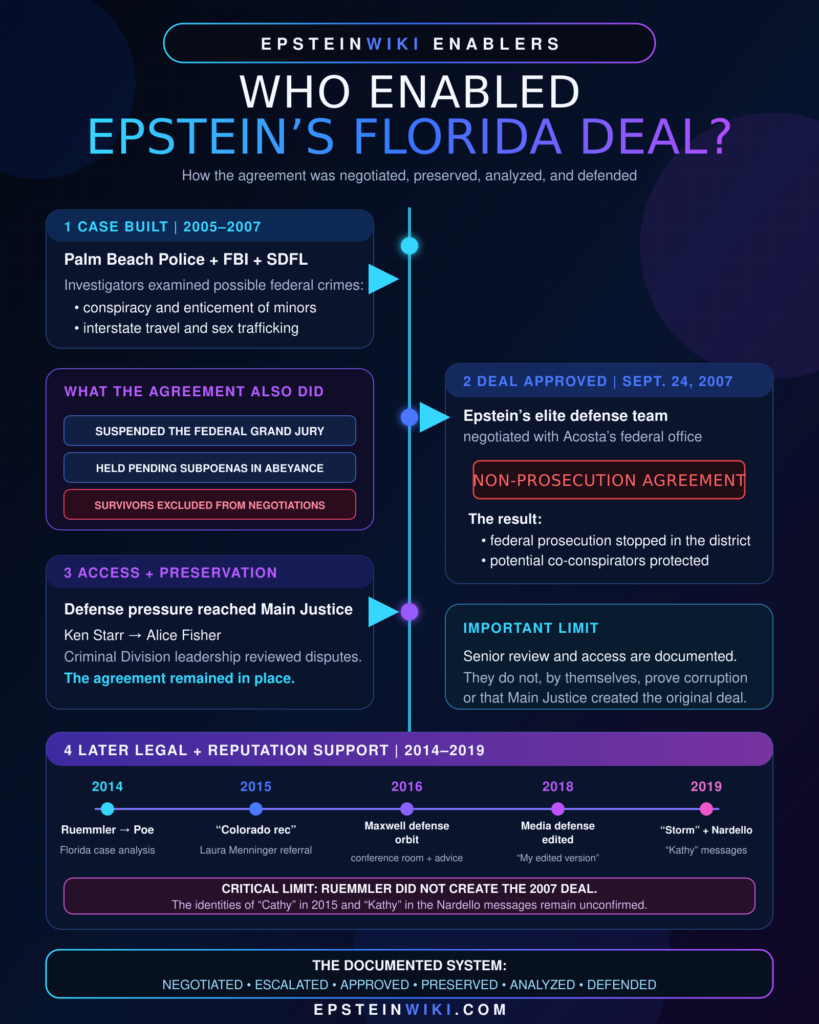
The Enablers Behind Jeffrey Epstein’s Florida Deal
The Lawyers, Prosecutors, Justice Department Officials, and Reputation Network That Helped Create, Preserve, and Defend the Non-Prosecution Agreement
EpsteinWiki Enablers Series
This article is part of the EpsteinWiki Enablers series, which documents the lawyers, government officials, advisers, investigators, institutions, and reputation managers whose actions helped Jeffrey Epstein avoid accountability, preserve favorable legal outcomes, defend his public image, or continue operating within elite networks.
The word “enabler” describes a documented function in the surrounding system. It does not mean that every person discussed committed a crime, knew the full extent of Epstein’s conduct, or shared the same motive. The available evidence distinguishes between those who negotiated the original agreement, those who approved or reviewed it, and those who later helped Epstein analyze or publicly defend the result.
Snapshot
| Category | Documented Finding |
|---|---|
| Central event | The Southern District of Florida’s 2007 non-prosecution agreement with Jeffrey Epstein |
| Agreement approved by | U.S. Attorney R. Alexander Acosta’s office |
| Lead federal prosecutor | Assistant U.S. Attorney A. Marie Villafaña |
| Epstein defense network | Ken Starr, Jay Lefkowitz, Alan Dershowitz, Roy Black, Gerald Lefcourt, Jack Goldberger, Lilly Ann Sanchez, and others |
| Main Justice involvement | Epstein’s attorneys sought review and intervention from senior Justice Department officials, including Criminal Division head Alice Fisher |
| Protection for others | The agreement promised no federal charges in the district against “any potential co-conspirators,” including four named women |
| Survivor impact | Survivors were not consulted before the agreement was completed and received misleading or incomplete information about the federal investigation |
| Later legal and media support | Records show Kathryn Ruemmler making legal referrals, discussing the Florida case, editing a proposed public defense, and offering Epstein support during a “media storm” |
| Core finding | The deal was produced and preserved through layers of legal access, prosecutorial discretion, institutional review, secrecy, and later reputation management |
What the Florida Investigation Found
The Palm Beach Police Department began investigating Jeffrey Epstein in 2005 after receiving a report involving a 14-year-old girl. Detectives identified a broader pattern in which teenage girls were recruited to provide paid massages that allegedly escalated into sexual activity.
EFTA01249021 contains evidence concerning recruitment through massages. EFTA00081180 is a court record describing the massage recruitment system and the allegations involving underage girls.
Federal investigators later examined possible violations involving conspiracy, the enticement of minors, interstate travel for illicit sexual conduct, and sex trafficking. The federal investigation timeline shows active drafting and revision of a proposed federal resolution between September 21 and September 24, 2007.
The non-prosecution agreement itself states that the FBI and the U.S. Attorney’s Office investigated possible federal offenses committed from approximately 2001 through September 2007. Those offenses included conspiracy, enticement, interstate travel, and recruiting or obtaining minors for commercial sex acts.
The available record therefore does not support describing the matter as a minor state prostitution case. Federal investigators were examining conduct involving minors and possible federal crimes.
The Agreement Alexander Acosta’s Office Approved
On September 24, 2007, the U.S. Attorney’s Office for the Southern District of Florida entered into the agreement under the authority of U.S. Attorney Alexander Acosta.
The agreement deferred federal prosecution in favor of state proceedings. Epstein agreed to plead guilty to felony solicitation of prostitution and procurement of a person under 18 for prostitution. The agreement required a recommended sentence of 18 months in county jail followed by 12 months of community control.
The agreement also contained provisions that were exceptionally protective.
- It promised that no federal prosecution would be instituted in the Southern District of Florida for the listed offenses or other offenses arising from the joint federal investigation if Epstein fulfilled the agreement.
- It stated that the parties anticipated the agreement would not become part of any public record.
- It suspended the federal grand jury investigation and held pending subpoenas in abeyance.
- It promised that the United States would not institute criminal charges against “any potential co-conspirators of Epstein,” including Sarah Kellen, Adriana Ross, Lesley Groff, and Nadia Marcinkova.
The wording “including but not limited to” made the protection broader than the four people expressly named.
Epstein pleaded guilty in state court in June 2008. Epstein ultimately served less than 13 months. Beginning in October 2008, he was permitted to leave custody for up to 12 hours a day under the Palm Beach County Sheriff’s work release program.
The Defense Team That Negotiated and Escalated the Case
Epstein assembled an unusually powerful defense team. Its members included former Independent Counsel Ken Starr, former White House and Justice Department lawyer Jay Lefkowitz, Alan Dershowitz, Roy Black, Gerald Lefcourt, Jack Goldberger, and Lilly Ann Sanchez.
The defense did more than negotiate with local federal prosecutors. Records show a sustained effort to challenge the proposed prosecution, contest the government’s legal theories, negotiate the terms of the agreement, and elevate disputes to senior Justice Department officials.
Starr and Lefkowitz correspondence documents the defense team’s advocacy. Additional Justice Department correspondence shows that questions concerning the agreement reached senior officials beyond the Southern District of Florida.
The lawyers were performing their professional role as defense counsel. Their importance to the Enablers series lies in the level of access, pressure, and institutional reach that Epstein’s money could purchase.
Barry Krischer and the State-Level Machinery
The federal non-prosecution agreement did not emerge in isolation. It followed an earlier state process overseen by Palm Beach County State Attorney Barry Krischer.
According to the Justice Department’s Office of Professional Responsibility report, the Palm Beach Police Department brought its investigation to Krischer’s office after uncovering allegations involving multiple teenage girls. Krischer’s office presented the matter to a state grand jury rather than filing charges directly.
On July 19, 2006, the grand jury returned a single charge of felony solicitation of prostitution. Palm Beach Police Chief Michael Reiter and the lead detective believed that charge failed to reflect the full scope of the evidence. Their dissatisfaction with the state response led the police department to refer the matter to the FBI, beginning the federal investigation that eventually produced the 2007 non-prosecution agreement.
The official Palm Beach County state case archive contains the investigative files, interviews, recordings, police correspondence, and state prosecution records from cases 06CF009454AMB and 08CF009381AMB.
Grand jury records released in 2024 added important context. The proceeding heard from only two alleged underage victims, two police officers, and an investigator from the State Attorney’s Office. The questioning included whether the girls understood that they had engaged in prostitution and whether they could themselves face criminal charges.
The state process later became the vehicle through which the federal agreement was implemented. Under the non-prosecution agreement, Epstein pleaded guilty to the pending felony solicitation charge and an additional charge of procuring a person under 18 for prostitution. The state court imposed consecutive jail terms totaling 18 months, followed by 12 months of community control.
The Palm Beach County Sheriff’s Office then controlled Epstein’s incarceration. The Sheriff’s Office approved Epstein for work release, allowing him to leave custody for as long as 12 hours a day. He began participating in that program in October 2008 and ultimately served less than 13 months.
Neither Barry Krischer nor the Palm Beach County Sheriff’s Office signed the federal non-prosecution agreement. Their roles were distinct. Krischer’s office controlled the initial state prosecution and later handled the state charges required by the federal agreement. The Sheriff’s Office administered Epstein’s unusually permissive incarceration and work release.
The Justice Department’s professional responsibility review did not investigate or reach conclusions about the conduct of state officials because they were outside its jurisdiction. A later Florida Department of Law Enforcement inquiry reported that it found no evidence that Krischer or his assistant committed crimes or accepted bribes or gifts in their handling of the case. A separate inquiry did not establish criminal violations by Sheriff’s Office personnel in administering Epstein’s incarceration and work release.
Those findings must be included. They do not erase the documented outcome. The state grand jury produced one charge after police uncovered a much broader pattern. The federal agreement then depended on the state prosecution, county jail, community control, and work release system to deliver the resolution Epstein’s lawyers had negotiated.
Ken Starr, Alice Fisher, and Main Justice
One of the most important escalation points involved Alice Fisher, then Assistant Attorney General for the Justice Department’s Criminal Division.
A federal record concerning Starr’s contact with Fisher documents the defense team’s access to Main Justice. Epstein’s lawyers sought review of disputes involving the Florida prosecutors and the agreement.
Main Justice did not create the original local investigation, and contact with a senior official does not by itself prove improper interference. The significant fact is that Epstein’s defense team could bring the matter directly to national Justice Department leadership. The agreement remained in place after that additional level of attention.
Fisher later joined Latham & Watkins. A Washingtonian profile of Fisher identified Kathryn Ruemmler as a friend. That relationship is relevant to mapping the legal network, but it is not evidence that Ruemmler participated in the 2007 agreement.
Survivors Were Excluded From the Negotiations
The agreement was negotiated without meaningful consultation with the survivors identified during the federal investigation.
Its text contemplated that the government would provide Epstein’s attorneys with a victim list only after Epstein had signed the agreement and been sentenced. Federal authorities also sent victims communications that left them with the impression that the federal investigation remained ongoing while the secret resolution was being completed.
Courtney Wild and another survivor challenged the government’s conduct under the Crime Victims’ Rights Act. In February 2019, U.S. District Judge Kenneth Marra ruled that federal prosecutors had violated the Crime Victims’ Rights Act by failing to confer with the victims before entering the agreement. After Epstein died, the district court dismissed the action without granting a remedy. In 2021, the en banc Eleventh Circuit held that the CVRA did not authorize Wild to enforce those rights through a freestanding civil action when no federal criminal proceeding existed. The Supreme Court declined review in February 2022.
The later appellate history must also be included. In 2021, the en banc Eleventh Circuit held in In re Wild that the CVRA did not authorize Wild to enforce those rights through a freestanding civil action when no federal criminal proceeding had been filed. The Supreme Court declined review in 2022.
That appellate ruling concerned the available legal remedy and the timing of CVRA enforcement. It did not transform the secret negotiations into a survivor-centered process.
Kathryn Ruemmler Entered the Story Years Later
Kathryn Ruemmler did not negotiate or approve the 2007 non-prosecution agreement. According to her July 2026 congressional testimony, she first met Epstein in July 2014 after he cold-called Latham & Watkins.
EFTA02589929 and EFTA02591335 document early communications between Epstein and Ruemmler in 2014. They show that the relationship quickly expanded into professional, political, financial, and personal discussions. They do not place Ruemmler inside the 2007 negotiations.
That distinction is essential. Ruemmler belongs in the later phase of the story, when Epstein was seeking legal analysis, referrals, strategic advice, and help responding to renewed scrutiny of the Florida outcome.
Ellie Leonard’s detailed reconstruction maps five years of emails, meetings, gifts, legal discussions, and political commentary between Ruemmler and Epstein. EpsteinWiki prioritizes Leonard’s chronology as an investigative source while cross-checking its key claims against the released records and Ruemmler’s testimony.
Gregory Poe and the Florida Case Analysis
In 2014, Epstein asked Ruemmler for a lawyer referral connected to an analysis of the Florida criminal case. She recommended Washington attorney Gregory Poe.
Ruemmler testified that she offered to act as a “legal translator” between Epstein and the attorney retained to perform the analysis. She described the assignment as examining the Florida criminal case rather than the separate Crime Victims’ Rights Act litigation.
Billing correspondence involving Gregory Poe referenced approximately $50,000 in invoices and work that included “communicating with Kathy and Marty.” During her congressional interview, Ruemmler said she might have communicated with Poe but did not recall specific conversations from that period.
This evidence does not place Ruemmler inside the 2007 negotiations. It shows that Epstein later sought a fresh legal analysis of the Florida case and that Ruemmler helped arrange and potentially translate that work.
The “Colorado” Referral and Laura Menninger
The “Colorado woman” clue appears in emails from late September 2015.
In the Colorado referral email chain, Epstein wrote that “Brad said the colorado rec was tough and sharp.” The surrounding chronology and Ruemmler’s later testimony support identifying the referred Colorado attorney as Laura Menninger, a Denver lawyer who went on to represent Ghislaine Maxwell in Virginia Giuffre’s defamation litigation.
Ruemmler testified that Epstein requested a referral, that she obtained Menninger’s name through her law firm, and that she passed the contact information to Epstein. Epstein then forwarded the recommendation to Maxwell with a proposed “50K retainer.”
EFTA0124924 was introduced during Ruemmler’s congressional interview as part of the Menninger referral evidence. EFTA01789935 separately captures Epstein forwarding the recommendation to Maxwell and writing “50K retainer.” These records document connected steps in the same referral sequence and should not be misrepresented as separate referrals.
The October 2015 email chain contains a message from Maxwell stating that Laura had requested an extension “per Cathy’s instructions” and could meet with Maxwell “and with Cathy.”
The identity of “Cathy” is not established. The email spells the name with a C. Ruemmler spells Kathy with a K. When questioned by Congress, Ruemmler said she did not know whether the reference was to her and denied instructing Menninger about Maxwell’s case.
The record does establish the referral chain:
- Epstein asked Ruemmler for a lawyer recommendation.
- Ruemmler provided Laura Menninger’s contact information.
- Epstein forwarded the referral to Maxwell and referenced a $50,000 retainer.
- Menninger represented Maxwell in the Giuffre litigation.
- Ruemmler’s Latham office later hosted Menninger and Maxwell in a conference room.
The April 2016 email states, “Laura and Ghislaine here tomorrow.” Ruemmler testified that she reserved the conference room, briefly introduced herself to Menninger, and did not participate in deposition preparation.
The “Perjury Trap” Exchange
Another April 2016 exchange adds a more substantive connection to Maxwell’s defense strategy.
In EFTA02463487, Epstein asked Ruemmler, “How does Laura set a perjury trap?” Ruemmler responded that preparation could involve getting a witness to repeat prior statements and then impeaching the witness with a contradictory document. She added, “The age issue is perfect for that.”
Ruemmler told Congress that she viewed the response as generic cross-examination advice. The email nevertheless shows her answering a strategy question that referenced Laura Menninger and an age issue in the period surrounding Maxwell’s litigation with Virginia Giuffre.
This exchange should not be used to claim that Ruemmler formally represented Maxwell. It does show that Epstein consulted her about a legal tactic connected to the defense effort.
The “VR” Counterclaim Discussion
EFTA02486838 contains another exchange in which Ruemmler discussed a possible counterclaim involving “VR,” meaning Virginia Roberts Giuffre.
During her congressional testimony, Ruemmler said the message had nothing to do with Maxwell and connected it instead to a separate dispute involving Alan Dershowitz. She did not recall precisely what prompted the exchange.
The record therefore establishes that Ruemmler and Epstein discussed a possible counterclaim involving Giuffre. It does not, by itself, establish that Ruemmler was formally participating in Maxwell’s defense.
The CVRA Litigation Appeared in Epstein and Ruemmler’s Emails
Ruemmler and Epstein also discussed the victims’ rights litigation. A February 2015 email record concerns the CVRA case challenging the secret agreement.
These communications reinforce the distinction between the original agreement and its later defense. Ruemmler did not create the 2007 deal. She became part of the legal and social network through which Epstein discussed the agreement, related litigation, and his exposure years later.
Editing a Public Defense of the “Sweetheart Deal”
After Julie K. Brown’s reporting for the Miami Herald returned national attention to the Florida case, Epstein’s network prepared a response defending the agreement.
In December 2018, Ruemmler sent Epstein an email with the subject “My edited version.” The attached draft and email presented arguments defending the Florida resolution and included statements portraying Epstein as having accepted responsibility and lived a good and law-abiding life.
EFTA00784058 contains an additional proposed public defense stating that Epstein was “far from receiving a sweetheart deal.” The record reinforces that people around Epstein were actively developing a public narrative defending the Florida resolution as media scrutiny increased.
During her congressional testimony, Ruemmler said she did not remember who drafted the original version. She described it as a proposed media response that would be authored or signed by Epstein’s attorneys. She said she reviewed it for tone and style and was not one of the lawyers involved in the original Florida resolution.
The distinction does not erase the function. A former White House Counsel edited language intended to rebut claims that Epstein had received a sweetheart deal through undue influence or corruption.
Additional Media Management Evidence
EFTA02462711 documents a May 2016 exchange in which Ruemmler told Epstein she was considering contacting NBC’s general counsel about comments by Donny Deutsch and asked Epstein for his thoughts.
This message does not concern the creation of the 2007 agreement. It is relevant to the later enabler network because it shows Ruemmler consulting Epstein while considering direct contact with a media company’s senior lawyer about comments they were discussing.
“We Will Get You Through This Storm”
On February 23, 2019, shortly after Judge Marra’s victims’ rights ruling, Ruemmler wrote to Epstein, “We will get you through this storm.”
When questioned by Congress, Ruemmler said she was referring to a media storm. She described the use of “we” as an expression of empathy and support rather than evidence of a legal team or coordinated defense.
The email does not establish that Ruemmler had authority over the Florida agreement. It documents that she offered Epstein personal support while the agreement and the treatment of survivors were again under intense scrutiny.
The Dan Nardello Messages
The final weeks before Epstein’s July 2019 arrest include communications with private investigator Dan Nardello, Partner and Executive Chairman of Nardello & Co.
In EFTA01612358, Epstein contacted Nardello on June 2, 2019, and asked when it would be convenient to speak. On June 7, the exchange included the statement, “Kathy will make contact over the weekend.”
The later EFTA01612359 message sequence includes the question, “Did you get her,” followed by Nardello’s response, “I did and she will fill you in.”
The messages show that a person identified only as “Kathy” was expected to contact Nardello and provide information. They do not identify that person as Kathryn Ruemmler. The surrounding screenshots also contain incomplete and ambiguous fragments.
The identity of “Kathy” remains unconfirmed. EpsteinWiki does not treat a shared first name as proof of identity.
Dan Nardello’s official biography describes him as a private investigator whose firm handles complex litigation, corruption, fraud, asset tracing, and reputational matters. The messages therefore warrant continued investigation into what work Epstein was considering or requesting, but they do not establish that Nardello accepted an assignment or knew of criminal conduct.
The Intelligence Claim Remains Unproven
Journalist Vicky Ward reported that Acosta had allegedly been told Epstein “belonged to intelligence” and to leave the matter alone. The statement has been repeated widely, but it remains a secondhand account rather than a documented finding in the non-prosecution agreement or the Justice Department’s review.
Ward’s account is relevant because it describes what Acosta was reportedly told. It is not proof that Epstein worked for an intelligence service or that an intelligence agency ordered the Florida resolution.
The documented evidence of legal access, secrecy, negotiation, and institutional review is substantial without converting the intelligence allegation into an established fact.
What the Justice Department Later Concluded
The Justice Department’s Office of Professional Responsibility reviewed the federal handling of the case. Its 2020 report did not find that Acosta or other Department attorneys committed professional misconduct.
OPR did conclude that Acosta exercised poor judgment in resolving the federal investigation through the agreement. It also concluded that victims were not treated with the forthrightness and sensitivity expected by the Department.
OPR found additional problems with the resolution, including reliance on actions by state officials outside Acosta’s control and the decision to end the federal investigation before significant investigative steps were completed.
The absence of a professional misconduct finding should not be misrepresented as an endorsement of the agreement. The Department’s own review criticized the judgment, process, and treatment of survivors.
Who Enabled What?
| Person or Institution | Documented Role | Necessary Limitation |
|---|---|---|
| Alexander Acosta and the Southern District of Florida | Approved and executed the federal non-prosecution agreement | OPR found poor judgment but not professional misconduct |
| A. Marie Villafaña and federal prosecutors | Investigated the case, negotiated terms, and communicated with the defense and victims | The record reflects internal efforts by Villafaña to pursue a serious federal case as well as her role in the final process |
| Epstein’s defense team | Negotiated protections, challenged prosecution theories, and escalated disputes | Defense advocacy is lawful, but the extraordinary access and result are central to understanding the agreement |
| Alice Fisher and Main Justice | Received defense approaches and reviewed aspects of the dispute | The available evidence does not prove Fisher ordered the original agreement or acted corruptly |
| State officials and corrections authorities | Implemented the state plea, sentence, incarceration, and work release | Their actions were distinct from the federal promise not to prosecute |
| Kathryn Ruemmler | Beginning in 2014, made legal referrals, discussed the Florida case, offered to translate legal analysis, commented on related strategy, edited a proposed media defense, and supported Epstein during renewed scrutiny | She did not negotiate or approve the 2007 agreement |
| Gregory Poe | Was retained to analyze the Florida criminal case | The public record does not establish that he participated in the original negotiations |
| Laura Menninger | Received the Colorado referral and represented Maxwell in the Giuffre litigation | Her role concerned Maxwell’s later civil defense, not creation of the Florida agreement |
| Dan Nardello | Communicated with Epstein shortly before the 2019 arrest | The messages do not establish the proposed assignment or identify “Kathy” |
EpsteinWiki Findings
The record does not support a theory in which one secret mastermind controlled every stage of the Florida deal.
It supports a layered institutional account.
Epstein’s wealth bought a nationally connected defense team. That team negotiated with local prosecutors and reached senior Justice Department officials. The agreement ended the federal investigation and foreclosed federal prosecution in the Southern District of Florida for the covered conduct.
Years later, a separate group of elite legal contacts helped Epstein analyze the Florida case, locate lawyers, discuss related litigation, prepare media defenses, and manage the renewed scrutiny surrounding the agreement.
Not every participant performed the same role. Not every questionable decision proves corruption. Not every contact establishes knowledge of Epstein’s full conduct.
Together, however, the records show that the Florida outcome was negotiated, escalated, approved, preserved, analyzed, and defended through a network of powerful professionals and institutions.
The survivors were the people consistently denied comparable access.
Key Epstein Data Evidence
- EFTA00040089: Non-Prosecution Agreement record
- EFTA00224943: Federal investigation and agreement timeline
- EFTA00176111: Ken Starr and Jay Lefkowitz defense material
- EFTA00230208: Ken Starr contact involving Alice Fisher and Main Justice
- EFTA00013783: Senior Justice Department correspondence
- EFTA01196604: Gregory Poe invoices and communications with “Kathy and Marty”
- EFTA02392662: September 2015 “Colorado rec” referral chain
- EFTA01789934: Laura Menninger referral and Maxwell’s “Cathy” message
- EFTA02465272: “Laura and Ghislaine here tomorrow”
- EFTA02463487: Epstein’s “perjury trap” question and Ruemmler’s response
- EFTA02341025: Epstein and Ruemmler discuss the CVRA litigation
- EFTA02610779: Ruemmler’s edited version of the proposed sweetheart-deal defense
- EFTA02613412: “We will get you through this storm”
- EFTA01612358: Epstein’s June 2019 contact with Dan Nardello and “Kathy will make contact”
- EFTA01612359: “Did you get her” and “she will fill you in”
- EFTA02732620: Archived Palm Beach Post material concerning the Florida case
Additional Supporting Records
- EFTA01249021: Evidence concerning recruitment through massages
- EFTA00081180: Court record describing the massage recruitment system
- EFTA02589929: Early 2014 Epstein and Ruemmler correspondence
- EFTA02591335: Additional September 2014 Epstein and Ruemmler correspondence
- EFTA0124924: Menninger referral evidence introduced during Ruemmler’s testimony
- EFTA01789935: Epstein forwards the Menninger recommendation to Maxwell with “50K retainer”
- EFTA02486838: Possible counterclaim discussion involving Virginia Roberts Giuffre
- EFTA00784058: Additional proposed public defense of the Florida resolution
- EFTA02462711: Ruemmler discusses contacting NBC’s general counsel
Duplicate Production Note
Some communications appear more than once in the released datasets under different EFTA identifiers. The “Colorado rec” chain is one example. Duplicate productions should be used for authentication and comparison, but they should not be counted as separate events or separate referrals.
Sources
- Ellie Leonard, “Why Resignation Isn’t Good Enough”
- EpsteinWiki Sleuth Report: Ellie Leonard Maps Kathy Ruemmler’s Five Years of Emails With Jeffrey Epstein
- Last Page First: Kathryn Ruemmler’s “Perjury Trap” Email
- Full 2007 Non-Prosecution Agreement and addenda
- U.S. Department of Justice Office of Professional Responsibility report
- Justice Department statement summarizing the OPR findings
- House Oversight Committee release of Kathryn Ruemmler’s transcript
- Kathryn Ruemmler transcribed interview, July 15, 2026
- Doe v. United States district court case summary
- In re Wild, Eleventh Circuit en banc decision
- Doe v. United States docket
- Dan Nardello official biography
- Washingtonian profile of Alice Fisher
- Vicky Ward account of the reported intelligence statement