
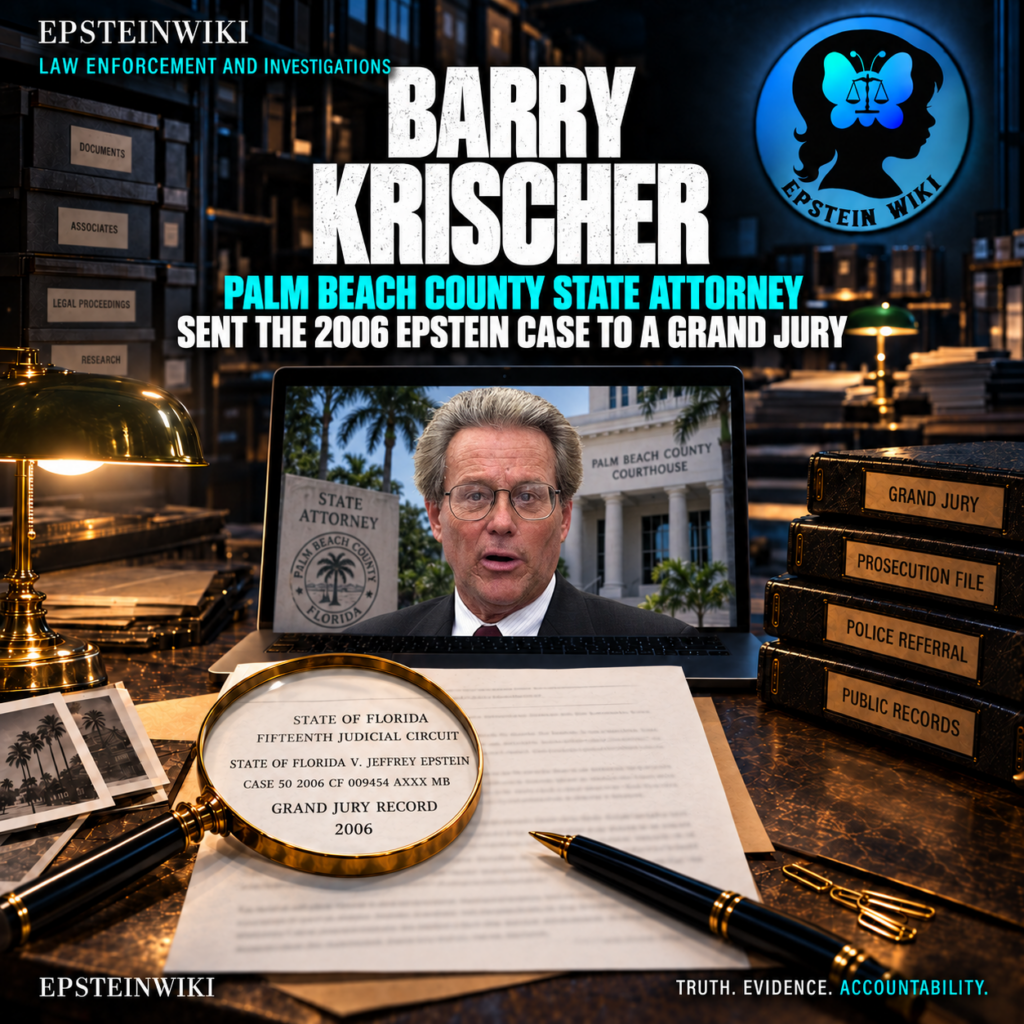
Barry Krischer: The Palm Beach State Attorney Who Controlled the First Epstein Charging Decision
Snapshot
| Category | Details |
|---|---|
| Full name | Barry E. Krischer |
| Born | 1943, Brooklyn, New York |
| EpsteinWiki classification | Former prosecutor and public official central to the first Epstein charging failure |
| Recommended categories | Legal Associates, Politicians |
| Principal office | State Attorney for Florida’s Fifteenth Judicial Circuit |
| Time in office | Elected in 1992 and served until January 2009 |
| Epstein case role | Final authority over the Palm Beach County state charging decision |
| Police referral | Palm Beach Police Department investigation led by Detective Joseph Recarey under Chief Michael Reiter |
| Grand jury date | July 19, 2006 |
| Grand jury result | One felony count of solicitation of prostitution, with no minor identified in the indictment |
| Later state resolution | Epstein pleaded guilty in 2008 to solicitation of prostitution and procuring a person under eighteen for prostitution |
| Criminal finding against Krischer | None identified |
| 2021 FDLE conclusion | Investigators reported no evidence that Krischer or Lanna Belohlavek committed crimes, accepted bribes or gifts, or acted improperly |
| Current accountability issue | Renewed calls in 2026 for Krischer and other officials to answer questions under oath |
Barry Krischer was the elected Palm Beach County State Attorney when local police brought his office evidence that Jeffrey Epstein was sexually exploiting teenage girls. Police identified a pattern involving paid massages, escalating sexual contact, recruitment payments, repeated visits, and girls as young as fourteen. Krischer’s office did not file the multiple felony charges recommended by police. It presented the case to a grand jury that returned one solicitation count without identifying a minor victim.
The narrow indictment was not the final federal nonprosecution agreement. That agreement was negotiated later by the United States Attorney’s Office under Alexander Acosta. The distinction matters. Krischer controlled the original state prosecution. Acosta controlled the later federal resolution. Both decisions contributed to an outcome that denied survivors a public trial and allowed Epstein to avoid the federal charges prosecutors had prepared.
Krischer has never been charged with bribery, corruption, obstruction, or another crime arising from the Epstein case. A Florida Department of Law Enforcement investigation reported in 2021 that it found no evidence of criminal wrongdoing by Krischer or Assistant State Attorney Lanna Belohlavek. That conclusion does not answer whether the office exercised sound judgment, presented the grand jury case fairly, treated teenage witnesses appropriately, or yielded too much ground to Epstein’s defense campaign.
The public record supports intense scrutiny of those questions. It does not support inventing a secret payment, personal relationship with Epstein, or proven criminal conspiracy where none has been established.
Content Note
This article discusses child sexual abuse, rape allegations, victim blaming, prosecutorial failure, and institutional treatment of teenage survivors. It avoids unnecessary identifying or graphic detail.
Who Is Barry Krischer?
Barry E. Krischer was born in Brooklyn in 1943. He attended Brooklyn College and earned his law degree from Brooklyn Law School. He served as an assistant district attorney in Kings County from 1970 until 1973.
Krischer moved to Palm Beach County in 1973 and joined the State Attorney’s Office. He later served for approximately ten years as chief assistant to State Attorney David Bludworth. He left the office in 1983, practiced privately, and worked with the Palm Beach County Child Protection Team.
Krischer won election as State Attorney in 1992 and reelection in 1996. He ran without opposition in 2000 and 2004. He retired from elective office in January 2009.
His professional record extended beyond the Epstein case. He taught at the Palm Beach Community College Police Academy, held leadership roles in the Florida Bar Criminal Law Section, served with national prosecutor organizations, and received awards connected to juvenile justice, family violence prevention, and community service. After retirement, he volunteered with the Palm Beach County Sheriff’s Office Legal Department and remained involved in child welfare organizations.
That career makes the Epstein decision more difficult to dismiss as simple inexperience. Krischer was a veteran prosecutor with decades of criminal law experience and a public reputation for child protection work.
Florida Bar Criminal Law Section biography
Krischer’s Authority in the Epstein Case
The State Attorney for Florida’s Fifteenth Judicial Circuit is the elected prosecutor for Palm Beach County. The office decides whether state criminal charges should be filed, which charges are supportable, whether a case should be presented to a grand jury, and how plea negotiations should proceed.
Krischer did not personally conduct every interview or ask every grand jury question. Assistant State Attorney Lanna Belohlavek led the office’s Crimes Against Children Unit and handled important parts of the presentation. Staff investigators also participated.
Krischer nevertheless occupied the top decision making position. The choice to refrain from filing the felony charges sought by police, the choice to use a grand jury, and the office’s overall approach occurred under his authority.
This is why describing him merely as a name in the file understates his role. He was not an Epstein social associate. He was the public official responsible for deciding how the first major criminal case against Epstein would proceed.
The Palm Beach Police Investigation
The investigation began after the family of a fourteen year old girl reported that she had been paid to massage Epstein at his Palm Beach residence. Detective Joseph Recarey became the lead investigator. Chief Michael Reiter supervised the department and followed the case closely.
Police interviews uncovered a repeating structure. Girls were invited to provide massages. Epstein allegedly escalated the encounters into sexual activity. Girls received cash. Some were paid to recruit additional girls. Several witnesses described repeated visits. Investigators learned of alleged conduct involving minors and reports of nonconsensual intercourse.
The released DOJ review summarizes the opening investigation in EFTA02847320. The reported payment, scheduling, abuse, and recruitment pattern appears in EFTA02847322.
By May 2006, Palm Beach police had prepared probable cause affidavits recommending serious felony charges. The police position was that the evidence justified prosecution and that fact finders should evaluate witness credibility in court.
Chief Reiter later testified that Krischer initially responded forcefully when briefed. According to Reiter, Krischer said the adult suspect had to be stopped and indicated that the State Attorney’s Office had a unit equipped for the case. Reiter said Krischer’s attitude later changed after Epstein’s identity, wealth, and defense effort became clear.
Reiter’s account is testimony, not a finding about Krischer’s motive. It is significant because it describes a change perceived by the police chief while the charging decision was being made.
EFTA02755398 contains portions of Reiter’s 2009 deposition. The pages describe surveillance of investigators, defense pressure, conversations with Krischer, and Reiter’s disagreement with the state’s approach.
The Defense Pressure Campaign
Epstein assembled a powerful defense team. Released records identify attorneys including Alan Dershowitz, Gerald Lefcourt, Jack Goldberger, Roy Black, Guy Fronstin, Jay Lefkowitz, and Kenneth Starr in different phases of the state and federal matter.
The defense did more than argue the law. Investigators and prosecutors received material attacking the credibility of teenage witnesses. The material included criminal histories, allegations of drug use, social media posts, sexual history, claims about dishonesty, and other personal information.
The DOJ review records this strategy in EFTA02847323. It also records concerns within the State Attorney’s Office about witness credibility and the office’s prior practice of prosecuting minors for prostitution.
Krischer later told DOJ reviewers that Dershowitz threatened that the defense would destroy the prosecution’s witnesses and the girls. That account appears in EFTA02847324.
Defense lawyers are permitted to investigate witnesses and challenge evidence. The troubling issue is how government officials responded. A prosecutor’s obligation is not to adopt a defense presentation before charges are filed. The prosecutor must independently assess probable cause, admissible evidence, public safety, and the vulnerability of child witnesses.
The released record shows that Epstein’s defense campaign reached the State Attorney’s Office. It does not prove that Krischer accepted every claim or acted from corrupt motives. It does show that the campaign became part of the charging environment.
The February 2006 Krischer Message
An archived email thread dated February 18, 2006 is titled “krischer.” Its text argues that charges should not be brought against Epstein, attacks the credibility of girls under investigation, criticizes a possible grand jury presentation, invokes Epstein’s philanthropy, and proposes a private resolution that would avoid a public sex related charge.
The document must be handled carefully. The displayed account information does not show that the message was sent to a Krischer email address. The body speaks in the voice of a lawyer and refers to Epstein as “my client,” but the available record does not conclusively identify the author. It may be a draft, a copied communication, or material preserved for later use.
EpsteinWiki’s analysis of the Krischer thread explains the authorship and transmission limits. The thread is important as evidence of the defense position. It is not proof that Krischer received that exact text or agreed with it.
The surrounding events are independently corroborated. Defense attorneys met with prosecutors. They urged the office not to charge Epstein. They supplied information intended to damage the witnesses. The State Attorney’s Office ultimately declined to file the full set of police recommended felonies.
The Decision to Use a Grand Jury
Florida prosecutors could have filed charges by information if they believed probable cause existed. Krischer instead sent the matter to a grand jury.
Grand juries operate in secret. Defense attorneys are not present. Witnesses are questioned by prosecutors and jurors. The prosecutor decides which witnesses and evidence to present, although jurors deliberate and vote without the prosecutor in the room.
The DOJ review says state prosecutors and police held concerns about the witnesses. Krischer said the grand jury process allowed citizens to evaluate the evidence. Critics contend that the process was unusual for this kind of case and enabled the office to avoid direct responsibility for filing stronger charges.
The crucial question is not merely whether using a grand jury was legally permissible. It was. The central question is whether the office presented the evidence in a way designed to obtain an accurate assessment of Epstein’s conduct or in a way that foregrounded attacks on the teenage witnesses.
EFTA02847324 summarizes the defense pressure and decision to use the grand jury. EFTA02847325 records Chief Reiter’s concern that Krischer no longer wanted to prosecute and documents the May 1, 2006 probable cause submission.
What the 2006 Grand Jury Heard
The grand jury met on July 19, 2006. The proceeding lasted less than four hours. The public transcript shows testimony from Detective Recarey, two teenage witnesses, another police witness, and an investigator from the State Attorney’s Office.
Recarey described the recruitment and payment system. He told jurors that some girls visited the residence many times. He relayed allegations that two victims experienced intercourse without consent while under eighteen. He described a reported incident in which a girl screamed no and Epstein stopped, apologized, and paid her additional money.
Only two alleged victims testified. The transcript shows prosecutors questioning them about conduct that could discredit or criminalize them. Topics included shoplifting, alcohol, drug use, body piercings, sexualized social media photographs, lying about age, and whether the girls understood that they had engaged in prostitution.
The final witness was an investigator from Krischer’s office. Prosecutors elicited testimony about the girls’ backgrounds and MySpace material. Much of this information had originated with Epstein’s defense team.
The transcript does not show every discussion inside the State Attorney’s Office. It does not reveal the grand jurors’ private deliberations. It also does not specify every charging option explained to them.
It does establish that the presentation devoted meaningful attention to impeaching and potentially blaming the teenage witnesses. That choice was made by prosecutors presenting a case about alleged sexual exploitation by a wealthy adult.
The released 2006 grand jury transcript permits readers to review the presentation directly.
The Single Count Indictment
The grand jury returned one felony count of solicitation of prostitution. The indictment did not identify a victim and did not state that the alleged solicitation involved a minor.
The charging outcome appears in EFTA02847329. It was dramatically narrower than the police recommendation and the conduct described during the investigation.
The indictment did not charge rape, unlawful sexual activity with a minor, a recruitment scheme, conspiracy, or offenses corresponding to the full pattern reported by police. It framed the conduct as solicitation of prostitution rather than sexual exploitation of children.
That framing had consequences beyond the statutory count. It recast girls who described being recruited and sexually used as participants in prostitution. It reduced the visibility of age, coercion, recruitment, and the adult power imbalance.
Krischer’s office remained legally able to continue investigating or pursue other charges supported by evidence. The public record does not show a state prosecution matching the scope sought by Palm Beach police.
Reiter’s Break With the State Attorney’s Office
Chief Michael Reiter publicly disagreed with the outcome. He apologized to the victims and took the case to federal authorities.
Reiter later testified that he believed the State Attorney’s Office had handled the case in an unusual manner. He said Krischer initially supported aggressive prosecution but later viewed the witnesses as not credible after contacts with defense attorneys and review of material concerning their backgrounds.
The police referral to the FBI mattered because it preserved the investigation after the state result. Federal agents and prosecutors found additional victims and developed a much broader potential case.
EFTA02847330 documents the opening of the federal investigation. It also records an internal federal concern about notifying Krischer because information might leak to Epstein.
The existence of that concern does not prove that Krischer leaked information. It establishes that at least one federal supervisor considered the risk serious enough to affect information sharing.
The Federal Investigation and Nonprosecution Agreement
The FBI investigation identified additional victims and produced extensive evidence. Federal prosecutors prepared a lengthy draft indictment. The United States Attorney’s Office nevertheless negotiated a secret nonprosecution agreement with Epstein’s lawyers.
Under the agreement, federal prosecutors promised not to prosecute Epstein in South Florida. The language also protected named and potential co conspirators. Victims were not told about the agreement before it was executed.
Epstein returned to state court and pleaded guilty in 2008 to solicitation of prostitution and procuring a person under eighteen for prostitution. He received an eighteen month county jail sentence, served approximately thirteen months, obtained extraordinary work release privileges, and registered as a sex offender.
Krischer’s office did not negotiate the federal nonprosecution agreement. The federal decision belonged to Acosta and his office. Krischer’s original state handling nevertheless shaped the procedural path and supplied the state charges used to resolve the federal case.
Accountability should not become a contest in which one prosecutor’s failure erases another’s. The state office reduced the first case to a single generic solicitation indictment. Federal prosecutors later built a broader case and then abandoned it through the secret agreement.
The Crime Victims’ Rights Litigation
Survivors challenged the federal government’s secret handling of the case under the Crime Victims’ Rights Act. In 2019, United States District Judge Kenneth Marra ruled that federal prosecutors violated the law by concealing the agreement while telling victims that the investigation remained active.
The Eleventh Circuit later held, sitting as a full court, that the statute did not authorize the survivors’ standalone action because federal charges had never been filed. That appellate result limited the available remedy. It did not convert the government’s secrecy into good practice or disprove the district court’s factual account.
The litigation exposed communications between Epstein’s lawyers and federal prosecutors. It also created a record through which police witnesses, survivors, and attorneys explained how the state and federal decisions connected.
Krischer was not a defendant accused of violating the federal Crime Victims’ Rights Act. His decisions form part of the history that brought the case to federal authorities and ultimately back to state court.
The 2019 Dispute Between Krischer and Acosta
When Epstein was arrested again in 2019, Acosta defended the federal agreement by arguing that his office had intervened because the state prosecution was inadequate and might have allowed Epstein to avoid incarceration.
Krischer responded that Acosta’s account was completely wrong. He emphasized that federal prosecutors possessed independent authority to bring federal charges regardless of the state outcome. He also said his office had no role in the secret federal negotiations or the confidentiality arrangement that kept victims uninformed.
Krischer’s core jurisdictional point is correct. The United States Attorney did not need the State Attorney’s permission to prosecute federal crimes. Acosta’s office prepared a federal indictment and chose not to file it.
That does not resolve criticism of Krischer. His office still controlled the first state case. It received the police evidence, met with Epstein’s defense team, chose the grand jury route, presented two teenage witnesses in a proceeding that emphasized credibility attacks, and obtained only the single solicitation count.
The dispute shows two institutions attempting to allocate blame after the consequences became undeniable. The record supports scrutiny of both.
Krischer’s 2019 response to Acosta
The DOJ Office of Professional Responsibility Review
The Department of Justice Office of Professional Responsibility investigated the federal resolution. Its report concluded that Acosta exercised poor judgment but did not commit professional misconduct under the standards applied by the office.
The report also reconstructed the state investigation in detail. It documented the witness accounts, defense credibility campaign, Krischer’s description of pressure from Dershowitz, the grand jury decision, Reiter’s objections, and the transition to federal investigation.
The full report begins at EFTA02847284. The Krischer related sequence is especially visible in EFTA02847320 through EFTA02847330.
The OPR review was not a disciplinary investigation of Krischer under Florida law. Its principal task concerned federal prosecutors. Its discussion of Krischer is historical evidence collected while evaluating the federal agreement.
DOJ Office of Professional Responsibility report
The Florida Criminal Review
Governor Ron DeSantis ordered a Florida Department of Law Enforcement review in 2019 amid public outrage over the original prosecution and Epstein’s work release treatment.
In 2021, FDLE reported that it found no evidence that Krischer or Belohlavek committed crimes, accepted bribes or gifts, or acted improperly in handling the case. Investigators also reported no criminal wrongdoing by sheriff’s personnel connected to work release, although they acknowledged that Epstein appeared to receive differential treatment.
That finding is important and must be included. There is no established evidence that Krischer was bribed. There is no public criminal charge accusing him of deliberately protecting Epstein.
The FDLE conclusion does not answer every institutional question. Criminal liability requires proof of a specific offense and a high evidentiary threshold. Poor judgment, weak advocacy for survivors, excessive deference to defense attacks, and a damaging grand jury strategy can exist without constituting a prosecutable crime.
FDLE findings reported in May 2021
The 2024 Grand Jury Release
Florida grand jury records are normally secret. The Palm Beach Post fought for access beginning in 2019. Florida lawmakers later changed state law to permit disclosure in cases involving sexual activity with minors when the subject is deceased and disclosure serves the public interest.
Circuit Judge Luis Delgado ordered the records released on July 1, 2024. He described conduct in the record ranging from grossly unacceptable behavior to rape and emphasized the exceptional public interest.
The release allowed the public to evaluate the prosecution rather than rely on competing summaries from Krischer, Acosta, police, defense attorneys, or news organizations. It confirmed that jurors heard serious allegations while prosecutors and jurors questioned teenage witnesses about prostitution, personal conduct, and credibility.
The transcript transformed criticism of the state presentation from an inference into a document based assessment. It did not reveal Krischer’s private thoughts or all internal office discussions.
Florida legislative analysis for the disclosure law
Sleuth Reporting and Investigative Sources
Julie K. Brown and Perversion of Justice
Julie K. Brown’s Perversion of Justice reporting for the Miami Herald revived national scrutiny of the Epstein resolution. Brown interviewed survivors, reconstructed the state and federal decisions, examined the nonprosecution agreement, and showed how Epstein’s sentence and work release departed from ordinary expectations.
Her reporting documented that Krischer’s office wanted a narrow state resolution, that police objected, and that the FBI later developed a much larger case. Brown also reported on the 2019 Florida investigation of Krischer’s office and the sheriff’s handling of work release.
Brown’s work is a primary investigative source for this article because it connected survivor accounts with court files, police records, government correspondence, and interviews with participants. It also forced institutions to answer questions they had avoided for years.
Julie K. Brown’s report on the Florida investigation
Ellie Leonard and the Unsigned Plea Pressure Letter
In How Epstein Faked a Plea Deal, Ellie Leonard analyzes an unsigned document addressed to Acosta that appears at EFTA01302111. The message pressures federal prosecutors to revisit their position and avoid creating a written record.
Leonard argues that the spelling, punctuation, spacing, capitalization, and voice resemble Epstein’s writing. That authorship conclusion is her analysis, not a government finding. The document is relevant to Krischer because it illustrates the wider pressure campaign that followed the state charging failure and targeted the federal case.
EpsteinWiki’s Sleuth Report on Leonard’s analysis preserves the claim while identifying what remains unverified.
R. Howard Stone and Epstein Data
R. Howard Stone’s Epstein Data project makes the released DOJ production searchable and provides direct document viewers for each EFTA record. The platform is essential here because the OPR report appears across consecutive EFTA pages rather than as one easily navigated article.
The database should be used as a document access and research tool. Its analytical pages can contain automated summaries, so factual claims should be checked against the underlying scan or OCR text.
Tommy Carstensen’s Document Mapping
Tommy Carstensen’s Barry Krischer profile indexes hundreds of document appearances. His archive also surfaces EFTA02755398, the Reiter deposition excerpt, and EFTA02735316, a Palm Beach Post records demand identifying missing communications and prosecution files.
The records demand sought internal memos, defense correspondence, meeting notes, communications with federal prosecutors, plea materials, and drafts of arrest warrants. The request shows how much of Krischer’s internal decision making remained outside the public record years after the case.
Survivor Hearing and Congressional Pressure
At a May 2026 hearing in Palm Beach County, survivors, attorneys, and members of Congress again examined the original prosecution. Speakers called for the local prosecutors involved to be subpoenaed and questioned under oath.
The searchable hearing transcript records criticism of the grand jury presentation and questions about the influence of wealth, defense pressure, and institutional fear.
As of September 22, 2026, no public record reviewed for this article establishes that Krischer has given a comprehensive sworn congressional deposition about the charging decision.
Evidence Appearances
| Evidence | What it documents | What it does not establish |
|---|---|---|
| EFTA02847284 | Beginning of the DOJ OPR report | A criminal finding against Krischer |
| EFTA02847320 | Opening of the Palm Beach investigation | Every witness interview or police record |
| EFTA02847322 | Payment, abuse, scheduling, and recruitment pattern | The complete trial admissibility of every allegation |
| EFTA02847323 | State concerns and defense material attacking witness credibility | That every defense assertion was true |
| EFTA02847324 | Krischer’s account of defense pressure and the grand jury decision | Bribery, conspiracy, or unlawful motive |
| EFTA02847325 | Reiter’s concerns and the police probable cause package | Krischer’s private reasoning |
| EFTA02847329 | The July 19, 2006 single count indictment | Charges involving every identified victim |
| EFTA02847330 | Opening of the federal investigation and concern about notifying Krischer | Proof that Krischer leaked information |
| EFTA02755398 | Reiter deposition testimony about the investigation and charging dispute | An adjudicated finding that Krischer acted corruptly |
| EFTA02735316 | Palm Beach Post demand for missing state prosecution records | Proof that every requested document existed or was withheld unlawfully |
| EFTA01302111 | Unsigned pressure letter analyzed by Ellie Leonard | Conclusive authorship by Epstein |
Timeline
| Date | Event |
|---|---|
| 1943 | Barry Krischer is born in Brooklyn, New York |
| 1970 to 1973 | Krischer serves as an assistant district attorney in Kings County |
| 1973 | He joins the Palm Beach County State Attorney’s Office |
| 1992 | He wins election as State Attorney for the Fifteenth Judicial Circuit |
| March 2005 | Palm Beach police receive the complaint that begins the Epstein investigation |
| 2005 and 2006 | Recarey and other investigators identify a wider pattern and multiple alleged victims |
| February 18, 2006 | The archived “krischer” defense advocacy thread is dated |
| May 1, 2006 | Police submit probable cause materials recommending multiple felony charges |
| July 19, 2006 | The grand jury returns one felony solicitation count |
| 2006 | Reiter refers the case to the FBI after objecting to the state outcome |
| 2007 | Federal prosecutors prepare a broad potential indictment while negotiating with Epstein’s lawyers |
| September 2007 | The federal nonprosecution agreement is executed |
| June 30, 2008 | Epstein pleads guilty to two state prostitution related offenses |
| January 2009 | Krischer leaves office |
| 2009 | Reiter gives deposition testimony about the investigation and Krischer’s response |
| November 2018 | Julie K. Brown’s Perversion of Justice series renews national scrutiny |
| February 21, 2019 | Judge Marra finds that federal prosecutors violated survivors’ rights through concealment |
| July 2019 | Krischer publicly disputes Acosta’s attempt to blame the state case for the federal deal |
| August 2019 | Florida orders a criminal review involving the prosecution and work release history |
| November 2020 | DOJ OPR releases its review of the federal resolution |
| May 2021 | FDLE reports no evidence of criminal wrongdoing by Krischer or Belohlavek |
| July 1, 2024 | The 2006 grand jury transcript becomes public |
| May 2026 | A Palm Beach survivor hearing renews calls for sworn testimony from the original officials |
| September 22, 2026 | No comprehensive public sworn congressional deposition by Krischer was identified in the reviewed record |
What the Public Record Establishes
- Krischer was the elected State Attorney with final authority over the original state charging decision.
- Palm Beach police developed evidence involving multiple teenage girls and recommended substantially stronger felony charges.
- Epstein’s defense team supplied prosecutors with material intended to attack the credibility of potential witnesses.
- Krischer told DOJ reviewers that Dershowitz threatened to destroy the prosecution’s witnesses and the girls.
- Krischer’s office chose to present the case to a grand jury rather than file the police recommended charges directly.
- The grand jury presentation called only two alleged victims and included extensive questioning about their conduct, credibility, and possible prostitution.
- The grand jury returned one generic solicitation count that did not identify a minor.
- Chief Reiter rejected the outcome and referred the case to federal authorities.
- Federal prosecutors later developed a much broader case and abandoned it through a secret nonprosecution agreement.
- Krischer did not control the federal agreement and publicly disputed Acosta’s effort to place responsibility on the state office.
- FDLE reported finding no evidence of crimes, bribes, gifts, or improper conduct by Krischer or Belohlavek.
- The grand jury transcript and later investigations leave serious questions about prosecutorial judgment and survivor treatment.
What Has Not Been Established
- No reviewed record proves that Krischer accepted money, gifts, or another benefit from Epstein or his representatives.
- No criminal charge has accused Krischer of obstruction, bribery, conspiracy, or official misconduct in the Epstein case.
- The record does not establish a personal friendship between Krischer and Epstein.
- The existence of meetings with defense counsel does not itself prove corruption. Prosecutors routinely meet with defense lawyers.
- The February 2006 “krischer” thread does not prove that Krischer received the displayed message.
- Federal concern about a possible leak does not establish that Krischer leaked information.
- Krischer did not negotiate or sign the federal nonprosecution agreement.
- The 2021 FDLE conclusion does not prove that every charging decision was wise, fair, or survivor centered.
- The public record does not reveal every internal conversation, memo, charging analysis, or meeting note from Krischer’s office.
Accountability Assessment
Barry Krischer belongs in EpsteinWiki because his office was the first institution with a developed police case and the authority to seek meaningful criminal accountability. The office chose a path that produced one narrow charge and presented teenage witnesses in a proceeding where their credibility and conduct received extraordinary attention.
The fairest conclusion is neither that Krischer was secretly bribed nor that the grand jury outcome absolves his office. No bribery evidence has been established. The charging failure is still documented.
The public needs Krischer’s sworn explanation of why the police recommended charges were not filed, why only two alleged victims testified, why defense supplied credibility material dominated part of the presentation, which charging instructions were given to jurors, what plea terms were discussed before the grand jury, and how his office communicated with federal prosecutors afterward.
Until those answers are given with supporting records, the central problem remains institutional opacity. Survivors were asked to carry the burden of credibility while officials retained the protection of secrecy.
Priority Sleuth Sources
- Julie K. Brown reporting on the Florida investigation
- Ellie Leonard, How Epstein Faked a Plea Deal
- EpsteinWiki Sleuth Report on Ellie Leonard’s unsigned letter analysis
- EpsteinWiki analysis of the February 2006 Krischer thread
- R. Howard Stone’s Epstein Data research database
- Tommy Carstensen’s Barry Krischer document profile
- Tommy Carstensen transcript of the May 2026 Palm Beach survivor hearing
Court, Government, and Documentary Sources
- DOJ Office of Professional Responsibility report
- Released 2006 Palm Beach grand jury transcript
- Representative Lois Frankel’s 2019 call for congressional testimony
- Florida legislative analysis concerning grand jury disclosure
- ABC News analysis of the released grand jury transcript
- FDLE findings reported by CBS12
- Florida Bar Criminal Law Section biography
- Florida Bar report on Krischer’s later professional activities
- EFTA02735316 Palm Beach Post records demand
- EFTA02755398 Reiter deposition excerpt
Questions That Remain
- Why did Krischer’s office decline to file the felony charges recommended by Palm Beach police?
- Who made the final decision to use a grand jury?
- What written charging memorandum supported that decision?
- Which statutes and possible charges were explained to the grand jurors?
- Why were only two alleged victims called?
- Who selected those two witnesses?
- Why was testimony about MySpace photographs, shoplifting, alcohol, drugs, and body piercings emphasized?
- Why were teenage witnesses questioned about whether they had committed prostitution?
- Did prosecutors give jurors a child exploitation framework or principally a prostitution framework?
- What evidence supplied by Epstein’s defense team was independently verified?
- How many times did Krischer or his senior staff meet Epstein’s lawyers?
- Who attended each meeting and were contemporaneous notes preserved?
- Did Krischer receive any version of the February 18, 2006 “krischer” message?
- What did Dershowitz say when, according to Krischer, he threatened to destroy the witnesses?
- Did the State Attorney’s Office investigate reported surveillance of police and witnesses?
- Why did Reiter believe Krischer’s attitude changed?
- What did Krischer tell Reiter after the grand jury result?
- Did the office consider filing additional charges after the indictment?
- What plea offer was made before the grand jury proceeding?
- Did Krischer initially offer Epstein probation, and what were the complete proposed terms?
- What communications occurred between Krischer’s office and the FBI?
- What communications occurred between Krischer’s office and Acosta’s office?
- Why did a federal supervisor fear information might leak if Krischer was notified?
- Did federal investigators ever determine whether a leak occurred?
- What state prosecution records requested by the Palm Beach Post remain unavailable?
- Were any charging memoranda, defense submissions, or meeting notes destroyed under routine retention rules?
- Did the FDLE review examine prosecutorial judgment or only possible criminal conduct?
- Will the full FDLE investigative file be released?
- Has Krischer been formally asked to appear before the current House Oversight investigation?
- Will Congress subpoena Krischer, Belohlavek, and other officials for sworn testimony?
- How does Krischer now assess the grand jury presentation after release of the transcript?
- Does he believe the teenage witnesses were treated appropriately?
- What reforms would prevent defense supplied character attacks from displacing evidence of child sexual abuse?
- How many later victims might have been protected if stronger charges had been filed in 2006?
- What accountability exists when a prosecutorial decision causes enormous harm but does not satisfy the elements of a crime?