
Jack Goldberger
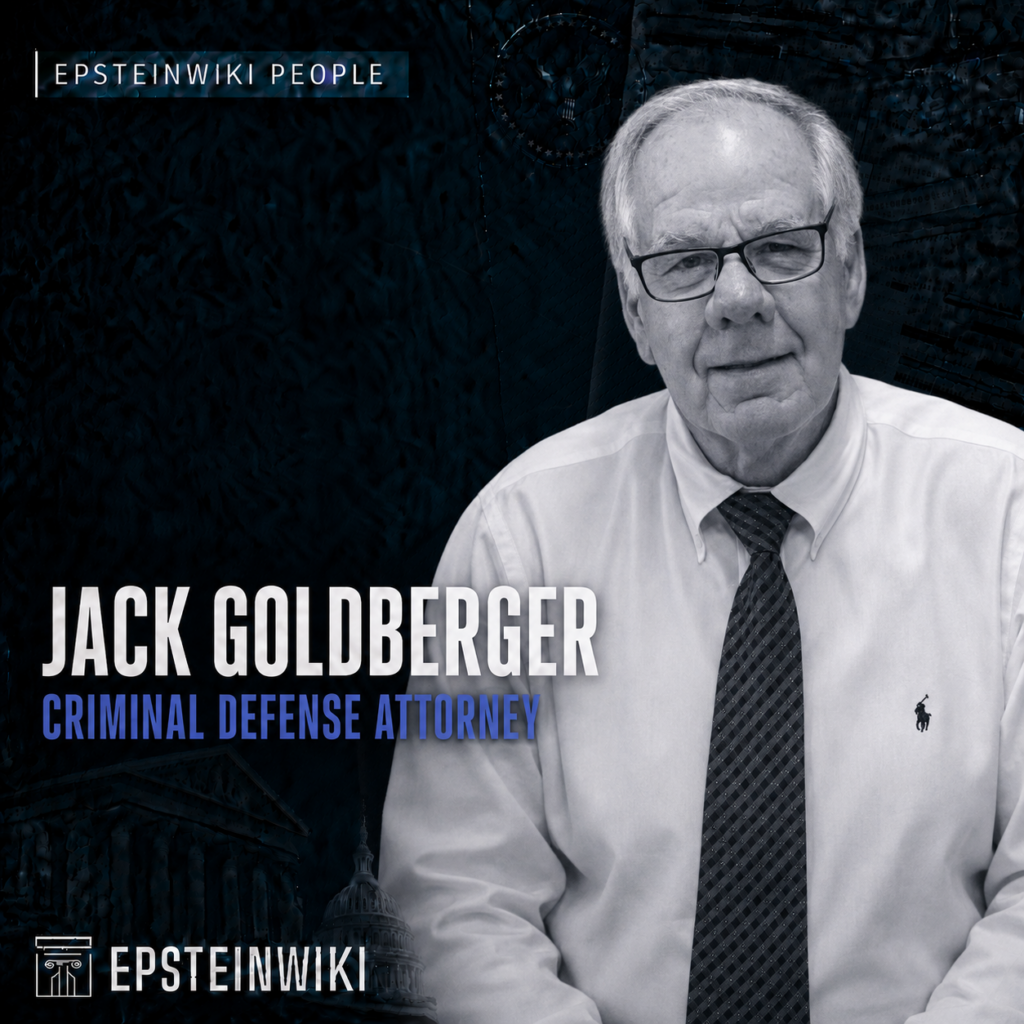
The West Palm Beach criminal defense lawyer served as one of Jeffrey Epstein’s principal Florida attorneys during the investigation that ended in the secret 2007 federal nonprosecution agreement, the June 2008 state guilty pleas, the extraordinary work release period, and years of survivor litigation. The public record shows aggressive defense advocacy, continuing communications, and repeated appearances in Epstein related proceedings. It does not establish that Goldberger participated in Epstein’s sexual abuse or trafficking crimes.
Snapshot
| Field | Detail |
|---|---|
| Full name | Jack Alan Goldberger |
| Profession | Criminal defense attorney |
| Primary location | West Palm Beach, Florida |
| Education | Syracuse University, Bachelor of Arts, 1974; University of Miami School of Law, Juris Doctor, 1978 |
| Florida Bar admission | November 7, 1978 |
| Epstein related role | Florida criminal defense counsel and later counsel in civil and Crime Victims’ Rights Act proceedings |
| Documented period | At least 2006 through 2019, with a later released 2017 calendar entry and 2019 communications |
| Key legal events | Palm Beach investigation, federal investigation, 2007 nonprosecution agreement, June 30, 2008 guilty pleas, work release, survivor civil litigation, and Doe v. United States |
| Defense team colleagues | Roy Black, Jay Lefkowitz, Kenneth Starr, Alan Dershowitz, Gerald Lefcourt, Lilly Ann Sanchez, Martin Weinberg, and other counsel at different stages |
| Key evidence identifiers | EFTA00013865, EFTA00014100, EFTA00014102, EFTA00204627, EFTA00209946, EFTA00211946, EFTA00211956, EFTA00214385, EFTA00215497, EFTA00459490, EFTA00611616, EFTA00645624, EFTA01203309, EFTA01246851, and EFTA01379213 |
| Legal status | Goldberger has not been charged with or found liable for participating in Epstein’s sexual abuse or trafficking operation |
| Narrow role classification | Documented criminal defense attorney for Jeffrey Epstein |
| Why the record matters | His work places him inside the legal process that converted a potential federal prosecution into a state plea, managed later compliance disputes, challenged survivor claims, and protected Epstein during sworn discovery |
Content note: This article discusses sexual abuse of minors, survivor credibility attacks, coercive litigation practices, and institutional failures. It does not identify anonymous survivors or reproduce unnecessary personal details from their records.
Overview
Jack Alan Goldberger was not a casual name in Jeffrey Epstein’s address book. He was one of Epstein’s principal Florida criminal defense lawyers during the decisive period between the Palm Beach Police Department investigation and Epstein’s June 30, 2008 guilty pleas.
The Department of Justice Office of Professional Responsibility executive summary describes how the federal investigation developed toward a proposed sixty count indictment before prosecutors instead negotiated a nonprosecution agreement with Epstein’s large defense team. The agreement ended the Southern District of Florida investigation if Epstein entered state pleas, served a negotiated sentence, registered as a sex offender, and accepted provisions intended to facilitate civil compensation.
Goldberger appears throughout the surviving record as local criminal counsel. His name is found in correspondence with federal prosecutors, state proceedings, deposition transcripts, litigation scheduling, court filings, and later communications with Epstein.
His professional role requires careful description. A criminal defense attorney has a constitutional and ethical duty to represent a client zealously within the law. Representing an accused person is not evidence that the lawyer shares the client’s conduct or beliefs. A strong defense is indispensable even when allegations are horrifying.
That principle does not place every defense tactic beyond scrutiny. Congress and the public may properly examine how Epstein’s lawyers investigated minor victims, negotiated secrecy, pursued senior Justice Department review after signing the agreement, handled compliance disputes, helped establish the purported workplace used for work release, and managed depositions in which Epstein invoked the Fifth Amendment.
The legally supportable conclusion is narrow. Goldberger was a significant member of the team that obtained and implemented an exceptionally favorable resolution for Epstein. The public record documents his actions as counsel. It does not prove that he knew the full scope of Epstein’s continuing crimes, helped commit them, or engaged in criminal misconduct.
Identity Verification
The attorney in the Epstein records is Jack Alan Goldberger of West Palm Beach, Florida.
The Florida Bar’s official certification profile identifies Jack Alan Goldberger, Florida Bar number 262013, as a criminal law specialist admitted on November 7, 1978. The professional address and telephone information correspond to the law office details found in Epstein related correspondence.
The Goldberger Weiss professional biography states that Goldberger earned a Bachelor of Arts from Syracuse University in 1974 and a law degree from the University of Miami in 1978. His firm describes him as a board certified criminal trial lawyer.
Court records independently confirm the match. The Epstein litigation lists Jack Goldberger at the West Palm Beach firm then known as Atterbury, Goldberger & Weiss. Released Department of Justice correspondence includes his full name, local telephone number, and office contact information.
This identity should not be confused with other people named Jack or John Goldberger. EpsteinWiki’s record should use the full name Jack Alan Goldberger and, where space permits, Florida Bar number 262013.
Professional Background
Goldberger began his legal career in the Palm Beach County Public Defender’s Office and entered private practice in 1981, according to his current professional biography. He developed a long career in state and federal criminal defense and became board certified in criminal trial law.
His biography lists admission to the Florida and New Jersey bars, federal district courts in Florida, the United States Court of Appeals for the Eleventh Circuit, and the United States Supreme Court. It also credits him with service on the Palm Beach County Criminal Justice Commission and involvement in local drug court and community court initiatives.
These credentials help explain why Epstein retained him. Goldberger combined local courtroom knowledge with experience in serious criminal matters. Epstein then added nationally prominent lawyers with former government, appellate, academic, and media credentials.
The result was not merely a defense team prepared for trial. It was a coordinated legal operation capable of approaching state prosecutors, federal prosecutors, Justice Department leadership, local corrections officials, civil courts, and the press.
Goldberger’s local position mattered because the investigation began in Palm Beach, the state charge was pending there, Epstein’s mansion and purported work release office were there, and many survivors lived nearby. National counsel could challenge federal jurisdiction and appeal to Washington. Local counsel could manage the state docket, jail issues, depositions, subpoenas, and relationships with nearby agencies.
How Goldberger Entered the Epstein Case
Palm Beach police began investigating Epstein in March 2005 after the family of a fourteen year old girl reported that Epstein had paid her following a massage. Investigators identified a larger pattern involving teenage girls brought to Epstein’s home, cash payments, and recruitment of additional girls.
Police searched Epstein’s Palm Beach residence in October 2005. The investigation produced telephone records, message slips, photographs, statements, and evidence concerning multiple girls. Police Chief Michael Reiter and Detective Joseph Recarey believed the evidence justified serious felony charges.
State Attorney Barry Krischer presented the matter to a Palm Beach County grand jury. On July 19, 2006, the grand jury returned one count of felony solicitation of prostitution. Police considered that result inadequate and referred the matter to the FBI.
By 2006, Goldberger was acting for Epstein in the criminal matter. Contemporary records and later reporting identify him as a leading local member of the defense team.
The federal investigation eventually identified additional victims. In May 2007, an assistant United States attorney submitted a proposed sixty count indictment and a detailed prosecution memorandum to supervisors. The government did not file that indictment.
Instead, the United States Attorney’s Office began negotiating with Epstein’s lawyers. Those negotiations produced the September 2007 agreement that became one of the most controversial federal nonprosecution agreements in modern American history.
The Defense Team Around Epstein
Epstein assembled lawyers with different forms of leverage and expertise.
Goldberger and Roy Black brought Florida criminal defense experience. Jay Lefkowitz had served in senior positions in the George W. Bush administration and worked at Kirkland & Ellis. Kenneth Starr had been a federal appellate judge, solicitor general, and independent counsel. Alan Dershowitz was a prominent Harvard Law School professor and appellate lawyer. Gerald Lefcourt was a nationally known criminal defense attorney. Other lawyers, including Lilly Ann Sanchez and later Martin Weinberg, handled related parts of Epstein’s defense and litigation.
The Justice Department review found that Epstein’s lawyers continued pressing the government for nine months after the nonprosecution agreement had already been signed. They disputed its meaning, sought to change negotiated obligations, and asked senior Justice Department officials to invalidate or revise the resolution.
Goldberger’s precise authorship of every defense submission is not established. The records do establish that he received material communications, joined calls, represented Epstein in the state case, appeared in later civil proceedings, and remained part of the working legal team.
Calling him the sole architect of the nonprosecution agreement would overstate the evidence. Erasing his role because other lawyers handled major federal negotiations would understate it. The accurate description is that Goldberger was a central local criminal lawyer within Epstein’s coordinated defense team.
The Campaign Against Victim Credibility
One of the earliest documented features of Epstein’s defense was an effort to discredit the girls who had reported him.
CBS12’s review of released records reported that Goldberger wrote to prosecutors in June 2006 about information gathered from a girl’s MySpace page. The letter argued that her credibility was questionable and cited name changes, sexualized photographs, marijuana, alcohol, and other personal material.
Defense lawyers may investigate a witness’s credibility and preserve impeachment evidence. The problem in the Epstein case was the larger frame applied to minors who described being paid by an adult for sexual activity. Social media photographs, adolescent drinking, drug use, prior trauma, or inconsistent behavior do not make sexual exploitation lawful.
The credibility campaign also had institutional consequences. Police had accumulated corroborating evidence that extended beyond any single girl’s account. Yet attacks on the girls became part of the argument against a stronger prosecution.
The Palm Beach editorial preserved in House records criticized state authorities for appearing more persuaded by defense attacks on the girls than by evidence that Epstein knew they were underage. The editorial specifically noted that lawyers used MySpace discussions about marijuana and alcohol to impugn accusers.
The record does not establish that Goldberger’s letter alone caused the grand jury result, the federal agreement, or any prosecutor’s decision. It does establish that survivor credibility attacks were an intentional part of the defense strategy and that Goldberger personally participated in that strategy.
For a survivor centered archive, the key point is not that defense counsel performed investigation. It is that institutions repeatedly evaluated vulnerable teenagers through the language of moral worthiness while evaluating Epstein through the language of litigation risk.
The Federal Investigation and the Proposed Indictment
After Palm Beach police referred the case, the FBI and the Southern District of Florida developed a federal investigation.
The Justice Department later reported that prosecutors discovered additional victims and prepared a proposed sixty count federal indictment in May 2007. The prosecution memorandum addressed possible federal charges and the evidence supporting them.
At a July 31, 2007 meeting, the United States Attorney’s Office offered to end the federal investigation if Epstein pleaded guilty to state offenses, accepted at least two years of incarceration, registered as a sex offender, and agreed to a mechanism that would permit victims to pursue damages.
Further negotiations reduced the incarceration recommendation to eighteen months in the Palm Beach County jail. The final agreement also promised that federal prosecutors would not prosecute Epstein, four named potential coconspirators, or any other potential coconspirators in the Southern District of Florida for the conduct under investigation.
Victims were not informed before the agreement was signed.
The absence of victim consultation was not a defense lawyer’s legal obligation under the Crime Victims’ Rights Act. Prosecutors carried the government’s statutory and institutional duties. Still, Epstein’s team benefited from a process in which the defense had extensive access to prosecutors while the girls whose cases were being resolved did not.
Goldberger’s relevance comes from his documented position on the team receiving that access and implementing the resulting agreement.
The September 2007 Nonprosecution Agreement
The United States Attorney’s Office and Epstein executed the agreement on September 24, 2007.
EFTA00014102 preserves material concerning the agreement between Epstein and the Southern District of Florida. The agreement required state guilty pleas, a negotiated sentence, sex offender registration, and provisions addressing civil claims.
In return, the federal government agreed to suspend and ultimately close its investigation if Epstein complied. The immunity language extended beyond Epstein to four named individuals and any potential coconspirators.
Goldberger’s name appears in correspondence surrounding the agreement and its performance. The public record does not show that he signed the agreement on behalf of the government or held authority to grant immunity. He was Epstein’s lawyer, not a government decision maker.
The agreement was kept from victims before execution and initially kept from public filing. In 2019, a federal district judge concluded that prosecutors violated the Crime Victims’ Rights Act by failing to confer with victims and that later communications misled them into believing federal prosecution remained possible.
The Eleventh Circuit later ruled en banc that the Crime Victims’ Rights Act did not provide a freestanding precharge judicial action under the circumstances before it. That appellate ruling changed the available remedy. It did not make the government’s treatment of survivors transparent, respectful, or institutionally sound.
Epstein’s Team Tried to Change the Deal After Signing It
The agreement did not immediately produce a guilty plea.
According to the Justice Department review, Epstein spent the next nine months using his legal team to dispute the terms, seek further concessions, and argue that federal officials should abandon the agreement entirely. His lawyers approached the Criminal Division and the Office of the Deputy Attorney General.
The defense argued that Epstein’s conduct presented a state matter and that federal intervention was inappropriate. Senior Department officials reviewed submissions from both sides. On June 23, 2008, the Deputy Attorney General’s office declined to intervene.
EFTA00013865 captures the end of that process. A prosecutor informed Jay Lefkowitz that Epstein had until June 30 to comply with the agreement by pleading guilty, being sentenced, and surrendering. Roy Black then requested a wrap up call and wrote that he wanted Goldberger included.
EFTA00209946 preserves another copy of that communication chain. It places Goldberger in the final discussions immediately before the plea deadline.
The record shows participation in a closing call, not necessarily the substance of everything Goldberger said. It nevertheless confirms that he was not peripheral when the agreement moved from negotiation to enforcement.
The June 30, 2008 Guilty Pleas
On June 30, 2008, Epstein appeared in Palm Beach County Circuit Court and pleaded guilty to felony solicitation of prostitution and procurement of a person under eighteen for prostitution.
The court imposed consecutive terms totaling eighteen months in the county jail, followed by twelve months of community control. Epstein was also required to register as a sex offender.
The courtroom resolution was presented jointly by the prosecution and defense in accordance with the federal agreement. Victims were not given meaningful advance notice or an opportunity to address the court before the deal was completed.
Goldberger acted as Epstein’s local criminal counsel during this period. Released correspondence refers to him as lead counsel in connection with state and work release matters.
The two state convictions were real felony convictions. It is inaccurate to say Epstein escaped every consequence. It is equally inaccurate to describe the outcome as proportionate to a federal investigation involving dozens of identified girls and a proposed sixty count indictment.
Epstein ultimately served less than thirteen months. Much of that time included up to twelve hours a day outside the jail, six days a week, under an unusually permissive work release arrangement.
The Florida Science Foundation
Epstein applied for work release on the day he entered custody. His proposed workplace was the Florida Science Foundation.
The Justice Department’s official executive summary states that the entity had recently been incorporated and occupied space at the West Palm Beach office of one of Epstein’s attorneys. Other released records identify a connection to the building where Goldberger maintained his office and place Goldberger in the paperwork and correspondence supporting Epstein’s work release arrangement. The presently cited record does not, by itself, establish that Goldberger personally incorporated the foundation.
The work release application described the foundation as an established scientific operation requiring Epstein’s daily attention. Prosecutors questioned that description because the entity had been created only months earlier.
This distinction matters. The foundation was not simply an unrelated employer that had existed independently for years. It was an Epstein controlled entity created while the criminal resolution was pending and used to justify his release from custody for most waking hours.
The public record should distinguish several separate propositions:
- Goldberger represented Epstein and had an office in the same building.
- Records associate him with paperwork and communications supporting the foundation based work release process.
- Corrections officials, not Goldberger, held the legal authority to approve and supervise work release.
- Later survivor accounts and FBI records alleged that Epstein engaged in sexual conduct or abuse at the work release office.
- The released record does not establish that Goldberger knew abuse would occur there or personally witnessed it.
Those limits do not eliminate the oversight question. Congress should determine who created the foundation, who described its history and function, who selected the office, what representations were made to the sheriff, and what warnings counsel received about the arrangement.
The Work Release Arrangement
Epstein began work release in October 2008. He was permitted to leave the Palm Beach County Stockade for as many as twelve hours a day, six days a week.
His foundation paid the sheriff’s office for deputies who monitored him. He used a private driver, received visitors, and made trips outside the stated workplace, including visits to his Palm Beach residence.
Later investigations found that normal visitor records were incomplete or destroyed under retention practices. The lack of preserved logs created a major evidentiary gap concerning who entered the office and what occurred during work release.
Several women later alleged that Epstein used the office to continue sexual exploitation. Those allegations sharply change the significance of the legal and administrative paperwork that created the arrangement.
No public finding establishes that Goldberger arranged visits by women, knew that Epstein would engage in sexual conduct at the office, or directed sheriff’s personnel. His documented role was legal representation and assistance around the framework that allowed Epstein to work there.
The appropriate investigation is therefore documentary. Congress should obtain the incorporation papers, lease, work release application, supporting letters, billing records, visitor communications, deputy reports, security logs, and correspondence between Epstein’s lawyers and county officials.
Compliance Problems After the Plea
The federal agreement made nonprosecution conditional on Epstein’s compliance.
EFTA00204627 contains a July 17, 2008 letter from the United States Attorney’s Office addressing what prosecutors viewed as a misrepresentation of the federal investigation’s status. The letter explained that a motion to quash involving computer equipment should have been withdrawn under the agreement. It warned that if Epstein treated the federal investigation as still pending, prosecutors could seek resolution of the motion, analyze the computers, and resume the investigation.
Goldberger was copied on the letter. The accompanying transmission pages identify Jack Alan Goldberger and his West Palm Beach contact information.
EFTA00211956 preserves correspondence concerning a notice of noncompliance in late June 2008. EFTA00214385 describes another email chain about whether the contemplated state plea complied with the agreement.
Recent reporting by Florida Bulldog argues that records show multiple breaches that did not produce renewed federal prosecution. Goldberger and Jay Lefkowitz did not respond to that outlet’s requests for comment, according to the report.
These documents do not prove that Goldberger personally caused a breach. They do show that he received notice of disputes that could have reopened federal exposure and remained involved while prosecutors decided whether Epstein had complied.
Civil Lawsuits and the Use of Criminal Depositions
Survivors began filing civil suits while the criminal matter was pending. The overlap created disputes over depositions, subpoenas, confidentiality, and the use of criminal procedure.
EFTA00611616 preserves an affidavit connected to a dispute over whether a witness had been produced for deposition and whether a reciprocal understanding had been honored. Goldberger is named in the affidavit.
Another released filing describes a 2008 scheduling conflict in which a survivor’s lawyer alleged that Goldberger agreed to coordinate a deposition date but Epstein’s process server then served the survivor at work and served her mother out of state. Goldberger later agreed to postpone the deposition.
That description is an allegation in a lawyer’s filing, not a disciplinary finding against Goldberger. It still matters because service at a workplace and contact with a survivor’s family can intensify fear, exposure, and pressure.
The broader strategy used criminal case tools while survivors pursued civil claims. Defense lawyers had legitimate reasons to investigate allegations and preserve testimony. Survivors’ lawyers argued that the tactics were being used to burden, intimidate, or gain advantage over young women who had already faced a vastly unequal power structure.
Congress should examine the full subpoena record rather than treating any single affidavit as conclusive.
Epstein’s Depositions and the Fifth Amendment
Goldberger appeared for Epstein in sworn depositions connected to survivor litigation.
An April 30, 2009 transcript identifies “Jack Goldberger on behalf of Jeffrey Epstein.” Other released transcripts show Goldberger advising Epstein while Epstein invoked the Fifth Amendment in response to substantive questions.
EFTA01246851 preserves deposition pages in which Epstein repeatedly answered “Fifth.” The transcript includes Goldberger participating as counsel and managing time and questioning.
Epstein was asked about victims, recruitment, properties, employees, travel, and people in his social orbit. His refusal to answer was a lawful exercise of the privilege against self incrimination.
The Fifth Amendment is not proof that an answer would have established guilt. In a criminal case, invoking it cannot be treated as an admission. In civil litigation, courts may sometimes draw limited adverse inferences under applicable law, but the context matters.
Goldberger’s advice that Epstein invoke the privilege was conventional criminal defense work given continuing legal exposure. The public interest lies in the result: survivors seeking facts encountered a wall of privileged refusals while Epstein retained the benefits of a federal agreement that had prevented the underlying evidence from being tested at trial.
The 2009 Trump Deposition Communication
One of the most significant later released communications is an October 14, 2009 email from Goldberger to Epstein with the subject “Trump.”
ABC News reported that Goldberger told Epstein he had spoken with Donald Trump’s attorney, Alan Garten. According to the visible portion, Garten arranged a twenty minute telephone conference with Trump and another lawyer in place of a deposition. The substantive summary that followed was redacted in the public release.
Epstein forwarded Goldberger’s email to Ghislaine Maxwell.
Members of Congress later reviewed an unredacted version. Representative Jamie Raskin said the contents appeared inconsistent with some later public accounts about when and why Trump ended his association with Epstein. ABC News stated that it had not independently seen the unredacted text.
This record establishes that Goldberger communicated with Epstein about a lawyer arranged call involving Trump in the context of deposition discovery. It does not establish what Trump said unless the unredacted text is produced and authenticated.
It also does not prove criminal conduct by Trump. The oversight issue is preservation, redaction, privilege, and whether a scheduled or contemplated deposition was replaced by an informal call whose substance remains hidden.
Congress should obtain the complete email, identify the second lawyer referenced as Brad, determine which case generated the deposition request, and establish whether any transcript, notes, affidavit, or discovery response memorialized the call.
Continued Legal Work After Epstein’s Release
Goldberger’s Epstein related work did not end with the 2008 plea or Epstein’s July 2009 release.
He appeared in civil proceedings and remained involved in disputes connected to survivor litigation. EFTA01379213 identifies Goldberger among defense counsel in Doe No. 4 v. Epstein.
EFTA01203309 concerns Epstein’s effort to strike a postjudgment deposition notice issued by survivor attorney Bradley Edwards. The record places later deposition disputes within the continuing litigation campaign.
EFTA00645624 is a legal memorandum dated April 22, 2015, sent to Epstein, Darren Indyke, and Goldberger concerning Epstein v. Rothstein, Edwards, et al. and a fees and costs motion. Independent researcher R. Howard Stone recovered the document from a damaged file that ordinary PDF tools did not render correctly.
EFTA00459490 records a July 25, 2017 scheduled call with Goldberger. The calendar entry alone does not reveal the call’s purpose, participants beyond those shown, or substance. It does demonstrate continuing access years after Epstein became a registered sex offender.
By March 2019, Goldberger joined Kenneth Starr, Martin Weinberg, and Lilly Ann Sanchez in a public letter defending the Florida resolution and challenging criticism of the plea arrangement. This was more than historical silence. It was affirmative advocacy for the deal after the Miami Herald’s reporting had renewed national scrutiny.
The Robert Kraft Referral Communications
Released 2019 messages show another dimension of Goldberger’s continuing relationship with Epstein.
Forbes reported that Epstein told Goldberger he was trying to persuade New England Patriots owner Robert Kraft to hire him after Kraft was charged in a Florida solicitation case. Kraft added Goldberger to his legal team days later.
Subsequent messages reportedly discussed the defense team, thanked Epstein for assistance, and referred to an unspecified past issue involving Kraft that Epstein said might surface.
The messages do not establish that Kraft hired Goldberger because of Epstein, that Epstein received compensation, or that the unspecified issue involved unlawful conduct. Kraft’s criminal charges were later dismissed after courts excluded video evidence.
The significance for this profile is narrower. More than a decade after the Florida plea, Goldberger and Epstein were still communicating in a manner that included potential client referrals and defense strategy information.
That continuing relationship complicates any description of Goldberger as merely a lawyer who completed a closed representation in 2008.
Attorney Client Privilege and the Released Files
Many Goldberger communications were created within an attorney client relationship. Their release does not automatically eliminate every privilege claim, nor does a privilege label prove that every sentence is legally protected.
Attorney client privilege generally protects confidential communications made for the purpose of seeking or providing legal advice. It does not protect underlying facts simply because a client tells them to a lawyer. It also does not protect communications made to further future crime or fraud when the legal requirements for that exception are established.
No court ruling cited in this article finds that Goldberger’s communications fall within a crime fraud exception. EpsteinWiki should not make that determination independently.
Congress has broader investigative tools than ordinary civil litigants, but privilege disputes remain complex. The Committee can request privilege logs, negotiate protective procedures, seek voluntary waivers, segregate survivor identifying information, and challenge unsupported redactions.
The public release of the 2009 Trump email creates a specific issue. The government disclosed the header and introductory text but redacted the summary. Congress should require a written explanation identifying the legal authority for each redaction and clarifying whether the claim belongs to Epstein’s estate, Goldberger, another participant, or the government.
Legal Defense Is Not Complicity
This distinction must remain explicit.
The Constitution guarantees a criminal defendant the assistance of counsel. Lawyers do not become participants in a client’s alleged offense merely by testing evidence, negotiating a plea, advising silence, asserting privilege, interviewing witnesses, or presenting legal arguments.
Goldberger has not been criminally charged in connection with Epstein. No court has found that he sexually abused a survivor, participated in trafficking, or knowingly helped Epstein continue committing sex crimes.
The record supports scrutiny of conduct, not guilt by profession.
That scrutiny includes whether representations to government agencies were accurate, whether a new foundation was portrayed as an established workplace, whether service and deposition practices were unnecessarily coercive, whether evidence was preserved, and whether lawyers knew of postconviction conduct requiring withdrawal or reporting under applicable rules.
Those are questions for documents, testimony, and lawful fact finding. They are not conclusions supplied by a client list.
Survivor Perspective and Institutional Impact
For survivors, Epstein’s legal defense was not an abstract contest between skilled professionals.
Girls who described sexual exploitation watched lawyers search their social media, examine school and juvenile records, investigate drug and alcohol use, contact family members, schedule depositions, and challenge their credibility. At the same time, prosecutors negotiated privately with Epstein and withheld the agreement from them.
The imbalance was structural. Epstein had money, investigators, multiple elite lawyers, and access to senior government officials. Many survivors were teenagers from unstable, low income, or traumatic circumstances. The characteristics that increased their vulnerability to exploitation were later repurposed as reasons not to believe them.
Goldberger did not control federal victim notification. Prosecutors did. He did not approve work release. The sheriff did. He did not impose the sentence. The court did.
Yet institutional accountability requires examining how those pieces interacted. An effective defense team sought concessions. Government actors repeatedly granted them. Corrections officials created freedoms that went beyond ordinary incarceration. Records were lost or destroyed. Survivors carried the consequences.
The system’s failure cannot be explained by assigning every outcome to one lawyer. It also cannot be understood without documenting the lawyers who designed, defended, and prolonged the arrangements from which Epstein benefited.
Evidence Appearances
| Record | Date or period | Goldberger connection | What it establishes | What it does not establish |
|---|---|---|---|---|
| EFTA00014102 | 2007 to 2008 | Nonprosecution agreement material naming or involving counsel | Goldberger’s documented connection to the agreement record | Sole authorship of the agreement |
| EFTA00013865 | June 24, 2008 | Roy Black requested that Goldberger join the final wrap up call | Participation in the last compliance discussions before the plea | What Goldberger said during the call |
| EFTA00209946 | June 2008 | Duplicate or related communication chain | Corroborates the final negotiation timeline | Independent proof of every underlying claim |
| EFTA00211946 | June 24, 2008 | Email correspondence from Goldberger concerning Epstein | Direct communication in the active criminal matter | Criminal wrongdoing by counsel |
| EFTA00211956 | June 27, 2008 | Goldberger copied on notice of noncompliance correspondence | Counsel received a formal compliance dispute | That he caused the alleged noncompliance |
| EFTA00214385 | June 27 to 28, 2008 | Email chain about whether the proposed plea complied with the agreement | Continuing dispute immediately before sentencing | Final adjudication of a breach |
| EFTA00014100 | 2008 | Email discussing the proper jail facility and sentencing terms | Defense discussion of where Epstein would serve time | Authority to select or approve the facility |
| EFTA00215497 | July 11, 2008 | Correspondence addressed to Goldberger after a federal hearing | Continued implementation work after the plea | Full substance without the complete document context |
| EFTA00204627 | July 17, 2008 | Goldberger copied on federal warning about the motion to quash and agreement compliance | Direct notice of a post plea dispute | That Goldberger concealed or destroyed evidence |
| EFTA00611616 | 2008 to 2009 | Affidavit concerning deposition production and Goldberger | His role in witness and deposition disputes | A finding of litigation misconduct |
| EFTA01246851 | 2009 | Goldberger appears as Epstein’s lawyer during deposition testimony | Direct representation while Epstein invoked the Fifth Amendment | That the invocation itself proved guilt |
| EFTA01379213 | Civil litigation period | Lists Goldberger among counsel in Doe No. 4 v. Epstein | Defense role in survivor litigation | Personal involvement in alleged abuse |
| EFTA01203309 | Later Florida litigation | Postjudgment deposition dispute involving Epstein and Bradley Edwards | Continued litigation over survivor discovery | The merits of every position asserted |
| EFTA00645624 | April 22, 2015 | Legal memorandum sent to Epstein, Indyke, and Goldberger | Continuing involvement in Epstein related litigation | Knowledge of unrelated criminal activity |
| EFTA00459490 | July 25, 2017 | Calendar entry for a call with Goldberger | Continuing communication or planned communication | Subject or substance of the call |
Evidence Assessment
| Proposition | Status | Basis | Limitation |
|---|---|---|---|
| Goldberger represented Epstein in the Florida criminal matter | Established | Court records, correspondence, depositions, and professional identification | Does not prove participation in Epstein’s offenses |
| He was part of the defense team involved with the 2007 agreement | Established | Justice Department review and released correspondence | Does not establish sole authorship or governmental authority |
| He personally attacked a survivor’s credibility using MySpace material | Documented | June 2006 defense correspondence reported from released files | The complete defense file and response should be reviewed |
| Goldberger joined final discussions before the June 2008 plea | Established | EFTA00013865 and related correspondence | The call’s full substance is not public |
| Goldberger created the lenient sentence | Unsupported as stated | He advocated for Epstein as counsel | Prosecutors and the court exercised governmental authority |
| He was connected to paperwork supporting the Florida Science Foundation work release arrangement and to the building where it operated | Substantially documented | Work release and government records | Does not establish that he personally incorporated the foundation or knew of later alleged abuse at the office |
| He advised Epstein during depositions where Epstein invoked the Fifth | Established | Deposition transcripts including EFTA01246851 | Invoking the Fifth is a lawful constitutional act |
| He spoke with Trump’s attorney about replacing a deposition with a call | Established by visible email text | October 14, 2009 Goldberger email reported by ABC News | Most of the summary remains redacted publicly |
| Goldberger remained in contact with Epstein after 2009 | Established | 2015 memorandum, 2017 calendar entry, 2019 communications | Each contact requires its own context |
| Epstein helped Goldberger obtain Robert Kraft as a client | Possible and supported by released messages | Epstein said he was trying to have Kraft hire Goldberger, and Kraft later did | Public record does not prove causation or compensation |
| Goldberger participated in Epstein’s trafficking operation | Not established | No cited charge, finding, or adjudicated evidence supports this claim | Legal representation alone cannot support such an inference |
| Goldberger committed professional misconduct | Not established | No cited disciplinary finding arising from the Epstein representation | Tactics may still be examined and criticized |
Detailed Timeline
| Date | Event |
|---|---|
| November 7, 1978 | Goldberger was admitted to the Florida Bar. |
| 1981 | Goldberger entered private criminal defense practice after work in the Palm Beach County Public Defender’s Office. |
| March 2005 | Palm Beach police began investigating Epstein following a report involving a fourteen year old girl. |
| October 2005 | Police searched Epstein’s Palm Beach residence. |
| 2006 | Goldberger was acting as Epstein’s Florida criminal defense attorney. |
| June 2006 | Goldberger sent prosecutors material challenging a girl’s credibility using information from her MySpace page and personal behavior. |
| July 19, 2006 | A Palm Beach County grand jury indicted Epstein on one felony solicitation count. |
| 2006 to 2007 | The FBI and Southern District of Florida developed a federal investigation and identified additional victims. |
| May 2007 | The lead federal prosecutor submitted a proposed sixty count indictment and prosecution memorandum. |
| July 31, 2007 | Federal prosecutors offered a state based resolution requiring incarceration, registration, and civil recovery provisions. |
| September 24, 2007 | Epstein and the United States Attorney’s Office executed the nonprosecution agreement. |
| Late 2007 to June 2008 | Epstein’s defense team sought revisions and senior Justice Department review while delaying the guilty plea. |
| November 2007 | The Florida Science Foundation was incorporated during the period when the plea remained unresolved. |
| June 23, 2008 | The Deputy Attorney General’s office declined to override the Southern District of Florida’s position. |
| June 24, 2008 | Roy Black requested that Goldberger join a wrap up call with federal prosecutors. |
| June 27 to 28, 2008 | Correspondence addressed notice and alleged noncompliance immediately before the plea deadline. |
| June 30, 2008 | Epstein pleaded guilty to two Florida felonies, received an eighteen month county jail sentence, and applied for work release. |
| July 7, 2008 | A survivor filed the first Crime Victims’ Rights Act petition against the United States. |
| July 17, 2008 | Federal prosecutors copied Goldberger on a warning concerning the motion to quash, computer evidence, and agreement compliance. |
| October 2008 | Epstein began leaving custody for up to twelve hours a day, six days a week, to work at the Florida Science Foundation office. |
| March and April 2009 | Epstein sat for civil depositions with Goldberger appearing as counsel and invoked the Fifth Amendment to substantive questions. |
| July 22, 2009 | Epstein was released after serving less than thirteen months and began community control. |
| August and September 2009 | Lawyers scheduled or attempted to schedule depositions involving Epstein, Maxwell, Trump, and other witnesses in survivor litigation. |
| October 14, 2009 | Goldberger emailed Epstein about a call arranged by Trump attorney Alan Garten in place of a deposition. Epstein forwarded the message to Maxwell. |
| September 2009 | A state judge ordered the nonprosecution agreement released publicly. |
| 2010 | Multiple survivor civil cases were resolved while Crime Victims’ Rights Act litigation continued. |
| April 22, 2015 | A legal memorandum concerning Epstein v. Rothstein, Edwards, et al. was sent to Epstein, Indyke, and Goldberger. |
| July 25, 2017 | Epstein’s calendar recorded a call with Goldberger. |
| November 28, 2018 | The Miami Herald published Julie K. Brown’s Perversion of Justice investigation. |
| February 21, 2019 | Judge Kenneth Marra ruled that federal prosecutors violated survivors’ rights by failing to confer before the agreement and misled them afterward. |
| March 2019 | Goldberger joined three other current or former Epstein lawyers in a letter defending the Florida resolution. |
| February and March 2019 | Released messages show Epstein communicating with Goldberger concerning a possible Robert Kraft representation. |
| July 2019 | Federal prosecutors in Manhattan charged Epstein with sex trafficking conspiracy and sex trafficking of minors. |
| August 10, 2019 | Epstein died in federal custody before trial. |
| November 2020 | The Justice Department released its Office of Professional Responsibility conclusions, finding poor judgment by Acosta but no professional misconduct by the federal prosecutors it reviewed. |
| 2025 to 2026 | Congressional and Department of Justice releases made additional Goldberger communications available for public review. |
Questions for the House Oversight Committee
Goldberger’s role and retention
- When did Jeffrey Epstein first retain Jack Goldberger?
- What was the written scope of Goldberger’s representation?
- Which Epstein entities paid Goldberger or his firm?
- What were the total fees paid between 2005 and 2019?
- Did any third party pay or reimburse those fees?
- Which lawyers treated Goldberger as lead counsel for the Florida criminal matter?
- What authority did Goldberger have to negotiate state plea, jail, work release, or civil litigation terms?
Victim credibility strategy
- Who collected the MySpace photographs and personal information used against minor victims?
- Did Goldberger or his firm retain investigators for that work?
- Which victims, family members, classmates, employers, or schools were contacted?
- What juvenile, medical, school, employment, or social media records were sought?
- Were investigators given written restrictions protecting minors and confidential information?
- Did any investigator use a false identity, pretext, or undisclosed surveillance?
- Which credibility claims were independently verified before being sent to prosecutors?
- Did prosecutors test those claims or accept them without adequate review?
The federal agreement
- Which nonprosecution agreement meetings did Goldberger attend?
- Which drafts did he receive, edit, or approve?
- Did he request secrecy or advance notice before disclosure to victims?
- Did he participate in drafting immunity for named and potential coconspirators?
- What communications did he have with Jay Lefkowitz, Roy Black, Kenneth Starr, Alan Dershowitz, Gerald Lefcourt, or Lilly Ann Sanchez concerning the agreement?
- What representations did the defense make about Epstein’s future conduct?
- Did Goldberger know that prosecutors had prepared a proposed sixty count indictment?
- Which defense submissions disputed federal jurisdiction?
- What did Goldberger communicate to senior Justice Department officials or their staff?
Delay and compliance
- What issues were discussed during the June 24, 2008 wrap up call?
- Which obligations did prosecutors believe Epstein had failed to satisfy?
- Why was the guilty plea delayed for nine months after the agreement was signed?
- Did Goldberger advise Epstein to withdraw the motion to quash concerning computer equipment?
- What happened to the computer equipment identified in the July 17, 2008 letter?
- Was it ever fully searched, imaged, or returned?
- Which alleged breaches were reported to Goldberger?
- What cure did the defense offer for each alleged breach?
- Why did federal prosecutors decline to resume the investigation?
Florida Science Foundation and work release
- Who prepared or filed the Florida Science Foundation’s corporate and work release records, and what role did Goldberger or his firm play in each category?
- Who wrote the work release application?
- Who claimed the foundation had operated for approximately fifteen years?
- What evidence supported that statement?
- Who selected the office in the same building as Goldberger’s firm?
- Did Goldberger or his firm lease, sublease, furnish, staff, or manage the office?
- What warnings did state or federal prosecutors send counsel about the foundation?
- Did Goldberger know which visitors entered the office during work release?
- Did counsel receive complaints or allegations of sexual conduct at the office?
- What records were preserved after Epstein completed his sentence?
- Did Goldberger communicate with Sheriff Ric Bradshaw or work release supervisors about exceptions granted to Epstein?
Depositions and survivor litigation
- Which survivor depositions did Goldberger request or attend?
- Who authorized service of a subpoena at a survivor’s workplace and on her mother?
- What agreement existed concerning the deposition date?
- Which questions did Goldberger direct Epstein not to answer?
- Were blanket Fifth Amendment instructions reviewed question by question?
- What deposition exhibits, notes, recordings, or correspondence remain under seal?
- Did any settlement restrict survivors from speaking to law enforcement or Congress?
- Which records were returned, destroyed, or designated confidential after settlement?
The Trump communication
- Which lawsuit generated the request for Donald Trump’s deposition?
- Who is the “Brad” referenced in Goldberger’s October 14, 2009 email?
- Why was a telephone conference accepted in place of a formal deposition?
- Was the call recorded or transcribed?
- Who took notes?
- What did Goldberger report to Epstein after the call?
- Why is the substantive portion redacted in the public release?
- Did Epstein’s forwarding of the email to Maxwell affect any privilege claim?
Continuing relationship and preservation
- What work did Goldberger perform for Epstein after community control ended?
- What was discussed during the July 25, 2017 scheduled call?
- What role did Goldberger play in the 2019 public defense of the plea agreement?
- Did Epstein refer Robert Kraft or other clients to Goldberger?
- Were referral fees, gifts, or benefits exchanged?
- What Epstein related files remain in Goldberger’s possession or control?
- Has the Committee requested a privilege log rather than accepting categorical withholding?
- Has Goldberger been asked to testify voluntarily?
- If not, why not?
- What safeguards can permit testimony while protecting legitimate privilege and survivor privacy?
Reliability and Limitations
This profile relies primarily on court records, Department of Justice documents, released correspondence, deposition transcripts, official professional records, and reporting that quotes or reproduces those materials.
An EFTA identifier proves that a document appeared in the released corpus. It does not automatically prove that every statement inside the document is true. Letters contain advocacy. Affidavits may contain disputed allegations. Emails can be incomplete. Calendar entries show planned activity, not necessarily completed activity.
The Justice Department Office of Professional Responsibility investigated federal prosecutors, not Goldberger. Its finding that the reviewed prosecutors did not commit professional misconduct is not a finding about every defense tactic. Its conclusion that Acosta exercised poor judgment is not a judicial verdict against Epstein’s lawyers.
Several public records remain redacted. The October 2009 Trump email is a prominent example. Descriptions by lawmakers who viewed unredacted material should be attributed to them unless the underlying text is released.
The absence of a public disciplinary finding against Goldberger should be reported accurately. It should not be converted into a claim that every action was ethically ideal. Conversely, criticism of his defense work should not be converted into an allegation that he participated in Epstein’s crimes.
Fact Check
Claim: Jack Goldberger was one of Jeffrey Epstein’s criminal defense lawyers.
Finding: True. Court records, correspondence, depositions, and the Justice Department review document the representation.
Claim: Goldberger was the sole author of Epstein’s nonprosecution agreement.
Finding: Unsupported. He was part of a large defense team. Federal prosecutors drafted, negotiated, approved, and executed the government’s agreement.
Claim: Goldberger personally granted immunity to Epstein’s coconspirators.
Finding: False. Only the government could make that commitment. Defense counsel sought favorable terms.
Claim: Goldberger used a victim’s MySpace content to attack her credibility.
Finding: Documented. Released 2006 correspondence attributes such arguments to him.
Claim: Social media photographs or marijuana use disproved sexual abuse.
Finding: False. Such material may be offered for impeachment, but it does not make abuse lawful or disprove it by itself.
Claim: Goldberger participated in the final discussions before Epstein’s June 2008 plea.
Finding: Supported. EFTA00013865 shows Roy Black requesting that he be included in the wrap up call.
Claim: Goldberger approved Epstein’s work release.
Finding: False as stated. Corrections officials approved it. Goldberger and Epstein’s lawyers were involved in seeking and supporting the arrangement.
Claim: The Florida Science Foundation had operated for fifteen years before the plea.
Finding: Contradicted by the public corporate timeline. The entity was recently created before Epstein entered custody.
Claim: Goldberger knew Epstein abused women at the work release office.
Finding: Not established by the cited public record.
Claim: Advising Epstein to invoke the Fifth Amendment was illegal.
Finding: False. Advising a client about a valid constitutional privilege is ordinary defense work.
Claim: Epstein’s Fifth Amendment answers proved every allegation against him.
Finding: False. The privilege protects against compelled self incrimination and is not itself a criminal admission.
Claim: Goldberger communicated with Trump’s lawyer about avoiding a formal deposition.
Finding: The visible October 2009 email supports that a telephone conference was arranged in place of a deposition. The public copy does not reveal the full substance.
Claim: The released email proves Trump committed a crime.
Finding: False. It proves a legal communication and raises discovery questions. It does not establish criminal conduct.
Claim: Goldberger’s Epstein relationship ended in 2008.
Finding: False. Records document later litigation work and communications extending through 2019.
Claim: Goldberger has been charged with assisting Epstein’s trafficking operation.
Finding: False. No such charge or adjudicated finding is identified in the sources reviewed for this article.
Related People and Organizations
Goldberger’s documented Epstein work intersects with Jeffrey Epstein, Ghislaine Maxwell, Roy Black, Jay Lefkowitz, Kenneth Starr, Alan Dershowitz, Gerald Lefcourt, Lilly Ann Sanchez, Martin Weinberg, Alexander Acosta, Jeffrey Sloman, A. Marie Villafaña, Barry Krischer, Michael Reiter, Joseph Recarey, Bradley Edwards, Scott Rothstein, Darren Indyke, Alan Garten, Donald Trump, Robert Kraft, the Palm Beach Police Department, the Palm Beach County Sheriff’s Office, the State Attorney’s Office for the Fifteenth Judicial Circuit, the United States Attorney’s Office for the Southern District of Florida, the Department of Justice, the FBI, and the Florida Science Foundation.
Related EpsteinWiki coverage includes the Nonprosecution Agreement Litigation and the Alexander Acosta transcript examination.
Conclusion
Jack Goldberger’s place in the Epstein record is neither incidental nor equivalent to criminal complicity.
He was the experienced local criminal defense lawyer working inside a formidable team. That team challenged victims, negotiated with prosecutors, obtained a secret federal agreement, delayed compliance while appealing to senior Justice Department officials, managed the state plea, pursued work release, defended Epstein in civil discovery, and continued representing him in later litigation.
Goldberger was doing the work of a defense lawyer. Government officials made the decisions that transformed his advocacy into public power.
That is why the record belongs in an accountability archive. The question is not whether Epstein deserved counsel. He did. The question is how prosecutors, courts, jail officials, and other institutions responded to that counsel while denying survivors equivalent access, notice, dignity, and protection.
The documents show that Goldberger remained involved far beyond the moment of conviction. They show final negotiation calls, compliance warnings, deposition appearances, later legal memoranda, a 2017 calendar entry, a 2019 public defense of the plea deal, and communications involving a potential client referral.
They do not show that he committed Epstein’s crimes.
A responsible investigation can hold both truths at once: the right to counsel is fundamental, and the legal machinery that delivered Epstein extraordinary protection must still be examined document by document.
Sources
- Department of Justice Office of Professional Responsibility executive summary
- House Oversight Committee release of Alexander Acosta’s transcript and estate records
- Florida Bar profile for Jack Alan Goldberger
- Goldberger Weiss attorney biography
- CBS12 investigation of defense use of victims’ MySpace pages
- Palm Beach editorial and related House Oversight records
- ABC News report on Goldberger’s October 2009 Trump email
- Florida Bulldog investigation of alleged nonprosecution agreement breaches
- House Oversight work release application record, DOJ-OGR-00021316
- David Lat report reproducing the March 2019 defense letter
- R. Howard Stone’s recovery of the 2015 legal memorandum
- Forbes report on Goldberger, Epstein, and the Robert Kraft representation
- Doe v. United States, Crime Victims’ Rights Act docket
- EpsteinWiki: Nonprosecution Agreement Litigation
- EpsteinWiki: Alexander Acosta Transcript
- EFTA00014102, nonprosecution agreement records
- EFTA00013865, June 2008 wrap up call correspondence
- EFTA00209946, related June 2008 communication
- EFTA00211946, Goldberger communication concerning Epstein
- EFTA00211956, notice of noncompliance correspondence
- EFTA00214385, state plea compliance discussion
- EFTA00014100, sentencing and detention facility discussion
- EFTA00215497, July 2008 correspondence addressed to Goldberger
- EFTA00204627, July 17, 2008 federal compliance letter
- EFTA00611616, deposition dispute affidavit
- EFTA01246851, Epstein deposition transcript
- EFTA01379213, Doe No. 4 v. Epstein counsel record
- EFTA01203309, postjudgment deposition dispute
- EFTA00645624, April 2015 legal memorandum
- EFTA00459490, July 2017 calendar entry