
Michael McAuliffe and the Enforcement of Jeffrey Epstein’s Florida Sentence
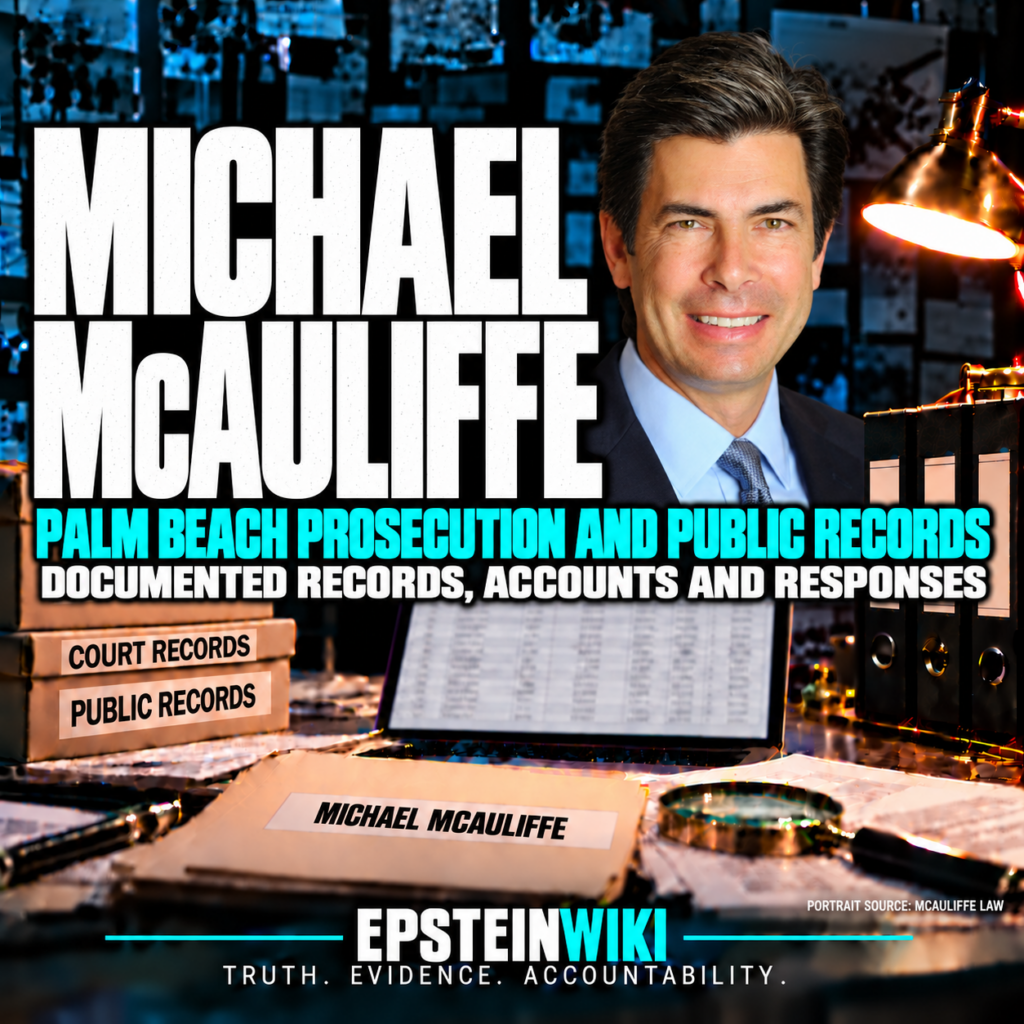
Snapshot
| Field | Documented information |
|---|---|
| Public identity | Michael F. McAuliffe, lawyer, former federal prosecutor and former Palm Beach County State Attorney |
| Office | State Attorney for Florida’s Fifteenth Judicial Circuit |
| Tenure | January 6, 2009 through March 16, 2012 |
| Place in the Epstein chronology | Took office after the federal nonprosecution agreement and the June 2008 state guilty plea |
| Principal documented action | Directed that Epstein should complete the sentence already agreed upon; his office opposed early termination or further relaxation of community control |
| Other documented office activity | Addressed missing written victim contact restrictions and sought records concerning Epstein’s travel |
| Attempts to influence him | Epstein discussed an indirect approach through David Mitchell and Danny Abraham in October 2009, and a possible approach before McAuliffe left office in 2012 |
| Evidentiary limit | The cited records do not establish that those proposed approaches produced a favor, that McAuliffe received a benefit or that he participated in Epstein’s crimes |
| Last checked | October 4, 2026 |
Michael McAuliffe’s April 1, 2010 instruction provides the clearest direct evidence of his position on Epstein’s sentence. Answering Assistant State Attorney Barbara Jean Burns, he said the defendant should finish the sentence agreed upon in the original resolution. The same message is preserved on page 5 of the State Attorney’s official supplemental release.
The chronology matters. McAuliffe inherited an already resolved prosecution. His responsibility concerns how his office handled that inheritance, including supervision disputes, victim protection and requests for additional concessions. The records support scrutiny of those decisions without assigning him the earlier charging and plea decisions made before he became State Attorney.
Important Points
- McAuliffe took office in January 2009. He was not Palm Beach County’s State Attorney when the 2006 grand jury heard the case or when Epstein pleaded guilty in June 2008.
- His office opposed several efforts to modify Epstein’s community control. The April 2010 correspondence records McAuliffe’s own instruction, rather than merely his name on office stationery.
- Burns’s description of the original arrangement as the “deal of the century” was her wording. It should not be presented as a quotation from McAuliffe.
- The office used investigative tools to examine Epstein’s travel. A November 2009 subpoena for pilot Larry Visoski’s flight logs makes a blanket claim of complete inaction inaccurate.
- Epstein’s effort to obtain a favorable word through intermediaries establishes an attempted route of influence. It does not establish that McAuliffe received the message or acted on it.
- State prosecutors, federal prosecutors, the sheriff, corrections officers and judges had different responsibilities. Their actions must be identified separately.
Professional Background and Exact Tenure
William & Mary Law School’s biography identifies McAuliffe as a graduate of the University of Texas at Austin and William & Mary Law School. His career includes service as a Justice Department Civil Rights Division trial attorney and a supervisory Assistant United States Attorney in the Southern District of Florida. He later worked in private practice, corporate legal leadership and legal education, including teaching at William & Mary, Duke and George Washington University.
The Fifteenth Judicial Circuit’s contemporary newsletter records his swearing in on January 6, 2009. His wife, then Circuit Judge Robin Rosenberg, administered the oath. Election in November 2008 should not be confused with taking office that month.
McAuliffe’s own farewell column, published in the April 2012 UCO Reporter, states that his tenure ended March 16. Contemporary reporting identifies Oxbow Carbon as his next employer. Peter Antonacci was appointed to complete his term. Dave Aronberg subsequently took office at the start of 2013, as the State Attorney’s Office confirms.
The relevant succession is therefore Barry Krischer, Michael McAuliffe, Peter Antonacci and Dave Aronberg. Aronberg was not McAuliffe’s immediate replacement. McAuliffe’s earlier federal employment also does not make him the United States Attorney who approved Epstein’s federal agreement.
Who Controlled Which Part of the Case
| Person or institution | Relevant responsibility | Distinction from McAuliffe |
|---|---|---|
| Barry Krischer and his state prosecution team | Initial state charging decisions, the 2006 grand jury presentation and the 2008 state resolution | These events preceded McAuliffe’s term |
| Alexander Acosta and the Southern District of Florida United States Attorney’s Office | Federal investigation and the 2007 nonprosecution agreement | A separate federal office |
| Palm Beach County Sheriff’s Office | Jail custody and administration of work release | McAuliffe did not operate the jail or originate the 2008 work release approval |
| Florida Department of Corrections | Community control supervision after release from jail | Supervision officers were not McAuliffe’s prosecutors |
| State circuit court | Sentencing and judicial decisions on requested modifications | A prosecutor’s opposition was not itself a court order |
| McAuliffe and his assistants | The state prosecution office’s position and actions during his 2009 to 2012 tenure | Includes the documented supervision and modification disputes |
The Justice Department’s 2020 chronology places Epstein’s guilty plea on June 30, 2008. The sentence included eighteen months in county custody followed by twelve months of community control. The sheriff approved work release, which was operating by October 2008. Epstein left custody on July 22, 2009, and his community control continued until July 2010.
Work release and community control were different stages. McAuliffe entered office while the jail sentence and work release were continuing, then remained State Attorney throughout the subsequent community control period. The fact that he did not create the original arrangement does not remove the need to examine what his office did once it had responsibility for the state case.
EpsteinWiki’s Barry Krischer profile covers the original state charging decisions. The Palm Beach County Sheriff’s Office article addresses custody and work release administration.
Meetings and Notice During 2009
An April 2009 email chain records civil plaintiffs’ counsel Katherine Ezell reporting a meeting involving McAuliffe, Burns, Chief Assistant State Attorney Paul Zacks, Evelyn Sheehan and a colleague identified as Bob. The passage establishes contact between the new state prosecution leadership and lawyers working on the civil side of the case. It does not record every issue discussed or any resulting decision.
A June 1, 2009 legal invoice from Bruce E. Reinhart, P.A., addressed to Jack Goldberger and concerning Epstein, includes a May 8 entry for several meetings, one with McAuliffe. The invoice documents a billed meeting. It does not establish that Epstein attended the meeting with McAuliffe, what was said or that McAuliffe granted a concession. The charge on the line covers the grouped activities and does not record a payment to the prosecutor.
A June 2 federal status email also records that McAuliffe had been given notice of a June 10 hearing concerning the Palm Beach Post’s effort to unseal the nonprosecution agreement. Notice of a hearing is evidence of notification. It is not proof of how he argued or voted on disclosure, and it does not make him an author of the agreement.
Opposition to Further Sentence Concessions
September 2009
The Notice of Non Agreement says defense counsel submitted a proposed agreed order on September 10, 2009 to modify Epstein’s community control. Burns responded that the state did not agree and requested an evidentiary hearing if the court considered the issue. The notice asked the court not to act on the proposed order as though it had the state’s consent.
McAuliffe’s name appears in the printed State Attorney block, with Burns signing as Assistant State Attorney. This is an action of his office. The document should not be described as bearing his personal handwritten signature.
February and March 2010
Burns’s February 10 email told a federal prosecutor that the state office would not agree to early termination of community control. The exchange concerned whether Epstein might obtain early termination or a transfer to ordinary probation. Burns also discussed the absence of an evaluation requirement, but her reference to her predecessor should not automatically be treated as a statement by McAuliffe about Krischer.
The March 26 summary was sent to McAuliffe at his request. Burns reported discussions with the Department of Corrections and federal prosecutor A. Marie Villafaña. The attached federal position left the matter to the State Attorney’s Office and the circuit judge. It expressly warned against portraying the federal office as agreeing to, or declining to oppose, Epstein’s request.
That distinction rules out a misleading description of federal approval. The United States Attorney’s Office had taken no position. The state office still had to make and explain its own decision.
April 2010
The April 1 exchange shows the issue reaching McAuliffe personally. At 8:25 a.m., Burns asked for direction and criticized the exceptional advantages Epstein had already received. At 8:31 a.m., McAuliffe replied that he should complete the agreed sentence. At 8:49 a.m., Burns told Goldberger that she and McAuliffe agreed he should complete community control. She also requested sufficient notice of any motion so the detective and victims could attend a hearing.
The defense position remains part of the record. Goldberger argued that a step down to ordinary probation or more flexible travel could be appropriate. He also said the state office had discussed supporting a transfer of community control. That is why the record should be described as opposition to the particular concessions under discussion, rather than an assertion that the office rejected every conceivable change in supervision.
McAuliffe’s reply established the prosecution’s position. It was not a new sentence, a judicial finding that Epstein had violated supervision or a reopening of the original prosecution.
Missing Written Victim Contact Restrictions
The October 9, 2009 correspondence records Burns telling McAuliffe and Zacks that she had searched the boxes and could not locate written no contact orders. The exchange concerned the practical problem of identifying and documenting restrictions that officials expected to exist.
Burns’s October 24 letter, sent on the State Attorney’s letterhead, raised the absence of written orders with Goldberger and asked for an enclosed order to be reviewed, signed and returned for presentation to the court. The available transcription is incomplete in part of the opening paragraph. The readable wording supports the documentation issue and the proposed corrective step, without reconstructing the missing words.
These records matter because victim protection depends on clear, enforceable conditions and a record available to the people responsible for supervision. They also require a limited conclusion. A letter requesting an order does not establish when a final order was entered, who received it or how compliance was monitored. The cited pages do not determine responsibility for the original omission.
The Office Investigated Supervision and Travel
An August 21, 2009 subpoena shows an earlier supervision inquiry. Burns sought office building sign in records and surveillance video. The investigator’s August 24 memorandum records that the materials were obtained and given to Burns. The video’s poor camera angle prevented identification of Epstein, and the building required sign in only after 7 p.m. The memorandum therefore documents investigative work and the limitations of the evidence it produced.
The November 30, 2009 investigator request provides concrete evidence of action by McAuliffe’s office. Burns requested service of a subpoena on Larry Visoski, identified as Epstein’s pilot. The completed service paperwork is followed by a subpoena for flight logs and an appearance on December 14.
The signed subpoena sought records concerning flights involving Epstein. The service notation records delivery on November 30. This is stronger evidence of investigative activity than a general statement that the office had concerns or received information.
Goldberger’s December 3 response said he was supplying information following a November 30 conversation and a subsequent email from Burns. He described two flights after Epstein’s release, asserted that probation had authorized the trips and transportation, and disputed allegations of supervision violations. Those were defense representations, not findings by the court or an independent adjudication of compliance.
The distinction is important for evaluating the office. The documents show that travel allegations generated inquiries and compulsory process. They do not, on their own, show the complete results of the investigation, whether Visoski appeared, which records were ultimately produced or why no particular sanction followed. It would be inaccurate to replace those unresolved outcome questions with the assertion that the office did nothing.
Epstein’s Attempted Approach Through Intermediaries
The October 7, 2009 Mitchell exchange records Epstein asking David J. Mitchell to seek a favorable word from Danny Abraham for the local prosecutor, whom Epstein spelled “Michael Maculiffe.” Epstein described the official as someone who could help or hinder him. He said he had been told of a connection to Abraham and attributed political ambitions to McAuliffe.
The thread discusses a possible meeting at Abraham’s house. Epstein instead sought a favorable characterization of himself, including his claimed support for Israel. A reply says “Consider it done.” Epstein subsequently mentioned Governor Richardson and wrote that he had avoided calls from powerful figures because of how they might appear publicly.
This correspondence documents Epstein’s strategy and what he said about other people. It does not independently establish McAuliffe’s ambitions, Abraham’s relationship with him, a message actually reaching the prosecutor or an official favor. The reply is not evidence that McAuliffe received or accepted anything. The documents discussed above show his office continuing to oppose requested concessions afterward.
The surviving text is useful evidence of attempted access. It should not be transformed into a finding of bribery, a political agreement or participation in Epstein’s abuse.
A Proposed Approach Before McAuliffe Left Office
A January 2012 email preserves a forwarded headline about McAuliffe leaving the State Attorney’s Office for Oxbow Carbon. Epstein asked whether they should approach him for help before he left. The correspondent replied that they were still trying to learn whether he intended to remain for the last year of his term.
The separately preserved headline message carries a January 17, 2012 date. The reply chain’s date fields are incomplete, so the approach discussion is dated here to January rather than assigned a precise day. The context identifies McAuliffe as the apparent subject of Epstein’s question, although the question itself uses a pronoun.
Nothing in those messages records a completed approach, an engagement after public service or assistance provided by McAuliffe. His subsequent departure should not be treated as the fulfillment of Epstein’s proposal.
Robin Rosenberg and the Separate Grand Jury Disclosure Issue
McAuliffe’s public professional biography identifies his marriage to federal judge Robin Rosenberg. That relationship is relevant background when assessing later public discussion, but the two officials’ roles and decisions remain distinct.
Rosenberg’s July 23, 2025 order denied a government request to unseal Florida federal grand jury transcripts. The stated basis was the governing law on grand jury secrecy and the lack of an applicable exception. It concerned federal grand jury material, not McAuliffe’s 2010 decision on state community control.
Judge Rodney Smith’s December 5, 2025 order subsequently granted disclosure after the Epstein Files Transparency Act changed the applicable legal framework. A current account should include that later development rather than present the July denial as the final procedural outcome.
The marriage does not establish that McAuliffe participated in either ruling or that the stated legal reasoning concealed a decision to protect him. A claim of improper coordination would require evidence beyond the family relationship.
What the Public Reviews Establish
The DOJ Office of Professional Responsibility summary expressly states that OPR did not investigate or reach conclusions about the conduct of state officials. Its principal inquiry concerned the federal prosecutors’ handling of the 2006 to 2008 investigation and their interactions with victims.
The OPR report is therefore useful for the surrounding chronology and the limits of federal responsibility. It should not be presented as either a misconduct finding against McAuliffe or a comprehensive clearance of his state office. Nor should conclusions concerning Krischer, the sheriff or other officials be silently transferred to him.
The most probative evidence of McAuliffe’s own conduct remains the contemporaneous state correspondence and filings. Those materials show resistance to further concessions and investigative activity. They do not by themselves settle every question about victim protection, supervision enforcement or the adequacy of the response to the original deal.
Evidence Timeline
| Date | Event | Principal source |
|---|---|---|
| June 30, 2008 | Epstein enters the state plea before McAuliffe takes office | DOJ OPR chronology |
| January 6, 2009 | McAuliffe is sworn in | Circuit Courier, page 4 |
| April 2009 | Plaintiffs’ counsel reports a meeting with the state prosecution leadership | EFTA00212044 |
| May 8, 2009 | Reinhart’s later invoice records a meeting with McAuliffe among several billed activities | EFTA00722333 |
| June 2, 2009 | Federal email records notice to McAuliffe of the agreement unsealing hearing | EFTA00014173 |
| July 22, 2009 | Epstein leaves jail and begins the subsequent supervision period | DOJ OPR chronology |
| August 21 and 24, 2009 | Office obtains building records and video during a supervision inquiry | State supplement, pages 58 and 59 |
| September 2009 | Burns files notice that the state does not agree to the proposed modification | EFTA02728836 |
| October 7, 2009 | Epstein discusses seeking indirect influence over McAuliffe | EFTA00740396 |
| October 9 and 24, 2009 | Office correspondence addresses missing written no contact restrictions | EFTA01248886, EFTA02728790 |
| November 30, 2009 | Burns requests an investigator and serves a flight log subpoena | State supplement, pages 17 and 18 |
| December 3, 2009 | Defense responds to questions about travel | State supplement, pages 11 and 12 |
| February 10, 2010 | Burns states the office’s opposition to early termination | EFTA00207139 |
| March 26, 2010 | Burns provides the summary McAuliffe requested | EFTA02728859 |
| April 1, 2010 | McAuliffe directs that Epstein complete the agreed sentence | EFTA02728854 |
| January 2012 | Epstein discusses approaching McAuliffe before his departure | EFTA00708822 |
| March 16, 2012 | McAuliffe leaves office | McAuliffe’s farewell column |
Source Boundaries and the Separate Yahoo Collection
The state supplement contains copies of official correspondence, investigative requests, defense submissions and service records. Those categories carry different evidentiary weight. A defense assertion of authorization is not the same as the authorization itself. A subpoena proves that records were sought; it does not establish what the records ultimately showed.
The EFTA material also contains duplicate or overlapping copies. The April 1 correspondence appears in EFTA02728854 and in the official state supplement. These are copies of the same exchange, not independent occasions on which McAuliffe made the decision. The invoice and the October 2009 and January 2012 email passages were checked in the public archive’s document text; their page images were not independently inspected for this article.
The public Jmail snapshot provides a separately identified Yahoo source collection. A search of its 17,441 Yahoo records across the relevant name variants located two surname matches, both in news material about Terry McAuliffe. Neither identified Michael McAuliffe. This is a bounded result from that snapshot, not proof that no additional communication exists. Email attachments were not searched as independent binary documents.
The Yahoo collection should not be conflated with the DOJ’s EFTA releases or with news stories hosted on Yahoo News. A shared surname is also insufficient to identify the Palm Beach prosecutor.
Accountability Questions
- What did the office conclude after seeking Visoski’s flight logs, and which returned records, interview notes or written findings document that conclusion?
- When were the missing written no contact restrictions entered, served and communicated to supervision officials?
- What was discussed in the May 8, 2009 meeting recorded in Reinhart’s invoice?
- Did the October 2009 proposed approach through Mitchell and Abraham ever reach McAuliffe, and is there a contemporaneous record of any response?
- Did Epstein’s January 2012 proposal lead to any contact, and if so, what was requested and how was it handled?
- What other contemporaneous records explain the office’s assessment of the inherited sentence, the available enforcement options and the protection of victims?
Sources
- Fifteenth Judicial Circuit, Circuit Courier, January to March 2009, page 4. Contemporary official account of the January 6 swearing in.
- William & Mary Law School faculty biography. Education, federal prosecution work, later professional roles and marriage to Rosenberg.
- Michael McAuliffe’s UCO Reporter column, April 2012, printed page B2. First person account identifying March 16 as the end of his tenure.
- WPBF, appointment of Peter Antonacci, March 9, 2012. Immediate succession.
- State Attorney’s Office release, February 26, 2024. Confirms Aronberg took office at the start of 2013.
- State Attorney’s official Epstein supplemental release. Pages 1 and 5 contain the April 1 exchange; pages 8 through 10 contain the March summary and federal position; pages 11 and 12 contain the travel response; pages 17 and 18 contain the flight log investigator request and subpoena; pages 58 and 59 document the separate building records inquiry.
- EFTA00212044. April 2009 email chain reporting a meeting with McAuliffe, Burns and Zacks.
- EFTA00722333. June 1, 2009 Reinhart invoice containing the May 8 meeting entry.
- EFTA00014173. June 2, 2009 federal email concerning upcoming hearings and notice to McAuliffe.
- EFTA02728836. September 2009 Notice of Non Agreement.
- EFTA01248886 and EFTA02728790. October 2009 correspondence about written no contact orders.
- EFTA00207139. Burns’s February 10, 2010 response concerning early termination.
- EFTA02728859. March 26, 2010 summary requested by McAuliffe.
- EFTA02728854. April 1, 2010 correspondence, including McAuliffe’s reply on page 3.
- EFTA00740396. October 7, 2009 Epstein and Mitchell thread discussing the proposed Abraham approach.
- EFTA00708822 and EFTA01999290. January 2012 headline and discussion of a possible approach before McAuliffe’s departure.
- DOJ Office of Professional Responsibility executive summary, November 2020. Federal chronology and express limit concerning state officials.
- Rosenberg’s July 23, 2025 order, case 9:25 mc 80920, document 4. Denial of the earlier federal grand jury disclosure petition.
- Smith’s December 5, 2025 order, same case, document 8. Later disclosure ruling under the new statute.
- Jmail public snapshot manifest, generated October 2, 2026. Provenance of the separately searched public Yahoo subset.